

The DOI matches its Crossref record; 21 of the 21 references it cites were found in a registry or an index.
Enantioseparation by crystallization using magnetic substrates
Open accessAbstract
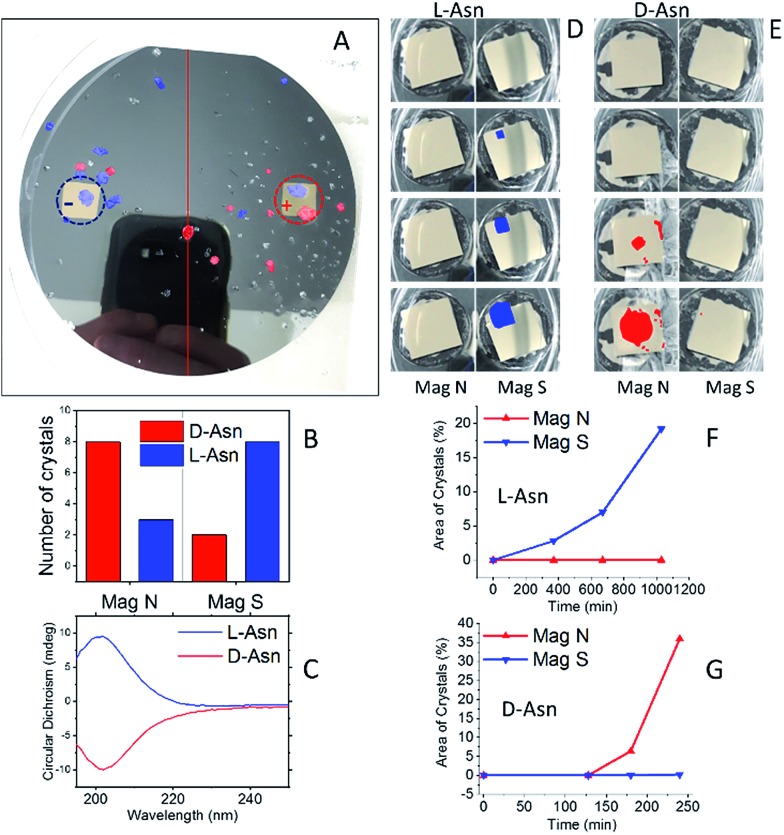
Enantiospecific crystallization of the three amino acids asparagine (Asn), glutamic acid hydrochloride (Glu·HCl) and threonine (Thr), induced by ferromagnetic (FM) substrates, is reported.
Overview
The claims and statistics of this paper haven’t been checked yet.
Free: it reads the open-access text and checks the first 5 claims that cite a source we can check. Create a free account to check every claim.
Integrity signals
Registry
Cites
Statistics
Figures



Verification
Claims the paper makes
The claims and statistics of this paper haven’t been checked yet.
Free: it reads the open-access text and checks the first 5 claims that cite a source we can check. Create a free account to check every claim.
Claims other papers make about this one
Each is checked against this paper’s own text: does it say what the citing paper says it does?
The source backs part of the claim, not all of it — or backs it for a different population, condition or comparison.
In the citing paper
“In this work, we demonstrate that the spin-polarized surfaces themselves can function as chiral agents, breaking the chiral symmetry in a further expansion of the role of the CISS effect (30–32).”
From Origin of biological homochirality by crystallization of an RNA precursor on a magnetic surface (2023) · cites this paper as [31]
Experimental — accuracy not yet measuredThe source backs part of the claim, not all of it — or backs it for a different population, condition or comparison.
In the citing paper
“In addition, they achieve the selective crystallization of racemic amino acids from their aqueous solutions only by asparagine as they could not resolve racemic threonine, and glutamic acid is resolved as its hydrochloric acid (HCl) salt in high concentrations of HCl.”
From Origin of biological homochirality by crystallization of an RNA precursor on a magnetic surface (2023) · cites this paper as [31]
Experimental — accuracy not yet measuredThe source backs part of the claim, not all of it — or backs it for a different population, condition or comparison.
In the citing paper
“In addition, we used magnetite as the magnetic substrate with near-unity spin polarization at its Fermi level (56) in comparison to commonly used Ni/Au substrates with lower intrinsic spin polarization (around 20%) and protective gold layer further reducing the spin polarization (31, 32).”
From Origin of biological homochirality by crystallization of an RNA precursor on a magnetic surface (2023) · cites this paper as [31]
Experimental — accuracy not yet measuredThe source backs part of the claim, not all of it — or backs it for a different population, condition or comparison.
In the citing paper
“The low solubility of RAO in water allowed for obtaining its crystals at low concentrations; therefore, we could achieve high enantioselectivity in just one crystallization in comparison to the previous work by Tassinari et al. (31) with highly soluble amino acids in water.”
From Origin of biological homochirality by crystallization of an RNA precursor on a magnetic surface (2023) · cites this paper as [31]
Experimental — accuracy not yet measuredThe cited source says what the claim attributes to it.
In the citing paper
“Moreover, enantioseparation on magnetic surfaces by conglomerate crystallization has been realized by Tassinari et al. (31) with a moderate ee.”
From Origin of biological homochirality by crystallization of an RNA precursor on a magnetic surface (2023) · cites this paper as [31]
2 more claims about this paper
Create a free account to see every claim other papers make about this one.
Self-check
Percentages, sums and reported differences re-computed from the paper’s own numbers.
The self-check needs the paper’s full text.
Citations
Cites
Chiral Symmetry Breaking in Sodium Chlorate Crystallization
Kondepudi, D. K., Kaufman, R. J., & Singh, N. (1990) · Science · doi:10.1126/science.250.4983.975 · Cited by 965
Observation of magneto-chiral dichroism
Rikken, G. L. J. A., & Raupach, E. (1997) · Nature · doi:10.1038/37323 · Cited by 780
Curie, P. (1894) · Journal de Physique Théorique et Appliquée · doi:10.1051/jphystap:018940030039300 · Cited by 633
Enantioselective magnetochiral photochemistry
Rikken, G. L. J. A., & Raupach, E. (2000) · Nature · doi:10.1038/35016043 · Cited by 585
Separation of enantiomers by their enantiospecific interaction with achiral magnetic substrates
Banerjee-Ghosh, K., Ben Dor, O., Tassinari, F., Capua, E., Yochelis, S., Capua, A., Yang, S.-H., Parkin, S. S. P., Sarkar, S., Kronik, L., et al. (2018) · Science · doi:10.1126/science.aar4265 · Cited by 460
Self-citationMolecular Optical Activity and the Chiral Discriminations
Mason, S. F. (1982) · Medical Entomology and Zoology · Cited by 444
Handbook of Spin Transport and Magnetism
(2016) · Chapman & Hall/CRC eBooks · doi:10.1201/b11086 · Cited by 285
Chirality-induced spin polarization places symmetry constraints on biomolecular interactions
Kumar, A., Capua, E., Kesharwani, M. K., Martin, J. M. L., Sitbon, E., Waldeck, D. H., & Naaman, R. (2017) · Proceedings of the National Academy of Sciences · doi:10.1073/pnas.1611467114 · Cited by 222
Self-citationJohnson, M. (1993) · Science · doi:10.1126/science.260.5106.320 · Cited by 221
Ben Dor, O., Yochelis, S., Radko, A., Vankayala, K., Capua, E., Capua, A., Yang, S.-H., Baczewski, L. T., Parkin, S. S. P., Naaman, R., et al. (2017) · Nature Communications · doi:10.1038/ncomms14567 · Cited by 218
Self-citation
Research works printed but not linked: 4
- Pasteur, 1848, Ann. Chim. Phys., 24, 442
- L. Kelvin , Baltimore Lectures , C. J. Clay and Sons , London , 1904
- De Gennes, 1970, C. R. Acad. Sci. Paris, Ser. B, 270, 891
- Staunton, 2014, J. Phys.: Condens. Matter, 26, 274210
Cited by
Chiral Induced Spin Selectivity
Bloom, B. P., Paltiel, Y., Naaman, R., & Waldeck, D. H. (2024) · Chemical Reviews · doi:10.1021/acs.chemrev.3c00661 · Cited by 603
Self-citationTheory of Chirality Induced Spin Selectivity: Progress and Challenges
Evers, F., Aharony, A., Bar‐Gill, N., Entin‐Wohlman, O., Hedegård, P., Hod, O., Jelinek, P., Kamieniarz, G., Lemeshko, M., Michaeli, K., et al. (2022) · Advanced Materials · doi:10.1002/adma.202106629 · Cited by 359
Self-citationChiral Molecules and the Spin Selectivity Effect
Naaman, R., Paltiel, Y., & Waldeck, D. H. (2020) · The Journal of Physical Chemistry Letters · doi:10.1021/acs.jpclett.0c00474 · Cited by 275
Self-citationNanophotonic Platforms for Chiral Sensing and Separation
Solomon, M. L., Saleh, A. A. E., Poulikakos, L. V., Abendroth, J. M., Tadesse, L. F., & Dionne, J. A. (2020) · Accounts of Chemical Research · doi:10.1021/acs.accounts.9b00460 · Cited by 244
A Chirality-Based Quantum Leap
Aiello, C. D., Abendroth, J. M., Abbas, M., Afanasev, A., Agarwal, S., Banerjee, A. S., Beratan, D. N., Belling, J. N., Berche, B., Botana, A., et al. (2022) · ACS Nano · doi:10.1021/acsnano.1c01347 · Cited by 207
Self-citation
Metadata
- Authors
- Tassinari, F., Steidel, J., Paltiel, S., Fontanesi, C., Lahav, M., Paltiel, Y., & Naaman, R.
- Affiliations
- Weizmann Institute of Science (IL)
- University of Modena and Reggio Emilia (IT)
- Hebrew University of Jerusalem (IL)
- Corresponding author
- Naaman, Ron
- Venue
- Chemical Science
- Publisher
- Royal Society of Chemistry (RSC)
- Published
- 2019
- Volume
- 10
- Issue
- 20
- Pages
- 5246-5250
- ISSN
- 2041-6520 (ISSN-L)
- 2041-6539
- PMC
- PMC6540959
- OpenAlex
- W2938267947
- Cited by
- 101
- References
- 21
- Citations by year
- 2026: 7 · 2025: 17 · 2024: 10 · 2023: 21 · 2022: 13 · 2021: 12 · 2020: 17 · 2019: 4
- FWCI
- 4.15
- Type
- journal article
- Language
- en
- Open access
- diamond
- doi.org
- Licence
- Locations
- Chemical Science (publishedVersion, cc-by)
- PubMed Central (publishedVersion, cc-by)
- PubMed (publishedVersion)
- IRIS UNIMORE (University of Modena and Reggio Emilia) (submittedVersion, cc-by)
- Funders
- John Templeton Foundation
- Israel Science Foundation
- Topics
- Physical Sciences › Materials Science › Materials Chemistry › Crystallization and Solubility Studies
- Physical Sciences › Chemistry › Analytical Chemistry › Analytical Chemistry and Chromatography
- Physical Sciences › Chemistry › Spectroscopy › Molecular spectroscopy and chirality
- Keywords
- enantiomer separation, ferromagnetic substrate, asparagine, threonine, asymmetric induction, racemic mixtures, spin alignment, conglomerate crystallization
About these checks
Registry, retraction, Cites and statistics results are computed, not judged, with one exception: a printed reference that no index lists is read once by a model before it counts as a citation error. Claims are extracted by a model and kept only when their quote appears verbatim in the text; each cited source is then checked, with a model’s help, for whether it says what the claim relies on. Those verdicts can be wrong — read the claim’s quote and the cited source before relying on one.
Statistics and arithmetic are recomputed, not judged.
Confidence bands are shown only for fields calibrated on our annotated test set. None is calibrated yet, so no band is shown.
What counts as a claim ›How we measure confidence ›How we check this ›
Are you an author, or do you see a problem with this page? Request a review
How to cite
Cite CoChat for the checks on this page, and the paper for its own findings.
- This page
- CoChat. (2026). Citation check: Enantioseparation by crystallization using magnetic substrates. https://app.cochat.ai/papers/10.1039/c9sc00663j
- The paper
- Tassinari, F., Steidel, J., Paltiel, S., Fontanesi, C., Lahav, M., Paltiel, Y., & Naaman, R. (2019). Enantioseparation by crystallization using magnetic substrates. Chemical Science. https://doi.org/10.1039/c9sc00663j
Data sources
Bibliographic data: Semantic Scholar, OpenAlex, Crossref.
Contains information from the Semantic Scholar Academic Graph Datasets, made available under the ODC Attribution License (ODC-BY 1.0).
Semantic Scholar’s data is described in: Kinney, R., et al. (2023). The Semantic Scholar Open Data Platform. arXiv:2301.10140.
