

CRIRES+ transmission spectroscopy of WASP-127 b: Detection of the resolved signatures of a supersonic equatorial jet and cool poles in a hot planet
Open accessThe DOI matches its Crossref record; 69 of the 70 references it cites were found in a registry or an index; none of the 39 sources its claims cite is checked for support yet.
Abstract
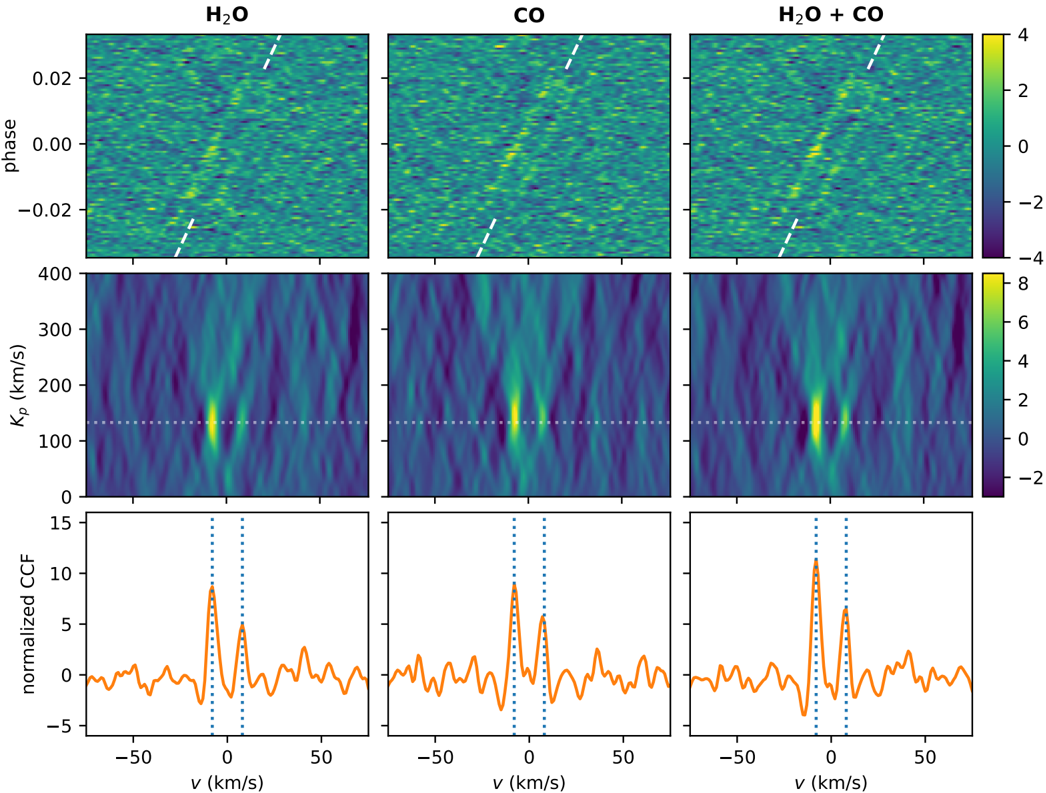
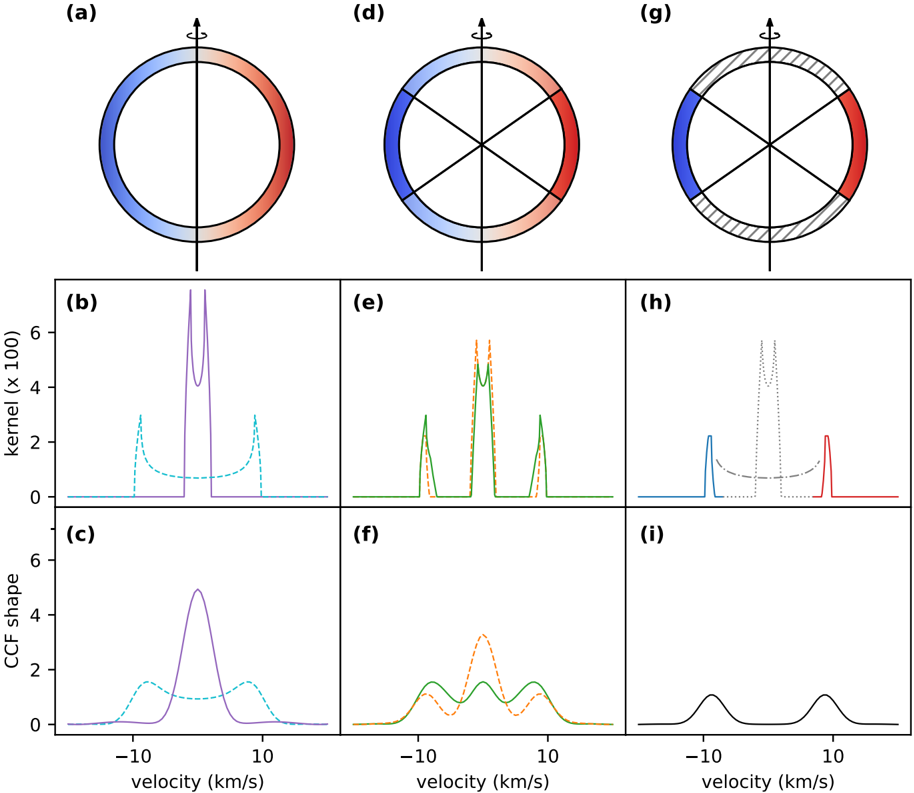
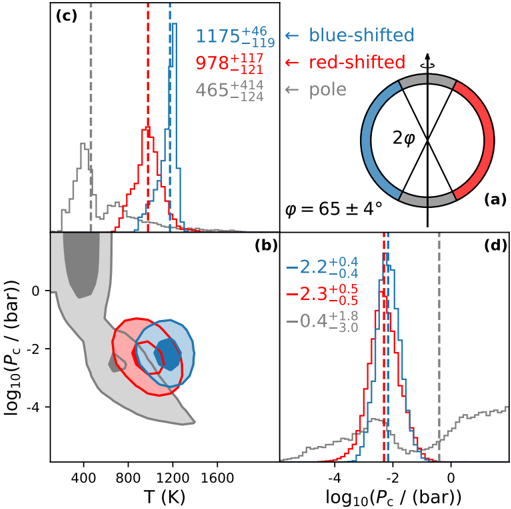
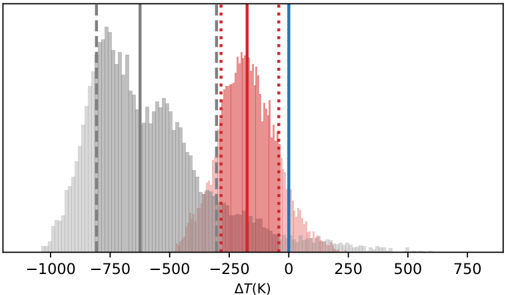
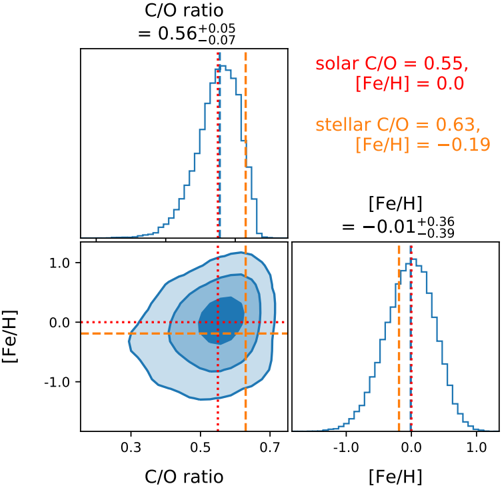
Context. General circulation models of gas giant exoplanets predict equatorial jets that drive inhomogeneities in the atmospheric physical parameters across the planetary surface. Aims. We studied the transmission spectrum of the hot Jupiter WASP-127 b during one transit in the K band with CRIRES+. Methods. Telluric and stellar signals were removed from the data using SYSREM and the planetary signal was investigated using the cross-correlation technique. After detecting a spectral signal indicative of atmospheric inhomogeneities, we employed a Bayesian retrieval framework with a two-dimensional modelling approach tailored to address this scenario. Results. We detected strong signals of H 2 O and CO, which exhibited not one but two distinct cross-correlation peaks. The doublepeaked signal can be explained by a supersonic equatorial jet and muted signals at the planetary poles, with the two peaks representing the signals from the planet’s morning and evening terminators. We calculated an equatorial jet velocity of 7.7 ± 0.2 km s−1 from our retrieved overall equatorial velocity and the planet’s tidally locked rotation, and derive distinct atmospheric properties for the two terminators as well as the polar region. Our retrieval yields a solar C/O ratio and metallicity, and shows that the muted signals from the poles can be explained by either significantly lower temperatures or a high cloud deck. It provides tentative evidence for the morning terminator to be cooler than the evening terminator by −175−117+133 K. Conclusions. Our detection of CO challenges previous non-detections of this species in WASP-127b’s atmosphere. The presence of a clear double-peaked signal highlights the importance of taking planetary three-dimensional structure into account during interpretation of atmospheric signals. The measured supersonic jet velocity and the lack of signal from the polar regions, representing a detection of latitudinal inhomogeneity in a spatially unresolved target, showcases the power of high-resolution transmission spectroscopy for the characterisation of global circulation in exoplanet atmospheres.
Overview
CoChat Summary
TL;DR
CRIRES+ K-band transmission spectroscopy of WASP-127 b reveals H₂O and CO with a double-peaked cross-correlation signal at about ±8 km s⁻¹, interpreted as a supersonic equatorial jet and muted polar regions. A 2D Bayesian retrieval yields solar C/O and metallicity, an equatorial velocity of 9.3 ± 0.2 km s⁻¹ (excess jet 7.7 ± 0.2 km s⁻¹), and tentative terminator/pole temperature differences.
Key findings
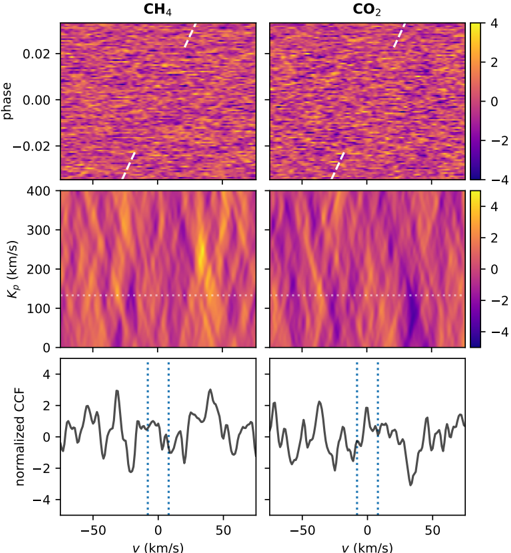
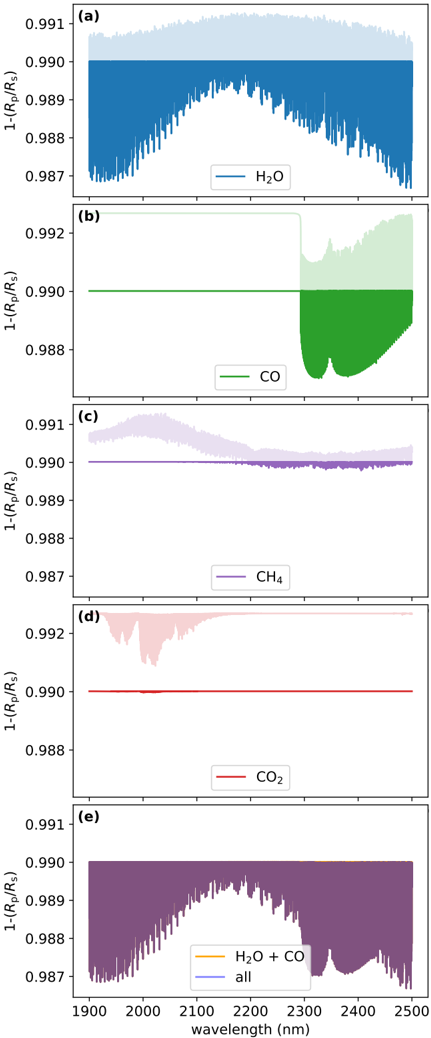
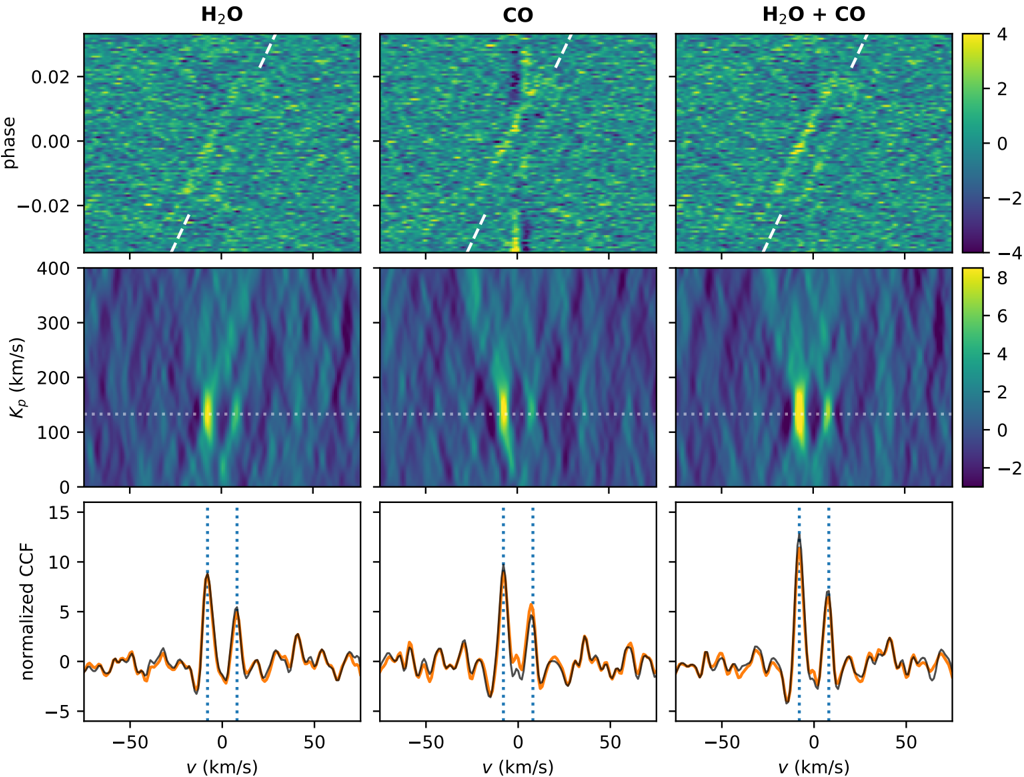
- Detected H₂O and CO; the CO detection is reported as the first conclusive detection of CO in WASP-127 b. CH₄ and CO₂ showed no significant signals (>4σ). Both H₂O and CO CCFs show two spectroscopically resolved peaks at approximately ±8 km s⁻¹, with no zero-velocity peak.
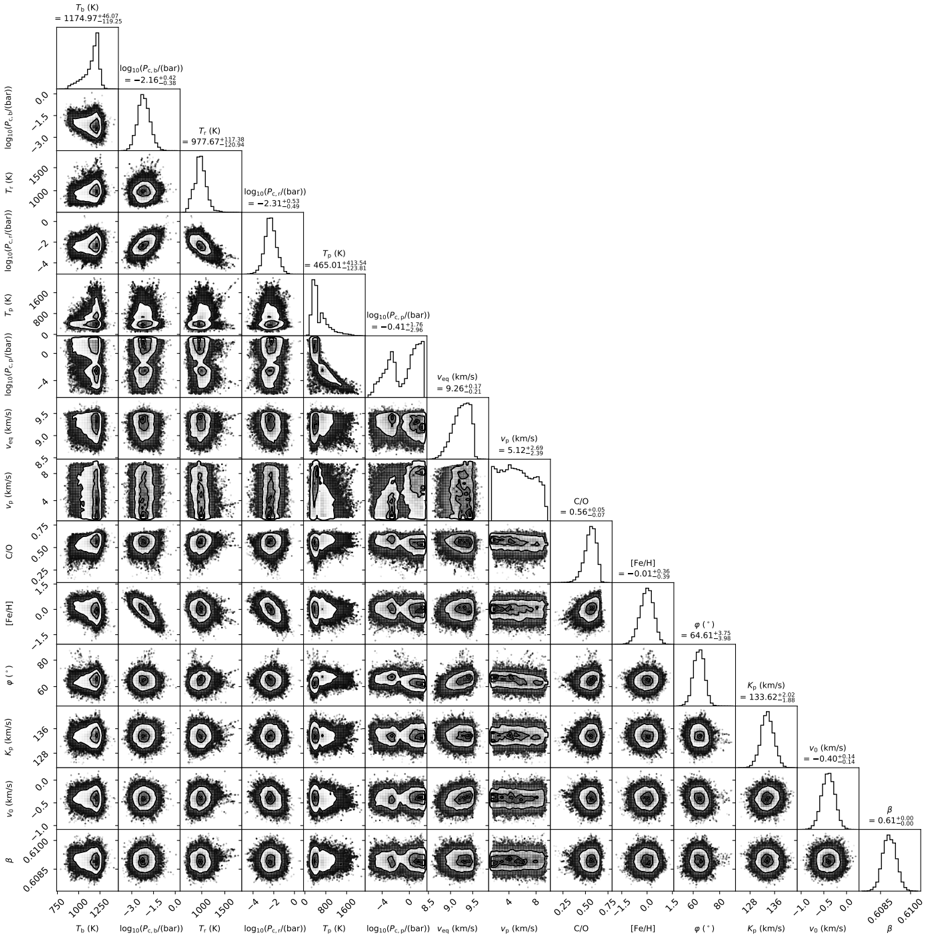
- Retrieved a supersonic equatorial jet with maximum equatorial velocity v_eq = 9.3 ± 0.2 km s⁻¹, about six times faster than tidally locked rotation; the excess wind speed is 7.7 ± 0.2 km s⁻¹. The jet opening angle is φ = 65 ± 4°, with terminator-to-terminator transport in 10.4 hours and equatorial revolution in 0.87 days.
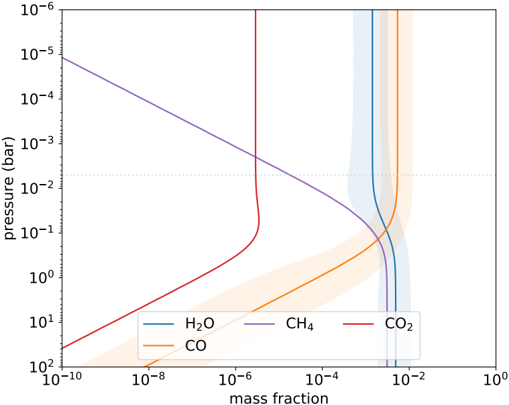
- Retrieved solar-like chemistry: C/O = 0.56⁺⁰·⁰⁵₋₀.₀₇ and [Fe/H] = 0.01⁺⁰·³⁶₋₀.₃₉, compatible with solar and stellar values within 2σ. Corresponding mass-fraction abundances are log₁₀(H₂O) = −2.82⁺⁰·³³₋₀.₃₉ and log₁₀(CO) = −2.26⁺⁰·³⁵₋₀.₃₉.
- Retrieved distinct regional properties: T_b = 1174.97⁺⁴⁹·⁰⁷₋₁₁₉.₂₅ K, T_r = 977.67⁺¹¹⁷·³⁸₋₁₂₀.₉₄ K, T_p = 465.01⁺⁴¹³·⁵⁴₋₁₂₃.₈₁ K; log₁₀(P_c,b) = −2.16⁺⁰·⁴²₋₀.₃₈, log₁₀(P_c,r) = −2.31⁺⁰·⁵³₋₀.₄₉, log₁₀(P_c,p) = −0.41⁺¹·⁷⁶₋₂.₉₆. Temperature differences are ΔT_red = −175⁺¹³³₋₁₁₆ K and ΔT_pole = −624⁺³²⁸₋₁₉₀ K.
Methods
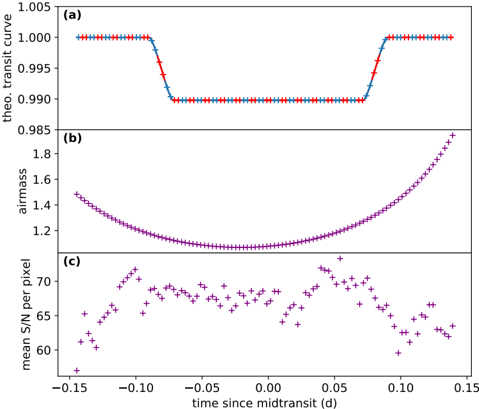
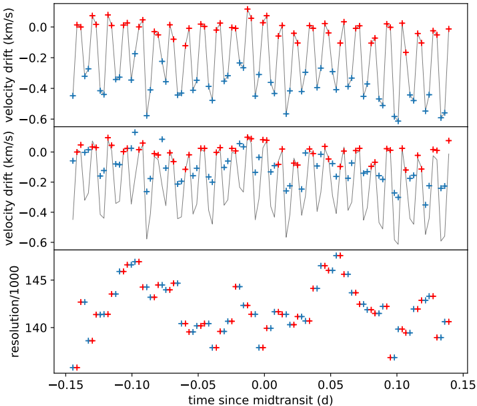
- Observed WASP-127 b during one transit on 24–25 March 2022 with CRIRES+ in K band (1972–2452 nm) at R ≈ 140,000, obtaining 98 spectra (62 in transit, 50 between T2–T3) with 240 s exposures over 6.6 hours, using ABBA nodding and adaptive optics.
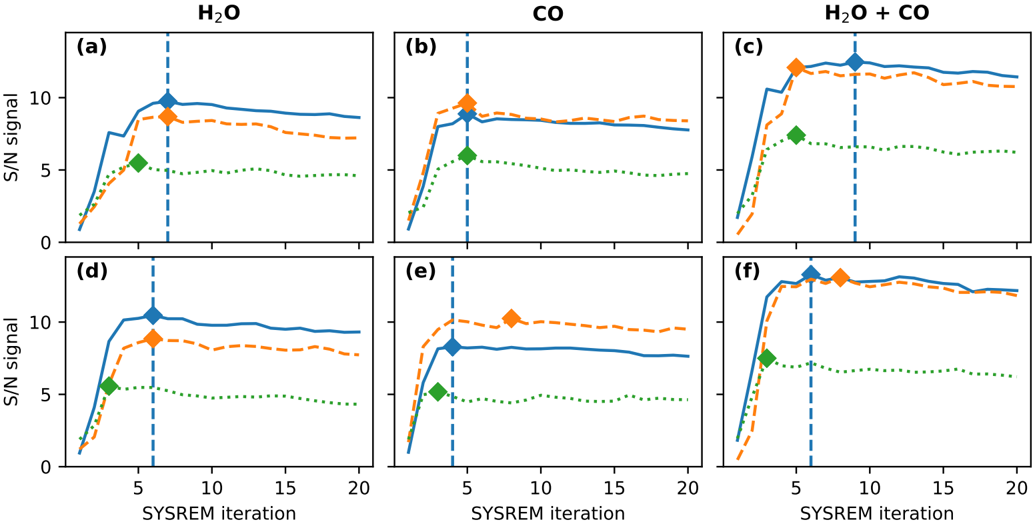
- Reduced data with CR2RES pipeline, refined wavelength solution with molecfit, removed stellar/telluric signals with SYSREM over 20 iterations, and used weighted cross-correlation with petitRADTRANS models and K_p–v maps; best SYSREM iteration for H₂O+CO was selected via injection-recovery.
- Performed a Bayesian MCMC retrieval with a simplified 2D ring model split into morning and evening equatorial terminators plus a polar region, each represented by a 1D petitRADTRANS model convolved with velocity kernels; free parameters included C/O, [Fe/H], temperatures, cloud top pressures, v_eq, v_p, φ, K_p, v₀, and β, using 32 walkers for 11,000 steps with 5,000 burn-in.
Limitations
- The paper states that the data are not sensitive to κ_IR, γ, and T_int; isothermal T–p profiles were adopted as an adequate simplification. The polar velocity v_p could not be constrained, with its posterior covering the prior range. The significance of temperature differences could be reduced if the model allowed more independent parameters.
- The paper states that CH₄ and CO₂ non-detections do not imply absence, as their features can be hidden below the continuum; cloud and haze effects are interchangeable over the short wavelength range; the velocity kernel uses a one-layer approximation; and K_p–v maps assume a circular orbit.
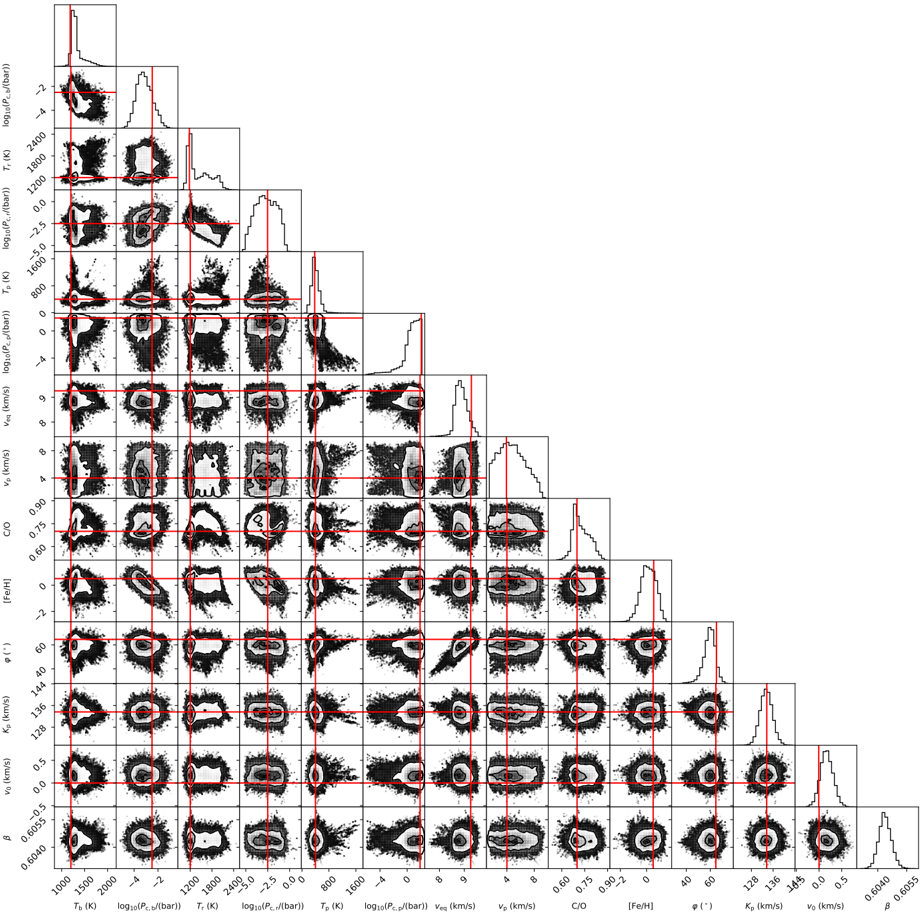
- Evident from the text: results come from a single transit, one instrument/band, and a simplified three-region 2D model; no simultaneous low-resolution continuum is included, and injection-recovery shows systematic overestimation of temperatures and underestimation of cloud deck pressures with a T–P_c degeneracy.
Model-written summary. Check it against the paper before relying on it.
Integrity signals
Registry
Cites
Statistics
Figures
Verification
Claims the paper makes
0 Valid · 0 Not valid · 29 Not checked · 119 Own results and interpretations
A result the paper reports from its own data — it cites no other source for it, so there is none to check. The quote shows it is in the paper.
In the paper
“and derive distinct atmospheric properties for the two terminators as well as the polar region.”
§ CRIRES + transmission spectroscopy of WASP-127 b Detection of the resolved signatures of a supersonic equatorial jet and cool poles in a hot planet > Abstract
plainstates an associationSingle case- Asserted: passes — The authors put it forward as true.
- Checkable: passes — It can be checked against evidence.
- Load-bearing: passes — The paper’s conclusions depend on it.
- Based: passes — The paper gives a reason why it holds.
In the paper
“We find that Guillot T -p profiles, with values for κ IR , γ, and T int fixed to the values obtained by Spake et al. (2021) and varying T eq , approach isothermal T -p profiles at pressures below approximately log 10 (P c ) = -2.”
§ CRIRES + transmission spectroscopy of WASP-127 b Detection of the resolved signatures of a supersonic equatorial jet and cool poles in a hot planet > 5.1.2. Parameters regulating atmospheric properties
What the sources say
- Not checked yetcites Spake et al. (2021) matched to “Abundance measurements of H2O and carbon-bearing species in the atmosphere of WASP-127b confirm its supersolar metallicity” (2020) source
plainstates a cause- Asserted: passes — The authors put it forward as true.
- Checkable: passes — It can be checked against evidence.
- Load-bearing: passes — The paper’s conclusions depend on it.
- Based: passes — The paper gives a reason why it holds.
A result the paper states — it cites no source for it, so there is none to check. The quote shows it is in the paper.
In the paper
“The results are, moreover, robust against small variations in the model parameters.”
§ CRIRES + transmission spectroscopy of WASP-127 b Detection of the resolved signatures of a supersonic equatorial jet and cool poles in a hot planet > 4.3. Results of the cross-correlation analysis
plain- Asserted: passes — The authors put it forward as true.
- Checkable: passes — It can be checked against evidence.
- Load-bearing: unclear — It is unclear whether the paper’s conclusions depend on it.
- Based: passes — The paper gives a reason why it holds.
A result the paper states — it cites no source for it, so there is none to check. The quote shows it is in the paper.
In the paper
“These peaks remained resolved throughout the entire duration of the planetary transit.”
§ CRIRES + transmission spectroscopy of WASP-127 b Detection of the resolved signatures of a supersonic equatorial jet and cool poles in a hot planet > 1. Introduction
plain- Asserted: passes — The authors put it forward as true.
- Checkable: passes — It can be checked against evidence.
- Load-bearing: passes — The paper’s conclusions depend on it.
- Based: passes — The paper gives a reason why it holds.
A result the paper reports from its own data — it cites no other source for it, so there is none to check. The quote shows it is in the paper.
In the paper
“For CO 2 and CH 4 we found no significant signals (> 4σ) close to the expected K p .”
§ CRIRES + transmission spectroscopy of WASP-127 b Detection of the resolved signatures of a supersonic equatorial jet and cool poles in a hot planet > 4.3. Results of the cross-correlation analysis
plain- Asserted: passes — The authors put it forward as true.
- Checkable: passes — It can be checked against evidence.
- Load-bearing: unclear — It is unclear whether the paper’s conclusions depend on it.
- Based: passes — The paper gives a reason why it holds.
77 more claims
Create a free account to see all 148 claims and to verify the 38 references still open.
- It may state two separate claims as one. 43
- Probably not a substantial claim. 28
- The quote only partly states this claim. 3
Self-check
Percentages, sums and reported differences re-computed from the paper’s own numbers.
Each contradiction between two passages listed here was confirmed by an independent check.
Rated minor: it would not touch a result — a value no result rests on, a p-value that stays on the same side of the significance level, or a conflict that is clerical, resolved elsewhere in the paper, or outside its own findings.
In the paper
§ CRIRES + transmission spectroscopy of WASP-127 b Detection of the resolved signatures of a supersonic equatorial jet and cool poles in a hot planet > Appendix A.2: Determination of spectral resolution and correction of the wavelength solution
“| v p | [1.6, v eq ] | 5.12 +2.69 -1.39 | 4 | 1 | km s -1 |”
§ CRIRES + transmission spectroscopy of WASP-127 b Detection of the resolved signatures of a supersonic equatorial jet and cool poles in a hot planet > Additional information
“vp (km/s) vp (km/s) = 5.12 +2.69 2.39”
Rated minor: it would not touch a result — a value no result rests on, a p-value that stays on the same side of the significance level, or a conflict that is clerical, resolved elsewhere in the paper, or outside its own findings.
In the paper
§ CRIRES + transmission spectroscopy of WASP-127 b Detection of the resolved signatures of a supersonic equatorial jet and cool poles in a hot planet > Appendix A.2: Determination of spectral resolution and correction of the wavelength solution
“| C/O | [0,1.5] | -0.56 +0.05 -0.07 | 0.56 | 0.01 | ... |”
§ CRIRES + transmission spectroscopy of WASP-127 b Detection of the resolved signatures of a supersonic equatorial jet and cool poles in a hot planet > 5.5. Results of the retrieval and discussion
“C/O = 0.56 +0.05 -0.07”
Rated minor: it would not touch a result — a value no result rests on, a p-value that stays on the same side of the significance level, or a conflict that is clerical, resolved elsewhere in the paper, or outside its own findings.
In the paper
§ CRIRES + transmission spectroscopy of WASP-127 b Detection of the resolved signatures of a supersonic equatorial jet and cool poles in a hot planet > Appendix A.2: Determination of spectral resolution and correction of the wavelength solution
“| T b | [100, 3000] | 1174.97 +49.07 -119.25 | 1210 | 10 | K |”
§ CRIRES + transmission spectroscopy of WASP-127 b Detection of the resolved signatures of a supersonic equatorial jet and cool poles in a hot planet > Additional information
“Tb (K) = 1174.97+46.07 119.25”
Citations
Cites
<tt>emcee</tt>: The MCMC Hammer
Foreman-Mackey, D., Hogg, D. W., Lang, D., & Goodman, J. (2013) · Publications of the Astronomical Society of the Pacific · doi:10.1086/670067 · Cited by 12,414 · cited 1×
“We set up a retrieval framework using a log-likelihood optimisation (as described in Yan et al. 2020, 2023; Lesjak et al. 2023; Cont et al. 2024), using the Markov chain Monte Carlo (MCMC) method, as implemented by Foreman-Mackey et al. (2013).”
HITEMP, the high-temperature molecular spectroscopic database
Rothman, L. S., Gordon, I. E., Barber, R. J., Dothe, H., Gamache, R. R., Goldman, A., Perevalov, V. I., Tashkun, S. A., & Tennyson, J. (2010) · Journal of Quantitative Spectroscopy and Radiative Transfer · doi:10.1016/j.jqsrt.2010.05.001 · Cited by 2,285
Achieving Better Than 1 Minute Accuracy in the Heliocentric and Barycentric Julian Dates
Eastman, J., Siverd, R., & Gaudi, B. S. (2010) · Publications of the Astronomical Society of the Pacific · doi:10.1086/655938 · Cited by 868
The orbital motion, absolute mass and high-altitude winds of exoplanet HD 209458b
Snellen, I. A. G., de Kok, R. J., de Mooij, E. J. W., & Albrecht, S. (2010) · Nature · doi:10.1038/nature09111 · Cited by 840 · cited 1×
“To detect the planet signal in the noise, we used the high-resolution cross-correlation spectroscopy (HRCCS) method (Snellen et al. 2010; Brogi et al. 2012; de Kok et al. 2013; Birkby et al. 2013; Lockwood et al. 2014), meaning that we calculated the cross-correlation functions (CCFs) of the data…”
Smette, A., Sana, H., Noll, S., Horst, H., Kausch, W., Kimeswenger, S., Barden, M., Szyszka, C., Jones, A. M., Gallenne, A., et al. (2015) · Astronomy & Astrophysics · doi:10.1051/0004-6361/201423932 · Cited by 758 · cited 3×
“Appendix A.3: Molecfit correction of the A and B reference spectra We performed a telluric correction of the third and fourth spectra of the night using the ESO tool molecfit (Smette et al. 2015; Kausch et al. 2015).”
petitRADTRANS: A Python radiative transfer package for exoplanet characterization and retrieval
Mollière, P., Wardenier, J. P., van Boekel, R., Henning, T., Molaverdikhani, K., & Snellen, I. A. G. (2019) · Astronomy & Astrophysics · doi:10.1051/0004-6361/201935470 · Cited by 583 · cited 1×
“The models we used in this step of the analysis were calculated with petitRADTRANS (Mollière et al. 2019).”
On the radiative equilibrium of irradiated planetary atmospheres
Guillot, T. (2010) · Astronomy and Astrophysics · doi:10.1051/0004-6361/200913396 · Cited by 573 · cited 1×
“29 in Guillot (2010), which is implemented in petitRADTRANS as a function with five input parameters: the planetary internal temperature T int , the atmospheric equilibrium temperature T eq , the atmospheric opacity in the infrared (IR) wavelengths κ IR , the ratio of the optical to IR opacity γ ,…”
Molecfit: A general tool for telluric absorption correction
Kausch, W., Noll, S., Smette, A., Kimeswenger, S., Barden, M., Szyszka, C., Jones, A. M., Sana, H., Horst, H., & Kerber, F. (2015) · Astronomy and Astrophysics · doi:10.1051/0004-6361/201423909 · Cited by 539 · cited 2×
“Appendix A.3: Molecfit correction of the A and B reference spectra We performed a telluric correction of the third and fourth spectra of the night using the ESO tool molecfit (Smette et al. 2015; Kausch et al. 2015).”
Correcting systematic effects in a large set of photometric light curves
Tamuz, O., Mazeh, T., & Zucker, S. (2005) · Monthly Notices of the Royal Astronomical Society · doi:10.1111/j.1365-2966.2004.08585.x · Cited by 534 · cited 2×
“We then brought all spectra into the stellar rest frame, and removed stellar and telluric signals, which are quasi-static in time, using the detrending algorithm SYSREM (Tamuz et al. 2005; Birkby et al. 2013).”
The signature of orbital motion from the dayside of the planet τ Boötis b
Brogi, M., Snellen, I. A. G., de Kok, R. J., Albrecht, S., Birkby, J., & de Mooij, E. J. W. (2012) · Nature · doi:10.1038/nature11161 · Cited by 432 · cited 1×
“To detect the planet signal in the noise, we used the high-resolution cross-correlation spectroscopy (HRCCS) method (Snellen et al. 2010; Brogi et al. 2012; de Kok et al. 2013; Birkby et al. 2013; Lockwood et al. 2014), meaning that we calculated the cross-correlation functions (CCFs) of the data…”
Birkby, J. L., de Kok, R. J., Brogi, M., de Mooij, E. J. W., Schwarz, H., Albrecht, S., & Snellen, I. A. G. (2013) · Monthly Notices of the Royal Astronomical Society: Letters · doi:10.1093/mnrasl/slt107 · Cited by 380 · cited 2×
“We then brought all spectra into the stellar rest frame, and removed stellar and telluric signals, which are quasi-static in time, using the detrending algorithm SYSREM (Tamuz et al. 2005; Birkby et al. 2013).”
Nightside condensation of iron in an ultrahot giant exoplanet
Ehrenreich, D., Lovis, C., Allart, R., Zapatero Osorio, M. R., Pepe, F., Cristiani, S., Rebolo, R., Santos, N. C., Borsa, F., Demangeon, O., et al. (2020) · Nature · doi:10.1038/s41586-020-2107-1 · Cited by 309 · cited 1×
“…to disentangle signals in the time domain was that very close-in planets with very short orbital periods ( ∼ 1-2 days) undergo significant changes in projected viewing angle between transit ingress and egress (Gandhi et al. 2022; Ehrenreich et al. 2020; Sei-del et al. 2023; Prinoth et al. 2023).”
ROTATION AND WINDS OF EXOPLANET HD 189733 b MEASURED WITH HIGH-DISPERSION TRANSMISSION SPECTROSCOPY
Brogi, M., Kok, R. J. D., Albrecht, S., Snellen, I. A. G., Birkby, J. L., & Schwarz, H. (2016) · The Astrophysical Journal · doi:10.3847/0004-637x/817/2/106 · Cited by 250
An Accurate, Extensive, and Practical Line List of Methane for the HITEMP Database
Hargreaves, R. J., Gordon, I. E., Rey, M., Nikitin, A. V., Tyuterev, V. G., Kochanov, R. V., & Rothman, L. S. (2020) · The Astrophysical Journal Supplement Series · doi:10.3847/1538-4365/ab7a1a · Cited by 231
Detection of carbon monoxide in the high-resolution day-side spectrum of the exoplanet HD 189733b
de Kok, R. J., Brogi, M., Snellen, I. A. G., Birkby, J., Albrecht, S., & de Mooij, E. J. W. (2013) · Astronomy & Astrophysics · doi:10.1051/0004-6361/201321381 · Cited by 230 · cited 1×
“…the planet signal in the noise, we used the high-resolution cross-correlation spectroscopy (HRCCS) method (Snellen et al. 2010; Brogi et al. 2012; de Kok et al. 2013; Birkby et al. 2013; Lockwood et al. 2014), meaning that we calculated the cross-correlation functions (CCFs) of the data and…”
Gibson, N. P., Merritt, S., Nugroho, S. K., Cubillos, P. E., de Mooij, E. J. W., Mikal-Evans, T., Fossati, L., Lothringer, J., Nikolov, N., Sing, D. K., et al. (2020) · Monthly Notices of the Royal Astronomical Society · doi:10.1093/mnras/staa228 · Cited by 208 · cited 2×
“We ran SYSREM for 20 iterations and applied the correction in flux space following Gibson et al. 2020, through division of the data by the summed up SYSREM models.”
Observing transiting planets with JWST: Prime targets and their synthetic spectral observations
Mollière, P., van Boekel, R., Bouwman, J., Henning, T., Lagage, P.-O., & Min, M. (2017) · Astronomy & Astrophysics · doi:10.1051/0004-6361/201629800 · Cited by 203
Barycentric Corrections at 1 cm s-1for Precise Doppler Velocities
Wright, J. T., & Eastman, J. D. (2014) · Publications of the Astronomical Society of the Pacific · doi:10.1086/678541 · Cited by 197
THREE-DIMENSIONAL MODELING OF HOT JUPITER ATMOSPHERIC FLOWS
Rauscher, E., & Menou, K. (2010) · The Astrophysical Journal · doi:10.1088/0004-637x/714/2/1334 · Cited by 196
Five carbon- and nitrogen-bearing species in a hot giant planet’s atmosphere
Giacobbe, P., Brogi, M., Gandhi, S., Cubillos, P. E., Bonomo, A. S., Sozzetti, A., Fossati, L., Guilluy, G., Carleo, I., Rainer, M., et al. (2021) · Nature · doi:10.1038/s41586-021-03381-x · Cited by 186 · cited 1×
“When summing over the segments we do not apply any additional weighting or exclusion of individual segments as is sometimes done by other groups (e.g. Giacobbe et al. 2021; Basilicata et al. 2024).”
A method for the direct determination of the surface gravities of transiting extrasolar planets
Southworth, J. H., Wheatley, P. J., & Sams, G. (2007) · Monthly Notices of the Royal Astronomical Society Letters · doi:10.1111/j.1745-3933.2007.00324.x · Cited by 181 · cited 1×
“36, which we calculated following Southworth et al. (2007) using the literature sys-tem parameters from Seidel et al. (2020), which are summarised in Table 1.”
SPATIALLY RESOLVED EASTWARD WINDS AND ROTATION OF HD 189733b
Louden, T., & Wheatley, P. J. (2015) · The Astrophysical Journal · doi:10.1088/2041-8205/814/2/l24 · Cited by 180
Towards consistent mapping of distant worlds: secondary-eclipse scanning of the exoplanet HD 189733b
de Wit, J., Gillon, M., Demory, B.-O., & Seager, S. (2012) · Astronomy and Astrophysics · doi:10.1051/0004-6361/201219060 · Cited by 179 · cited 1×
“…from line broadening in high-resolution planetary dayside spectra (Zhang et al. 2017; Lesjak et al. 2023), ingress and egress asymmetries in transmission spectroscopy (Louden & Wheatley 2015; Salz et al. 2018), and hot spot shifts derived from low-resolution eclipse mapping (de Wit et al. 2012).”
Salz, M., Czesla, S., Schneider, P. C., Nagel, E., Schmitt, J. H. M. M., Nortmann, L., Alonso-Floriano, F. J., López-Puertas, M., Lampón, M., Bauer, F. F., et al. (2018) · Astronomy & Astrophysics · doi:10.1051/0004-6361/201833694 · Cited by 158 · cited 1×
“…from line broadening in high-resolution planetary dayside spectra (Zhang et al. 2017; Lesjak et al. 2023), ingress and egress asymmetries in transmission spectroscopy (Louden & Wheatley 2015; Salz et al. 2018), and hot spot shifts derived from low-resolution eclipse mapping (de Wit et al. 2012).”
Self-citationMacDonald, R. J., Goyal, J., & Lewis, N. K. (2020) · The Astrophysical Journal Letters · doi:10.3847/2041-8213/ab8238 · Cited by 143 · cited 1×
“This would then result in the typical asymmetric planet radius often depicted in other works discussing terminator differences (e.g. MacDonald et al. 2020; Grant & Wakeford 2023).”
NEAR-IR DIRECT DETECTION OF WATER VAPOR IN TAU BOÖTIS b
Lockwood, A., Johnson, J. A., Bender, C. F., Carr, J. S., Barman, T., Richert, A. J. W., & Blake, G. A. (2014) · The Astrophysical Journal Letters · doi:10.1088/2041-8205/783/2/l29 · Cited by 140
Titanium oxide and chemical inhomogeneity in the atmosphere of the exoplanet WASP-189 b
Prinoth, B., Hoeijmakers, H. J., Kitzmann, D., Sandvik, E., Seidel, J. V., Lendl, M., Borsato, N. W., Thorsbro, B., Anderson, D. R., Barrado, D., et al. (2022) · Nature Astronomy · doi:10.1038/s41550-021-01581-z · Cited by 127 · cited 1×
“Using this benefit, high wind speeds from jet streams and dayside-to-nightside winds as well as temperature di ff erences can be deduced from observed line broadening and asymmetries (Prinoth et al. 2022; Keles 2021).”
Showman, A. P., Lewis, N. K., & Fortney, J. J. (2015) · The Astrophysical Journal · doi:10.1088/0004-637x/801/2/95 · Cited by 124
Dorn, R. J., Bristow, P., Smoker, J. V., Rodler, F., Lavail, A., Accardo, M., van den Ancker, M. E., Baade, D., Baruffolo, A., Courtney-Barrer, B., et al. (2023) · Astronomy and Astrophysics · doi:10.1051/0004-6361/202245217 · Cited by 121 · cited 6×
“We observed the extrasolar planet WASP-127 b during a transit event (i.e. when the planet passed in front of its host star in our line of sight) on the night 24-25 March 2022 in the K band us-ing the upgraded infrared spectrograph CRIRES + , mounted at the Nasmyth B focus of the 8m UT3 telescope at the VLT Facility of…”
InfluentialSelf-citationChen, G., Palle, E., Welbanks, L., Prieto-Arranz, J., Madhusudhan, N., Gandhi, S., Casasayas-Barris, N., Murgas, F., Nortmann, L., Crouzet, N., et al. (2018) · Astronomy and Astrophysics · doi:10.1051/0004-6361/201833033 · Cited by 115 · cited 1×
“These findings were later confirmed with higher precision us-ing the OSIRIS instrument at the 10m Gran Telescopio Canarias (GranTeCan) (Chen et al. 2018), showing not only sodium and potassium absorption, but also a tentative detection of lithium in the planet.”
Self-citationBrogi, M., Emeka-Okafor, V., Line, M. R., Gandhi, S., Pino, L., Kempton, E. M.-R., Rauscher, E., Parmentier, V., Bean, J. L., Mace, G. N., et al. (2023) · The Astronomical Journal · doi:10.3847/1538-3881/acaf5c · Cited by 106
Gibson, N. P., Nugroho, S. K., Lothringer, J. D., Maguire, C., & Sing, D. K. (2022) · Monthly Notices of the Royal Astronomical Society · doi:10.1093/mnras/stac091 · Cited by 106 · cited 1×
“The global model was then shifted into the rest frame of the data for each exposure and the e ff ects of SYSREM on the data were reproduced in the model following the pre-processing approach described by Gibson et al. (2022).”
Gaia Data Release 2: The first Gaia catalogue of long-period variable candidates
Mowlavï, N., Lecœur-Taïbi, I., Lebzelter, T., Rimoldini, L., Lorenz, D., Audard, M., Ridder, J. D., Eyer, L., Guy, L. P., Holl, B., et al. (2018) · Astronomy and Astrophysics · doi:10.1051/0004-6361/201833366 · Cited by 104 · cited 1×
“89 km s − 1 based on the value from the Gaia catalogue; Mowlavi et al. 2018).”
Gandhi, S., Kesseli, A. Y., Zhang, Y., Louca, A., Snellen, I. A. G., Brogi, M., Miguel, Y., Casasayas-Barris, N., Pelletier, S., Landman, R., et al. (2023) · The Astronomical Journal · doi:10.3847/1538-3881/accd65 · Cited by 102 · cited 4×
“…superimposed on each other and had to be disentangled through comparison with models containing combined absorption features of di ff erent regions (Gandhi et al. 2022, 2023; Maguire et al. 2024) and comparing di ff er-ences between ingress and egress line shapes (Seidel et al. 2023; Louden &…”
InfluentialA temperature inversion with atomic iron in the ultra-hot dayside atmosphere of WASP-189b
Yan, F., Pallé, E., Reiners, A., Molaverdikhani, K., Casasayas-Barris, N., Nortmann, L., Chen, G., Mollière, P., & Stangret, M. (2020) · Astronomy and Astrophysics · doi:10.1051/0004-6361/202038294 · Cited by 96 · cited 2×
“We set up a retrieval framework using a log-likelihood optimisation (as described in Yan et al. 2020, 2023; Lesjak et al. 2023; Cont et al. 2024), using the Markov chain Monte Carlo (MCMC) method, as implemented by Foreman-Mackey et al. (2013).”
Self-citationDetection of a westward hotspot offset in the atmosphere of hot gas giant CoRoT-2b
Dang, L., Cowan, N. B., Schwartz, J. C., Rauscher, E., Zhang, M., Knutson, H. A., Line, M., Dobbs‐Dixon, I., Deming, D., Sundararajan, S., et al. (2018) · Nature Astronomy · doi:10.1038/s41550-017-0351-6 · Cited by 90 · cited 1×
“When observing at high resolution ( R ∼ 100 000) the dynamics of the atmospheric material can be measured through Doppler shifts of the signals caused by their relative motions towards the observer (Dang et al. 2018; Ehren-reich et al. 2020).”
Skaf, N., Bieger, M. F., Edwards, B., Changeat, Q., Morvan, M., Kiefer, F., Blain, D., Zingales, T., Poveda, M., Al-Refaie, A. F., et al. (2020) · The Astronomical Journal · doi:10.3847/1538-3881/ab94a3 · Cited by 86 · cited 1×
“Low-resolution space-based spectroscopy obtained in the H band with the WFC3 instrument on the Hubble Space telescope (HST) led to a detection of water in the planet’s transmission spectrum (Skaf et al. 2020; Spake et al. 2021).”
Detection of Fe and evidence for TiO in the dayside emission spectrum of WASP-33b
Cont, D., Yan, F., Reiners, A., Casasayas-Barris, N., Mollière, P., Πάλλη, Ε., Henning, T. K., Nortmann, L., Stangret, M., Czesla, S., et al. (2021) · Astronomy and Astrophysics · doi:10.1051/0004-6361/202140732 · Cited by 82
Self-citationFrom dense hot Jupiter to low-density Neptune: The discovery of WASP-127b, WASP-136b, and WASP-138b
Lam, K. W. F., Faedi, F., Brown, D. J. A., Anderson, D. R., Delrez, L., Gillon, M., Hébrard, G., Lendl, M., Mancini, L., Southworth, J., et al. (2017) · Astronomy & Astrophysics · doi:10.1051/0004-6361/201629403 · Cited by 76 · cited 12×
“Our value for log 10 ( g p ) is consistent within the errors with the value given by Lam et al. (2017).”
InfluentialGandhi, S., Kesseli, A. Y., Snellen, I. A. G., Brogi, M., Wardenier, J. P., Parmentier, V., Welbanks, L., & Savel, A. B. (2022) · Monthly Notices of the Royal Astronomical Society · doi:10.1093/mnras/stac1744 · Cited by 73 · cited 5×
“…is analogous to previous studies using 2D retrievals to disentangle the components of the morning and evening terminator in unresolved signals (Gandhi et al. 2022, 2023; Boucher et al. 2023; Maguire et al. 2024), but additionally includes the option of latitudinal variations, further pushing…”
InfluentialPino, L., Brogi, M., Désert, J.-M., Nascimbeni, V., Bonomo, A. S., Rauscher, E., Basilicata, M., Biazzo, K., Bignamini, A., Borsa, F., et al. (2022) · Astronomy and Astrophysics · doi:10.1051/0004-6361/202244593 · Cited by 70
Allart, R., Pino, L., Lovis, C., Sousa, S. G., Casasayas-Barris, N., Zapatero Osorio, M. R., Cretignier, M., Palle, E., Pepe, F., Cristiani, S., et al. (2020) · Astronomy & Astrophysics · doi:10.1051/0004-6361/202039234 · Cited by 67 · cited 5×
“We observed the extrasolar planet WASP-127 b during a transit event (i.e. when the planet passed in front of its host star in our line of sight) on the night 24-25 March 2022 in the K band us-ing the upgraded infrared spectrograph CRIRES + , mounted at the Nasmyth B focus of the 8m UT3 telescope at the VLT Facility of…”
InfluentialSuperrotation in Planetary Atmospheres
Imamura, T., Mitchell, J. L., Lebonnois, S., Kaspi, Y., Showman, A. P., & Korablev, O. (2020) · Space Science Reviews · doi:10.1007/s11214-020-00703-9 · Cited by 66
Lee, E. K. H., Parmentier, V., Hammond, M., Grimm, S. L., Kitzmann, D., Tan, X., Tsai, S.-M., & Pierrehumbert, R. T. (2021) · Monthly Notices of the Royal Astronomical Society · doi:10.1093/mnras/stab1851 · Cited by 64 · cited 2×
“This value aligns with general circulation models (GCMs), which depict that the jets occupy similarly large areas of the planet (Lee et al. 2021).”
An intense thermospheric jet on Titan
Lellouch, E., Gurwell, M., Moreno, R., Vinatier, S., Strobel, D. F., Moullet, A., Butler, B. J., Lara, L. M., Hidayat, T., & Villard, E. (2019) · Nature Astronomy · doi:10.1038/s41550-019-0749-4 · Cited by 64 · cited 1×
“While we can readily resolve and study the three-dimensional (3D) structure of Solar System planets (Lellouch et al. 2019; Cavalié et al. 2019), similar investigations of exoplanets are challenging due to their vast distances from us.”
Time-resolved transmission spectroscopy of the ultra-hot Jupiter WASP-189 b
Prinoth, B., Hoeijmakers, H. J., Pelletier, S., Kitzmann, D., Morris, B. M., Seifahrt, A., Kasper, D., Korhonen, H., Burheim, M., Bean, J. L., et al. (2023) · Astronomy and Astrophysics · doi:10.1051/0004-6361/202347262 · Cited by 61 · cited 1×
“…to disentangle signals in the time domain was that very close-in planets with very short orbital periods ( ∼ 1-2 days) undergo significant changes in projected viewing angle between transit ingress and egress (Gandhi et al. 2022; Ehrenreich et al. 2020; Sei-del et al. 2023; Prinoth et al. 2023).”
Constraining Hot Jupiter Atmospheric Structure and Dynamics through Doppler-shifted Emission Spectra
Zhang, J., Kempton, E. M.-R., & Rauscher, E. (2017) · The Astrophysical Journal · doi:10.3847/1538-4357/aa9891 · Cited by 56 · cited 1×
“…planets (Showman et al. 2015; Rauscher & Menou 2010) and have been suggested from line broadening in high-resolution planetary dayside spectra (Zhang et al. 2017; Lesjak et al. 2023), ingress and egress asymmetries in transmission spectroscopy (Louden & Wheatley 2015; Salz et al. 2018), and…”
Detection of a high-velocity sodium feature on the ultra-hot Jupiter WASP-121 b
Seidel, J. V., Borsa, F., Pino, L., Ehrenreich, D., Stangret, M., Osorio, M. R. Z., Pallé, E., Alibert, Y., Allart, R., Bourrier, V., et al. (2023) · Astronomy and Astrophysics · doi:10.1051/0004-6361/202245800 · Cited by 56 · cited 1×
“…on each other and had to be disentangled through comparison with models containing combined absorption features of di ff erent regions (Gandhi et al. 2022, 2023; Maguire et al. 2024) and comparing di ff er-ences between ingress and egress line shapes (Seidel et al. 2023; Louden & Wheatley 2015).”
Spake, J. J., Sing, D. K., Wakeford, H. R., Nikolov, N., Mikal-Evans, T., Deming, D., Barstow, J. K., Anderson, D. R., Carter, A. L., Gillon, M., et al. (2020) · Monthly Notices of the Royal Astronomical Society · doi:10.1093/mnras/staa3116 · Cited by 55
Cheverall, C. J., Madhusudhan, N., & Holmberg, M. (2023) · Monthly Notices of the Royal Astronomical Society · doi:10.1093/mnras/stad648 · Cited by 54 · cited 2×
“The best SYSREM iteration was then determined objectively, based on the highest signal to noise ratio recovery of the injected artificial signal analogous to Cheverall et al. (2023).”
Boucher, A., Lafreniére, D., Pelletier, S., Darveau-Bernier, A., Radica, M., Allart, R., Artigau, É., Cook, N. J., Debras, F., Doyon, R., et al. (2023) · Monthly Notices of the Royal Astronomical Society · doi:10.1093/mnras/stad1247 · Cited by 52 · cited 9×
“…T - p profiles; II) with Guillot T - p profiles, where T eq is a free parameter and κ IR , γ , and T int are fixed to the values given by Spake et al. (2021) (an approach analogous to that used by Boucher et al. 2023); and III) Guillot T - p profiles with all four parameters set as free parameters.”
InfluentialYan, F., Nortmann, L., Reiners, A., Piskunov, N., Hatzes, A., Seemann, U., Shulyak, D., Lavail, A., Rains, A. D., Cont, D., et al. (2023) · Astronomy & Astrophysics · doi:10.1051/0004-6361/202245371 · Cited by 48 · cited 4×
“We set up a retrieval framework using a log-likelihood optimisation (as described in Yan et al. 2020, 2023; Lesjak et al. 2023; Cont et al. 2024), using the Markov chain Monte Carlo (MCMC) method, as implemented by Foreman-Mackey et al. (2013).”
InfluentialSelf-citationA First Look at CRIRES+: Performance Assessment and Exoplanet Spectroscopy
Holmberg, M., & Madhusudhan, N. (2022) · The Astronomical Journal · doi:10.3847/1538-3881/ac77eb · Cited by 47 · cited 1×
“The instrument has recently been used to successfully investigate exoplanet atmospheres, in transmission and in emission spectroscopy (e.g. Holmberg & Madhusudhan 2022; Yan et al. 2023; Lesjak et al. 2023; Ramkumar et al. 2023; Grasser et al. 2024; Parker et al. 2024; Cont et al. 2024).”
Πάλλη, Ε., Chen, G., Prieto-Arranz, J., Nowak, G., Murgas, F., Nortmann, L., Pollacco, D., Lam, K. W. F., Montañés-Rodríguez, P., Parviainen, H., et al. (2017) · Astronomy and Astrophysics · doi:10.1051/0004-6361/201731018 · Cited by 45 · cited 1×
“The first indication of a feature-rich transmission spectrum on this planet was obtained at low resolution with the Andalucia Faint Object Spectrograph and Camera (ALFOSC) mounted on the 2.5m Nordic Optical Telescope (NOT) at the Roque de los Muchachos Observatory (ORM) (Palle et al. 2017).”
Self-citationSeidel, J. V., Lendl, M., Bourrier, V., Ehrenreich, D., Allart, R., Sousa, S. G., Cegla, H. M., Bonfils, X., Conod, U., Grandjean, A., et al. (2020) · Astronomy & Astrophysics · doi:10.1051/0004-6361/202039058 · Cited by 43 · cited 6×
“We calculated the phase of the orbit based on the ephemeris information from (Seidel et al. 2020, listed in Table 1).”
InfluentialBasilicata, M., Giacobbe, P., Bonomo, A. S., Scandariato, G., Brogi, M., Singh, V., Paola, A. D., Mancini, L., Sozzetti, A., Lanza, A. F., et al. (2024) · Astronomy and Astrophysics · doi:10.1051/0004-6361/202347659 · Cited by 43 · cited 1×
“When summing over the segments we do not apply any additional weighting or exclusion of individual segments as is sometimes done by other groups (e.g. Giacobbe et al. 2021; Basilicata et al. 2024).”
Parker, L. T., Birkby, J., Landman, R., Wardenier, J. P., Young, M. E., Vaughan, S. R., van Sluijs, L., Brogi, M., Parmentier, V., & Line, M. R. (2024) · Monthly Notices of the Royal Astronomical Society · doi:10.1093/mnras/stae1277 · Cited by 37 · cited 1×
“The instrument has recently been used to successfully investigate exoplanet atmospheres, in transmission and in emission spectroscopy (e.g. Holmberg & Madhusudhan 2022; Yan et al. 2023; Lesjak et al. 2023; Ramkumar et al. 2023; Grasser et al. 2024; Parker et al. 2024; Cont et al. 2024).”
Herschel map of Saturn’s stratospheric water, delivered by the plumes of Enceladus
Cavalié, T., Hue, V., Hartogh, P., Moreno, R., Lellouch, E., Feuchtgruber, H., Jarchow, C., Cassidy, T., Fletcher, L. N., Billebaud, F., et al. (2019) · Astronomy and Astrophysics · doi:10.1051/0004-6361/201935954 · Cited by 35 · cited 1×
“While we can readily resolve and study the three-dimensional (3D) structure of Solar System planets (Lellouch et al. 2019; Cavalié et al. 2019), similar investigations of exoplanets are challenging due to their vast distances from us.”
Self-citationVariable and Supersonic Winds in the Atmosphere of an Ultrahot Giant Planet
Pai Asnodkar, A., Wang 王, J. 吉., Eastman, J. D., Cauley, P. W., Gaudi, B. S., Ilyin, I., & Strassmeier, K. (2022) · The Astronomical Journal · doi:10.3847/1538-3881/ac51d2 · Cited by 35 · cited 1×
“1 from Pai Asnodkar et al. (2022), who observed supersonic day-to-nightside wind speeds for the ultra-hot Jupiter KELT-9 b.”
Ramkumar, S., Gibson, N. P., Nugroho, S. K., Maguire, C., & Fortune, M. (2023) · Monthly Notices of the Royal Astronomical Society · doi:10.1093/mnras/stad2476 · Cited by 33 · cited 1×
“The instrument has recently been used to successfully investigate exoplanet atmospheres, in transmission and in emission spectroscopy (e.g. Holmberg & Madhusudhan 2022; Yan et al. 2023; Lesjak et al. 2023; Ramkumar et al. 2023; Grasser et al. 2024; Parker et al. 2024; Cont et al. 2024).”
Retrieval of the dayside atmosphere of WASP-43b with CRIRES +
Lesjak, F., Nortmann, L., Yan, F., Cont, D., Reiners, A., Piskunov, N., Hatzes, A., Boldt-Christmas, L., Czesla, S., Heiter, U., et al. (2023) · Astronomy & Astrophysics · doi:10.1051/0004-6361/202347151 · Cited by 32 · cited 5×
“The instrument has recently been used to successfully investigate exoplanet atmospheres, in transmission and in emission spectroscopy (e.g. Holmberg & Madhusudhan 2022; Yan et al. 2023; Lesjak et al. 2023; Ramkumar et al. 2023; Grasser et al. 2024; Parker et al. 2024; Cont et al. 2024).”
InfluentialSelf-citationGrant, D., & Wakeford, H. R. (2022) · Monthly Notices of the Royal Astronomical Society · doi:10.1093/mnras/stac3632 · Cited by 30
Cont, D., Nortmann, L., Yan, F., Lesjak, F., Czesla, S., Lavail, A., Reiners, A., Piskunov, N., Hatzes, A. P., Boldt-Christmas, L., et al. (2024) · Astronomy and Astrophysics · doi:10.1051/0004-6361/202450064 · Cited by 28 · cited 3×
“…model with the data, we used a Gaussian log likelihood function following Gibson et al. (2020), Yan et al. (2020, 2023), Lesjak et al. (2023) and Cont et al. (2024): Here R is the 2D matrix of the residual spectra, S is the matrix containing the corresponding errors, M is the matrix of the…”
Self-citationPeering above the clouds of the warm Neptune GJ 436 b with CRIRES+
Grasser, N., Snellen, I. A. G., Landman, R., Picos, D. G., & Gandhi, S. (2024) · Astronomy and Astrophysics · doi:10.1051/0004-6361/202449932 · Cited by 26 · cited 1×
“The instrument has recently been used to successfully investigate exoplanet atmospheres, in transmission and in emission spectroscopy (e.g. Holmberg & Madhusudhan 2022; Yan et al. 2023; Lesjak et al. 2023; Ramkumar et al. 2023; Grasser et al. 2024; Parker et al. 2024; Cont et al. 2024).”
Maguire, C., Gibson, N. P., Nugroho, S. K., Fortune, M., Ramkumar, S., Gandhi, S., & de Mooij, E. (2024) · Astronomy & Astrophysics · doi:10.1051/0004-6361/202449449 · Cited by 26 · cited 5×
“…on each other and had to be disentangled through comparison with models containing combined absorption features of di ff erent regions (Gandhi et al. 2022, 2023; Maguire et al. 2024) and comparing di ff er-ences between ingress and egress line shapes (Seidel et al. 2023; Louden & Wheatley 2015).”
InfluentialOptimising spectroscopic observations of transiting exoplanets
Boldt-Christmas, L., Lesjak, F., Wehrhahn, A., Piskunov, N., Rains, A. D., Nortmann, L., & Kochukhov, O. (2024) · Astronomy & Astrophysics · doi:10.1051/0004-6361/202347398 · Cited by 22
Self-citationCaRM: Exploring the chromatic Rossiter-McLaughlin effect
Cristo, E., Santos, N. C., Demangeon, O. D. S., Martins, J. H. C., Figueira, P., Casasayas-Barris, N., Osorio, M. R. Z., Borsa, F., Sousa, S. G., Oshagh, M., et al. (2022) · Astronomy and Astrophysics · doi:10.1051/0004-6361/202142353 · Cited by 12 · cited 1×
“Using the Rossiter-McLaughlin e ff ect, these high-resolution observations of the planet during transit revealed that the planet is or-biting its host on a misaligned orbit (Allart et al. 2020; Cristo et al. 2022).”
Trends in Spitzer Secondary Eclipses
Wallack, N. L., Knutson, H. A., & Deming, D. (2021) · The Astronomical Journal · doi:10.3847/1538-3881/abdbb2 · Cited by 11 · cited 1×
“− 41 K at 3.6 µ m and 4.5 µ m, respectively; Wallack et al. 2021).”
InfluentialSpectral signature of atmospheric winds in high-resolution transit observations
Keles, E. (2021) · Monthly Notices of the Royal Astronomical Society · doi:10.1093/mnras/stab099 · Cited by 9 · cited 1×
“Using this benefit, high wind speeds from jet streams and dayside-to-nightside winds as well as temperature di ff erences can be deduced from observed line broadening and asymmetries (Prinoth et al. 2022; Keles 2021).”
Cited by
Pelletier, S., Benneke, B., Chachan, Y., Bazinet, L., Allart, R., Hoeijmakers, H. J., Lavail, A., Prinoth, B., Coulombe, L.-P., Lothringer, J. D., et al. (2024) · The Astronomical Journal · doi:10.3847/1538-3881/ad8b28 · Cited by 58
“…at play through deviations from the expected orbital velocities (e.g., Ehrenreich et al. 2020; Wardenier et al. 2021, 2023, 2024; Kesseli et al. 2022; Pino et al. 2022; Prinoth et al. 2022; Savel et al. 2022; van Sluijs et al. 2023; Boucher et al. 2023; Pelletier et al. 2023; Nortmann et al. 2024).”
Self-citationWardenier, J. P., Parmentier, V., Line, M. R., Mansfield, M., Tan, X., Tsai, S., Bean, J. L., Birkby, J., Brogi, M., Désert, J.-M., et al. (2024) · Publications of the Astronomical Society of the Pacific · doi:10.1088/1538-3873/ad5c9f · Cited by 40
The Metallicity and Carbon-to-oxygen Ratio of the Ultrahot Jupiter WASP-76b from Gemini-S/IGRINS
Mansfield, M., Line, M. R., Wardenier, J. P., Brogi, M., Bean, J. L., Beltz, H., Smith, P., Zalesky, J. A., Batalha, N. E., Kempton, E. M.-R., et al. (2024) · The Astronomical Journal · doi:10.3847/1538-3881/ad4a5f · Cited by 39
Simonnin, A., Parmentier, V., Wardenier, J. P., Chauvin, G., Chiavassa, A., N’Diaye, M., Tan, X., Heidari, N., Prinoth, B., Bean, J. L., et al. (2025) · Astronomy and Astrophysics · doi:10.1051/0004-6361/202453241 · Cited by 31
Titanium chemistry of WASP-121 b with ESPRESSO in 4-UT mode
Prinoth, B., Seidel, J. V., Hoeijmakers, H. J., Morris, B. M., Baratella, M., Borsato, N. W., Damasceno, Y. C., Parmentier, V., Kitzmann, D., Sedaghati, E., et al. (2025) · Astronomy and Astrophysics · doi:10.1051/0004-6361/202452405 · Cited by 31
Metadata
- Authors
- Nortmann, L., Lesjak, F., Yan, F., Cont, D., Czesla, S., Lavail, A., Rains, A. D., Nagel, E., Boldt-Christmas, L., Hatzes, A., Reiners, A., Piskunov, N., Kochukhov, O., Heiter, U., Shulyak, D., Rengel, M., & Seemann, U.
- Affiliations
- University of Göttingen (DE)
- University of Science and Technology of China (CN)
- Excellence Cluster Origins (DE)
- Thüringer Landessternwarte Tautenburg (DE)
- Centre National de la Recherche Scientifique (FR)
- Uppsala University (SE)
- Instituto de Astrofísica de Andalucía (ES)
- Max Planck Institute for Solar System Research (DE)
- European Southern Observatory (DE)
- Corresponding author
- Nortmann, L.
- ORCID
- Venue
- Astronomy & Astrophysics
- Publisher
- EDP Sciences
- Published
- 2025-01
- Volume
- 693
- Pages
- A213
- ISSN
- 0004-6361 (ISSN-L)
- 1432-0746
- OpenAlex
- W4406681445
- Semantic Scholar
- 28efcaf1181789e0e49112166cf7776e90c229ca
- Cited by
- 57
- References
- 70
- Citations by year
- 2026: 25 · 2025: 22
- FWCI
- 7.69
- Type
- journal article
- Language
- en
- Open access
- gold
- doi.org
- Licence
- Locations
- Astronomy and Astrophysics (publishedVersion, cc-by)
- DIGITAL.CSIC (Spanish National Research Council (CSIC)) (publishedVersion)
- arXiv (submittedVersion, cc-by)
- Uppsala University Publications (Uppsala University) (submittedVersion, other-oa)
- HAL (submittedVersion, cc-by)
- GoeScholar The Publication Server of the Georg-August-Universität Göttingen (Georg-August-Universität Göttingen) (submittedVersion)
- MPG.PuRe (Max Planck Society) (submittedVersion)
- Funders
- Deutsche Forschungsgemeinschaft (DFG PR 36 24602/41, SPP 1992, EXC 2094, 390783311, 314665159, CZ 222/5-1)
- Royal Swedish Academy of Sciences
- Swedish National Space Agency
- Bundesministerium für Forschung, Technologie und Raumfahrt (05A14MG4, 05A17MG2, 05A11MG3)
- Knut och Alice Wallenbergs Stiftelse (03667, 2018.0192)
- Vetenskapsrådet (2023-03667, 2019-03548)
- European Southern Observatory
- Uppsala Universitet (MCIN/AEI/10.13039/501100011033)
- Agencia Estatal de Investigación (CEX2021‐ 001131‐S, PID2021‐126365NB‐C21, CEX2021-001131-)
- Topics
- Physical Sciences › Physics and Astronomy › Astronomy and Astrophysics › Stellar, planetary, and galactic studies
- Physical Sciences › Earth and Planetary Sciences › Space and Planetary Science › Astro and Planetary Science
- Physical Sciences › Physics and Astronomy › Instrumentation › Astronomy and Astrophysical Research
- Keywords
- hot Jupiters, transmission spectroscopy, equatorial jet, atmospheric circulation, polar regions, CO detection, water vapor, C/O ratio, metallicity, tidally locked planets, Bayesian retrieval, CRIRES
About these checks
Registry, retraction, Cites and statistics results are computed, not judged, with one exception: a printed reference that no index lists is read once by a model before it counts as a citation error. Claims are extracted by a model and kept only when their quote appears verbatim in the text; each cited source is then checked, with a model’s help, for whether it says what the claim relies on. Those verdicts can be wrong — read the claim’s quote and the cited source before relying on one.
A language model drew the claims from the paper on 2026-11-28, under version 3 of the claim definition (model deepseek-v4.1-flash, prompt extract-v3).
A second model labelled each claim on 2026-11-28 (model jev-1.13-20260917, definition revision gold-guideline-v0.2).
Statistics and arithmetic are recomputed, not judged.
Confidence bands are shown only for fields calibrated on our annotated test set. None is calibrated yet, so no band is shown.
What counts as a claim ›How we measure confidence ›How we check this ›
Are you an author, or do you see a problem with this page? Request a review
Data sources
Bibliographic data: Semantic Scholar, OpenAlex, Crossref.
Contains information from the Semantic Scholar Academic Graph Datasets, made available under the ODC Attribution License (ODC-BY 1.0).
Semantic Scholar’s data is described in: Kinney, R., et al. (2023). The Semantic Scholar Open Data Platform. arXiv:2301.10140.
