

The magnitude and effects of extreme solar particle events
Open accessThe DOI matches its Crossref record; 51 of the 51 references it cites were found in a registry or an index.
Abstract
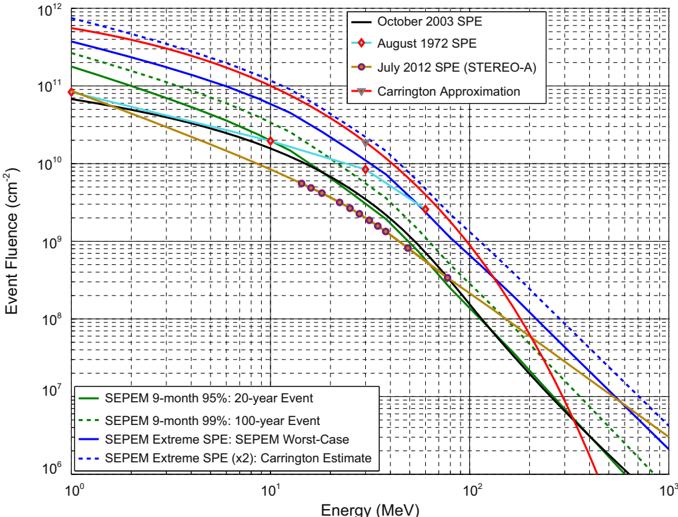
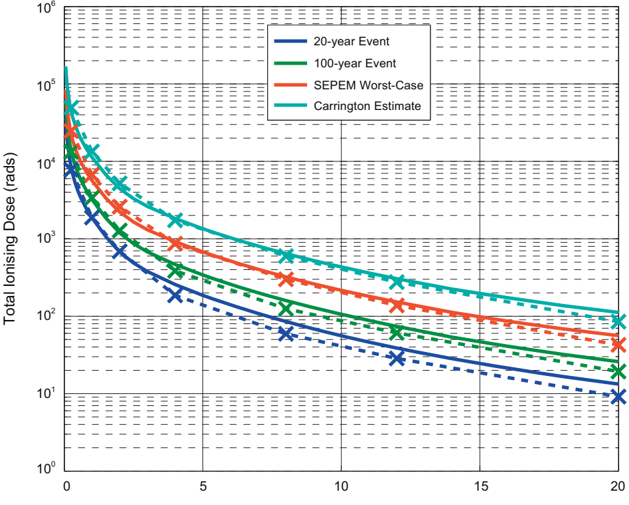
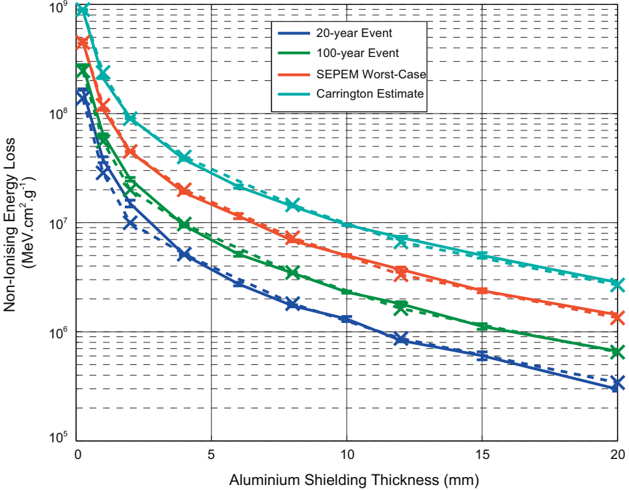
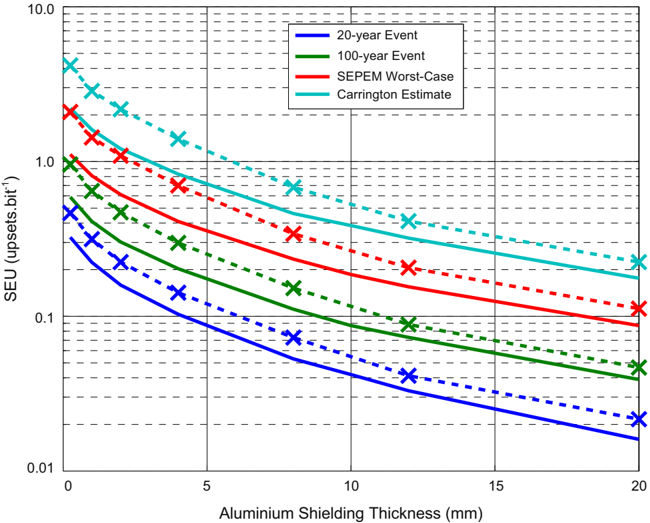
The solar energetic particle (SEP) radiation environment is an important consideration for spacecraft design, spacecraft mission planning and human spaceflight. Herein is presented an investigation into the likely severity of effects of a very large Solar Particle Event (SPE) on technology and humans in space. Fluences for SPEs derived using statistical models are compared to historical SPEs to verify their appropriateness for use in the analysis which follows. By combining environment tools with tools to model effects behind varying layers of spacecraft shielding it is possible to predict what impact a large SPE would be likely to have on a spacecraft in Near-Earth interplanetary space or geostationary Earth orbit. Also presented is a comparison of results generated using the traditional method of inputting the environment spectra, determined using a statistical model, into effects tools and a new method developed as part of the ESA SEPEM Project allowing for the creation of an effect time series on which statistics, previously applied to the flux data, can be run directly. The SPE environment spectra is determined and presented as energy integrated proton fluence (cm−2) as a function of particle energy (in MeV). This is input into the SHIELDOSE-2, MULASSIS, NIEL, GRAS and SEU effects tools to provide the output results. In the case of the new method for analysis, the flux time series is fed directly into the MULASSIS and GEMAT tools integrated into the SEPEM system. The output effect quantities include total ionising dose (in rads), non-ionising energy loss (MeV g−1), single event upsets (upsets/bit) and the dose in humans compared to established limits for stochastic (or cancer-causing) effects and tissue reactions (such as acute radiation sickness) in humans given in grey-equivalent and sieverts respectively.
Overview
The claims and statistics of this paper haven’t been checked yet.
Free: it reads the open-access text and checks the first 5 claims that cite a source we can check. Create a free account to check every claim.
Integrity signals
Registry
Cites
Statistics
Figures
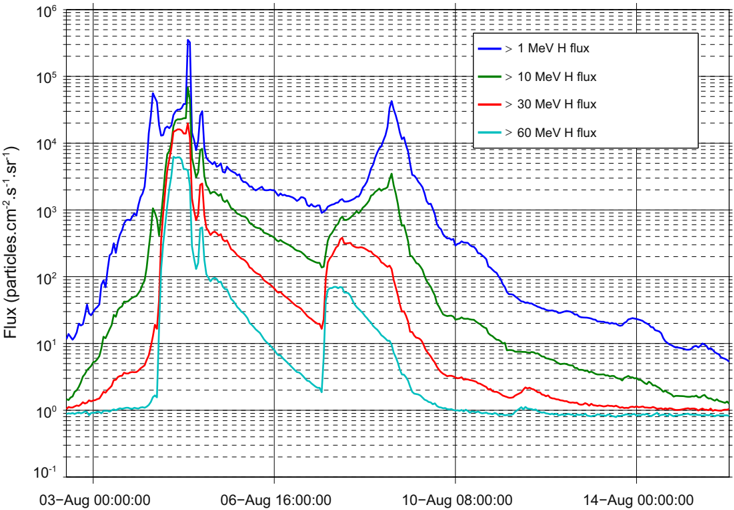
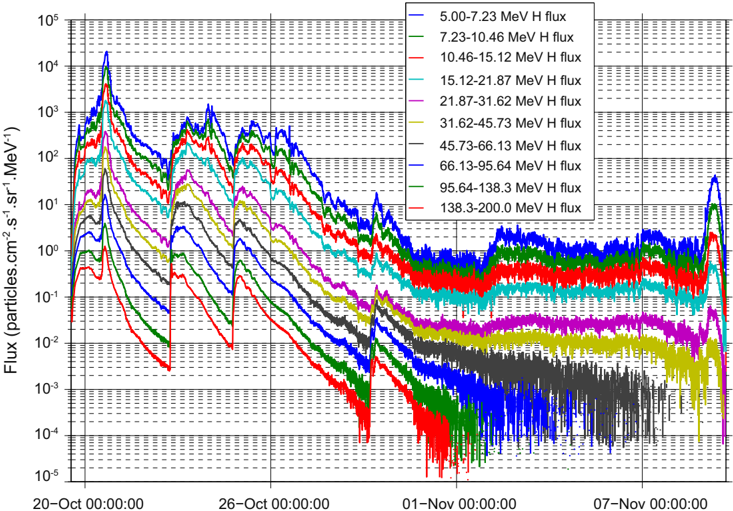
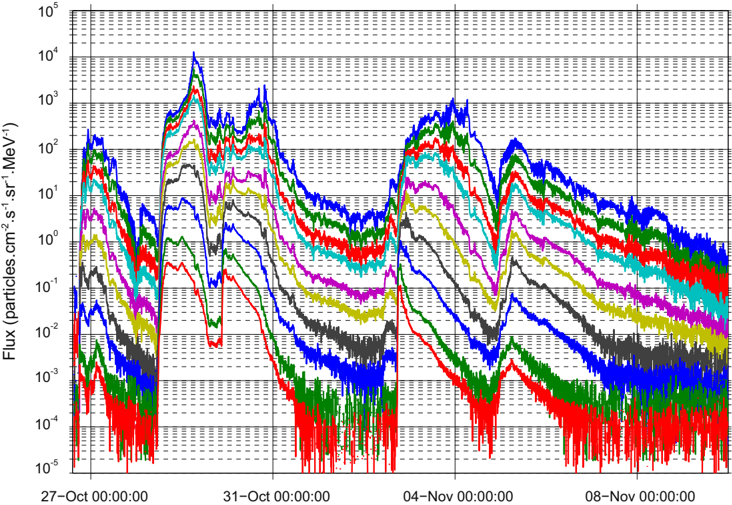
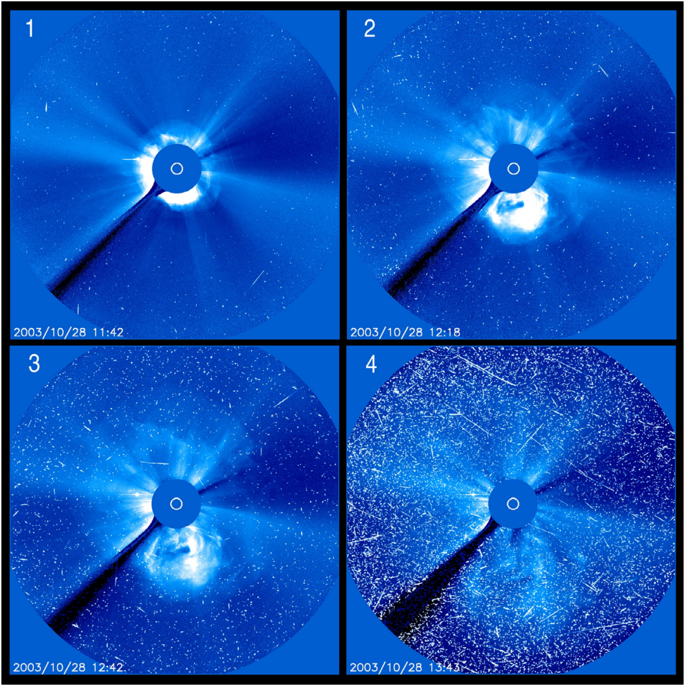
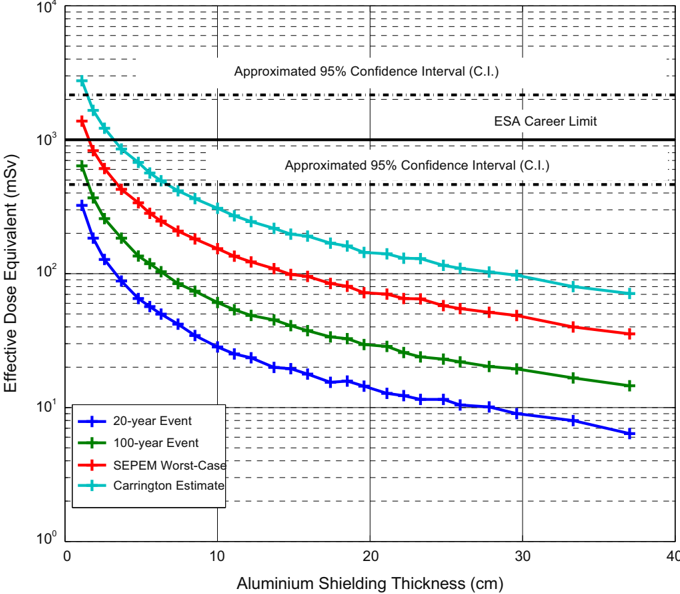
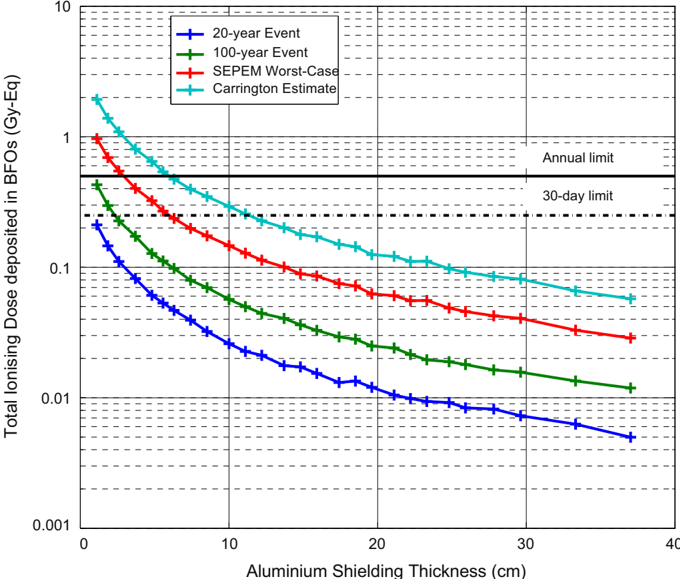
Verification
Claims the paper makes
The claims and statistics of this paper haven’t been checked yet.
Free: it reads the open-access text and checks the first 5 claims that cite a source we can check. Create a free account to check every claim.
Claims other papers make about this one
Each is checked against this paper’s own text: does it say what the citing paper says it does?
The source backs part of the claim, not all of it — or backs it for a different population, condition or comparison.
In the citing paper
“During an SPE, the flux of protons with energies of more than 10 MeV may increase by four to five orders of magnitude over periods of time ranging from several hours to a few days (3).”
From First evaluation of wearable radiation protection for human deep space exploration, as flown on Artemis I (2026) · cites this paper as [3]
Experimental — accuracy not yet measuredThe source backs part of the claim, not all of it — or backs it for a different population, condition or comparison.
In the citing paper
“SPEs result from solar eruptions that release an intense burst of radiation, consisting primarily of protons, with a monotonically decreasing energy spectrum.”
From First evaluation of wearable radiation protection for human deep space exploration, as flown on Artemis I (2026) · cites this paper as [3]
Experimental — accuracy not yet measured
Self-check
Percentages, sums and reported differences re-computed from the paper’s own numbers.
The self-check needs the paper’s full text.
Citations
Cites
Description of a Singular Appearance seen in the Sun on September 1, 1859
Carrington, R. C. (1859) · Monthly Notices of the Royal Astronomical Society · doi:10.1093/mnras/20.1.13 · Cited by 885
CREME96: A Revision of the Cosmic Ray Effects on Micro-Electronics Code
Tylka, A. J., Adams, J. H., Boberg, P. R., Brownstein, B., Dietrich, W. F., Flueckiger, E. O., Petersen, E. L., Shea, M. A., Smart, D. F., & Smith, E. C. (1997) · IEEE Transactions on Nuclear Science · doi:10.1109/23.659030 · Cited by 638
Physical basis of radiation protection in space travel
Durante, M., & Cucinotta, F. A. (2011) · Reviews of Modern Physics · doi:10.1103/revmodphys.83.1245 · Cited by 528 · cited 1×
“However, the majority of this shielding is provided by equipment stored on racks on-board ISS and this number may be closer to ~20 g cm 2 (or >7.4 cm Al equivalent) for the space station in general (Durante & Cucinotta 2011).”
BackgroundInfluentialA summary of major solar proton events
Shea, M. A., & Smart, D. F. (1990) · Solar Physics · doi:10.1007/bf00152170 · Cited by 309
Intensity variation of large solar energetic particle events associated with coronal mass ejections
Gopalswamy, N., Yashiro, S., Krucker, S., Stenborg, G., & Howard, R. A. (2004) · Journal of Geophysical Research: Space Physics · doi:10.1029/2004ja010602 · Cited by 306
The 1859 space weather event revisited: limits of extreme activity
Cliver, E. W., & Dietrich, W. F. (2013) · Journal of Space Weather and Space Climate · doi:10.1051/swsc/2013053 · Cited by 289
Kahler, S. W. (2001) · Journal of Geophysical Research: Space Physics · doi:10.1029/2000ja002231 · Cited by 263
Solar Proton Fluences for 1977-1983 Space Missions
KING, J. H. (1974) · Journal of Spacecraft and Rockets · doi:10.2514/3.62088 · Cited by 241
Proton, helium, and electron spectra during the large solar particle events of October–November 2003
Mewaldt, R. A., Cohen, C. M. S., Labrador, A. W., Leske, R. A., Mason, G. M., Desai, M. I., Looper, M. D., Mazur, J. E., Selesnick, R. S., & Haggerty, D. K. (2005) · Journal of Geophysical Research: Space Physics · doi:10.1029/2005ja011038 · Cited by 232
Space Radiation Cancer Risk Projections and Uncertainties – 2012
Cucinotta, F. A., Y.Kim, M.-H., & Chappell, L. J. (2013) · NASA · doi:10.13140/rg.2.1.1413.3528 · Cited by 218
Solar cosmic ray events for the period 1561–1994: 1. Identification in polar ice, 1561–1950
McCracken, K. G., Dreschhoff, G. A. M., Zeller, E. J., Smart, D. F., & Shea, M. A. (2001) · Journal of Geophysical Research: Space Physics · doi:10.1029/2000ja000237 · Cited by 196
Proton nonionizing energy loss (NIEL) for device applications
Jun, I., Xapsos, M. A., Messenger, S. R., Burke, E. A., Walters, R. J., Summers, G. P., & Jordan, T. (2003) · IEEE Transactions on Nuclear Science · doi:10.1109/tns.2003.820760 · Cited by 195
Galactic cosmic radiation model and its applications
Badhwar, G. D., & O'Neill, P. M. (1996) · Advances in Space Research · doi:10.1016/0273-1177(95)00507-b · Cited by 188
Cosmic Ray Effects on Microelectronics
Adams, J. H., Silberberg, R., & Tsao, C. H. (1982) · IEEE Transactions on Nuclear Science · doi:10.1109/tns.1982.4335821 · Cited by 181
O'Neill, P. M. (2005) · Advances in Space Research · doi:10.1016/j.asr.2005.02.001 · Cited by 175
MULASSIS: a Geant4-based multilayered shielding simulation tool
Lei, F., Truscott, R. R., Dyer, C. S., Quaghebeur, B., Heynderickx, D., Nieminen, R., Evans, H., & Daly, E. (2002) · IEEE Transactions on Nuclear Science · doi:10.1109/tns.2002.805351 · Cited by 167
Self-citationBadhwar–O'Neill 2010 Galactic Cosmic Ray Flux Model—Revised
O'Neill, P. M. (2010) · IEEE Transactions on Nuclear Science · doi:10.1109/tns.2010.2083688 · Cited by 166
The SEU figure of merit and proton upset rate calculations
Petersen, E. L. (1998) · IEEE Transactions on Nuclear Science · doi:10.1109/23.736497 · Cited by 166
Dst of the Carrington storm of 1859
Siscoe, G., Crooker, N. U., & Clauer, C. R. (2006) · Advances in Space Research · doi:10.1016/j.asr.2005.02.102 · Cited by 158
Effective stress law for the permeability of clay‐rich sandstones
Al‐Wardy, W., & Zimmerman, R. W. (2004) · Journal of Geophysical Research Atmospheres · doi:10.1029/2003jb002836 · Cited by 155
Lario, D., Kallenrode, M. B., Decker, R. B., Roelof, E. C., Krimigis, S. M., Aran, A., & Sanahuja, B. (2006) · The Astrophysical Journal · doi:10.1086/508982 · Cited by 138
GRAS: a general-purpose 3-D Modular Simulation tool for space environment effects analysis
Santin, G., Ivanchenko, V., Evans, H., Nieminen, P., & Daly, E. (2005) · IEEE Transactions on Nuclear Science · doi:10.1109/tns.2005.860749 · Cited by 125
Self-citationShielding from solar particle event exposures in deep space
Wilson, J. W., Cucinotta, F. A., Shinn, J. L., Simonsen, L. C., Dubey, R. R., Jordan, W. R., Jones, T. D., Chang, C. K., & Kim, M. Y. (1999) · Radiation Measurements · doi:10.1016/s1350-4487(99)00063-3 · Cited by 117
Galactic cosmic ray flux simulation and prediction
Ныммик, Р. А., Panasyuk, M. I., & Suslov, A. A. (1996) · Advances in Space Research · doi:10.1016/0273-1177(95)00508-c · Cited by 116
The Carrington event not observed in most ice core nitrate records
Wolff, E. W., Bigler, M., Curran, M. A. J., Dibb, J. E., Frey, M. M., Legrand, M., & McConnell, J. R. (2012) · Geophysical Research Letters · doi:10.1029/2012gl051603 · Cited by 114
Probability model for worst case solar proton event fluences
Xapsos, M. A., Summers, G. P., Barth, J. L., Stassinopoulos, E. G., & Burke, E. A. (1999) · IEEE Transactions on Nuclear Science · doi:10.1109/23.819111 · Cited by 110
Updated Calculations for Routine Space-Shielding Radiation Dose Estimates: SHIELDOSE-2
Seltzer, S. M. (1994) · NIST Interagency/Internal Report (NISTIR) - · Cited by 99
International Commission on Radiological Protection
(1971) · British Journal of Radiology · doi:10.1259/0007-1285-44-526-814 · Cited by 95
Model for Cumulative Solar Heavy Ion Energy and Linear Energy Transfer Spectra
Xapsos, M. A., Stauffer, C. A., Jordan, T., Barth, J. L., & Mewaldt, R. A. (2007) · IEEE Transactions on Nuclear Science · doi:10.1109/tns.2007.910850 · Cited by 92
Characterizing solar proton energy spectra for radiation effects applications
Xapsos, M. A., Barth, J. L., Stassinopoulos, E. G., Messenger, S. R., Walters, R. J., Summers, G. P., & Burke, E. A. (2000) · IEEE Transactions on Nuclear Science · doi:10.1109/23.903756 · Cited by 91
Two parameter Bendel model calculations for predicting proton induced upset (ICs)
Stapor, W. J., Meyers, J. P., Langworthy, J. B., & Petersen, E. L. (1990) · IEEE Transactions on Nuclear Science · doi:10.1109/23.101216 · Cited by 85
Charge separation techniques for irradiated pseudo-MOS SOI transistors
Jun, B., Fleetwood, D. M., Schrimpf, R. D., Zhou, X. J., Montes, E. J., & Cristoloveanu, S. (2003) · IEEE Transactions on Nuclear Science · doi:10.1109/tns.2003.821380 · Cited by 83
Cosmic Ray Effects on Microelectronics. Part 4
Adams, J. H. (1986) · Naval Research Lab. Report · Cited by 55
The Carrington event: Possible solar proton intensity–time profile
Smart, D. F., Shea, M. A., & McCracken, K. G. (2006) · Advances in Space Research · doi:10.1016/j.asr.2005.04.116 · Cited by 52
Straube, U., Berger, T., Reitz, G., Facius, R., Fuglesang, C., Reiter, T., Damann, V., & Tognini, M. (2010) · Acta Astronautica · doi:10.1016/j.actaastro.2009.10.004 · Cited by 51 · cited 4×
“…then the current 30-day exposure limit of 0.25 Gy-Eq for the bloodforming organs recommended by the latest NASA Standard Technical Standard NASA-STD-3001 (2007) and agreed upon A20-p2 by consensus of all ISS space agencies (NASA, Roskosmos, ESA, JAXA, CSA) (Straube et al. 2010) would be exceeded.”
BackgroundMethodInfluentialThe great historical geomagnetic storm of 1859: A modern look
Clauer, C. R., & Siscoe, G. L. (2006) · Advances in Space Research · doi:10.1016/j.asr.2006.09.001 · Cited by 51
Evaluation of skin cancer risk for lunar and Mars missions
Kim, M.-H. Y., George, K. A., & Cucinotta, F. A. (2006) · Advances in Space Research · doi:10.1016/j.asr.2006.03.032 · Cited by 49
ESA SEPEM Project: Peak Flux and Fluence Model
Jiggens, P. T. A., Gabriel, S. B., Heynderickx, D., Crosby, N. B., Glover, A., & Hilgers, A. (2012) · IEEE Transactions on Nuclear Science · doi:10.1109/tns.2012.2198242 · Cited by 47
Self-citationCarrington flare of 1859 as a prototypical worst-case solar energetic particle event
Townsend, L. W., Zapp, E. N., Stephens, D. L., & Hoff, J. L. (2003) · IEEE Transactions on Nuclear Science · doi:10.1109/tns.2003.821602 · Cited by 44
Dorman, L. I., Pustilnik, L. A., Sternlieb, A., Zukerman, I. G., Belov, A. V., Eroshenko, E. A., Yanke, V. G., Mavromichalaki, H., Sarlanis, C., Souvatzoglou, G., et al. (2004) · IEEE Transactions on Plasma Science · doi:10.1109/tps.2004.831738 · Cited by 43
Lewis, R. W., Pao, W. K. S., & Yang, X. (2003) · Geophysical Research Letters · doi:10.1029/2003gl017579 · Cited by 39
Ныммик, Р. А. (2000) · Advances in Space Research · doi:10.1016/s0273-1177(99)01242-9 · Cited by 30
Improved environment radiation models
Ныммик, Р. А. (2007) · Advances in Space Research · doi:10.1016/j.asr.2006.12.028 · Cited by 26
South Pole neutron monitor forecasting of solar proton radiation intensity
Oh, S. Y., Bieber, J. W., Clem, J., Evenson, P. A., Pyle, R., Yi, Y., & Kim, Y. K. (2012) · Space Weather · doi:10.1029/2012sw000795 · Cited by 24
Energetic particle acceleration by coronal mass ejections
Kahler, S. W. (2003) · Advances in Space Research · doi:10.1016/j.asr.2003.02.006 · Cited by 23
Spacesuit Radiation Shield Design Methods
Wilson, J. W., Anderson, B. M., Cucinotta, F. A., Ware, J., & Zeitlin, C. J. (2006) · SAE Technical Paper Series · doi:10.4271/2006-01-2110 · Cited by 22
Time distributions of solar energetic particle events: Are SEPEs really random?
Jiggens, P. T. A., & Gabriel, S. B. (2009) · Journal of Geophysical Research Atmospheres · doi:10.1029/2009ja014291 · Cited by 22
Self-citationSensitivity of a statistical solar proton fluence model to the size of the event data set
Rosenqvist, L., & Hilgers, A. (2003) · Geophysical Research Letters · doi:10.1029/2003gl017038 · Cited by 10
Self-citationImportance of predicting the dose temporal profile for large solar energetic particle events
Neal, J. S., Nichols, T. F., & Townsend, L. W. (2008) · Space Weather · doi:10.1029/2008sw000393 · Cited by 6
Chavy-Macdonald, M.-A., Menicucci, A., Santin, G., Evans, H. D. R., Jiggens, P. T. A., Nieminen, P. J., & Hovland, S. (2013) · IEEE Transactions on Nuclear Science · doi:10.1109/tns.2013.2273375 · Cited by 4
Self-citation(2009)
Research works printed but not linked: 1
- Wu, H., J.L. Huff, R. Casey, M.-H. Kim, and F.A. Cucinotta, Chapter 5: risk of acute radiation syndromes due to solar particle events. In: J.C., McPhee, and J.B. Charles (Eds.), Human Health and Performance Risks of Space Exploration Missions, US, NASA, Lyndon B. Johnson Space Center, pp. 171-190, 2009.
Cited by
The Energetic Particle Detector: Energetic particle instrument suite for the Solar Orbiter mission
Rodríguez-Pacheco, J., Wimmer-Schweingruber, R. F., Mason, G. M., Ho, G. C., Sánchez-Prieto, S., Prieto, M., Martín, C., Seifert, H., Andrews, G. B., Kulkarni, S. R., et al. (2020) · Astronomy & Astrophysics · doi:10.1051/0004-6361/201935287 · Cited by 219
“…they can cause large radiation increases in interplanetary space and over the polar regions of the Earth, potentially harmful for human crews in space and for space-based technology (e.g. Chenette et al. 1994; Mewaldt 2006; Vainio et al. 2009; Jiggens et al. 2014; McKenna-Lawlor et al. 2015).”
BackgroundCliver, E. W., Schrijver, C. J., Shibata, K., & Usoskin, I. G. (2022) · Living Reviews in Solar Physics · doi:10.1007/s41116-022-00033-8 · Cited by 175
Acceleration and Propagation of Solar Energetic Particles
Klein, K.-L., & Dalla, S. (2017) · Space Science Reviews · doi:10.1007/s11214-017-0382-4 · Cited by 165
Earth-affecting solar transients: a review of progresses in solar cycle 24
Zhang, J., Temmer, M., Gopalswamy, N., Malandraki, O., Nitta, N., Patsourakos, S., Shen, F., Vrsnak, B., Wang, Y., Webb, D. F., et al. (2021) · Progress in Earth and Planetary Science · doi:10.1186/s40645-021-00426-7 · Cited by 156
Knipp, D. J., Fraser, B. J., Shea, M. A., & Smart, D. F. (2018) · Space Weather · doi:10.1029/2018sw002024 · Cited by 94
Metadata
- Authors
- Jiggens, P., Chavy-Macdonald, M.-A., Santin, G., Menicucci, A., Evans, H., & Hilgers, A.
- Affiliations
- European Space Research and Technology Centre (NL)
- Corresponding author
- Jiggens, Piers
- Venue
- Journal of Space Weather and Space Climate
- Publisher
- EDP Sciences
- Published
- 2014
- Volume
- 4
- Pages
- A20
- ISSN
- 2115-7251 (ISSN-L)
- OpenAlex
- W2167616225
- Semantic Scholar
- 7de7bfb37f22fd457c01ccce8a062b6d5a139fe8
- Cited by
- 52
- References
- 51
- Citations by year
- 2026: 7 · 2025: 3 · 2024: 3 · 2023: 1 · 2022: 8 · 2021: 7 · 2020: 4 · 2019: 4 · 2018: 6 · 2017: 4 · 2015: 3 · 2014: 2
- FWCI
- 1.59
- Type
- journal article
- Language
- en
- Open access
- gold
- doi.org
- Licence
- cc-by
- Locations
- Journal of Space Weather and Space Climate (publishedVersion, cc-by)
- Springer Link (Chiba Institute of Technology) (submittedVersion)
- DOAJ (DOAJ: Directory of Open Access Journals) (submittedVersion)
- Topics
- Physical Sciences › Engineering › Electrical and Electronic Engineering › Radiation Effects in Electronics
- Physical Sciences › Physics and Astronomy › Astronomy and Astrophysics › Solar and Space Plasma Dynamics
- Physical Sciences › Physics and Astronomy › Radiation › Radiation Therapy and Dosimetry
- Keywords
- solar energetic particle events, solar energetic particles, radiation environment, spacecraft shielding, spacecraft radiation effects, single event upset, total ionizing dose, geostationary orbit, radiation protection limits
About these checks
Registry, retraction, Cites and statistics results are computed, not judged, with one exception: a printed reference that no index lists is read once by a model before it counts as a citation error. Claims are extracted by a model and kept only when their quote appears verbatim in the text; each cited source is then checked, with a model’s help, for whether it says what the claim relies on. Those verdicts can be wrong — read the claim’s quote and the cited source before relying on one.
Statistics and arithmetic are recomputed, not judged.
Confidence bands are shown only for fields calibrated on our annotated test set. None is calibrated yet, so no band is shown.
What counts as a claim ›How we measure confidence ›How we check this ›
Are you an author, or do you see a problem with this page? Request a review
Data sources
Bibliographic data: Semantic Scholar, OpenAlex, Crossref.
Contains information from the Semantic Scholar Academic Graph Datasets, made available under the ODC Attribution License (ODC-BY 1.0).
Semantic Scholar’s data is described in: Kinney, R., et al. (2023). The Semantic Scholar Open Data Platform. arXiv:2301.10140.
