

The DOI matches its Crossref record; 8 of the 8 references it cites were found in a registry or an index.
Evaluation of pathogen from the FilmArray meningitis/encephalitis panel and recommendations on atypical findings
Open accessAbstract
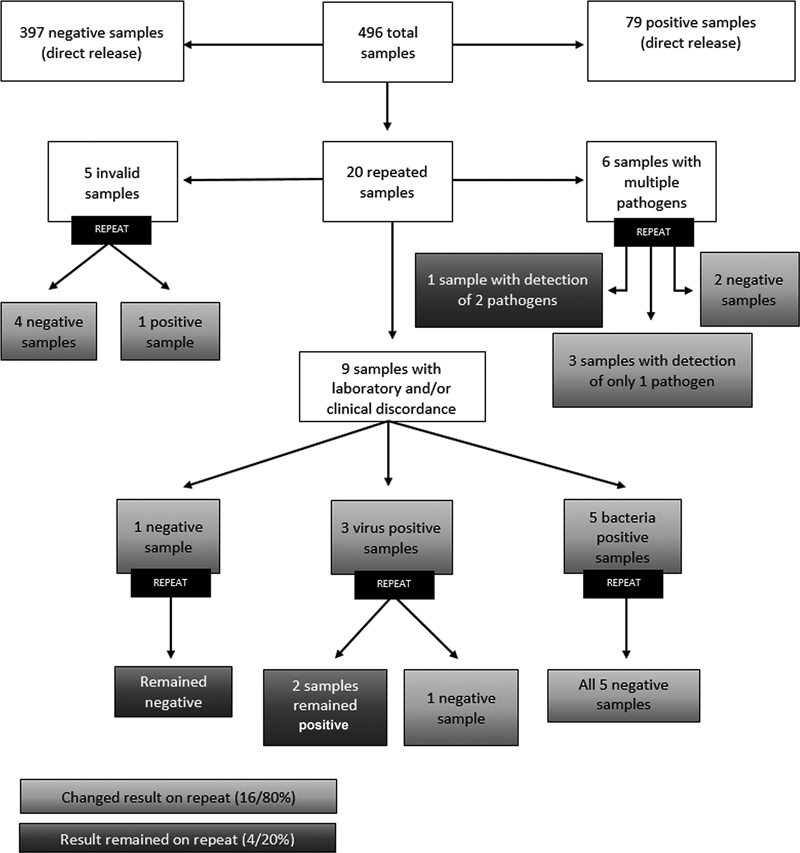
BACKGROUND: Infectious meningoencephalitis is a potentially fatal clinical condition that causes inflammation of the central nervous system secondary to the installation of different microorganisms. The FilmArray meningitis/encephalitis panel allows the simultaneous detection of 14 pathogens with results in about one hour. OBJECTIVE: This study is based on retrospectively evaluating the implementation of the FilmArray meningitis/encephalitis panel in a hospital environment, highlighting the general results and, especially, analyzing the consistency of the test results against the clinical and laboratory conditions of the patients. METHODS: Data were collected through the results reported by the BioFire FilmArray system software from the meningitis/encephalitis panel. The correlated laboratory tests used in our analysis, when available, included biochemical, cytological, direct and indirect microbiological tests. RESULTS: In the analyzed period, there were 496 samples with released results. Of the total of 496 samples analyzed, 88 (17.75%) were considered positive, and 90 pathogens were detected, and in 2 of these (2.27%) there was co-detection of pathogens. Viruses were the agents most frequently found within the total number of pathogens detected. Of the 496 proven samples, 20 (4.03%) were repeated, 5 of which were repeated due to invalid results, 6 due to the detection of multiple pathogens and 9 due to disagreement between the panel results and the other laboratory tests and/or divergence of the clinical-epidemiological picture. Of these 20 repeated samples, only 4 of them (20%) maintained the original result after repeating the test, with 16 (80%) being non-reproducible. The main factor related to the disagreement of these 16 samples during retesting was the detection of bacterial agents without any relationship with other laboratory tests or with the patients' clinical condition. CONCLUSION: In our study, simply reproducing tests with atypical results from the FilmArray meningitis/encephalitis panel proved, in most cases, effective and sufficient for interpreting these results.
Overview
The claims and statistics of this paper haven’t been checked yet.
Run the check — free, no account needed. It reads the open-access text and checks the sources it cites.
Integrity signals
Registry
Cites
Statistics
Figures
Verification
Claims the paper makes
The claims and statistics of this paper haven’t been checked yet.
Run the check — free, no account needed. It reads the open-access text and checks the sources it cites.
Claims other papers make about this one
Each is checked against this paper’s own text: does it say what the citing paper says it does?
The source backs part of the claim, not all of it — or backs it for a different population, condition or comparison.
In the citing paper
“The overall positivity rate of multiplex panels in our cohort was comparable to that reported in previous BioFire® FilmArray® studies,10,14-16 and positivity was notably higher in paediatric patients, confirming their higher diagnostic yield in children.10,15”
From Utility and clinical relevance of multiplex PCR panels for diagnosis of central nervous system infections (2026) · cites this paper as [16]
Experimental — accuracy not yet measured
Self-check
Percentages, sums and reported differences re-computed from the paper’s own numbers.
The self-check needs the paper’s full text.
Citations
Cites
Epidemiology, Diagnosis, and Antimicrobial Treatment of Acute Bacterial Meningitis
Brouwer, M. C., Tunkel, A. R., & van de Beek, D. (2010) · Clinical Microbiology Reviews · doi:10.1128/cmr.00070-09 · Cited by 930 · cited 1×
“1,2 Furthermore, the costs associated with these infections are considerable, both in the short term, linked to hospitalization and treatment costs, and in the long term, considering the possible productive losses of the affected individuals.”
BackgroundLeber, A. L., Everhart, K., Balada-Llasat, J.-M., Cullison, J., Daly, J., Holt, S., Lephart, P., Salimnia, H., Schreckenberger, P. C., DesJarlais, S., et al. (2016) · Journal of Clinical Microbiology · doi:10.1128/jcm.00730-16 · Cited by 609 · cited 1×
“10 Furthermore, to mitigate these possibilities of incorrect or inconclusive results, based on our fi ndings and the experience of other studies, we created a panel with recommendations to be taken into account when using and interpreting the test ( ► Chart 2 ).”
MethodTansarli, G. S., & Chapin, K. C. (2020) · Clinical Microbiology and Infection · doi:10.1016/j.cmi.2019.11.016 · Cited by 263 · cited 1×
“21 However, after judging the test results in conjunctionwithclinical information and/or after checking with other laboratory tests, the percentage of false-positive samples dropped to 4%, making clear the importance of reviewing the results and the relevance and frequency of false-positive samples.”
BackgroundRadmard, S., Reid, S., Ciryam, P., Boubour, A., Ho, N., Zucker, J., Sayre, D., Greendyke, W. G., Miko, B. A., Pereira, M. R., et al. (2019) · Frontiers in Neurology · doi:10.3389/fneur.2019.00281 · Cited by 127 · cited 1×
“13 If it were actually considered positive and clinically relevant, its prevalence would have surpassed that of the Enterovirus in the mentioned study.”
BackgroundGomez, C. A., Pinsky, B. A., Liu, A., & Banaei, N. (2017) · Open Forum Infectious Diseases · doi:10.1093/ofid/ofw245 · Cited by 53 · cited 1×
“18 On that occasion, when the test was repeated on the remaining sample, the panel result was negative and another conventional single-plex PCR test performed separately for HSV-1 was also negative, unlike the PCR test for M tuberculosis which gave a positive result.”
ResultBoudet, A., Pantel, A., Carles, M.-J., Boclé, H., Charachon, S., Enault, C., Stéphan, R., Cadot, L., Lavigne, J.-P., & Marchandin, H. (2019) · PLOS ONE · doi:10.1371/journal.pone.0223887 · Cited by 49
State-of-the-Art Microbiologic Testing for Community-Acquired Meningitis and Encephalitis
Polage, C. R., & Cohen, S. H. (2016) · Journal of Clinical Microbiology · doi:10.1128/jcm.00289-16 · Cited by 43
Tarai, B., & Das, P. (2019) · Neurological Sciences · doi:10.1007/s10072-018-3584-y · Cited by 41
Research works printed but not linked: 15
- R M Liesman, 2018, Evaluation of a Commercial Multiplex Molecular Panel for Diagnosis of Infectious Meningitis and Encephalitis, J Clin Microbiol, 56, e01927, 10.1128/JCM.01927-17 · DOI · Paper page
- A Portnoy, 2015, Estimating costs of care for meningitis infections in low- and middle-income countries, Vaccine, 33, A240, 10.1016/j.vaccine.2014.11.061 · DOI · Paper page
- K E Hanson, 2016, Preclinical Assessment of a Fully Automated Multiplex PCR Panel for Detection of Central Nervous System Pathogens, J Clin Microbiol, 54, 785, 10.1128/JCM.02850-15 · DOI · Paper page
- K E Hanson, 2016, Multiplexed Molecular Diagnostics for Respiratory, Gastrointestinal, and Central Nervous System Infections, Clin Infect Dis, 63, 1361, 10.1093/cid/ciw494 · DOI · Paper page
- P Ramanan, 2017, Syndromic Panel-Based Testing in Clinical Microbiology, Clin Microbiol Rev, 31, e00024, 10.1128/CMR.00024-17 · DOI · Paper page
- C N van Ettekoven, 2017, Update on community-acquired bacterial meningitis: guidance and challenges, Clin Microbiol Infect, 23, 601, 10.1016/j.cmi.2017.04.019 · DOI
- R B Domingues, 2019, FilmArray Meningitis/Encephalitis (ME) panel in the diagnosis of bacterial meningitis, Braz J Infect Dis, 23, 468, 10.1016/j.bjid.2019.10.008 · DOI
- S H Lee, 2019, Usefulness of the FilmArray meningitis/encephalitis (M/E) panel for the diagnosis of infectious meningitis and encephalitis in Taiwan, J Microbiol Immunol Infect, 52, 760, 10.1016/j.jmii.2019.04.005 · DOI · Paper page
- S N Naccache, 2018, One Year in the Life of a Rapid Syndromic Panel for Meningitis/Encephalitis: a Pediatric Tertiary Care Facility's Experience, J Clin Microbiol, 56, e01940, 10.1128/JCM.01940-17 · DOI
- S Pfefferle, 2020, Implementation of the FilmArray ME panel in laboratory routine using a simple sample selection strategy for diagnosis of meningitis and encephalitis, BMC Infect Dis, 20, 170, 10.1186/s12879-020-4904-4 · DOI · Paper page
- K E Hanson, 2016, The First Fully Automated Molecular Diagnostic Panel for Meningitis and Encephalitis: How Well Does It Perform, and When Should It Be Used?, J Clin Microbiol, 54, 2222, 10.1128/JCM.01255-16 · DOI · Paper page
- S F Lumley, 2018, Multiplex PCR reveals high prevalence of enterovirus and HHV6 in acellular paediatric cerebrospinal fluid samples, J Infect, 77, 249, 10.1016/j.jinf.2018.05.008 · DOI · Paper page
- S Duff, 2018, Economic analysis of rapid multiplex polymerase chain reaction testing for meningitis/encephalitis in pediatric patients, Future Microbiol, 13, 617, 10.2217/fmb-2017-0238 · DOI
- S Duff, 2019, Economic analysis of rapid multiplex polymerase chain reaction testing for meningitis/encephalitis in adult patients, Infection, 47, 945, 10.1007/s15010-019-01320-7 · DOI
- D K Soucek, 2019, Cost Justification of the BioFire FilmArray Meningitis/Encephalitis Panel Versus Standard of Care for Diagnosing Meningitis in a Community Hospital, J Pharm Pract, 32, 36, 10.1177/0897190017737697 · DOI
Cited by
Sorted by citations
Gürler, M., Karaoğlu, Ç., Yurtcu, E. E., Us, E., & Karahan, Z. C. (2026) · The Indian Journal of Medical Research · doi:10.25259/ijmr_2107_2025
Metadata
- Authors
- Côrtes, L. G. F., Maldonado, M. M., Koga, P. C. M., Santiago, K. A. D. S., Fernandes, G. B. P., Maluf, M. M., & Martino, M. D. V.
- Affiliations
- Hospital Israelita Albert Einstein, Laboratório Clínico, São Paulo SP, Brazil.
- Hospital Israelita Albert Einstein (BR)
- Corresponding author
- Martino, Marinês Dalla Valle
- ORCID
- Venue
- Arquivos de Neuro-Psiquiatria
- Publisher
- Georg Thieme Verlag KG
- Published
- 2024-01
- Volume
- 82
- Issue
- 01
- Pages
- 001-008
- ISSN
- 0004-282X (ISSN-L)
- 1678-4227
- PMC
- PMC10843913
- OpenAlex
- W4392729241
- Cited by
- 2
- References
- 8
- Citations by year
- 2024: 2
- FWCI
- 0.58
- Type
- journal article
- Language
- en
- Open access
- gold
- dx.doi.org
- Licence
- Locations
- Arquivos de Neuro-Psiquiatria (publishedVersion, cc-by)
- PubMed Central (publishedVersion, cc-by)
- PubMed (publishedVersion)
- DOAJ (DOAJ: Directory of Open Access Journals) (submittedVersion, cc-by-sa)
- Topics
- Health Sciences › Medicine › Microbiology (medical) › Bacterial Identification and Susceptibility Testing
- Life Sciences › Immunology and Microbiology › Microbiology › Bacterial Infections and Vaccines
- Health Sciences › Medicine › Infectious Diseases › Infectious Encephalopathies and Encephalitis
- Keywords
- FilmArray Meningitis/Encephalitis panel, multiplex PCR, test reproducibility, false positives, viral pathogens, pathogenic bacteria, central nervous system infection, molecular diagnosis
- MeSH terms
- Encephalitis, Humans, Inflammation, Meningitis, Retrospective Studies, Viruses
About these checks
Registry, retraction, Cites and statistics results are computed, not judged, with one exception: a printed reference that no index lists is read once by a model before it counts as a citation error. Claims are extracted by a model and kept only when their quote appears verbatim in the text; each cited source is then checked, with a model’s help, for whether it says what the claim relies on. Those verdicts can be wrong — read the claim’s quote and the cited source before relying on one.
Statistics and arithmetic are recomputed, not judged.
Confidence bands are shown only for fields calibrated on our annotated test set. None is calibrated yet, so no band is shown.
What counts as a claim ›How we measure confidence ›How we check this ›
Are you an author, or do you see a problem with this page? Request a review
