

The DOI matches its Crossref record; 60 of the 60 references it cites were found in a registry or an index; none of the 60 sources its claims cite is checked for support yet.
Artificial Intelligence in Crisis Communication: Investigating Source Effects and Matched Crisis Responses on Stakeholder Perceptions
Open accessAbstract
As public relations efforts increasingly integrate AI into operations, examining how the disclosure of AI as the source in organizational crisis communications affects public perceptions is increasingly relevant. This research investigates the effects of AI disclosure across matched crisis responses within a 3 (match crisis response: victim crisis-scapegoating, accidental crisis-excuse, preventable crisis-apology) x 2 (source disclosure: AI vs. human) experimental design survey. Key findings reveal that crisis responses with human sources, compared to those with AI disclosure, led to greater perceptions of organizational reputation and credibility across the three matched crisis responses. AI-disclosed messages from the company were also associated with increased perceptions of injustice, potentially due to concerns over fairness and authenticity. No significant interaction was detected between crisis response type and source disclosure, suggesting that they have independent effects on stakeholder perceptions. Trust in AI showed a small but statistically significant interaction with source disclosure within AI conditions for reputation, where higher trust slightly reduced the negative effects of AI disclosure. Practically, these findings suggest PR professionals should prioritize crisis communication with human sources while considering ongoing perceptions of trust in AI.
Overview
CoChat Summary
TL;DR
A 3 (matched crisis response: victim-scapegoating, accidental-excuse, preventable-apology) × 2 (source disclosure: AI vs. human) online experiment with 347 U.S. participants finds that disclosing AI as the source of a crisis response modestly lowers perceived reputation and credibility and raises perceived injustice, but that crisis type dominates these outcomes. Trust in AI weakly moderated the reputation penalty only.
Key findings
- Source disclosure had significant but small main effects: human-sourced responses were rated more reputable (M = 4.53, SE = 0.14) than AI-sourced (M = 3.90, SE = 0.16), F(1, 337) = 10.10, p = .002, η²p = .03; more credible (M = 3.82 vs. 3.32), F(1, 337) = 7.50, p = .007, η²p = .02; and lower on injustice (M = 3.64 vs. 4.27), F(1, 337) = 8.45, p = .004, η²p = .02. H1 supported.
- Crisis type produced much larger effects than source: reputation F(2, 333) = 100.96, η²p = .38; credibility F(2, 333) = 57.32, η²p = .26; injustice F(2, 333) = 120.47, η²p = .42. Preventable crises yielded the worst outcomes (reputation M = 3.26, credibility M = 2.86, injustice M = 5.18), differing significantly from both victim and accidental crises (all p < .001).
- No significant interaction between source disclosure and crisis response for reputation (p = .839), credibility (p = .715), or injustice (p = .523); the two factors operated independently.
- Trust in AI moderated the source-disclosure effect on reputation only (interaction β = 0.25, SE = 0.12, t = 1.98, p = .048, ΔR² = 0.01): at low trust (−1 SD) AI sources scored M = 3.50 vs. human M = 4.19, a gap that shrank at high trust (AI M = 4.44 vs. human M = 4.64). The interaction was not significant for credibility (p = .521) or injustice (p = .136).
Methods
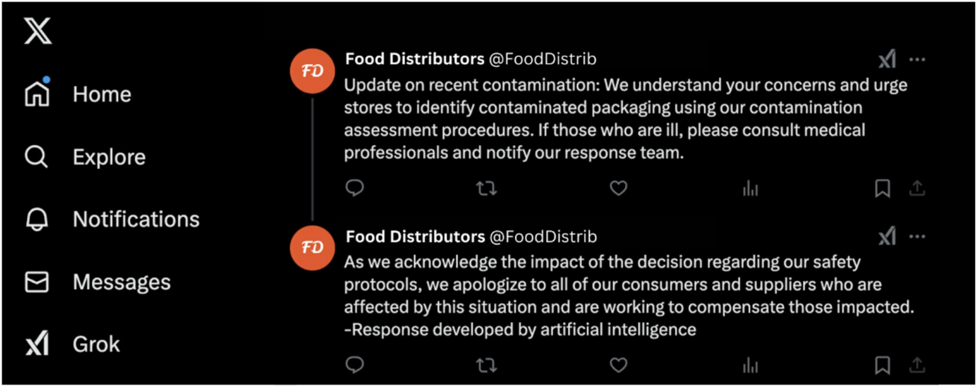
- Online 3 × 2 between-subjects experiment using a fictitious food processing company ("Food Distributors") and a contamination crisis; participants were explicitly told the social media response was developed by company executives or by artificial intelligence.
- U.S. representative sample recruited via Prolific; 613 recruited, 347 retained after exclusions (incorrect/uncertain source identification n = 146, incomplete n = 79, response-time outliers n = 37, under-18 n = 4); average age 45.19 years, 51.01% female; G*Power indicated a minimum of 251 participants.
- Two-way ANCOVAs (controlling for crisis severity, AI use, and pre-existing attitudes toward the company) plus multiple linear regression with a mean-centered source disclosure × trust-in-AI interaction term; manipulation checks confirmed crisis responsibility differences, F(2, 344) = 62.83, p < .001, η² = 0.27, and source identification, χ²(1, n = 347) = 343.01, p < .001.
Limitations
- Stated: all scenarios came from a single industry and a single contamination crisis, limiting generalizability to other industries or crisis contexts; the joint manipulation of crisis type and matched response strategy prevents isolating the unique contribution of each; and all stimuli were written by a research team member rather than actually generated by AI, so future work should compare genuinely human- vs. AI-written responses.
- Stated: the authors note the source-disclosure effects were statistically significant but small (η²p ≈ .02–.03), suggesting modest practical differences.
- Evident from the text: the removal of 266 of 613 recruited participants produced some imbalance across conditions (the authors acknowledge this but argue power remained adequate), and the moderation finding for reputation rests on a very small interaction effect (ΔR² = 0.01).
Model-written summary. Check it against the paper before relying on it.
Integrity signals
Registry
Cites
Statistics
Figures
Verification
Claims the paper makes
0 Valid · 1 Not valid · 48 Not checked · 46 Own results and interpretations
A result the paper reports from its own data — it cites no other source for it, so there is none to check. The quote shows it is in the paper.
In the paper
“trust in AI positively predicted credibility, β = 0.35, p < .001.”
§ Artificial Intelligence in Crisis Communication: Investigating Source Effects and Matched Crisis Responses on Stakeholder Perceptions > Control Variables
plainstates a cause- Asserted: passes — The authors put it forward as true.
- Checkable: passes — It can be checked against evidence.
- Load-bearing: unclear — It is unclear whether the paper’s conclusions depend on it.
- Based: passes — The paper gives a reason why it holds.
A result the paper reports from its own data — it cites no other source for it, so there is none to check. The quote shows it is in the paper.
In the paper
“There were significant main effects of the response for reputation, F(2, 333) = 100.96,p < .001,η²p = .38,credibility, F(2, 333) = 57.32,p < .001,η²p = .26,and injustice, F(2, 333) = 120.47,p < .001,η²p = .42.”
§ Artificial Intelligence in Crisis Communication: Investigating Source Effects and Matched Crisis Responses on Stakeholder Perceptions > Results
plainstates a cause- Asserted: passes — The authors put it forward as true.
- Checkable: passes — It can be checked against evidence.
- Load-bearing: passes — The paper’s conclusions depend on it.
- Based: passes — The paper gives a reason why it holds.
A result the paper reports from its own data — it cites no other source for it, so there is none to check. The quote shows it is in the paper.
In the paper
“Trust in AI (p = .314)and the interaction (p = .136)were not significant predictors.”
§ Artificial Intelligence in Crisis Communication: Investigating Source Effects and Matched Crisis Responses on Stakeholder Perceptions > Control Variables
plain- Asserted: passes — The authors put it forward as true.
- Checkable: passes — It can be checked against evidence.
- Load-bearing: unclear — It is unclear whether the paper’s conclusions depend on it.
- Based: passes — The paper gives a reason why it holds.
A result the paper reports from its own data — it cites no other source for it, so there is none to check. The quote shows it is in the paper.
In the paper
“The research on the effects of matched crisis responses was extended in our research to find that higher responsibility was also associated with greater perceptions of injustice.”
§ Artificial Intelligence in Crisis Communication: Investigating Source Effects and Matched Crisis Responses on Stakeholder Perceptions > Control Variables
plainstates an association- Asserted: passes — The authors put it forward as true.
- Checkable: passes — It can be checked against evidence.
- Load-bearing: unclear — It is unclear whether the paper’s conclusions depend on it.
- Based: passes — The paper gives a reason why it holds.
A result the paper reports from its own data — it cites no other source for it, so there is none to check. The quote shows it is in the paper.
In the paper
“Regarding injustice, the human source reported lower perceptions of injustice (M = 3.64, SE = 0.17) than the AI source (M = 4.27, SE = 0.19).”
- Also stated in: § Control Variables · plain
“Source disclosure was positively related to injustice perceptions, β = 0.52, SE = 0.20, t = 2.63, p = .009.”
§ Artificial Intelligence in Crisis Communication: Investigating Source Effects and Matched Crisis Responses on Stakeholder Perceptions > Results
plainstates a cause- Asserted: passes — The authors put it forward as true.
- Checkable: passes — It can be checked against evidence.
- Load-bearing: passes — The paper’s conclusions depend on it.
- Based: passes — The paper gives a reason why it holds.
- Also stated in: § Control Variables · plain
32 more claims
Create a free account to see all 95 claims and to verify the 55 references still open.
- It may state two separate claims as one. 38
- Probably not a substantial claim. 38
- The quote only partly states this claim. 3
Statistics that don’t add up
Each reported p-value recomputed from its test statistic and degrees of freedom.
Rated minor: it would not touch a result — a value no result rests on, a p-value that stays on the same side of the significance level, or a conflict that is clerical, resolved elsewhere in the paper, or outside its own findings.
In the paper
“F(2, 339) = 1.33, p = .523”
§ Artificial Intelligence in Crisis Communication: Investigating Source Effects and Matched Crisis Responses on Stakeholder Perceptions > Results
Reported p = .523 · recomputed p = .266
Rated minor: it would not touch a result — a value no result rests on, a p-value that stays on the same side of the significance level, or a conflict that is clerical, resolved elsewhere in the paper, or outside its own findings.
In the paper
“F(2, 339) = 0.57, p = .715”
§ Artificial Intelligence in Crisis Communication: Investigating Source Effects and Matched Crisis Responses on Stakeholder Perceptions > Results
Reported p = .715 · recomputed p = .566
Rated minor: it would not touch a result — a value no result rests on, a p-value that stays on the same side of the significance level, or a conflict that is clerical, resolved elsewhere in the paper, or outside its own findings.
In the paper
“F(2, 339) = 0.27, p = .839”
§ Artificial Intelligence in Crisis Communication: Investigating Source Effects and Matched Crisis Responses on Stakeholder Perceptions > Results
Reported p = .839 · recomputed p = .764
Statistics recomputed
Every reported test result, recomputed from its test statistic and degrees of freedom. A result shows as not adding up only once an independent check has confirmed it.
- Doesn’t add upF(2, 339) = 0.27reported p = .839 · recomputed p = .764
“F(2, 339) = 0.27, p = .839”
- Doesn’t add upF(2, 339) = 0.57reported p = .715 · recomputed p = .566
“F(2, 339) = 0.57, p = .715”
- Doesn’t add upF(2, 339) = 1.33reported p = .523 · recomputed p = .266
“F(2, 339) = 1.33, p = .523”
- ConsistentF(2, 344) = 62.83reported p < .001 · recomputed p < .001
“F(2, 344) = 62.83, p < .001”
- ConsistentF(2, 333) = 100.96reported p < .001 · recomputed p < .001
“F(2, 333) = 100.96,p < .001”
8 more recomputed tests
Create a free account to see every test the Stats check recomputed.
Self-check
Percentages, sums and reported differences re-computed from the paper’s own numbers.
Each contradiction between two passages listed here was confirmed by an independent check.
Rated minor: it would not touch a result — a value no result rests on, a p-value that stays on the same side of the significance level, or a conflict that is clerical, resolved elsewhere in the paper, or outside its own findings.
In the paper
§ Artificial Intelligence in Crisis Communication: Investigating Source Effects and Matched Crisis Responses on Stakeholder Perceptions > Practical Implications
“The second research question tested whether trust in AI moderates the relationship between source disclosure and reputational evaluations within AI disclosure conditions.”
§ Artificial Intelligence in Crisis Communication: Investigating Source Effects and Matched Crisis Responses on Stakeholder Perceptions > Control Variables
“Source disclosure negatively predicted reputation, β = -0.45,SE = 0.17, t = -2.69,p = .007,indicating lower reputational perceptions for AI source disclosure compared to human.”
Citations
Cites
Perceived usefulness, perceived ease of use, and user acceptance of information technology
Davis, F. D. (1989) · MIS Quarterly · doi:10.2307/249008 · Cited by 68,483
Faul, F., Erdfelder, E., Lang, A.-G., & Buchner, A. (2007) · Behavior Research Methods · doi:10.3758/bf03193146 · Cited by 65,971
A Theoretical Extension of the Technology Acceptance Model: Four Longitudinal Field Studies
Venkatesh, V., & Davis, F. D. (2000) · Management Science · doi:10.1287/mnsc.46.2.186.11926 · Cited by 23,066
An integrative model of organizational trust
Mayer, R. C., Davis, J. H., & Schoorman, F. D. (1995) · The Academy of Management Review · doi:10.2307/258792 · Cited by 10,736
Ohanian, R. (1990) · Journal of Advertising · doi:10.1080/00913367.1990.10673191 · Cited by 4,043
Coombs, W. T. (2007) · Corporate Reputation Review · doi:10.1057/palgrave.crr.1550049 · Cited by 2,790
Douglas, B. D., Ewell, P. J., & Brauer, M. (2023) · PLOS ONE · doi:10.1371/journal.pone.0279720 · Cited by 1,532
Image repair discourse and crisis communication
Benoit, W. L. (1997) · Public Relations Review · doi:10.1016/s0363-8111(97)90023-0 · Cited by 1,400
The Reputation QuotientSM: A multi-stakeholder measure of corporate reputation
Fombrun, C. J., Gardberg, N. A., & Sever, J. M. (2000) · Journal of Brand Management · doi:10.1057/bm.2000.10 · Cited by 1,297
Trust in a specific technology: An investigation of its components and measures
Mcknight, D. H., Carter, M., Thatcher, J. B., & Clay, P. F. (2011) · ACM Transactions on Management Information Systems · doi:10.1145/1985347.1985353 · Cited by 1,185
Research works printed but not linked: 4
- Coombs, W. T. 1995. Choosing the right words: The development of guidelines for the selection of the appropriate crisis-response strategies. Management Communication Quarterly 8(4):447–476. https://doi.org/10.1177/089331899500800400 · doi:10.1177/089331899500800400
- O’Keefe, D. J. 2004. Trends and prospects in persuasion theory and research. In Readings in persuasion: Social influence, and compliance gaining, ed. John S. Seiter and Robert H. Gass, 31–43. Boston: Pearson/Allyn and Bacon.
- Petty, R. E., and J. T. Cacioppo. 1984. Source factors and the elaboration likelihood model of persuasion. Advances in Consumer Research 11(1):668–672. http://www.communicationcache.com/uploads/1/0/8/8/10887248/source_factors_and_the_elaboration_likelihood_model_of_persuasion.pdf
- Sellnow-Richmond, D. D., M. N. Lukacovic, S. A. Sellnow-Richmond, and L. Kraushaar. 2021. Messages in conflict: Examining leadership communication during the COVID-19 pandemic in the US. Journal of International Crisis and Risk Communication Research 4(3):347–378. https://doi.org/10.70135/jicrcr.v4i3.56 · doi:10.70135/jicrcr.v4i3.56
Cited by
إطار استراتيجي للتواصل المؤسسي في عصر الذكاء الاصطناعي والتحول الرقمي
Yusof, M. A. M. (2026) · SIBAWAYH Arabic Language and Education · doi:10.37134/sibawayh.vol7.1.5.2026
Honest brand messaging during crises: communication principles from retail marketing practitioners
Pozzo, G. D., Sit, J., & Cicekli, I. (2026) · Cogent Business & Management · doi:10.1080/23311975.2026.2747479
Song, B., & Tao, W. (2026) · Journal of Contingencies and Crisis Management · doi:10.1111/1468-5973.70255
Subrahmanyam, S. (2026) · Advances in computational intelligence and robotics book series · doi:10.4018/979-8-2600-5213-6.ch015
Metadata
- Authors
- Schneider, E., Kyriakopoulos, V., Seo, Y., Hong, N., Lee, M., & Lim, J. S.
- Affiliations
- Syracuse University (US)
- Baylor University (US)
- Corresponding author
- Schneider, Erika
- Venue
- Corporate Reputation Review
- Published
- 2026-02-09
- ISSN
- 1363-3589 (ISSN-L)
- 1479-1889
- OpenAlex
- W7128426753
- Semantic Scholar
- b5c93d8fc86bcdeaecd508c54caf66cf6c72701b
- Cited by
- 4
- References
- 60
- Citations by year
- 2026: 4
- FWCI
- 23.11
- Type
- journal article
- Language
- en
- Open access
- hybrid
- doi.org
- Licence
- cc-by
- creativecommons.org/licenses/by/4.0 (tdm)
- creativecommons.org/licenses/by/4.0 (vor)
- Locations
- Corporate Reputation Review (publishedVersion, cc-by)
- SURFACE: the Syracuse University Research Facility and Collaborative Environment (Syracuse University) (submittedVersion, cc-by)
- Syracuse University Libraries (Syracuse University) (submittedVersion, cc-by)
- Topics
- Social Sciences › Communication › Public Relations and Crisis Communication
- Social Sciences › Business, Management and Accounting › Strategy and Management › Corporate Identity and Reputation
- Social Sciences › Business, Management and Accounting › Marketing › AI in Service Interactions
- Keywords
- organizational crisis response, organizational reputation, organizational credibility, stakeholder perspectives, trust in AI, scapegoating, excuses, apology, perceived injustice, authenticity
About these checks
Registry, retraction, Cites and statistics results are computed, not judged, with one exception: a printed reference that no index lists is read once by a model before it counts as a citation error. Claims are extracted by a model and kept only when their quote appears verbatim in the text; each cited source is then checked, with a model’s help, for whether it says what the claim relies on. Those verdicts can be wrong — read the claim’s quote and the cited source before relying on one.
A language model drew the claims from the paper on 2026-11-14, under version 3 of the claim definition (model deepseek-v4.1-flash, prompt extract-v3).
A second model labelled each claim on 2026-11-14 (model jev-1.13-20260917, definition revision gold-guideline-v0.2).
Statistics and arithmetic are recomputed, not judged.
Confidence bands are shown only for fields calibrated on our annotated test set. None is calibrated yet, so no band is shown.
What counts as a claim ›How we measure confidence ›How we check this ›
Are you an author, or do you see a problem with this page? Request a review
Data sources
Bibliographic data: Semantic Scholar, OpenAlex, Crossref.
Contains information from the Semantic Scholar Academic Graph Datasets, made available under the ODC Attribution License (ODC-BY 1.0).
Semantic Scholar’s data is described in: Kinney, R., et al. (2023). The Semantic Scholar Open Data Platform. arXiv:2301.10140.
