

The processing and evaluation of news content on social media is influenced by peer-user commentary
Open accessThe DOI matches its Crossref record; 45 of the 46 references it cites were found in a registry or an index.
Abstract
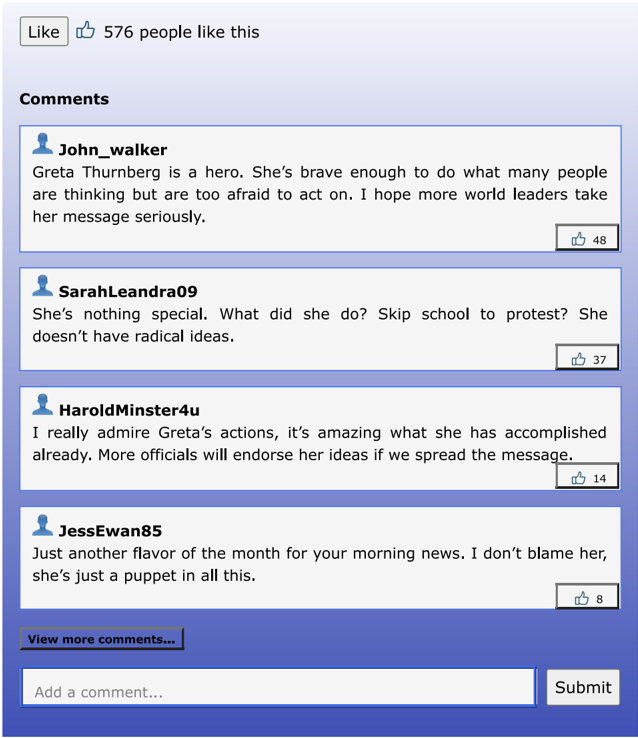
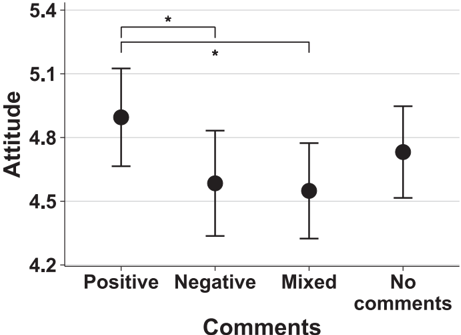
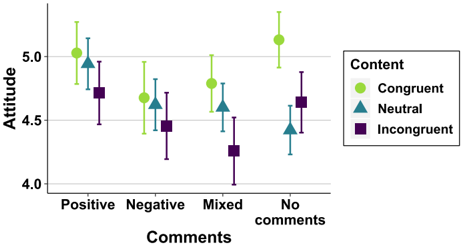
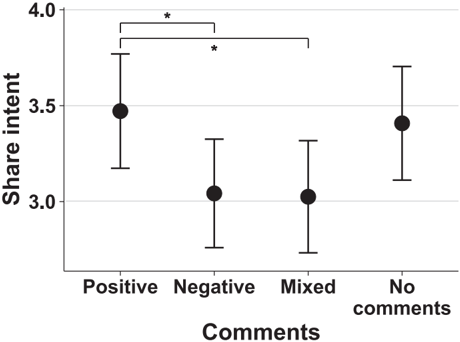
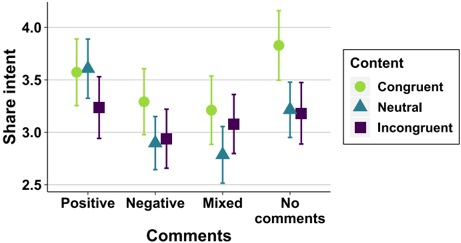
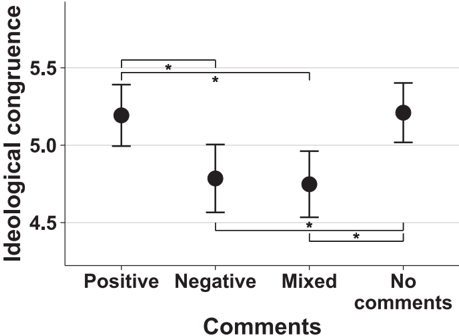
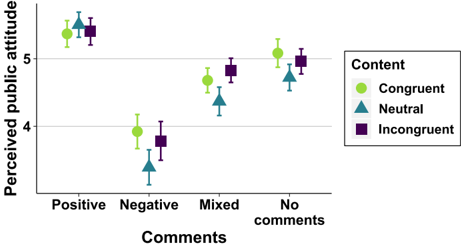
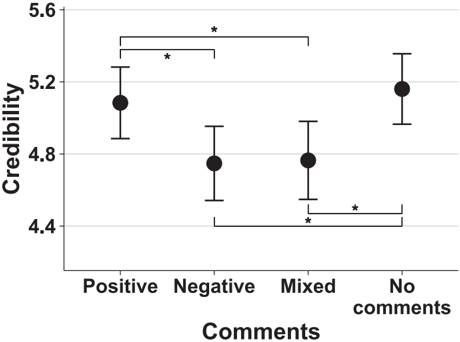
Contemporary news often spreads via social media. This study investigated whether the processing and evaluation of online news content can be influenced by Likes and peer-user comments. An online experiment was designed, using a custom-built website that resembled Facebook, to explore how Likes, positive comments, negative comments, or a combination of positive and negative comments would affect the reader’s processing of news content. The results showed that especially negative comments affected the readers’ personal opinions about the news content, even in combination with other positive comments: They (1) induced more negative attitudes, (2) lowered intent to share it, (3) reduced agreement with conveyed ideas, (4) lowered perceived attitude of the general public, and (5) decreased the credibility of the content. Against expectations, the presence of Likes did not affect the readers, irrespective of the news content. An important consideration is that, while the negative comments were persuasive, they comprised subjective, emotive, and fallacious rhetoric. Finally, negativity bias, the perception of expert authority, and cognitive heuristics are discussed as potential explanations for the persuasive effect of negative comments.
Overview
The claims and statistics of this paper haven’t been checked yet.
Free: it reads the open-access text and checks the first 5 claims that cite a source we can check. Create a free account to check every claim.
Integrity signals
Registry
Cites
Statistics
Figures
Verification
Claims the paper makes
The claims and statistics of this paper haven’t been checked yet.
Free: it reads the open-access text and checks the first 5 claims that cite a source we can check. Create a free account to check every claim.
Claims other papers make about this one
Each is checked against this paper’s own text: does it say what the citing paper says it does?
The source backs part of the claim, not all of it — or backs it for a different population, condition or comparison.
In the citing paper
“At the content level, 141 emotional ties are shaped by the emotional tone or sentiment of the post, with emotionally 142 charged content, particularly negative content, eliciting stronger cognitive and affective 143 reactions (Boot et al., 2021).”
From Drivers of engagement with influencer posts about tourism destinations on Instagram: the role of number of followers, destination connection and content sentiment (2026) · cites this paper as Boot et al., 2021
Experimental — accuracy not yet measuredThe cited source says what the claim attributes to it.
In the citing paper
“Negative content generally results in 468 higher engagement across influencer types, which is consistent with research indicating 469 that there are stronger reactions to negative stimuli on social media (Boot et al., 2021).”
From Drivers of engagement with influencer posts about tourism destinations on Instagram: the role of number of followers, destination connection and content sentiment (2026) · cites this paper as Boot et al., 2021
Self-check
Percentages, sums and reported differences re-computed from the paper’s own numbers.
The self-check needs the paper’s full text.
Citations
Cites
Baumeister, R. F., Bratslavsky, E., Finkenauer, C., & Vohs, K. D. (2001) · Review of General Psychology · doi:10.1037/1089-2680.5.4.323 · Cited by 7,678
Cacioppo, J. T., & Petty, R. E. (1982) · Journal of Personality and Social Psychology · doi:10.1037/0022-3514.42.1.116 · Cited by 5,359 · cited 2×
“However, for conservative readers with low need for cognition (a construct that represents the joy of engaging in one ’ s own thought processes), even anecdotal rhetoric was found to in fl uence the perceived credibility and disrupt the intended message of the story (Cacioppo and Petty, 1982).”
BackgroundBehavioral Study of obedience.
Milgram, S. (1963) · The Journal of Abnormal and Social Psychology · doi:10.1037/h0040525 · Cited by 4,918 · cited 1×
“In turn, the reader might engage in the heuristic cognition known as authority bias (Milgram, 1963), attributing greater accuracy or value to this comment than more positive comments.”
BackgroundNegativity Bias, Negativity Dominance, and Contagion
Rozin, P., & Royzman, E. B. (2001) · Personality and Social Psychology Review · doi:10.1207/s15327957pspr0504_2 · Cited by 4,342 · cited 3×
“The results show a pattern of negativity bias (Baumeister et al., 2001; Ito et al., 1998; Norris, 2021; Rozin and Royzman, 2001); even when readers were exposed to both positive and negative comments, they were more influenced by the negative comments, showing similar results as readers who were only exposed to negati…”
BackgroundResultStudies of independence and conformity: I. A minority of one against a unanimous majority
Asch, S. E. (1956) · Psychological Monographs: General and Applied · doi:10.1037/h0093718 · Cited by 4,267
Lazer, D. M. J., Baum, M. A., Benkler, Y., Berinsky, A. J., Greenhill, K. M., Menczer, F., Metzger, M. J., Nyhan, B., Pennycook, G., Rothschild, D., et al. (2018) · Science · doi:10.1126/science.aao2998 · Cited by 4,160 · cited 1×
“The bandwagon effect predicts that social media users adapt their own beliefs, attitudes, and opinions to match that of their peers (Lowe-Calverley and Grieve, 2018; Kim, 2018; Sundar, 2008; Waddell, 2018a, 2018b).”
BackgroundIntegration of the cognitive and the psychodynamic unconscious
Epstein, S. (1994) · American Psychologist · doi:10.1037/0003-066x.49.8.709 · Cited by 2,883 · cited 2×
“In addition to exempli fi cation theory, dual processing system theories may provide a useful framework for the processing of Likes and comments (Barrett et al., 2004; Epstein, 1994).”
MethodEffects of Group Pressure Upon the Modification and Distortion of Judgments
Asch, S. E. (1961) · Documents of Gestalt Psychology · doi:10.1525/9780520313514-017 · Cited by 2,644
Asch, S. E. (1955) · Scientific American · doi:10.1038/scientificamerican1155-31 · Cited by 2,281 · cited 1×
“The early Asch paradigm studies have shown that individuals tend to change their judgements to conform to the majority group (Asch, 1951, 1955, 1956).”
BackgroundIto, T. A., Larsen, J. T., Smith, N. K., & Cacioppo, J. T. (1998) · Journal of Personality and Social Psychology · doi:10.1037/0022-3514.75.4.887 · Cited by 1,340 · cited 3×
“The results show a pattern of negativity bias (Baumeister et al., 2001; Ito et al., 1998; Norris, 2021; Rozin and Royzman, 2001); even when readers were exposed to both positive and negative comments, they were more influenced by the negative comments, showing similar results as readers who were only exposed to negati…”
BackgroundResult
Research works printed but not linked: 1
- 5. Bak MP, Keßler T (2012) I like it if you like it! Conformity effects on Facebook J Bus Media Psychol 3(2):23-30
Cited by
The link between changing news use and trust: longitudinal analysis of 46 countries
Fletcher, R., Andı, S., Badrinathan, S., Eddy, K. A., Kalogeropoulos, A., Mont’Alverne, C., Robertson, C., Arguedas, A. R., Schulz, A. M., Toff, B., et al. (2024) · Journal of Communication · doi:10.1093/joc/jqae044 · Cited by 87
Ross, A. A., Badrinathan, S., Mont’Alverne, C., Toff, B., Fletcher, R., & Nielsen, R. K. (2023) · Journalism · doi:10.1177/14648849231194485 · Cited by 62
“This is consistent with previous work fi nding negative comments decrease message credibility (Boot et al., 2021; Waddell, 2017).”
ResultWang, G., Wang, Y., Liu, K., & Sun, S. (2024) · Humanities and Social Sciences Communications · doi:10.1057/s41599-024-02711-4 · Cited by 15
The influence mechanism of emotion on intuitive and analytical processing
Shuqi, Y., Junting, Y., Li, Z., & Junlong, L. (2023) · Advances in Psychological Science · doi:10.3724/sp.j.1042.2023.00736 · Cited by 16
Butler, L. H., Fay, N., & Ecker, U. K. H. (2023) · Applied Cognitive Psychology · doi:10.1002/acp.4146 · Cited by 11
Wang, C., Wang, H., Yang, Z., & Ding, S. (2025) · Journal of Health Communication · doi:10.1080/10810730.2024.2448492 · Cited by 9
“Comments serve as digital footprints that reflect the genuine sentiments of a subset of viewers and possess the potential to influence other audience members who read them (Anderson et al., 2014; Boot et al., 2021; Winter et al., 2015).”
Lu, Z., Li, P., Wang, W., & Yin, M. (2025) · CHI Conference on Human Factors in Computing Systems · doi:10.1145/3706598.3713871 · Cited by 7
Salah, I., Jouini, K., Pachon, C., & Korbaa, O. (2024) · Cluster Computing · doi:10.1007/s10586-024-04637-7 · Cited by 4
“As highlighted by various studies, including [19], sharing and commenting news are the prevalent forms of news engagement among social media users and are more participatory and intuitive than voting and other paralinguistic digital affordances, which are more passive and impersonal actions.”
Public Health Messaging to Address Indoor Tanning: A Scoping Review
Gosselin, S., Thaivalappil, A., Papadopoulos, A., & McWhirter, J. E. (2023) · Journal of Health Communication · doi:10.1080/10810730.2023.2196519 · Cited by 4
“The skin cancer prevention literature has explored several interventions, including facial morphing software (Blashill, Rooney, Luberto, Gonzales, & Grogan, 2018; Brinker et al., 2018; Persson, Grogan, Dhingra, & Benn, 2018; Williams, Grogan, Clark-Carter, & Buckley, 2013b); media literacy interventions (Cho, Yu, Cann…”
BackgroundQinyu, E., Wei, X., & Zhang, X. (2025) · Health Communication · doi:10.1080/10410236.2025.2574500 · Cited by 3
“Recent research increasingly documents that negative comments can undermine perceived consensus around a message, leading to lower evaluations of its credibility and quality (e.g., Boot et al., 2021; Waddell, 2018; Waddell & Bailey, 2019).”
Lu, X., Zhao, W., van der Meer, T. G. L. A., & Jin, Y. (2025) · Journal of Communication Management · doi:10.1108/jcom-09-2024-0160 · Cited by 3
The national rugby league and the Bundesliga: a study of brand hate
Beermann, S., Hallmann, K., Dickson, G., & Naylor, M. E. (2024) · International Journal of Sports Marketing and Sponsorship · doi:10.1108/ijsms-07-2023-0145 · Cited by 3
Opening the Pandora box: Neural processing of self-relevant negative social information
Nicolaou, S., Vega, D., & Marco‐Pallarés, J. (2024) · Biological Psychology · doi:10.1016/j.biopsycho.2024.108982 · Cited by 3
van Dalen, A. (2023) · International journal of communication · Cited by 7
Duong, H. T., Nguyen, T. T., & Triệu, L. T. (2022) · International journal of communication · Cited by 7
Harding, N., Fitzpatrick, S., & McCormack, L. (2024) · Culture & Psychology · doi:10.1177/1354067x241300984 · Cited by 2
“Given that media is so readily available and consumed (Boot et al., 2021), and refugee-related government policy is so important for those who have been forcibly displaced, the main objective of the current research aims to highlight how societal attitudes expressed through media and politics in a…”
Ma, Y., Lu, X., & Zhao, R. (2026) · Mass Communication & Society · doi:10.1080/15205436.2025.2596081 · Cited by 3
“Empirical studies have confirmed that online comments with content, like disagreement or negative evaluations of post content and uncivil language, could increase people’s negative judgment about post content and source (e.g., Boot et al., 2021; Petit et al., 2021; Thorson et al., 2010).”
Duffy, F. F., McDonnell, G. P., Auslander, M. V., Bricault, S. A., Kim, P. Y., Rachlin, N. W., & Quartana, P. J. (2023) · Military Medicine · doi:10.1093/milmed/usad322 · Cited by 1
Boiko, N. (2025) · Sociology Theory Methods Marketing · doi:10.15407/sociology2025.02.059 · Cited by 1
Commenters and lurkers: Navigating the two-step flow of communication in online news discourse
Han, J. (2025) · New Media & Society · doi:10.1177/14614448251363954 · Cited by 3
“Comment readers consider user comments as reliable indicators of public opinion (Barnes, 2015; Diakopoulos and Naaman, 2011) and are inclined to adjust their views accordingly (Boot et al., 2021; Lee et al., 2021; Lee and Jang, 2010; Winter et al., 2015).”
InfluentialStoeckel, F., Stöckli, S., Lyons, B. A., Kroker, H., & Reifler, J. (2025) · Cambridge University Press eBooks · doi:10.1017/9781009677165 · Cited by 1
U.S. Partisan Media Criticize the Out-Party More than They Praise the In-Party
Yu, X., & Wojcieszak, M. (2026) · Political Behavior · doi:10.1007/s11109-025-10115-6 · Cited by 2
Are influencers more influential? Social endorsement and memory on social media
Bilgin, E., & Wang, Q. (2025) · Memory · doi:10.1080/09658211.2025.2513604 · Cited by 1
“These cues, which include dislikes, negative comments, or other forms of negative feedback, have been found to influence users’ evaluations to a greater extent than endorsement cues (Boot et al., 2021).”
Blanco-Moreno, S., González-Fernández, A. M., & Casaló, L. V. (2026) · Journal of Hospitality and Tourism Technology · doi:10.1108/jhtt-02-2025-0168
ضغط الأقران بين المراهقين على وسائل التواصل الاجتماعي وعلاقته بتقدير الذات
سلامة, ح. ع. (2024) · المجلة العربية لبحوث الاعلام والاتصال · doi:10.21608/jkom.2024.360793
Lu, F. (2025) · Health Communication · doi:10.1080/10410236.2025.2549082 · Cited by 1
“This perceived majority’s voices in society suggest the perceived injunctive norms (Boot et al., 2021; S. Lee et al., 2022; Winter et al., 2015).”
Influence of social media comments on opinions about newsPreprint
Nisini, F., Weis, J. F., Lux, S., Sensen, D., van den Bos, W., & Schultz, J. (2025) · Research Square · doi:10.21203/rs.3.rs-7876614/v1
Joyner, L. C. (2023) · WestminsterResearch (University of Westminster) · doi:10.34737/w702w
The Effects of Intellectually Humble Communication in Online Political Discussions
Montez, D., & Montez, D. (2024) · UA Campus Repository (The University of Arizona) · Cited by 1
Digital (dis-)engagement and individual autonomy on Chinese social media: The case of Xiaohongshu
Huang, C., Liu, Z., & Wang, H. (2026) · China Information · doi:10.1177/0920203x261450482
Directing Audience Responses: How Nonprofit Donation Appeals Shape User Comments on Social Media
Chen, T. (2026) · Nonprofit and Voluntary Sector Quarterly · doi:10.1177/08997640261455421
Social Expectations of Ukrainian War Migrants (The Case of Poland)
Shevchenko, S. V. (2025) · doi:10.15407/book8.978-617-14-0292-8.07
Shulga, M. (2025) · doi:10.15407/book8.978-617-14-0292-8.03
Boiko, N., & Злобіна, О. Г. (2025) · doi:10.15407/book8.978-617-14-0292-8.08
Kanerva, N. (2026) · Osuva (University of Vaasa)
DeBlaere, A., Shoemaker, L., & Muise, A. (2026) · Sex Roles · doi:10.1007/s11199-026-01688-5
“These metrics may function as social signals that indicate which messages are supported, contested or popular with an audience (Boot et al., 2021 ; Seo et al., 2019 ; Waddell, 2017 ).”
Metadata
- Authors
- Boot, A. B., Dijkstra, K., & Zwaan, R. A.
- Affiliations
- Erasmus University Rotterdam (NL)
- Corresponding author
- Boot, Arnout B.
- Venue
- Humanities and Social Sciences Communications
- Published
- 2021-09-10
- Volume
- 8
- Issue
- 1
- ISSN
- 2055-1045 (ISSN-L)
- 2662-9992
- OpenAlex
- W3199628591
- Cited by
- 38
- References
- 46
- Citations by year
- 2026: 5 · 2025: 21 · 2024: 7 · 2023: 5
- FWCI
- 4.16
- Type
- journal article
- Language
- en
- Update notices
- correction (2021-09-28)
- Open access
- gold
- doi.org
- Licence
- cc-by
- creativecommons.org/licenses/by/4.0 (tdm)
- creativecommons.org/licenses/by/4.0 (vor)
- Locations
- Humanities and Social Sciences Communications (publishedVersion, cc-by)
- EUR Research Repository (Erasmus University Rotterdam) (publishedVersion, cc-by)
- EUR Research Repository (Erasmus University Rotterdam) (submittedVersion)
- EUR Research Repository (Erasmus University Rotterdam) (submittedVersion, cc-by)
- RePEc: Research Papers in Economics (submittedVersion)
- DOAJ (DOAJ: Directory of Open Access Journals) (submittedVersion, cc-by-sa)
- Topics
- Social Sciences › Sociology and Political Science › Misinformation and Its Impacts
- Social Sciences › Communication › News Media Framing and Political Communication
- Social Sciences › Communication › Journalism and Media Studies
- Keywords
- online news, social media, peer comments, likes, negative comments, persuasion, news credibility, attitude change, sharing intention, negativity bias, cognitive heuristics, expert authority, news processing
About these checks
Registry, retraction, Cites and statistics results are computed, not judged, with one exception: a printed reference that no index lists is read once by a model before it counts as a citation error. Claims are extracted by a model and kept only when their quote appears verbatim in the text; each cited source is then checked, with a model’s help, for whether it says what the claim relies on. Those verdicts can be wrong — read the claim’s quote and the cited source before relying on one.
Statistics and arithmetic are recomputed, not judged.
Confidence bands are shown only for fields calibrated on our annotated test set. None is calibrated yet, so no band is shown.
What counts as a claim ›How we measure confidence ›How we check this ›
Are you an author, or do you see a problem with this page? Request a review
Data sources
Bibliographic data: Semantic Scholar, OpenAlex, Crossref.
Contains information from the Semantic Scholar Academic Graph Datasets, made available under the ODC Attribution License (ODC-BY 1.0).
Semantic Scholar’s data is described in: Kinney, R., et al. (2023). The Semantic Scholar Open Data Platform. arXiv:2301.10140.
