

The processing and evaluation of news content on social media is influenced by peer-user commentary
Open accessThe DOI matches its Crossref record; 45 of the 46 references it cites were found in a registry or an index.
Abstract
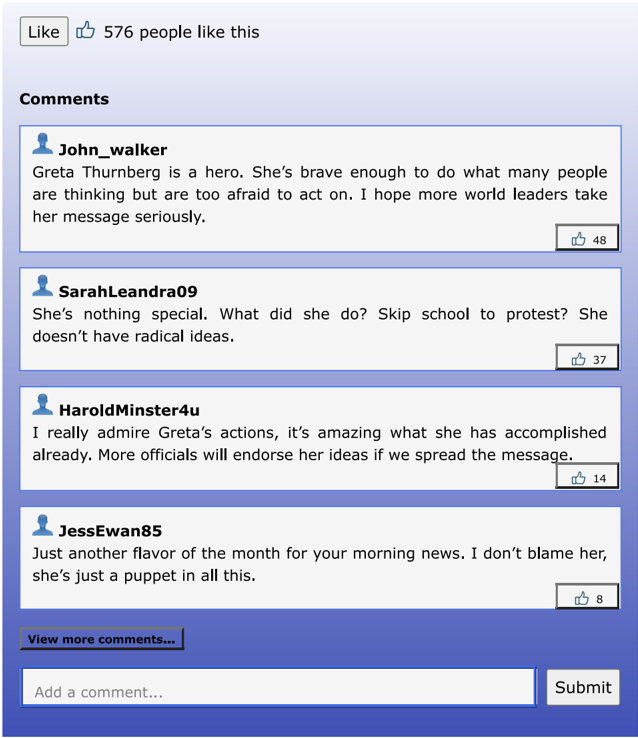
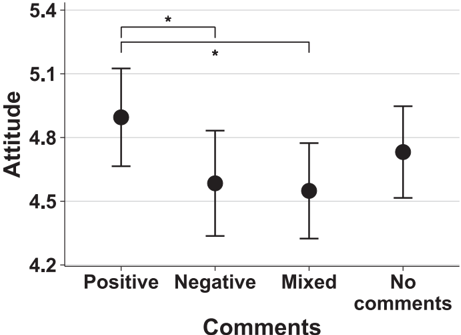
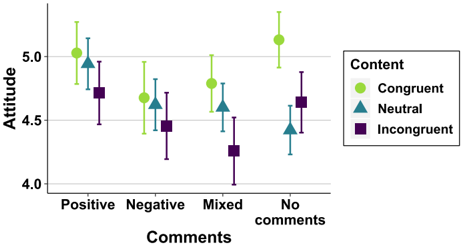
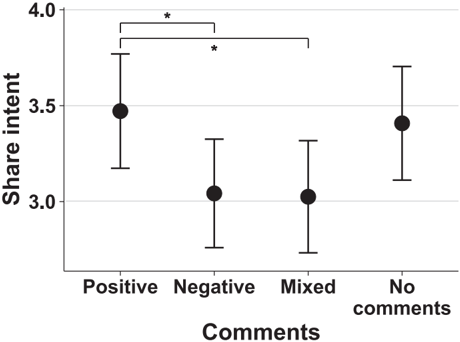
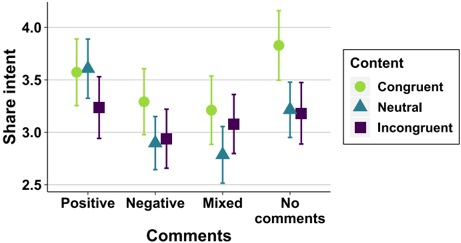
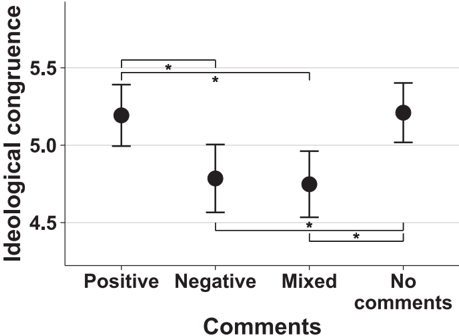
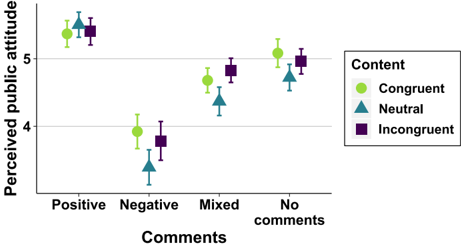
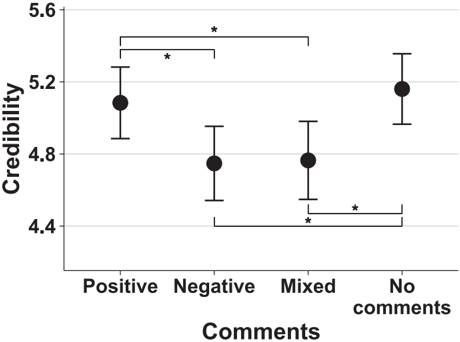
Contemporary news often spreads via social media. This study investigated whether the processing and evaluation of online news content can be influenced by Likes and peer-user comments. An online experiment was designed, using a custom-built website that resembled Facebook, to explore how Likes, positive comments, negative comments, or a combination of positive and negative comments would affect the reader’s processing of news content. The results showed that especially negative comments affected the readers’ personal opinions about the news content, even in combination with other positive comments: They (1) induced more negative attitudes, (2) lowered intent to share it, (3) reduced agreement with conveyed ideas, (4) lowered perceived attitude of the general public, and (5) decreased the credibility of the content. Against expectations, the presence of Likes did not affect the readers, irrespective of the news content. An important consideration is that, while the negative comments were persuasive, they comprised subjective, emotive, and fallacious rhetoric. Finally, negativity bias, the perception of expert authority, and cognitive heuristics are discussed as potential explanations for the persuasive effect of negative comments.
Overview
The claims and statistics of this paper haven’t been checked yet.
Free: it reads the open-access text and checks the first 5 claims that cite a source we can check. Create a free account to check every claim.
Integrity signals
Registry
Cites
Statistics
Figures
Verification
Claims the paper makes
The claims and statistics of this paper haven’t been checked yet.
Free: it reads the open-access text and checks the first 5 claims that cite a source we can check. Create a free account to check every claim.
Claims other papers make about this one
Each is checked against this paper’s own text: does it say what the citing paper says it does?
The source backs part of the claim, not all of it — or backs it for a different population, condition or comparison.
In the citing paper
“At the content level, 141 emotional ties are shaped by the emotional tone or sentiment of the post, with emotionally 142 charged content, particularly negative content, eliciting stronger cognitive and affective 143 reactions (Boot et al., 2021).”
From Drivers of engagement with influencer posts about tourism destinations on Instagram: the role of number of followers, destination connection and content sentiment (2026) · cites this paper as Boot et al., 2021
Experimental — accuracy not yet measuredThe cited source says what the claim attributes to it.
In the citing paper
“Negative content generally results in 468 higher engagement across influencer types, which is consistent with research indicating 469 that there are stronger reactions to negative stimuli on social media (Boot et al., 2021).”
From Drivers of engagement with influencer posts about tourism destinations on Instagram: the role of number of followers, destination connection and content sentiment (2026) · cites this paper as Boot et al., 2021
Self-check
Percentages, sums and reported differences re-computed from the paper’s own numbers.
The self-check needs the paper’s full text.
Citations
Cites
Baumeister, R. F., Bratslavsky, E., Finkenauer, C., & Vohs, K. D. (2001) · Review of General Psychology · doi:10.1037/1089-2680.5.4.323 · Cited by 7,678
Cacioppo, J. T., & Petty, R. E. (1982) · Journal of Personality and Social Psychology · doi:10.1037/0022-3514.42.1.116 · Cited by 5,359 · cited 2×
“However, for conservative readers with low need for cognition (a construct that represents the joy of engaging in one ’ s own thought processes), even anecdotal rhetoric was found to in fl uence the perceived credibility and disrupt the intended message of the story (Cacioppo and Petty, 1982).”
BackgroundBehavioral Study of obedience.
Milgram, S. (1963) · The Journal of Abnormal and Social Psychology · doi:10.1037/h0040525 · Cited by 4,918 · cited 1×
“In turn, the reader might engage in the heuristic cognition known as authority bias (Milgram, 1963), attributing greater accuracy or value to this comment than more positive comments.”
BackgroundNegativity Bias, Negativity Dominance, and Contagion
Rozin, P., & Royzman, E. B. (2001) · Personality and Social Psychology Review · doi:10.1207/s15327957pspr0504_2 · Cited by 4,342 · cited 3×
“The results show a pattern of negativity bias (Baumeister et al., 2001; Ito et al., 1998; Norris, 2021; Rozin and Royzman, 2001); even when readers were exposed to both positive and negative comments, they were more influenced by the negative comments, showing similar results as readers who were only exposed to negati…”
BackgroundResultStudies of independence and conformity: I. A minority of one against a unanimous majority
Asch, S. E. (1956) · Psychological Monographs: General and Applied · doi:10.1037/h0093718 · Cited by 4,267
Lazer, D. M. J., Baum, M. A., Benkler, Y., Berinsky, A. J., Greenhill, K. M., Menczer, F., Metzger, M. J., Nyhan, B., Pennycook, G., Rothschild, D., et al. (2018) · Science · doi:10.1126/science.aao2998 · Cited by 4,160 · cited 1×
“The bandwagon effect predicts that social media users adapt their own beliefs, attitudes, and opinions to match that of their peers (Lowe-Calverley and Grieve, 2018; Kim, 2018; Sundar, 2008; Waddell, 2018a, 2018b).”
BackgroundIntegration of the cognitive and the psychodynamic unconscious
Epstein, S. (1994) · American Psychologist · doi:10.1037/0003-066x.49.8.709 · Cited by 2,883 · cited 2×
“In addition to exempli fi cation theory, dual processing system theories may provide a useful framework for the processing of Likes and comments (Barrett et al., 2004; Epstein, 1994).”
MethodEffects of Group Pressure Upon the Modification and Distortion of Judgments
Asch, S. E. (1961) · Documents of Gestalt Psychology · doi:10.1525/9780520313514-017 · Cited by 2,644
Asch, S. E. (1955) · Scientific American · doi:10.1038/scientificamerican1155-31 · Cited by 2,281 · cited 1×
“The early Asch paradigm studies have shown that individuals tend to change their judgements to conform to the majority group (Asch, 1951, 1955, 1956).”
BackgroundIto, T. A., Larsen, J. T., Smith, N. K., & Cacioppo, J. T. (1998) · Journal of Personality and Social Psychology · doi:10.1037/0022-3514.75.4.887 · Cited by 1,340 · cited 3×
“The results show a pattern of negativity bias (Baumeister et al., 2001; Ito et al., 1998; Norris, 2021; Rozin and Royzman, 2001); even when readers were exposed to both positive and negative comments, they were more influenced by the negative comments, showing similar results as readers who were only exposed to negati…”
BackgroundResultDigital Media, Youth, and Credibility
Metzger, M. J., & Flanagin, A. J. (2007) · Cited by 1,065
Individual Differences in Working Memory Capacity and Dual-Process Theories of the Mind.
Barrett, L. F., Tugade, M. M., & Engle, R. W. (2004) · Psychological Bulletin · doi:10.1037/0033-2909.130.4.553 · Cited by 913
Sherman, L. E., Payton, A. A., Hernandez, L. M., Greenfield, P. M., & Dapretto, M. (2016) · Psychological Science · doi:10.1177/0956797616645673 · Cited by 627
Measuring Message Credibility: Construction and Validation of an Exclusive Scale
Appelman, A., & Sundar, S. S. (2016) · Journalism & Mass Communication Quarterly · doi:10.1177/1077699015606057 · Cited by 625 · cited 3×
“These variables were partially adapted from previous studies (Appelman and Sundar, 2016; Winter et al., 2015; Xu, 2013): (a) attitude—the reader’s personal disposition towards the content, (b) share intent —the reader’s intension to share or recommend the content, (c) ideological congruence—the extent to which the rea…”
MethodImpersonal Influence: How Perceptions of Mass Collectives Affect Political Attitudes
Mutz, D. C. (1998) · Cambridge University Press eBooks · doi:10.1017/cbo9781139175074 · Cited by 529
The Behavioral Foundations of Public Policy
(2013) · Princeton University Press eBooks · doi:10.2307/j.ctv550cbm · Cited by 502 · cited 1×
“For example, when a data display presents a large number of human casualties to an audience, this number does not engender equally representative feelings of empathy in this audience (Slovic et al., 2011).”
BackgroundImpersonal Influence: How Perceptions of Mass Collectives Affect Political Attitudes
Mutz, D. C. (1998) · Cited by 501
Performing high‐powered studies efficiently with sequential analyses
Lakens, D. (2014) · European Journal of Social Psychology · doi:10.1002/ejsp.2023 · Cited by 414 · cited 1×
“We used a sequential-analyses design (Lakens, 2014).”
The positivity effect: a negativity bias in youth fades with age
Carstensen, L. L., & DeLiema, M. (2018) · Current Opinion in Behavioral Sciences · doi:10.1016/j.cobeha.2017.07.009 · Cited by 359 · cited 1×
“In addition to exempli fi cation theory, dual processing system theories may provide a useful framework for the processing of Likes and comments (Barrett et al., 2004; Epstein, 1994).”
MethodPolitical Diversity in Social and Personality Psychology
Inbar, Y., & Lammers, J. (2012) · Perspectives on Psychological Science · doi:10.1177/1745691612448792 · Cited by 359 · cited 1×
“Considering the cohort and background of the subject pool for the current study (psychology students at Erasmus University Rotterdam) it was assumed that they tend to have more liberal than conservative ideologies (Inbar and Lammers, 2012; Pohl et al., 2021).”
BackgroundOne click, many meanings: interpreting paralinguistic digital affordances in social media
Hayes, R. A., Carr, C. T., & Wohn, D. Y. (2016) · Journal of Broadcasting & Electronic Media · doi:10.1080/08838151.2015.1127248 · Cited by 346 · cited 5×
“In line with this notion, Likes have been conceptualized as paralinguistic digital affordances, which allegedly do not convey a specific predefined meaning (Hayes et al., 2016).”
BackgroundInfluentialExemplification Theory: Judging the Whole by Some of Its Parts
Zillmann, D. (1999) · Media Psychology · doi:10.1207/s1532785xmep0101_5 · Cited by 292 · cited 1×
“Both studies refer to the exempli fi - cation theory by Zillmann (1999) and stipulate that comments, which are more concrete, are better exemplars of peer-user attitudes than the aggregated user feedback.”
BackgroundAttention capture by novel stimuli.
Johnston, W. A., Hawley, K. J., Plewe, S. H., Elliott, J. M. G., & DeWitt, M. J. (1990) · Journal of Experimental Psychology: General · doi:10.1037/0096-3445.119.4.397 · Cited by 282
Credibility in Context: How Uncivil Online Commentary Affects News Credibility
Thorson, K., Vraga, E., & Ekdale, B. (2010) · Mass Communication and Society · doi:10.1080/15205430903225571 · Cited by 199
New Evidence About the Existence of a Bandwagon Effect in the Opinion Formation Process
Nadeau, R., Cloutier, E., & Guay, J.-H. (1993) · International Political Science Review · doi:10.1177/019251219301400204 · Cited by 199 · cited 1×
“In literature about opinion formation processes, conformity to public opinions has been referred to as the bandwagon effect (Nadeau et al., 1993).”
BackgroundThe International Encyclopedia of Political Communication
(2015) · Wiley eBooks · doi:10.1002/9781118541555 · Cited by 199
Carr, C. T., Wohn, D. Y., & Hayes, R. A. (2016) · Computers in Human Behavior · doi:10.1016/j.chb.2016.03.087 · Cited by 196
Habernal, I., & Gurevych, I. (2016) · Proceedings of the 54th Annual Meeting of the Association for Computational Linguistics (Volume 1: Long Papers) · doi:10.18653/v1/p16-1150 · Cited by 190
They Came, They Liked, They Commented: Social Influence on Facebook News Channels
Winter, S., Brückner, C., & Krämer, N. C. (2015) · Cyberpsychology, Behavior, and Social Networking · doi:10.1089/cyber.2015.0005 · Cited by 172 · cited 9×
“Comments, on the other hand, are more concrete exemplars of peer-user attitudes and therefore are more influential (Kluck et al., 2019; Winter et al., 2015).”
BackgroundMethodResultInfluentialNorris, C. J. (2021) · Social Neuroscience · doi:10.1080/17470919.2019.1696225 · Cited by 172 · cited 4×
“…they were assumed to have more progressive ideas and to be likely to have a personal af fi nity for video games (e.g., 92% of people between the ages 16 and 24 years play video games in the UK; see "Gaming penetration in the United Kingdom (UK) from 2013 to 2021, by age group and gender", 2021).”
BackgroundResultInfluentialWaddell, T. F. (2017) · New Media & Society · doi:10.1177/1461444817742905 · Cited by 154 · cited 4×
“They can increase or decrease the acceptance and attitudes of the reader (Kim, 2018; Waddell, 2018a, 2018b; Winter et al., 2015).”
BackgroundInfluentialSmirnov, O., Zhang, M., Xiao, T., Orbell, J., Lobben, A., & Gordon, J. (2016) · Climatic Change · doi:10.1007/s10584-016-1716-z · Cited by 133
Xu, Q. (2013) · Journalism & Mass Communication Quarterly · doi:10.1177/1077699013503158 · Cited by 129 · cited 3×
“These variables were partially adapted from previous studies (Appelman and Sundar, 2016; Winter et al., 2015; Xu, 2013): (a) attitude—the reader’s personal disposition towards the content, (b) share intent —the reader’s intension to share or recommend the content, (c) ideological congruence—the extent to which the rea…”
MethodKim, J. W. (2018) · Computers in Human Behavior · doi:10.1016/j.chb.2018.01.030 · Cited by 126 · cited 4×
“Online news readers use peer comments as cues that are representative of the general public ’ s opinion, which in fl uences their own attitude towards the content (Kim, 2018).”
BackgroundInfluentialThumbs up: A thematic analysis of image-based posting and liking behaviour on social media
Lowe-Calverley, E., & Grieve, R. (2018) · Telematics and Informatics · doi:10.1016/j.tele.2018.06.003 · Cited by 97 · cited 1×
“The bandwagon effect predicts that social media users adapt their own beliefs, attitudes, and opinions to match that of their peers (Lowe-Calverley and Grieve, 2018; Kim, 2018; Sundar, 2008; Waddell, 2018a, 2018b).”
BackgroundSchmitt‐Beck, R. (2015) · Wiley eBooks · doi:10.1002/9781118541555.wbiepc015 · Cited by 94
An Investigation Into Facebook “Liking” Behavior An Exploratory Study
Ozanne, M., Navas, A. M. C., Mattila, A. S., & Hoof, H. B. V. (2017) · Social Media + Society · doi:10.1177/2056305117706785 · Cited by 66 · cited 1×
“For example, the Like button is also used for social support, to maintain social ties, and as a tool for impression management (Carr et al., 2016; Eranti and Lonkila, 2015; Hayes et al., 2016; Ozanne et al., 2017).”
BackgroundThe social significance of the Facebook Like button
Eranti, V., & Lonkila, M. (2015) · First Monday · doi:10.5210/fm.v20i6.5505 · Cited by 66 · cited 1×
“For example, the Like button is also used for social support, to maintain social ties, and as a tool for impression management (Carr et al., 2016; Eranti and Lonkila, 2015; Hayes et al., 2016; Ozanne et al., 2017).”
BackgroundPsychic Numbing and Mass Atrocity
Slovic, P., Zionts, D., Woods, A. K., Goodman, R., & Jinks, D. P. (2018) · Princeton University Press eBooks · doi:10.2307/j.ctv550cbm.13 · Cited by 65 · cited 1×
“For example, when a data display presents a large number of human casualties to an audience, this number does not engender equally representative feelings of empathy in this audience (Slovic et al., 2011).”
BackgroundFeeling numbers: The emotional impact of proximity techniques in visualization
Campbell, S., & Offenhuber, D. (2022) · Information Design Journal · doi:10.1075/idj.25.1.06cam · Cited by 32
User comments on climate stories: impacts of anecdotal vs. scientific evidence
Hinnant, A., Subramanian, R., & Young, R. (2016) · Climatic Change · doi:10.1007/s10584-016-1759-1 · Cited by 30 · cited 1×
“” (Example 2) Hinnant et al. (2016) investigated the effects of anecdotal versus scienti fi c evidence in comments on an article about climate change.”
BackgroundKluck, J. P., Schaewitz, L., & Krämer, N. C. (2019) · Studies in Communication and Media · doi:10.5771/2192-4007-2019-4-446 · Cited by 24
Waddell, T. F. (2017) · Electronic News · doi:10.1177/1931243117739946 · Cited by 17
Kümpel, A. S., & Unkel, J. (2021) · Communication Research Reports · doi:10.1080/08824096.2021.1915269 · Cited by 3 · cited 3×
“Previous studies have shown the prevalence of negativity bias; generally, negative information induces stronger psychological effects than neutral and positive information (Baumeister et al., 2001; Ito et al., 1998; Norris, 2021; Rozin and Royzman, 2001).”
BackgroundResult
Research works printed but not linked: 1
- 5. Bak MP, Keßler T (2012) I like it if you like it! Conformity effects on Facebook J Bus Media Psychol 3(2):23-30
Cited by
The link between changing news use and trust: longitudinal analysis of 46 countries
Fletcher, R., Andı, S., Badrinathan, S., Eddy, K. A., Kalogeropoulos, A., Mont’Alverne, C., Robertson, C., Arguedas, A. R., Schulz, A. M., Toff, B., et al. (2024) · Journal of Communication · doi:10.1093/joc/jqae044 · Cited by 87
Ross, A. A., Badrinathan, S., Mont’Alverne, C., Toff, B., Fletcher, R., & Nielsen, R. K. (2023) · Journalism · doi:10.1177/14648849231194485 · Cited by 62
“This is consistent with previous work fi nding negative comments decrease message credibility (Boot et al., 2021; Waddell, 2017).”
ResultWang, G., Wang, Y., Liu, K., & Sun, S. (2024) · Humanities and Social Sciences Communications · doi:10.1057/s41599-024-02711-4 · Cited by 15
The influence mechanism of emotion on intuitive and analytical processing
Shuqi, Y., Junting, Y., Li, Z., & Junlong, L. (2023) · Advances in Psychological Science · doi:10.3724/sp.j.1042.2023.00736 · Cited by 16
Butler, L. H., Fay, N., & Ecker, U. K. H. (2023) · Applied Cognitive Psychology · doi:10.1002/acp.4146 · Cited by 11
Metadata
- Authors
- Boot, A. B., Dijkstra, K., & Zwaan, R. A.
- Affiliations
- Erasmus University Rotterdam (NL)
- Corresponding author
- Boot, Arnout B.
- Venue
- Humanities and Social Sciences Communications
- Published
- 2021-09-10
- Volume
- 8
- Issue
- 1
- ISSN
- 2055-1045 (ISSN-L)
- 2662-9992
- OpenAlex
- W3199628591
- Cited by
- 38
- References
- 46
- Citations by year
- 2026: 5 · 2025: 21 · 2024: 7 · 2023: 5
- FWCI
- 4.16
- Type
- journal article
- Language
- en
- Update notices
- correction (2021-09-28)
- Open access
- gold
- doi.org
- Licence
- cc-by
- creativecommons.org/licenses/by/4.0 (tdm)
- creativecommons.org/licenses/by/4.0 (vor)
- Locations
- Humanities and Social Sciences Communications (publishedVersion, cc-by)
- EUR Research Repository (Erasmus University Rotterdam) (publishedVersion, cc-by)
- EUR Research Repository (Erasmus University Rotterdam) (submittedVersion)
- EUR Research Repository (Erasmus University Rotterdam) (submittedVersion, cc-by)
- RePEc: Research Papers in Economics (submittedVersion)
- DOAJ (DOAJ: Directory of Open Access Journals) (submittedVersion, cc-by-sa)
- Topics
- Social Sciences › Sociology and Political Science › Misinformation and Its Impacts
- Social Sciences › Communication › News Media Framing and Political Communication
- Social Sciences › Communication › Journalism and Media Studies
- Keywords
- online news, social media, peer comments, likes, negative comments, persuasion, news credibility, attitude change, sharing intention, negativity bias, cognitive heuristics, expert authority, news processing
About these checks
Registry, retraction, Cites and statistics results are computed, not judged, with one exception: a printed reference that no index lists is read once by a model before it counts as a citation error. Claims are extracted by a model and kept only when their quote appears verbatim in the text; each cited source is then checked, with a model’s help, for whether it says what the claim relies on. Those verdicts can be wrong — read the claim’s quote and the cited source before relying on one.
Statistics and arithmetic are recomputed, not judged.
Confidence bands are shown only for fields calibrated on our annotated test set. None is calibrated yet, so no band is shown.
What counts as a claim ›How we measure confidence ›How we check this ›
Are you an author, or do you see a problem with this page? Request a review
Data sources
Bibliographic data: Semantic Scholar, OpenAlex, Crossref.
Contains information from the Semantic Scholar Academic Graph Datasets, made available under the ODC Attribution License (ODC-BY 1.0).
Semantic Scholar’s data is described in: Kinney, R., et al. (2023). The Semantic Scholar Open Data Platform. arXiv:2301.10140.
