

Using SOR framework to explore the driving factors of older adults smartphone use behavior
Open accessThe DOI matches its Crossref record; 134 of the 134 references it cites were found in a registry or an index.
Abstract
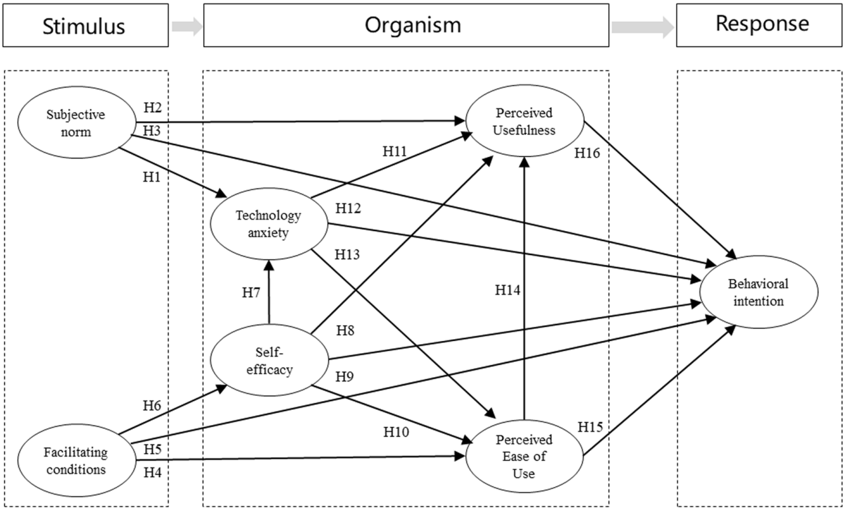
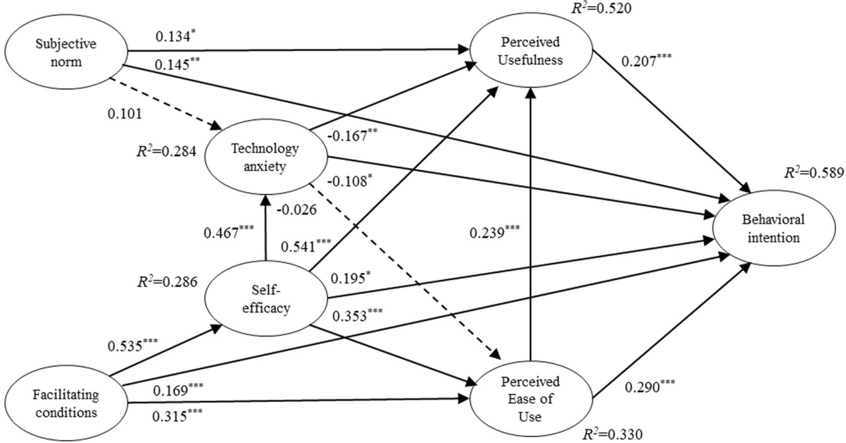
At a time when the population is aging and the digital divide among older adults is becoming increasingly prominent, the research on the smartphone use behavior of the older adult in China is slightly insufficient. Therefore, this study aims to develop a smartphone acceptance model for older adults in China to predict the factors of their behavioral intention to use smartphones. Using Stimulus-organism-response (SOR) theory as the framework, planned behavior theory, self-efficacy theory and technology acceptance model as the theoretical basis, and employed a mixed quantitative and qualitative research approach to analyze the data from 244 older adults using structural equation modeling. The results show that technology anxiety, subjective norms, self-efficacy, perceived usefulness, facilitating conditions, and perceived ease of use had significant effects on the behavioral intention smartphones among older adults. In addition, perceived usefulness was directly influenced by subjective norms and perceived ease of use, facilitating conditions significantly influenced perceived ease of use and self-efficacy, and subjective norms and self-efficacy significantly affect technology anxiety. This study expanded the applicability of SOR framework, further expanded the technology acceptance model, and enriched the theory of smart phone use behavior of older adults users. The results of this study provide a valuable theoretical framework for the study on older adults users’ behaviors and have implications for the design and marketing of smartphones with high acceptancy from older adults.
Overview
The claims and statistics of this paper haven’t been checked yet.
Free: it reads the open-access text and checks the first 5 claims that cite a source we can check. Create a free account to check every claim.
Integrity signals
Registry
Cites
Statistics
Figures
Verification
Claims the paper makes
The claims and statistics of this paper haven’t been checked yet.
Free: it reads the open-access text and checks the first 5 claims that cite a source we can check. Create a free account to check every claim.
Self-check
Percentages, sums and reported differences re-computed from the paper’s own numbers.
The self-check needs the paper’s full text.
Citations
Cites
Evaluating structural equation models with unobservable variables and measurement error
Fornell, C., & Larcker, D. F. (1981) · Journal of Marketing Research · doi:10.1177/002224378101800104 · Cited by 109,190
Podsakoff, P. M., MacKenzie, S. B., Lee, J.-Y., & Podsakoff, N. P. (2003) · Journal of Applied Psychology · doi:10.1037/0021-9010.88.5.879 · Cited by 82,194
Perceived usefulness, perceived ease of use, and user acceptance of information technology
Davis, F. D. (1989) · MIS Quarterly · doi:10.2307/249008 · Cited by 68,483
User Acceptance of Information Technology: Toward A Unified View1
Venkatesh, V., Morris, M. G., Davis, G. B., & Davis, F. D. (2003) · MIS Quarterly · doi:10.2307/30036540 · Cited by 45,035
Self-efficacy: Toward a unifying theory of behavioral change
Bandura, A. (1977) · Psychological Review · doi:10.1037/0033-295x.84.2.191 · Cited by 43,925
Structural equation modeling in practice: A review and recommended two-step approach
Anderson, J. C., & Gerbing, D. W. (1988) · Psychological Bulletin · doi:10.1037/0033-2909.103.3.411 · Cited by 41,941
A Theoretical Extension of the Technology Acceptance Model: Four Longitudinal Field Studies
Venkatesh, V., & Davis, F. D. (2000) · Management Science · doi:10.1287/mnsc.46.2.186.11926 · Cited by 23,066
Venkatesh, V., Thong, J. Y. L., & Xu, X. (2012) · MIS Quarterly · doi:10.2307/41410412 · Cited by 15,756
Structural equation models with unobservable variables and measurement error: Algebra and statistics
Fornell, C., & Larcker, D. F. (1981) · Journal of Marketing Research · doi:10.1177/002224378101800313 · Cited by 13,287
Partial Least Squares Structural Equation Modeling (PLS-SEM) Using R: A Workbook
Hair, J. F., Hult, G. T. M., Ringle, C. M., Sarstedt, M., Danks, N. P., & Ray, S. (2021) · Classroom Companion: Business · doi:10.1007/978-3-030-80519-7 · Cited by 10,343
Research works printed but not linked: 12
- Chan XY, Rahman MK, Mamun AA, Salameh A, Wan Hussain WMH, Alam SS (2022) Predicting the intention and adoption of mobile shopping during the COVID-19 lockdown in Malaysia. Sage Open 12(2):21582440221095012
- Chin WW (1998) The partial least squares approach to structural equation mod- eling. Modern Methods Busin Res 295(2):295-336
- Doan TTT (2021) The effect of perceived risk and technology self-efficacy on online learning intention: An empirical study in Vietnam. J Asian Finance Econ Business 8(10):385-393
- Fishbein M, Ajzen I (1975) Belief, Attitude and Behavior: An Introduction to Theory and Research. Addison-Wesley, Reading, UK
- Hsiao YJ (2015) Senior citizens' behavior intention toward smart phones: The theory of planned behavior. National Pingtung University, Taiwan
- Huang L-T (2017) Exploring consumers' intention to urge to buy in mobile commerce: the perspective of pleasure-arousal-dominance Illeris K (2003) Towards a contemporary and comprehensive theory of learning. International journal of lifelong education 22(4):396-406
- Liu T-P, Chen Y-Y, Yu J-Y (2021) Implementation and Evaluation of Mobile Shopping Services Based on RFID Sensing Technology. Sens Mater 33(5):1501-1516
- Nunnally J (1994) Psychometric theory 3E. Tata McGraw-hill education, New York, NY
- Purnomo SH, Lee Y-H (2013) E-learning adoption in the banking workplace in Indonesia: An empirical study. Information. Development 29(2):138-153
- Rahmi B, Birgoren B, Aktepe A (2021) Identifying factors affecting intention to use in distance learning systems. Turkish Online J Distance Educ 22(2):58-80
- Rong C (2018) Research on smartphone use behavior of migrant workers and its Influencing factors. Hanzhou Dianzi University, Hangzhou
- Sun YQ, Wang N, Guo XT, Peng ZY (2013) Understanding the acceptance of mobile health services: A comparison and integration of alternative models. J Electron Commer Res 14(2):183-200
Cited by
Ezeudoka, B. C., & Fan, M. (2024) · Humanities and Social Sciences Communications · doi:10.1057/s41599-024-03457-9 · Cited by 70
“In previous research, Huang (2023) has studied self-ef fi cacy as an organism in the SOR theory.”
Explore the driving factors of designers’ AIGC usage behavior based on SOR framework
Wang, S.-F., & Chen, C.-C. (2024) · Frontiers in Computer Science · doi:10.3389/fcomp.2024.1417016 · Cited by 39
Maleknia, R., & Enescu, R. E. (2024) · Ecological Modelling · doi:10.1016/j.ecolmodel.2024.111000 · Cited by 34
Theorizing Deception: A Scoping Review of Theory in Research on Dark Patterns and Deceptive Design
Chang, W. J., Seaborn, K., & Adams, A. A. (2024) · CHI Conference Extended Abstracts on Human Factors in Computing Systems (CHI EA) · doi:10.1145/3613905.3650997 · Cited by 34
“We have leaned on a broad conceptualization of theory here, to ensure a comprehensive review.”
MethodZhou, W., Fan, S., Wu, Y., Wang, G., & Lan, S. (2024) · Frontiers in Psychology · doi:10.3389/fpsyg.2024.1493422 · Cited by 32
“However, as research has advanced, it has become increasingly recognized that any factor capable of triggering psychological or behavioral responses, whether external or internal, can be considered a stimulus (Dong et al., 2022; Huang, 2023; Duong and Nguyen, 2024).”
Investigating students' behavioral intention to use ChatGPT for educational purposes
Sun, P., Li, L., Hossain, M. S., & Zabin, S. (2025) · Sustainable Futures · doi:10.1016/j.sftr.2025.100531 · Cited by 47
Mahajan, A., Sharma, S., Agrawal, V., & Nikalje, V. (2025) · Young Consumers Insight and Ideas for Responsible Marketers · doi:10.1108/yc-10-2024-2307 · Cited by 32
Mohammad, A. A. A., Elshaer, I. A., Azazz, A. M. S., Kooli, C., Algezawy, M., & Fayyad, S. (2024) · Sustainability · doi:10.3390/su16146050 · Cited by 60
The More Anxious, the More Dependent? The Impact of Math Anxiety on AI‐Assisted Problem‐Solving
Chen, F., Chen, J., & Xu, Y. (2025) · Psychology in the Schools · doi:10.1002/pits.23500 · Cited by 38
“Anxiety is a significant driving force behind human behavior (Huang 2023), yet there is limited research examining technology use behaviors triggered by learning anxiety.”
Understanding older adults’ continued-use intention of AI voice assistants
Xie, C., Xie, Y., Wang, Y., Zhou, P., Lu, L., Feng, Y., & Liang, C. (2024) · Universal Access in the Information Society · doi:10.1007/s10209-024-01172-5 · Cited by 22
“…in understanding the complexity of human attitudes and behaviors has been validated in numerous studies, and it provides a structured perspective [47] for elucidating the influence of antecedents associated with AI VAs on the psychological and cognitive states of older adults, and the subsequent…”
Understanding the purchase intention in live streaming from the perspective of social image
Zou, J., & Fu, X. (2024) · Humanities and Social Sciences Communications · doi:10.1057/s41599-024-04054-6 · Cited by 44
“First, this model has gained considerable popularity recently in the fi eld of online consumer behavior research (Huang, 2023; Song et al., 2022; Tian and Li, 2022).”
Rosli, M. S., & Saleh, N. S. (2024) · SN Computer Science · doi:10.1007/s42979-024-03015-9 · Cited by 24
“For example, Huang’s [35] research on the Technology Acceptance Model with Self-Efficacy, Subjective Norms, and Facilitating Conditions reported that only 58.9% of the variance was explained, leaving 41.1% unexplained.”
InfluentialMcGinty, J., Oest, J., & Divido, J. (2024) · New Directions for Adult and Continuing Education · doi:10.1002/ace.20517 · Cited by 22
“For example, NTL stands out for addressing social isolation and loneliness among older adults by providing digital literacy education and advocating for the use of tablets and video conferencing technology, significantly empowering older adults in these aspects (Oest & McGinty, 2020; Older Adults Technology Services, 2…”
Wang, Y.-Y. (2024) · Education and Information Technologies · doi:10.1007/s10639-024-13199-5 · Cited by 19
“In contrast to previous research that mainly focused on individuals’ adoption inten - tions (e.g., Hsu, 2024; Huang, 2023a), this study establishes a theoretical relation - ship between these constructs that can predict students’ behavioral intention to learn AI knowledge and skills.”
InfluentialJisham, M., Selvaraj, V., & John, A. (2024) · International Journal of Human-Computer Interaction · doi:10.1080/10447318.2024.2436605 · Cited by 21
“Researchers have successfully explored the SOR framework in various contexts, including the adoption of AI mobile banking (Lee & Chen, 2022), the continuance usage of AI voice assistance (Zhou et al., 2023), and smartphone use behavior (Huang, 2023).”
Maleknia, R., Hălălișan, A.-F., Namdari, S., & Susaeta, A. I. (2025) · Agroforestry Systems · doi:10.1007/s10457-025-01190-z · Cited by 12
“Although numerous studies have identified SNs as significant determinants of individuals’ intention to engage in specific behaviors (Li et al. 2023; Huang 2023), the findings of this study align with others (Jacob et al. 2021; Cao Minh and Nguyen Thi Quynh 2024) in demonstrating that SNs do not…”
Yaqub, M. Z., Badghish, S., Yaqub, R. M. S., Ali, İ., & Ali, N. S. (2024) · Journal of economic and administrative sciences. · doi:10.1108/jeas-09-2023-0259 · Cited by 21
Rashid, M. H., Wang, Y., Anwar, I., Aslam, S., Yasin, N., & Khuram, W. (2024) · The International Journal of Management Education · doi:10.1016/j.ijme.2024.101062 · Cited by 19
Wang, T., & Long, Y. (2025) · Acta Psychologica · doi:10.1016/j.actpsy.2025.105904 · Cited by 13
The power of livestreaming: Will it become an alternative strategy for startups?
Hossain, M. A., Hossain, M. S., Chowdhury, M. S., & Shuvro, R. A. (2024) · Technology in Society · doi:10.1016/j.techsoc.2024.102640 · Cited by 10
WeChat Adoption among Older Adults and Urban-Rural Differences in China
Lu, Q., Rong, B., Meng, X., Luo, X., Chen, Q., Xi, G., & Yang, H. (2024) · International Journal of Human-Computer Interaction · doi:10.1080/10447318.2024.2364475 · Cited by 10
“PEU reflects that older adults perceive WeChat as easy to use (Huang, 2023).”
InfluentialChen, J. L., Hashim, R., Sthapit, E., Yan, Z., & Garrod, B. (2025) · Current Issues in Tourism · doi:10.1080/13683500.2025.2523536 · Cited by 19
Zhu, Y., & Song, W. (2025) · Computers & Industrial Engineering · doi:10.1016/j.cie.2025.111480 · Cited by 13
Lo, M., Mohamad, A. A., Ibrahim, W. H. W., & Thong, J. Z. (2024) · Global Knowledge, Memory and Communication · doi:10.1108/gkmc-03-2024-0139 · Cited by 16
Wang, B. (2025) · Humanities and Social Sciences Communications · doi:10.1057/s41599-025-04490-y · Cited by 8
“This difference may stem from relatively low Internet penetration and persistent educational inequalities in China (Cheng et al. 2024; Huang 2023; Wang and Lu 2024).”
Wu, Q., Liao, Y., & Brannon, G. E. (2025) · Health Services Research · doi:10.1111/1475-6773.14653 · Cited by 8
“Research also used this model to study how PPC and health-related social media use affect cancer survivors' meaning in life [26, 27].”
Yu, S., Zhao, X., Xu, F., Sun, Y., & Guo, Y. (2025) · Energy Policy · doi:10.1016/j.enpol.2025.114727 · Cited by 11
Syamsuar, D., & Witarsyah, D. (2025) · Journal of theoretical and applied electronic commerce research · doi:10.3390/jtaer20040298 · Cited by 31
“Huang [24] combined several variables from other acceptance theories, such as the Theory of Planned Behaviour (subjective norm) and Technology Acceptance Theory (Perceived Usefulness and Perceived Ease of Use), as well as other theories, to develop a smartphone acceptance model.”
Adoption of smartphones among older adults and the role of perceived threat of cyberattacks
Pucer, P., Žvanut, B., & Vrhovec, S. L. R. (2025) · International Journal of Information Security · doi:10.1007/s10207-025-01014-2 · Cited by 13
“In the US, for example, over three quarters of older adults (76”
InfluentialThe impact of digital technology on sports consumption: evidence from Chinese college students
Zhong, Y.-J., Yang, J.-W., Guo, W.-H., & Wang, Y.-S. (2025) · Frontiers in Psychology · doi:10.3389/fpsyg.2025.1501327 · Cited by 7
“The S-O-R theory delineates a process where external stimuli elicit cognitive and emotional shifts within individuals, subsequently influencing their behavioral responses (Huang, 2023).”
Lan, Y., Liu, S., & Chen, H. (2026) · Frontiers in Psychology · doi:10.3389/fpsyg.2026.1769964 · Cited by 7
“Accordingly, S-O-R provides a robust theoretical foundation for examining emerging technology adoption across diverse scenarios (Huang, 2023).”
Li, J., Ling, R., Sun, F., Zhou, J., & Cai, H. (2024) · Asia Pacific Journal of Marketing and Logistics · doi:10.1108/apjml-04-2024-0460 · Cited by 7
Yang, M., & Jin, J. (2025) · PLoS ONE · doi:10.1371/journal.pone.0335522 · Cited by 5
“Applying models from structured settings, such as Huang’s study on smartphone adoption among older adults [8], to AIGC-assisted creative scenarios risks overlooking the critical role of task-technology fit (TTF) and the complex psychological motivations underlying creative work.”
Thi Thuy An, N. G. O., Pham, T. T., Tran, V. S., Nguyen Boi Ngoc, L. E., Thai Ngan, D. I. N. H., & Nguyen, Q. M. C. (2025) · Acta Psychologica · doi:10.1016/j.actpsy.2025.105873 · Cited by 12
Hwang, I., & Son, H. (2025) · Transportation Research Part D Transport and Environment · doi:10.1016/j.trd.2025.105091 · Cited by 6
Wu, H., Zhang, Z., Guo, Y., & Li, X. (2026) · Journal of Retailing and Consumer Services · doi:10.1016/j.jretconser.2026.104782 · Cited by 7
Irawan, A. J. (2024) · International Journal of Current Science Research and Review · doi:10.47191/ijcsrr/v7-i2-48 · Cited by 8
“The research found that self-efficacy is a significant factor to overcome technology anxiety which likely to be a barrier in technology adoption (Huang, 2023).”
BackgroundResultInfluentialOptimal hybrid renewable microgrids via energy demand control using media platforms in South Korea
Ifaei, P., Esfehankalateh, A. T., Na, J., & Yoo, C. (2024) · Sustainable Cities and Society · doi:10.1016/j.scs.2024.106027 · Cited by 5
Ali, I., Warraich, N. F., & Butt, K. (2025) · The Electronic Library · doi:10.1108/el-04-2025-0160 · Cited by 6
Le, T. T., Chau, T. L. Q., & Kim, N. N. D. (2026) · International Journal of Quality and Service Sciences · doi:10.1108/ijqss-09-2025-0225 · Cited by 6
Yu, Z., Rosbi, S., & Amlus, M. H. (2024) · Sustainability · doi:10.3390/su16156521 · Cited by 13
“These responses include usage behavior [39] and purchasing intention [40].”
Chatterjee, R. S., Hameed, I., Chatterjee, S., Chaudhuri, R., Vrontis, D., & Foroudi, P. (2025) · Journal of Macromarketing · doi:10.1177/02761467251325070 · Cited by 4
“However, studies have also observed that the model ’ s attenuation is oversimpli fi ed, which does not allow it to capture the psychological ambivalence associated with technology transition-related decisions (Huang, 2023; Huang et al., 2024a, Huang et al., 2024b).”
Dining with robots: exploring the customer willingness to adopt service robots in restaurants
Himanshu, H., Goel, A., Dhingra, S., & Taneja, U. (2025) · Industrial Management & Data Systems · doi:10.1108/imds-08-2024-0762 · Cited by 9
Fan, J., Wu, R., Tang, C., & Yang, X. (2025) · International Journal of Human-Computer Interaction · doi:10.1080/10447318.2025.2536624 · Cited by 6
Liu, X., Shen, W., Hu, X.-Y., & Lu, F. (2025) · The American Journal of Psychology · doi:10.5406/19398298.138.1.03 · Cited by 3
Smartphone advocacy: perceived brand authenticity and love and the need for uniqueness
Elsotouhy, M. M., Ghonim, M. A., & Khashan, M. A. (2025) · Management Decision · doi:10.1108/md-05-2025-1319 · Cited by 6
Yang, L., Xie, R., Zhao, X., Zheng, G., & She, S. (2025) · Frontiers in Public Health · doi:10.3389/fpubh.2025.1724540 · Cited by 4
Kim, J. S., Feng, Y., Li, P., & Lee, T. J. (2025) · Journal of Hospitality and Tourism Technology · doi:10.1108/jhtt-06-2025-0513 · Cited by 4
Le, N. T. C., Nguyen, T. T. P., & Voak, A. (2026) · Journal of Global Scholars of Marketing Science · doi:10.1080/21639159.2025.2577721 · Cited by 10
“In another study, Huang (2023) applied the S-O-R model to predict smartphone usage behaviors among older adults in China.”
Nebenzahl-Elitzur, N., Kagan, M., & Zychlinski, E. (2026) · International Psychogeriatrics · doi:10.1016/j.inpsyc.2025.100179 · Cited by 3
Why do people use P2P lending services? The role of AI literacy and green self identity
Setiawan, B., Utami, D., Arifin, F., Igamo, A. M., Permana, K. W. A., Nathan, R. J., & Fekete‐Farkas, M. (2026) · Journal of Financial Services Marketing · doi:10.1057/s41264-026-00357-8 · Cited by 5
“This pattern is consistent with prior empirical evidence demonstrating that structural support systems contribute to technology utilization across diverse contexts (Bervelland Arkorful 2020; Zhang et al. 2025 ; Huang 2023).”
Meena, R., & Sarabhai, S. (2024) · Journal of Marketing Communications · doi:10.1080/13527266.2024.2394782 · Cited by 4
“On one end, feelings of incompetence arise due to low self-JOURNAL efficacy (Huang 2023), while a high sense of self-efficacy increases likingness and anxiety towards mobile phones for older adults (A.”
InfluentialImmanuel, J., & Thoyyibah, T. (2025) · International Conference on Advances in Electrical, Electronics and Computing Technology (EECT) · doi:10.1109/eect64505.2025.10966960 · Cited by 2
Hoque, F., Seet, P., Meek, S., & Sadeque, S. (2025) · Business Strategy & Development · doi:10.1002/bsd2.70249 · Cited by 2
Obuobi, B., Awuah, F., Nketiah, E., & Adu‐Gyamfi, G. (2025) · Journal of Material Cycles and Waste Management · doi:10.1007/s10163-025-02449-4 · Cited by 3
“Huang [53] describes “response” as an individual’s behavioral intention, which stems from their cognitive and emotional reactions.”
Peiró‐Signes, Á., Adamashvili, N., Tupá, M., & Galati, A. (2026) · Journal of Innovation & Knowledge · doi:10.1016/j.jik.2026.100944 · Cited by 3
Mai, X., Jiale, Z., Long, J., & Xu, J. (2026) · Journal of Sensory Studies · doi:10.1111/joss.70107 · Cited by 5
Zhang, L., & Wu, Z. (2026) · Digital Health · doi:10.1177/20552076261420892 · Cited by 3
Adaptive engagement in smart tourism: a context-sensitive multi-condition model for older adults
Chen, Y., Shi, Z., Lin, D., & Gupta, R. (2026) · Journal of Hospitality and Tourism Technology · doi:10.1108/jhtt-05-2025-0395 · Cited by 4
Wijaya, L., Iqbal, A., Carissa, M., Manik, N. L. N. G., Cheng, K. M., & Valerie, J. (2024) · IEEE International Conference on Interdisciplinary Approaches in Technology and Management for Social Innovation (IATMSI) · doi:10.1109/iatmsi60426.2024.10503439 · Cited by 4
“Subjective norms (SN) and perceived ease of use (PEOU) have a direct impact on perceived usefulness [15].”
BackgroundGonzaga, E. B. (2024) · International Journal of Research -GRANTHAALAYAH · doi:10.29121/granthaalayah.v12.i4.2024.5598 · Cited by 11
Özbük, R. M. Y., & Bayhan, B. O. (2025) · Journal of Organizational Change Management · doi:10.1108/jocm-02-2025-0169 · Cited by 6
Hou, T., Zhang, Y., Wang, Y., Chen, S., & Matsuoka, H. (2025) · International Journal of Sports Marketing and Sponsorship · doi:10.1108/ijsms-01-2025-0016 · Cited by 1
Lu, X., Gong, D., Zhang, X., & Kim, K. (2025) · Geriatric Nursing · doi:10.1016/j.gerinurse.2025.103527 · Cited by 1
Exploring Drivers of AIGC-Designer Collaborative Innovation
Wang, S.-F., & Chen, C.-C. (2025) · SAGE Open · doi:10.1177/21582440251344044 · Cited by 4
“It is widely applied in studies of human behavior change, particularly in measuring behavior change and technology acceptance (T. Huang, 2023).”
Schiaroli, V., & Fraccascia, L. (2025) · Business Strategy and the Environment · doi:10.1002/bse.70440 · Cited by 2
Live temptations: exploring the trigger pathway to immediate buying behaviour in livestream commerce
Widiatmo, G., & Wu, W. (2026) · Behaviour and Information Technology · doi:10.1080/0144929x.2026.2623944 · Cited by 4
“…applied in consumer behaviour studies because it offers a comprehensive method for integrating external stimuli in the stimulus stage, internal states in the organism stage, and consumer purchasing responses in the context of livestream commerce (Gao et al. 2022; Huang 2023; Lou et al. 2022).”
InfluentialNurhayati, A., Nawi, N. M., Kamarulzaman, N. H., Hadi, A. H. I. A., & Irham, I. (2026) · Discover Sustainability · doi:10.1007/s43621-026-02994-4 · Cited by 3
Jabar, F. A., Hashim, N. S., Jabar, M. A., & Noor, M. N. M. (2026) · Journal of Islamic marketing · doi:10.1108/jima-01-2025-0042 · Cited by 4
Ding, N., Hu, L., & Chen, M. (2026) · Humanities and Social Sciences Communications · doi:10.1057/s41599-026-07075-5 · Cited by 1
“For instance, Huang (2023), in a study on smartphone adoption among older adults, found that PEU had a stronger direct effect on behavioral intention than PU.”
“My effort is worthwhile”: unpacking tourists’ emotional returns and behavioral engagement with AI
Beiting (Betty), H. E., Wang, X., & Qu, J. (2026) · Journal of Hospitality and Tourism Technology · doi:10.1108/jhtt-03-2025-0185 · Cited by 1
Yacoub, L., Elhajjar, S., & Maalouf, N. J. A. (2026) · Acta Psychologica · doi:10.1016/j.actpsy.2026.106913 · Cited by 4
Grapas, C., Llaguno-Munitxa, M., Pisello, A. L., & Irajpour, A. (2026) · Urban Climate · doi:10.1016/j.uclim.2026.102906 · Cited by 1
Fan, H., Shi, C., Shao, X., Shuai, J., Sun, J., Li, W., Liu, P., & Li, Y. (2026) · Frontiers in Sustainable Food Systems · doi:10.3389/fsufs.2026.1786677 · Cited by 1
Ceyssens, C., Verhulst, N., & Vermeulen, M. (2026) · Journal of Business Research · doi:10.1016/j.jbusres.2026.116364 · Cited by 1
The Effect of Social Support on Smartphone Use among Older Adults and Its Mechanisms
范, 文. (2024) · Advances in Social Sciences · doi:10.12677/ass.2024.132123
Ferani, A., Wardhana, C. S. P., Gunawan, R. V., & Karsen, M. (2024) · International Conference on Information Management and Technology (ICIMTech) · doi:10.1109/icimtech63123.2024.10780886
“The SOR Model explains how external stimuli affect internal organism states and individual behavioral responses [26].”
Prasetyo, A., & Praswati, A. N. (2024) · Ilomata International Journal of Management · doi:10.61194/ijjm.v6i2.1450 · Cited by 7
Examining Customer Attitudes Towards Self-Service Technology in Fast-Food Restaurants
Immanuel, J., Limantara, N., & Kenedy, K. (2024) · International Conference on Informatics, Multimedia, Cyber and Information System (ICIMCIS) · doi:10.1109/icimcis63449.2024.10956444 · Cited by 1
Wang, T., & Long, Y. (2025) · SSRN Electronic Journal · doi:10.2139/ssrn.5362327
Wang, W. (2025) · British Food Journal · doi:10.1108/bfj-04-2024-0344
The hidden facets of artificial intelligence: delivery employees’ insights into service sabotage
Song, R., Qin, W., Shi, W., & Xue, X. (2025) · Management Decision · doi:10.1108/md-08-2024-1820
Cuong, D. T. (2025) · Innovative Marketing · doi:10.21511/im.21(4).2025.11
Isalman, & Akbar, I. (2025) · SIGMA Journal of Economic and Business · doi:10.60009/qq4ahg36
Maleknia, R., & Hălălișan, A.-F. (2025) · Urban Science · doi:10.3390/urbansci10010015
Impact of Perceived Value and Security on Satisfaction and Trust in Loyalty Mobile Payment
Muljana, T. M., Jonathan, B., Bratakencana, I. W., & Justianto, J. S. (2025) · International Conference on Digital Transformation and Applications (ICDXA) · doi:10.1109/icdxa69105.2025.11330025
“It is also applied in organizational behavior and educational psychology [32, 33, 34].”
Liu, Y., Yi, X., & Liang, H. (2026) · International Journal of Human-Computer Interaction · doi:10.1080/10447318.2026.2618549
Gen Z's Online Hotel Booking Intention Explored via SOR Framework
Berry, K. (2026) · Advances in Hospitality and Tourism Research (AHTR) · doi:10.30519/ahtr.1665987
What drives smartphone users to click on the in-app advertisements? An S-O-R model approach
Kashyap, S., Mishra, S. K., & Salunke, P. (2026) · The Journal of Marketing Theory and Practice · doi:10.1080/10696679.2026.2629473 · Cited by 1
On the user friendliness of password creation policy designs in the wild
Wang, D., Wei, T., & Hou, Z. (2026) · Science China Information Sciences · doi:10.1007/s11432-025-4594-4
“Various factors influence user passwords (e.g., user demographics [33,66] and password requirements [20,63]).”
Hoque, F., Seet, P., Meek, S., & Sadeque, S. (2026) · SSRN Electronic Journal · doi:10.2139/ssrn.6447998
Rashid, M. H., Wang, Y., & Riaz, S. (2026) · The International Journal of Management Education · doi:10.1016/j.ijme.2026.101417
Song, R., Qin, W., & Xue, X. (2026) · Research Square · doi:10.21203/rs.3.rs-9263933/v1
Otsuru, K., Taoka, Y., & Nakatani, M. (2026) · Lecture notes in computer science · doi:10.1007/978-3-032-29583-5_35
Barati, A. A., Mahabadi, K. N., & Asadi, A. (2026) · Journal of Agriculture and Food Research · doi:10.1016/j.jafr.2026.103169
Li, H., Li, L., Xu, E., Chen, W., & Hu, P. (2026) · Acta Psychologica · doi:10.1016/j.actpsy.2026.107589
Rashid, M. H., Wang, Y., & Riaz, S. (2026) · SAGE Open · doi:10.1177/21582440261469274
Chatterjee, R. S., Hameed, I., Waris, I., Hosen, M., & Rehman, H. M. (2026) · International Journal of Innovation Studies · doi:10.1016/j.ijis.2026.100224
Nguyễn, H. V., Le, N. K. N., Nguyen, T. H. T., Tran, N. M., Phu, G. T., Nguyen, N. T., & Nguyen, K. M. (2026) · China Finance Review International · doi:10.1108/cfri-07-2025-0470 · Cited by 1
Chaw, L. Y., Lim, J. T. B., Aw, E. C., Lim, A., & Tee, M. (2026) · International Journal of Bank Marketing · doi:10.1108/ijbm-09-2025-0733 · Cited by 1
Metadata
- Authors
- Huang, T.
- Affiliations
- Guangdong Ocean University (CN)
- Corresponding author
- Huang, Tianyang
- ORCID
- Huang, Tianyang
- Venue
- Humanities and Social Sciences Communications
- Published
- 2023-10-11
- Volume
- 10
- Issue
- 1
- ISSN
- 2055-1045 (ISSN-L)
- 2662-9992
- OpenAlex
- W4387517387
- Semantic Scholar
- bc1d1a7adbaec36112654a39d0e9139183b10db5
- Cited by
- 102
- References
- 134
- Citations by year
- 2026: 35 · 2025: 39 · 2024: 28
- FWCI
- 59.45
- Type
- journal article
- Language
- en
- Open access
- gold
- doi.org
- Licence
- cc-by
- creativecommons.org/licenses/by/4.0 (tdm)
- creativecommons.org/licenses/by/4.0 (vor)
- Locations
- Humanities and Social Sciences Communications (publishedVersion, cc-by)
- RePEc: Research Papers in Economics (submittedVersion)
- DOAJ (DOAJ: Directory of Open Access Journals) (submittedVersion, cc-by-sa)
- Funders
- Guangdong Ocean University
- Topics
- Health Sciences › Medicine › Geriatrics and Gerontology › Technology Use by Older Adults
- Social Sciences › Decision Sciences › Information Systems and Management › Technology Adoption and User Behaviour
- Health Sciences › Health Professions › Health Information Management › Health, Technology, Consumer Behavior
- Keywords
- older adults, technology acceptance model, stimulus-organism-response model, behavioral intention, technology anxiety, self-efficacy, perceived usefulness, perceived ease of use, facilitating conditions, subjective norms, digital divide, population aging, China
About these checks
Registry, retraction, Cites and statistics results are computed, not judged, with one exception: a printed reference that no index lists is read once by a model before it counts as a citation error. Claims are extracted by a model and kept only when their quote appears verbatim in the text; each cited source is then checked, with a model’s help, for whether it says what the claim relies on. Those verdicts can be wrong — read the claim’s quote and the cited source before relying on one.
Statistics and arithmetic are recomputed, not judged.
Confidence bands are shown only for fields calibrated on our annotated test set. None is calibrated yet, so no band is shown.
What counts as a claim ›How we measure confidence ›How we check this ›
Are you an author, or do you see a problem with this page? Request a review
Data sources
Bibliographic data: Semantic Scholar, OpenAlex, Crossref.
Contains information from the Semantic Scholar Academic Graph Datasets, made available under the ODC Attribution License (ODC-BY 1.0).
Semantic Scholar’s data is described in: Kinney, R., et al. (2023). The Semantic Scholar Open Data Platform. arXiv:2301.10140.
