

Using SOR framework to explore the driving factors of older adults smartphone use behavior
Open accessThe DOI matches its Crossref record; 134 of the 134 references it cites were found in a registry or an index.
Abstract
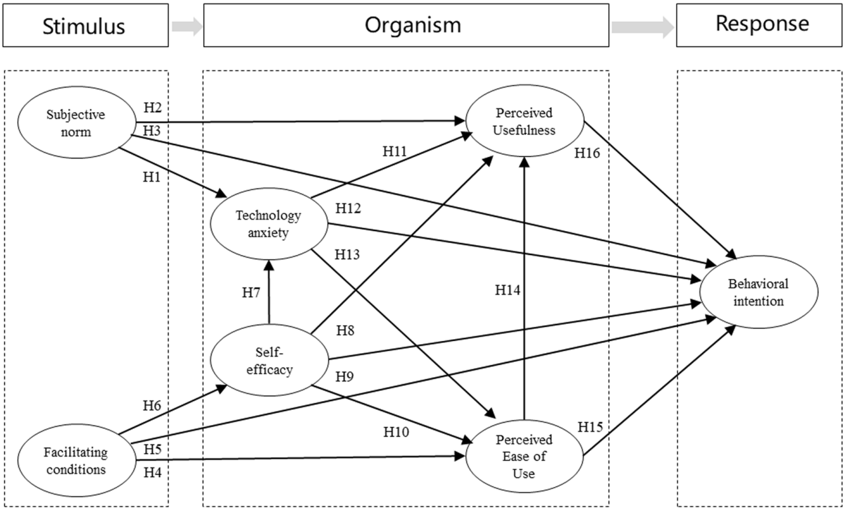
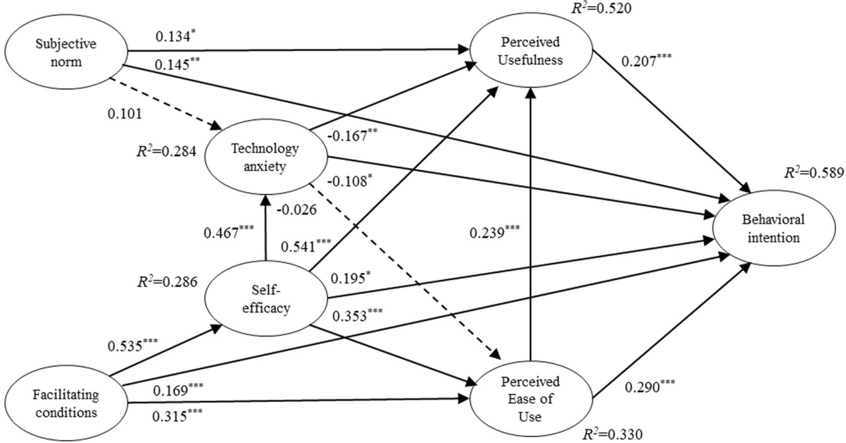
At a time when the population is aging and the digital divide among older adults is becoming increasingly prominent, the research on the smartphone use behavior of the older adult in China is slightly insufficient. Therefore, this study aims to develop a smartphone acceptance model for older adults in China to predict the factors of their behavioral intention to use smartphones. Using Stimulus-organism-response (SOR) theory as the framework, planned behavior theory, self-efficacy theory and technology acceptance model as the theoretical basis, and employed a mixed quantitative and qualitative research approach to analyze the data from 244 older adults using structural equation modeling. The results show that technology anxiety, subjective norms, self-efficacy, perceived usefulness, facilitating conditions, and perceived ease of use had significant effects on the behavioral intention smartphones among older adults. In addition, perceived usefulness was directly influenced by subjective norms and perceived ease of use, facilitating conditions significantly influenced perceived ease of use and self-efficacy, and subjective norms and self-efficacy significantly affect technology anxiety. This study expanded the applicability of SOR framework, further expanded the technology acceptance model, and enriched the theory of smart phone use behavior of older adults users. The results of this study provide a valuable theoretical framework for the study on older adults users’ behaviors and have implications for the design and marketing of smartphones with high acceptancy from older adults.
Overview
The claims and statistics of this paper haven’t been checked yet.
Free: it reads the open-access text and checks the first 5 claims that cite a source we can check. Create a free account to check every claim.
Integrity signals
Registry
Cites
Statistics
Figures
Verification
Claims the paper makes
The claims and statistics of this paper haven’t been checked yet.
Free: it reads the open-access text and checks the first 5 claims that cite a source we can check. Create a free account to check every claim.
Self-check
Percentages, sums and reported differences re-computed from the paper’s own numbers.
The self-check needs the paper’s full text.
Citations
Cites
Evaluating structural equation models with unobservable variables and measurement error
Fornell, C., & Larcker, D. F. (1981) · Journal of Marketing Research · doi:10.1177/002224378101800104 · Cited by 109,190
Podsakoff, P. M., MacKenzie, S. B., Lee, J.-Y., & Podsakoff, N. P. (2003) · Journal of Applied Psychology · doi:10.1037/0021-9010.88.5.879 · Cited by 82,194
Perceived usefulness, perceived ease of use, and user acceptance of information technology
Davis, F. D. (1989) · MIS Quarterly · doi:10.2307/249008 · Cited by 68,483
User Acceptance of Information Technology: Toward A Unified View1
Venkatesh, V., Morris, M. G., Davis, G. B., & Davis, F. D. (2003) · MIS Quarterly · doi:10.2307/30036540 · Cited by 45,035
Self-efficacy: Toward a unifying theory of behavioral change
Bandura, A. (1977) · Psychological Review · doi:10.1037/0033-295x.84.2.191 · Cited by 43,925
Structural equation modeling in practice: A review and recommended two-step approach
Anderson, J. C., & Gerbing, D. W. (1988) · Psychological Bulletin · doi:10.1037/0033-2909.103.3.411 · Cited by 41,941
A Theoretical Extension of the Technology Acceptance Model: Four Longitudinal Field Studies
Venkatesh, V., & Davis, F. D. (2000) · Management Science · doi:10.1287/mnsc.46.2.186.11926 · Cited by 23,066
Venkatesh, V., Thong, J. Y. L., & Xu, X. (2012) · MIS Quarterly · doi:10.2307/41410412 · Cited by 15,756
Structural equation models with unobservable variables and measurement error: Algebra and statistics
Fornell, C., & Larcker, D. F. (1981) · Journal of Marketing Research · doi:10.1177/002224378101800313 · Cited by 13,287
Partial Least Squares Structural Equation Modeling (PLS-SEM) Using R: A Workbook
Hair, J. F., Hult, G. T. M., Ringle, C. M., Sarstedt, M., Danks, N. P., & Ray, S. (2021) · Classroom Companion: Business · doi:10.1007/978-3-030-80519-7 · Cited by 10,343
An assessment of the use of partial least squares structural equation modeling in marketing research
Hair, J. F., Sarstedt, M., Ringle, C. M., & Mena, J. A. (2012) · Journal of the Academy of Marketing Science · doi:10.1007/s11747-011-0261-6 · Cited by 8,088
(1974) · Medical Entomology and Zoology · Cited by 7,295
Computer Self-Efficacy: Development of a Measure and Initial Test
Compeau, D. R., & Higgins, C. A. (1995) · MIS Quarterly · doi:10.2307/249688 · Cited by 6,553
Tenenhaus, M., Vinzi, V. E., Chatelin, Y.-M., & Lauro, C. (2005) · Computational Statistics & Data Analysis · doi:10.1016/j.csda.2004.03.005 · Cited by 6,312
Self-Efficacy Beliefs of Adolescents
(2006) · Emerald Group Publishing Limited eBooks · doi:10.1108/978-1-60752-750-3 · Cited by 3,506
Parasuraman, A. (2000) · Journal of Service Research · doi:10.1177/109467050024001 · Cited by 3,328
Czaja, S. J., Charness, N., Fisk, A. D., Hertzog, C., Nair, S. N., Rogers, W. A., & Sharit, J. (2006) · Psychology and Aging · doi:10.1037/0882-7974.21.2.333 · Cited by 2,113
AGE DIFFERENCES IN TECHNOLOGY ADOPTION DECISIONS: IMPLICATIONS FOR A CHANGING WORK FORCE
MORRIS, M. G., & VENKATESH, V. (2000) · Personnel Psychology · doi:10.1111/j.1744-6570.2000.tb00206.x · Cited by 1,723
Trust and Electronic Government Success: An Empirical Study
Teo, T. S. H., Srivastava, S. C., & Jiang, L. (2008) · Journal of Management Information Systems · doi:10.2753/mis0742-1222250303 · Cited by 1,400
A Cross-Cultural Study on Escalation of Commitment Behavior in Software Projects1
Keil, M., Tan, B. C. Y., Wei, K.-K., Saarinen, T., Tuunainen, V., & Wassenaar, A. (2000) · MIS Quarterly · doi:10.2307/3250940 · Cited by 1,370
The influence of technology anxiety on consumer use and experiences with self-service technologies
Meuter, M. L., Ostrom, A. L., Bitner, M. J., & Roundtree, R. (2003) · Journal of Business Research · doi:10.1016/s0148-2963(01)00276-4 · Cited by 1,247
Assessing Acceptance of Assistive Social Agent Technology by Older Adults: the Almere Model
Heerink, M., Kröse, B., Evers, V., & Wielinga, B. (2010) · International Journal of Social Robotics · doi:10.1007/s12369-010-0068-5 · Cited by 1,229
The digital divide has grown old: Determinants of a digital divide among seniors
Friemel, T. N. (2016) · New Media & Society · doi:10.1177/1461444814538648 · Cited by 1,136
Stimulus‐Organism‐Response Reconsidered: An Evolutionary Step in Modeling (Consumer) Behavior
Jacoby, J. (2002) · Journal of Consumer Psychology · doi:10.1207/s15327663jcp1201_05 · Cited by 1,135
Hoque, R., & Sorwar, G. (2017) · International Journal of Medical Informatics · doi:10.1016/j.ijmedinf.2017.02.002 · Cited by 1,004
Abdullah, F., & Ward, R. (2016) · Computers in Human Behavior · doi:10.1016/j.chb.2015.11.036 · Cited by 986
Store environment and consumer purchase behavior: Mediating role of consumer emotions
Sherman, E., Mathur, A., & Smith, R. B. (1997) · Psychology and Marketing · doi:10.1002/(sici)1520-6793(199707)14:4<361::aid-mar4>3.0.co;2-7 · Cited by 854
Self-efficacy conception of anxiety
Bandura, A. (1988) · Anxiety Research · doi:10.1080/10615808808248222 · Cited by 801
Wang, S., Fan, J., Zhao, D., Yang, S., & Fu, Y. (2016) · Transportation · doi:10.1007/s11116-014-9567-9 · Cited by 751
Gerontechnology acceptance by elderly Hong Kong Chinese: A senior technology acceptance model (STAM)
Chen, K., & Chan, A. H. S. (2014) · Ergonomics · doi:10.1080/00140139.2014.895855 · Cited by 679
Analyzing older users’ home telehealth services acceptance behavior—applying an Extended UTAUT model
Cimperman, M., Makovec Brenčič, M., & Trkman, P. (2016) · International Journal of Medical Informatics · doi:10.1016/j.ijmedinf.2016.03.002 · Cited by 614
Elderly persons’ perception and acceptance of using wireless sensor networks to assist healthcare
Steele, R., Lo, A., Secombe, C., & Wong, Y. K. (2009) · International Journal of Medical Informatics · doi:10.1016/j.ijmedinf.2009.08.001 · Cited by 508
Antecedents of the adoption of the new mobile payment systems: The moderating effect of age
Liébana-Cabanillas, F., Sánchez-Fernández, J., & Muñoz-Leiva, F. (2014) · Computers in Human Behavior · doi:10.1016/j.chb.2014.03.022 · Cited by 504
The role of atmospheric cues in online impulse-buying behavior.
Floh, A., & Madlberger, M. (2013) · Electronic Commerce Research and Applications · doi:10.1016/j.elerap.2013.06.001 · Cited by 460
Predicting m-commerce adoption determinants: A neural network approach
Chong, A. Y.-L. (2013) · Expert Systems with Applications · doi:10.1016/j.eswa.2012.07.068 · Cited by 454
Health monitoring through wearable technologies for older adults: Smart wearables acceptance model
Li, J., Ma, Q., Chan, A. H., & Man, S. S. (2019) · Applied Ergonomics · doi:10.1016/j.apergo.2018.10.006 · Cited by 436
Comparison of the middle-aged and older users’ adoption of mobile health services in China
Deng, Z., Mo, X., & Liu, S. (2014) · International Journal of Medical Informatics · doi:10.1016/j.ijmedinf.2013.12.002 · Cited by 435
The impact of technology on older adults’ social isolation
Khosravi, P., Rezvani, A., & Wiewiora, A. (2016) · Computers in Human Behavior · doi:10.1016/j.chb.2016.05.092 · Cited by 402
Towards a contemporary and comprehensive theory of learning
ILLERIS, K. (2003) · International Journal of Lifelong Education · doi:10.1080/02601370304837 · Cited by 401
Consumer Acceptance and Use of Information Technology: A Meta-Analytic Evaluation of UTAUT2
Tamilmani, K., Rana, N. P., & Dwivedi, Y. K. (2021) · Information Systems Frontiers · doi:10.1007/s10796-020-10007-6 · Cited by 341
Senior citizens’ acceptance of information systems: A study in the context of e-government services
Phang, C. W., Sutanto, J., Kankanhalli, A., Li, Y., Tan, B. C. Y., & Teo, H.-H. (2006) · IEEE Transactions on Engineering Management · doi:10.1109/tem.2006.883710 · Cited by 331
Lunney, A., Cunningham, N. R., & Eastin, M. S. (2016) · Computers in Human Behavior · doi:10.1016/j.chb.2016.08.007 · Cited by 322
Digitalization and sustainability: virtual reality tourism in a post pandemic world
Talwar, S., Kaur, P., Nunkoo, R., & Dhir, A. (2023) · Journal of Sustainable Tourism · doi:10.1080/09669582.2022.2029870 · Cited by 303
Pan, S., & Jordan-Marsh, M. (2010) · Computers in Human Behavior · doi:10.1016/j.chb.2010.03.015 · Cited by 300
Bonoto, B. C., de Araújo, V. E., Godói, I. P., de Lemos, L. L. P., Godman, B., Bennie, M., Diniz, L. M., & Junior, A. A. G. (2017) · JMIR mhealth and uhealth · doi:10.2196/mhealth.6309 · Cited by 294
Facilitators and inhibitors of organic food buying behavior
Tandon, A., Jabeen, F., Talwar, S., Sakashita, M., & Dhir, A. (2021) · Food Quality and Preference · doi:10.1016/j.foodqual.2020.104077 · Cited by 276
The impact of post-adoption beliefs on the continued use of health apps
Cho, J. (2016) · International Journal of Medical Informatics · doi:10.1016/j.ijmedinf.2015.12.016 · Cited by 273
Guner, H., & Acarturk, C. (2020) · Universal Access in the Information Society · doi:10.1007/s10209-018-0642-4 · Cited by 270
The dark side of elderly acceptance of preventive mobile health services in China
Guo, X., Sun, Y., Wang, N., Peng, Z., & Yan, Z. (2013) · Electronic Markets · doi:10.1007/s12525-012-0112-4 · Cited by 265
Perez-Vega, R., Kaartemo, V., Lages, C. R., Borghei Razavi, N., & Männistö, J. (2021) · Journal of Business Research · doi:10.1016/j.jbusres.2020.11.002 · Cited by 263
Tsai, T.-H., Lin, W.-Y., Chang, Y.-S., Chang, P.-C., & Lee, M.-Y. (2020) · PLOS ONE · doi:10.1371/journal.pone.0227270 · Cited by 262
Sultan, P., Wong, H. Y., & Azam, M. S. (2021) · Journal of Cleaner Production · doi:10.1016/j.jclepro.2021.127807 · Cited by 257
What drives brand love for natural products? The moderating role of household size
Kumar, S., Dhir, A., Talwar, S., Chakraborty, D., & Kaur, P. (2021) · Journal of Retailing and Consumer Services · doi:10.1016/j.jretconser.2020.102329 · Cited by 241
Bridging the divide: using UTAUT to predict multigenerational tablet adoption practices
Magsamen-Conrad, K., Upadhyaya, S., Joa, C. Y., & Dowd, J. (2015) · Computers in Human Behavior · doi:10.1016/j.chb.2015.03.032 · Cited by 241
Personal and other factors affecting acceptance of smartphone technology by older Chinese adults
Ma, Q., Chan, A. H. S., & Chen, K. (2016) · Applied Ergonomics · doi:10.1016/j.apergo.2015.11.015 · Cited by 236
Scott, J. E., & Walczak, S. (2009) · Information & Management · doi:10.1016/j.im.2008.10.003 · Cited by 235
Lee, J.-C., & Chen, X. (2022) · International Journal of Bank Marketing · doi:10.1108/ijbm-08-2021-0394 · Cited by 233
Talwar, M., Talwar, S., Kaur, P., Islam, A. K. M. N., & Dhir, A. (2021) · Journal of Retailing and Consumer Services · doi:10.1016/j.jretconser.2020.102396 · Cited by 217
A study on Singaporean women's acceptance of using mobile phones to seek health information
Lim, S., Xue, L., Yen, C. C., Chang, L., Chan, H. C., Tai, B. C., Duh, H. B. L., & Choolani, M. (2011) · International Journal of Medical Informatics · doi:10.1016/j.ijmedinf.2011.08.007 · Cited by 215
Beh, P. K., Ganesan, Y., Iranmanesh, M., & Foroughi, B. (2021) · Behaviour & Information Technology · doi:10.1080/0144929x.2019.1685597 · Cited by 212
Pandita, S., Mishra, H. G., & Chib, S. (2020) · Children and Youth Services Review · doi:10.1016/j.childyouth.2020.105783 · Cited by 211
Predictors of gerontechnology acceptance by older Hong Kong Chinese
Chen, K., & Chan, A. H. S. (2014) · Technovation · doi:10.1016/j.technovation.2013.09.010 · Cited by 208
Talukder, M. S., Chiong, R., Bao, Y., & Hayat Malik, B. (2019) · Industrial Management & Data Systems · doi:10.1108/imds-01-2018-0009 · Cited by 206
Lavuri, R., Chiappetta Jabbour, C. J., Grebinevych, O., & Roubaud, D. (2022) · Journal of Environmental Management · doi:10.1016/j.jenvman.2021.113899 · Cited by 206
Fu, S., Chen, X., & Zheng, H. (2021) · Behaviour & Information Technology · doi:10.1080/0144929x.2020.1716848 · Cited by 173
Lin, J., Li, T., & Guo, J. (2021) · Electronic Commerce Research and Applications · doi:10.1016/j.elerap.2021.101103 · Cited by 172
Choudrie, J., Pheeraphuttranghkoon, S., & Davari, S. (2020) · Information Systems Frontiers · doi:10.1007/s10796-018-9875-2 · Cited by 166
Xue, L., Yen, C. C., Chang, L., Chan, H. C., Tai, B. C., Tan, S. B., Duh, H. B. L., & Choolani, M. (2012) · International Journal of Medical Informatics · doi:10.1016/j.ijmedinf.2012.04.008 · Cited by 161
Zhang, G., Yue, X., Ye, Y., & Peng, M. Y. (2021) · Frontiers in Psychology · doi:10.3389/fpsyg.2021.712323 · Cited by 160
Oyedele, A., & Simpson, P. M. (2007) · International Journal of Service Industry Management · doi:10.1108/09564230710751497 · Cited by 157
Rahardja, U., Sigalingging, C. T., Putra, P. O. H., Hidayanto, A. N., & Phusavat, K. (2023) · SAGE Open · doi:10.1177/21582440231151919 · Cited by 150
K-12 teachers’ remote teaching self-efficacy during the pandemic
Cardullo, V., Wang, C.-H., Burton, M., & Dong, J. (2021) · Journal of Research in Innovative Teaching & Learning · doi:10.1108/jrit-10-2020-0055 · Cited by 146
Blok, M., van Ingen, E. J., de Boer, A. H., & Slootman, M. W. (2019) · Computers in Human Behavior · doi:10.1016/j.chb.2019.106173 · Cited by 138
Dogruel, L., Joeckel, S., & Bowman, N. D. (2015) · Behaviour & Information Technology · doi:10.1080/0144929x.2015.1077890 · Cited by 135
What drives students’ intention to use tablet computers: An extended technology acceptance model
Zheng, J., & Li, S. (2020) · International Journal of Educational Research · doi:10.1016/j.ijer.2020.101612 · Cited by 132
Do cultural differences affect users’ e‐learning adoption? A meta‐analysis
Zhao, Y., Wang, N., Li, Y., Zhou, R., & Li, S. (2021) · British Journal of Educational Technology · doi:10.1111/bjet.13002 · Cited by 132
Perceived values and motivations influencing m-commerce use: A nine-country comparative study
Ashraf, A. R., Thongpapanl, N., Anwar, A., Lapa, L., & Venkatesh, V. (2021) · International Journal of Information Management · doi:10.1016/j.ijinfomgt.2021.102318 · Cited by 129
Sampat, B. H., & Raj, S. (2022) · Aslib Journal of Information Management · doi:10.1108/ajim-08-2021-0232 · Cited by 128
Technophobia, gender influences and consumer decision‐making for technology‐related products
Gilbert, D., Lee‐Kelley, L., & Barton, M. (2003) · European Journal of Innovation Management · doi:10.1108/14601060310500968 · Cited by 126
Wang, Z., & Chu, Z. (2023) · Sustainability · doi:10.3390/su151410945 · Cited by 124
Duong, C. D. (2023) · Social enterprise journal · doi:10.1108/sej-10-2022-0091 · Cited by 123
Chou, S.-F., Horng, J., Liu, C.-H. S., Yu, T., & Kuo, Y.-T. (2022) · Journal of Hospitality and Tourism Management · doi:10.1016/j.jhtm.2022.02.010 · Cited by 119
The importance of subjective norms for people who care what others think of them
Latimer‐Cheung, A. E., & Ginis, K. A. M. (2005) · Psychology and Health · doi:10.1080/08870440412331300002 · Cited by 117
Ha, J., & Park, H. K. (2020) · Clinical Interventions in Aging · doi:10.2147/cia.s268606 · Cited by 115
Technology and Aging: An Evolving Partnership
Pruchno, R. (2019) · The Gerontologist · doi:10.1093/geront/gny153 · Cited by 111
Understanding consumers' mobile shopping continuance intention: New perspectives from South Africa
Maduku, D. K., & Thusi, P. (2022) · Journal of Retailing and Consumer Services · doi:10.1016/j.jretconser.2022.103185 · Cited by 109
Wang, M., Lin-lin, S., & Hou, J. (2021) · Psychology Research and Behavior Management · doi:10.2147/prbm.s301286 · Cited by 107
Sun, J., Chen, P.-J., Ren, L., Shih, E. H.-W., Ma, C., Wang, H., & Ha, N.-H. (2021) · Journal of Business Research · doi:10.1016/j.jbusres.2020.10.005 · Cited by 106
I love you, but you let me down! How hate and retaliation damage customer-brand relationship
Jabeen, F., Kaur, P., Talwar, S., Malodia, S., & Dhir, A. (2022) · Technological Forecasting and Social Change · doi:10.1016/j.techfore.2021.121183 · Cited by 101
Wu, S., Wong, I. A., & Lin, Z. (. (2021) · Journal of Hospitality and Tourism Management · doi:10.1016/j.jhtm.2021.09.014 · Cited by 97
Smith, T. J. (2008) · Informing Science The International Journal of an Emerging Transdiscipline · doi:10.28945/440 · Cited by 94
Kim, M. (2021) · Journal of Retailing and Consumer Services · doi:10.1016/j.jretconser.2021.102606 · Cited by 90
Dahri, N. A., Al-Rahmi, W. M., Almogren, A. S., Yahaya, N., Vighio, M. S., Al-maatuok, Q., Al-Rahmi, A. M., & Al-Adwan, A. S. (2023) · Sustainability · doi:10.3390/su15118514 · Cited by 86
Success factors for telehealth—A case study
Moehr, J. R., Schaafsma, J., Anglin, C., Pantazi, S. V., Grimm, N. A., & Anglin, S. (2006) · International Journal of Medical Informatics · doi:10.1016/j.ijmedinf.2005.11.001 · Cited by 84
Kim, T. B., & Ho, C. B. (2021) · Telematics and Informatics · doi:10.1016/j.tele.2021.101603 · Cited by 78
Determinants of adoption of latest version smartphones: Theory and evidence
Mehra, A., Rajput, S., & Paul, J. (2021) · Technological Forecasting and Social Change · doi:10.1016/j.techfore.2021.121410 · Cited by 78
Staying connected: Exploring mobile phone use amongst older adults in the UK
Hardill, I., & Olphert, C. W. (2012) · Geoforum · doi:10.1016/j.geoforum.2012.03.016 · Cited by 77
Awofala, A. O. A., Olabiyi, O. S., Awofala, A. A., Arigbabu, A. A., Fatade, A. O., & Udeani, U. (2019) · Digital Education Review · doi:10.1344/der.2019.36.51-67 · Cited by 77
How Do Fresh Live Broadcast Impact Consumers’ Purchase Intention? Based on the SOR Theory
Song, Z., Liu, C., & Shi, R. (2022) · Sustainability · doi:10.3390/su142114382 · Cited by 76
Gong, J., Said, F., Ting, H., Firdaus, A., Aksar, I. A., & Xu, J. (2023) · Current Psychology · doi:10.1007/s12144-022-02857-x · Cited by 74
Interactions: Studies in Communication & Culture
Álvares, C., Krijnen, T., & Bauwel, S. V. (2010) · Cited by 69
Julsrud, T. E., & Krogstad, J. R. (2020) · Technological Forecasting and Social Change · doi:10.1016/j.techfore.2020.120314 · Cited by 64
Cognitive Therapy Applied to Personality Disorders
Freeman, A., & Leaf, R. C. (1989) · Springer eBooks · doi:10.1007/978-1-4757-9779-4_21 · Cited by 62
Sajid, S., Rashid, R. M., & Haider, W. (2022) · Frontiers in Psychology · doi:10.3389/fpsyg.2022.919334 · Cited by 58
Torres, M. D. R. M., Fernández, M. D. C. D., Toral, S. L., & Barrero, F. (2014) · Technological Forecasting and Social Change · doi:10.1016/j.techfore.2014.02.004 · Cited by 57
Yang, C., Liu, C., & Wang, Y. (2022) · Library Hi Tech · doi:10.1108/lht-12-2021-0432 · Cited by 56
Raj, S., Gupta, S., Singh, A., & Lascu, D. (2023) · Journal of Cleaner Production · doi:10.1016/j.jclepro.2023.136658 · Cited by 54
Mobile social commerce content, consumer emotions and behaviour
Liu, Y., Li, Q., Edu, T., Fam, K., Zaharia, R., & Negricea, C. I. (2023) · International Journal of Consumer Studies · doi:10.1111/ijcs.12908 · Cited by 53
Srinivasan, R. (2015) · Journal of Internet Commerce · doi:10.1080/15332861.2015.1008891 · Cited by 52
Everyone Does It—Differently: A Window into Emerging Adults’ Smartphone Use
Griffioen, N., Scholten, H., Lichtwarck-Aschoff, A., van Rooij, M., & Granic, I. (2021) · Humanities and Social Sciences Communications · doi:10.1057/s41599-021-00863-1 · Cited by 51
Yang, C., Li, C.-L., Yeh, T., & Chang, Y.-C. (2022) · International Journal of Environmental Research and Public Health · doi:10.3390/ijerph19095403 · Cited by 50
Theodorou, A., Hatzithomas, L., Fotiadis, T. A., Diamantidis, A. D., & Gasteratos, A. C. (2023) · Sustainability · doi:10.3390/su15032545 · Cited by 50
Mobile Shoppers: Types, Drivers, and Impediments
San-Martín, S., López-Catalán, B., & Ramón-Jerónimo, M. A. (2013) · Journal of Organizational Computing and Electronic Commerce · doi:10.1080/10919392.2013.837793 · Cited by 46
Li, J., Zhang, S., & Ao, W. (2023) · Computers in Human Behavior · doi:10.1016/j.chb.2023.107655 · Cited by 45
Man, S. S., Guo, Y., Chan, A. H. S., & Zhuang, H. (2022) · ISPRS International Journal of Geo-Information · doi:10.3390/ijgi11110558 · Cited by 44
Macdonald, E. M., Perrin, B., Hyett, N., & Kingsley, M. (2019) · Journal of Foot and Ankle Research · doi:10.1186/s13047-019-0340-3 · Cited by 42
Determinants of the Adoption of Wearable Devices for Health and Fitness: A Meta-analytical Study
Gopinath, K., Selvam, G., CADS Global, C., & Narayanamurthy, G. (2022) · Communications of the Association for Information Systems · doi:10.17705/1cais.05019 · Cited by 42
Liu, A., Grande, E. U., López-Sánchez, P., & López, Á. R. (2022) · Technology in Society · doi:10.1016/j.techsoc.2022.102041 · Cited by 40
Hasan, B., & Ahmed, M. U. (2010) · Journal of Organizational and End User Computing · doi:10.4018/joeuc.2010070105 · Cited by 38
Jun, J. S., Galambos, C. M., & Lee, K. H. (2020) · Journal of Social Service Research · doi:10.1080/01488376.2020.1848969 · Cited by 37
Staying connected: smartphone acceptance and use level differences of older adults in China
Zhu, X., & Cheng, X. (2022) · Universal Access in the Information Society · doi:10.1007/s10209-022-00933-4 · Cited by 37
Lee, M.-S. (2019) · International Journal of Mobile Communications · doi:10.1504/ijmc.2019.102719 · Cited by 36
Hsu, C., & Peng, C.-C. (2021) · Informatics for Health and Social Care · doi:10.1080/17538157.2021.1990299 · Cited by 35
COVID-19 and E-Learning Adoption in Higher Education: A Multi-Group Analysis and Recommendation
Dash, G., Akmal, S., Mehta, P., & Chakraborty, D. (2022) · Sustainability · doi:10.3390/su14148799 · Cited by 35
Public’s acceptance of automated vehicles: the role of initial trust and subjective norm
Zhang, T., Tan, H., Li, S., Zhu, H.-Y., & Tao, D. (2019) · Proceedings of the Human Factors and Ergonomics Society Annual Meeting · doi:10.1177/1071181319631183 · Cited by 26
How Seniors in Taiwan Use Information Technology: Computer and Cell Phones
Chen, A. N., McGaughey, R. E., Zeltmann, S. M., Lu, H.-K., & Lee, M. R. (2017) · International Journal of Human-Computer Interaction · doi:10.1080/10447318.2017.1335445 · Cited by 24
Hong, J., Hwang, M., Tai, K., & Lin, P.-C. (2015) · Educational Technology Research and Development · doi:10.1007/s11423-015-9389-2 · Cited by 23
The Influence of Enjoyment Factor Toward the Acceptance of Social Commerce
Momani, A. M., Yafooz, W. M. S., & Jamous, M. M. (2018) · International Journal of E-Business Research · doi:10.4018/ijebr.2018040105 · Cited by 21
Rokhim, R., Mayasari, I., Wulandari, P., & Haryanto, H. C. (2022) · VINE Journal of Information and Knowledge Management Systems · doi:10.1108/vjikms-04-2022-0113 · Cited by 20
Post-purchase behaviour triggers in branded mobile shopping apps
Dobre, C., Milovan, A.-M., Preda, G., & Naghi, R. I. (2023) · Marketing Intelligence & Planning · doi:10.1108/mip-08-2022-0357 · Cited by 19
Chaveesuk, S., & Chaiyasoonthorn, W. (2022) · Education Research International · doi:10.1155/2022/6909120 · Cited by 17
Chen, C., Lou, S., & Kaewkitipong, L. (2022) · Cogent Business & Management · doi:10.1080/23311975.2022.2133632 · Cited by 15
Hswen, Y., Nguemdjo, U., Yom‐Tov, E., Marcus, G. M., & Ventelou, B. (2022) · Humanities and Social Sciences Communications · doi:10.1057/s41599-022-01338-7 · Cited by 11
Factors Influencing Intention to Use Fitness Trackers: A Case Study on Thais’ Living in Bangkok
Vongurai, R. (2020) · International Journal of Economics and Business Administration · doi:10.35808/ijeba/475 · Cited by 7
Research works printed but not linked: 12
- Chan XY, Rahman MK, Mamun AA, Salameh A, Wan Hussain WMH, Alam SS (2022) Predicting the intention and adoption of mobile shopping during the COVID-19 lockdown in Malaysia. Sage Open 12(2):21582440221095012
- Chin WW (1998) The partial least squares approach to structural equation mod- eling. Modern Methods Busin Res 295(2):295-336
- Doan TTT (2021) The effect of perceived risk and technology self-efficacy on online learning intention: An empirical study in Vietnam. J Asian Finance Econ Business 8(10):385-393
- Fishbein M, Ajzen I (1975) Belief, Attitude and Behavior: An Introduction to Theory and Research. Addison-Wesley, Reading, UK
- Hsiao YJ (2015) Senior citizens' behavior intention toward smart phones: The theory of planned behavior. National Pingtung University, Taiwan
- Huang L-T (2017) Exploring consumers' intention to urge to buy in mobile commerce: the perspective of pleasure-arousal-dominance Illeris K (2003) Towards a contemporary and comprehensive theory of learning. International journal of lifelong education 22(4):396-406
- Liu T-P, Chen Y-Y, Yu J-Y (2021) Implementation and Evaluation of Mobile Shopping Services Based on RFID Sensing Technology. Sens Mater 33(5):1501-1516
- Nunnally J (1994) Psychometric theory 3E. Tata McGraw-hill education, New York, NY
- Purnomo SH, Lee Y-H (2013) E-learning adoption in the banking workplace in Indonesia: An empirical study. Information. Development 29(2):138-153
- Rahmi B, Birgoren B, Aktepe A (2021) Identifying factors affecting intention to use in distance learning systems. Turkish Online J Distance Educ 22(2):58-80
- Rong C (2018) Research on smartphone use behavior of migrant workers and its Influencing factors. Hanzhou Dianzi University, Hangzhou
- Sun YQ, Wang N, Guo XT, Peng ZY (2013) Understanding the acceptance of mobile health services: A comparison and integration of alternative models. J Electron Commer Res 14(2):183-200
Cited by
Ezeudoka, B. C., & Fan, M. (2024) · Humanities and Social Sciences Communications · doi:10.1057/s41599-024-03457-9 · Cited by 70
“In previous research, Huang (2023) has studied self-ef fi cacy as an organism in the SOR theory.”
Explore the driving factors of designers’ AIGC usage behavior based on SOR framework
Wang, S.-F., & Chen, C.-C. (2024) · Frontiers in Computer Science · doi:10.3389/fcomp.2024.1417016 · Cited by 39
Maleknia, R., & Enescu, R. E. (2024) · Ecological Modelling · doi:10.1016/j.ecolmodel.2024.111000 · Cited by 34
Theorizing Deception: A Scoping Review of Theory in Research on Dark Patterns and Deceptive Design
Chang, W. J., Seaborn, K., & Adams, A. A. (2024) · CHI Conference Extended Abstracts on Human Factors in Computing Systems (CHI EA) · doi:10.1145/3613905.3650997 · Cited by 34
“We have leaned on a broad conceptualization of theory here, to ensure a comprehensive review.”
MethodZhou, W., Fan, S., Wu, Y., Wang, G., & Lan, S. (2024) · Frontiers in Psychology · doi:10.3389/fpsyg.2024.1493422 · Cited by 32
“However, as research has advanced, it has become increasingly recognized that any factor capable of triggering psychological or behavioral responses, whether external or internal, can be considered a stimulus (Dong et al., 2022; Huang, 2023; Duong and Nguyen, 2024).”
Metadata
- Authors
- Huang, T.
- Affiliations
- Guangdong Ocean University (CN)
- Corresponding author
- Huang, Tianyang
- ORCID
- Huang, Tianyang
- Venue
- Humanities and Social Sciences Communications
- Published
- 2023-10-11
- Volume
- 10
- Issue
- 1
- ISSN
- 2055-1045 (ISSN-L)
- 2662-9992
- OpenAlex
- W4387517387
- Semantic Scholar
- bc1d1a7adbaec36112654a39d0e9139183b10db5
- Cited by
- 102
- References
- 134
- Citations by year
- 2026: 35 · 2025: 39 · 2024: 28
- FWCI
- 59.45
- Type
- journal article
- Language
- en
- Open access
- gold
- doi.org
- Licence
- cc-by
- creativecommons.org/licenses/by/4.0 (tdm)
- creativecommons.org/licenses/by/4.0 (vor)
- Locations
- Humanities and Social Sciences Communications (publishedVersion, cc-by)
- RePEc: Research Papers in Economics (submittedVersion)
- DOAJ (DOAJ: Directory of Open Access Journals) (submittedVersion, cc-by-sa)
- Funders
- Guangdong Ocean University
- Topics
- Health Sciences › Medicine › Geriatrics and Gerontology › Technology Use by Older Adults
- Social Sciences › Decision Sciences › Information Systems and Management › Technology Adoption and User Behaviour
- Health Sciences › Health Professions › Health Information Management › Health, Technology, Consumer Behavior
- Keywords
- older adults, technology acceptance model, stimulus-organism-response model, behavioral intention, technology anxiety, self-efficacy, perceived usefulness, perceived ease of use, facilitating conditions, subjective norms, digital divide, population aging, China
About these checks
Registry, retraction, Cites and statistics results are computed, not judged, with one exception: a printed reference that no index lists is read once by a model before it counts as a citation error. Claims are extracted by a model and kept only when their quote appears verbatim in the text; each cited source is then checked, with a model’s help, for whether it says what the claim relies on. Those verdicts can be wrong — read the claim’s quote and the cited source before relying on one.
Statistics and arithmetic are recomputed, not judged.
Confidence bands are shown only for fields calibrated on our annotated test set. None is calibrated yet, so no band is shown.
What counts as a claim ›How we measure confidence ›How we check this ›
Are you an author, or do you see a problem with this page? Request a review
Data sources
Bibliographic data: Semantic Scholar, OpenAlex, Crossref.
Contains information from the Semantic Scholar Academic Graph Datasets, made available under the ODC Attribution License (ODC-BY 1.0).
Semantic Scholar’s data is described in: Kinney, R., et al. (2023). The Semantic Scholar Open Data Platform. arXiv:2301.10140.
