

Comparison of dielectric loss in titanium nitride and aluminum superconducting resonators
Open accessThe DOI matches its Crossref record; 27 of the 27 references it cites were found in a registry or an index.
Abstract
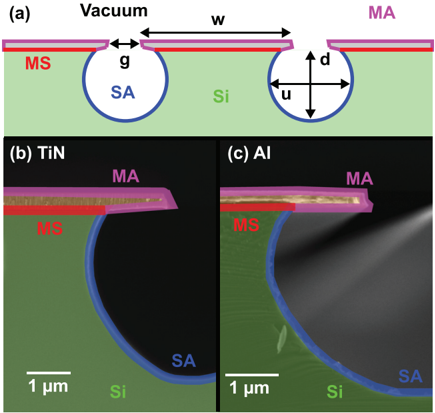
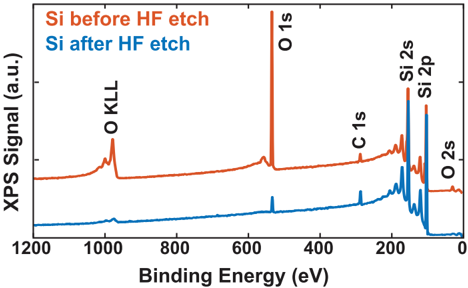
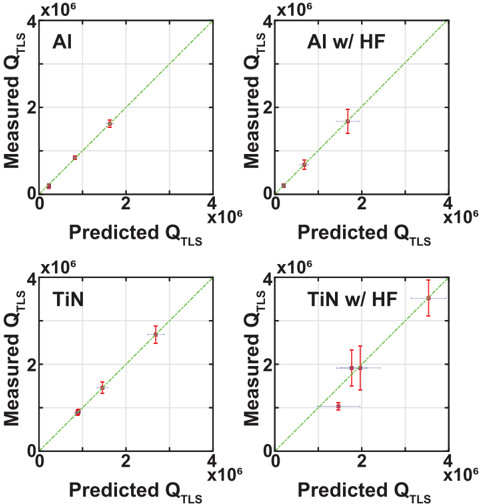
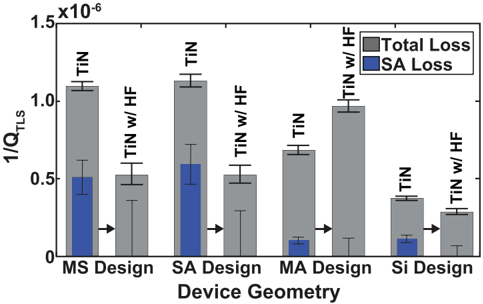
Lossy dielectrics are a significant source of decoherence in superconducting quantum circuits. In this report, we model and compare the dielectric loss in bulk and interfacial dielectrics in titanium nitride (TiN) and aluminum (Al) superconducting coplanar waveguide resonators. We fabricate isotropically trenched resonators to produce a series of device geometries that accentuate a specific dielectric region's contribution to the resonator quality factor. While each dielectric region contributes significantly to loss in TiN devices, the metal–air interface dominates the loss in the Al devices. Furthermore, we evaluate the quality factor of each TiN resonator geometry with and without a post-process hydrofluoric etch and find that it reduced losses from the substrate–air interface, thereby improving the quality factor.
Overview
The claims and statistics of this paper haven’t been checked yet.
Free: it reads the open-access text and checks the first 5 claims that cite a source we can check. Create a free account to check every claim.
Integrity signals
Registry
Cites
Statistics
Figures

Verification
Claims the paper makes
The claims and statistics of this paper haven’t been checked yet.
Free: it reads the open-access text and checks the first 5 claims that cite a source we can check. Create a free account to check every claim.
Claims other papers make about this one
Each is checked against this paper’s own text: does it say what the citing paper says it does?
The cited source says what the claim attributes to it.
In the citing paper
“Under the assumptions made for the interface thicknesses and dielectric constants, the effective interface loss tangent of our devices is , which is slightly better than the equivalently calculated values of for previously reported aluminium on silicon resonators44.”
From Advanced CMOS manufacturing of superconducting qubits on 300 mm wafers (2024) · cites this paper as [44]
Self-check
Percentages, sums and reported differences re-computed from the paper’s own numbers.
The self-check needs the paper’s full text.
Citations
Cites
Decoherence in Josephson Qubits from Dielectric Loss
Martinis, J. M., Cooper, K. B., McDermott, R., Steffen, M., Ansmann, M., Osborn, K. D., Cicak, K., Oh, S., Pappas, D. P., Simmonds, R. W., et al. (2005) · Physical Review Letters · doi:10.1103/physrevlett.95.210503 · Cited by 838
Place, A. P. M., Rodgers, L. V. H., Mundada, P., Smitham, B. M., Fitzpatrick, M., Leng, Z., Premkumar, A., Bryon, J., Vrajitoarea, A., Sussman, S., et al. (2021) · Nature Communications · doi:10.1038/s41467-021-22030-5 · Cited by 563
Towards understanding two-level-systems in amorphous solids: insights from quantum circuits
Müller, C., Cole, J. H., & Lisenfeld, J. (2019) · Reports on Progress in Physics · doi:10.1088/1361-6633/ab3a7e · Cited by 508
Planar superconducting resonators with internal quality factors above one million
Megrant, A., Neill, C., Barends, R., Chiaro, B., Chen, Y., Feigl, L., Kelly, J., Lucero, E., Mariantoni, M., O’Malley, P. J. J., et al. (2012) · Applied Physics Letters · doi:10.1063/1.3693409 · Cited by 481
Surface participation and dielectric loss in superconducting qubits
Wang, C., Axline, C., Gao, Y. Y., Brecht, T., Chu, Y., Frunzio, L., Devoret, M. H., & Schoelkopf, R. J. (2015) · Applied Physics Letters · doi:10.1063/1.4934486 · Cited by 340
Microwave dielectric loss at single photon energies and millikelvin temperatures
O’Connell, A. D., Ansmann, M., Bialczak, R. C., Hofheinz, M., Katz, N., Lucero, E., McKenney, C., Neeley, M., Wang, H., Weig, E. M., et al. (2008) · Applied Physics Letters · doi:10.1063/1.2898887 · Cited by 274
Improved superconducting qubit coherence using titanium nitride
Chang, J. B., Vissers, M. R., Córcoles, A. D., Sandberg, M., Gao, J., Abraham, D. W., Chow, J. M., Gambetta, J. M., Beth Rothwell, M., Keefe, G. A., et al. (2013) · Applied Physics Letters · doi:10.1063/1.4813269 · Cited by 247
Bruno, A., de Lange, G., Asaad, S., van der Enden, K. L., Langford, N. K., & DiCarlo, L. (2015) · Applied Physics Letters · doi:10.1063/1.4919761 · Cited by 239
Surface loss simulations of superconducting coplanar waveguide resonators
Wenner, J., Barends, R., Bialczak, R. C., Chen, Y., Kelly, J., Lucero, E., Mariantoni, M., Megrant, A., O’Malley, P. J. J., Sank, D., et al. (2011) · Applied Physics Letters · doi:10.1063/1.3637047 · Cited by 211
Study of loss in superconducting coplanar waveguide resonators
Sage, J. M., Bolkhovsky, V., Oliver, W. D., Turek, B., & Welander, P. B. (2011) · Journal of Applied Physics · doi:10.1063/1.3552890 · Cited by 210
Self-citation
Cited by
Materials challenges and opportunities for quantum computing hardware
de Leon, N. P., Itoh, K. M., Kim, D., Mehta, K. K., Northup, T. E., Paik, H., Palmer, B. S., Samarth, N., Sangtawesin, S., & Steuerman, D. W. (2021) · Science · doi:10.1126/science.abb2823 · Cited by 710
“For example, direct measurements of dielectric loss-limited resonators can be made more rapidly than full superconducting qubit measurements (60, 348).”
BackgroundSelf-citationQuantum information processing with bosonic qubits in circuit QED
Joshi, A., Noh, K., & Gao, Y. Y. (2021) · Quantum Science and Technology · doi:10.1088/2058-9565/abe989 · Cited by 152
Material matters in superconducting qubits
Murray, C. E. (2021) · Materials Science and Engineering R Reports · doi:10.1016/j.mser.2021.100646 · Cited by 173
Localization and Mitigation of Loss in Niobium Superconducting Circuits
Altoé, M. V. P., Banerjee, A., Berk, C., Hajr, A., Schwartzberg, A., Song, C., Alghadeer, M., Aloni, S., Elowson, M. J., Kreikebaum, J. M., et al. (2022) · PRX Quantum · doi:10.1103/prxquantum.3.020312 · Cited by 119
Investigation of Microwave Loss Induced by Oxide Regrowth in High- Q Niobium Resonators
Verjauw, J., Potočnik, A., Mongillo, M., Acharya, R., Mohiyaddin, F., Simion, G., Pacco, A., Ivanov, T., Wan, D., Vanleenhove, A., et al. (2021) · Physical Review Applied · doi:10.1103/physrevapplied.16.014018 · Cited by 105
“The LER receive a hydrofluoric acid (HF) etch to remove surface oxides [10], followed by a controlled oxide regrowth.”
BackgroundMethodGanjam, S., Wang, Y., Lu, Y., Banerjee, A., Lei, C. U., Krayzman, L., Kisslinger, K., Zhou, C., Li, R., Jia, Y., et al. (2024) · Nature Communications · doi:10.1038/s41467-024-47857-6 · Cited by 93
“Additionally, their sensitivities to particular sources of loss can be tuned by modifying their geometries, a feature that has been heavily utilized in other studies to investigate various sources of loss in thin-fi lm resonators and bulk superconductors 33,38,45 – 47 , 50 – 52 .”
BackgroundResultError per single-qubit gate below 10−4 in a superconducting qubit
Li, Z., Liu, P., Zhao, P., Mi, Z., Xu, H., Liang, X., Su, T., Sun, W., Xue, G., Zhang, J.-N., et al. (2023) · npj Quantum Information · doi:10.1038/s41534-023-00781-x · Cited by 105
Titanium Nitride Film on Sapphire Substrate with Low Dielectric Loss for Superconducting Qubits
Deng, H., Song, Z., Gao, R., Xia, T., Bao, F., Jiang, X., Ku, H.-S., Li, Z., Ma, X., Qin, J., et al. (2023) · Physical Review Applied · doi:10.1103/physrevapplied.19.024013 · Cited by 66
Advanced CMOS manufacturing of superconducting qubits on 300 mm wafers
Van Damme, J., Massar, S., Acharya, R., Ivanov, T., Perez Lozano, D., Canvel, Y., Demarets, M., Vangoidsenhoven, D., Hermans, Y., Lai, J. G., et al. (2024) · Nature · doi:10.1038/s41586-024-07941-9 · Cited by 63
“Projecting the total interface participation to zero yields δ = (1.67±1.69) × 10 0 −7 , comparable with previously reported values for similar Si substrates 43,44 , although here it also includes JJ-induced losses.”
ResultInfluentialFano Interference in Microwave Resonator Measurements
Rieger, D., Günzler, S., Spiecker, M., Nambisan, A., Wernsdorfer, W., & Pop, I. M. (2023) · Physical Review Applied · doi:10.1103/physrevapplied.20.014059 · Cited by 75
Path toward manufacturable superconducting qubits with relaxation times exceeding 0.1 ms
Verjauw, J., Acharya, R., Van Damme, J., Ivanov, T., Lozano, D. P., Mohiyaddin, F. A., Wan, D., Jussot, J., Vadiraj, A. M., Mongillo, M., et al. (2022) · npj Quantum Information · doi:10.1038/s41534-022-00600-9 · Cited by 45
“The MA participation ratio was chosen since its interface was found to dominate microwave loss [52] and generally scales with other interface participation ratios (Supplementary Table 2).”
MethodLozano, D. P., Mongillo, M., Piao, X., Couet, S., Wan, D., Canvel, Y., Vadiraj, A. M., Ivanov, T. T., Verjauw, J., Acharya, R., et al. (2024) · Materials for Quantum Technology · doi:10.1088/2633-4356/ad4b8c · Cited by 47
Surface loss calculations and design of a superconducting transmon qubit with tapered wiring
Martinis, J. M. (2022) · npj Quantum Information · doi:10.1038/s41534-022-00530-6 · Cited by 51
Gao, R., Yu, W., Deng, H., Ku, H., Li, Z., Wang, M., Miao, X., Lin, Y., & Deng, C. (2022) · Physical Review Materials · doi:10.1103/physrevmaterials.6.036202 · Cited by 44
Nitrogen plasma passivated niobium resonators for superconducting quantum circuits
Zheng, K., Kowsari, D., Thobaben, N. J., Du, X., Song, X., Ran, S., Henriksen, E. A., Wisbey, D., & Murch, K. W. (2022) · Applied Physics Letters · doi:10.1063/5.0082755 · Cited by 40
Loss mechanisms in TiN high impedance superconducting microwave circuits
Amin, K. R., Ladner, C., Jourdan, G., Hentz, S., Roch, N., & Renard, J. (2022) · Applied Physics Letters · doi:10.1063/5.0086019 · Cited by 43
Zikiy, E. V., Ivanov, A. I., Smirnov, N. S., Moskalev, D. O., Polozov, V. I., Matanin, A. R., Malevannaya, E. I., Echeistov, V. V., Константинова, Т. Г., & Rodionov, I. A. (2023) · Scientific Reports · doi:10.1038/s41598-023-42332-6 · Cited by 40
Checchin, M., Frolov, D., Lunin, A., Grassellino, A., & Romanenko, A. (2022) · Physical Review Applied · doi:10.1103/physrevapplied.18.034013 · Cited by 33
Strong Kinetic-Inductance Kerr Nonlinearity with Titanium Nitride Nanowires
Joshi, C., Chen, W., LeDuc, H. G., Day, P. K., & Mirhosseini, M. (2022) · Physical Review Applied · doi:10.1103/physrevapplied.18.064088 · Cited by 28
“The narrow-gap capacitor geometry and the resulting large electric fields in our designs make our devices sensitive to TLS loss at interfaces [33, 34].”
BackgroundMagnetic field robust high quality factor NbTiN superconducting microwave resonators
Müller, M., Luschmann, T., Faltermeier, A., Weichselbaumer, S., Koch, L., Huber, G. B. P., Schumacher, H. W., Ubbelohde, N., Reifert, D., Scheller, T., et al. (2022) · Materials for Quantum Technology · doi:10.1088/2633-4356/ac50f8 · Cited by 39
Su, Q.-P., Zhang, Y., & Yang, C. (2022) · Physical Review A · doi:10.1103/physreva.105.062436 · Cited by 25
Wiring surface loss of a superconducting transmon qubit
Smirnov, N. S., Krivko, E. A., Solovyova, A. A., Ivanov, А. I., & Rodionov, I. A. (2024) · Scientific Reports · doi:10.1038/s41598-024-57248-y · Cited by 25
“…participation ratios of qubit components, we consider bulk superconductor and crystal-line dielectric to be lossless ( tan δ i 10 − 8 for silicon 29 and sapphire 30,31 ), so that: In order to mitigate surface dielectric loss in qubits, previous work was primarily focused on capacitor pads…”
BackgroundMethodAcceptor-Induced Bulk Dielectric Loss in Superconducting Circuits on Silicon
Zhang, Z.-H., Godeneli, K., He, J., Odeh, M., Zhou, H., Meesala, S., & Sipahigil, A. (2024) · Physical Review X · doi:10.1103/physrevx.14.041022 · Cited by 36
“High-resistivity ( > 1000 Ω · cm), float-zone (FZ) grown silicon substrates show bulk dielectric loss tangents below 5 × 10 − 7 [24–26], and are a standard choice to realize high-performance superconducting devices.”
BackgroundKowsari, D., Zheng, K., Monroe, J., Thobaben, N. J., Du, X., Harrington, P. M., Henriksen, E. A., Wisbey, D., & Murch, K. W. (2021) · Applied Physics Letters · doi:10.1063/5.0066441 · Cited by 23
Chemical and structural identification of material defects in superconducting quantum circuits
de Graaf, S. E., Un, S., Shard, A. G., & Lindström, T. (2022) · Materials for Quantum Technology · doi:10.1088/2633-4356/ac78ba · Cited by 25
Characterization of Microwave Loss Using Multimode Superconducting Resonators
Lei, C. U., Ganjam, S., Krayzman, L., Banerjee, A., Kisslinger, K., Hwang, S., Frunzio, L., & Schoelkopf, R. J. (2023) · Physical Review Applied · doi:10.1103/physrevapplied.20.024045 · Cited by 18
The Rise of Refractory Transition‐Metal Nitride Films for Advanced Electronics and Plasmonics
Bi, J., Zhang, R., Yao, X., & Cao, Y. (2025) · Advanced Materials Interfaces · doi:10.1002/admi.202500116 · Cited by 18
Su, Q.-P., Bin, L., Zhang, Y., & Yang, C. (2023) · Physical Review A · doi:10.1103/physreva.107.032616 · Cited by 17
Shape optimization of superconducting transmon qubits for low surface dielectric loss
Eun, S., Park, S. H., Seo, K., Choi, K., & Hahn, S. (2023) · Journal of Physics D Applied Physics · doi:10.1088/1361-6463/acf7cf · Cited by 19
Chayanun, L., Biznárová, J., Zeng, L. J., Malmberg, P., Nylander, A., Osman, A., Rommel, M., Tam, P. L., Olsson, E., Delsing, P., et al. (2024) · APL Quantum · doi:10.1063/5.0208140 · Cited by 23
Universal bound on microwave dissipation in superconducting circuits
Charpentier, T., Khvalyuk, A. V., Ioffe, L. B., Feigel’man, M. V., Roch, N., & Sacépé, B. (2026) · Science Advances · doi:10.1126/sciadv.aed3922 · Cited by 16
Argon-Milling-Induced Decoherence Mechanisms in Superconducting Quantum Circuits
Van Damme, J., Ivanov, T., Favia, P., Conard, T., Verjauw, J., Acharya, R., Perez Lozano, D., Raes, B., Van de Vondel, J., Vadiraj, A. M., et al. (2023) · Physical Review Applied · doi:10.1103/physrevapplied.20.014034 · Cited by 14
Compact Superconducting Microwave Resonators Based on Al-AlOx -Al Capacitors
Zotova, J., Wang, R., Semenov, A. V., Zhou, Y., Khrapach, I., Tomonaga, A., Astafiev, O. V., & Tsai, J.-S. (2023) · Physical Review Applied · doi:10.1103/physrevapplied.19.044067 · Cited by 15
300 mm CMOS-compatible superconducting HfN and ZrN thin films for quantum applications
Potjan, R., Wislicenus, M., Ostien, O., Hoffmann, R., Lederer, M., Reck, A., Emara, J., Roy, L., Uhlig, B., & Wosnitza, J. (2023) · Applied Physics Letters · doi:10.1063/5.0176060 · Cited by 15
Tominaga, Y., Shirai, S., Hishida, Y., Terai, H., & Noguchi, A. (2025) · EPJ Quantum Technology · doi:10.1140/epjqt/s40507-025-00367-w · Cited by 18
“This analysis examined PR contributions from three critical interfaces: metal-air (MA), metal-substrate (MS), and substrate-air (SA), following methodologies widely employed in the study of microwave losses in superconducting materials [9, 30–33].”
InfluentialRaniwala, H., Krastanov, S., Hackett, L., Eichenfield, M., Englund, D. R., & Trusheim, M. E. (2023) · Physical Review Applied · doi:10.1103/physrevapplied.19.064051 · Cited by 15
Kar, S., Weiland, C. R., Zhou, C., Bhatia, E., Martinick, B., Nalaskowski, J., Mucci, J., Olson, S., Hung, P. Y., Wells, I., et al. (2023) · Journal of Applied Physics · doi:10.1063/5.0153617 · Cited by 14
“Introduction In recent years, a major component of microwave loss in state-of-the-art quantum devices has been attributed to native oxides that grow on various materials upon exposure to ambient air [1, 2].”
BackgroundPreparation of maximally-entangled states with multiple cat-state qutrits in circuit QED
Yang, C., Ni, J.-H., Bin, L., Zhang, Y., Yu, Y., & Su, Q.-P. (2023) · Frontiers of Physics · doi:10.1007/s11467-023-1357-4 · Cited by 12
Su, Q.-P., Bin, L., Zhang, Y., & Yang, C. (2023) · Applied Physics Letters · doi:10.1063/5.0138627 · Cited by 12
Improving the performance of transmon qubits with fluorine-based surface treatments
Gingras, M., Niedzielski, B. M., Grossklaus, K. A., Miller, D., Contipelli, F., Azar, K., Burkhart, L., Calusine, G., Davis, D., Pinero, R. D., et al. (2026) · Physical Review Applied · doi:10.1103/x1gl-mx6f · Cited by 12
Self-citationHigh resistance of superconducting TiN thin films against environmental attacks
Guo, Z., Ge, M., Zhou, Y.-Q., Bi, J., Zhang, Q., Zhang, J., Ye, J., Zhai, R., Ge, F., Huang, Y., et al. (2024) · Materials Horizons · doi:10.1039/d4mh00959b · Cited by 9
Anomalous Loss Reduction Below Two‐Level System Saturation in Aluminum Superconducting Resonators
Tai, T., Cai, J., & Anlage, S. M. (2023) · Advanced Quantum Technologies · doi:10.1002/qute.202200145 · Cited by 10
Shu, R., Zhang, X., Tasnádi, F., Olovsson, W., Rao, S. G., Greczynski, G., le Febvrier, A., Magnuson, M., & Eklund, P. (2024) · Annalen der Physik · doi:10.1002/andp.202300470 · Cited by 7
Dielectric loss due to charged-defect acoustic phonon emission
Turiansky, M. E., & de Walle, C. G. V. (2024) · APL Quantum · doi:10.1063/5.0205532 · Cited by 8
Chen, J., He, X., Gao, W., Liu, X., Niu, Z., Liu, K., Peng, W., Wang, Z., & Lin, Z. (2025) · Applied Physics Letters · doi:10.1063/5.0258397 · Cited by 6
Physical patterning of high-Q superconducting niobium resonators via ion beam etching
Manzo-Perez, M., Jamalzadeh, M., Nguyen, M., Nadeau, C., Madden, A., Shiravand, I., Kisslinger, K., Tong, X., Sardashti, K., Senatore, M., et al. (2025) · Applied Physics Letters · doi:10.1063/5.0278956 · Cited by 5
Generation of a hybrid W entangled state of three photonic qubits with different encodings
Su, Q.-P., Bin, L., Zhang, Y., Ma, M.-Y., & Yang, C. (2024) · Quantum Information Processing · doi:10.1007/s11128-023-04227-3 · Cited by 5
“Furthermore, a coplanar waveguide microwave resonator with a (load) quality factor Q = 10 6 [59, 60] and a three-dimensional microwave resonator with a (loaded) quality factor Q ≈ 3 .”
Design of Scalable Superconducting Quantum Circuits Using Flip-Chip Assembly
Park, S. H., Baek, D., Park, I., & Hahn, S. (2023) · IEEE Transactions on Applied Superconductivity · doi:10.1109/tasc.2023.3244142 · Cited by 5
“nitride (TiN) on a silicon substrate (Si) as shown in Table I from [28] and [29], respectively.”
MethodQuantum defects from a single surface exhibit strong mutual interactions
Hung, C.-C., Kohler, T., & Osborn, K. D. (2024) · Physical Review Applied · doi:10.1103/physrevapplied.21.044021 · Cited by 6
Efficient preparation of high-dimensional hybrid entangled states in circuit quantum electrodynamics
Lv, W.-C., Zhao, W., Wang, Y., Kang, Y., Feng, W., Zhang, G., Yu, L. Z., Yang, C., & Su, Q.-P. (2025) · Physical Review Applied · doi:10.1103/physrevapplied.23.054037 · Cited by 5
Realization of a hybrid multi-qubit quantum phase gate in circuit QED
Zhang, Y., Su, Q.-P., Kang, Y., Zheng, W., Li, S., Yang, C., & Yu, Y. (2024) · Applied Physics Letters · doi:10.1063/5.0227281 · Cited by 5
Highly crystalline superconducting TiN resonators grown on thermally reconstructed sapphire
Smart, T. J., Neis, M., Lorenz, J., Guardascione, M. P., Hanna, R., Schleenvoigt, M., Gao, Y., Domnick, J., Bennemann, B., Jalil, A. R., et al. (2026) · Superconductor Science and Technology · doi:10.1088/1361-6668/aea939 · Cited by 3
“…resonators are known to be strongly influenced by TLS associated with processed surfaces and interfaces, and recent studies indicate that fabrication conditions and interfacial oxide chemistry can affect microwave loss more strongly than the crystalline orientation of the TiN film itself [48–50].”
Measurement Techniques for Superconducting Microwave Resonators Towards Quantum Device Applications
McRae, C. R. (2022) · IEEE MTT-S International Microwave Symposium digest · doi:10.1109/ims37962.2022.9865517 · Cited by 4
“Interesting such experiments include using 3D cavities with inserted dielectrics to measure cryogenic microwave single photon loss of bare bulk substrates [11], using sets of planar resonators for A/B interface engineering studies [12], [13], and using on-chip resonators to monitor power-independent losses such as tho…”
MethodGarcia, C. A. T., Bailey, N., Kirby, C., Strong, J., Talanov, V. V., Herr, A., & Anlage, S. M. (2024) · Physical Review Applied · doi:10.1103/physrevapplied.21.024056 · Cited by 3
Quantum Voting Machine Encoded with Microwave Photons
张, Y. 钰. Z., 杨, C. 垂. Y., 苏, Q. 奇. S., 康, Y. 逸. K., 郑, W. 文. Z., 李, S. 邵. L., & Yu, Y. (2024) · Chinese Physics Letters · doi:10.1088/0256-307x/41/7/070302 · Cited by 3
Ni, J.-H., Zhang, D.-X., Lv, W.-C., Bin, L., Kang, Y., Su, Q.-P., & Yang, C. (2024) · Applied Physics Letters · doi:10.1063/5.0230436 · Cited by 3
Development of TiN/AlN-Based Superconducting Qubit Components
Schoof, B., Singer, M., Lang, S., Gupta, H. M., Zahn, D., Weber, J., & Tornow, M. (2024) · IEEE International Conference on Quantum Computing and Engineering (QCE) · doi:10.1109/qce60285.2024.00145 · Cited by 3
“Hence, they are slightly higher than those reported in, e.g. [ 14] ( δ i = 0.4 · 10 − 6 to 1.1 · 10 − 6 ).”
InfluentialLuo, Z., Mayer, T., Zahn, D., Guizán, C. M., Weber, J., Lang, S., Bender, H., Schwarzenbach, L., Nebrich, L., Pereira, R. N., et al. (2025) · IEEE Microwave and Wireless Technology Letters · doi:10.1109/lmwt.2025.3559221 · Cited by 2
Scaling superconducting quantum chip with highly integratable quantum building blocks
Cai, X. H., Zhou, B., Wu, Y., Li, S., Dong, Y., Feng, J., & Xiong, K. (2023) · Superconductor Science and Technology · doi:10.1088/1361-6668/acdafe · Cited by 2
“…the surface interfaces or region i in the calculation domain The total loss tangent for these interfaces is, Based on the dielectric-loss model [7, 39] and the two-step finite-element simulation method [43], the PR p i in 3D qubit space can be expressed as: where p i ,int and p i ,peri are the PR…”
Blurred interface induced control of electrical transport properties in Josephson junctions
Qiu, J., Sun, H., Han, C., Ding, X., Zhao, B., Wang, S., Wang, L., & Shan, Z. (2024) · Scientific Reports · doi:10.1038/s41598-024-68285-y · Cited by 2
Surface optimization of superconducting aluminum resonators for robust quantum device fabrication
Lang, S., Eisele, I., Maiwald, A., Music, E., Schwarzenbach, L., Guizán, C. M., Weber, J., Zahn, D., Mayer, T., Pereira, R. N., et al. (2026) · Physical Review Applied · doi:10.1103/mwsd-q1zm · Cited by 1
“Extracted data from publications: light-blue [46], light-yellow [47], green [49], blue [3], brown [12], red [27, 50], purple [27, 51], orange [48]. power direct plasma or remote plasma was applied, which is likely attributed to additional ashing that removes residual resist or polymer contamination.”
Price, N., Londoño, J. D. D. G., Padhye, S., McGinnis, S., Wade, C., Yusuf, H., Don, L. D. M., Eyink, K. G., Back, T. C., Guerrero-Sánchez, J., et al. (2026) · AVS Quantum Science · doi:10.1116/5.0332825 · Cited by 2
Ni, J.-H., Lv, W.-C., Zhang, D.-X., Bin, L., Zhang, Y., Yu, Y., Su, Q.-P., & Yang, C. (2025) · Chinese Journal of Physics · doi:10.1016/j.cjph.2025.01.040 · Cited by 1
α-Ta (111) Thin Films for Qubit Applications: A Study of Thickness Dependence and Universal ScalingPreprint
Price, N., Gutiérrez, J., Padhye, S., McGinnis, S., Wade, C., Yusuf, H., Don, L. D. M., Eyink, K., Guerrero-Sánchez, J., Mikheev, E., et al. (2025) · arXiv (Cornell University) · doi:10.48550/arxiv.2504.01130 · Cited by 2
Precise 2D electric field density simulations for superconducting quantum devicesPreprint
Gimbutas, Z., Syong, W.-R., Nguyen, N., Taylor, A., Ullom, J. N., Alpert, B. K., Bennett, D. A., & McRae, C. R. (2026) · arXiv (Cornell University) · doi:10.48550/arxiv.2607.26242 · Cited by 1
“Because of the resource-intensive nature of these simulations, it is common practice to rely on assumptions of participation linearity with respect to interface dielectric constant and thickness [5, 6, 13], which have not been probed extensively but do not seem to hold generally [14].”
Fabrication of microresonators by using photoresist developer as etchant*
Song, S., Xu, J., Han, Z., Yang, X., Sun, Y.-T., Wang, X., Li, S., Lan, D., Zhao, J., Tan, X., et al. (2021) · Chinese Physics B · doi:10.1088/1674-1056/abf112
Fabrication of superconducting qubits and auxiliary devices with niobium base layer
Su, F., Yang, Z., Zhao, S., Hai-sheng, Y., Tian, Y., & Zhao, S.-P. (2022) · Acta Physica Sinica · doi:10.7498/aps.71.20211865
Scheme of preparing cluster states with cat qubits
Zhu, F., Yu, K.-H., Han, Y., Xue, J.-J., & Li, H. (2024) · New Journal of Physics · doi:10.1088/1367-2630/ad825d · Cited by 1
Transmission of photonic entangled states encoded via eigenstates of photon-number parity operator
Bin, L., Zhang, D.-X., Chen, L., Kang, Y.-H., Zhong, Z., Su, Q.-P., & Yang, C. (2025) · Applied Physics Letters · doi:10.1063/5.0249115
Proposal for implementing quantum walks on multidimensional networks
Su, Q.-P., Shen, R.-Q., Yu, L. Z., Wang, Y., Kang, Y., Shen, L., Feng, W., Zhang, G.-Q., & Yang, C. (2025) · Physical Review A · doi:10.1103/f3kt-qf1d
Noise and dissipation in superconducting granular aluminum circuits
Kristen, M. D. (2023) · Repository KITopen (Karlsruhe Institute of Technology) · doi:10.5445/ir/1000163867 · Cited by 1
Zhang, Q., Bin, L., Zhang, Y., Kong, W.-H., Ni, J.-H., Yu, L. Z., Kang, Y., Su, Q.-P., & Yang, C. (2026) · Physical Review A · doi:10.1103/g2nv-9cy7
Oxide-Nitride Heteroepitaxy for Low-Loss Dielectrics in Superconducting Quantum Circuits
Wetten, D. A. G., Walker, M. J., Lim, P. G., Vallières, A., Jimenez-Guillermo, M. G., Alvarado, M. A., Goronzy, D. P., Grassellino, A., Koch, J., Dravid, V. P., et al. (2026) · ACS Nano · doi:10.1021/acsnano.6c09621
Effect of the Environment on Fluxonium Qubits and Thermodynamics of Quantum Measurement
Stevens, J. (2021) · theses.fr (ABES) · doi:10.70675/45412444z86eaz418fzabfaz7d4012e9145b · Cited by 1
Implementation of deterministic quantum spatial searches in a circuit QED system
Su, Q.-P., Shen, R.-Q., Kang, Y., Shen, L., & Yang, C.-P. (2026) · Science China Information Sciences · doi:10.1007/s11432-025-4566-7
Characterization of aluminum microwave SQUID multiplexers for CE ν NS detection
Amidei, J., Armatol, A., Augier, C., Bailly-Salins, L., Baulieu, G., Bergé, L., Billard, J., Blé, J., Brenot, G., Bres, G., et al. (2026) · Superconductor Science and Technology · doi:10.1088/1361-6668/aeaa8f
“Motivated by these considerations, we report our progress toward developing an aluminum-based µ MUX suitable for the TES readout of Ricochet .”
Self-citation
Metadata
- Authors
- Melville, A., Calusine, G., Woods, W., Serniak, K., Golden, E., Niedzielski, B. M., Kim, D. K., Sevi, A., Yoder, J. L., Dauler, E. A., & Oliver, W. D.
- Affiliations
- MIT Lincoln Laboratory (US)
- Corresponding author
- Melville, A.
- Venue
- Applied Physics Letters
- Publisher
- AIP Publishing
- Published
- 2020-09-21
- Volume
- 117
- Issue
- 12
- ISSN
- 0003-6951 (ISSN-L)
- 1077-3118
- OpenAlex
- W3043049963
- Cited by
- 69
- References
- 26
- Citations by year
- 2026: 7 · 2025: 8 · 2024: 17 · 2023: 18 · 2022: 12 · 2021: 7
- FWCI
- 3.63
- Type
- journal article
- Language
- en
- Open access
- hybrid
- doi.org
- Licence
- cc-by
- creativecommons.org/licenses/by/4.0/ (vor, 2 d)
- creativecommons.org/licenses/by/4.0/ (tdm, 2 d)
- Locations
- Applied Physics Letters (publishedVersion, cc-by)
- arXiv (Cornell University) (submittedVersion)
- arXiv (Cornell University)
- Funders
- U.S. Department of Defense (FA8721-05-C-0002, FA8702-15-D-0001)
- Topics
- Physical Sciences › Physics and Astronomy › Atomic and Molecular Physics, and Optics › Quantum Information and Cryptography
- Physical Sciences › Engineering › Electrical and Electronic Engineering › Superconducting and THz Device Technology
- Physical Sciences › Physics and Astronomy › Atomic and Molecular Physics, and Optics › Mechanical and Optical Resonators
- Keywords
- dielectric loss, titanium nitride, aluminum, superconducting resonators, coplanar waveguide resonators, quality factor, decoherence, metal-air interface, lossy dielectrics, superconducting quantum circuits
About these checks
Registry, retraction, Cites and statistics results are computed, not judged, with one exception: a printed reference that no index lists is read once by a model before it counts as a citation error. Claims are extracted by a model and kept only when their quote appears verbatim in the text; each cited source is then checked, with a model’s help, for whether it says what the claim relies on. Those verdicts can be wrong — read the claim’s quote and the cited source before relying on one.
Statistics and arithmetic are recomputed, not judged.
Confidence bands are shown only for fields calibrated on our annotated test set. None is calibrated yet, so no band is shown.
What counts as a claim ›How we measure confidence ›How we check this ›
Are you an author, or do you see a problem with this page? Request a review
Data sources
Bibliographic data: Semantic Scholar, OpenAlex, Crossref.
Contains information from the Semantic Scholar Academic Graph Datasets, made available under the ODC Attribution License (ODC-BY 1.0).
Semantic Scholar’s data is described in: Kinney, R., et al. (2023). The Semantic Scholar Open Data Platform. arXiv:2301.10140.
