

The DOI matches its Crossref record.
West Nile virus nonstructural protein NS1 inhibits complement activation by binding the regulatory protein factor H
Abstract
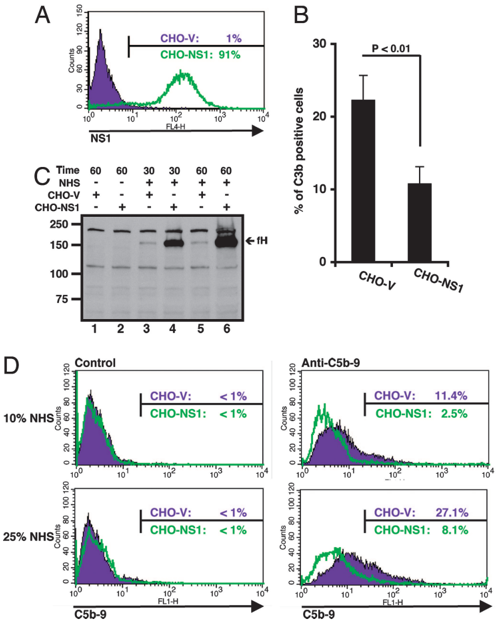
The complement system, by virtue of its dual effector and priming functions, is a major host defense against pathogens. Flavivirus nonstructural protein (NS)-1 has been speculated to have immune evasion activity, because it is a secreted glycoprotein, binds back to cell surfaces, and accumulates to high levels in the serum of infected patients. Herein, we demonstrate an immunomodulatory function of West Nile virus NS1. Soluble and cell-surface-associated NS1 binds to and recruits the complement regulatory protein factor H, resulting in decreased complement activation in solution and attenuated deposition of C3 fragments and C5b–9 membrane attack complexes on cell surfaces. Accordingly, extracellular NS1 may function to minimize immune system targeting of West Nile virus by decreasing complement recognition of infected cells.
Overview
The claims and statistics of this paper haven’t been checked yet.
Run the check — free, no account needed. It reads the open-access text and checks the sources it cites.
Integrity signals
Registry
Cites
Statistics
Figures
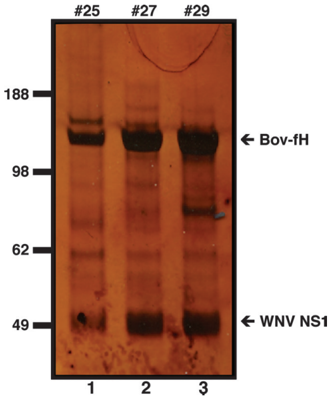
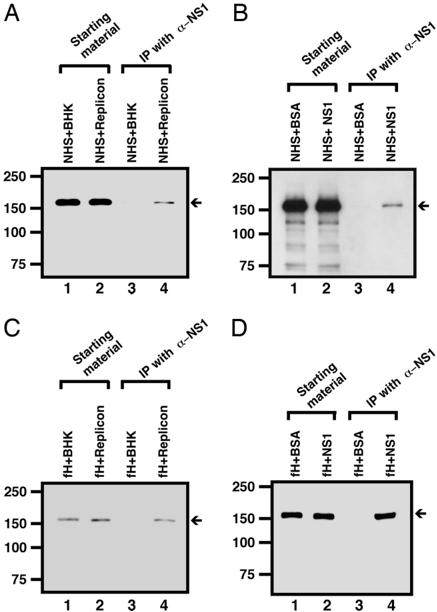
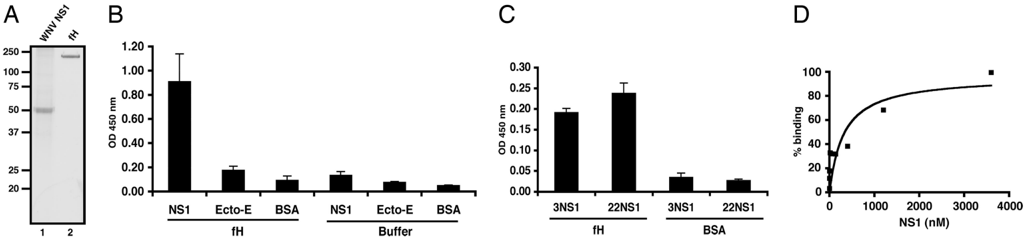
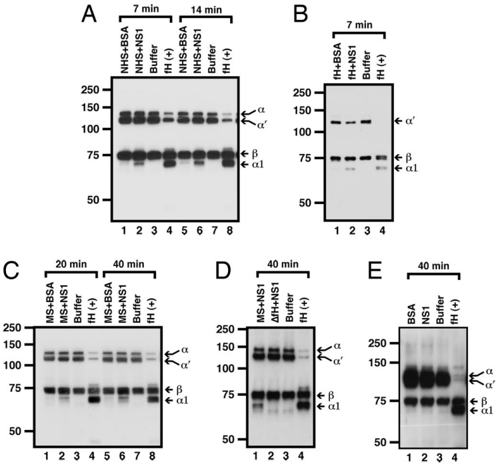
Verification
Claims the paper makes
The claims and statistics of this paper haven’t been checked yet.
Run the check — free, no account needed. It reads the open-access text and checks the sources it cites.
Claims other papers make about this one
Each is checked against this paper’s own text: does it say what the citing paper says it does?
In the citing paper
“The non-structural protein NS1 of the West Nile virus, a flavivirus, inhibits complement activation by binding to CFH[39].”
From miR-155 induction in microglial cells suppresses Japanese encephalitis virus replication and negatively modulates innate immune responses (2014) · cites this paper as [39]
Self-check
Percentages, sums and reported differences re-computed from the paper’s own numbers.
The self-check needs the paper’s full text.
Citations
Cites
No references could be resolved yet.
Research works printed but not linked: 55
- 10.1006/viro.1996.0307 · DOI
- 10.1006/viro.1996.0406 · DOI
- 10.1128/jvi.71.12.9608-9617.1997 · DOI
- 10.1128/JVI.73.12.10272-10280.1999 · DOI
- 10.1016/0042-6822(89)90161-X · DOI
- 10.1016/0042-6822(89)90544-8 · DOI
- 10.1016/0042-6822(88)90408-4 · DOI
- 10.1128/JCM.40.02.376-381.2002 · DOI
- 10.1128/JCM.38.3.1053-1057.2000 · DOI
- 10.1086/343813 · DOI
- 10.1128/JVI.79.22.13924-13933.2005 · DOI
- 10.1086/500949 · DOI
- 10.1086/342600 · DOI
- 10.1007/s007050050127 · DOI
- 10.4049/jimmunol.174.1.395 · DOI
- 10.1002/jmv.10261 · DOI
- 10.4049/jimmunol.169.2.657 · DOI
- 10.1128/JVI.79.17.11403-11411.2005 · DOI
- JE Volanakis Curr Top Microbiol Immunol 266, 41–56 (2002).
- 10.1016/S0167-5699(00)01754-0 · DOI
- 10.1084/jem.190.8.1165 · DOI
- 10.1038/nm0402-373 · DOI
- 10.1073/pnas.96.22.12708 · DOI
- 10.4049/jimmunol.167.5.2446 · DOI
- 10.1128/iai.30.3.899-901.1980 · DOI
- JT Hicks, FA Ennis, E Kim, M Verbonitz J Immunol 121, 1437–1445 (1978). · DOI
- 10.1084/jem.20052388 · DOI
- 10.1128/JVI.79.12.7466-7477.2005 · DOI
- 10.1016/S1074-7613(02)00369-2 · DOI
- 10.1073/pnas.82.5.1490 · DOI
- 10.1084/jem.182.2.501 · DOI
- 10.1006/viro.1998.9205 · DOI
- 10.1016/S0161-5890(99)00038-3 · DOI
- 10.1084/jem.146.1.257 · DOI
- 10.1056/NEJM200104123441506 · DOI
- 10.1056/NEJM200104053441406 · DOI
- 10.1016/S0161-5890(03)00108-1 · DOI
- 10.1016/j.molimm.2005.06.016 · DOI
- 10.1128/JVI.80.3.1340-1351.2006 · DOI
- BJ Geiss, TC Pierson, MS Diamond Virology J 2 53, 1–13 (2005).
- 10.1042/bst0300971 · DOI
- 10.1038/nm1240 · DOI
- MK Liszewski, JP Atkinson J Immunol 156, 4415–4421 (1996). · DOI
- 10.1074/jbc.M004650200 · DOI
- 10.4049/jimmunol.168.12.6298 · DOI
- WE Brandt, D Chiewslip, DL Harris, PK Russell J Immunol 105, 1565–1568 (1970). · DOI
- J Rai, SK Basu, SN Ghosh Indian J Med Res 65, 167–170 (1977).
- 10.1056/NEJM197311082891902 · DOI
- 10.1073/pnas.85.5.1657 · DOI
- 10.4049/jimmunol.172.10.6195 · DOI
- 10.1128/iai.61.8.3129-3136.1993 · DOI
- 10.1084/jem.188.4.671 · DOI
- 10.1099/0022-1317-72-4-961 · DOI
- 10.1021/ac026136s · DOI
- 10.1073/pnas.0402353101 · DOI
Cited by
Sorted by citations
Complement Is an Essential Component of the Immune Response to Adeno-Associated Virus Vectors
Zaiss, A. K., Cotter, M. J., White, L. R., Clark, S. A., Wong, N. C. W., Holers, V. M., Bartlett, J. S., & Muruve, D. A. (2008) · Journal of Virology · doi:10.1128/jvi.01990-07 · Cited by 177
Alternative complement pathway deregulation is correlated with dengue severity
Nascimento, E. J. M., Silva, A. M., Cordeiro, M. T., Brito, C. A., Gil, L. H. V. G., Braga-Neto, U., & Marques, E. T. A. (2009) · PLoS ONE · doi:10.1371/journal.pone.0006782 · Cited by 124
Pareek, S., Roy, S., Kumari, B., Jain, P., Banerjee, A., & Vrati, S. (2014) · Journal of Neuroinflammation · doi:10.1186/1742-2094-11-97 · Cited by 121
Hijacking Factor H for Complement Immune Evasion
Moore, S. R., Menon, S. S., Cortes, C., & Ferreira, V. P. (2021) · Frontiers in Immunology · doi:10.3389/fimmu.2021.602277 · Cited by 83
Ram, S., Shaughnessy, J., DeOliveira, R. B., Lewis, L. A., Gulati, S., & Rice, P. A. (2016) · Immunobiology · doi:10.1016/j.imbio.2016.05.016 · Cited by 35
Metadata
- Authors
- Chung, K. M., Liszewski, M. K., Nybakken, G., Davis, A. E., Townsend, R. R., Fremont, D. H., Atkinson, J. P., & Diamond, M. S.
- Affiliations
- Departments of *Medicine,
- Pathology and Immunology,
- Venue
- Proceedings of the National Academy of Sciences
- Publisher
- National Academy of Sciences
- Published
- 2006-12-12
- Volume
- 103
- Issue
- 50
- Pages
- 19111-19116
- ISSN
- 0027-8424
- 1091-6490
- Cited by
- 238
- References
- 0
- Language
- en
About these checks
Registry, retraction, Cites and statistics results are computed, not judged, with one exception: a printed reference that no index lists is read once by a model before it counts as a citation error. Claims are extracted by a model and kept only when their quote appears verbatim in the text; each cited source is then checked, with a model’s help, for whether it says what the claim relies on. Those verdicts can be wrong — read the claim’s quote and the cited source before relying on one.
Statistics and arithmetic are recomputed, not judged.
Confidence bands are shown only for fields calibrated on our annotated test set. None is calibrated yet, so no band is shown.
What counts as a claim ›How we measure confidence ›How we check this ›
Are you an author, or do you see a problem with this page? Request a review
How to cite
Cite CoChat for the checks on this page, and the paper for its own findings.
- This page
- CoChat. (2026). Citation check: West Nile virus nonstructural protein NS1 inhibits complement activation by binding the regulatory protein factor H. https://app.cochat.ai/papers/10.1073/pnas.0605668103
- The paper
- Chung, K. M., Liszewski, M. K., Nybakken, G., Davis, A. E., Townsend, R. R., Fremont, D. H., Atkinson, J. P., & Diamond, M. S. (2006). West Nile virus nonstructural protein NS1 inhibits complement activation by binding the regulatory protein factor H. Proceedings of the National Academy of Sciences. https://doi.org/10.1073/pnas.0605668103
