

The DOI matches its Crossref record; 49 of the 50 references it cites were found in a registry or an index.
Spectral dynamics of shift current in ferroelectric semiconductor SbSI
Open accessAbstract
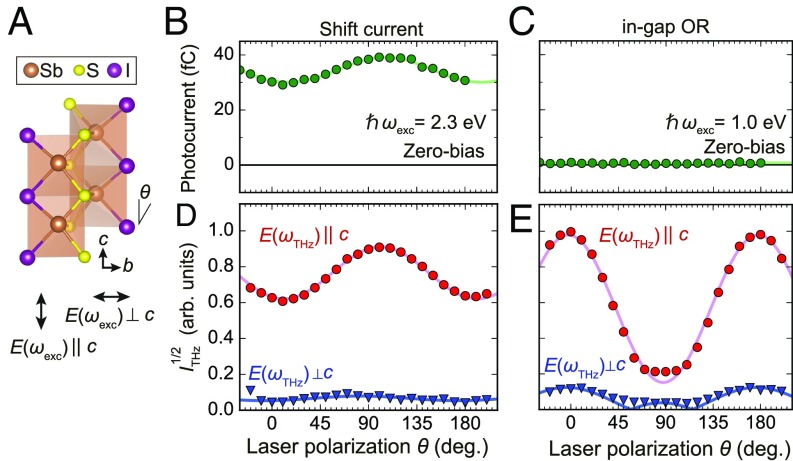
Significance: Shift current is one of the bulk photovoltaic phenomena in the materials without inversion symmetry, originating from the geometric Berry phase of the constituting electron bands. This concept of photocurrent generation based on the real-space shift of the electron cloud on the short timescale of optical transition is distinct from that of conventional p–n junction photovoltaics, where the carriers are driven by the built-in Coulomb potential. We experimentally demonstrate for a ferroelectric polar semiconductor how the subpicosecond charge swing on the relevant chemical bond changes its dynamics while scanning the excitation photon energy across the bandgap. On the interband photoexcitation above the bandgap, a finite net charge flow is produced along the electrically polar direction.
Overview
The claims and statistics of this paper haven’t been checked yet.
Run the check — free, no account needed. It reads the open-access text and checks the sources it cites.
Integrity signals
Registry
Cites
Statistics
Figures
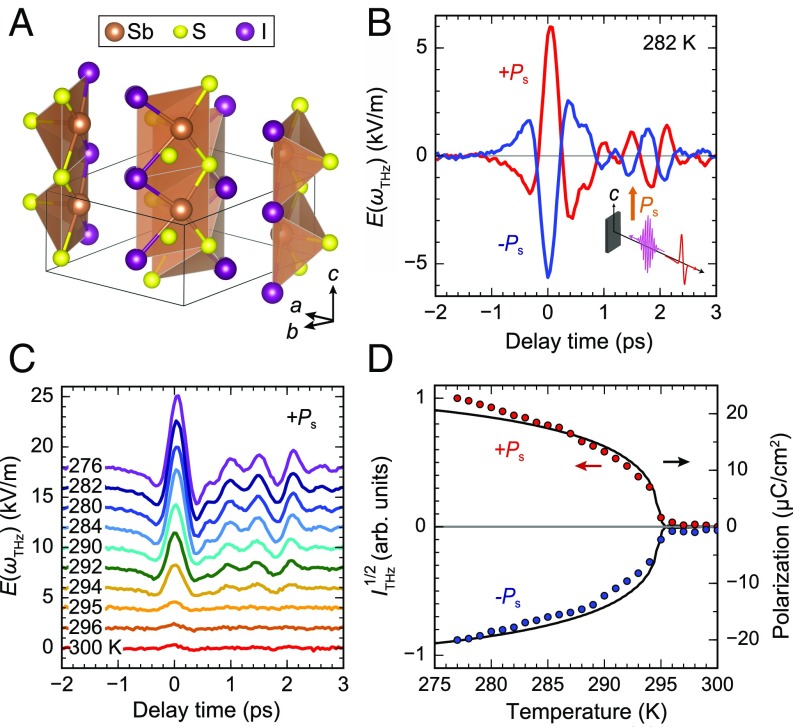
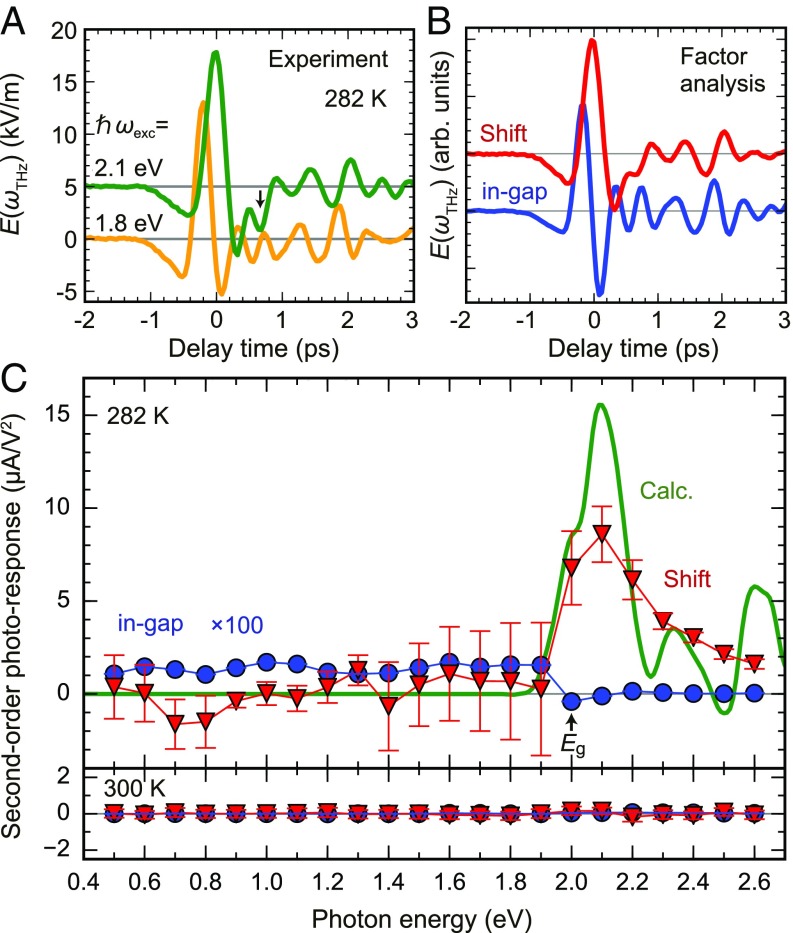
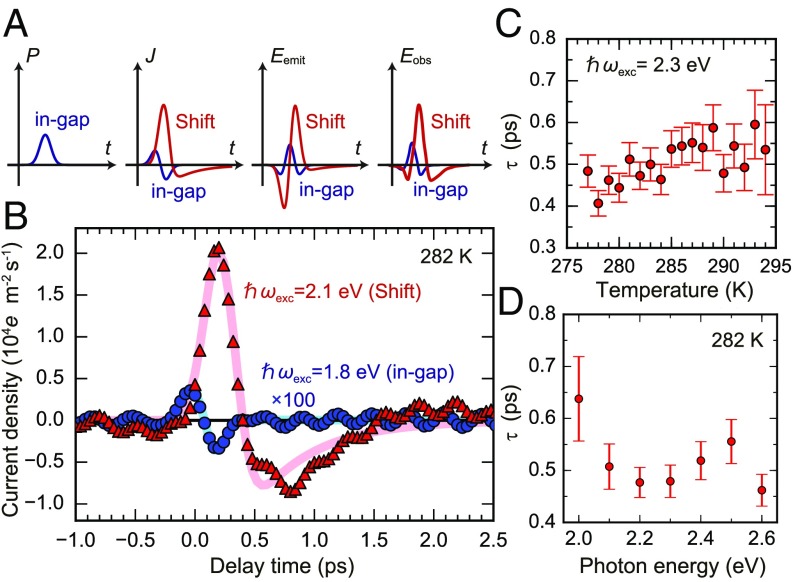
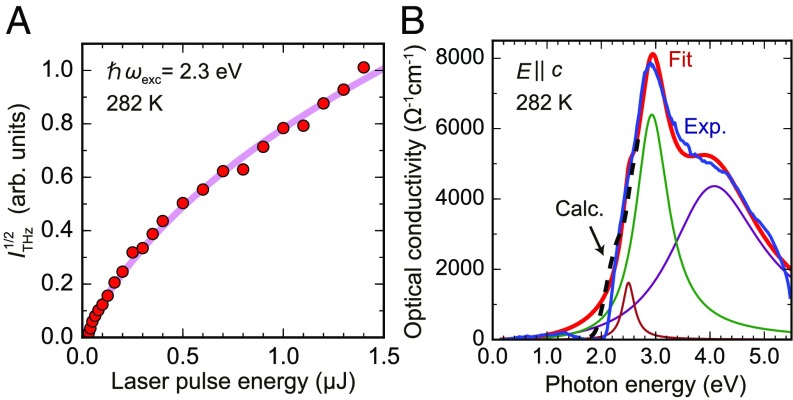
Verification
Claims the paper makes
The claims and statistics of this paper haven’t been checked yet.
Run the check — free, no account needed. It reads the open-access text and checks the sources it cites.
Claims other papers make about this one
Each is checked against this paper’s own text: does it say what the citing paper says it does?
The cited source says what the claim attributes to it.
In the citing paper
“Shift currents, resulting from the real space coherent shift of electron density following photoexcitation42, can be traced to a local geometric property defined by the difference in Berry connection between bands participating in the optical transition86,87.”
From Ultrafast terahertz emission from emerging symmetry-broken materials (2023) · cites this paper as [87]
Self-check
Percentages, sums and reported differences re-computed from the paper’s own numbers.
The self-check needs the paper’s full text.
Citations
Cites
Generalized Gradient Approximation Made Simple
Perdew, J. P., Burke, K., & Ernzerhof, M. (1996) · Physical Review Letters · doi:10.1103/physrevlett.77.3865 · Cited by 215,824
VESTA 3 for three-dimensional visualization of crystal, volumetric and morphology data
Momma, K., & Izumi, F. (2011) · Journal of Applied Crystallography · doi:10.1107/s0021889811038970 · Cited by 26,123
Book Review: Pattern Recognition and Machine Learning
Nasrabadi, N. M. (2007) · Journal of Electronic Imaging · doi:10.1117/1.2819119 · Cited by 22,066
Pattern Recognition and Machine Learning
Neal, R. M. (2007) · Technometrics · doi:10.1198/tech.2007.s518 · Cited by 4,629
Wooten, F., & Davis, S. P. (1973) · American Journal of Physics · doi:10.1119/1.1987434 · Cited by 4,577
Characterizing dissolved organic matter fluorescence with parallel factor analysis: a tutorial
Stedmon, C. A., & Bro, R. (2008) · Limnology and Oceanography Methods · doi:10.4319/lom.2008.6.572 · Cited by 2,824
Full-potential nonorthogonal local-orbital minimum-basis band-structure scheme
Koepernik, K., & Eschrig, H. (1999) · Physical review. B, Condensed matter · doi:10.1103/physrevb.59.1743 · Cited by 2,067
Second-order optical response in semiconductors
Sipe, J. E., & Shkrebtii, A. I. (2000) · Physical Review B · doi:10.1103/physrevb.61.5337 · Cited by 910
First Principles Calculation of the Shift Current Photovoltaic Effect in Ferroelectrics
Young, S. M., & Rappe, A. M. (2012) · Physical Review Letters · doi:10.1103/physrevlett.109.116601 · Cited by 630
The Photovoltaic and Photorefractive Effects in Noncentrosymmetric Materials
Sturman, B. I., & Fridkin, V. M. (2021) · Routledge eBooks · doi:10.1201/9780203743416 · Cited by 582
Photovoltaic effects in BiFeO3
Yang, S., Martin, L. W., Byrnes, S. J., Conry, T. E., Basu, S. R., Paran, D., Reichertz, L. A., Ihlefeld, J. F., Adamo, C., Melville, A. J., et al. (2009) · Applied Physics Letters · doi:10.1063/1.3204695 · Cited by 571
Topological nature of nonlinear optical effects in solids
Morimoto, T., & Nagaosa, N. (2016) · Science Advances · doi:10.1126/sciadv.1501524 · Cited by 569
Self-citationThe photogalvanic effect in media lacking a center of symmetry
Belinicher, V. I., & Sturman, B. I. (1980) · Soviet Physics Uspekhi · doi:10.1070/pu1980v023n03abeh004703 · Cited by 566
Generation of femtosecond electromagnetic pulses from semiconductor surfaces
Zhang, X.-C., Hu, B. B., Darrow, J. T., & Auston, D. H. (1990) · Applied Physics Letters · doi:10.1063/1.102601 · Cited by 538
Theory of the bulk photovoltaic effect in pure crystals
Baltz, R. V., & Kraut, W. (1981) · Physical review. B, Condensed matter · doi:10.1103/physrevb.23.5590 · Cited by 455
Ferroelectric materials for solar energy conversion: photoferroics revisited
Butler, K. T., Frost, J. M., & Walsh, A. (2014) · Energy & Environmental Science · doi:10.1039/c4ee03523b · Cited by 446
Ultrafast electro-optic field sensors
Wu, Q., & Zhang, X. (1996) · Applied Physics Letters · doi:10.1063/1.115665 · Cited by 416
Theory of Polarization: A Modern Approach
Resta, R., & Vanderbilt, D. (2007) · Springer eBooks · doi:10.1007/978-3-540-34591-6_2 · Cited by 404
Shift current bulk photovoltaic effect in polar materials—hybrid and oxide perovskites and beyond
Tan, L. Z., Zheng, F., Young, S. M., Wang, F., Liu, S., & Rappe, A. M. (2016) · npj Computational Materials · doi:10.1038/npjcompumats.2016.26 · Cited by 393
Design principles for shift current photovoltaics
Cook, A. M., Fregoso, B. M., de Juan, F., Coh, S., & Moore, J. E. (2017) · Nature Communications · doi:10.1038/ncomms14176 · Cited by 361
Fridkin, V. M. (1979) · Springer series in solid-state sciences · doi:10.1007/978-3-642-81351-1 · Cited by 316
Fatuzzo, E., Harbeke, G., Merz, W. J., Nitsche, R., Roetschi, H., & Ruppel, W. (1962) · Physical Review · doi:10.1103/physrev.127.2036 · Cited by 266
Ultrafast photocurrents at the surface of the three-dimensional topological insulator Bi2Se3
Braun, L., Mussler, G., Hruban, A., Konczykowski, M., Schumann, T., Wolf, M., Münzenberg, M., Perfetti, L., & Kampfrath, T. (2016) · Nature Communications · doi:10.1038/ncomms13259 · Cited by 236
Shift current photovoltaic effect in a ferroelectric charge-transfer complex
Nakamura, M., Horiuchi, S., Kagawa, F., Ogawa, N., Kurumaji, T., Tokura, Y., & Kawasaki, M. (2017) · Nature Communications · doi:10.1038/s41467-017-00250-y · Cited by 233
Self-citationTHz electromagnetic emission by coherent infrared-active phonons
Dekorsy, T., Auer, H., Bakker, H. J., Roskos, H. G., & Kurz, H. (1996) · Physical review. B, Condensed matter · doi:10.1103/physrevb.53.4005 · Cited by 205
Electrical polarization and orbital magnetization: the modern theories
Resta, R. (2010) · Journal of Physics Condensed Matter · doi:10.1088/0953-8984/22/12/123201 · Cited by 197
Coherent measurement of THz optical rectification from electro-optic crystals
Zhang, X., Jin, Y., & Ma, X. F. (1992) · Applied Physics Letters · doi:10.1063/1.108083 · Cited by 175
Optical rectification and shift currents in GaAs and GaP response: Below and above the band gap
Nastos, F., & Sipe, J. E. (2006) · Physical Review B · doi:10.1103/physrevb.74.035201 · Cited by 151
Anomalous photovoltage in BaTiO 3
Koch, W., Munser, R., Ruppel, W., & Würfel, P. (1976) · Ferroelectrics · doi:10.1080/00150197608236596 · Cited by 137
Rectification and shift currents in GaAs
Côté, D., Laman, N., & van Driel, H. M. (2002) · Applied Physics Letters · doi:10.1063/1.1436530 · Cited by 123
Photogalvanic effect in Weyl semimetals from first principles
Zhang, Y., Ishizuka, H., van den Brink, J., Felser, C., Yan, B., & Nagaosa, N. (2018) · Physical review. B./Physical review. B · doi:10.1103/physrevb.97.241118 · Cited by 117
Self-citationLaman, N., Bieler, M., & van Driel, H. M. (2005) · Journal of Applied Physics · doi:10.1063/1.2131191 · Cited by 95
Shift current in the ferroelectric semiconductor SbSI
Ogawa, N., Sotome, M., Kaneko, Y., Ogino, M., & Tokura, Y. (2017) · Physical review. B./Physical review. B · doi:10.1103/physrevb.96.241203 · Cited by 89
Self-citationTopological aspects of nonlinear excitonic processes in noncentrosymmetric crystals
Morimoto, T., & Nagaosa, N. (2016) · Physical review. B./Physical review. B · doi:10.1103/physrevb.94.035117 · Cited by 85
Self-citationButler, K. T., McKechnie, S., Azarhoosh, P., van Schilfgaarde, M., Scanlon, D. O., & Walsh, A. (2016) · Applied Physics Letters · doi:10.1063/1.4943973 · Cited by 81
Shift charge and spin photocurrents in Dirac surface states of topological insulator
Kim, K. W., Morimoto, T., & Nagaosa, N. (2017) · Physical Review B · doi:10.1103/physrevb.95.035134 · Cited by 79
Self-citationNakamura, M., Kagawa, F., Tanigaki, T., Park, H. S., Matsuda, T., Shindo, D., Tokura, Y., & Kawasaki, M. (2016) · Physical Review Letters · doi:10.1103/physrevlett.116.156801 · Cited by 76
Self-citationUltrafast Zero-Bias Photocurrent in GeS Nanosheets: Promise for Photovoltaics
Kushnir, K., Wang, M., Fitzgerald, P. D., Koski, K. J., & Titova, L. V. (2017) · ACS Energy Letters · doi:10.1021/acsenergylett.7b00330 · Cited by 65
Terahertz electromagnetic pulses as probes for transient velocity overshoot in GaAs and Si
Son, J., Norris, T. B., & Whitaker, J. F. (1994) · Journal of the Optical Society of America B · doi:10.1364/josab.11.002519 · Cited by 49
Current-Voltage Characteristic and Shot Noise of Shift Current Photovoltaics
Morimoto, T., Nakamura, M., Kawasaki, M., & Nagaosa, N. (2018) · Physical Review Letters · doi:10.1103/physrevlett.121.267401 · Cited by 47
Self-citationSimultaneous generation of shift and injection currents in (110)-grown GaAs∕AlGaAs quantum wells
Bieler, M., Pierz, K., & Siegner, U. (2006) · Journal of Applied Physics · doi:10.1063/1.2360380 · Cited by 46
Phonon Influence on Bulk Photovoltaic Effect in the Ferroelectric Semiconductor GeTe
Gong, S., Zheng, F., & Rappe, A. M. (2018) · Physical Review Letters · doi:10.1103/physrevlett.121.017402 · Cited by 46
Quantum kinetic theory of shift-current electron pumping in semiconductors
Král, P. (2000) · Journal of Physics Condensed Matter · doi:10.1088/0953-8984/12/22/317 · Cited by 42
The relation between shift and ballistic currents in the theory of photogalvanic effect
Belinicher, V. I., & Sturman, B. I. (1988) · Ferroelectrics · doi:10.1080/00150198808235446 · Cited by 35
Ab initioapproach to structural, electronic, and ferroelectric properties of antimony sulphoiodide
Amoroso, D., & Picozzi, S. (2016) · Physical review. B./Physical review. B · doi:10.1103/physrevb.93.214106 · Cited by 30
Mics, Z., Němec, H., Rychetský, I., Kužel, P., Formánek, P., Malý, P., & Němec, P. (2011) · Physical Review B · doi:10.1103/physrevb.83.155326 · Cited by 22
Sotome, M., Kida, N., Takeda, R., & Okamoto, H. (2014) · Physical Review A · doi:10.1103/physreva.90.033842 · Cited by 20
Self-citationAnomalous photovoltaic effect in ferroelectric SbSI and cubic piezoelectric ZnS
Fridkin, V. M., & Rodin, A. I. (1980) · physica status solidi (a) · doi:10.1002/pssa.2210610113 · Cited by 18
Kinetic theory of the displacement photovoltaic effect in piezoelectric
Belinicher, V. I., Ivchenko, E. L., & СТУРМАН, Б. И. (1982) · Journal of Experimental and Theoretical Physics · Cited by 17
Cited by
Sorted by citations
Nonreciprocal responses from non-centrosymmetric quantum materials
Tokura, Y., & Nagaosa, N. (2018) · Nature Communications · doi:10.1038/s41467-018-05759-4 · Cited by 694
Self-citationSwitchable magnetic bulk photovoltaic effect in the two-dimensional magnet CrI3
Zhang, Y., Holder, T., Ishizuka, H., de Juan, F., Nagaosa, N., Felser, C., & Yan, B. (2019) · Nature Communications · doi:10.1038/s41467-019-11832-3 · Cited by 208
Self-citationTopology and geometry under the nonlinear electromagnetic spotlight
Ma, Q., Grushin, A. G., & Burch, K. S. (2021) · Nature Materials · doi:10.1038/s41563-021-00992-7 · Cited by 204
Giant topological longitudinal circular photo-galvanic effect in the chiral multifold semimetal CoSi
Ni, Z., Wang, K., Zhang, Y., Pozo, O., Xu, B., Han, X., Manna, K., Paglione, J., Felser, C., Grushin, A. G., et al. (2021) · Nature Communications · doi:10.1038/s41467-020-20408-5 · Cited by 170
Self-citationChiral terahertz wave emission from the Weyl semimetal TaAs
Gao, Y., Kaushik, S., Philip, E. J., Li, Z., Qin, Y., Liu, Y. P., Zhang, W. L., Su, Y. L., Chen, X., Weng, H., et al. (2020) · Nature Communications · doi:10.1038/s41467-020-14463-1 · Cited by 169
Metadata
- Authors
- Sotome, M., Nakamura, M., Fujioka, J., Ogino, M., Kaneko, Y., Morimoto, T., Zhang, Y., Kawasaki, M., Nagaosa, N., Tokura, Y., & Ogawa, N.
- Affiliations
- RIKEN Center for Emergent Matter Science (JP)
- Japan Science and Technology Agency (JP)
- The University of Tokyo (JP)
- University of California, Berkeley (US)
- Leibniz Institute for Solid State and Materials Research (DE)
- Corresponding author
- Sotome, M.
- ORCID
- Venue
- Proceedings of the National Academy of Sciences
- Publisher
- National Academy of Sciences
- Published
- 2019-01-22
- Volume
- 116
- Issue
- 6
- Pages
- 1929-1933
- ISSN
- 0027-8424 (ISSN-L)
- 1091-6490
- PMC
- PMC6369763
- OpenAlex
- W2785837563
- Cited by
- 138
- References
- 50
- Citations by year
- 2026: 16 · 2025: 17 · 2024: 18 · 2023: 14 · 2022: 20 · 2021: 15 · 2020: 25 · 2019: 12
- FWCI
- 7.91
- Type
- journal article
- Language
- en
- Open access
- hybrid
- doi.org
- Licence
- Locations
- Proceedings of the National Academy of Sciences (publishedVersion, cc-by-nc-nd)
- Europe PMC (PubMed Central) (publishedVersion, cc-by-nc-nd)
- PubMed Central (publishedVersion, cc-by-nc-nd)
- PubMed (publishedVersion)
- arXiv (Cornell University) (submittedVersion)
- OSTI OAI (U.S. Department of Energy Office of Scientific and Technical Information) (submittedVersion)
- RENATE (submittedVersion, cc-by-nc-nd)
- MPG.PuRe (Max Planck Society) (submittedVersion)
- arXiv (Cornell University)
- RENATE
- Funders
- MEXT | Japan Society for the Promotion of Science (24224009, 16K13705, 17H02914, 16H00981, 18K14155)
- MEXT | Japan Science and Technology Agency (JPMJPR16R5, JPMJPR15R5, JPMJPR17I3)
- Deutsche Forschungsgemeinschaft (SFB1143)
- Topics
- Physical Sciences › Physics and Astronomy › Condensed Matter Physics › Topological Materials and Phenomena
- Physical Sciences › Engineering › Electrical and Electronic Engineering › Terahertz technology and applications
- Physical Sciences › Physics and Astronomy › Atomic and Molecular Physics, and Optics › Laser-Matter Interactions and Applications
- Keywords
- shift current, ferroelectric semiconductors, Berry connection, terahertz emission, ultrafast electron dynamics, interband transitions, inversion symmetry breaking, photoexcitation, spectral dynamics
About these checks
Registry, retraction, Cites and statistics results are computed, not judged, with one exception: a printed reference that no index lists is read once by a model before it counts as a citation error. Claims are extracted by a model and kept only when their quote appears verbatim in the text; each cited source is then checked, with a model’s help, for whether it says what the claim relies on. Those verdicts can be wrong — read the claim’s quote and the cited source before relying on one.
Statistics and arithmetic are recomputed, not judged.
Confidence bands are shown only for fields calibrated on our annotated test set. None is calibrated yet, so no band is shown.
What counts as a claim ›How we measure confidence ›How we check this ›
Are you an author, or do you see a problem with this page? Request a review
