

The DOI matches its Crossref record; 38 of the 38 references it cites were found in a registry or an index.
Defining a new nomenclature for the structures of active and inactive kinases
Open accessPublished version of a preprint
Abstract
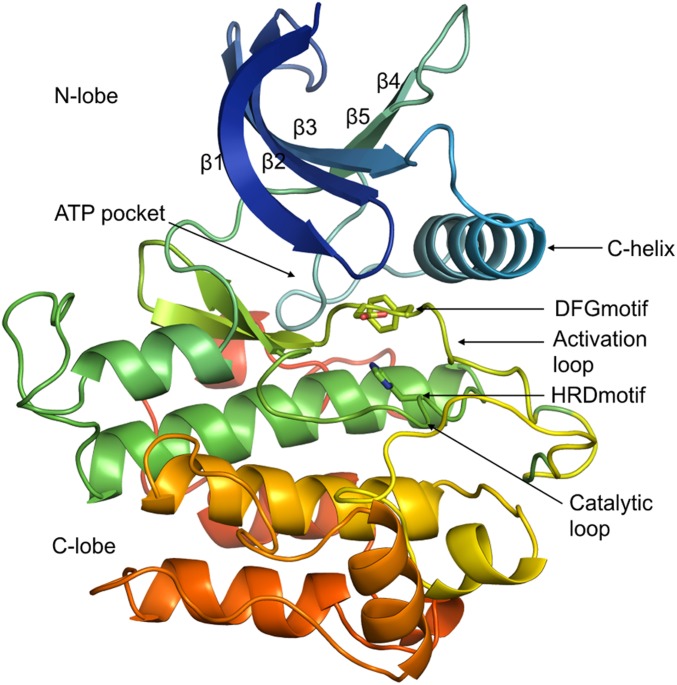
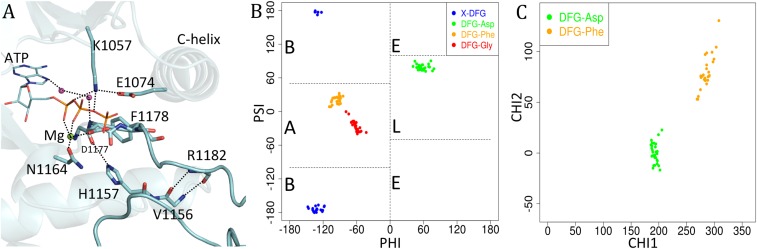
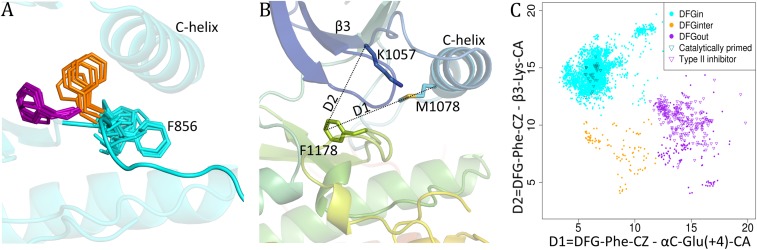
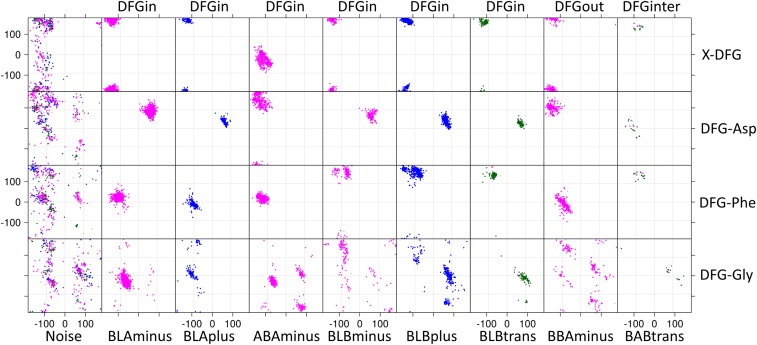
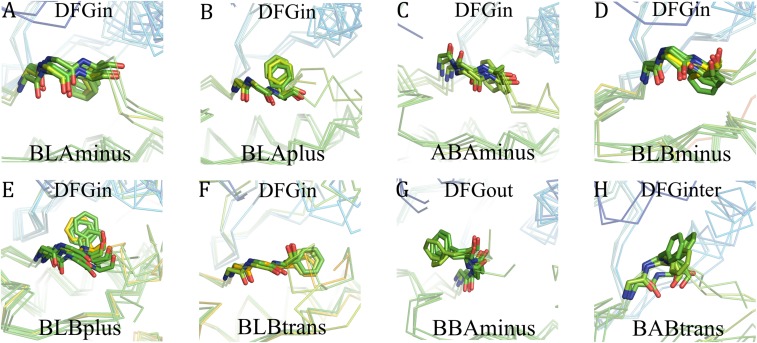
Targeting protein kinases is an important strategy for intervention in cancer. Inhibitors are directed at the active conformation or a variety of inactive conformations. While attempts have been made to classify these conformations, a structurally rigorous catalog of states has not been achieved. The kinase activation loop is crucial for catalysis and begins with the conserved DFGmotif. This motif is observed in two major classes of conformations, DFGin—a set of active and inactive conformations where the Phe residue is in contact with the C-helix of the N-terminal lobe—and DFGout—an inactive form where Phe occupies the ATP site exposing the C-helix pocket. We have developed a clustering of kinase conformations based on the location of the Phe side chain (DFGin, DFGout, and DFGinter or intermediate) and the backbone dihedral angles of the sequence X-D-F, where X is the residue before the DFGmotif, and the DFG-Phe side-chain rotamer, utilizing a density-based clustering algorithm. We have identified eight distinct conformations and labeled them based on the Ramachandran regions (A, alpha; B, beta; L, left) of the XDF motif and the Phe rotamer (minus, plus, trans). Our clustering divides the DFGin group into six clusters including BLAminus, which contains active structures, and two common inactive forms, BLBplus and ABAminus. DFGout structures are predominantly in the BBAminus conformation, which is essentially required for binding type II inhibitors. The inactive conformations have specific features that make them unable to bind ATP, magnesium, and/or substrates. Our structurally intuitive nomenclature will aid in understanding the conformational dynamics of kinases and structure-based development of kinase drugs.
Overview
The claims and statistics of this paper haven’t been checked yet.
Run the check — free, no account needed. It reads the open-access text and checks the sources it cites.
Integrity signals
Registry
Cites
Statistics
Figures

Verification
Claims the paper makes
The claims and statistics of this paper haven’t been checked yet.
Run the check — free, no account needed. It reads the open-access text and checks the sources it cites.
Claims other papers make about this one
Each is checked against this paper’s own text: does it say what the citing paper says it does?
In the citing paper
“However, a protein can exist in one conformation in its “inactive” state and another in its “active” state.53–56”
From AlphaFold 2: Why It Works and Its Implications for Understanding the Relationships of Protein Sequence, Structure, and Function (2021) · cites this paper as [54]
Self-check
Percentages, sums and reported differences re-computed from the paper’s own numbers.
The self-check needs the paper’s full text.
Citations
Cites
Gapped BLAST and PSI-BLAST: a new generation of protein database search programs
Altschul, S. (1997) · Nucleic Acids Research · doi:10.1093/nar/25.17.3389 · Cited by 73,302
PHENIX : a comprehensive Python-based system for macromolecular structure solution
Adams, P. D., Afonine, P. V., Bunkóczi, G., Chen, V. B., Davis, I. W., Echols, N., Headd, J. J., Hung, L.-W., Kapral, G. J., Grosse-Kunstleve, R. W., et al. (2010) · Acta Crystallographica Section D Biological Crystallography · doi:10.1107/s0907444909052925 · Cited by 23,716
(1996) · Cited by 20,179
The protein kinase complement of the human genome
Manning, G., Whyte, D. B., Martinez, R., Hunter, T., & Sudarsanam, S. (2002) · Science · doi:10.1126/science.1075762 · Cited by 8,145
PHENIX: a comprehensive Python-based system for macromolecular structure solution
Adams, P. D., Afonine, P. V., Bunkòczi, G., Chen, V. B., Davis, I., Echols, N., Headd, J. J., Hung, L., Kapral, G. J., Grosse‐Kunstleve, R. W., et al. (2012) · International Tables for Crystallography · doi:10.1107/97809553602060000865 · Cited by 7,334
Mardia, K. V., & Jupp, P. E. (1999) · Wiley series in probability and statistics · doi:10.1002/9780470316979 · Cited by 3,277
Targeting cancer with small molecule kinase inhibitors
Zhang, J., Yang, P. L., & Gray, N. S. (2008) · Nature reviews. Cancer · doi:10.1038/nrc2559 · Cited by 2,648
Satisfying Hydrogen Bonding Potential in Proteins
McDonald, I. K., & Thornton, J. M. (1994) · Journal of Molecular Biology · doi:10.1006/jmbi.1994.1334 · Cited by 2,136
The Conformational Plasticity of Protein Kinases
Huse, M., & Kuriyan, J. (2002) · Cell · doi:10.1016/s0092-8674(02)00741-9 · Cited by 1,760
Proceedings of the Second International Conference on Knowledge Discovery and Data Mining
Simoudis, E., Han, J., & Fayyad, U. M. (1996) · Cited by 1,121
Shapovalov, M. V., & Dunbrack, R. L. (2011) · Structure · doi:10.1016/j.str.2011.03.019 · Cited by 1,000
Self-citationProtein kinases: evolution of dynamic regulatory proteins
Taylor, S. S., & Kornev, A. P. (2010) · Trends in Biochemical Sciences · doi:10.1016/j.tibs.2010.09.006 · Cited by 940
Crystal Structures of c-Src Reveal Features of Its Autoinhibitory Mechanism
Xu, W., Doshi, A. H., Lei, M., Eck, M. J., & Harrison, S. C. (1999) · Molecular Cell · doi:10.1016/s1097-2765(00)80356-1 · Cited by 871
Kornev, A. P., Haste, N. M., Taylor, S. S., & Eyck, L. F. T. (2006) · Proceedings of the National Academy of Sciences · doi:10.1073/pnas.0607656103 · Cited by 766
Through the “Gatekeeper Door”: Exploiting the Active Kinase Conformation
Zuccotto, F., Ardini, E., Casale, E., & Angiolini, M. (2009) · Journal of Medicinal Chemistry · doi:10.1021/jm901443h · Cited by 560
A fresh look at the Ramachandran plot and the occurrence of standard structures in proteins
Hollingsworth, S. A., & Karplus, P. A. (2010) · BioMolecular Concepts · doi:10.1515/bmc.2010.022 · Cited by 448
A new clustering of antibody CDR loop conformations
North, B., Lehmann, A., & Dunbrack, R. L. (2011) · Journal of Molecular Biology · doi:10.1016/j.jmb.2010.10.030 · Cited by 380
Self-citationPISCES: recent improvements to a PDB sequence culling server
Wang, G., & Dunbrack, R. L. (2005) · Nucleic Acids Research · doi:10.1093/nar/gki402 · Cited by 355
Self-citationActivation pathway of Src kinase reveals intermediate states as targets for drug design
Shukla, D., Meng, Y., Roux, B., & Pande, V. S. (2014) · Nature Communications · doi:10.1038/ncomms4397 · Cited by 333
A Src-Like Inactive Conformation in the Abl Tyrosine Kinase Domain
Levinson, N. M., Kuchment, O., Shen, K., Young, M. A., Koldobskiy, M. A., Karplus, M., Cole, P. A., & Kuriyan, J. (2006) · PLoS Biology · doi:10.1371/journal.pbio.0040144 · Cited by 312
KLIFS: A Knowledge-Based Structural Database To Navigate Kinase–Ligand Interaction Space
van Linden, O. P. J., Kooistra, A. J., Leurs, R., de Esch, I. J. P., & de Graaf, C. (2013) · Journal of Medicinal Chemistry · doi:10.1021/jm400378w · Cited by 310
Protein kinase inhibitors: contributions from structure to clinical compounds
Johnson, L. N. (2009) · Quarterly Reviews of Biophysics · doi:10.1017/s0033583508004745 · Cited by 264
Transitions to catalytically inactive conformations in EGFR kinase
Shan, Y., Arkhipov, A. S., Kim, E. T., Pan, A. C., & Shaw, D. E. (2013) · Proceedings of the National Academy of Sciences · doi:10.1073/pnas.1220843110 · Cited by 217
Yang, S., Banavali, N. K., & Roux, B. (2009) · Proceedings of the National Academy of Sciences · doi:10.1073/pnas.0808261106 · Cited by 115
The ABC of protein kinase conformations
Möbitz, H. (2015) · Biochimica et Biophysica Acta (BBA) - Proteins and Proteomics · doi:10.1016/j.bbapap.2015.03.009 · Cited by 105
Redefining the Protein Kinase Conformational Space with Machine Learning
Ung, P. M. U., Rahman, R., & Schlessinger, A. (2018) · Cell chemical biology · doi:10.1016/j.chembiol.2018.05.002 · Cited by 104
Dodson, C. A., Kosmopoulou, M. N., Richards, M. W., Atrash, B., Bavetsias, V., Blagg, J., & Bayliss, R. W. (2010) · Biochemical Journal · doi:10.1042/bj20091530 · Cited by 96
A new clustering and nomenclature for beta turns derived from high-resolution protein structures
Shapovalov, M. V., Vučetić, S., & Dunbrack, R. L. (2019) · PLoS Computational Biology · doi:10.1371/journal.pcbi.1006844 · Cited by 94
Self-citationExposing Hidden Alternative Backbone Conformations in X-ray Crystallography Using qFit
Keedy, D. A., Fraser, J. S., & van den Bedem, H. (2015) · PLoS Computational Biology · doi:10.1371/journal.pcbi.1004507 · Cited by 93
Estimating Electron Density Support for Individual Atoms and Molecular Fragments in X-ray Structures
Meyder, A., Nittinger, E., Lange, G., Klein, R., & Rarey, M. (2017) · Journal of Chemical Information and Modeling · doi:10.1021/acs.jcim.7b00391 · Cited by 86
Jacobs, M. D., Caron, P. R., & Hare, B. J. (2007) · Proteins Structure Function and Bioinformatics · doi:10.1002/prot.21633 · Cited by 84
Brooijmans, N., Chang, Y., Mobilio, D., Denny, R. A., & Humblet, C. C. (2010) · Protein Science · doi:10.1002/pro.355 · Cited by 52
Tong, M., Pelton, J., Gill, M. L., Zhang, W., Picart, F., & Seeliger, M. A. (2017) · Nature Communications · doi:10.1038/s41467-017-02240-6 · Cited by 49
Grossi, V., Liuzzi, M., Murzilli, S., Martelli, N., Napoli, A., Ingravallo, G., Río, A. D., & Simone, C. (2012) · Cancer Biology & Therapy · doi:10.4161/cbt.22254 · Cited by 32
Detection oftrans–cisflips and peptide-plane flips in protein structures
Touw, W. G., Joosten, R. P., & Vriend, G. (2015) · Acta Crystallographica Section D Biological Crystallography · doi:10.1107/s1399004715008263 · Cited by 26
Chiu, Y.-Y., Lin, C.-T., Huang, J.-W., Hsu, K., Tseng, J.-H., You, S.-R., & Yang, J. (2012) · Nucleic Acids Research · doi:10.1093/nar/gks1218 · Cited by 26
Dixit, A., & Verkhivker, G. M. (2012) · Journal of Chemical Information and Modeling · doi:10.1021/ci3002638 · Cited by 25
Ung, P. M. U., & Schlessinger, A. (2015) · Biophysical Journal · doi:10.1016/j.bpj.2014.11.2590 · Cited by 3
Cited by
Sorted by citations
AlphaFill: enriching AlphaFold models with ligands and cofactors
Hekkelman, M. L., de Vries, I., Joosten, R. P., & Perrakis, A. (2023) · Nature Methods · doi:10.1038/s41592-022-01685-y · Cited by 511
Properties of FDA-approved small molecule protein kinase inhibitors: A 2024 update
Roskoski, R. J. (2024) · Pharmacological Research · doi:10.1016/j.phrs.2024.107059 · Cited by 418
Properties of FDA-approved small molecule protein kinase inhibitors: A 2023 update
Roskoski, R. J. (2022) · Pharmacological Research · doi:10.1016/j.phrs.2022.106552 · Cited by 326
Skolnick, J., Gao, M., Zhou, H., & Singh, S. (2021) · Journal of Chemical Information and Modeling · doi:10.1021/acs.jcim.1c01114 · Cited by 251
Structural features of the protein kinase domain and targeted binding by small-molecule inhibitors
Arter, C., Trask, L., Ward, S., Yeoh, S., & Bayliss, R. W. (2022) · Journal of Biological Chemistry · doi:10.1016/j.jbc.2022.102247 · Cited by 238
Metadata
- Authors
- Modi, V., & Dunbrack, R. L.
- Affiliations
- Fox Chase Cancer Center (US)
- Corresponding author
- Dunbrack, Roland L.
- Venue
- Proceedings of the National Academy of Sciences
- Publisher
- National Academy of Sciences
- Published
- 2019-03-13
- Volume
- 116
- Issue
- 14
- Pages
- 6818-6827
- ISSN
- 0027-8424 (ISSN-L)
- 1091-6490
- PMC
- PMC6452665
- OpenAlex
- W2922340164
- Cited by
- 367
- References
- 38
- Citations by year
- 2026: 54 · 2025: 44 · 2024: 65 · 2023: 68 · 2022: 48 · 2021: 48 · 2020: 33 · 2019: 6
- FWCI
- 11.16
- Type
- journal article
- Language
- en
- Open access
- hybrid
- doi.org
- Licence
- Locations
- Proceedings of the National Academy of Sciences (publishedVersion, cc-by-nc-nd)
- bioRxiv (Cold Spring Harbor Laboratory) (acceptedVersion, cc-by-nc)
- Europe PMC (PubMed Central) (publishedVersion, cc-by-nc-nd)
- PubMed Central (publishedVersion, cc-by-nc-nd)
- PubMed (publishedVersion)
- Funders
- HHS | NIH | National Institute of General Medical Sciences (R35 GM122517)
- Topics
- Life Sciences › Biochemistry, Genetics and Molecular Biology › Molecular Biology › Protein Structure and Dynamics
- Life Sciences › Biochemistry, Genetics and Molecular Biology › Molecular Biology › Protein Kinase Regulation and GTPase Signaling
- Life Sciences › Biochemistry, Genetics and Molecular Biology › Structural Biology › Enzyme Structure and Function
- Keywords
- protein kinases, DFG motif, kinase activation loop, kinase inhibitors, backbone dihedral angles, density-based clustering, structure-based drug design, type II kinase inhibitors
- MeSH terms
- Algorithms, Models, Molecular, Terminology as Topic, Protein Kinases, Substrate Specificity, Protein Structure, Secondary, Catalytic Domain, Protein Kinase Inhibitors
About these checks
Registry, retraction, Cites and statistics results are computed, not judged, with one exception: a printed reference that no index lists is read once by a model before it counts as a citation error. Claims are extracted by a model and kept only when their quote appears verbatim in the text; each cited source is then checked, with a model’s help, for whether it says what the claim relies on. Those verdicts can be wrong — read the claim’s quote and the cited source before relying on one.
Statistics and arithmetic are recomputed, not judged.
Confidence bands are shown only for fields calibrated on our annotated test set. None is calibrated yet, so no band is shown.
What counts as a claim ›How we measure confidence ›How we check this ›
Are you an author, or do you see a problem with this page? Request a review
