

Risk attitudes and personality traits of entrepreneurs and venture team members
Open accessThe DOI matches its Crossref record; 18 of the 18 references it cites were found in a registry or an index.
Abstract
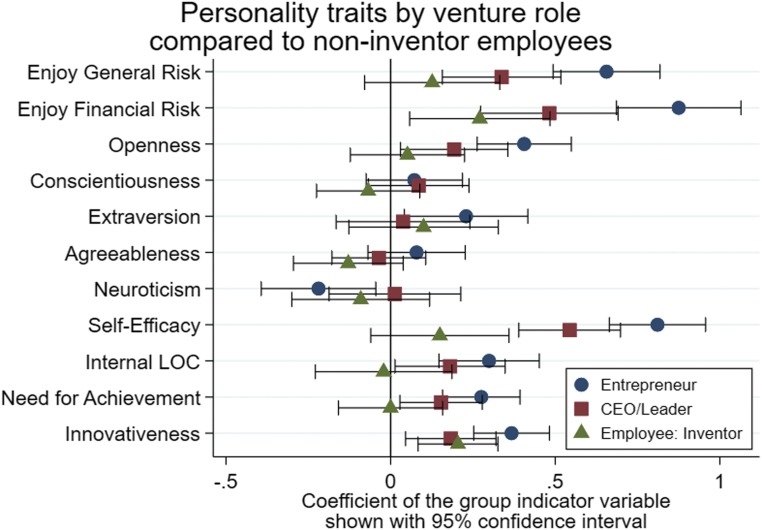
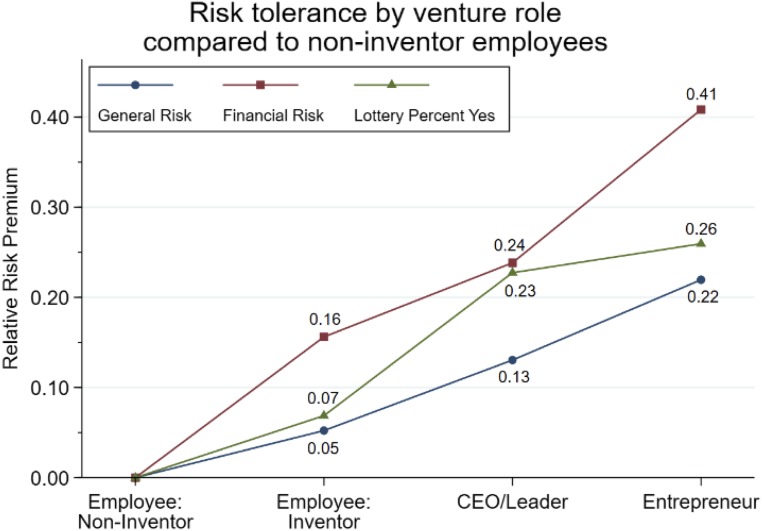
Significance: We quantify personality traits and risk tolerances among entrepreneurs and their venture team members using a unique and in-depth survey of multiple locations of an innovation and coworking center. Our survey captures respondents’ own perceptions of their personality traits and an observational assessment of their risk tolerance via a prize lottery. These detailed profiles allow us to describe similarities and differences between entrepreneurs, nonfounder CEOs/leaders, inventor employees, and noninventor employees. This survey provides a characterization of these different personality profiles in innovative firms and environments that have all roles present and thus controlling for confounding environment factors.
Overview
The claims and statistics of this paper haven’t been checked yet.
Free: it reads the open-access text and checks the first 5 claims that cite a source we can check. Create a free account to check every claim.
Integrity signals
Registry
Cites
Statistics
Figures
Verification
Claims the paper makes
The claims and statistics of this paper haven’t been checked yet.
Free: it reads the open-access text and checks the first 5 claims that cite a source we can check. Create a free account to check every claim.
Claims other papers make about this one
Each is checked against this paper’s own text: does it say what the citing paper says it does?
In the citing paper
“and starting a business is often correlated with risk tolerance (Kerr et al., 2019).”
From Double-edged sword: persistent effects of Communist regime affiliations on well-being and preferences (2023) · doi:10.1007/s00148-022-00930-0 · cites this paper as Kerr et al., 2019
Self-check
Percentages, sums and reported differences re-computed from the paper’s own numbers.
The self-check needs the paper’s full text.
Citations
Cites
A General Equilibrium Entrepreneurial Theory of Firm Formation Based on Risk Aversion
Kihlstrom, R. E., & Laffont, J.-J. (1979) · Journal of Political Economy · doi:10.1086/260790 · Cited by 1,917
The Economics of Entrepreneurship
Parker, S. C. (2009) · Cambridge University Press eBooks · doi:10.1017/cbo9780511817441 · Cited by 1,176
Smart and Illicit: Who Becomes an Entrepreneur and Do They Earn More?*
Levine, R., & Rubinstein, Y. (2017) · The Quarterly Journal of Economics · doi:10.1093/qje/qjw044 · Cited by 792
Entrepreneurship as Experimentation
Kerr, W. R., Nanda, R., & Rhodes-Kropf, M. (2014) · Journal of Economic Perspectives · doi:10.1257/jep.28.3.25 · Cited by 704
Self-citationPersonality Traits of Entrepreneurs: A Review of Recent Literature
Kerr, S. P., Kerr, W. R., & Xu, T. (2018) · Foundations and Trends® in Entrepreneurship · doi:10.1561/0300000080 · Cited by 548
Self-citationHurst, E., & Pugsley, B. W. (2011) · National Bureau of Economic Research · doi:10.3386/w17041 · Cited by 431
Hurst, E., & Pugsley, B. W. (2011) · Brookings Papers on Economic Activity · doi:10.1353/eca.2011.0017 · Cited by 405
The rise of coworking spaces: a literature review
Gandini, A. (2015) · Archivio Istituzionale della Ricerca (Universita Degli Studi Di Milano) · Cited by 372
Seeking the Roots of Entrepreneurship: Insights from Behavioral Economics
Åstebro, T., Herz, H., Nanda, R., & Weber, R. A. (2014) · Journal of Economic Perspectives · doi:10.1257/jep.28.3.49 · Cited by 326
Who Becomes an Inventor in America? The Importance of Exposure to Innovation
Bell, A., Chetty, R., Jaravel, X., Petkova, N., & Van Reenen, J. (2017) · National Bureau of Economic Research · doi:10.3386/w24062 · Cited by 287
Risk tolerance and entrepreneurship
Hvide, H. K., & Panos, G. A. (2014) · Journal of Financial Economics · doi:10.1016/j.jfineco.2013.06.001 · Cited by 239
Roach, M., & Sauermann, H. (2015) · Management Science · doi:10.1287/mnsc.2014.2100 · Cited by 193
The Social Origins of Inventors
Aghion, P., Akcigit, U., Hyytinen, A., & Toivanen, O. (2017) · National Bureau of Economic Research · doi:10.3386/w24110 · Cited by 102
The Gift of Global Talent: How Migration Shapes Business, Economy & Society
Kerr, W. R. (2018) · Cited by 78
Self-citationUusitalo, R. (2001) · Applied Economics · doi:10.1080/00036840010015778 · Cited by 70
The Gift of Global Talent: How Migration Shapes Business, Economy & Society
Kerr, W. R. (2020) · Stanford University Press eBooks · doi:10.1515/9781503607361 · Cited by 53
Self-citationFranco, A. M., Liu, S., Marinoni, A., Huber, L. R., & Yu, S. (2019) · Academy of Management Proceedings · doi:10.5465/ambpp.2019.19060symposium · Cited by 52
Fire in the Belly? Employee Motives and Innovative Performance in Startups versus Established Firms
Sauermann, H. (2017) · National Bureau of Economic Research · doi:10.3386/w23099 · Cited by 16
Research works printed but not linked: 1
- Kerr W. R., Kerr S., Brownell A., “CIC: Catalyzing entrepreneurial ecosystems (A)” (HBS No. N-817-126, Harvard Business School Publishing, Cambridge, MA, 2017).
Cited by
Personality trait differences across types of entrepreneurs: a systematic literature review
Salmony, F. U., & Kanbach, D. K. (2021) · Review of Managerial Science · doi:10.1007/s11846-021-00466-9 · Cited by 197
Immigrant entrepreneurship in America: Evidence from the survey of business owners 2007 & 2012
Pekkala Kerr, S., & Kerr, W. (2020) · Research Policy · doi:10.1016/j.respol.2019.103918 · Cited by 127
Self-citationWennberg, K. J., & Sandström, C. (2022) · International studies in entrepreneurship · doi:10.1007/978-3-030-94273-1 · Cited by 130
The Entrepreneurial Story and its Implications for Research
Brattström, A., & Wennberg, K. J. (2021) · Entrepreneurship Theory and Practice · doi:10.1177/10422587211053802 · Cited by 123
Emotional skills for entrepreneurial success: the promise of entrepreneurship education and policy
Aly, M., Audretsch, D. B., & Grimm, H. (2021) · The Journal of Technology Transfer · doi:10.1007/s10961-021-09866-1 · Cited by 115
Metadata
- Authors
- Kerr, S. P., Kerr, W. R., & Dalton, M.
- Affiliations
- National Bureau of Economic Research (US)
- Harvard University (US)
- Corresponding author
- Kerr, Sari Pekkala
- Venue
- Proceedings of the National Academy of Sciences
- Publisher
- National Academy of Sciences
- Published
- 2019-08-19
- Volume
- 116
- Issue
- 36
- Pages
- 17712-17716
- ISSN
- 0027-8424 (ISSN-L)
- 1091-6490
- PMC
- PMC6731656
- OpenAlex
- W2969858930
- Cited by
- 87
- References
- 18
- Citations by year
- 2026: 7 · 2025: 12 · 2024: 12 · 2023: 13 · 2022: 19 · 2021: 16 · 2020: 6 · 2019: 2
- FWCI
- 18.08
- Type
- journal article
- Language
- en
- Open access
- hybrid
- doi.org
- Licence
- Locations
- Proceedings of the National Academy of Sciences (publishedVersion, cc-by)
- PubMed Central (publishedVersion, cc-by)
- PubMed (publishedVersion)
- RePEc: Research Papers in Economics (submittedVersion)
- Funders
- National Science Foundation (1461935)
- Smith Richardson Foundation (20150790)
- Topics
- Social Sciences › Business, Management and Accounting › Management of Technology and Innovation › Entrepreneurship Studies and Influences
- Social Sciences › Psychology › Clinical Psychology › Personality Traits and Psychology
- Social Sciences › Decision Sciences › General Decision Sciences › Decision-Making and Behavioral Economics
- Keywords
- risk preferences, personality traits, entrepreneurs, self-efficacy, locus of control, need for achievement, innovative personality, coworking spaces, innovative firms
- MeSH terms
- Achievement, Adult, Attitude, Female, Humans, Leadership, Male, Middle Aged, Self Efficacy
About these checks
Registry, retraction, Cites and statistics results are computed, not judged, with one exception: a printed reference that no index lists is read once by a model before it counts as a citation error. Claims are extracted by a model and kept only when their quote appears verbatim in the text; each cited source is then checked, with a model’s help, for whether it says what the claim relies on. Those verdicts can be wrong — read the claim’s quote and the cited source before relying on one.
Statistics and arithmetic are recomputed, not judged.
Confidence bands are shown only for fields calibrated on our annotated test set. None is calibrated yet, so no band is shown.
What counts as a claim ›How we measure confidence ›How we check this ›
Are you an author, or do you see a problem with this page? Request a review
Data sources
Bibliographic data: Semantic Scholar, OpenAlex, Crossref.
Contains information from the Semantic Scholar Academic Graph Datasets, made available under the ODC Attribution License (ODC-BY 1.0).
Semantic Scholar’s data is described in: Kinney, R., et al. (2023). The Semantic Scholar Open Data Platform. arXiv:2301.10140.
