

The DOI matches its Crossref record; 48 of the 49 references it cites were found in a registry or an index.
Vulnerable robots positively shape human conversational dynamics in a human–robot team
Open accessAbstract
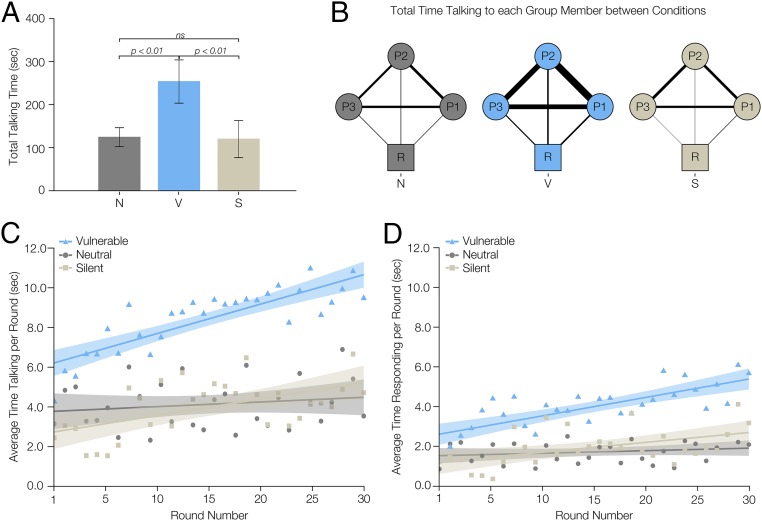
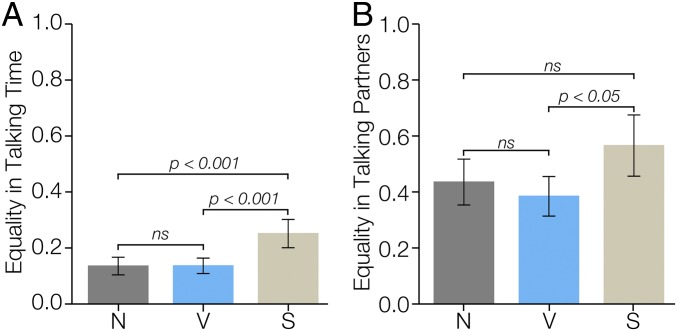
Social robots are becoming increasingly influential in shaping the behavior of humans with whom they interact. Here, we examine how the actions of a social robot can influence human-to-human communication, and not just robot–human communication, using groups of three humans and one robot playing 30 rounds of a collaborative game ( n = 51 groups). We find that people in groups with a robot making vulnerable statements converse substantially more with each other, distribute their conversation somewhat more equally, and perceive their groups more positively compared to control groups with a robot that either makes neutral statements or no statements at the end of each round. Shifts in robot speech have the power not only to affect how people interact with robots, but also how people interact with each other, offering the prospect for modifying social interactions via the introduction of artificial agents into hybrid systems of humans and machines.
Overview
The claims and statistics of this paper haven’t been checked yet.
Run the check — free, no account needed. It reads the open-access text and checks the sources it cites.
Integrity signals
Registry
Cites
Statistics
Figures
Verification
Claims the paper makes
The claims and statistics of this paper haven’t been checked yet.
Run the check — free, no account needed. It reads the open-access text and checks the sources it cites.
Claims other papers make about this one
Each is checked against this paper’s own text: does it say what the citing paper says it does?
In the citing paper
“Conversely, Traeger et al. find automated agents that are trained to perform poorly at collaborative tasks can actually improve the behavior of human team members (29).”
From Can Generative AI improve social science? (2024) · cites this paper as [29]
Self-check
Percentages, sums and reported differences re-computed from the paper’s own numbers.
The self-check needs the paper’s full text.
Citations
Cites
Advances In Experimental Social Psychology
(2022) · Advances in experimental social psychology · doi:10.1016/s0065-2601(22)x0002-6 · Cited by 22,559
Psychological Safety and Learning Behavior in Work Teams
Edmondson, A. (1999) · Administrative Science Quarterly · doi:10.2307/2666999 · Cited by 12,026
An integrative model of organizational trust
Mayer, R. C., Davis, J. H., & Schoorman, F. D. (1995) · The Academy of Management Review · doi:10.2307/258792 · Cited by 10,736
Big Data : The Management Revolution
マカフィー, ア., ブリニョルフソン, エ., & 有賀, 裕. (2013) · Harvard business review · Cited by 3,545
The ripple effect: emotional contagion and its influence on group behavior
Barsade, S. G. (2002) · Administrative Science Quarterly · doi:10.2307/3094912 · Cited by 3,361
A 61-million-person experiment in social influence and political mobilization
Bond, R. M., Fariss, C. J., Jones, J. J., Kramer, A. D. I., Marlow, C., Settle, J. E., & Fowler, J. H. (2012) · Nature · doi:10.1038/nature11421 · Cited by 2,575
The experience and evolution of trust: Implications for cooperation and teamwork
Jones, G. R., & George, J. M. (1998) · The Academy of Management Review · doi:10.2307/259293 · Cited by 2,135
Rahwan, I., Cebrian, M., Obradovich, N., Bongard, J., Bonnefon, J.-F., Breazeal, C., Crandall, J. W., Christakis, N. A., Couzin, I. D., Jackson, M. O., et al. (2019) · Nature · doi:10.1038/s41586-019-1138-y · Cited by 1,364 · cited 1×
“Without an understanding of how machines may influence our connections with the people around us, we may encounter negative and unexpected consequences of interacting with these robots (41, 42).”
Self-citationSelf-disclosure: A literature review.
Cozby, P. C. (1973) · Psychological Bulletin · doi:10.1037/h0033950 · Cited by 1,314
Dynamics of Dyads in Social Networks: Assortative, Relational, and Proximity Mechanisms
Rivera, M. T., Soderstrom, S. B., & Uzzi, B. (2010) · Annual Review of Sociology · doi:10.1146/annurev.soc.34.040507.134743 · Cited by 978
Cited by
Sorted by citations
Items 101–141 of 141
Javed, H., Wang, W., Usman, A., & Jamali, N. (2024) · Frontiers in Robotics and AI · doi:10.3389/frobt.2024.1410957 · Cited by 3
Yin, Y., Shen, Z., Deng, B., & Xu, Q. (2025) · Journal of Business Ethics · doi:10.1007/s10551-025-06144-0 · Cited by 3
Eine ethische Perspektive auf KI in der Bildung
Schönmann, M., & Uhl, M. (2023) · Springer eBooks · doi:10.1007/978-3-658-40079-8_21 · Cited by 6
Social Robot Haru Assisting Dynamic Group Discussion with Autonomous Eye Gaze Behavior
Tang, F., Hu, M., Fang, Y., Yu, H., Nichols, E., Gómez, R., & Li, G. (2025) · IEEE/RSJ International Conference on Intelligent Robots and Systems (IROS) · doi:10.1109/iros60139.2025.11245910 · Cited by 3
Human Capital Robotic Integration and Value Creation for Organizations
Tsai, C., Marshall, J., Eckardt, R., Dionne, S. D., Jung, M. F., Hou, Y. T.-Y., & Yang, B. (2025) · Journal of Organizational Behavior · doi:10.1002/job.70044 · Cited by 2
Self-citationFollowing to Talk: Effects of Mobile Robot Guidance on Dialogue Motivation in a Field Trial
Iwasaki, M., Masuda, K., Sakai, K., Ban, M., Chi, Z., Kawata, M., Meneses, A., Ishiguro, H., & Yoshikawa, Y. (2026) · IEEE Robotics and Automation Letters · doi:10.1109/lra.2026.3661319 · Cited by 2
Liao, W., Bazarova, N. N., Yuan, Y. C., & McLeod, P. L. (2021) · Emerald Group Publishing Limited eBooks · doi:10.1108/978-1-80043-500-120211024 · Cited by 2
Formosa, P., Bankins, S., Griep, Y., & Richards, D. (2025) · Behaviour and Information Technology · doi:10.1080/0144929x.2025.2579773 · Cited by 1
Koshino, A., Uchida, T., Yoshikawa, Y., Ban, M., Mitsuno, S., Sakai, K., & Ishiguro, H. (2024) · Transactions of the Japanese Society for Artificial Intelligence · doi:10.1527/tjsai.39-3_ids6-d · Cited by 1
Robot can reduce superior's dominance in group discussions with human social hierarchy
Komura, K., Ozaki, K., & Yamada, S. (2024) · International Conference on Human-Agent Interaction (HAI) · doi:10.1145/3687272.3688314 · Cited by 1
Human–AI social cooperation: convergences, divergences, and challenges
Yao, S., Shan, J., Hu, L., & lu, X. (2025) · Chinese Science Bulletin (Chinese Version) · doi:10.1360/csb-2025-0662 · Cited by 1
Seven questions on perceiving and understanding other minds
van beek, H., Boda, D., Diana, F., Held, R., Hogenhuis, A., Lorusso, A. M., & Hortensius, R. (2026) · Behaviour · doi:10.1163/1568539x-bja10345 · Cited by 1
Multilevel dynamics of the brain, hormones, mind, and behavior in social human-robot interaction
Topoglu, Y., Krüeger, F., Joshi, S., Rothstein, N. J., Franke, A. A., Li, X., Gratch, J. S., de Visser, E. J., & Ayaz, H. (2026) · Science Robotics · doi:10.1126/scirobotics.aec1762 · Cited by 1
Li, Y., Qiling, X., & Wu, S. (2024) · Communications in computer and information science · doi:10.1007/978-3-031-56373-7_10 · Cited by 1
Toward Designing Social Human-Robot Interactions for Deep Space ExplorationPreprint
Chen, H., & Breazeal, C. (2021) · arXiv (Cornell University) · doi:10.48550/arxiv.2105.08631 · Cited by 1
Face Memorization Using AIM Model for Mobile Robot and Its Application to Name Calling Function
Mikawa, M., Chen, H., & Fujisawa, M. (2020) · Sensors · doi:10.3390/s20226629
FACT: A Full-body Ad-hoc Collaboration Testbed for Modeling Complex TeamworkPreprint
Ajaykumar, G., Mao, A., Brown, J. D., & Huang, C. (2021) · arXiv (Cornell University) · doi:10.48550/arxiv.2106.03290
Duckworth, A. L., & Lab, C. (2020) · Character Lab Tips · doi:10.53776/tips-v-for-vulnerability
Дорофеева, В. В. (2021) · Jyväskylä University Digital Archive (University of Jyväskylä)
Çakıroğlu, Z., FETTAHLIOĞLU, H. S., & ÇİLDİR, Ç. (2022) · JOURNAL OF ACADEMIC SOCIAL RESOURCES · doi:10.29228/asrjournal.66127
Pineda, J. (2021) · FIU - Digital Commons (Florida International University) · doi:10.25148/etd.fidc009720
Wyzwania współpracy z robotem jako członkiem zespołu
Krawczyk‐Bryłka, B., & Nowicki, K. (2024) · Krakow Review of Economics and Management/Zeszyty Naukowe Uniwersytetu Ekonomicznego w Krakowie · doi:10.15678/krem.2024.1003.0106
AI-Enhanced Healthcare and Eldercare Delivery Using Non-Intrusive Sensors and Physical Robots
Karayaneva, Y., Sharifzadeh, S., Szczepura, A. K., Jing, Y., & Tan, B. (2024) · Advances in medical technologies and clinical practice book series · doi:10.4018/979-8-3693-5237-3.ch001
Effects of Virtual Agents’ Affective Favoritism on Users’ Self-esteem and Perception of Agents
Zhang, Y., Umemuro, H., & Koike, M. (2025) · Lecture notes in computer science · doi:10.1007/978-981-96-3522-1_31
Chandan, M. S., & Sharma, V. (2025) · Cambridge University Press eBooks · doi:10.1017/9781009391573.011
Methodological Approaches to Studying Group Behavior: From Human Interaction to Agent-Based Models
Yin, J., Chen, H., & Liang, J. (2025) · Journal of Pacific Rim Psychology · doi:10.1177/18344909251393753
Dyadic Human-Robot Interaction: Emerging Technologies, Challenges, and Opportunities
Adebayo, S., Dessing, J. C., & McLoone, S. (2025) · Transactions on computer systems and networks · doi:10.1007/978-981-96-9471-6_1
Artificial Influence: How AI Role and Gender Reshape Team DynamicsPreprint
Traeger, M. L., Kormylo, C., Hubbard, T. D., & Villano, M. A. (2026) · SSRN Electronic Journal · doi:10.2139/ssrn.6469423
Self-citationKoshino, A., Uchida, T., Ban, M., Maeda, M., Sakai, K., Matsuura, N., Ishiguro, H., & Yoshikawa, Y. (2026) · IEEE Robotics and Automation Letters · doi:10.1109/lra.2026.3682529
Friend, Foe, or Bot? Exploring Intergroup Dynamics in Hybrid Human-Bot Teams
Zhunis, A., Pan, Z., Zhang, Y., & Ma, X. (2026) · CHI Conference on Human Factors in Computing Systems · doi:10.1145/3772318.3791939
Hard to Resist Quicker Decisions: How Response Time Shapes Conformity in Human–Robot Hybrid Groups
Lei, C., Pan, J., Gregory, L., Hasford, J., Zhang, P., & Tao, H. (2026) · Journal of Behavioral Decision Making · doi:10.1002/bdm.70082
Teaming Up with Artificial Agents in Non-routine Analytical Tasks
Cominelli, L., Galatolo, F., Giannetti, C., Dell'orletta, F., Ciaccio, C., Chapkovski, P., & Venturi, G. (2026) · ACM Trans. Hum. Robot Interact. · doi:10.1145/3816428
チャットボットによる「弱さ」の表出は温かみの知覚と心理的受容を促進するか
中村, 都. (2026) · Institutional Repositories DataBase (IRDB)
Floating Companion: Exploring Design Space for Soft Floating Robots in Indoor Environments
Xu, M., Li, Y., Dumlu, B. N., Lc, R., Barbareschi, G., Hoppe, M., Li, J., Minamizawa, K., & Kunze, K. S. (2026) · Designing Interactive Systems Conference · doi:10.1145/3800645.3813051
Who Owns the Robot Matters: How Robot Ownership Shapes Belonging and Social Roles in Human Groups
Pham, T. V., Dörrenbächer, J., Weisswange, T. H., & Hassenzahl, M. (2026) · Symposium on Designing Interactive Systems · doi:10.1145/3800645.3812876
The Individual-Targeting Assumption: A Systematic Review of Proactive Robots in Human Group Settings
Tanjim, T., Mayen, T., Jung, M. F., & Fussell, S. R. (2026) · IEEE RO-MAN · doi:10.1109/ro-man72286.2026.11714729
Self-citationLv, Y., Jing, C., 雷贯宇, & Zhao, T. (2026) · Transportation Research Part F Traffic Psychology and Behaviour · doi:10.1016/j.trf.2026.103755
Wang, J., Shen, J., Wang, J., & An, R. (2026) · Frontiers in Psychology · doi:10.3389/fpsyg.2026.1825127
AI agents in human social decision-making: A framework from social inference to social action
Yin, Y., Yu, G., Pan, J., & Zhu, L. (2026) · Cognitive Science Research · doi:10.1016/j.csres.2026.09.001
Volf, A. R. R., & Frederiksen, M. R. (2026) · WRC Symposium on Advanced Robotics and Automation (WRC SARA) · doi:10.1109/wrcsara71458.2026.11732576
Leadership in Human–Robot Teams: Effects of Proactive Agent Behavior on Group Cohesion
Sassier--Roublin, M., Saunier, J., & Pauchet, A. (2026) · ACM Symposium on User Interface Software and Technology (UIST) · doi:10.1145/3830398.3830576
Metadata
- Authors
- Traeger, M. L., Strohkorb Sebo, S., Jung, M., Scassellati, B., & Christakis, N. A.
- Affiliations
- Yale University (US)
- Department of Computer Science, Yale University, New Haven, CT 06520;
- Cornell University (US)
- Corresponding author
- Christakis, Nicholas A.
- Venue
- Proceedings of the National Academy of Sciences
- Publisher
- National Academy of Sciences
- Published
- 2020-03-09
- Volume
- 117
- Issue
- 12
- Pages
- 6370-6375
- ISSN
- 0027-8424 (ISSN-L)
- 1091-6490
- PMC
- PMC7104178
- OpenAlex
- W3009999177
- Cited by
- 140
- References
- 49
- Citations by year
- 2026: 16 · 2025: 22 · 2024: 23 · 2023: 13 · 2022: 27 · 2021: 25 · 2020: 13
- FWCI
- 21.34
- Type
- journal article
- Language
- en
- Open access
- hybrid
- doi.org
- Licence
- Locations
- Proceedings of the National Academy of Sciences (publishedVersion, cc-by)
- Europe PMC (PubMed Central) (publishedVersion, cc-by)
- PubMed Central (publishedVersion, cc-by)
- PubMed (publishedVersion)
- RePEc: Research Papers in Economics (submittedVersion)
- Funders
- Robert Wood Johnson Foundation (75421)
- National Science Foundation (1139078, GR104893)
- Topics
- Social Sciences › Psychology › Social Psychology › Social Robot Interaction and HRI
- Physical Sciences › Computer Science › Artificial Intelligence › Speech and dialogue systems
- Social Sciences › Business, Management and Accounting › Marketing › AI in Service Interactions
- Keywords
- social robots, human-robot teams, human-to-human communication, conversational dynamics, collaborative games, group interaction, robot speech, hybrid human-machine systems
- MeSH terms
- Communication, Cooperative Behavior, Group Processes, Humans, Interpersonal Relations, Robotics, Social Behavior
About these checks
Registry, retraction, Cites and statistics results are computed, not judged, with one exception: a printed reference that no index lists is read once by a model before it counts as a citation error. Claims are extracted by a model and kept only when their quote appears verbatim in the text; each cited source is then checked, with a model’s help, for whether it says what the claim relies on. Those verdicts can be wrong — read the claim’s quote and the cited source before relying on one.
Statistics and arithmetic are recomputed, not judged.
Confidence bands are shown only for fields calibrated on our annotated test set. None is calibrated yet, so no band is shown.
What counts as a claim ›How we measure confidence ›How we check this ›
Are you an author, or do you see a problem with this page? Request a review
