

The DOI matches its Crossref record; 48 of the 49 references it cites were found in a registry or an index.
Vulnerable robots positively shape human conversational dynamics in a human–robot team
Open accessAbstract
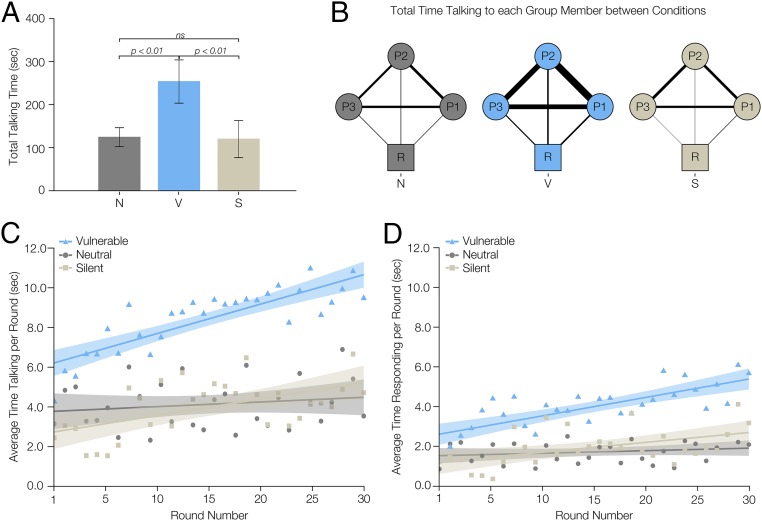
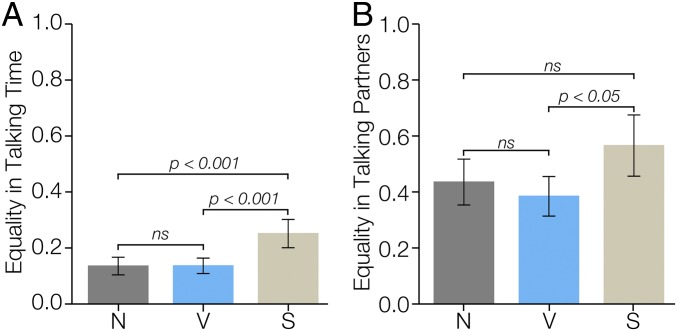
Social robots are becoming increasingly influential in shaping the behavior of humans with whom they interact. Here, we examine how the actions of a social robot can influence human-to-human communication, and not just robot–human communication, using groups of three humans and one robot playing 30 rounds of a collaborative game ( n = 51 groups). We find that people in groups with a robot making vulnerable statements converse substantially more with each other, distribute their conversation somewhat more equally, and perceive their groups more positively compared to control groups with a robot that either makes neutral statements or no statements at the end of each round. Shifts in robot speech have the power not only to affect how people interact with robots, but also how people interact with each other, offering the prospect for modifying social interactions via the introduction of artificial agents into hybrid systems of humans and machines.
Overview
The claims and statistics of this paper haven’t been checked yet.
Run the check — free, no account needed. It reads the open-access text and checks the sources it cites.
Integrity signals
Registry
Cites
Statistics
Figures
Verification
Claims the paper makes
The claims and statistics of this paper haven’t been checked yet.
Run the check — free, no account needed. It reads the open-access text and checks the sources it cites.
Claims other papers make about this one
Each is checked against this paper’s own text: does it say what the citing paper says it does?
In the citing paper
“Conversely, Traeger et al. find automated agents that are trained to perform poorly at collaborative tasks can actually improve the behavior of human team members (29).”
From Can Generative AI improve social science? (2024) · cites this paper as [29]
Self-check
Percentages, sums and reported differences re-computed from the paper’s own numbers.
The self-check needs the paper’s full text.
Citations
Cites
Advances In Experimental Social Psychology
(2022) · Advances in experimental social psychology · doi:10.1016/s0065-2601(22)x0002-6 · Cited by 22,559
Psychological Safety and Learning Behavior in Work Teams
Edmondson, A. (1999) · Administrative Science Quarterly · doi:10.2307/2666999 · Cited by 12,026
An integrative model of organizational trust
Mayer, R. C., Davis, J. H., & Schoorman, F. D. (1995) · The Academy of Management Review · doi:10.2307/258792 · Cited by 10,736
Big Data : The Management Revolution
マカフィー, ア., ブリニョルフソン, エ., & 有賀, 裕. (2013) · Harvard business review · Cited by 3,545
The ripple effect: emotional contagion and its influence on group behavior
Barsade, S. G. (2002) · Administrative Science Quarterly · doi:10.2307/3094912 · Cited by 3,361
A 61-million-person experiment in social influence and political mobilization
Bond, R. M., Fariss, C. J., Jones, J. J., Kramer, A. D. I., Marlow, C., Settle, J. E., & Fowler, J. H. (2012) · Nature · doi:10.1038/nature11421 · Cited by 2,575
The experience and evolution of trust: Implications for cooperation and teamwork
Jones, G. R., & George, J. M. (1998) · The Academy of Management Review · doi:10.2307/259293 · Cited by 2,135
Rahwan, I., Cebrian, M., Obradovich, N., Bongard, J., Bonnefon, J.-F., Breazeal, C., Crandall, J. W., Christakis, N. A., Couzin, I. D., Jackson, M. O., et al. (2019) · Nature · doi:10.1038/s41586-019-1138-y · Cited by 1,364 · cited 1×
“Without an understanding of how machines may influence our connections with the people around us, we may encounter negative and unexpected consequences of interacting with these robots (41, 42).”
Self-citationSelf-disclosure: A literature review.
Cozby, P. C. (1973) · Psychological Bulletin · doi:10.1037/h0033950 · Cited by 1,314
Dynamics of Dyads in Social Networks: Assortative, Relational, and Proximity Mechanisms
Rivera, M. T., Soderstrom, S. B., & Uzzi, B. (2010) · Annual Review of Sociology · doi:10.1146/annurev.soc.34.040507.134743 · Cited by 978
Cited by
Sorted by citations
Managing artificial intelligence
Berente, N., Gu, B., Recker, J., & Santhanam, R. (2021) · MIS Quarterly · doi:10.25300/misq/2021/16274 · Cited by 898
Digital transformation, for better or worse: a critical multi‐level research agenda
Dąbrowska, J., Almpanopoulou, A., Brem, A., Chesbrough, H. W., Cucino, V., Minin, A. D., Giones, F., Hakala, H., Marullo, C., Mention, A., et al. (2022) · R and D Management · doi:10.1111/radm.12531 · Cited by 442
Can Generative AI improve social science?
Bail, C. A. (2024) · Proceedings of the National Academy of Sciences · doi:10.1073/pnas.2314021121 · Cited by 369
Trusting Automation: Designing for Responsivity and Resilience
Chiou, E. K., & Lee, J. D. (2023) · Human Factors: The Journal of the Human Factors and Ergonomics Society · doi:10.1177/00187208211009995 · Cited by 301
The most human bot: Female gendering increases humanness perceptions of bots and acceptance of AI
Borau, S., Otterbring, T., Laporte, S., & Wamba, S. F. (2021) · Psychology and Marketing · doi:10.1002/mar.21480 · Cited by 311
Metadata
- Authors
- Traeger, M. L., Strohkorb Sebo, S., Jung, M., Scassellati, B., & Christakis, N. A.
- Affiliations
- Yale University (US)
- Department of Computer Science, Yale University, New Haven, CT 06520;
- Cornell University (US)
- Corresponding author
- Christakis, Nicholas A.
- Venue
- Proceedings of the National Academy of Sciences
- Publisher
- National Academy of Sciences
- Published
- 2020-03-09
- Volume
- 117
- Issue
- 12
- Pages
- 6370-6375
- ISSN
- 0027-8424 (ISSN-L)
- 1091-6490
- PMC
- PMC7104178
- OpenAlex
- W3009999177
- Cited by
- 140
- References
- 49
- Citations by year
- 2026: 16 · 2025: 22 · 2024: 23 · 2023: 13 · 2022: 27 · 2021: 25 · 2020: 13
- FWCI
- 21.34
- Type
- journal article
- Language
- en
- Open access
- hybrid
- doi.org
- Licence
- Locations
- Proceedings of the National Academy of Sciences (publishedVersion, cc-by)
- Europe PMC (PubMed Central) (publishedVersion, cc-by)
- PubMed Central (publishedVersion, cc-by)
- PubMed (publishedVersion)
- RePEc: Research Papers in Economics (submittedVersion)
- Funders
- Robert Wood Johnson Foundation (75421)
- National Science Foundation (1139078, GR104893)
- Topics
- Social Sciences › Psychology › Social Psychology › Social Robot Interaction and HRI
- Physical Sciences › Computer Science › Artificial Intelligence › Speech and dialogue systems
- Social Sciences › Business, Management and Accounting › Marketing › AI in Service Interactions
- Keywords
- social robots, human-robot teams, human-to-human communication, conversational dynamics, collaborative games, group interaction, robot speech, hybrid human-machine systems
- MeSH terms
- Communication, Cooperative Behavior, Group Processes, Humans, Interpersonal Relations, Robotics, Social Behavior
About these checks
Registry, retraction, Cites and statistics results are computed, not judged, with one exception: a printed reference that no index lists is read once by a model before it counts as a citation error. Claims are extracted by a model and kept only when their quote appears verbatim in the text; each cited source is then checked, with a model’s help, for whether it says what the claim relies on. Those verdicts can be wrong — read the claim’s quote and the cited source before relying on one.
Statistics and arithmetic are recomputed, not judged.
Confidence bands are shown only for fields calibrated on our annotated test set. None is calibrated yet, so no band is shown.
What counts as a claim ›How we measure confidence ›How we check this ›
Are you an author, or do you see a problem with this page? Request a review
