

The DOI matches its Crossref record; 48 of the 49 references it cites were found in a registry or an index.
Vulnerable robots positively shape human conversational dynamics in a human–robot team
Open accessAbstract
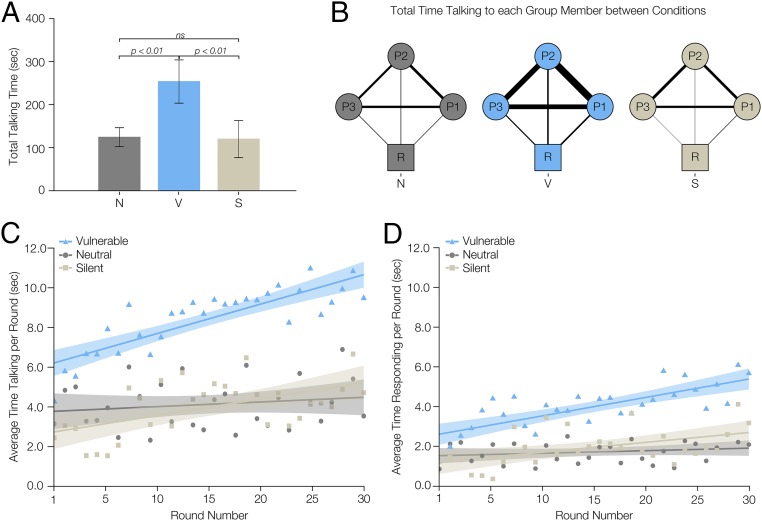
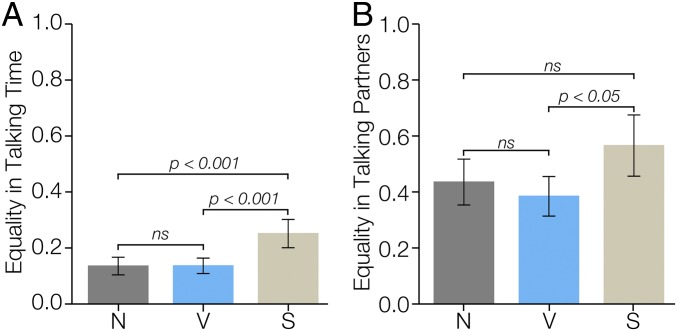
Social robots are becoming increasingly influential in shaping the behavior of humans with whom they interact. Here, we examine how the actions of a social robot can influence human-to-human communication, and not just robot–human communication, using groups of three humans and one robot playing 30 rounds of a collaborative game ( n = 51 groups). We find that people in groups with a robot making vulnerable statements converse substantially more with each other, distribute their conversation somewhat more equally, and perceive their groups more positively compared to control groups with a robot that either makes neutral statements or no statements at the end of each round. Shifts in robot speech have the power not only to affect how people interact with robots, but also how people interact with each other, offering the prospect for modifying social interactions via the introduction of artificial agents into hybrid systems of humans and machines.
Overview
The claims and statistics of this paper haven’t been checked yet.
Run the check — free, no account needed. It reads the open-access text and checks the sources it cites.
Integrity signals
Registry
Cites
Statistics
Figures
Verification
Claims the paper makes
The claims and statistics of this paper haven’t been checked yet.
Run the check — free, no account needed. It reads the open-access text and checks the sources it cites.
Claims other papers make about this one
Each is checked against this paper’s own text: does it say what the citing paper says it does?
In the citing paper
“Conversely, Traeger et al. find automated agents that are trained to perform poorly at collaborative tasks can actually improve the behavior of human team members (29).”
From Can Generative AI improve social science? (2024) · cites this paper as [29]
Self-check
Percentages, sums and reported differences re-computed from the paper’s own numbers.
The self-check needs the paper’s full text.
Citations
Cites
Advances In Experimental Social Psychology
(2022) · Advances in experimental social psychology · doi:10.1016/s0065-2601(22)x0002-6 · Cited by 22,559
Psychological Safety and Learning Behavior in Work Teams
Edmondson, A. (1999) · Administrative Science Quarterly · doi:10.2307/2666999 · Cited by 12,026
An integrative model of organizational trust
Mayer, R. C., Davis, J. H., & Schoorman, F. D. (1995) · The Academy of Management Review · doi:10.2307/258792 · Cited by 10,736
Big Data : The Management Revolution
マカフィー, ア., ブリニョルフソン, エ., & 有賀, 裕. (2013) · Harvard business review · Cited by 3,545
The ripple effect: emotional contagion and its influence on group behavior
Barsade, S. G. (2002) · Administrative Science Quarterly · doi:10.2307/3094912 · Cited by 3,361
A 61-million-person experiment in social influence and political mobilization
Bond, R. M., Fariss, C. J., Jones, J. J., Kramer, A. D. I., Marlow, C., Settle, J. E., & Fowler, J. H. (2012) · Nature · doi:10.1038/nature11421 · Cited by 2,575
The experience and evolution of trust: Implications for cooperation and teamwork
Jones, G. R., & George, J. M. (1998) · The Academy of Management Review · doi:10.2307/259293 · Cited by 2,135
Rahwan, I., Cebrian, M., Obradovich, N., Bongard, J., Bonnefon, J.-F., Breazeal, C., Crandall, J. W., Christakis, N. A., Couzin, I. D., Jackson, M. O., et al. (2019) · Nature · doi:10.1038/s41586-019-1138-y · Cited by 1,364 · cited 1×
“Without an understanding of how machines may influence our connections with the people around us, we may encounter negative and unexpected consequences of interacting with these robots (41, 42).”
Self-citationSelf-disclosure: A literature review.
Cozby, P. C. (1973) · Psychological Bulletin · doi:10.1037/h0033950 · Cited by 1,314
Dynamics of Dyads in Social Networks: Assortative, Relational, and Proximity Mechanisms
Rivera, M. T., Soderstrom, S. B., & Uzzi, B. (2010) · Annual Review of Sociology · doi:10.1146/annurev.soc.34.040507.134743 · Cited by 978
Cited by
Sorted by citations
Managing artificial intelligence
Berente, N., Gu, B., Recker, J., & Santhanam, R. (2021) · MIS Quarterly · doi:10.25300/misq/2021/16274 · Cited by 898
Digital transformation, for better or worse: a critical multi‐level research agenda
Dąbrowska, J., Almpanopoulou, A., Brem, A., Chesbrough, H. W., Cucino, V., Minin, A. D., Giones, F., Hakala, H., Marullo, C., Mention, A., et al. (2022) · R and D Management · doi:10.1111/radm.12531 · Cited by 442
Can Generative AI improve social science?
Bail, C. A. (2024) · Proceedings of the National Academy of Sciences · doi:10.1073/pnas.2314021121 · Cited by 369
Trusting Automation: Designing for Responsivity and Resilience
Chiou, E. K., & Lee, J. D. (2023) · Human Factors: The Journal of the Human Factors and Ergonomics Society · doi:10.1177/00187208211009995 · Cited by 301
The most human bot: Female gendering increases humanness perceptions of bots and acceptance of AI
Borau, S., Otterbring, T., Laporte, S., & Wamba, S. F. (2021) · Psychology and Marketing · doi:10.1002/mar.21480 · Cited by 311
Henschel, A., Laban, G., & Cross, E. S. (2021) · Current Robotics Reports · doi:10.1007/s43154-020-00035-0 · Cited by 297
How Human–Chatbot Interaction Impairs Charitable Giving: The Role of Moral Judgment
Zhou, Y., Fei, Z., He, Y., & Yang, Z. (2022) · Journal of Business Ethics · doi:10.1007/s10551-022-05045-w · Cited by 124
Chugunova, M., & Sele, D. (2022) · Journal of Behavioral and Experimental Economics · doi:10.1016/j.socec.2022.101897 · Cited by 118
AI-enhanced collective intelligence
Cui, H., & Yasseri, T. (2024) · Patterns · doi:10.1016/j.patter.2024.101074 · Cited by 112
IdeaBot: Investigating Social Facilitation in Human-Machine Team Creativity
Hwang, A. H., & Won, A. S. (2021) · CHI Conference on Human Factors in Computing Systems · doi:10.1145/3411764.3445270 · Cited by 108
A new sociology of humans and machines
Tsvetkova, M., Yasseri, T., Pescetelli, N., & Werner, T. (2024) · Nature Human Behaviour · doi:10.1038/s41562-024-02001-8 · Cited by 122
Open Problems in Cooperative AI
Dafoe, A., Hughes, E., Bachrach, Y., Collins, T., McKee, K. R., Leibo, J. Z., Larson, K., & Graepel, T. (2020) · arXiv · doi:10.48550/arxiv.2012.08630 · Cited by 93
The Handbook on Socially Interactive Agents
Lugrin, B., Pélachaud, C., & Traum, D. R. (2022) · ACM eBooks · doi:10.1145/3563659 · Cited by 89
Tell me more! assessing interactions with social robots from speech
Laban, G., George, J.-N., Morrison, V., & Cross, E. S. (2020) · Paladyn, Journal of Behavioral Robotics · doi:10.1515/pjbr-2021-0011 · Cited by 81
Harmonizing Artificial Intelligence for Social Good
Berberich, N., Nishida, T., & Suzuki, S. (2020) · Philosophy & Technology · doi:10.1007/s13347-020-00421-8 · Cited by 80
Robot Gaze Can Mediate Participation Imbalance in Groups with Different Skill Levels
Gillet, S., Cumbal, R., Pereira, A., Lopes, J., Engwall, O., & Leite, I. (2021) · ACM/IEEE International Conference on Human-Robot Interaction (HRI) · doi:10.1145/3434073.3444670 · Cited by 68
Empirica: a virtual lab for high-throughput macro-level experiments
Almaatouq, A., Becker, J. A., Houghton, J. P., Paton, N., Watts, D. J., & Whiting, M. E. (2021) · Behavior Research Methods · doi:10.3758/s13428-020-01535-9 · Cited by 61
Can a Humorous Conversational Agent Enhance Learning Experience and Outcomes?
Ceha, J., Lee, K. J., Nilsen, E., Goh, J., & Law, E. (2021) · CHI Conference on Human Factors in Computing Systems · doi:10.1145/3411764.3445068 · Cited by 58
Adults still can't resist: A social robot can induce normative conformity
Qin, X., Chen, C., Yam, K. C., Cao, L., Li, W., Guan, J., Zhao, P., Dong, X., & Lin, Y. (2021) · Computers in Human Behavior · doi:10.1016/j.chb.2021.107041 · Cited by 58
My Bad! Repairing Intelligent Voice Assistant Errors Improves Interaction
Cuadra, A., Li, S., Lee, H., Cho, J., & Ju, W. (2021) · Proceedings of the ACM on Human-Computer Interaction · doi:10.1145/3449101 · Cited by 52
How and When Can Robots Be Team Members? Three Decades of Research on Human–Robot Teams
Wolf, F. D., & Stock, R. (2022) · Group & Organization Management · doi:10.1177/10596011221076636 · Cited by 56
Network Engineering Using Autonomous Agents Increases Cooperation in Human Groups
Shirado, H., & Christakis, N. A. (2020) · iScience · doi:10.1016/j.isci.2020.101438 · Cited by 50
Self-citationInteraction-Shaping Robotics: Robots That Influence Interactions between Other Agents
Gillet, S., Vázquez, M., Andrist, S., Leite, I., & Sebo, S. S. (2024) · ACM Transactions on Human-Robot Interaction · doi:10.1145/3643803 · Cited by 51
Machine Thinking, Fast and Slow
Bonnefon, J., & Rahwan, I. (2020) · Trends in Cognitive Sciences · doi:10.1016/j.tics.2020.09.007 · Cited by 47
Fan, J., Mion, L. C., Beuscher, L. M., Ullal, A., NEWHOUSE, P. A., & Sarkar, N. (2021) · IEEE Transactions on Robotics · doi:10.1109/tro.2021.3092162 · Cited by 46
The emergence of social robots: Adding physicality and agency to technology
Ulhøi, J. P., & Nørskov, S. (2022) · Journal of Engineering and Technology Management · doi:10.1016/j.jengtecman.2022.101703 · Cited by 45
The foundations of a policy for the use of social robots in care
Sætra, H. S. (2020) · Technology in Society · doi:10.1016/j.techsoc.2020.101383 · Cited by 45
Zhang, A. W., Lin, T.-H., Zhao, X., & Sebo, S. S. (2023) · CHI Conference on Human Factors in Computing Systems · doi:10.1145/3544548.3581135 · Cited by 40
A Practical Guide to Conversation Research: How to Study What People Say to Each Other
Yeomans, M., Boland, F. K., Collins, H. K., Abi-Esber, N., & Brooks, A. W. (2023) · Advances in Methods and Practices in Psychological Science · doi:10.1177/25152459231183919 · Cited by 44
Fraune, M. R., Komatsu, T., Preusse, H. R., Langlois, D., Au, R. H. Y., Ling, K., Suda, S., Nakamura, K., & Tsui, K. M. (2022) · Frontiers in Psychology · doi:10.3389/fpsyg.2022.904019 · Cited by 39
Scaffolding cooperation in human groups with deep reinforcement learning
McKee, K. R., Tacchetti, A., Bakker, M. A., Balaguer, J., Campbell-Gillingham, L., Everett, R., & Botvinick, M. (2023) · Nature Human Behaviour · doi:10.1038/s41562-023-01686-7 · Cited by 43
Vero: An accessible method for studying human–AI teamwork
Schecter, A., Hohenstein, J., Larson, L., Harris, A. M., Hou, T.-Y., Lee, W.-Y., Lauharatanahirun, N., DeChurch, L. A., Contractor, N., & Jung, M. F. (2022) · Computers in Human Behavior · doi:10.1016/j.chb.2022.107606 · Cited by 36
Self-citationSocial robots as conversational catalysts: Enhancing long-term human-human interaction at home
Chen, H., Kim, Y., Patterson, K., Breazeal, C., & Park, H. W. (2025) · Science Robotics · doi:10.1126/scirobotics.adk3307 · Cited by 37
Who's Laughing NAO? Examining Perceptions of Failure in a Humorous Robot Partner
Green, H. N., Islam, M. M., Ali, S., & Iqbal, T. (2022) · ACM/IEEE International Conference on Human-Robot Interaction (HRI) · doi:10.1109/hri53351.2022.9889353 · Cited by 36
YAPAY ZEKÂ VE ÖRGÜTSEL DAVRANIŞ
Erkutlu, H., ERGÜN, E. E., KÖSEOĞLU, İ., & VURGUN, T. (2023) · Nevşehir Hacı Bektaş Veli Üniversitesi SBE Dergisi · doi:10.30783/nevsosbilen.1246678 · Cited by 31
Sebo, S. S., Dong, L. L., Chang, N., Lewkowicz, M. A., Schutzman, M., & Scassellati, B. M. (2020) · Frontiers in Psychology · doi:10.3389/fpsyg.2020.590181 · Cited by 32
Self-citationCohesion in human–autonomy teams: an approach for future research
Lakhmani, S. G., Neubauer, C. E., Krausman, A., Fitzhugh, S. M., Berg, S. K., Wright, J. L., Rovira, E. M., Blackman, J., & Schaefer, K. E. (2022) · Theoretical Issues in Ergonomics Science · doi:10.1080/1463922x.2022.2033876 · Cited by 29
Increasing sustainable behavior through conversation
Hurst, K. F., Sintov, N. D., & Donnelly, G. E. (2022) · Journal of Environmental Psychology · doi:10.1016/j.jenvp.2022.101948 · Cited by 28
UnIC: Towards Unmanned Intelligent Cluster and Its Integration into Society
Zhang, F., Yu, J., Lin, D., & Zhang, J. (2022) · Engineering · doi:10.1016/j.eng.2022.02.008 · Cited by 27
Duan, W., Yamashita, N., Shirai, Y., & Fussell, S. R. (2021) · Proceedings of the ACM on Human-Computer Interaction · doi:10.1145/3479579 · Cited by 27
Jensen, J. L., Karell, D., Tanigawa-Lau, C., Habash, N. Y., Oudah, M., & Fani, D. F. S. (2021) · Sociological Methodology · doi:10.1177/00811750211053370 · Cited by 27
Ng, Y.-L. (2022) · New Media & Society · doi:10.1177/14614448221074047 · Cited by 29
The Effect of Bots on Human Interaction in Online Communities
Safadi, H., Lalor, J. P., & Berente, N. (2024) · MIS Quarterly · doi:10.25300/misq/2023/17901 · Cited by 29
Theories of Conversation for Conversational IR
Thomas, P., Czerwinksi, M., McDuff, D., & Craswell, N. (2021) · ACM Transactions on Information Systems · doi:10.1145/3439869 · Cited by 26
Hybrid social learning in human-algorithm cultural transmission
Brinkmann, L., Gezerli, D., Kleist, K. V., Müller, T. F., Rahwan, I., & Pescetelli, N. (2022) · Philosophical Transactions of the Royal Society A: Mathematical, Physical and Engineering Sciences · doi:10.1098/rsta.2020.0426 · Cited by 24
Options for mobility and network reciprocity to jointly yield robust cooperation in social dilemmas
Li, W., Chen, Z., Jin, K.-Z., Wang, J., Lin, Y., Gu, C., Jiang, L.-L., & Perc, M. (2022) · Applied Mathematics and Computation · doi:10.1016/j.amc.2022.127456 · Cited by 24
Understanding the impact and design of AI teammate etiquette
Flathmann, C., McNeese, N. J., Schelble, B. G., Knijnenburg, B. P., & Freeman, G. (2023) · Human-Computer Interaction · doi:10.1080/07370024.2023.2189595 · Cited by 29
Human preferences toward algorithmic advice in a word association task
Bogert, E., Lauharatanahirun, N., & Schecter, A. (2022) · Scientific Reports · doi:10.1038/s41598-022-18638-2 · Cited by 26
Guardrails for Human-AI Ecologies: Norm-Based Coordination and Design for Predictability
Grisold, T., Berente, N., & Seidel, S. (2025) · MIS Quarterly · doi:10.25300/misq/2025/18058 · Cited by 23
Confidant: A Privacy Controller for Social Robots
Tang, B., Sullivan, D., Çağıltay, B., Chandrasekaran, V., Fawaz, K., & Mutlu, B. (2022) · ACM/IEEE International Conference on Human-Robot Interaction (HRI) · doi:10.1109/hri53351.2022.9889540 · Cited by 22
Socially Interactive Agents as Peers
Cassell, J. (2022) · ACM eBooks · doi:10.1145/3563659.3563670 · Cited by 23
Artificial Intelligence Policymaking: An Agenda for Sociological Research
Law, T. L., & McCall, L. (2024) · Socius Sociological Research for a Dynamic World · doi:10.1177/23780231241261596 · Cited by 25
Claure, H., Kim, S., Kizilcec, R. F., & Jung, M. F. (2022) · Computers in Human Behavior · doi:10.1016/j.chb.2022.107628 · Cited by 25
Self-citationCapiola, A., Lyons, J. B., Harris, K. N., Hamdan, I. A., Kailas, S., & Sycara, K. P. (2023) · Computers in Human Behavior · doi:10.1016/j.chb.2023.107966 · Cited by 21
Chen, C., Liao, M., & Sundar, S. S. (2024) · International Symposium on Trustworthy Autonomous Systems (TAS) · doi:10.1145/3686038.3686066 · Cited by 20
Wester, J., Moghe, B., Winkle, K., & van Berkel, N. (2024) · Proceedings of the ACM on Human-Computer Interaction · doi:10.1145/3687036 · Cited by 18
Leaders Inflate Performance Ratings for Employees Who Use Robots to Augment Their Performance
He, G., Yam, K. C., Zhao, P., Dong, X., Zheng, L., & Qin, X. (2024) · Human Resource Management · doi:10.1002/hrm.22267 · Cited by 18
Chen, H., Alghowinem, S., Breazeal, C., & Park, H. W. (2024) · ACM/IEEE International Conference on Human-Robot Interaction (HRI) · doi:10.1145/3610977.3634945 · Cited by 21
What should a robot disclose about me? A study about privacy-appropriate behaviors for social robots
Dietrich, M., Krüger, M., & Weisswange, T. H. (2023) · Frontiers in Robotics and AI · doi:10.3389/frobt.2023.1236733 · Cited by 17
Enhancing social cohesion with cooperative bots in societies of greedy, mobile individuals
Shi, L., He, Z., Shen, C., & Tanimoto, J. (2024) · PNAS Nexus · doi:10.1093/pnasnexus/pgae223 · Cited by 18
Cuadra, A., Baek, H., Estrin, D., Jung, M., & Dell, N. (2022) · International Conference on Information & Communication Technologies and Development 2022 · doi:10.1145/3572334.3572371 · Cited by 16
Self-citationTeam Learning in the Field: An Organizing Framework and Avenues for Future Research
Edmondson, A. C., & Harvey, J. (2025) · Small Group Research · doi:10.1177/10464964251316877 · Cited by 19
Correia, F., Melo, F. S., & Paiva, A. (2022) · Topics in Cognitive Science · doi:10.1111/tops.12634 · Cited by 20
Intelligent machines as social catalysts
Rahwan, I., Crandall, J. W., & Bonnefon, J. (2020) · Proceedings of the National Academy of Sciences · doi:10.1073/pnas.2002744117 · Cited by 16
Emerging Roles for Social Robots in Rehabilitation
Langer, A., & Levy‐Tzedek, S. (2021) · ACM Transactions on Human-Robot Interaction · doi:10.1145/3462256 · Cited by 14
Emergence and collapse of reciprocity in semiautomatic driving coordination experiments with humans
Shirado, H., Kasahara, S., & Christakis, N. A. (2023) · Proceedings of the National Academy of Sciences · doi:10.1073/pnas.2307804120 · Cited by 16
Self-citationMultiparty Interaction Between Humans and Socially Interactive Agents
Gillet, S., Vázquez, M., Peters, C., Yang, F., & Leite, I. (2022) · ACM eBooks · doi:10.1145/3563659.3563665 · Cited by 16
Weisswange, T. H., Javed, H., Dietrich, M., Jung, M. F., & Jamali, N. (2025) · ACM Transactions on Human-Robot Interaction · doi:10.1145/3777455 · Cited by 16
Self-citationRobot Vulnerability and the Elicitation of User Empathy
Frederiksen, M. R., Fischer, K., & Matarić, M. J. (2022) · IEEE RO-MAN · doi:10.1109/ro-man53752.2022.9900573 · Cited by 15
Measuring an artificial intelligence language model’s trust in humans using machine incentives
Johnson, T., & Obradovich, N. (2024) · Journal of Physics Complexity · doi:10.1088/2632-072x/ad1c69 · Cited by 13
Hannibal, G., Weiss, A., & Charisi, V. (2021) · 2021 30th IEEE International Conference on Robot & Human Interactive Communication (RO-MAN) · doi:10.1109/ro-man50785.2021.9515513 · Cited by 11
Hwang, A. H., Adler, D. A., Friedenberg, M., & Yang, Q. (2024) · CHI Conference on Human Factors in Computing Systems · doi:10.1145/3613904.3642793 · Cited by 15
Embodied Mediation in Group Ideation – A Gestural Robot Can Facilitate Consensus-Building
Pham, T. V., Weisswange, T. H., & Hassenzahl, M. (2024) · Designing Interactive Systems Conference · doi:10.1145/3643834.3660696 · Cited by 10
An Evaluation of Human Conversational Preferences in Social Human-Robot Interaction
Sirithunge, C., Jayasekara, A. G. B. P., & Chandima, D. P. (2021) · Applied Bionics and Biomechanics · doi:10.1155/2021/3648479 · Cited by 10
Xu, J., Zhang, C., Cuijpers, R. H., & IJsselsteijn, W. A. (2025) · CHI Conference on Human Factors in Computing Systems · doi:10.1145/3706598.3714271 · Cited by 9
Robotic technologies, touch and posthuman embodiment in queer dementia care
Shildrick, M. (2023) · The Senses and Society · doi:10.1080/17458927.2023.2179239 · Cited by 9
Hall, T. A., Gardner, J. W., & Wright, Z. A. (2025) · Production and Operations Management · doi:10.1177/10591478251407777 · Cited by 8
Rigoli, L. M., Patil, G., Nalepka, P., Kallen, R. W., Hosking, S. G., Best, C. J., & Richardson, M. J. (2022) · Journal of Cognitive Engineering and Decision Making · doi:10.1177/15553434221092930 · Cited by 10
Challenges of deploying assistive robots in real-life scenarios: an industrial perspective
Cooper, S., Ros, R., & Lemaignan, S. (2023) · IEEE RO-MAN · doi:10.1109/ro-man57019.2023.10309467 · Cited by 9
Xu, S., Gong, Z. H., Li, Y., Zhao, Y., & Huang, S. (2025) · International Journal of Human-Computer Interaction · doi:10.1080/10447318.2025.2560522 · Cited by 7
AI-human learning systems: Investigating the strategic role of AI for organizational learning
Figge, P., Anderson, E. G., & Lewis, K. (2025) · Strategic Organization · doi:10.1177/14761270251385860 · Cited by 7
Simple autonomous agents can enhance creative semantic discovery by human groups
Ueshima, A., Jones, M. I., & Christakis, N. A. (2024) · Nature Communications · doi:10.1038/s41467-024-49528-y · Cited by 10
Self-citationMultiple-Robot Mediated Discussion System to support group discussion
Ikari, S., Yoshikawa, Y., & Ishiguro, H. (2020) · IEEE RO-MAN · doi:10.1109/ro-man47096.2020.9223444 · Cited by 7
Industry 4.0: A Chance or a Threat for Gen Z? The Perspective of Economics Students
Bińczycki, B., & Dorocki, S. (2022) · Sustainability · doi:10.3390/su14148925 · Cited by 7
Evidence of spillovers from (non)cooperative human-bot to human-human interactions
Harrell, A., & Traeger, M. L. (2025) · iScience · doi:10.1016/j.isci.2025.113006 · Cited by 7
Self-citationReputation-based reciprocity in human–bot and human–human networks
Harrell, A., & Traeger, M. L. (2025) · PNAS Nexus · doi:10.1093/pnasnexus/pgaf150 · Cited by 5
Self-citationBienefeld, N., & Grote, G. (2025) · Oxford University Press eBooks · doi:10.1093/oso/9780197692554.003.0019 · Cited by 5
Learning from machines: How negative feedback from machines improves learning between humans
Zou, T., Ertug, G., & Roulet, T. J. (2023) · Journal of Business Research · doi:10.1016/j.jbusres.2023.114417 · Cited by 5
Social assistive robots in elderly care: Exploring the role of empathy
Buono, P., Castellano, G., Decarolis, B., & Macchiarulo, N. (2020) · CINECA IRIS Institutional Research Information System (University of Bari Aldo Moro) · Cited by 5
Kim, S., Choi, J., Lim, Y., & Kwak, S. S. (2022) · IEEE/RSJ International Conference on Intelligent Robots and Systems (IROS) · doi:10.1109/iros47612.2022.9981755 · Cited by 5
Tip of the Finger or Tip of the Tongue?
Simpson, J., Nalepka, P., Crone, C., Kallen, R. W., Dras, M., Reichle, E. D., Hosking, S. G., Best, C. J., Richards, D., & Richardson, M. J. (2021) · ACM Conference on Computer Supported Cooperative Work (CSCW) · doi:10.1145/3462204.3481777 · Cited by 5
Stingy bots can improve human welfare in experimental sharing networks
Shirado, H., Hou, Y. T.-Y., & Jung, M. F. (2023) · Scientific Reports · doi:10.1038/s41598-023-44883-0 · Cited by 5
Self-citationSocial Network Data Collection: Principles and Modalities*
adams, J., & Lubbers, M. J. (2024) · SAGE Publications Ltd eBooks · doi:10.4135/9781529614695.n40 · Cited by 5
Perspectives de l'emploi de l'OCDE
OECD (2009) · Perspectives de l'emploi de l'OCDE/OCDE perspectives de l'emploi · doi:10.1787/19991274 · Cited by 5
Can Providing Algorithmic Performance Information Facilitate Humans' Inventory Ordering Behaviors?
Lu, Y., Luo, X.-M., Huang, L.-Q., & Wang, D. (2025) · Information systems research · doi:10.1287/isre.2022.0621 · Cited by 3
Cao, L., Zhou, H., Zhao, P., Jiang, L., Li, Y., Shang, J., & Qin, X. (2025) · Journal of Management · doi:10.1177/01492063251350938 · Cited by 4
Pan, P., Hu, B., Feng, Y., Song, X., Zhang, Z., Cui, Z., & Tan, J. (2025) · International Journal of Production Research · doi:10.1080/00207543.2025.2588646 · Cited by 4
On the optimal integration of intelligent agents into network systems to steer cooperation
Fu, F., Chen, X., & Christakis, N. A. (2026) · Proceedings of the National Academy of Sciences · doi:10.1073/pnas.2537939123 · Cited by 4
Self-citationAI-Empowered Human Research Integrating Brain Science and Social Sciences Insights
Xiong, F., Yu, X., & Leong, H. W. (2024) · International Conference on Intelligent Education and Intelligent Research (IEIR) · doi:10.1109/ieir62538.2024.10960181 · Cited by 6
Identification and Engagement of Passive Subjects in Multiparty Conversations by a Humanoid Robot
Ayllón, D., Chou, T.-S., King, A., & Shen, Y. (2021) · ACM/IEEE International Conference on Human-Robot Interaction (HRI) · doi:10.1145/3434074.3447229 · Cited by 4
Metadata
- Authors
- Traeger, M. L., Strohkorb Sebo, S., Jung, M., Scassellati, B., & Christakis, N. A.
- Affiliations
- Yale University (US)
- Department of Computer Science, Yale University, New Haven, CT 06520;
- Cornell University (US)
- Corresponding author
- Christakis, Nicholas A.
- Venue
- Proceedings of the National Academy of Sciences
- Publisher
- National Academy of Sciences
- Published
- 2020-03-09
- Volume
- 117
- Issue
- 12
- Pages
- 6370-6375
- ISSN
- 0027-8424 (ISSN-L)
- 1091-6490
- PMC
- PMC7104178
- OpenAlex
- W3009999177
- Cited by
- 140
- References
- 49
- Citations by year
- 2026: 16 · 2025: 22 · 2024: 23 · 2023: 13 · 2022: 27 · 2021: 25 · 2020: 13
- FWCI
- 21.34
- Type
- journal article
- Language
- en
- Open access
- hybrid
- doi.org
- Licence
- Locations
- Proceedings of the National Academy of Sciences (publishedVersion, cc-by)
- Europe PMC (PubMed Central) (publishedVersion, cc-by)
- PubMed Central (publishedVersion, cc-by)
- PubMed (publishedVersion)
- RePEc: Research Papers in Economics (submittedVersion)
- Funders
- Robert Wood Johnson Foundation (75421)
- National Science Foundation (1139078, GR104893)
- Topics
- Social Sciences › Psychology › Social Psychology › Social Robot Interaction and HRI
- Physical Sciences › Computer Science › Artificial Intelligence › Speech and dialogue systems
- Social Sciences › Business, Management and Accounting › Marketing › AI in Service Interactions
- Keywords
- social robots, human-robot teams, human-to-human communication, conversational dynamics, collaborative games, group interaction, robot speech, hybrid human-machine systems
- MeSH terms
- Communication, Cooperative Behavior, Group Processes, Humans, Interpersonal Relations, Robotics, Social Behavior
About these checks
Registry, retraction, Cites and statistics results are computed, not judged, with one exception: a printed reference that no index lists is read once by a model before it counts as a citation error. Claims are extracted by a model and kept only when their quote appears verbatim in the text; each cited source is then checked, with a model’s help, for whether it says what the claim relies on. Those verdicts can be wrong — read the claim’s quote and the cited source before relying on one.
Statistics and arithmetic are recomputed, not judged.
Confidence bands are shown only for fields calibrated on our annotated test set. None is calibrated yet, so no band is shown.
What counts as a claim ›How we measure confidence ›How we check this ›
Are you an author, or do you see a problem with this page? Request a review
