

Cognitive and noncognitive predictors of success
Open accessThe DOI matches its Crossref record; 65 of the 66 references it cites were found in a registry or an index; 3 of the 17 sources its claims cite were checked for support.
Abstract
When predicting success, how important are personal attributes other than cognitive ability? To address this question, we capitalized on a full decade of prospective, longitudinal data from n = 11,258 cadets entering training at the US Military Academy at West Point. Prior to training, cognitive ability was negatively correlated with both physical ability and grit. Cognitive ability emerged as the strongest predictor of academic and military grades, but noncognitive attributes were more prognostic of other achievement outcomes, including successful completion of initiation training and 4-y graduation. We conclude that noncognitive aspects of human capital deserve greater attention from both scientists and practitioners interested in predicting real-world success.
Overview
CoChat Summary
TL;DR
In a decade-long megaanalysis of over 10,000 West Point cadets, cognitive ability best predicted academic and military grades, while physical ability best predicted physical performance. Grit was the only reliable predictor of completing initial Beast Barracks training, and grit and physical ability were more prognostic of 4-y graduation than cognitive ability.
Key findings
- Cognitive ability was negatively related to physical ability (r = −0.05, P < 0.001) and grit (r = −0.07, P < 0.001); physical ability and grit were positively related (r = 0.07, P < 0.001).
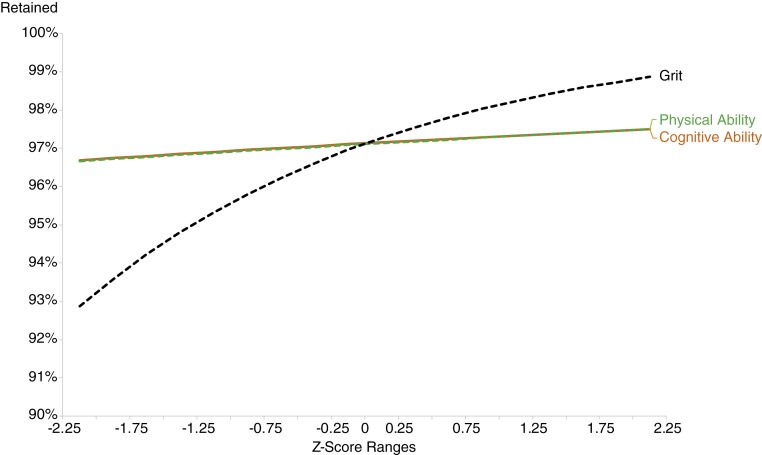
- Grit was the only reliable predictor of completing Beast Barracks: 1 SD higher grit gave 54% greater odds of completion (OR = 1.54, P < 0.001, 99% CI: 1.31–1.81), whereas cognitive ability (OR = 1.06, P = 0.33) and physical ability (OR = 1.08, P = 0.14) did not reliably predict retention.
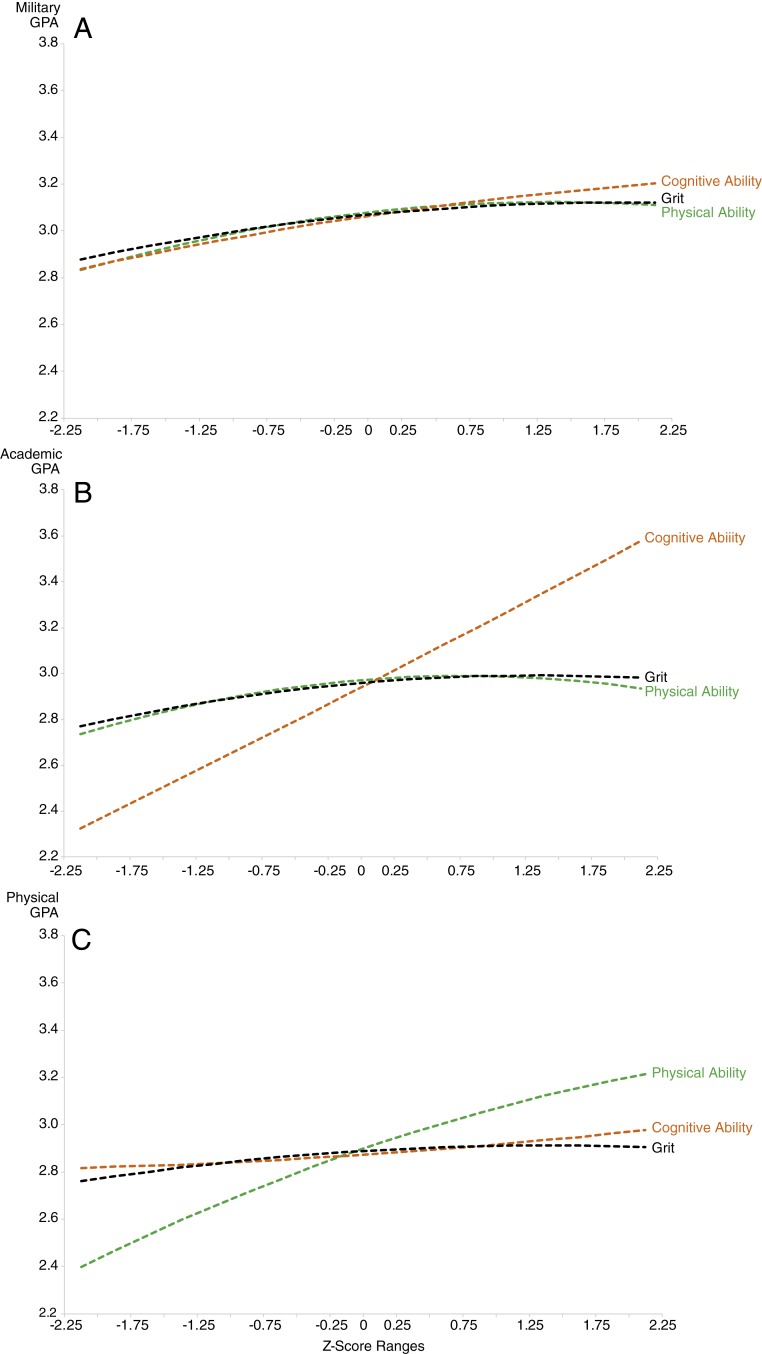
- Cognitive ability was the strongest predictor of academic GPA (β = 0.41, P < 0.001) and military GPA (β = 0.16, P < 0.001); physical ability was the strongest predictor of physical GPA (β = 0.36, P < 0.001). Grit predicted smaller variance in military (β = 0.10), academic (β = 0.07), and physical (β = 0.06) GPAs.
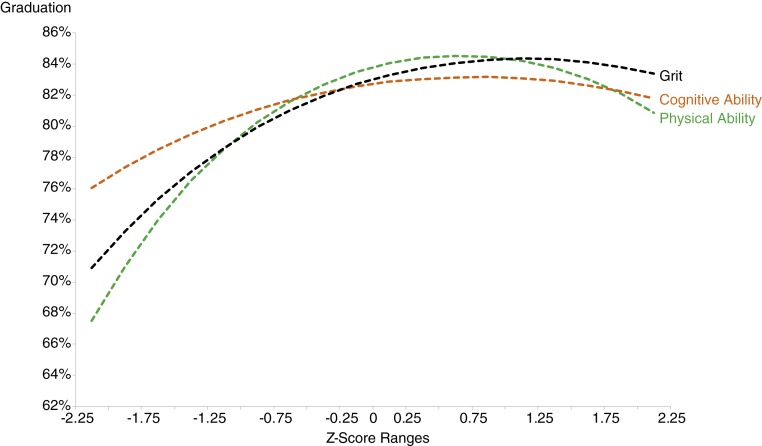
- About 81 of every 100 cadets graduated; grit (OR = 1.18, P < 0.001) and physical ability (OR = 1.18, P < 0.001) were better predictors of graduation than cognitive ability (OR = 1.08, P = 0.011). Concave effects indicated decreased odds of graduation beyond the 89th percentile of physical ability, 95th percentile of cognitive ability, and 99th percentile of grit.
Methods
- Prospective, longitudinal megaanalysis of 9 separate cohorts of over 10,000 women and men entering the US Military Academy at West Point over a full decade; entry measures included grit, cognitive ability, and physical ability, with outcomes from official records: Beast Barracks completion, 4-y graduation, and military, academic, and physical GPAs.
- Binary outcomes were analyzed with logistic regression and continuous GPA outcomes with ordinary least squares regression; predictors were standardized, a 2-tailed P < 0.01 threshold adjusted for 5 outcomes, and quadratic terms plus 2-way interactions were included.
- Robustness checks examined consistency across cohorts, separate entry of pretraining predictors, separate passion and perseverance subscores, and an 8-item short-form Grit Scale; models controlled for gender, race, age, and cohort year.
Limitations
- Stated by the paper: generalizability cannot be assumed beyond the military, structured settings, or this select sample; the data are correlational rather than experimental, limiting causal inference; the study relied on available measures administered by West Point over a decade, and future work should include broader cognitive and noncognitive attributes and repeated measures to unpack mechanisms.
- Evident from the text: the battery of cognitive and noncognitive attributes plus demographic covariates explained less than 4% of variance in 4-y graduation, and the authors note possible severe limits to forecasting individual outcomes because people, contexts, and life trajectories change.
Model-written summary. Check it against the paper before relying on it.
Integrity signals
Registry
Cites
Statistics
Figures
Verification
Claims the paper makes
3 Valid · 0 Not valid · 9 Not checked · 37 Own results and interpretations
The cited sources support only part of this claim — read each source’s verdict below.
In the paper
“The scientific literature is particularly lacking in high-quality, longitudinal studies that assess both cognitive and noncognitive attributes before objectively gauging success outcomes weeks, months, and years later (16).”
§ Cognitive and noncognitive predictors of success > Abstract
What the sources say
- Partly supportedcites [16] Smithers L. G., A systematic review and meta-analysis of effects of early life non-cognitive skills on academic, psychosocial, cognitive and health outcomes. Nat. Hum. Behav. 2, 867– 880 (2018). 30525112 PMC6277013 sourceExperimental — accuracy not yet measured
Smithers et al. (2018) do support the core of the claim: the Discussion > Implications for future research ('Long-term follow-up', paucity of literature with long-term follow-up, median follow-up ~1 year, very few studies beyond age 10), the Discussion > Evidence Quality ('66% were judged as weak or poor quality'; 42% made little or no attempt to adjust for confounding), and the Conclusion ('needs higher quality, adequately powered studies'). The 'both cognitive and noncognitive attributes' element is also touched in Discussion > Implications for future research ('Designing studies for effect modification': a combination of high cognitive and non-cognitive ability would be desirable, 'We found no publications attempting to test this theory'). However, the specific element that the gap concerns 'objectively gauging' success outcomes is not stated as a deficiency in our copy — the Results (Academic Achievement Outcomes, Observational) report that measures included teacher-report, parent report and objective tests and that there was 'little evidence to conclude that any one measurement tool, measurement method (objective or subjective)... was consistently associated with academic achievement'; likewise the 'weeks, months' time-frame is not the paper's framing, which concerns longer-term follow-up. (LLM, conf=0.72)
plain- Asserted: passes — The authors put it forward as true.
- Checkable: passes — It can be checked against evidence.
- Load-bearing: passes — The paper’s conclusions depend on it.
- Based: passes — The paper gives a reason why it holds.
- Partly supported
The cited sources support only part of this claim — read each source’s verdict below.
In the paper
“Grit seems to be independent of cognitive ability (22, 23) and has demonstrated incremental predictive validity, over and above cognitive ability, for achievement (22, 24, 25), particularly for goals of personal significance (26).”
§ Cognitive and noncognitive predictors of success > Cognitive and Noncognitive Attributes
What the sources say
- Not checked yetcites [22] Duckworth A. L., Peterson C., Matthews M. D., Kelly D. R., Grit: Perseverance and passion for long-term goals. J. Pers. Soc. Psychol. 92, 1087– 1101 (2007). 17547490 source
- Partly supportedcites [24] Eskreis-Winkler L., Shulman E. P., Beal S. A., Duckworth A. L., The grit effect: Predicting retention in the military, the workplace, school and marriage. Front. Psychol. 5, 36 (2014). 24550863 PMC3910317 sourceExperimental — accuracy not yet measured
In Study 1 (Results and discussion; page unavailable), grit predicted completion of military selection beyond general intelligence, which the Methods identify as a measure of cognitive ability. Study 3 (Results and discussion; page unavailable) found that grit predicted high-school graduation after controlling for standardized achievement test scores. These findings support incremental prediction of specific retention and graduation outcomes, but the paper does not establish the broader claim for achievement generally. (LLM, conf=0.82)
- Not checked yetcites [25] Akos P., Kretchmar J., Investigating grit at a non-cognitive predictor of college success. Rev. Higher Educ. 40, 163– 186 (2017). source
boostedstates an association- Asserted: passes — The authors put it forward as true.
- Checkable: passes — It can be checked against evidence.
- Load-bearing: passes — The paper’s conclusions depend on it.
- Based: passes — The paper gives a reason why it holds.
The cited sources support only part of this claim — read each source’s verdict below.
In the paper
“Put simply, the outcomes examined in this investigation are consequential in a way that laboratory measures of success are not (26, 28).”
§ Cognitive and noncognitive predictors of success > This Investigation
What the sources say
- Not checked yetcites [26] Jachimowicz J. M., Wihler A., Bailey E. R., Galinsky A. D., Why grit requires perseverance and passion to positively predict performance. Proc. Natl. Acad. Sci. U.S.A. 115, 9980– 9985 (2018). 30224491 PMC6176608 source
- Partly supportedcites [28] Duckworth A., Gross J. J., Self-control and grit: Related but separable determinants of success. Curr. Dir. Psychol. Sci. 23, 319– 325 (2014). 26855479 PMC4737958 sourceExperimental — accuracy not yet measured
The section “Self-Control: Resisting the Hourly Temptations” describes academic achievement, earnings, savings, and physical health as consequential outcomes. The paper does not compare those outcomes with laboratory measures of success or identify the outcomes of the citing authors’ investigation, so it supports only the general point about real-world consequences. (LLM, conf=0.80)
plain- Asserted: passes — The authors put it forward as true.
- Checkable: unclear — It is unclear whether it could be checked against evidence.
- Load-bearing: passes — The paper’s conclusions depend on it.
- Based: passes — The paper gives a reason why it holds.
- Rests on an assumption not shown here.
A result the paper reports from its own data — it cites no other source for it, so there is none to check. The quote shows it is in the paper.
In the paper
“In contrast, cognitive ability (OR = 1.06, P = 0.33, 99% CI: 0.91 to 1.24) and physical ability (OR = 1.08, P = 0.14, 99% CI: 0.94 to 1.25) did not reliably predict retention during this period.”
§ Cognitive and noncognitive predictors of success > Results > Quitting Early: Only Grit Predicts Completing Beast Barracks.
plain- Asserted: passes — The authors put it forward as true.
- Checkable: passes — It can be checked against evidence.
- Load-bearing: passes — The paper’s conclusions depend on it.
- Based: passes — The paper gives a reason why it holds.
A result the paper reports from its own data — it cites no other source for it, so there is none to check. The quote shows it is in the paper.
In the paper
“female cadets scored lower than male cadets in both cognitive ability (d = −0.21, P < 0.001) and physical ability (d = −0.25, P < 0.001) but scored higher on grit (d = 0.07, P = 0.006).”
§ Cognitive and noncognitive predictors of success > Results > Cognitive and Noncognitive Attributes Are Distinct.
plainstates an association- Asserted: passes — The authors put it forward as true.
- Checkable: passes — It can be checked against evidence.
- Load-bearing: unclear — It is unclear whether the paper’s conclusions depend on it.
- Based: passes — The paper gives a reason why it holds.
32 more claims
Create a free account to see all 49 claims and to verify the 14 references still open.
- It may state two separate claims as one. 6
- Probably not a substantial claim. 6
Claims other papers make about this one
Each is checked against this paper’s own text: does it say what the citing paper says it does?
The source backs part of the claim, not all of it — or backs it for a different population, condition or comparison.
In the citing paper
“The necessary components for success in athletics extend beyond physical characteristics and likely include a combination of physical and mental attributes as well as training and persistence.[55][56][57]”
From Creatine supplementation in the pediatric and adolescent athlete-- A literature review (2023) · cites this paper as [56]
Experimental — accuracy not yet measured
Self-check
Percentages, sums and reported differences re-computed from the paper’s own numbers.
Rated minor: it would not touch a result — a value no result rests on, a p-value that stays on the same side of the significance level, or a conflict that is clerical, resolved elsewhere in the paper, or outside its own findings.
In the paper
“physical ability assessed prior to training was the best measured predictor of physical GPA (β = 0.36, P < 0.001, 99% CI: 0.34 to 0.49)”
§ Cognitive and noncognitive predictors of success > Results > Doing Well: Cognitive and Physical Abilities Best Predict Performance.
Reported 0.36 · recomputed 0.415
Citations
Cites
Frames of Mind: The Theory of Multiple Intelligences
Klitgaard, R., & Gardner, H. (1984) · Journal of Policy Analysis and Management · doi:10.2307/3324560 · Cited by 13,636
Grit: perseverance and passion for long-term goals
Duckworth, A. L., Peterson, C., Matthews, M. D., & Kelly, D. R. (2007) · Journal of Personality and Social Psychology · doi:10.1037/0022-3514.92.6.1087 · Cited by 6,911
Self-citationHandbook of industrial and organizational psychology
(1993) · Choice Reviews Online · doi:10.5860/choice.30-5278 · Cited by 5,339
A gradient of childhood self-control predicts health, wealth, and public safety
Moffitt, T. E., Arseneault, L., Belsky, D., Dickson, N., Hancox, R. J., Harrington, H., Houts, R., Poulton, R., Roberts, B. W., Ross, S., et al. (2011) · Proceedings of the National Academy of Sciences · doi:10.1073/pnas.1010076108 · Cited by 4,885 · cited 1×
“(54), which used a multimethod approach to assess the predictive validity of selfregulation, cognitive ability, and background socioeconomic status on outcomes in a birth cohort.”
Development and validation of the short grit scale (grit-s)
Duckworth, A. L., & Quinn, P. D. (2009) · Journal of Personality Assessment · doi:10.1080/00223890802634290 · Cited by 3,376
Self-citationEvaluating Effect Size in Psychological Research: Sense and Nonsense
Funder, D. C., & Ozer, D. J. (2019) · Advances in Methods and Practices in Psychological Science · doi:10.1177/2515245919847202 · Cited by 3,295 · cited 1×
“The work by Funder and Ozer (56) has an illuminating discussion on credible effect sizes in psychological research.”
The g factor: the science of mental ability
(1998) · Choice Reviews Online · doi:10.5860/choice.36-2443 · Cited by 2,746
Handbook of The Economics of Education
(2011) · Handbook of the Economics of Education · doi:10.1016/c2009-0-19772-6 · Cited by 2,525
Hereditary genius: An inquiry into its laws and consequences.
Galton, F. (1869) · Macmillan eBooks · doi:10.1037/13474-000 · Cited by 1,940
Much ado about grit: A meta-analytic synthesis of the grit literature
Credé, M., Tynan, M. C., & Harms, P. D. (2017) · Journal of Personality and Social Psychology · doi:10.1037/pspp0000102 · Cited by 1,653 · cited 1×
“be independent of cognitive ability (22, 23) and has demonstrated incremental predictive validity, over and above cognitive ability, for achievement (22, 24, 25), particularly for goals of personal significance (26).”
Research works printed but not linked: 3
- Cox C. M., Genetic Studies of Genius: The Early Mental Traits of Three Hundred Geniuses (Stanford University Press, 1926).
- Brown J., What Are Some Reasons Students Drop Out of the US Military Academies? Is It Because the Coursework Is Too Rigorous? Do They Not Like the Structure? (Quora, 2016).
- Winerip M., The beauty of Beast Barracks. NY Times Magazine (12 October 1997), pp. 46–53, 52-65.
Cited by
Items 101–194 of 194
Sistem Identifikasi Kesegaran Ikan Berbasis Android Menggunakan Convolutional Neural Network (CNN)
Justam, J., Takbir, M. N., Umar, S. M., Erlita, E., & Lewa, R. O. (2024) · Jurnal Ilmiah Sistem Informasi dan Teknik Informatika (JISTI) · doi:10.57093/jisti.v7i2.271 · Cited by 2
“Android Studio merupakan Integrated Development Environmen t (IDE) resmi untuk pengembangan aplikasi Android (Duckworth,. et al 2019).”
Association of grit and overall survival in patients undergoing nephrectomy for renal cell carcinoma
Midenberg, E. R., Schmeusser, B. N., Palacios, A. R., Larsen, K., Patil, D. H., Petrinec, B., Croll, B. J., Le, T., Hong, G., Lin, F. R., et al. (2022) · Translational Andrology and Urology · doi:10.21037/tau-22-408 · Cited by 2
“Grit, defined as passion and perseverance for long-term goals, offers potential advantages to the cancer population, as it denotes an increased ability to overcome adversity (12-17).”
Choice perseverance underlies pursuing a hard-to-get target in an avatar choice task
Sugawara, M., & Katahira, K. (2022) · Frontiers in Psychology · doi:10.3389/fpsyg.2022.924578 · Cited by 2
“The present findings shed light on the cognitive computational mechanisms underlying the pursuit of hard-to-get targets and may contribute to understanding the psychological substrates of grit constituted from passion and perseverance for one’s long-term goals, which are more general than the romantic context imitated…”
BackgroundPagani, L. S. (2023) · Euro-Mediterranean Journal for Environmental Integration · doi:10.1007/s41207-023-00394-y · Cited by 2
“Regardless of political orientation and community size, the best predictors of a population’s health and success are its cognitive and noncognitive human capital resources (Duckworth et al. 2019).”
Background¿Son los recursos personales la clave para mejorar el desempeño del residente?
Sabana, U. D. L., Colmenares, J. A. C., Vega, N. V., Sabana, U. D. L., Domínguez, L. C., & Sabana, U. D. L. (2024) · IATREIA · doi:10.17533/udea.iatreia.274 · Cited by 1
Nairoukh, R., Pitchay, A. A., Shaharudin, M. S., & Alshakhanbeh, M. A. A. Q. (2024) · International Journal of Academic Research in Accounting Finance and Management Sciences · doi:10.6007/ijarafms/v14-i4/23575 · Cited by 3
Liang, W., & Zhou, Y. (2023) · 经济学报. · doi:10.26599/cje.2023.9300112 · Cited by 2
Bowe, A. K., Urban, M., Staines, A. S., & Murray, D. M. (2025) · Frontiers in Public Health · doi:10.3389/fpubh.2025.1341797 · Cited by 1
“While cognitive ability alone does not determine a child’s success, happiness, or achievement (73), the results of this study clearly show it has an association with a child’s ability to engage in learning, with their appraisal of themselves, and with other aspects of their emotional and…”
Cocić, D., DeCouto, B. S., Fawver, B. J., Cowan, R. L., Hendry, D. T., WILLIAMS, A. M., & Bilalić, M. (2025) · Scientific Reports · doi:10.1038/s41598-025-22533-x · Cited by 2
“Published reports highlight that grit is a strong predictor of success in academic settings, sometimes even surpassing the explanatory power of practice and innate ability 15,23–25 .”
Mazza, N., & Arthur, W. (2025) · Human Performance · doi:10.1080/08959285.2025.2601967 · Cited by 1
“The use of cognitive and non-cognitive measures is pervasive in research in the organizational sciences (e.g., Duckworth et al., 2019; Joseph & Newman, 2010; Judge & Kammeyer-Mueller, 2012; Roberts, 2003; Schmitt, 2014) and other disciplines as well (e.g., Depp et al., 2012; Kajonius & MacGiolla,…”
Erbe, R. G., Konheim‐Kalkstein, Y. L., Bowen, S. S., Tilman, T. S., Gross, J. J., & Preece, D. A. (2025) · Military Psychology · doi:10.1080/08995605.2025.2605923 · Cited by 2
“Prior work among West Point cadets has shown that grit is a predictor of military and academic performance (Duckworth et al., 2019; Kelly et al., 2014; Maddi et al., 2017) but emotional integration may be an important capacity underlying grit.”
Erbe, R. G., Dykhuis, E. M., Gross, J. J., & Preece, D. A. (2026) · The Journal of Positive Psychology · doi:10.1080/17439760.2026.2620594 · Cited by 1
Güss, C. D., Domeier, M., & Powell, J. (2026) · Computers in Human Behavior Reports · doi:10.1016/j.chbr.2026.100969 · Cited by 1
Landoll, R. R., Clark, M. F., Bennion, L. D., Thornton, K. B., Iwuagwu, R. J., Torre, D. M., & Durning, S. J. (2026) · Medical Teacher · doi:10.1080/0142159x.2026.2628960 · Cited by 1
“…and passion for long-term goals, capturing two key dimensions: Consistency of Interest, which measures whether there is focused area of interest and if it is sustained over time, and Perseverance of Effort, which measures if effort will be sustained even if it is difficult or taxing [25,29].”
Denovan, A., Powell, D., & Dagnall, N. (2026) · Frontiers in Psychology · doi:10.3389/fpsyg.2026.1718213 · Cited by 1
What Skills Do Employers Seek? Four Perspectives
Hettich, P. I. (2021) · Eye on Psi Chi Magazine · doi:10.24839/2164-9812.eye26.1.20 · Cited by 1
Review of Non-Cognitive Ability Research
姜, 宇. (2021) · Advances in Social Sciences · doi:10.12677/ass.2021.105164 · Cited by 2
Elliott, B. J., & Kuncel, N. R. (2026) · Military Psychology · doi:10.1080/08995605.2026.2664940 · Cited by 1
Oliveira, D. L. A. D. (2023) · Brazilian Journal of Health Review · doi:10.34119/bjhrv6n1-200 · Cited by 1
THE EVOLUTION OF ROMANIAN AGRICULTURE MECHANIZATION DEGREE
Marin, A., Dragomir, V., Pop, R.-E., & Buțu, M. (2023) · INMATEH Agricultural Engineering · doi:10.35633/inmateh-71-61 · Cited by 1
Try smarter, not harder: Exploration and strategy diversity are related to infant persistencePreprint
Radovanovic, M., Solby, H., Soldovieri, A. K., & Sommerville, J. A. (2021) · PsyArXiv (OSF Preprints) · doi:10.31234/osf.io/rm265 · Cited by 3
Makridis, C. A., & Hickman, L. (2026) · Academy of Management Discoveries · doi:10.2139/ssrn.4365176 · Cited by 1
“…and engage in thinking (Cacioppo 1982) and is similar to the analytical thinking component of intellectual tenacity, and grit captures passion and perseverance for long-term goals (Duckworth et al. 2019) and is similar to the effort, persistence, and initiative components of intellectual tenacity.”
BackgroundGrowing to Perform: Student Perceptions on Using Drama to Expand the Comfort Zone in Public SpeakingPreprint
Luscombe, A., & Prins, F. J. (2023) · SSRN Electronic Journal · doi:10.2139/ssrn.4476244 · Cited by 1
A Correlational Predictive Study of Core Self-Evaluations, Grit, and Success ExpectancyPreprint
scott, C. (2024) · Research Square · doi:10.21203/rs.3.rs-3895266/v1 · Cited by 1
Pavlov, K. I., Petrenko, M. I., Mukhin, V. N., Сырцев, А. В., & Archimuk, A. N. (2021) · Educational Psychology in Polycultural Space · doi:10.24888/2073-8439-2021-53-1-18-36
Sakurai, R., & Watanabe, T. (2021) · International Journal of Institutional Research and Management · doi:10.52731/ijirm.v5.i1.593 · Cited by 1
Your Secret Decoder to Graduate School and/or Career Success
Cannon, B. (2021) · Eye on Psi Chi Magazine · doi:10.24839/2164-9812.eye26.1.40
Environmental Psychology: Not Just for Hippies
McMahan, E. A. (2021) · Eye on Psi Chi Magazine · doi:10.24839/2164-9812.eye26.1.16
Leading and Engaging Employees: Applying the INSPIRE Engagement Model During Pandemic Times
Lopez, P. D. (2021) · Eye on Psi Chi Magazine · doi:10.24839/2164-9812.eye26.1.36
How COVID-19 Transformed the Grief Process
Rivera, R. M., & Carballea, D. (2021) · Eye on Psi Chi Magazine · doi:10.24839/2164-9812.eye26.1.31
Evaluating the psychometric properties of the Grit scale in Marine recruits using Rasch analysis
Dijksma, I., Stuiver, M. M., Lucas, C., & Lindeboom, R. (2021) · BMJ Military Health · doi:10.1136/bmjmilitary-2021-001813 · Cited by 3
Matter, E. B. (2021) · Nurse Media Journal of Nursing · doi:10.14710/nmjn.v11i3.43694
Matter, E. B. (2021) · Nurse Media Journal of Nursing · doi:10.14710/nmjn.v11i2.41317
Modern foreign studies of the phenomenon of successfulness
Korshikov, B. N. (2022) · Вестник Костромского государственного университета им. Н.А. Некрасова. Серия: Педагогика. Психология. Социальная работа. Ювенология. Социокинетика · doi:10.34216/2073-1426-2021-27-4-189-193
Matter, E. B. (2021) · Nurse Media Journal of Nursing · doi:10.14710/nmjn.v11i1.41221
– The Asian Conference on Arts & Humanities 2020 Official Conference Proceedings
(2020) · The Asian Conference on the Arts, Humanities and Social Sciences Conference proceedings/Asian Conference on the Social Sciences official conference proceedings/Asian Conference on Arts & Humanities official conference proceedings · doi:10.22492/issn.2186-229x.2020
Putting the Goal back into Grit: Academic goal commitment, Grit and Academic AchievementPreprint
Tang, X., & Guo, J. (2019) · PsyArXiv (OSF Preprints) · doi:10.31234/osf.io/scnda
Research on the Development of Youth Grit Program
Park, J.-I. (2022) · Asia-pacific Journal of Convergent Research Interchange · doi:10.47116/apjcri.2022.06.17
Matter, E. B. (2022) · Nurse Media Journal of Nursing · doi:10.14710/nmjn.v12i1.48765
Matter, E. B. (2022) · Nurse Media Journal of Nursing · doi:10.14710/nmjn.v12i2.49353
Wu, N. S., & McIlroy, S. E. (2023) · Springer eBooks · doi:10.1007/978-3-030-81037-5_136-1
Matter, E. B. (2022) · Nurse Media Journal of Nursing · doi:10.14710/nmjn.v12i3.52051
Matter, E. B. (2023) · Nurse Media Journal of Nursing · doi:10.14710/nmjn.v13i1.54124
Matter, E. B. (2023) · Nurse Media Journal of Nursing · doi:10.14710/nmjn.v13i2.59083
زايد, أ. م. أ. (2023) · مجلة کلية التربية · doi:10.21608/jfe.2023.337363
Gwinn, A. F., & Gary, T. (2024) · ASEE Annual Conference & Exposition · doi:10.18260/1-2--37880
“[13] The results showed that the Grit Index score was a better predictor of graduation than GPA, SAT, and all other predictors used.”
ResultAnalisis Pelaksanaan Stockpile Terpadu dalam Tata Kelola Pertambangan di Kabupaten Lumajang
Adhania, L. S. O., Indrayani, N. M., & Sulaiman, S. (2024) · JURNAL ILMIAH GLOBAL EDUCATION · doi:10.55681/jige.v5i2.2711
Wu, N. S., & McIlroy, S. E. (2024) · Springer eBooks · doi:10.1007/978-3-031-25134-4_136
The Perfection of the Chinese-style System of the Right to Silence
Ye, M. (2024) · Jurnal Undang-Undang dan Masyarakat · doi:10.17576/juum-2024-3402-12
Hebishima, H., & Inage, S. (2024) · Journal of Economy and Technology · doi:10.1016/j.ject.2024.11.003
Wong, B. K. M., Vengusamy, S., & Wee, G. W. E. (2025) · Elsevier eBooks · doi:10.1016/b978-0-443-30168-1.00006-2 · Cited by 1
EVALUASI KELAYAKAN INVESTASI ASPHALT MIXING PLANT (AMP) PADA PT XYZ (NABIRE, PAPUA TENGAH)
Kanisius, S., Setiadi, M., & Pranoto, W. A. (2025) · JMTS Jurnal Mitra Teknik Sipil · doi:10.24912/jmts.v7i4.28088
Makridis, C. A. (2025) · Routledge eBooks · doi:10.4324/9781003391333-9
Impact of Academic Support Interventions on Failing First-Semester Medical Students
Chosie, K., & Shults, R. (2025) · Cureus · doi:10.7759/cureus.86479
Elucidating Higher Education Student’s Career Choice Decision in China
Bao, K., & Zainudin, Z. (2024) · ICCCM Journal of Social Sciences and Humanities · doi:10.53797/icccmjssh.v3i5.14.2024
PREDA, D. M., PANDELE, A., DURAN, B. O., Găgeanu, I., & Voicu, G. (2025) · INMATEH Agricultural Engineering · doi:10.35633/inmateh-76-53
Zumárraga-Espinosa, M. (2025) · Electronic Journal of Research in Educational Psychology · doi:10.25115/ejrep.v23i66.10504
Neuroeducación: implicaciones para estilos de aprendizaje en la educación básica en Ecuador
Suárez, D. A. L., Cuenca, A. L. V., Paladines, M. D. C. D., Quezada, S. M. A., & Rebolledo, I. M. M. (2025) · Arandu-UTIC. · doi:10.69639/arandu.v12i3.1386
Grade Level and Gender Perspectives: Middle Grade Mathematics Affect and Identity Stabilization
Lynch-Arroyo, R. L., Chamberlin, S. A., & Medina‐Jerez, W. (2025) · European Journal of Mathematics and Science Education · doi:10.12973/ejmse.6.3.191
Makhkamov, F. (2025) · Modern Methods and Innovation Technologies in Education: Present Status, Important Questions and Challenges · doi:10.61587/mmit.tiue.uz.v1i1.175
Putting the goal back into grit: Academic goal commitment, grit and academic achievementPreprint
Wang, M.-T., Tang, X., Salmela‐Aro, K., & Parada, F. (2021) · OSF Preprints (OSF Preprints)
Nguyen, N. N., & Plan, E. L. C. V. M. (2025) · Journal of Finance & Accounting Research · doi:10.71374/jfar.v25.i4.28
A Roadmap to Professional Success
Franklin, B. A. (2025) · ACSMʼs Health & Fitness Journal · doi:10.1249/fit.0000000000001126
Sugiyanto, Z., Sarmaeda, A., Syiffa, A., Aqilla, D., Agung, D., Fadhil, F., Sabila, F., & Galih, M. R. (2025) · Proceeding of International Seminar and Workshop on Public Health Action · doi:10.60074/iswopha.v1i1.14675
Evaluasi Penerapan GMP Menggunakan Diagram Fishbone di Industri Mie Instant PT. XYZ
Syahid, F. R., & Jumiono, A. (2025) · Jurnal Ilmiah Pangan Halal · doi:10.30997/jiph.v7i2.19931
Wang, Y., Wang, J., Zhang, L., Wang, C., Wang, G., Li, C., Yuan, Y., Qiu, B., & Yang, Y. (2026) · Frontiers in Physiology · doi:10.3389/fphys.2025.1685099
Edel, E. E., Kurniawan, E., & Supriadi, R. (2026) · e-Journal of Linguistics · doi:10.24843/ejl.2026.v20.i01.p01
Husain, W., Hafeez, A., Husain, M. A., Ijaz, F., Trabelsi, K., Ammar, A., & Jahrami, H. (2026) · Mental Health and Social Inclusion · doi:10.1108/mhsi-02-2026-0065
ZHANG, Y., Guo, W., Wang, C., & Pan, Y. (2026) · The Journal of Educational Research · doi:10.1080/00220671.2026.2642206
Li, L. (2025) · International Association of Societies of Design Research Congress (IASDR) · doi:10.21606/iasdr.2025.45 · Cited by 1
Skills in Low- and Middle-Income Countries
Atallah, M. A. (2022) · theses.fr (ABES) · doi:10.70675/a9579b55za5c3z412ez9245zb3ce964b3c7e
Exhibitions Outside the Gallery Space in China in the Twenty-first Century
Hu, Z., & Zhang, Y. (2026) · Design and Art Studies · doi:10.64229/das2026020101
Impact of Grit and Self-Control on the Academic Success of Pharmacy Students
Ngoc, L. T. M., & Khoa, N. N. Đ. (2026) · Journal of Science and Technology · doi:10.55401/c21prs65
Erianda, A., Dalim, C. S. C., Hidayat, R., & Putra, P. O. H. (2026) · Journal of Applied Science Engineering Technology and Education · doi:10.35877/454ri.asci4613
Oliver, T. E., Oppenheimer, A. V., Lange, E. S., Goldenstein, S. J., Bartlett, P. M., Gwin, J. A., Heaton, K. J., & McClung, H. L. (2026) · Physiological Reports · doi:10.14814/phy2.70915
“…elite military training courses (Benedict et al., 2023; Eskreis-Winkler et al., 2014; Tharion et al., 2023) but are higher than scores reported by individuals attending military leadership academies (Duckworth et al., 2007) and initial military training (Duckworth et al., 2019; Kelly et al., 2014).”
Physical activity and depressive symptoms among Chinese university students: Grit as a mediator
Chen, Y., & Zhang, J. (2026) · PLoS ONE · doi:10.1371/journal.pone.0350277
“Most previous studies on grit and mental health have been conducted in Western contexts [58,105], with limited empirical evidence from East Asia.”
InfluentialAmes, C. B., Wetzler, E. L., Matthews, M. D., & McGrath, R. E. (2026) · Military Psychology · doi:10.1080/08995605.2026.2677311
Self-citationCognitive Testing Practices for Basic Military Training in the Nordic Countries: A Scoping Review
Wahlkrantz, E., & Melin, J. (2026) · Scandinavian Journal of Psychology · doi:10.1111/sjop.70122
Guzman, H., Markiewitz, N., Gettings, J. M., Olivos‐Stewart, D., Moyer, J., & Willi, S. M. (2026) · Journal of Pediatric Psychology · doi:10.1093/jpepsy/jsag047
Geçgel, Ş., & Uslu, S. (2026) · Journal of Computer and Education Research · doi:10.18009/jcer.1816921
Ye, Z., Hu, F., & Yu, M. (2026) · Edelweiss Applied Science and Technology · doi:10.55214/2576-8484.v10i6.13050
“Research also indicates that university students with higher levels of non-cognitive skills tend to perform better academically and obtain more employment opportunities [2-4].”
Sriani, D., Syukur, Y., Karneli, Y., & Ardi, Z. (2026) · At- Ta lim Jurnal Pendidikan · doi:10.55210/attalim.v12i2.2612
“It is this achievement that reflects the students' level of mastery of the learning material.. Academic achievement not only reflects cognitive abilities (Duckworth et al., 2019; Stankov, 2013) but also involves affective and psychomotor aspects as the result of a continuous learning process.”
Exploring Psychosocial Stressors, Exam Performance, and Grit Among Preclinical Medical Students
Iwuagwu, R. J., Clark, M. F., Landoll, R. R., Jonas, C. E., Thornton, K. B., Torre, D. M., & Durning, S. J. (2026) · Advances in Medical Education and Practice · doi:10.2147/amep.s627973
Aljughaiman, A. M., & Almulhim, N. F. (2026) · Frontiers in Education · doi:10.3389/feduc.2026.1916590
Leng, R., Gu, T., Qian, L., Wang, X., & Li, W. (2026) · International Conference on Computer Science and Technologies in Education (CSTE) · doi:10.1109/cste69562.2026.11649811
“Cognitive outcomes reflect learners’ academic performance and cognitive processes, such as achievement and problem-solving ability [7], whereas affective outcomes involve motivational and emotional factors, including motivation and self-efficacy [8].”
Rocha, H. L., Gabardo-Martins, L. M. D., & Cúnico, S. D. (2026) · Ciencias Psicológicas · doi:10.22235/cp.v19i2.4856
Towards a Model of Grit: A Systematic Review and Future Research Avenues
Márki, G., Raut, S. K., Alon, I., & Levy, S. (2026) · FIIB Business Review · doi:10.1177/23197145261486657
Shuming, F., John, O. P., & Fruyt, F. D. (2026) · Psychological Science · doi:10.1177/09567976261479675
“From Confucian philosophy (Yu et al., 2018) to the Protestant work ethic (Heckhausen & Shane, 2015) and current thinking in U.S. education (Duckworth et al., 2019), hard work, persistence, and grit have been upheld as the key to academic and professional success.”
Sunarjo, W. A., Nurhayati, S. F., Adn, F. S., Satrio, D., & Taruna, M. S. (2026) · International Journal of Management Economic Business and Accounting · doi:10.58468/ijmeba.v5i1.219
THE ROLE OF DIGITAL PLATFORMS IN DEVELOPING FUTURE TEACHERS’ TESTOLOGICAL COMPETENCE
Shamsiddin, R. (2026) · Digitalization of Inclusive Education for Students with Disabilities: Modern Assistive Technologies · doi:10.61587/mmit.tiue.uz.v1i1.334
Jasur, J., & Abdulhakim, F. (2026) · doi:10.61587/mmit.tiue.uz.v1i1.360
Kanmani Thivya Jas, M., Padmavathy, N., & Santhanam, T. (2026) · doi:10.66669/cineforum.v66is5.2074
Metadata
- Authors
- Duckworth, A. L., Quirk, A., Gallop, R., Hoyle, R. H., Kelly, D. R., & Matthews, M. D.
- Affiliations
- University of Pennsylvania (US)
- Duke University (US)
- United States Military Academy (US)
- Corresponding author
- Duckworth, Angela L.
- Venue
- Proceedings of the National Academy of Sciences
- Publisher
- National Academy of Sciences
- Published
- 2019-11-04
- Volume
- 116
- Issue
- 47
- Pages
- 23499-23504
- ISSN
- 0027-8424 (ISSN-L)
- 1091-6490
- PMC
- PMC6876246
- OpenAlex
- W2986900544
- Semantic Scholar
- dd8cdb07c059d29114bcfaea096df2aefa5970db
- Cited by
- 170
- References
- 66
- Citations by year
- 2026: 19 · 2025: 17 · 2024: 24 · 2023: 26 · 2022: 34 · 2021: 29 · 2020: 18 · 2019: 2
- FWCI
- 26.07
- Type
- journal article
- Language
- en
- Update notices
- correction (2019-12-16)
- Open access
- hybrid
- doi.org
- Licence
- Locations
- Proceedings of the National Academy of Sciences (publishedVersion, cc-by-nc-nd)
- PubMed Central (publishedVersion, cc-by-nc-nd)
- PubMed (publishedVersion)
- OSF Preprints (OSF Preprints) (submittedVersion)
- Funders
- HHS | NIH | National Institute on Aging (R24-AG048081-01)
- Topics
- Social Sciences › Psychology › Social Psychology › Grit, Self-Efficacy, and Motivation
- Social Sciences › Psychology › Experimental and Cognitive Psychology › Cognitive Abilities and Testing
- Social Sciences › Education › Educational Outcomes and Influences
- Keywords
- cognitive ability, grit, success prediction, military cadets, academic performance, physical abilities, human capital, longitudinal prediction
- MeSH terms
- Academies and Institutes, Academic Success, Achievement, Adult, Attitude, Cognition, Educational Status, Forecasting, Goals, Humans, Intelligence, Longitudinal Studies, Male, Military Personnel, Motivation, Physical Endurance, Prospective Studies, Students, Young Adult
About these checks
Registry, retraction, Cites and statistics results are computed, not judged, with one exception: a printed reference that no index lists is read once by a model before it counts as a citation error. Claims are extracted by a model and kept only when their quote appears verbatim in the text; each cited source is then checked, with a model’s help, for whether it says what the claim relies on. Those verdicts can be wrong — read the claim’s quote and the cited source before relying on one.
The claim verdicts this report counts are experimental: their accuracy is not yet measured.
A language model drew the claims from the paper on 2026-10-07, under version 3 of the claim definition (model deepseek-v4.1-flash, prompt extract-v3).
A second model labelled each claim on 2026-10-07 (model jev-1.13-20260917, definition revision gold-guideline-v0.2).
Cited sources are checked with a language model’s help (qwen3.8-omni-flash and gpt-6-sol).
Statistics and arithmetic are recomputed, not judged.
Confidence bands are shown only for fields calibrated on our annotated test set. None is calibrated yet, so no band is shown.
What counts as a claim ›How we measure confidence ›How we check this ›
Are you an author, or do you see a problem with this page? Request a review
Data sources
Bibliographic data: Semantic Scholar, OpenAlex, Crossref.
Contains information from the Semantic Scholar Academic Graph Datasets, made available under the ODC Attribution License (ODC-BY 1.0).
Semantic Scholar’s data is described in: Kinney, R., et al. (2023). The Semantic Scholar Open Data Platform. arXiv:2301.10140.
