

Cognitive and noncognitive predictors of success
Open accessThe DOI matches its Crossref record; 65 of the 66 references it cites were found in a registry or an index; 3 of the 17 sources its claims cite were checked for support.
Abstract
When predicting success, how important are personal attributes other than cognitive ability? To address this question, we capitalized on a full decade of prospective, longitudinal data from n = 11,258 cadets entering training at the US Military Academy at West Point. Prior to training, cognitive ability was negatively correlated with both physical ability and grit. Cognitive ability emerged as the strongest predictor of academic and military grades, but noncognitive attributes were more prognostic of other achievement outcomes, including successful completion of initiation training and 4-y graduation. We conclude that noncognitive aspects of human capital deserve greater attention from both scientists and practitioners interested in predicting real-world success.
Overview
CoChat Summary
TL;DR
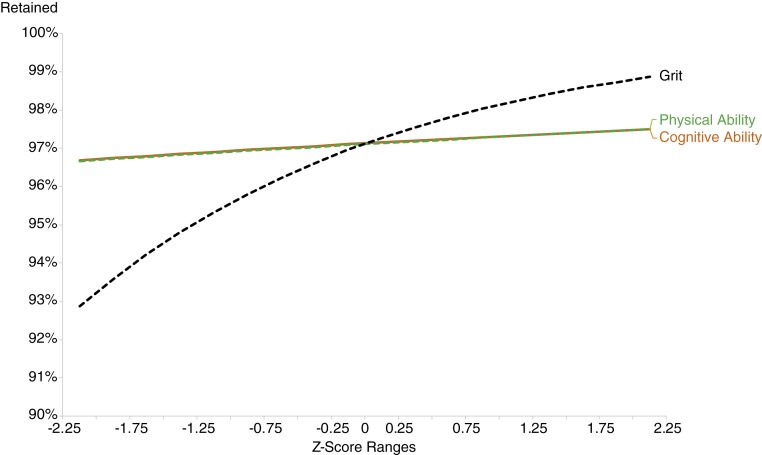
In a decade-long megaanalysis of over 10,000 West Point cadets, cognitive ability best predicted academic and military grades, while physical ability best predicted physical performance. Grit was the only reliable predictor of completing initial Beast Barracks training, and grit and physical ability were more prognostic of 4-y graduation than cognitive ability.
Key findings
- Cognitive ability was negatively related to physical ability (r = −0.05, P < 0.001) and grit (r = −0.07, P < 0.001); physical ability and grit were positively related (r = 0.07, P < 0.001).
- Grit was the only reliable predictor of completing Beast Barracks: 1 SD higher grit gave 54% greater odds of completion (OR = 1.54, P < 0.001, 99% CI: 1.31–1.81), whereas cognitive ability (OR = 1.06, P = 0.33) and physical ability (OR = 1.08, P = 0.14) did not reliably predict retention.
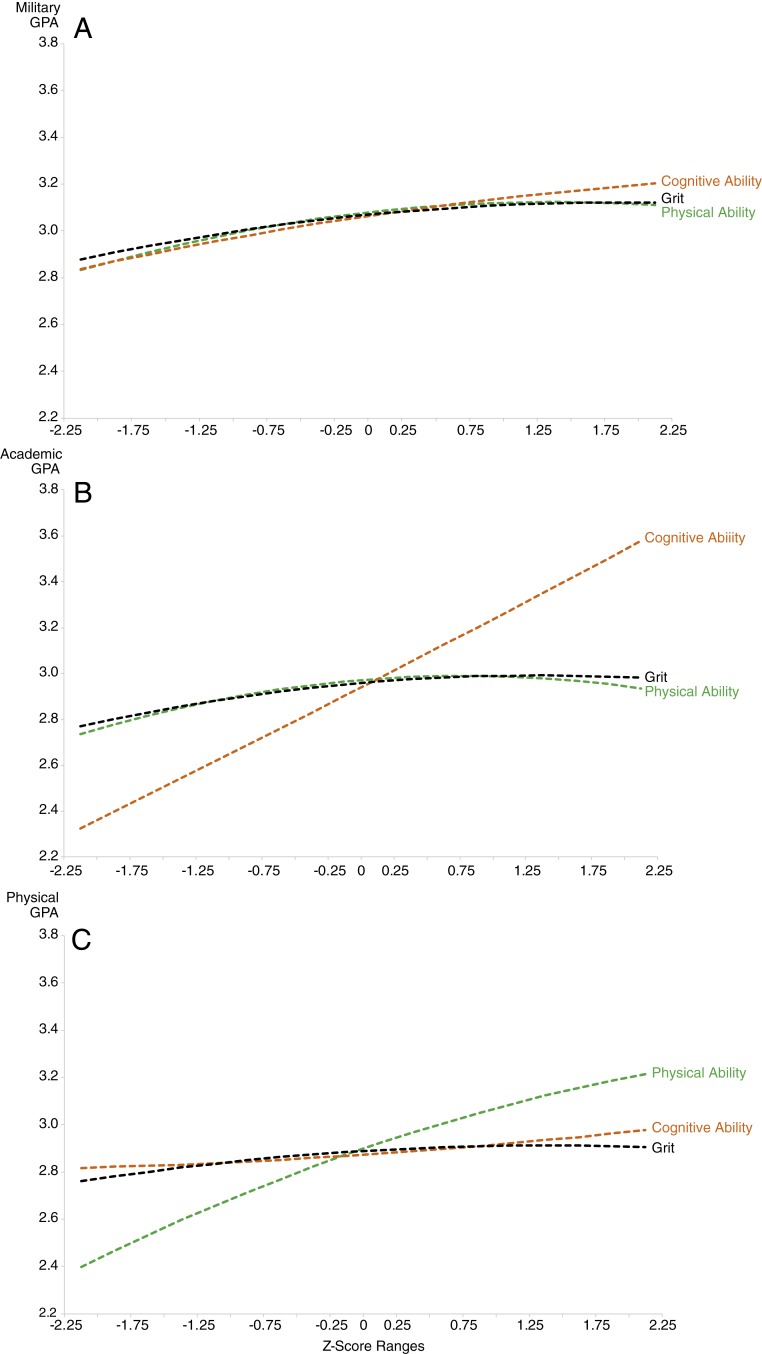
- Cognitive ability was the strongest predictor of academic GPA (β = 0.41, P < 0.001) and military GPA (β = 0.16, P < 0.001); physical ability was the strongest predictor of physical GPA (β = 0.36, P < 0.001). Grit predicted smaller variance in military (β = 0.10), academic (β = 0.07), and physical (β = 0.06) GPAs.
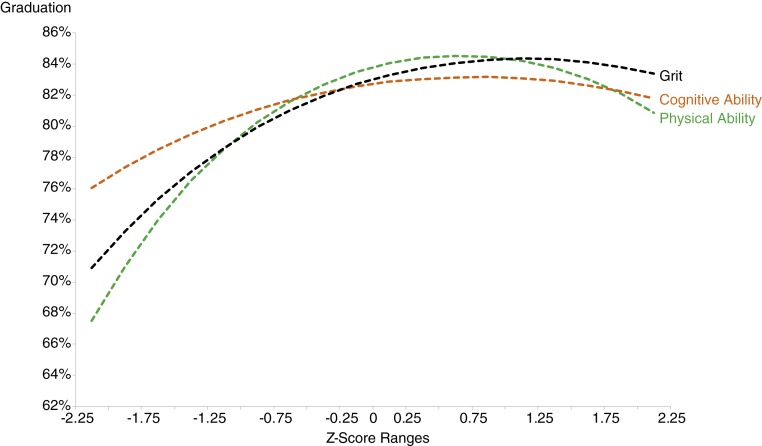
- About 81 of every 100 cadets graduated; grit (OR = 1.18, P < 0.001) and physical ability (OR = 1.18, P < 0.001) were better predictors of graduation than cognitive ability (OR = 1.08, P = 0.011). Concave effects indicated decreased odds of graduation beyond the 89th percentile of physical ability, 95th percentile of cognitive ability, and 99th percentile of grit.
Methods
- Prospective, longitudinal megaanalysis of 9 separate cohorts of over 10,000 women and men entering the US Military Academy at West Point over a full decade; entry measures included grit, cognitive ability, and physical ability, with outcomes from official records: Beast Barracks completion, 4-y graduation, and military, academic, and physical GPAs.
- Binary outcomes were analyzed with logistic regression and continuous GPA outcomes with ordinary least squares regression; predictors were standardized, a 2-tailed P < 0.01 threshold adjusted for 5 outcomes, and quadratic terms plus 2-way interactions were included.
- Robustness checks examined consistency across cohorts, separate entry of pretraining predictors, separate passion and perseverance subscores, and an 8-item short-form Grit Scale; models controlled for gender, race, age, and cohort year.
Limitations
- Stated by the paper: generalizability cannot be assumed beyond the military, structured settings, or this select sample; the data are correlational rather than experimental, limiting causal inference; the study relied on available measures administered by West Point over a decade, and future work should include broader cognitive and noncognitive attributes and repeated measures to unpack mechanisms.
- Evident from the text: the battery of cognitive and noncognitive attributes plus demographic covariates explained less than 4% of variance in 4-y graduation, and the authors note possible severe limits to forecasting individual outcomes because people, contexts, and life trajectories change.
Model-written summary. Check it against the paper before relying on it.
Integrity signals
Registry
Cites
Statistics
Figures
Verification
Claims the paper makes
3 Valid · 0 Not valid · 9 Not checked · 37 Own results and interpretations
The cited sources support only part of this claim — read each source’s verdict below.
In the paper
“The scientific literature is particularly lacking in high-quality, longitudinal studies that assess both cognitive and noncognitive attributes before objectively gauging success outcomes weeks, months, and years later (16).”
§ Cognitive and noncognitive predictors of success > Abstract
What the sources say
- Partly supportedcites [16] Smithers L. G., A systematic review and meta-analysis of effects of early life non-cognitive skills on academic, psychosocial, cognitive and health outcomes. Nat. Hum. Behav. 2, 867– 880 (2018). 30525112 PMC6277013 sourceExperimental — accuracy not yet measured
Smithers et al. (2018) do support the core of the claim: the Discussion > Implications for future research ('Long-term follow-up', paucity of literature with long-term follow-up, median follow-up ~1 year, very few studies beyond age 10), the Discussion > Evidence Quality ('66% were judged as weak or poor quality'; 42% made little or no attempt to adjust for confounding), and the Conclusion ('needs higher quality, adequately powered studies'). The 'both cognitive and noncognitive attributes' element is also touched in Discussion > Implications for future research ('Designing studies for effect modification': a combination of high cognitive and non-cognitive ability would be desirable, 'We found no publications attempting to test this theory'). However, the specific element that the gap concerns 'objectively gauging' success outcomes is not stated as a deficiency in our copy — the Results (Academic Achievement Outcomes, Observational) report that measures included teacher-report, parent report and objective tests and that there was 'little evidence to conclude that any one measurement tool, measurement method (objective or subjective)... was consistently associated with academic achievement'; likewise the 'weeks, months' time-frame is not the paper's framing, which concerns longer-term follow-up. (LLM, conf=0.72)
plain- Asserted: passes — The authors put it forward as true.
- Checkable: passes — It can be checked against evidence.
- Load-bearing: passes — The paper’s conclusions depend on it.
- Based: passes — The paper gives a reason why it holds.
- Partly supported
The cited sources support only part of this claim — read each source’s verdict below.
In the paper
“Grit seems to be independent of cognitive ability (22, 23) and has demonstrated incremental predictive validity, over and above cognitive ability, for achievement (22, 24, 25), particularly for goals of personal significance (26).”
§ Cognitive and noncognitive predictors of success > Cognitive and Noncognitive Attributes
What the sources say
- Not checked yetcites [22] Duckworth A. L., Peterson C., Matthews M. D., Kelly D. R., Grit: Perseverance and passion for long-term goals. J. Pers. Soc. Psychol. 92, 1087– 1101 (2007). 17547490 source
- Partly supportedcites [24] Eskreis-Winkler L., Shulman E. P., Beal S. A., Duckworth A. L., The grit effect: Predicting retention in the military, the workplace, school and marriage. Front. Psychol. 5, 36 (2014). 24550863 PMC3910317 sourceExperimental — accuracy not yet measured
In Study 1 (Results and discussion; page unavailable), grit predicted completion of military selection beyond general intelligence, which the Methods identify as a measure of cognitive ability. Study 3 (Results and discussion; page unavailable) found that grit predicted high-school graduation after controlling for standardized achievement test scores. These findings support incremental prediction of specific retention and graduation outcomes, but the paper does not establish the broader claim for achievement generally. (LLM, conf=0.82)
- Not checked yetcites [25] Akos P., Kretchmar J., Investigating grit at a non-cognitive predictor of college success. Rev. Higher Educ. 40, 163– 186 (2017). source
boostedstates an association- Asserted: passes — The authors put it forward as true.
- Checkable: passes — It can be checked against evidence.
- Load-bearing: passes — The paper’s conclusions depend on it.
- Based: passes — The paper gives a reason why it holds.
The cited sources support only part of this claim — read each source’s verdict below.
In the paper
“Put simply, the outcomes examined in this investigation are consequential in a way that laboratory measures of success are not (26, 28).”
§ Cognitive and noncognitive predictors of success > This Investigation
What the sources say
- Not checked yetcites [26] Jachimowicz J. M., Wihler A., Bailey E. R., Galinsky A. D., Why grit requires perseverance and passion to positively predict performance. Proc. Natl. Acad. Sci. U.S.A. 115, 9980– 9985 (2018). 30224491 PMC6176608 source
- Partly supportedcites [28] Duckworth A., Gross J. J., Self-control and grit: Related but separable determinants of success. Curr. Dir. Psychol. Sci. 23, 319– 325 (2014). 26855479 PMC4737958 sourceExperimental — accuracy not yet measured
The section “Self-Control: Resisting the Hourly Temptations” describes academic achievement, earnings, savings, and physical health as consequential outcomes. The paper does not compare those outcomes with laboratory measures of success or identify the outcomes of the citing authors’ investigation, so it supports only the general point about real-world consequences. (LLM, conf=0.80)
plain- Asserted: passes — The authors put it forward as true.
- Checkable: unclear — It is unclear whether it could be checked against evidence.
- Load-bearing: passes — The paper’s conclusions depend on it.
- Based: passes — The paper gives a reason why it holds.
- Rests on an assumption not shown here.
A result the paper reports from its own data — it cites no other source for it, so there is none to check. The quote shows it is in the paper.
In the paper
“In contrast, cognitive ability (OR = 1.06, P = 0.33, 99% CI: 0.91 to 1.24) and physical ability (OR = 1.08, P = 0.14, 99% CI: 0.94 to 1.25) did not reliably predict retention during this period.”
§ Cognitive and noncognitive predictors of success > Results > Quitting Early: Only Grit Predicts Completing Beast Barracks.
plain- Asserted: passes — The authors put it forward as true.
- Checkable: passes — It can be checked against evidence.
- Load-bearing: passes — The paper’s conclusions depend on it.
- Based: passes — The paper gives a reason why it holds.
A result the paper reports from its own data — it cites no other source for it, so there is none to check. The quote shows it is in the paper.
In the paper
“female cadets scored lower than male cadets in both cognitive ability (d = −0.21, P < 0.001) and physical ability (d = −0.25, P < 0.001) but scored higher on grit (d = 0.07, P = 0.006).”
§ Cognitive and noncognitive predictors of success > Results > Cognitive and Noncognitive Attributes Are Distinct.
plainstates an association- Asserted: passes — The authors put it forward as true.
- Checkable: passes — It can be checked against evidence.
- Load-bearing: unclear — It is unclear whether the paper’s conclusions depend on it.
- Based: passes — The paper gives a reason why it holds.
32 more claims
Create a free account to see all 49 claims and to verify the 14 references still open.
- It may state two separate claims as one. 6
- Probably not a substantial claim. 6
Claims other papers make about this one
Each is checked against this paper’s own text: does it say what the citing paper says it does?
The source backs part of the claim, not all of it — or backs it for a different population, condition or comparison.
In the citing paper
“The necessary components for success in athletics extend beyond physical characteristics and likely include a combination of physical and mental attributes as well as training and persistence.[55][56][57]”
From Creatine supplementation in the pediatric and adolescent athlete-- A literature review (2023) · cites this paper as [56]
Experimental — accuracy not yet measured
Self-check
Percentages, sums and reported differences re-computed from the paper’s own numbers.
Rated minor: it would not touch a result — a value no result rests on, a p-value that stays on the same side of the significance level, or a conflict that is clerical, resolved elsewhere in the paper, or outside its own findings.
In the paper
“physical ability assessed prior to training was the best measured predictor of physical GPA (β = 0.36, P < 0.001, 99% CI: 0.34 to 0.49)”
§ Cognitive and noncognitive predictors of success > Results > Doing Well: Cognitive and Physical Abilities Best Predict Performance.
Reported 0.36 · recomputed 0.415
Citations
Cites
Frames of Mind: The Theory of Multiple Intelligences
Klitgaard, R., & Gardner, H. (1984) · Journal of Policy Analysis and Management · doi:10.2307/3324560 · Cited by 13,636
Grit: perseverance and passion for long-term goals
Duckworth, A. L., Peterson, C., Matthews, M. D., & Kelly, D. R. (2007) · Journal of Personality and Social Psychology · doi:10.1037/0022-3514.92.6.1087 · Cited by 6,911
Self-citationHandbook of industrial and organizational psychology
(1993) · Choice Reviews Online · doi:10.5860/choice.30-5278 · Cited by 5,339
A gradient of childhood self-control predicts health, wealth, and public safety
Moffitt, T. E., Arseneault, L., Belsky, D., Dickson, N., Hancox, R. J., Harrington, H., Houts, R., Poulton, R., Roberts, B. W., Ross, S., et al. (2011) · Proceedings of the National Academy of Sciences · doi:10.1073/pnas.1010076108 · Cited by 4,885 · cited 1×
“(54), which used a multimethod approach to assess the predictive validity of selfregulation, cognitive ability, and background socioeconomic status on outcomes in a birth cohort.”
Development and validation of the short grit scale (grit-s)
Duckworth, A. L., & Quinn, P. D. (2009) · Journal of Personality Assessment · doi:10.1080/00223890802634290 · Cited by 3,376
Self-citationEvaluating Effect Size in Psychological Research: Sense and Nonsense
Funder, D. C., & Ozer, D. J. (2019) · Advances in Methods and Practices in Psychological Science · doi:10.1177/2515245919847202 · Cited by 3,295 · cited 1×
“The work by Funder and Ozer (56) has an illuminating discussion on credible effect sizes in psychological research.”
The g factor: the science of mental ability
(1998) · Choice Reviews Online · doi:10.5860/choice.36-2443 · Cited by 2,746
Handbook of The Economics of Education
(2011) · Handbook of the Economics of Education · doi:10.1016/c2009-0-19772-6 · Cited by 2,525
Hereditary genius: An inquiry into its laws and consequences.
Galton, F. (1869) · Macmillan eBooks · doi:10.1037/13474-000 · Cited by 1,940
Much ado about grit: A meta-analytic synthesis of the grit literature
Credé, M., Tynan, M. C., & Harms, P. D. (2017) · Journal of Personality and Social Psychology · doi:10.1037/pspp0000102 · Cited by 1,653 · cited 1×
“be independent of cognitive ability (22, 23) and has demonstrated incremental predictive validity, over and above cognitive ability, for achievement (22, 24, 25), particularly for goals of personal significance (26).”
Research works printed but not linked: 3
- Cox C. M., Genetic Studies of Genius: The Early Mental Traits of Three Hundred Geniuses (Stanford University Press, 1926).
- Brown J., What Are Some Reasons Students Drop Out of the US Military Academies? Is It Because the Coursework Is Too Rigorous? Do They Not Like the Structure? (Quora, 2016).
- Winerip M., The beauty of Beast Barracks. NY Times Magazine (12 October 1997), pp. 46–53, 52-65.
Cited by
When and How Artificial Intelligence Augments Employee Creativity
Jia, N., Luo, X., Fang, Z., & Liao, C. (2024) · Academy of Management Journal · doi:10.5465/amj.2022.0426 · Cited by 768
Integrating Models of Self-Regulation
Inzlicht, M., Werner, K. M., Briskin, J. L., & Roberts, B. W. (2021) · Annual Review of Psychology · doi:10.1146/annurev-psych-061020-105721 · Cited by 594
Evaluating the Big Five as an organizing framework for commonly used psychological trait scales.
Bainbridge, T. F., Ludeke, S. G., & Smillie, L. D. (2022) · Journal of Personality and Social Psychology · doi:10.1037/pspp0000395 · Cited by 162
Putting the Goal Back into Grit: Academic Goal Commitment, Grit, and Academic Achievement
Tang, X., Wang, M., Parada, F., & Salmela‐Aro, K. (2020) · Journal of Youth and Adolescence · doi:10.1007/s10964-020-01348-1 · Cited by 130
“Moreover, a newly published study espouse that grit (as compared to cognitive and physical ability) was the strongest predictor of completion of a highly-intensive training program and graduation status among cadets at West Point Academy (Duckworth et al. 2019).”
BackgroundIntegrating Models of Self-RegulationPreprint
Inzlicht, M., Werner, K. M., Briskin, J. L., & Roberts, B. W. (2020) · PsyArXiv (OSF Preprints) · doi:10.31234/osf.io/dpjye · Cited by 97
“…and comparing trait measures of self-regulation (e.g., conscientiousness) and intelligence on various beneficial life outcomes, such as academic achievement, health, and occupational status (e.g., Chamorro-Premuzic & Furnham, 2008; Duckworth et al., 2019; Duckworth, Weir, Tsukayama, & Kwok, 2012).”
BackgroundInfluentialChildhood self-control forecasts the pace of midlife aging and preparedness for old age
Richmond-Rakerd, L. S., Caspi, A., Ambler, A., d’Arbeloff, T., de Bruine, M., Elliott, M., Harrington, H., Hogan, S., Houts, R. M., Ireland, D., et al. (2021) · Proceedings of the National Academy of Sciences · doi:10.1073/pnas.2010211118 · Cited by 83
Paradowski, M. B., & Jelińska, M. (2023) · Computer Assisted Language Learning · doi:10.1080/09588221.2023.2192762 · Cited by 110
“Both are important contributing factors to performance (Duckworth et al., 2007, 2019; Duckworth & Quinn, 2009).”
Grit: The long and short of it.
Morell, M., Yang, J. S., Gladstone, J. R., Turci, L., Ponnock, A. R., Lim, H. J., & Wigfield, A. (2021) · Journal of Educational Psychology · doi:10.1037/edu0000594 · Cited by 104
Schimschal, S. E., Visentin, D. C., Kornhaber, R. A., & Cleary, M. L. (2020) · Issues in Mental Health Nursing · doi:10.1080/01612840.2020.1814913 · Cited by 96
“For example, in a 10- year follow-up study involving military cadets, grit increased the likelihood of training completion (Duckworth et al., 2019).”
BackgroundGuo, W., Bai, B., Zang, F., Wang, T., & Song, H. (2023) · System · doi:10.1016/j.system.2023.103018 · Cited by 95
Southwick, D. A., Tsay, C., & Duckworth, A. L. (2019) · Research in Organizational Behavior · doi:10.1016/j.riob.2020.100126 · Cited by 100
Self-citationEmerging neurodevelopmental perspectives on mathematical learning
Menon, V., & Chang, H. (2021) · Developmental Review · doi:10.1016/j.dr.2021.100964 · Cited by 66
“In addition to cognitive abilities, multiple lines of evidence suggest that affective, motivational, and sociocultural factors (Aiken, 1976; Duckworth et al., 2019; Halpern et al., 2007) contribute to individual differences in mathematical learning.”
BackgroundStudents’ long-term orientation role in e-learning success: A Brazilian study
Cidral, W., Aparício, M., & Oliveira, T. (2020) · Heliyon · doi:10.1016/j.heliyon.2020.e05735 · Cited by 75
“A possible reason that might explain these results can reside in previous fi ndings that indicate that non-cognitive attributes of the students are determinants to their success (Aparicio et al., 2017; Duckworth et al., 2019; Porter et al., 2020).”
ResultThe development of grit and growth mindset in Chinese children
Zhang, T., Park, D., Ungar, L., Tsukayama, E., Luo, L., & Duckworth, A. L. (2022) · Journal of Experimental Child Psychology · doi:10.1016/j.jecp.2022.105450 · Cited by 59
Self-citationEnhancing Undergraduate Student Success in STEM Fields through Growth-Mindset and Grit
Hacisalihoglu, G., Stephens, D., Stephens, S., Johnson, L. E., & Edington, M. D. (2020) · Education Sciences · doi:10.3390/educsci10100279 · Cited by 59
Gao, Z., Li, X., & Liao, H. (2024) · Acta Psychologica · doi:10.1016/j.actpsy.2024.104428 · Cited by 50
The fable of state self-control
Inzlicht, M., & Roberts, B. W. (2024) · Current Opinion in Psychology · doi:10.1016/j.copsyc.2024.101848 · Cited by 49
“…children who are rated by their parents and teachers as being high in self-control go on to become wealthy 40-year-olds [6]; gritty students admitted to West Point military academy are more likely to graduate within 4 years [13]; conscientious people go on to live long and fulfilling lives [14,15].”
Salesperson grit: reducing unethical behavior and job stress
Schwepker, C. H., & Good, M. C. (2021) · Journal of Business and Industrial Marketing · doi:10.1108/jbim-04-2021-0211 · Cited by 41
Review of Racially Equitable Admissions Practices in STEM Doctoral Programs
Roberts, S. F., Pyfrom, E. S., Hoffman, J. A., Pai, C., Reagan, E. K., & Light, A. E. (2021) · Education Sciences · doi:10.3390/educsci11060270 · Cited by 42
Chen, L., Chang, H., Rudoler, J., Arnardóttir, E., Zhang, Y., Angeles, C. D. L., & Menon, V. (2022) · npj Science of Learning · doi:10.1038/s41539-022-00146-7 · Cited by 40
“We then examined the relation between changes in connectivity in each of the four regions of interest and changes in growth mindset scores, and found that increased connectivity of two individual links of the right dorsal ACC were positively correlated with changes in growth mindset with training: right dorsal ACC lef…”
Refocusing Civic Education: Developing the Skills Young People Need to Engage in Democracy
Hillygus, D. S., & Holbein, J. B. (2023) · The Annals of the American Academy of Political and Social Science · doi:10.1177/00027162231177798 · Cited by 35
“…term noncognitive to contrast with standard conceptualizations of intelligence (e.g., Cunha and heckman 2007; Cunha, heckman, and Schennach 2010; Duckworth et al., 2019; Edin et al. 2022; gil-hernández 2021; heckman 2000; heckman, humphries, and Veramendi 2018; heckman and Rubinstein 2001;…”
BackgroundWhat Does it Take to Flow? Investigating Links Between Grit, Growth Mindset, and Flow in Musicians
Tan, J. S., Yap, K., & Bhattacharya, J. (2021) · Music & Science · doi:10.1177/2059204321989529 · Cited by 27
“For example, a recent study (Duckworth et al., 2019) has showed that grit is the strongest predictor of completing an intensive military summer training often associated with a high attrition rate.”
BackgroundLarkin, P., Cocić, D., Hendry, D. T., Williams, A. M., O’Connor, D., & Bilalić, M. (2022) · Psychology of sport and exercise · doi:10.1016/j.psychsport.2022.102328 · Cited by 32
Zisman, C., & Ganzach, Y. (2022) · Intelligence · doi:10.1016/j.intell.2022.101631 · Cited by 25
“Thus intelligence may be a better predictor of success complex occupation that involve variety of tasks than in simple repetitive jobs (Hunter & Hunter, 1984) while personality may be a better predictor of jobs that require endurance (Duckworth et al., 2019).”
BackgroundMeng, Y., Sun, Y., Yang, L., & Mydin, Y. O. (2025) · Behavioral Sciences · doi:10.3390/bs15050621 · Cited by 33
“Duckworth et al., 2019; Zimmerman, 2000); however, they manifest to varying extents.”
Cognitive abilities - a new direction in burnout research
Kulikowski, K. (2020) · European Journal of Work and Organizational Psychology · doi:10.1080/1359432x.2020.1841284 · Cited by 32
“…2012), happiness (Ali et al., 2013), occupational prestige (Judge et al., 2010), financial rewards perceptions (Ganzach & Fried, 2012), socioeconomic success (i.e. education level, income, and occupation prestige) (Strenze, 2007) and success in military settings (Duckworth et al., 2019).”
BackgroundLongitudinal bidirectional associations between personality and becoming a leader
Asselmann, E., Holst, E., & Specht, J. (2022) · Journal of Personality · doi:10.1111/jopy.12719 · Cited by 24
How to stay high-performing: developing organizational grit
de Waal, A. A., Burrell, J., Drake, S., Sampa, C., & Mulimbika, T. (2022) · Measuring Business Excellence · doi:10.1108/mbe-08-2021-0104 · Cited by 26
Relations between grit, career adaptability, and life satisfaction: a moderated mediation model
ÇARKIT, E. (2024) · Current Psychology · doi:10.1007/s12144-024-06375-w · Cited by 26
“Previous results have shown that grit increases academic achievement (Lucas et al., 2015), the likelihood of completing education (Duckworth et al., 2019), and academic engagement (Hodge et al., 2018).”
Self-Regulation in Adolescents: Polish Adaptation and Validation of the Self-Regulation Scale
Gajda, M., Małkowska‐Szkutnik, A., & Rodzeń, W. (2022) · International Journal of Environmental Research and Public Health · doi:10.3390/ijerph19127432 · Cited by 31
Gandhi, L., Manning, B. S., & Duckworth, A. L. (2024) · Current Directions in Psychological Science · doi:10.1177/09637214241268222 · Cited by 26
Self-citationStudying the effects of future-oriented factors and turnover when threatened
McGinley, S. P., Line, N. D., Wei, W., & Peyton, T. (2020) · International Journal of Contemporary Hospitality Management · doi:10.1108/ijchm-12-2019-1002 · Cited by 21
Return to Work After Primary Hip Arthroscopy: A Systematic Review and Meta-analysis
Blaeser, A. M., Mojica, E. S., Mannino, B. J., & Youm, T. J. (2022) · The American Journal of Sports Medicine · doi:10.1177/03635465211064271 · Cited by 17
Andereggen, L., Andereggen, S., Bello, C., Urman, R. D., & Luedi, M. M. (2022) · Best practice & research. Clinical anaesthesiology · doi:10.1016/j.bpa.2022.05.002 · Cited by 21
Jing, Y., Dai, J., Wang, C., Shen, S., & Shadiev, R. (2024) · Interactive Learning Environments · doi:10.1080/10494820.2024.2335481 · Cited by 22
“…as Traditional Learning Method and Self-directed Learning Method (Morris, 2019); (7) Learning Outcomes Type: Classi fi ed into Cognitive and Non-cognitive outcomes (Duckworth et al., 2019; Ma et al., 2023; Vanbecelaere et al., 2020; Wu et al., 2023); (8) Additional Information: Other collected…”
Tang, B., Xiao, S., Zhang, Y., Liu, S., Lin, X., & Liu, H. (2024) · Frontiers in Psychology · doi:10.3389/fpsyg.2024.1367308 · Cited by 15
“Non-cognitive abilities are a crucial component of the emerging human capital theory (Duckworth et al., 2019), referring to emotional and behavioral competencies demonstrated during interpersonal interactions (Roberts, 2009).”
BackgroundThe Role of Mindset in Education: A Large-Scale Field Experiment in Disadvantaged Schools
Huillery, É., Bouguen, A., Charpentier, A., Algan, Y., & Chevallier, C. (2025) · The Economic Journal · doi:10.1093/ej/ueaf015 · Cited by 28
Development of a scale to measure the psychological resources of grit in adults
Schimschal, S. E., Visentin, D. C., Kornhaber, R. A., Barnett, T., & Cleary, M. L. (2022) · Nursing and Health Sciences · doi:10.1111/nhs.12973 · Cited by 18
“One emerging area of enquiry is grit, a characteristic purported to enable one to pursue ideas, projects, and goals consistently over extended periods whilst overcoming adversity and setbacks (Duckworth et al., 2007; Duckworth et al., 2019).”
BackgroundFedina, N. V., Александрович, Д. Р., & Елисеев, В. К. (2022) · Science for Education Today · doi:10.15293/2658-6762.2206.01 · Cited by 14
Left-behind experience and children’s multidimensional poverty: Evidence from rural China
Xu, H., Jiang, Q., Zhang, C., & Ahmad, S. (2022) · Child Indicators Research · doi:10.1007/s12187-022-09965-x · Cited by 13
“It is defined as people’s ability to reason, plan, solve problems, think abstractly, understand complex ideas, learn quickly and learn from experience (Duckworth et al., 2019).”
BackgroundIversen, Z. A., Tikotzki, M. A., & Kurman, J. (2022) · Military Psychology · doi:10.1080/08995605.2022.2127986 · Cited by 13
“Gritty individuals pursue their specific goals despite failure and adversity, much like a marathon runner stays the course (long-term stamina rather than short-term intensity; Duckworth et al., 2019).”
BackgroundWu, Q., Ying, L., Dong, L., Leng, H., Iqbal, Z., & Jiang, Z. (2021) · The Journal of Social Psychology · doi:10.1080/00224545.2020.1856026 · Cited by 14
Ahmed, H., Mahmud, M., Said, F., & Tirmazee, Z. S. (2022) · Economic Development and Cultural Change · doi:10.1086/721615 · Cited by 21
“…achievement, and labor market prospects; and impacting earning differences and other important life outcomes (Heckman and Rubinstein 2001; Duckworth and Se-ligman 2005; Heckman and Kautz 2012, 2013; Kautz et al. 2014; Duckworth et al. 2019; Ashraf et al. 2020; Bhan 2020; Resnjanskij et al. 2021).”
BackgroundGenome scanning of behavioral selection in a canine olfactory detection breeding cohort
Eyre, A. W., Zapata, I., Hare, E., Lee, K. M. N., Bellis, C., Essler, J. L., Otto, C. M., Serpell, J. A., & Alvarez, C. E. (2022) · Scientific Reports · doi:10.1038/s41598-022-18698-4 · Cited by 12
“As an example of the problem, consider a study of over 11,000 cadets assessed throughout their time in the US Military Academy 39 .”
Creatine supplementation in the pediatric and adolescent athlete-- A literature review
Metzger, G. A., Minneci, P. M., Gehred, A., Day, A., & Klingele, K. E. (2023) · Journal of Orthopaedics · doi:10.1016/j.jor.2023.03.010 · Cited by 10
Michaelides, M. P., & Durkee, P. K. (2021) · Frontiers in Education · doi:10.3389/feduc.2021.724711 · Cited by 15
“Noncognitive characteristics are useful predictors of academic outcomes (Duckworth et al., 2019), but as the replication finding of the current study shows not all are equally important in predicting higher achievement.”
BackgroundGrit and Graduation: Exploring Persistence Among Urban University Students
Woodward, L. S., Patrick, S. D., & Rapport, L. J. (2024) · Journal of College Student Retention Research Theory & Practice · doi:10.1177/15210251241240742 · Cited by 15
“In a study of over 10,000 West Point cadets, grit scores were positively associated with the odds of completing summer training and four-year graduation, even after accounting for cognitive and physical ability (Duckworth et al., 2019).”
EMPOWERMENT OF COASTAL COMMUNITIES THROUGH MARINE TOURISM: A FUNCTIONAL APPROACH
Hamzah, A., Arifin, A., Abdullah, S., Salim, M. N. H. M., & Junaid, I. (2024) · PLANNING MALAYSIA · doi:10.21837/pm.v22i34.1633 · Cited by 10
Grit and uncertainty: Grit predicts performance and West Point graduation during pandemic conditions
Wetzler, E. L., Farina, A. G., Powers, J., & Matthews, M. D. (2023) · Military Psychology · doi:10.1080/08995605.2023.2222631 · Cited by 11
“This finding is generally consistent with those from Duckworth et al.’s (2019) study of nine cohorts of West Point cadets entering between 2004 and 2014; they found that both grit and physical fitness scores at the time of entry into West Point were better predictors of West Point graduation than…”
InfluentialSelf-citationKettrey, H. H., Quinn, S., Waddell, C., Evans, J., Imbody, C., & Nunez-Garcia, F. (2024) · Sex Roles · doi:10.1007/s11199-024-01526-6 · Cited by 13
Character strengths and performance outcomes among military brat and non-brat cadets
Gosnell, C. L., Kelly, D. R., Ender, M. G., & Matthews, M. D. (2020) · Military Psychology · doi:10.1080/08995605.2019.1703434 · Cited by 9
“Previous work has found that non-cognitive predictors, such as grit, can carry more weight than cognitive predictors of achievement in regards to success in certain tasks at West Point, such as the initial initiation period (Duckworth et al., 2019).”
BackgroundSelf-citationPredicting army cadets’ performance: The role of character strengths, GPA and GMA
Bang, H., Nilsen, F., Boe, O. C., Eilertsen, D. E., & Lang-Ree, O. C. (2021) · Journal of Military Studies · doi:10.2478/jms-2021-0016 · Cited by 9
“…and Clark 2020; Hiss and Franks 2014; Hodara and Cox 2016; Hodara and Lewis 2017; Wagerman and Funder 2007), general mental ability (GMA; e.g. Duckworth et al. 2019; Kobrin et al. 2008; Køber et al. 2017; Lounsbury et al. 2003; Roth et al. 2015; Schmidt and Hunter 1998; Strenze 2007) and Big…”
BackgroundDevelopment of a Smart Tourism Information Chatbot for Mauritius
Chiong, P. S. S. C., Seeam, A. K., & Seeam, P. (2022) · International Conference on Intelligent and Innovative Computing Applications · doi:10.59200/iconic.2022.013 · Cited by 11
What is “grit” and why it can be a personal resource?
Yerofeyeva, V. G., & Кимовна, Н.-Б. С. (2020) · Journal of Modern Foreign Psychology · doi:10.17759/jmfp.2020090402 · Cited by 15
“Недавнее исследование среди 11258 кадет военной академии в Вест-Пойнте показало, что при сравнении когнитивных и некогнитивных черт первые предсказывали академические и военные оценки, а последние, в том числе настойчивость, позволили сделать прогноз относительно того, кто же получит диплом военной академии [13].”
Adherence to Islamic principles of success and academic achievement
Abubakar, Z., & Maishanu, I. M. (2020) · International Journal of Evaluation and Research in Education (IJERE) · doi:10.11591/ijere.v9i2.20473 · Cited by 14
“Although various factors, such as parental engagement [3-6] and teachers factors [7, 8] have been documented to be associated with academic success, student factors, both cognitive and non-cognitive, are by far the most important [9-16].”
BackgroundPassion and perseverance: How the components of grit affect the probability of starting a business
Oradini, N. P. B., Rubio, A., Araya-Castillo, L., Boada-Cuerva, M., & Vallejo-Vélez, M. (2022) · Frontiers in Psychology · doi:10.3389/fpsyg.2022.906701 · Cited by 13
“, 2019), self-control (Duckworth and Gross, 2014), and leadership (Samborowski et al., 2021), among others constructs.”
BackgroundMixed Associations Between Grit and transformational Leadership Behavior
Caza, A., & Posner, B. Z. (2021) · Journal of Leadership Studies · doi:10.1002/jls.21781 · Cited by 10
Bilalić, M., Đokić, R., Koso-Drljević, M., Đapo, N., & Pollet, T. V. (2022) · Current Psychology · doi:10.1007/s12144-022-03336-z · Cited by 11
Grit and Academic Performance in Doctor of Physical Therapy Students
Richardson, S. A., Scotto, M., Belcina, M., Patel, R., & Wiener, K. (2020) · Internet Journal of Allied Health Sciences and Practice · doi:10.46743/1540-580x/2020.1976 · Cited by 8
Beyond cognitive rationality: integrating motivation and affect in human decision-making
Ganuthula, V. R. R. (2024) · DECISION · doi:10.1007/s40622-024-00410-2 · Cited by 8
“The idea of “grit” (Duckworth et al. 2007, 2019) illustrates how motivation propels perseverance in pursuing options as we move from evaluation to action.”
Lane, T. B., Vomvoridi-Ivanović, E., Cain, L. K., Willis, S., Ahmad, S., & Gaines, J. E. (2023) · Journal of Pre-College Engineering Education Research (J-PEER) · doi:10.7771/2157-9288.1352 · Cited by 7
Scenario forecasting for students’ professional future
Tretyakova, V. S. (2024) · The Education and science journal · doi:10.17853/1994-5639-2024-1-54-81 · Cited by 11
Gorelik, A. J., Paul, S. E., Miller, A. P., Baranger, D. A. A., Lin, S., Zhang, W., Elsayed, N. M., Modi, H., Addala, P., Bijsterbosch, J. D., et al. (2024) · Psychological Medicine · doi:10.1017/s0033291724002174 · Cited by 9
“…Lövdén, Fratiglioni, Glymour, Lindenberger, & Tucker-Drob, 2020) and non-cognitive factors (e.g. personality; Chamorro-Premuzic & Furnham, 2003; Noftle & Robins, 2007) may contribute to EduA, employment outcomes, and overall success later in life (Duckworth et al., 2019; Moffitt et al., 2011).”
Psychological Resilience in West Point Graduates: Results From a Nationally Representative Study
Thomas, M. M., Pietrzak, R. H., Nguyen, D. R., Ryan, D. M., Southwick, S. M., & Mazure, C. M. (2021) · Chronic Stress · doi:10.1177/24705470211053850 · Cited by 9
“Some studies show grit is associated with a reduced tendency for suicide ideation and decreased burnout in doctors and surgical residents.53–55 In studying West Point cadets, Duckworth and colleagues found that those who had higher grit at the entry to the academy were less likely to drop out of the first basic traini…”
BackgroundTretyakova, V. S., Kaigorodova, A. E., Sharov, А. А., & Zeer, E. F. (2024) · Science for Education Today · doi:10.15293/2658-6762.2402.09 · Cited by 7
Putting the goal back into grit: Academic goal commitment, grit and academic achievementPreprint
Tang, X., Wang, M., Parada, F., & Salmela‐Aro, K. (2020) · PsyArXiv (OSF Preprints) · doi:10.31234/osf.io/nmqu4 · Cited by 7
ÖZTÜRK, N., & SUMBAS, E. (2023) · Kuramsal Eğitimbilim · doi:10.30831/akukeg.1186981 · Cited by 13
Task repetition and L2 grit: Exploring the interplay in language learners’ oral performance
Róg, T., & Krawiec, M. (2024) · TASK Journal on Task-Based Language Teaching and Learning · doi:10.1075/task.00034.rog · Cited by 6
Long-term mortality of academy award winning actors and actresses
Redelmeier, D. A., & Singh, S. M. (2022) · PLoS ONE · doi:10.1371/journal.pone.0266563 · Cited by 6
“One possibility is lower resilience or another ingrained attribute that contributes to less success and less health [53].”
Dai, X., & Si, K. (2023) · Organization Science · doi:10.1287/orsc.2023.1667 · Cited by 8
Hossain, M., & Jukes, M. (2024) · The Journal of Development Studies · doi:10.1080/00220388.2024.2388100 · Cited by 14
“…have been shown to predict many life outcomes, including health and well-being (Holland & Roisman, 2008; Ozer & Benet-Mart (cid:2) ı nez, 2006; Paunonen & Ashton, 2001); and grit, a measure of perseverance which is a predictor of real-world success in work and academics (Duckworth et al., 2019).”
Breaking Down Grit: Persistency and Flexibility in the Career Plans of Military Medical Students
Landoll, R. R., Highland, K. B., Bell, K., Artino, A. R., Moores, C. L. K., Soh, M. Y., Uijtdehaage, S. H. J., Durning, S. J., Grunberg, N. E., & Dong, T. (2023) · Military Medicine · doi:10.1093/milmed/usac205 · Cited by 6
How small differences grow over time – the snowball effect of grit on practice in sport
Cocić, D., Larkin, P., Hendry, D. T., Williams, A. M., O’Connor, D., & Bilalić, M. (2024) · International Journal of Sport and Exercise Psychology · doi:10.1080/1612197x.2024.2359476 · Cited by 6
“Grit is defined as persisting interest and determination in achieving long-term goals in spite of challenges and setbacks (Duckworth et al., 2007, 2019).”
InfluentialImaging body-mind crosstalk in young adults
Yu, Q., Kong, Z., Zou, L., Herold, F., Ludyga, S., Zhang, Z., Hou, M., Kramer, A. F., Erickson, K. I., Taubert, M., et al. (2024) · International Journal of Clinical and Health Psychology · doi:10.1016/j.ijchp.2024.100498 · Cited by 6
“…social benefits, and life satisfaction (An et al., 2023; Kavaliunas et al., 2019), as a predictor of many forms of academic and career success (Duckworth et al., 2019), and also as a nexus of clinical significance in mental disorders (e.g., bipolar disorder, schizophrenia, major depressive…”
BackgroundNeurological Correlates of Grit: A Critical Review
Wang, S., & Li, J. (2021) · Springer eBooks · doi:10.1007/978-3-030-57389-8_9 · Cited by 6
Effects of a Futsal Sports-Specific Program on Cognitive Intelligence in Youth Male Futsal Players
homsombat, T., & Tunintaraarj, P. (2025) · Journal of Health Science and Medical Research · doi:10.31584/jhsmr.20251147 · Cited by 7
Sources of self-efficacy beliefs in learning accounting: does gender matter?
Beatson, N. J., Sithole, S. T. M., Lange, P. D., O’Connell, B., & Smith, J. K. (2025) · Journal of International Education in Business · doi:10.1108/jieb-02-2024-0014 · Cited by 8
“Navigating The Storm”: Peran Grit sebagai Penghambat Stres Mahasiswa di Masa Pandemi
Amawidyati, S. A. G., Rizki, B. M., & Ulya, L. L. (2023) · Intuisi : Jurnal Psikologi Ilmiah · doi:10.15294/intuisi.v14i2.33719 · Cited by 12
Grit was not associated to dropout in Dutch Marine recruits
Dijksma, I., Lucas, C., & Stuiver, M. M. (2022) · Military Psychology · doi:10.1080/08995605.2022.2028518 · Cited by 6
“Individual requested discharge is likely influenced by physical abilities but also by cognitive and abilities and personality traits (Duckworth et al., 2019).”
BackgroundResultInfluentialDiversifying faculty recruitment in biomedical sciences
Yassa, M. A., & Edinger, A. L. (2023) · The FASEB Journal · doi:10.1096/fj.202300688rr · Cited by 7
Grit Among US Surgical Residents—Food for Thought
Lipsett, P. A. (2021) · JAMA Surgery · doi:10.1001/jamasurg.2021.2379 · Cited by 4
The Role of Arts and Music in Early Childhood Education
Makridis, C. A., Guan, K., Ludington, E. R., Hopkins, M. T., & Parassidis, S. (2021) · Advances in early childhood and K-12 education · doi:10.4018/978-1-7998-8649-5.ch013 · Cited by 5
Mashau, T. S., & Fhatuwani, R. (2023) · International Journal of Research in Business and Social Science (2147-4478) · doi:10.20525/ijrbs.v12i7.2773 · Cited by 6
“Duckwortha, Quirka, Gallopa, Hoyleb, Kelly and Matthews (2019, p. 23499) define cognitive as the “ability to reason, plan, solve problems, think abstractly, comprehend complex ideas, learn quickly, and learn from experience.”
BackgroundSpiritual Leadership in Healthcare: A Systematic Review of Empirical Studies and Research Directions
Naqach, T.-Y., & Chaouki, F. (2025) · Journal of Religion and Health · doi:10.1007/s10943-025-02467-4 · Cited by 4
Surabaya, U. S. A., Muhid, A., Ahmad, Y., Surabaya, U. S. A., Kusaeri, K., Surabaya, U. S. A., Novitasari, D. C. R., Surabaya, U. S. A., Asyhar, A. Z., Surabaya, U. S. A., et al. (2020) · The New Educational Review · doi:10.15804/tner.20.61.3.16 · Cited by 3
“Cognitive abilities such as those measured on standardised tests like the SAT have a high predictive validity for academic achievement (Sulphey et al., 2018), Duckworth et al., 2019 also found the SAT to be a predictor of student academic achievement.”
BackgroundSkull Base Training and Mentorship
Haynes, D. S., Röser, F., Brackmann, D. E., & van Loveren, H. R. (2020) · Otology & Neurotology · doi:10.1097/mao.0000000000002903 · Cited by 3
EXPLORING THE IMPACT OF PRE-COLLEGE STEM EXPOSURE ON FIRST-YEAR ENGINEERING STUDENT SELF-EFFICACY
Hughes, M. D. (2021) · UKnowledge (University of Kentucky) · doi:10.13023/etd.2021.125 · Cited by 3
The Impact Grit and Achievement Goal Orientation have on Athletic Training Students' Persistence
Harner, H., Peer, K., Moser, C., & Cindric, J. (2021) · Journal of Sports Medicine and Allied Health Sciences Official Journal of the Ohio Athletic Trainers Association · doi:10.25035/jsmahs.07.02.02 · Cited by 3
Vîrgă, D., Balan, G., & Fodor, O. C. (2023) · Psihologia Resurselor Umane · doi:10.24837/pru.v21i1.526 · Cited by 4
The Use of CAKE Mobile Application Among ESL Undergraduate Students in the ODL Programme
Kamal, S. S. L. A., & Al‐Smadi, O. A. (2023) · AJELP The Asian Journal of English Language and Pedagogy · doi:10.37134/ajelp.vol11.2.3.2023 · Cited by 2
Is Grit Adaptive? Focusing on Goal-Pursuit Behavior When Facing Difficult-to-Achieve Goals
Toyama, M. (2025) · Springer eBooks · doi:10.1007/978-981-96-2325-9_22 · Cited by 2
Xiong, Y. (2025) · Acta Psychologica · doi:10.1016/j.actpsy.2025.105698 · Cited by 2
Hsiung, 熊. S.-Y. (2026) · Military Psychology · doi:10.1080/08995605.2026.2668742 · Cited by 2
Barrera, C. A. J. (2022) · Liminales · doi:10.54255/lim.vol11.num22.685 · Cited by 3
“The internship process is still a space to continue reflecting on the impact it can have on student learning, their personal development, and their socio-emotional skills (CASEL, 2019; Duckworth et al., 2019; Duckworth & Yeager, 2015) along with benefits in the development of formative quality (Brunello & Schlotter, 2…”
BackgroundGrit as a Determinant of Success in the Teacher Recruitment Examination
Sakurai, R., & Watanabe, T. (2020) · IIAI International Congress on Advanced Applied Informatics (IIAI-AAI) · doi:10.1109/iiai-aai50415.2020.00076 · Cited by 2
“Further, based on previous research [5], [8], eight of these items were used to also administer the Grit-S.”
MethodThe Effect of Grit Programs on Self-efficacy, Future Orientation Goals, and Self-directed Learning
Park, J.-I., Kim, K.-S., & Lee, M.-N. (2022) · Asia-pacific Journal of Convergent Research Interchange · doi:10.47116/apjcri.2022.05.11 · Cited by 2
Umo, U. P. (2022) · European Journal of Business Management and Research · doi:10.24018/ejbmr.2022.7.3.1048 · Cited by 2
Return to Work Following Hip Arthroscopy for Femoroacetabular Impingement Syndrome: A Case Series
Li, Z. I., Shankar, D. S., Garra, S., Hughes, A. J., Triana, J., Blaeser, A. M., & Youm, T. J. (2023) · Surgeries · doi:10.3390/surgeries4030039 · Cited by 2
Rizaldi, T. (2023) · Jurnal Ecoment Global · doi:10.36982/jeg.v8i2.3225 · Cited by 2
The mediating effect of beliefs about difficulties in the relation between grit and persistence
Toyama, M. (2024) · Current Psychology · doi:10.1007/s12144-024-06337-2 · Cited by 2
“…(e.g., it is not correlated with intelligence quotient [IQ]; Credé et al., 2017; Duckworth et al., 2007 ) and reliably predicts the achievement of important goals even controlling for measured cognitive ability (Duckworth et al., 2019; Eskreis-Winkler et al., 2014; Jachimowicz et al., 2018).”
Metadata
- Authors
- Duckworth, A. L., Quirk, A., Gallop, R., Hoyle, R. H., Kelly, D. R., & Matthews, M. D.
- Affiliations
- University of Pennsylvania (US)
- Duke University (US)
- United States Military Academy (US)
- Corresponding author
- Duckworth, Angela L.
- Venue
- Proceedings of the National Academy of Sciences
- Publisher
- National Academy of Sciences
- Published
- 2019-11-04
- Volume
- 116
- Issue
- 47
- Pages
- 23499-23504
- ISSN
- 0027-8424 (ISSN-L)
- 1091-6490
- PMC
- PMC6876246
- OpenAlex
- W2986900544
- Semantic Scholar
- dd8cdb07c059d29114bcfaea096df2aefa5970db
- Cited by
- 170
- References
- 66
- Citations by year
- 2026: 19 · 2025: 17 · 2024: 24 · 2023: 26 · 2022: 34 · 2021: 29 · 2020: 18 · 2019: 2
- FWCI
- 26.07
- Type
- journal article
- Language
- en
- Update notices
- correction (2019-12-16)
- Open access
- hybrid
- doi.org
- Licence
- Locations
- Proceedings of the National Academy of Sciences (publishedVersion, cc-by-nc-nd)
- PubMed Central (publishedVersion, cc-by-nc-nd)
- PubMed (publishedVersion)
- OSF Preprints (OSF Preprints) (submittedVersion)
- Funders
- HHS | NIH | National Institute on Aging (R24-AG048081-01)
- Topics
- Social Sciences › Psychology › Social Psychology › Grit, Self-Efficacy, and Motivation
- Social Sciences › Psychology › Experimental and Cognitive Psychology › Cognitive Abilities and Testing
- Social Sciences › Education › Educational Outcomes and Influences
- Keywords
- cognitive ability, grit, success prediction, military cadets, academic performance, physical abilities, human capital, longitudinal prediction
- MeSH terms
- Academies and Institutes, Academic Success, Achievement, Adult, Attitude, Cognition, Educational Status, Forecasting, Goals, Humans, Intelligence, Longitudinal Studies, Male, Military Personnel, Motivation, Physical Endurance, Prospective Studies, Students, Young Adult
About these checks
Registry, retraction, Cites and statistics results are computed, not judged, with one exception: a printed reference that no index lists is read once by a model before it counts as a citation error. Claims are extracted by a model and kept only when their quote appears verbatim in the text; each cited source is then checked, with a model’s help, for whether it says what the claim relies on. Those verdicts can be wrong — read the claim’s quote and the cited source before relying on one.
The claim verdicts this report counts are experimental: their accuracy is not yet measured.
A language model drew the claims from the paper on 2026-10-07, under version 3 of the claim definition (model deepseek-v4.1-flash, prompt extract-v3).
A second model labelled each claim on 2026-10-07 (model jev-1.13-20260917, definition revision gold-guideline-v0.2).
Cited sources are checked with a language model’s help (qwen3.8-omni-flash and gpt-6-sol).
Statistics and arithmetic are recomputed, not judged.
Confidence bands are shown only for fields calibrated on our annotated test set. None is calibrated yet, so no band is shown.
What counts as a claim ›How we measure confidence ›How we check this ›
Are you an author, or do you see a problem with this page? Request a review
Data sources
Bibliographic data: Semantic Scholar, OpenAlex, Crossref.
Contains information from the Semantic Scholar Academic Graph Datasets, made available under the ODC Attribution License (ODC-BY 1.0).
Semantic Scholar’s data is described in: Kinney, R., et al. (2023). The Semantic Scholar Open Data Platform. arXiv:2301.10140.
