

Staphylococcus aureus exhibits heterogeneous siderophore production within the vertebrate host
Open accessThe DOI matches its Crossref record; 23 of the 23 references it cites were found in a registry or an index; 5 of the 23 sources its claims cite were checked for support.
Abstract
Siderophores, iron-scavenging small molecules, are fundamental to bacterial nutrient metal acquisition and enable pathogens to overcome challenges imposed by nutritional immunity. Multimodal imaging mass spectrometry allows visualization of host−pathogen iron competition, by mapping siderophores within infected tissue. We have observed heterogeneous distributions of Staphylococcus aureus siderophores across infectious foci, challenging the paradigm that the vertebrate host is a uniformly iron-depleted environment to invading microbes.
Overview
CoChat Summary
TL;DR
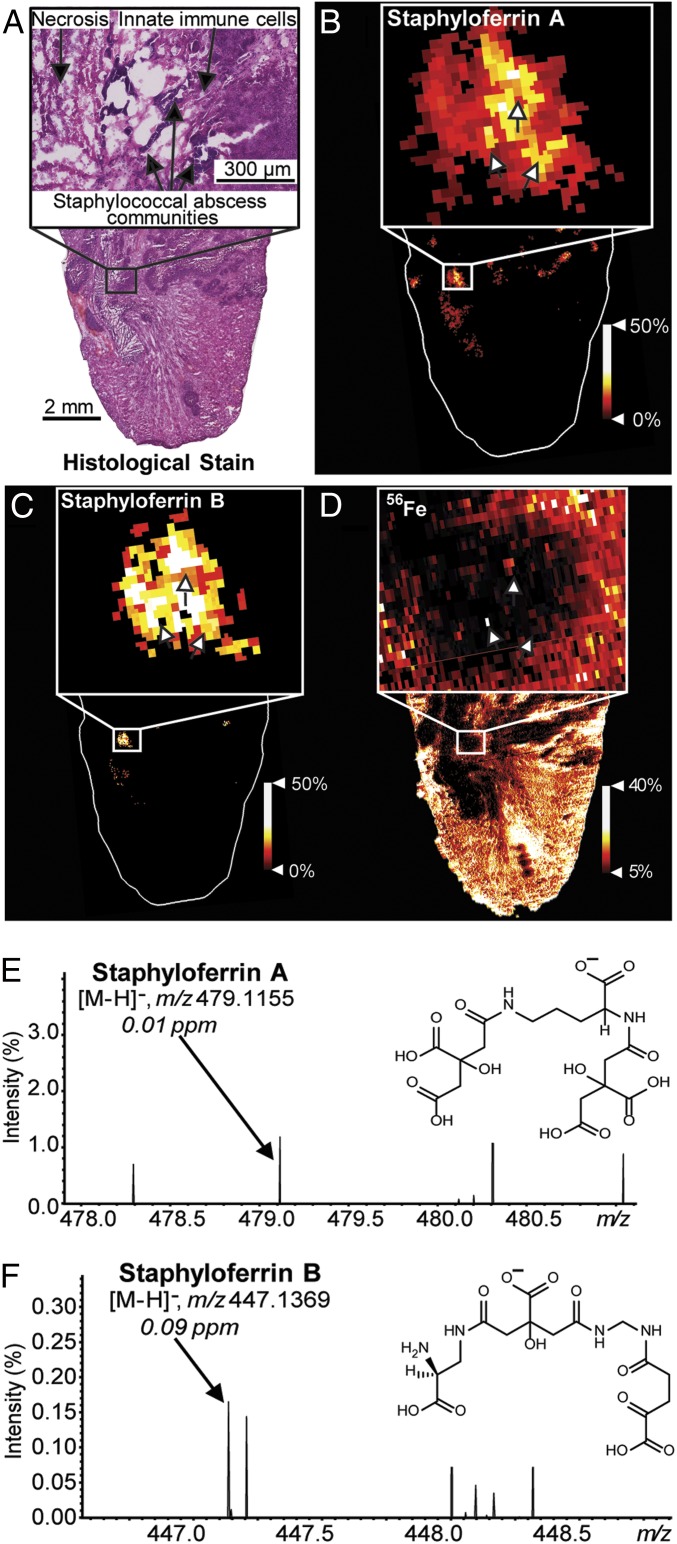
Using MALDI FT-ICR imaging mass spectrometry and multimodal imaging, this study visualizes *Staphylococcus aureus* siderophores staphyloferrin A (SA) and staphyloferrin B (SB) in infected mouse tissues and finds heterogeneous distributions across abscesses. The results challenge the paradigm that the vertebrate host is a uniformly iron-depleted environment for invading microbes.
Key findings
- SA and SB were detected within infected tissue: SA [M-H]− at m/z 479.1155 (0.01 ppm mass error) and SB [M-H]− at m/z 447.1369 (0.09 ppm mass error); both localize to infection sites and expand beyond the perimeter of staphylococcal abscess communities (SACs).
- Siderophore production is heterogeneous across abscesses: SA has increased prevalence at most infection sites, some foci show higher relative abundances of SB, and little to no siderophore is detected within some abscesses.
- Fe is largely excluded from infection sites, but some pixels show Fe colocalization with select SACs, presumably indicating successful metal acquisition.
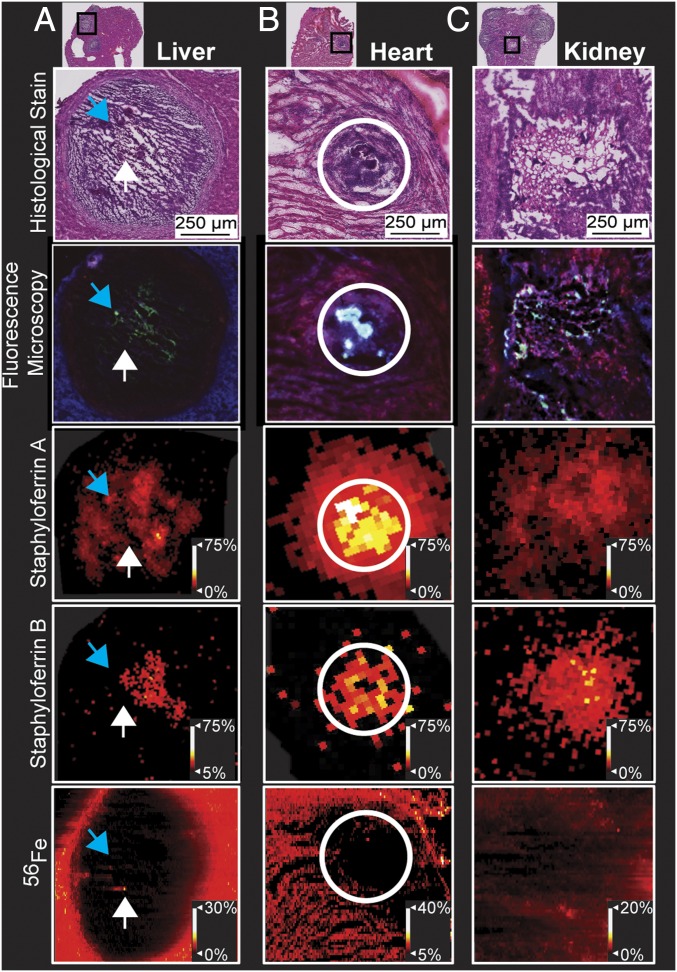
- In 10-DPI *S. aureus* PisdAgfp infections across heart, liver, and kidney, siderophores colocalized with GFP expression, while Fe distributions localized to GFP absence and lessened siderophore signals; in the heart abscess, SA extended beyond the abscess.
Methods
- Mice were infected with wild-type *S. aureus*; tissue was harvested 7 d post infection (DPI), frozen, and serially sectioned for H&E staining, MALDI IMS, and 56Fe analysis using laser ablation–inductively coupled plasma (LA-ICP) IMS. The SA assignment was validated using a *S. aureus* mutant genetically inactivated for SA production (∆sfa).
- Separate mice were infected with *S. aureus* PisdAgfp, in which GFP expression is driven by the Fur-regulated isdA promoter; after 10 DPI, heart, liver, and kidney lesions were compared using IMS, H&E staining, and fluorescence microscopy.
- Main analysis used high-performance MALDI Fourier transform ion cyclotron resonance imaging mass spectrometry (MALDI FT-ICR IMS) to map siderophore ions by accurate mass, integrated with histology and Fe imaging.
Limitations
- The paper does not state a dedicated limitations section. Evident from the text: SB identification is tentative based on accurate mass measurements, whereas only SA was validated using the ∆sfa mutant.
- Attempts to detect ferric SA and ferric SB were unsuccessful; the authors suggest the complex may not be stable under the MALDI matrix or may not survive the MALDI process, or may be present at low abundance.
- Findings are from murine infection models at 7 and 10 DPI and specific tissues; no human or clinical samples are reported.
Model-written summary. Check it against the paper before relying on it.
Integrity signals
Registry
Cites
Statistics
Figures
Verification
Claims the paper makes
3 Valid · 1 Not valid · 9 Not checked · 27 Own results and interpretations
The sources with a verdict support this claim; the rest weren’t checked yet, have no full text we could read, or their verdicts aren’t rated yet.
In the paper
“Staphylococcus aureus is an opportunistic pathogen that utilizes siderophores for Fe acquisition, and siderophore production is required for maximum virulence (5, 7).”
§ Staphylococcus aureus exhibits heterogeneous siderophore production within the vertebrate host > Abstract
What the sources say
- Not checked — no full text of the sourcecites [5] Sheldon J. R., Heinrichs D. E., Recent developments in understanding the iron acquisition strategies of gram positive pathogens. FEMS Microbiol. Rev. 39, 592– 630 (2015). 25862688 source
- Supportedcites [7] Beasley F. C., Marolda C. L., Cheung J., Buac S., Heinrichs D. E., Staphylococcus aureus transporters Hts, Sir, and Sst capture iron liberated from human transferrin by Staphyloferrin A, Staphyloferrin B, and catecholamine stress hormones, respectively, and contribute to virulence. Infect. Immun. 79, 2345– 2355 (2011). 21402762 PMC3125851 source
The DISCUSSION states that whole-locus sfa and sbn deletions alone did not drop bacterial burden, but 'Only when S. aureus was incapable of producing both staphyloferrin siderophores (i.e., the sfa sbn double mutant) was there a significant effect on the virulence of S. aureus,' and the RESULTS (murine sepsis model, 'Hts, Sir, and Sst transporters contribute to virulence') report that deletion of the sfa-sbn combination yielded significant reductions in heart colonization. The Abstract and INTRODUCTION also establish that S. aureus uses the siderophores staphyloferrin A and B to acquire iron (from transferrin), covering the first half of the sentence. Thus loss of siderophore production attenuates virulence, i.e., production is required for maximum virulence; the paper's own title asserts these systems 'Contribute to Virulence'. (LLM, conf=0.85)
plainstates a cause- Asserted: passes — The authors put it forward as true.
- Checkable: passes — It can be checked against evidence.
- Load-bearing: unclear — It is unclear whether the paper’s conclusions depend on it.
- Based: passes — The paper gives a reason why it holds.
The sources with a verdict support this claim; the rest weren’t checked yet, have no full text we could read, or their verdicts aren’t rated yet.
In the paper
“Staphylococcus aureus is an opportunistic pathogen that utilizes siderophores for Fe acquisition, and siderophore production is required for maximum virulence (5, 7).”
§ Staphylococcus aureus exhibits heterogeneous siderophore production within the vertebrate host > Abstract
What the sources say
- Not checked — no full text of the sourcecites [5] Sheldon J. R., Heinrichs D. E., Recent developments in understanding the iron acquisition strategies of gram positive pathogens. FEMS Microbiol. Rev. 39, 592– 630 (2015). 25862688 source
- Supportedcites [7] Beasley F. C., Marolda C. L., Cheung J., Buac S., Heinrichs D. E., Staphylococcus aureus transporters Hts, Sir, and Sst capture iron liberated from human transferrin by Staphyloferrin A, Staphyloferrin B, and catecholamine stress hormones, respectively, and contribute to virulence. Infect. Immun. 79, 2345– 2355 (2011). 21402762 PMC3125851 source
The Introduction (p.1) frames S. aureus as 'the opportunistic pathogen' and the Results ('Staphyloferrins mediate...') state that 'S. aureus assembles and secretes two polycarboxylate-type siderophores, staphyloferrin A and staphyloferrin B', which remove iron from human serum/holotransferrin — covering the iron-acquisition part of the claim. The virulence part is covered by the Results (murine sepsis model), where deletion of the sfa-sbn combination gave significant reductions in heart colonization, and by the Discussion, which states that only the siderophore-production-deficient sfa sbn double mutant showed a significant drop in virulence. Single-gene/single-locus deletions alone were not significant, but the claim as worded (production required for maximum virulence) matches the source. (LLM, conf=0.90)
plainstates a cause- Asserted: passes — The authors put it forward as true.
- Checkable: passes — It can be checked against evidence.
- Load-bearing: passes — The paper’s conclusions depend on it.
- Based: passes — The paper gives a reason why it holds.
Every source the paper cites for this claim was checked and supports it.
In the paper
“Fluorescence micrographs of GFP expression allow for a MALDI IMS-compatible technique to visualize SAC responses to host Fe sequestration (Fig. 2).”
§ Staphylococcus aureus exhibits heterogeneous siderophore production within the vertebrate host > Abstract
What the sources say
- Supportedcites [12] Cassat J. E., Integrated molecular imaging reveals tissue heterogeneity driving host-pathogen interactions. Sci. Transl. Med. 10, eaan6361 (2018). 29540616 PMC6005374 source
The Materials and Methods ('Fluorescent imaging') state that flash-frozen 20-µm kidneys from mice infected with the PisdAgfp construct (isdA promoter driving codon-optimized gfp, whose fluorescent response to iron starvation was confirmed in vitro with 2,2-dipyridyl) were imaged on slides selected 'to facilitate downstream imaging analyses (H&E staining, MALDI IMS, and LA-ICP-MS)', with slides re-frozen before MALDI IMS; the 'Matrix-assisted laser desorption/ionization imaging mass spectrometry' section confirms that frozen kidney sections from mice infected with the iron-responsive promoter were analyzed by MALDI IMS after fluorescent imaging. The Results ('LA-ICP-MS characterizes inflammation-associated shifts in nutrient distribution') show these reporter signals report bacterial iron starvation corresponding to abscess areas relatively devoid of iron, i.e. host iron sequestration, and the paper visualizes the staphylococcal microcolony/abscess-community structure (Fig. 2, 'Iterative blockface imaging...'). Our copy does not characterize the isdA promoter as 'Fur-regulated', but that descriptor is not part of the cited sentence, which attributes only the MALDI IMS-compatible fluorescence visualization. (LLM, conf=0.85)
plainstates a cause- Asserted: passes — The authors put it forward as true.
- Checkable: passes — It can be checked against evidence.
- Load-bearing: passes — The paper’s conclusions depend on it.
- Based: passes — The paper gives a reason why it holds.
- Supported
The cited sources that could be checked couldn’t confirm or dispute this claim.
In the paper
“In addition to Fe, glucose represses SA production, and heme affects SB production (7, 22, 23).”
§ Staphylococcus aureus exhibits heterogeneous siderophore production within the vertebrate host > Abstract
What the sources say
- Could not verifycites [7] Beasley F. C., Marolda C. L., Cheung J., Buac S., Heinrichs D. E., Staphylococcus aureus transporters Hts, Sir, and Sst capture iron liberated from human transferrin by Staphyloferrin A, Staphyloferrin B, and catecholamine stress hormones, respectively, and contribute to virulence. Infect. Immun. 79, 2345– 2355 (2011). 21402762 PMC3125851 sourceExperimental — accuracy not yet measured
Our copy of Beasley et al. (2011) contains no passage stating that glucose represses staphyloferrin A production, nor that heme affects staphyloferrin B production; searched 'glucose', 'glucose represses staphyloferrin A', 'heme affects staphyloferrin B production', and 'regulation of staphyloferrin synthesis Fur'. The paper's treatment of SA/SB is confined to their redundancy in capturing human transferrin iron via Hts/Sir (Introduction; Results, Fig. 1) and to siderophore output in transport mutants ('lack of inhibitory feedback on siderophore production', Discussion), while heme appears only as the presumed preferred iron source during infection (Discussion, ref 61) — none of which addresses carbon-source or heme-mediated repression of siderophore synthesis. Since the citing sentence carries three citations (7, 22, 23), the specific glucose/heme points may rest on the other works rather than on this one, but our copy neither supports nor contradicts them. (LLM, conf=0.70)
- Not checked — no full text of the sourcecites [22] Sheldon J. R., Marolda C. L., Heinrichs D. E., TCA cycle activity in Staphylococcus aureus is essential for iron-regulated synthesis of staphyloferrin A, but not staphyloferrin B: The benefit of a second citrate synthase. Mol. Microbiol. 92, 824– 839 (2014). 24666349 source
- Could not verifycites [23] Laakso H. A., Marolda C. L., Pinter T. B., Stillman M. J., Heinrichs D. E., A heme-responsive regulator controls synthesis of staphyloferrin B in Staphylococcus aureus. J. Biol. Chem. 291, 29– 40 (2016). 26534960 PMC4697164 sourceExperimental — accuracy not yet measured
Our copy of Laakso et al. (2016) never mentions glucose as a regulator of staphyloferrin A; searches for 'glucose' and for medium-composition/repression passages returned nothing on that point. The paper's own regulation results are iron (Fur-mediated) control of the sbn operon and heme-dependent repression of SB, and it explicitly states that extracellular heme decreased SB 'but not SA production' (Discussion; 'Extracellular Heme Controls SB Synthesis'). The nearest statement is that 'production of SA is repressed in RPMI 1640 medium', which the paper credits to its reference 28 (Sheldon et al. 2014) rather than reporting as a glucose effect, so the glucose attribution cannot be checked against this source. (LLM, conf=0.68)
plainstates a cause- Asserted: passes — The authors put it forward as true.
- Checkable: passes — It can be checked against evidence.
- Load-bearing: passes — The paper’s conclusions depend on it.
- Based: passes — The paper gives a reason why it holds.
- Could not verify
A result the paper reports from its own data — it cites no other source for it, so there is none to check. The quote shows it is in the paper.
In the paper
“Using MALDI IMS, ions corresponding to S. aureus siderophores SA [M-H]− at m/z 479.1155 (mass accuracy: 0.01 parts per million [ppm] error) and SB [M-H]− at m/z 447.1369 (mass accuracy: 0.09 ppm error) were observed within tissue (Fig. 1 B and C).”
§ Staphylococcus aureus exhibits heterogeneous siderophore production within the vertebrate host > Abstract
plain- Asserted: passes — The authors put it forward as true.
- Checkable: passes — It can be checked against evidence.
- Load-bearing: passes — The paper’s conclusions depend on it.
- Based: passes — The paper gives a reason why it holds.
22 more claims
Create a free account to see all 40 claims and to verify the 11 references still open.
- It may state two separate claims as one. 6
- The quote only partly states this claim. 2
- Probably not a substantial claim. 8
Claims other papers make about this one
Each is checked against this paper’s own text: does it say what the citing paper says it does?
The source backs part of the claim, not all of it — or backs it for a different population, condition or comparison.
In the citing paper
“Recent work has demonstrated heterogeneous production of specific siderophores during infection, suggesting that either bacteria experience distinct Fe levels within host tissue or additional, as yet unidentified, regulatory strategies for siderophore production or secretion exist 51-56 .”
From Nutritional immunity: the battle for nutrient metals at the host–pathogen interface (2022) · cites this paper as [51]
Experimental — accuracy not yet measuredThe cited source says what the claim attributes to it.
In the citing paper
“Recent work has demonstrated heterogeneous production of specific siderophores during infection, suggesting that either bacteria experience distinct Fe levels within host tissue or additional, as yet unidentified, regulatory strategies for siderophore production or secretion exist 51-56 .”
From Nutritional immunity: the battle for nutrient metals at the host–pathogen interface (2022) · cites this paper as [51]
Citations
Cites
Molecular Imaging of Biological Samples: Localization of Peptides and Proteins Using MALDI-TOF MS
Caprioli, R. M., Farmer, T. B., & Gile, J. (1997) · Analytical Chemistry · doi:10.1021/ac970888i · Cited by 2,234
Self-citationMetal ions in biological catalysis: from enzyme databases to general principles
Andreini, C., Bertini, I., Cavallaro, G., Holliday, G. L., & Thornton, J. M. (2008) · JBIC Journal of Biological Inorganic Chemistry · doi:10.1007/s00775-008-0404-5 · Cited by 1,150 · cited 1×
“M are required by organisms to carry out metabolic processes (1).”
BackgroundSiderophores in environmental research: roles and applications
Ahmed, E., & Holmström, S. J. M. (2014) · Microbial Biotechnology · doi:10.1111/1751-7915.12117 · Cited by 1,096
Casadevall, A., & Pirofski, L.-A. (2000) · Infection and Immunity · doi:10.1128/iai.68.12.6511-6518.2000 · Cited by 613
Stoichiometric and site characteristics of the binding of iron to human transferrin
Aisen, P., Leibman, A., & Zweier, J. (1978) · Journal of Biological Chemistry · doi:10.1016/s0021-9258(19)62337-9 · Cited by 601 · cited 1×
“During infection, host metalloproteins sequester nutrient metals to prevent microbial colonization, a process termed nutritional immunity (2, 3).”
BackgroundWeinberg, E. D. (1974) · Science · doi:10.1126/science.184.4140.952 · Cited by 579 · cited 1×
“During infection, host metalloproteins sequester nutrient metals to prevent microbial colonization, a process termed nutritional immunity (2, 3).”
BackgroundA robust scoring system to evaluate sepsis severity in an animal model
Shrum, B., Anantha, R. V., Xu, S. X., Donnelly, M., Haeryfar, S. M., McCormick, J. K., & Mele, T. (2014) · BMC Research Notes · doi:10.1186/1756-0500-7-233 · Cited by 520 · cited 1×
“aureus, and tissue was harvested 7 d post infection (DPI) and frozen on dry ice (20).”
BackgroundA play in four acts: Staphylococcus aureus abscess formation
Cheng, A. G., DeDent, A. C., Schneewind, O., & Missiakas, D. (2011) · Trends in Microbiology · doi:10.1016/j.tim.2011.01.007 · Cited by 310
Recent developments in understanding the iron acquisition strategies of gram positive pathogens
Sheldon, J. R., & Heinrichs, D. E. (2015) · FEMS Microbiology Reviews · doi:10.1093/femsre/fuv009 · Cited by 272 · cited 5×
“Bacteria have evolved sophisticated metal acquisition strategies, including the use of siderophores (4, 5).”
BackgroundInfluentialSelf-citationA Crystalline Organo-iron Pigment from a Rust Fungus (Ustilago sphaerogena)1
Neilands, J. B. (1952) · Journal of the American Chemical Society · doi:10.1021/ja01139a033 · Cited by 244 · cited 1×
“Bacteria have evolved sophisticated metal acquisition strategies, including the use of siderophores (4, 5).”
Background
Cited by
Nutritional immunity: the battle for nutrient metals at the host–pathogen interface
Murdoch, C. C., & Skaar, E. P. (2022) · Nature Reviews Microbiology · doi:10.1038/s41579-022-00745-6 · Cited by 701
Self-citationSheldon, J. R., & Skaar, E. P. (2020) · PLOS Pathogens · doi:10.1371/journal.ppat.1008995 · Cited by 177
“laser desorption/ionization imaging mass spectrometry (MALDI-IMS) was used to reveal that Staphylococcus aureus exhibits differential production of its siderophores, staphyloferrin A and staphyloferrin B, between abscesses within the same infected tissue [80].”
MethodSelf-citationAdvances in MALDI Mass Spectrometry Imaging Single Cell and Tissues
Zhu, X., Xu, T., Chen, P., & Wu, S. (2022) · Frontiers in Chemistry · doi:10.3389/fchem.2021.782432 · Cited by 166
“(e-f) The signals and the chemical structures of SA, [M-H] and SB, [M-H] (Perry et al., 2019).”
BackgroundMarchetti, M., De Bei, O., Bettati, S., Campanini, B., Kovachka, S., Gianquinto, E., Spyrakis, F., & Ronda, L. (2020) · International Journal of Molecular Sciences · doi:10.3390/ijms21062145 · Cited by 97
“SA and SB are reported to have different effects on infection outcomes in animal models and were recently shown by multimodal imaging mass spectrometry to have heterogeneous distribution across infection loci, suggesting specific roles rather than functional redundancy [50].”
BackgroundBourceau, P., Geier, B., Suerdieck, V., Bien, T., Soltwisch, J., Dreisewerd, K., & Liebeke, M. (2023) · Nature Protocols · doi:10.1038/s41596-023-00864-1 · Cited by 90
Emerging connections between gut microbiome bioenergetics and chronic metabolic diseases
Daisley, B. A., Koenig, D. W., Engelbrecht, K. C., Doney, L., Hards, K., Al, K. F., Reid, G., & Burton, J. P. (2021) · Cell Reports · doi:10.1016/j.celrep.2021.110087 · Cited by 92
Native mass spectrometry-based metabolomics identifies metal-binding compounds
Aron, A. T., Petras, D., Schmid, R., Gauglitz, J. M., Büttel, I., Antelo, L., Zhi, H., Nuccio, S.-P., Saak, C. C., Malarney, K. P., et al. (2022) · Nature Chemistry · doi:10.1038/s41557-021-00803-1 · Cited by 79
Liu, H., Pan, Y., Xiong, C., Han, J., Wang, X. D., Chen, J., & Nie, Z. (2022) · TrAC Trends in Analytical Chemistry · doi:10.1016/j.trac.2022.116809 · Cited by 73
Molecular Evolution of Transition Metal Bioavailability at the Host–Pathogen Interface
Antelo, G. T., Vila, A. J., Giedroc, D. P., & Capdevila, D. A. (2021) · Trends in Microbiology · doi:10.1016/j.tim.2020.08.001 · Cited by 63
The biogeography of infection revisited
Azimi, S., Lewin, G. R., & Whiteley, M. (2022) · Nature Reviews Microbiology · doi:10.1038/s41579-022-00683-3 · Cited by 66
The Emerging Role of Iron Acquisition in Biofilm-Associated Infections
Oliveira, F., Rohde, H., Vilanova, M., & Cerca, N. (2021) · Trends in Microbiology · doi:10.1016/j.tim.2021.02.009 · Cited by 54
Lavin, R. C., & Tan, S. (2022) · PLoS Pathogens · doi:10.1371/journal.ppat.1010459 · Cited by 49
Multi-metal nutrient restriction and crosstalk in metallostasis systems in microbial pathogens
Jordan, M. R., Wang, J., Capdevila, D. A., & Giedroc, D. P. (2020) · Current Opinion in Microbiology · doi:10.1016/j.mib.2020.01.010 · Cited by 44
“Multi-“omics” approaches [18**,54] and imaging strategies [64] needed to elucidate metal speciation in bacterial cells and infected tissues [65], promise new insights into this central host-defense process.”
BackgroundNovack, D. V., & Cassat, J. E. (2020) · Journal of Bone and Mineral Research · doi:10.1002/jbmr.4279 · Cited by 43
Self-citationMartin, D. R., Witten, J. C., Tan, C. D., Rodríguez, E. R., Blackstone, E. H., Pettersson, G., Seifert, D. E., Willard, B. B., & Apte, S. (2020) · JCI Insight · doi:10.1172/jci.insight.135317 · Cited by 36
Celis, A. I., & Relman, D. A. (2020) · Molecular Cell · doi:10.1016/j.molcel.2020.03.032 · Cited by 37
Experimental Methods for Evaluating the Bacterial Uptake of Trojan Horse Antibacterials
Southwell, J. W., Black, C. M., & Duhme‐Klair, A. (2020) · ChemMedChem · doi:10.1002/cmdc.202000806 · Cited by 34
Spatially Targeted Proteomics of the Host–Pathogen Interface during Staphylococcal Abscess Formation
Guiberson, E. R., Weiss, A., Ryan, D. J., Monteith, A. J., Sharman, K., Gutierrez, D. B., Perry, W., Caprioli, R. M., Skaar, E. P., & Spraggins, J. M. (2020) · ACS Infectious Diseases · doi:10.1021/acsinfecdis.0c00647 · Cited by 34
Self-citationMurine Models for Staphylococcal Infection
Klopfenstein, N., Cassat, J. E., Monteith, A. J., Miller, A. R., Drury, S. L., Skaar, E. P., & Serezani, C. H. (2021) · Current Protocols · doi:10.1002/cpz1.52 · Cited by 31
“Systemic infection S. aureus can be detected in the kidney, spleen, and liver as early as 12 hr following injection of 5 × 10⁷ CFU via retro-orbital inoculation (Perry et al., 2019).”
Self-citationIron Acquisition by Bacterial Pathogens: Beyond Tris‐Catecholate Complexes
Zhang, Y., Sen, S., & Giedroc, D. P. (2020) · ChemBioChem · doi:10.1002/cbic.201900778 · Cited by 30
Wheeler, K., Gosmanov, C., Sandoval, M. J., Yang, Z., & McCall, L. (2024) · TrAC Trends in Analytical Chemistry · doi:10.1016/j.trac.2024.117713 · Cited by 37
Endicott, N. P., Rivera, G. S. M., Yang, J. P., & Wencewicz, T. A. (2020) · ACS Central Science · doi:10.1021/acscentsci.9b01257 · Cited by 29
Castellanos-García, L. J., Elci, S. G., & Vachet, R. W. (2020) · The Analyst · doi:10.1039/c9an02472g · Cited by 29
Oliveira, F., Lima, T., Correia, A., Silva, A. M., Soares, C. M. D., Morais, S., Weißelberg, S., Vilanova, M., Rohde, H., & Cerca, N. (2021) · Frontiers in Medicine · doi:10.3389/fmed.2021.799227 · Cited by 31
“aureus, with siderophores being heterogeneously distributed across abscesses in different tissues (44).”
BackgroundWang, Z., Hülpüsch, C., Traidl‐Hoffmann, C., Reiger, M., & Schloter, M. (2024) · Frontiers in Medicine · doi:10.3389/fmed.2024.1480257 · Cited by 27
Good, C. J., Butrico, C. E., Colley, M. E., Emmerson, L. N., Gibson-Corley, K. N., Cassat, J. E., Spraggins, J. M., & Caprioli, R. M. (2024) · Cell chemical biology · doi:10.1016/j.chembiol.2024.09.005 · Cited by 26
Self-citationDing, X., Masselot, C. R., Fu, X., Léonard, R., Marsac, B., Dauriat, C. J. G., Lepissier, A., Rytter, H., Ramond, E., Dupuis, M., et al. (2023) · Nature Communications · doi:10.1038/s41467-023-43863-2 · Cited by 20
“The battle for iron acquisition is mediated through the production of bacterial siderophores 63 to combat the nutritional restriction imposed by host iron sequestration 64 .”
Batko, I. Z., Flannagan, R. S., Guariglia-Oropeza, V., Sheldon, J. R., & Heinrichs, D. E. (2021) · Journal of Bacteriology · doi:10.1128/jb.00458-21 · Cited by 19
“aureus contributes to bacterial 431 fitness during infection [56,79], however, siderophore expression can be heterogenous and 432 influenced by the niche occupied by the bacteria [80].”
BackgroundSelf-citationMetal sequestration by S100 proteins in chemically diverse environments
Rosen, T., Wang, K.-K. A., & Nolan, E. M. (2022) · Trends in Microbiology · doi:10.1016/j.tim.2021.12.006 · Cited by 21
Perry, W., Grunenwald, C. M., de Plas, R. V., Witten, J. C., Martin, D. R., Apte, S., Cassat, J. E., Pettersson, G., Caprioli, R. M., Skaar, E. P., et al. (2022) · Cell chemical biology · doi:10.1016/j.chembiol.2022.05.004 · Cited by 21
Self-citationParmar, D. S., Rosado-Rosa, J. M., Shrout, J. D., & Sweedler, J. V. (2024) · Methods · doi:10.1016/j.ymeth.2024.01.014 · Cited by 22
“They also complement other studies on tissue models that investigate the S. aureus pathogenicity in animals or humans [166–168].”
ResultCopper selects for siderophore-mediated virulence in Pseudomonas aeruginosa
Lear, L., Hesse, E., Buckling, A., & Vos, M. (2022) · BMC Microbiology · doi:10.1186/s12866-022-02720-w · Cited by 21
“Siderophores are therefore an important virulence factor in both gram-negative- (16-18) 53 and gram-positive human pathogens (19, 20).”
BackgroundCross, K. L., Leigh, B. A., Hatmaker, E. A., Mikaelyan, A., Miller, A. K., & Bordenstein, S. R. (2021) · mSystems · doi:10.1128/msystems.01342-20 · Cited by 22
Staphylococcus aureus metal acquisition in the mastitic mammary gland
Killpack, S., Erickson, D. L., & Wilson, E. (2020) · Microbial Pathogenesis · doi:10.1016/j.micpath.2020.104179 · Cited by 12
Seeing is Believing: Developing Multimodal Metabolic Insights at the Molecular Level
Chadha, R. S., Guerrero, J. A., Wei, L., & Sanchez, L. M. (2024) · ACS Central Science · doi:10.1021/acscentsci.3c01438 · Cited by 26
Central role of metabolism in Trypanosoma cruzi tropism and Chagas disease pathogenesis
Liu, Z., vonBargen, R. U., & McCall, L. (2021) · Current Opinion in Microbiology · doi:10.1016/j.mib.2021.07.015 · Cited by 27
Castellanos-García, L. J., Sikora, K. N., Doungchawee, J., & Vachet, R. W. (2021) · The Analyst · doi:10.1039/d1an01783g · Cited by 16
A Salmonella subset exploits erythrophagocytosis to subvert SLC11A1-imposed iron deprivation
Roche, B., Claudi, B., Cunrath, O., Bleck, C. K. E., Antelo-Varela, M., Li, J., & Bumann, D. (2025) · Cell Host & Microbe · doi:10.1016/j.chom.2025.04.013 · Cited by 15
Infection metallomics for critical care in the post‐COVID era
Patil, R. H., Luptáková, D., & Havlíček, V. (2021) · Mass Spectrometry Reviews · doi:10.1002/mas.21755 · Cited by 15
Zhang, Y., Martin, J. E., Edmonds, K. A., Winkler, M. E., & Giedroc, D. P. (2022) · Journal of Biological Chemistry · doi:10.1016/j.jbc.2022.102046 · Cited by 16
Janet-Maitre, M., Venanzio, G. D., Jackson-Litteken, C. D., Scott, N. E., & Feldman, M. F. (2025) · Proceedings of the National Academy of Sciences · doi:10.1073/pnas.2511369122 · Cited by 14
Transcriptomic analysis of stress response to novel antimicrobial coatings in a clinical MRSA strain
Vaishampayan, A., Ahmed, R., Wagner, O., de Jong, A., Haag, R., Kok, J., & Grohmann, E. (2020) · Materials Science and Engineering C · doi:10.1016/j.msec.2020.111578 · Cited by 16
“aureus produce siderophores under iron-limited growth conditions; production of siderophores is crucial to virulence of the bacteria [57,58].”
BackgroundOliveira, F., Lima, T., Correia, A., Silva, A. M., Soares, C., Morais, S., Weißelberg, S., Vilanova, M., Rohde, H., & Cerca, N. (2022) · Microbiology Spectrum · doi:10.1128/spectrum.02168-21 · Cited by 14
“aureus siderophores were heterogeneously distributed across abscesses in different tissues (12).”
BackgroundUncovering Molecular Heterogeneity in the Kidney With Spatially Targeted Mass Spectrometry
Kruse, A. R. S., & Spraggins, J. M. (2022) · Frontiers in Physiology · doi:10.3389/fphys.2022.837773 · Cited by 13
Self-citationWang, T. A., Chen, P.-L., Chen, Y.-C. S., Hung, H.-M., & Huang, J.-Y. (2021) · ACS Infectious Diseases · doi:10.1021/acsinfecdis.1c00235 · Cited by 11
Matrix-assisted laser desorption/ionization imaging mass spectrometry
Spraggins, J. M., Hummon, A. B., Ellis, S. R., Li, L., Prentice, B. M., Marchetti‐Deschmann, M., de Plas, R. V., & Caprioli, R. M. (2026) · Nature Reviews Methods Primers · doi:10.1038/s43586-026-00492-5 · Cited by 16
Self-citationLoss of Corpus-Specific Lipids in Helicobacter pylori-Induced Atrophic Gastritis
Lin, A. S., Shuman, J. H. B., Kotnala, A., Shaw, J. A., Beckett, A. C., Harvey, J. L., Tuck, M., Dixon, B. R. E. A., Reyzer, M. L., Algood, H. M. S., et al. (2021) · mSphere · doi:10.1128/msphere.00826-21 · Cited by 10
MALDI IMS-Derived Molecular Contour Maps: Augmenting Histology Whole-Slide Images
Sharman, K., Patterson, N. H., Migas, L. G., Neumann, E. K., Allen, J., Gibson-Corley, K. N., Spraggins, J. M., de Plas, R. V., Skaar, E. P., & Caprioli, R. M. (2023) · Journal of the American Society for Mass Spectrometry · doi:10.1021/jasms.2c00370 · Cited by 9
Self-citationMenghani, S. V., Cutcliffe, M. P., Sanchez-Rosario, Y., Pok, C., Watson, A., Neubert, M. J., Ochoa, K., Wu, H.-J. J., & Johnson, M. D. L. (2022) · Infection and Immunity · doi:10.1128/iai.00597-21 · Cited by 10
Dual-species proteomics and targeted intervention of animal-pathogen interactions
Liu, Y. S., Zhang, C., Khoo, B. L., Hao, P., & Chua, S. L. (2024) · Journal of Advanced Research · doi:10.1016/j.jare.2024.08.038 · Cited by 7
“14 Discussion: 319 Iron competition between host and pathogen has been studied extensively (36-38), but our 320”
BackgroundMicrogeography of staphyloccoci in human tissue explains antibiotic failurePreprint
Tripathi, V., Morin, B., Antelo-Varela, M., Loriol, A. A., Kurg, K., Jakonia, S., Ehsan, A., Herbert, S., Ferrand, A., Sauteur, L., et al. (2025) · bioRxiv (Cold Spring Harbor Laboratory) · doi:10.1101/2025.09.12.675782 · Cited by 7
Anil, A., Braza, R. E. D., Liu, B., Altouma, V., Adedeji, C., Welling, A., Ellison, A. L., Check, M. H., Irnov, I., Prescott, R. A., et al. (2025) · mBio · doi:10.1128/mbio.02043-25 · Cited by 7
“It is also likely that individual abscesses have distinct nutritional microenvironments, given the S. aureus inter-abscess heterogeneity in metal availability and siderophore production (36, 37).”
The anatomy and molecular inventory of Staphylococcus aureus abscesses
Enriquez, K. T., & Skaar, E. P. (2026) · Trends in Microbiology · doi:10.1016/j.tim.2026.02.005 · Cited by 6
Self-citationNO-Stressed Y. pseudotuberculosis Has Decreased Cell Division Rates in the Mouse Spleen
Liu, B., Braza, R. E. D., Cotten, K. L., Davidson, R. K., & Davis, K. M. (2022) · Infection and Immunity · doi:10.1128/iai.00167-22 · Cited by 5
Mass Spectrometry Imaging: Revolutionizing Molecular Insights in Infectious Diseases Research
Zhang, M., Wang, X., Su, X., Yimamu, A., Li, L., & Sun, Z. (2025) · Pathogens · doi:10.3390/pathogens14070645 · Cited by 4
“Such competition for metal between the host and pathogen revealed by MSI was further confirmed by H and E staining and fluorescence microscopy [54].”
Stephens, A. C., & Richardson, A. R. (2022) · Advances in microbial physiology/Advances in Microbial Physiology · doi:10.1016/bs.ampbs.2022.06.003 · Cited by 4
Abad, I., Bailac, A., Pérez, M. D., Carramiñana, J. J., Calvo, M., & Sánchez, L. (2024) · International Dairy Journal · doi:10.1016/j.idairyj.2024.105899 · Cited by 4
Ribeiro, M., Sousa, M., Borges, V., Gomes, J. P., Duarte, S., Isidro, J., Vieira, L., Torres, C., Santos, H. M., Capelo, J. L., et al. (2022) · Journal of Proteomics · doi:10.1016/j.jprot.2022.104714 · Cited by 4
Kim, S. H., Kwak, M., Hwang, J. K., Keum, J., Jin, H. Y., Lee, C.-Y., Tanpure, R. S., Kim, Y. J., Hoh, J., Park, J. Y., et al. (2025) · Computational and Structural Biotechnology Journal · doi:10.1016/j.csbj.2025.03.009 · Cited by 3
“Bacteria can synthesize heme from precursors shared with the host or lyse erythrocytes to release hemoglobin and extract heme [38 – 42].”
Shang, L., Li, F., Wang, Z., Hu, Z., Zou, H., Lu, J., Tang, Y. Z., & Deng, Y. (2025) · BMC Microbiology · doi:10.1186/s12866-025-04359-9 · Cited by 3
“…capacity were found to show significantly higher abundance in C4 group compared with those in C0123 group, including Alteromonas [58, 59], Arthrobacter [60], Pseudoalteromonas [61, 62], Brevundimonas [63, 64], Staphylococcus [65, 66], Micro-bacterium [67, 68], Bacillus [69, 70].”
SLC11A2 withholds divalent metals from Salmonella in the gut epithelium
Norberg, E. S., Westerman, T. L., Cruz, E., Bushman, S. D., Salogiannis, J., Skaar, E. P., Elfenbein, J. R., & Knodler, L. A. (2026) · Proceedings of the National Academy of Sciences · doi:10.1073/pnas.2532675123 · Cited by 4
“…within the gut tissue or tissue microcompartment, consistent with reports of differential iron availability in STm - infected spleens (45) and Staphylococcus aureus infected tissues (105, 106), and could contribute to the lack of an overt colonization defect for bacterial mutants in viv o.”
Self-citationImaging Infection Across Scales of Size: From Whole Animals to Single Molecules
Skaar, E. P. (2021) · Annual Review of Microbiology · doi:10.1146/annurev-micro-041521-121457 · Cited by 4
Self-citationWang, T. A., Chen, P.-L., Chen, Y.-C. S., Chiu, Y., Lin, Z.-J., Kao, C.-Y., & Hung, H.-M. (2024) · ChemBioChem · doi:10.1002/cbic.202400480 · Cited by 3
Prommachote, W., Deeudom, M., Koonyosying, P., Srichomphoo, P., Somnabut, R., Khamnoi, P., Cilibrizzi, A., Ravikumar, Y., & Srichairatanakool, S. (2025) · Antibiotics · doi:10.3390/antibiotics14050521 · Cited by 3
“For iron acquisition, Staphylococcus spp. produce and secrete two hydrophilic hexaden-tate carboxylate-type siderophores, known as staphyloferrin A (sfna), with a mass-to-charge ( m / z ) ratio of 479.12, and staphyloferrin B (sfnb), with an m / z value of 447.14 [25,26].”
InfluentialLuptáková, D., Juříková, T., Petřík, M., Bendová, K. D., Neužilová, B., Marešová, H., Palyzová, A., Benada, O., Lackner, M., Hubáček, P., et al. (2026) · Analytical and Bioanalytical Chemistry · doi:10.1007/s00216-026-06658-0 · Cited by 2
“For MALDI-MSI analysis of carboxylate siderophores and lipids, a previously published sample preparation protocol was used [27].”
Th IV –Desferrioxamine: characterization of a fluorescent bacterial probe
Aldrich, K. E., Livshits, M. Y., Stromberg, L. R., Janicke, M. T., Lam, M. N., Stein, B. W., Wagner, G. L., Abergel, R. J., Mukundan, H., Kozimor, S. A., et al. (2021) · Dalton Transactions · doi:10.1039/d1dt02177j · Cited by 3
Copper Selects for Siderophore-Mediated Virulence in Pseudomonas AeruginosaPreprint
Lear, L., Hesse, E., Buckling, A., & Vos, M. (2021) · SSRN Electronic Journal · doi:10.2139/ssrn.3985180 · Cited by 2
Imaging mass spectrometry in clinical pathology
Norris, J. L., Gutierrez, D. B., Patterson, N. H., & Caprioli, R. M. (2023) · Elsevier eBooks · doi:10.1016/b978-0-12-822824-1.00007-9 · Cited by 1
Self-citationCopper selects for siderophore-mediated virulence in Pseudomonas aeruginosaPreprint
Lear, L., Hesse, E., Buckling, A., & Vos, M. (2021) · bioRxiv (Cold Spring Harbor Laboratory) · doi:10.1101/2021.09.08.459405 · Cited by 1
Sheikh, A. A., Flannagan, R. S., Nicholson, N. J., Jarycki, N., Fabelurin, R. O., Lewis, I. A., & Heinrichs, D. E. (2026) · Journal of Bacteriology · doi:10.1128/jb.00149-26
Self-citationRodríguez-Rojas, A., Nath, A., Shazely, B. E., Santi, G., Kim, J. J., Weise, C., Kuropka, B., & Rolff, J. (2020) · bioRxiv (Cold Spring Harbor Laboratory) · doi:10.1101/2020.03.30.015206
“This enzyme participates in the biosynthesis of siderophore groups that in S. aureus are redundant systems and varies even across different vertebrates hosts (Perry et al., 2019).”
BackgroundDie chemische Sprache von Symbiosen sichtbar machen
Geier, B., & Liebeke, M. (2020) · BIOspektrum · doi:10.1007/s12268-020-1435-x
Cross, K. L., Leigh, B. A., Hatmaker, E. A., Mikaelyan, A., Miller, A. K., & Bordenstein, S. R. (2021) · bioRxiv (Cold Spring Harbor Laboratory) · doi:10.1101/2021.02.13.431100
Mass Spectrometry Imaging in Microbiology
Zou, Y., & Li, B. (2023) · Royal Society of Chemistry eBooks · doi:10.1039/bk9781837670338-00234
Wang, Z., Hülpüsch, C., Traidl‐Hoffmann, C., Reiger, M., & Schloter, M. (2025) · Kompass Dermatologie · doi:10.1159/000543583
Vanderschoot, K. A., White, C. J., Steineman, K. A., Caro, C. M. D., Williams, D. W., & Neumann, E. K. (2026) · ACS Measurement Science Au · doi:10.1021/acsmeasuresciau.6c00074
Native Proteomics Reveals Protease-Mediated Hemophore Release by Bacterial Pathogens
Goring, A. K., Lyman, L. R., Ford, J., Huang, J., Mullen, C., Melani, R. D., Schmitt, M. P., Clubb, R., & Loo, J. A. (2026) · Journal of the American Chemical Society · doi:10.1021/jacs.6c04584
Metadata
- Authors
- Perry, W. J., Spraggins, J. M., Sheldon, J. R., Grunenwald, C. M., Heinrichs, D. E., Cassat, J. E., Skaar, E. P., & Caprioli, R. M.
- Affiliations
- Vanderbilt University (US)
- Western University (CA)
- Corresponding author
- Skaar, Eric P.
- ORCID
- Venue
- Proceedings of the National Academy of Sciences
- Publisher
- National Academy of Sciences
- Published
- 2019-10-14
- Volume
- 116
- Issue
- 44
- Pages
- 21980-21982
- ISSN
- 0027-8424 (ISSN-L)
- 1091-6490
- PMC
- PMC6825271
- OpenAlex
- W2981274538
- Cited by
- 84
- References
- 23
- Citations by year
- 2026: 8 · 2025: 10 · 2024: 8 · 2023: 6 · 2022: 17 · 2021: 17 · 2020: 17 · 2019: 1
- FWCI
- 9.96
- Type
- journal article
- Language
- en
- Open access
- hybrid
- doi.org
- Licence
- Locations
- Proceedings of the National Academy of Sciences (publishedVersion, cc-by)
- Europe PMC (PubMed Central) (publishedVersion, cc-by)
- PubMed Central (publishedVersion, cc-by)
- PubMed (publishedVersion)
- Funders
- HHS | NIH | National Institute of Allergy and Infectious Diseases (2P41 GM103391-07, R01AI138581, R01AI069233, R01AI073843, 1R01AI132560)
- Burroughs Wellcome Fund (Career Award for Medical Scientists)
- Gouvernement du Canada | Canadian Institutes of Health Research (N/A)
- Topics
- Health Sciences › Medicine › Infectious Diseases › Antimicrobial Resistance in Staphylococcus
- Life Sciences › Biochemistry, Genetics and Molecular Biology › Molecular Biology › Bacterial biofilms and quorum sensing
- Life Sciences › Biochemistry, Genetics and Molecular Biology › Genetics › Bacterial Genetics and Biotechnology
- Keywords
- Staphylococcus aureus, siderophores, iron acquisition, nutritional immunity, infected tissue, bacterial virulence
- MeSH terms
- Abscess, Animals, Citrates, Iron, Ornithine, Staphylococcal Infections, Staphylococcus aureus, Siderophores, Spectrometry, Mass, Matrix-Assisted Laser Desorption-Ionization, Mice, Host-Pathogen Interactions
About these checks
Registry, retraction, Cites and statistics results are computed, not judged, with one exception: a printed reference that no index lists is read once by a model before it counts as a citation error. Claims are extracted by a model and kept only when their quote appears verbatim in the text; each cited source is then checked, with a model’s help, for whether it says what the claim relies on. Those verdicts can be wrong — read the claim’s quote and the cited source before relying on one.
The claim verdicts this report counts are experimental: their accuracy is not yet measured.
A language model drew the claims from the paper on 2026-11-14, under version 3 of the claim definition (model deepseek-v4.1-flash, prompt extract-v3).
A second model labelled each claim on 2026-11-14 (model jev-1.13-20260917, definition revision gold-guideline-v0.2).
Cited sources are checked with a language model’s help (qwen3.8-omni-flash).
Statistics and arithmetic are recomputed, not judged.
Confidence bands are shown only for fields calibrated on our annotated test set. None is calibrated yet, so no band is shown.
What counts as a claim ›How we measure confidence ›How we check this ›
Are you an author, or do you see a problem with this page? Request a review
Data sources
Bibliographic data: Semantic Scholar, OpenAlex, Crossref.
Contains information from the Semantic Scholar Academic Graph Datasets, made available under the ODC Attribution License (ODC-BY 1.0).
Semantic Scholar’s data is described in: Kinney, R., et al. (2023). The Semantic Scholar Open Data Platform. arXiv:2301.10140.
