

The DOI matches its Crossref record; 26 of the 27 references it cites were found in a registry or an index.
High-throughput antibody screening from complex matrices using intact protein electrospray mass spectrometry
Open accessAbstract
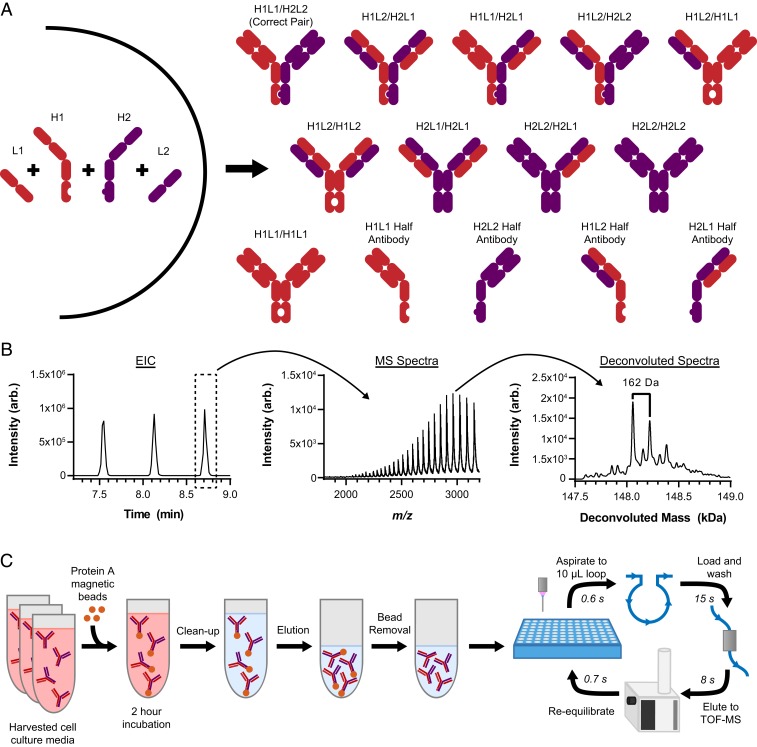
Significance: While electrospray ionization–mass spectrometry (ESI-MS) provides higher resolution for larger proteins, the conventional liquid chromatography (LC)-MS method suffers from low throughput. Our described RapidFire-MS workflow demonstrated unprecedented screening throughput as fast as 15 s/sample, a 10-fold improvement over conventional LC-MS approaches. The screening enabled selection of clones with the highest purity of bispecific antibody production with intact masses as accurate as 7 ppm with baseline resolution at the glycoform level in samples as complex as plasma sample. The utility of the method can be expanded to many other applications that can exploit the advantages of high-throughput intact protein MS analyses including but not limited to pharmacokinetic analyses, enzymatic screening, biotransformation characterization, and quality control screening.
Overview
The claims and statistics of this paper haven’t been checked yet.
Free: it reads the open-access text and checks the first 5 claims that cite a source we can check. Create a free account to check every claim.
Integrity signals
Registry
Cites
Statistics
Figures


Verification
Claims the paper makes
The claims and statistics of this paper haven’t been checked yet.
Free: it reads the open-access text and checks the first 5 claims that cite a source we can check. Create a free account to check every claim.
Claims other papers make about this one
Each is checked against this paper’s own text: does it say what the citing paper says it does?
The source backs part of the claim, not all of it — or backs it for a different population, condition or comparison.
In the citing paper
“For example, analysis of antibodies by top-down can quickly determine the modification state [81], drug conjugate ratio [161], quality control screening [162], and more [163,164].”
From Top-down proteomics: challenges, innovations, and applications in basic and clinical research (2020) · cites this paper as [162]
Experimental — accuracy not yet measured
Self-check
Percentages, sums and reported differences re-computed from the paper’s own numbers.
The self-check needs the paper’s full text.
Citations
Cites
Bispecific antibodies: a mechanistic review of the pipeline
Labrijn, A. F., Janmaat, M. L., Reichert, J. M., & Parren, P. W. H. I. (2019) · Nature Reviews Drug Discovery · doi:10.1038/s41573-019-0028-1 · Cited by 1,303
Alternative molecular formats and therapeutic applications for bispecific antibodies
Spiess, C., Zhai, Q., & Carter, P. J. (2015) · Molecular Immunology · doi:10.1016/j.molimm.2015.01.003 · Cited by 607 · cited 1×
“The major impact of antibody therapeutics in treating diseases, such as cancer, has led to the rise of many new format large molecules (18), such as bispecific antibodies (19, 20), which enables the binding of multiple antigens that are useful for many therapeutic applications.”
BackgroundSelf-citationStructure, heterogeneity and developability assessment of therapeutic antibodies
Xu, Y., Wang, D., Mason, B., Rossomando, T., Li, N., Liu, D., Cheung, J. K., Xu, W., Raghava, S., Katiyar, A., et al. (2019) · mAbs · doi:10.1080/19420862.2018.1553476 · Cited by 264 · cited 1×
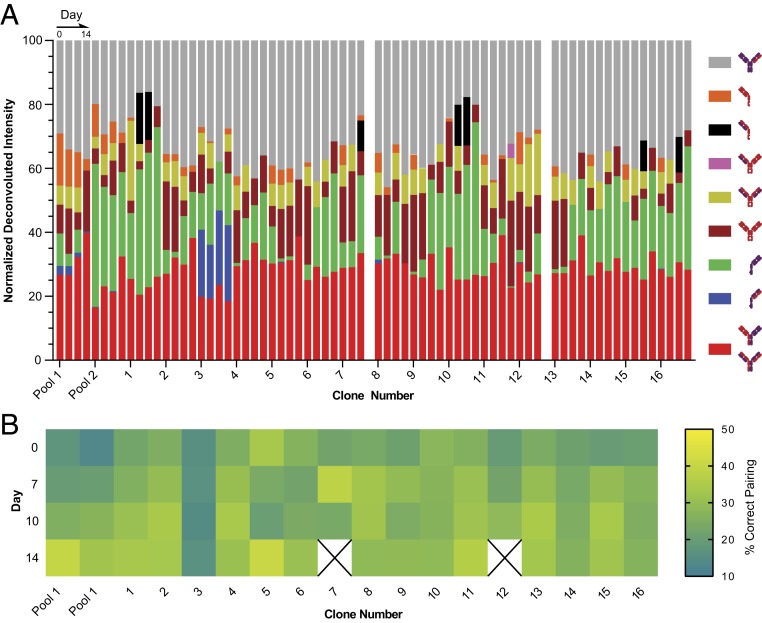
“Comparing these pools against the highperforming pools (3, 4, 7, 8) showed a decrease in overall intensity of correctly paired bispecific antibodies as well as an increase in the overall intensity of half-antibodies, which both contribute to the lower percent of correct pair matching.”
BackgroundForced degradation of recombinant monoclonal antibodies: A practical guide
Nowak, C., K. Cheung, J., M. Dellatore, S., Katiyar, A., Bhat, R., Sun, J., Ponniah, G., Neill, A., Mason, B., Beck, A., et al. (2017) · mAbs · doi:10.1080/19420862.2017.1368602 · Cited by 260
Mass Spectrometry of Self-Assembled Monolayers: A New Tool for Molecular Surface Science
Mrksich, M. (2008) · ACS Nano · doi:10.1021/nn7004156 · Cited by 196
Haslam, C. P., Hellicar, J., Dunn, A., Fütterer, A., Hardy, N., Marshall, P. S., Paape, R., Pemberton, M., Resemannand, A., & Leveridge, M. V. (2015) · SLAS DISCOVERY · doi:10.1177/1087057115608605 · Cited by 141
Multi‐Attribute Method for Quality Control of Therapeutic Proteins
Rogstad, S., Yan, H., Wang, X., Powers, D., Brorson, K., Damdinsuren, B., & Lee, S. (2019) · Analytical Chemistry · doi:10.1021/acs.analchem.9b03808 · Cited by 123 · cited 1×
“Deconvoluted RF-MS spectra for day 14 samples indicated that the primary impurity in low-performing pools (1, 2, 5, 6) was half-antibody.”
BackgroundA Retrospective Evaluation of the Use of Mass Spectrometry in FDA Biologics License Applications
Rogstad, S., Faustino, A. M., Ruth, A., Keire, D. A., Boyne, M., & Park, J. (2017) · Journal of the American Society for Mass Spectrometry · doi:10.1007/s13361-016-1531-9 · Cited by 110 · cited 1×
“Comparing these pools against the highperforming pools (3, 4, 7, 8) showed a decrease in overall intensity of correctly paired bispecific antibodies as well as an increase in the overall intensity of half-antibodies, which both contribute to the lower percent of correct pair matching.”
BackgroundAnalytical comparability study of recombinant monoclonal antibody therapeutics
Ambrogelly, A., Gozo, S., Katiyar, A., Dellatore, S. M., Kune, Y., Bhat, R., Sun, J., Li, N., Wang, D., Nowak, C., et al. (2018) · mAbs · doi:10.1080/19420862.2018.1438797 · Cited by 105 · cited 1×
“Deconvoluted RF-MS spectra for day 14 samples indicated that the primary impurity in low-performing pools (1, 2, 5, 6) was half-antibody.”
BackgroundHigh-Throughput Screening of Small Molecule Libraries using SAMDI Mass Spectrometry
Gurard‐Levin, Z. A., Scholle, M. D., Eisenberg, A. H., & Mrksich, M. (2011) · ACS Combinatorial Science · doi:10.1021/co2000373 · Cited by 104
Cited by
Taylor, M. J., Lukowski, J. K., & Anderton, C. R. (2021) · Journal of the American Society for Mass Spectrometry · doi:10.1021/jasms.0c00439 · Cited by 302
Top-down proteomics: challenges, innovations, and applications in basic and clinical research
Brown, K. A., Melby, J. A., Roberts, D. S., & Ge, Y. (2020) · Expert Review of Proteomics · doi:10.1080/14789450.2020.1855982 · Cited by 152
Medina, D. A. V., Maciel, E. V. S., & Lanças, F. M. (2023) · TrAC Trends in Analytical Chemistry · doi:10.1016/j.trac.2023.117171 · Cited by 91
T Cell–Activating Bispecific Antibodies in Cancer Therapy
Trabolsi, A., Arumov, A., & Schatz, J. H. (2019) · The Journal of Immunology · doi:10.4049/jimmunol.1900496 · Cited by 77
High-throughput screening for high-efficiency small-molecule biosynthesis
Rienzo, M., Jackson, S. J., Chao, L. K., Leaf, T. A., Schmidt, T. J., Navidi, A. H., Nadler, D. C., Ohler, M., & Leavell, M. D. (2020) · Metabolic Engineering · doi:10.1016/j.ymben.2020.09.004 · Cited by 53
Metadata
- Authors
- Sawyer, W. S., Srikumar, N., Carver, J., Chu, P. Y., Shen, A., Xu, A., Williams, A. J., Spiess, C., Wu, C., Liu, Y., & Tran, J. C.
- Affiliations
- Genentech (US)
- Corresponding author
- Tran, John C.
- ORCID
- Venue
- Proceedings of the National Academy of Sciences
- Publisher
- National Academy of Sciences
- Published
- 2020-04-23
- Volume
- 117
- Issue
- 18
- Pages
- 9851-9856
- ISSN
- 0027-8424 (ISSN-L)
- 1091-6490
- PMC
- PMC7211930
- OpenAlex
- W3020737329
- Cited by
- 55
- References
- 27
- Citations by year
- 2026: 2 · 2025: 8 · 2024: 6 · 2023: 12 · 2022: 13 · 2021: 7 · 2020: 5
- FWCI
- 3.53
- Type
- journal article
- Language
- en
- Open access
- hybrid
- doi.org
- Licence
- Locations
- Proceedings of the National Academy of Sciences (publishedVersion, cc-by)
- PubMed Central (publishedVersion, cc-by)
- PubMed (publishedVersion)
- Topics
- Physical Sciences › Chemistry › Spectroscopy › Mass Spectrometry Techniques and Applications
- Physical Sciences › Chemistry › Spectroscopy › Advanced Proteomics Techniques and Applications
- Life Sciences › Immunology and Microbiology › Immunology › Monoclonal and Polyclonal Antibodies Research
- Keywords
- high-throughput antibody screening, electrospray ionization mass spectrometry, bispecific antibodies, plasma analysis
- MeSH terms
- Antibodies, Cell Line, Chromatography, Liquid, Humans, Antibodies, Bispecific, Spectrometry, Mass, Electrospray Ionization, High-Throughput Screening Assays
About these checks
Registry, retraction, Cites and statistics results are computed, not judged, with one exception: a printed reference that no index lists is read once by a model before it counts as a citation error. Claims are extracted by a model and kept only when their quote appears verbatim in the text; each cited source is then checked, with a model’s help, for whether it says what the claim relies on. Those verdicts can be wrong — read the claim’s quote and the cited source before relying on one.
Statistics and arithmetic are recomputed, not judged.
Confidence bands are shown only for fields calibrated on our annotated test set. None is calibrated yet, so no band is shown.
What counts as a claim ›How we measure confidence ›How we check this ›
Are you an author, or do you see a problem with this page? Request a review
How to cite
Cite CoChat for the checks on this page, and the paper for its own findings.
- This page
- CoChat. (2026). Citation check: High-throughput antibody screening from complex matrices using intact protein electrospray mass spectrometry. https://app.cochat.ai/papers/10.1073/pnas.1917383117
- The paper
- Sawyer, W. S., Srikumar, N., Carver, J., Chu, P. Y., Shen, A., Xu, A., Williams, A. J., Spiess, C., Wu, C., Liu, Y., & Tran, J. C. (2020). High-throughput antibody screening from complex matrices using intact protein electrospray mass spectrometry. Proceedings of the National Academy of Sciences. https://doi.org/10.1073/pnas.1917383117
Data sources
Bibliographic data: Semantic Scholar, OpenAlex, Crossref.
Contains information from the Semantic Scholar Academic Graph Datasets, made available under the ODC Attribution License (ODC-BY 1.0).
Semantic Scholar’s data is described in: Kinney, R., et al. (2023). The Semantic Scholar Open Data Platform. arXiv:2301.10140.
