

Modulation of androgen receptor DNA binding activity through direct interaction with the ETS transcription factor ERG
Open accessThe DOI matches its Crossref record; 58 of the 58 references it cites were found in a registry or an index.
Abstract
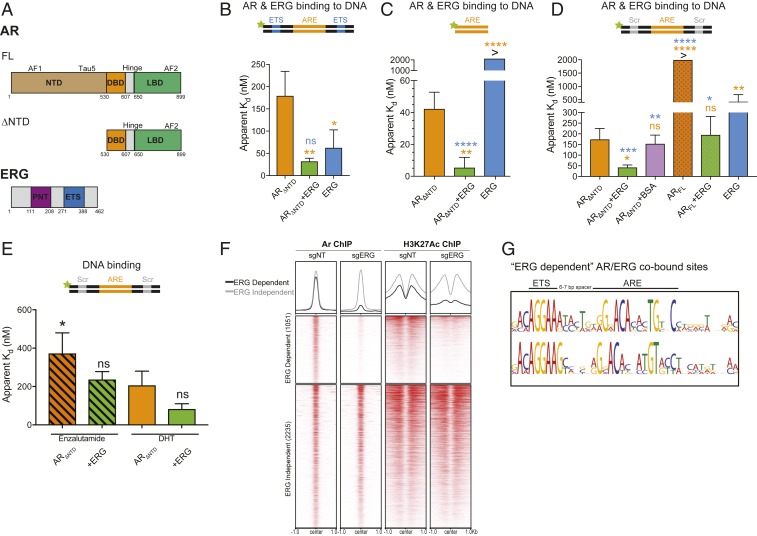
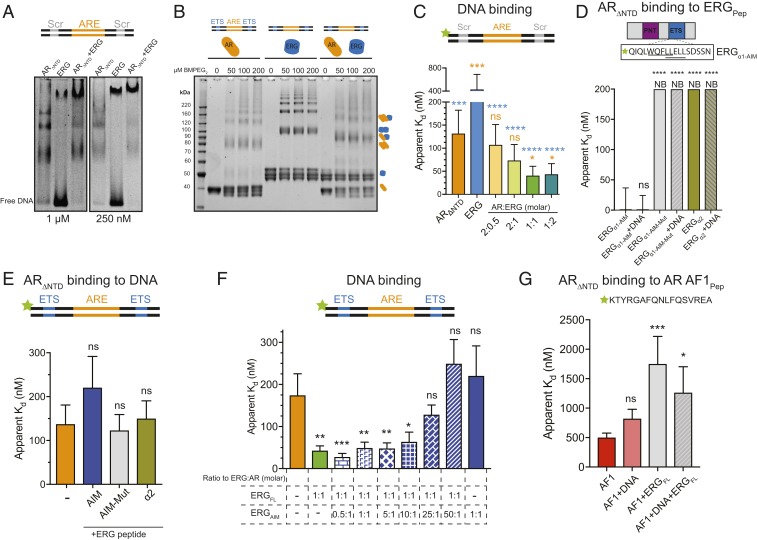
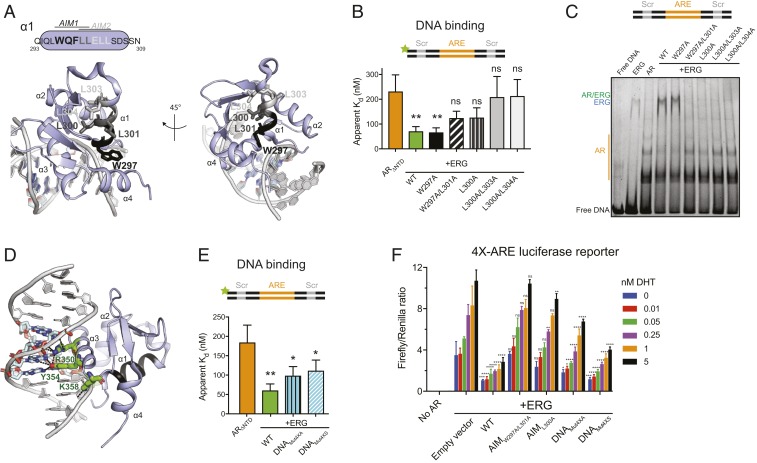
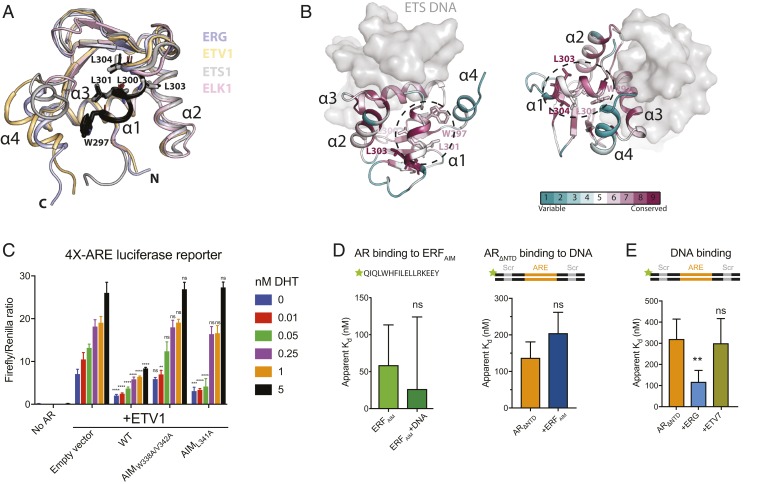
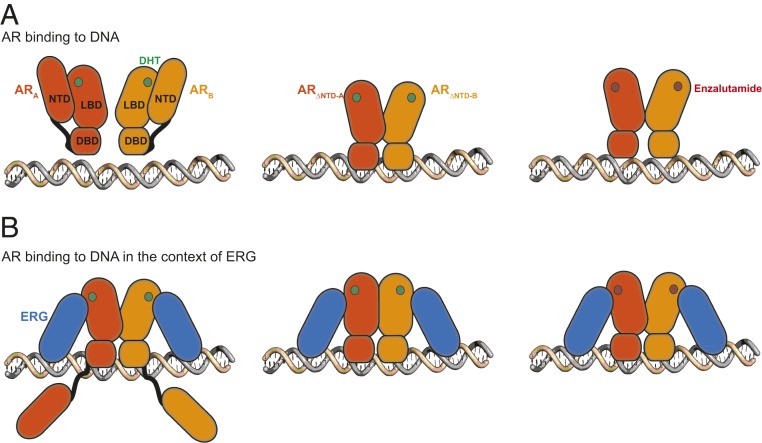
The androgen receptor (AR) is a type I nuclear hormone receptor and the primary drug target in prostate cancer due to its role as a lineage survival factor in prostate luminal epithelium. In prostate cancer, the AR cistrome is reprogrammed relative to normal prostate epithelium and particularly in cancers driven by oncogenic ETS fusion genes. The molecular basis for this change has remained elusive. Using purified proteins, we report a minimal cell-free system that demonstrates interdomain cooperativity between the ligand (LBD) and DNA binding domains (DBD) of AR, and its autoinhibition by the N terminus of AR. Furthermore, we identify ERG as a cofactor that activates AR's ability to bind DNA in both high and lower affinity contexts through direct interaction within a newly identified AR-interacting motif (AIM) in the ETS domain, independent of ERG's own DNA binding ability. Finally, we present evidence that this interaction is conserved among ETS factors whose expression is altered in prostate cancer. Our work highlights, at a biochemical level, how tumor-initiating ETS translocations result in reprogramming of the AR cistrome.
Overview
The claims and statistics of this paper haven’t been checked yet.
Free: it reads the open-access text and checks the first 5 claims that cite a source we can check. Create a free account to check every claim.
Integrity signals
Registry
Cites
Statistics
Figures
Verification
Claims the paper makes
The claims and statistics of this paper haven’t been checked yet.
Free: it reads the open-access text and checks the first 5 claims that cite a source we can check. Create a free account to check every claim.
Claims other papers make about this one
Each is checked against this paper’s own text: does it say what the citing paper says it does?
The cited source says what the claim attributes to it.
In the citing paper
“In contrast, the ERG ETS domain and mutants that fail to interact with AR or with DNA (Wasmuth et al., 2020) largely phenocopied the empty vector (Fig. 3B, Fig. S11E), corroborating the XL-MS data showing surfaces outside the ETS domain interact with the LBD.”
From Allosteric interactions prime androgen receptor dimerization and activation (2022) · cites this paper as Wasmuth et al., 2020
In the citing paper
“Indeed, in the Entrenched model, we observe additional density proximal to the LBDs that can accommodate ERG’s PNT and ETS domains (Fig. S11C, D) (Mackereth et al., 2004; Regan et al., 2013), consistent with the ERG-AR interface mapped by XL-MS (Fig. 3A, S11A) and our previous work suggesting that ERG interacts with the AR LBD (Wasmuth et al., 2020).”
From Allosteric interactions prime androgen receptor dimerization and activation (2022) · cites this paper as Wasmuth et al., 2020
Self-check
Percentages, sums and reported differences re-computed from the paper’s own numbers.
The self-check needs the paper’s full text.
Citations
Cites
Abiraterone and Increased Survival in Metastatic Prostate Cancer
de Bono, J. S., Logothetis, C. J., Molina, A., Fizazi, K., North, S., Chu, L., Chi, K. N., Jones, R. J., Goodman, O. B., Saad, F., et al. (2011) · New England Journal of Medicine · doi:10.1056/nejmoa1014618 · Cited by 4,407
Recurrent Fusion of TMPRSS2 and ETS Transcription Factor Genes in Prostate Cancer
Tomlins, S. A., Rhodes, D. R., Perner, S., Dhanasekaran, S. M., Mehra, R., Sun, X.-W., Varambally, S., Cao, X., Tchinda, J., Kuefer, R., et al. (2005) · Science · doi:10.1126/science.1117679 · Cited by 3,846
Integrative Genomic Profiling of Human Prostate Cancer
Taylor, B. S., Schultz, N., Hieronymus, H., Gopalan, A., Xiao, Y., Carver, B. S., Arora, V. K., Kaushik, P., Cerami, E., Reva, B., et al. (2010) · Cancer Cell · doi:10.1016/j.ccr.2010.05.026 · Cited by 3,701
Self-citationIntegrative Clinical Genomics of Advanced Prostate Cancer
Robinson, D., Van Allen, E. M., Wu, Y.-M., Schultz, N., Lonigro, R. J., Mosquera, J.-M., Montgomery, B., Taplin, M.-E., Pritchard, C. C., Attard, G., et al. (2015) · Cell · doi:10.1016/j.cell.2015.05.001 · Cited by 3,645
Self-citationAshkenazy, H., Abadi, S., Martz, E., Chay, O., Mayrose, I., Pupko, T., & Ben-Tal, N. (2016) · Nucleic Acids Research · doi:10.1093/nar/gkw408 · Cited by 3,163 · cited 1×
“Surface conservation of all ETS family members mapped onto the crystal structure of ERG and calculated with ConSurf (57).”
The Molecular Taxonomy of Primary Prostate Cancer
Abeshouse, A., Ahn, J., Akbani, R., Ally, A., Amin, S., Andry, C. D., Annala, M., Aprikian, A., Armenia, J., Arora, A., et al. (2015) · Cell · doi:10.1016/j.cell.2015.10.025 · Cited by 3,110
Self-citationDevelopment of a second-generation antiandrogen for treatment of advanced prostate cancer.
Tran, C., Ouk, S., Clegg, N. J., Chen, Y., Watson, P. A., Arora, V., Wongvipat, J., Smith-Jones, P. M., Yoo, D., Kwon, A., et al. (2009) · Science · doi:10.1126/science.1168175 · Cited by 2,292 · cited 6×
“Consistent with chromatin immunoprecipitation (ChIP) assays documenting that ENZ displaces AR binding from chromatin in cells (3, 31), we found that ENZ reduced DNA binding twofold relative to DHT in our minimal reconstitution system (Fig.”
BackgroundMethodInfluentialSelf-citationEmerging mechanisms of resistance to androgen receptor inhibitors in prostate cancer
Watson, P. A., Arora, V. K., & Sawyers, C. L. (2015) · Nature Reviews Cancer · doi:10.1038/nrc4016 · Cited by 1,536 · cited 4×
“AR-targeted therapies are primarily used to treat CRPC, the most widely used being the androgen synthesis inhibitor abiraterone (2) and the antiandrogen, enzalutamide (ENZ) (3).”
InfluentialSelf-citationAndrogen receptor: structure, role in prostate cancer and drug discovery
Tan, M. E., Li, J., Xu, H. E., Melcher, K., & Yong, E.-L. (2015) · Acta Pharmacologica Sinica · doi:10.1038/aps.2014.18 · Cited by 943 · cited 2×
“To control for potential ligand dissociation in the absence of the AR NTD (5, 27), we used supraphysiological concentrations of DHT in our assays.”
BackgroundMethodTherapeutic targeting of BET bromodomain proteins in castration-resistant prostate cancer
Asangani, I. A., Dommeti, V. L., Wang, X., Malik, R., Cieslik, M., Yang, R., Escara-Wilke, J., Wilder-Romans, K., Dhanireddy, S., Engelke, C., et al. (2014) · Nature · doi:10.1038/nature13229 · Cited by 927 · cited 1×
“Consistent with chromatin immunoprecipitation (ChIP) assays documenting that ENZ displaces AR binding from chromatin in cells (3, 31), we found that ENZ reduced DNA binding twofold relative to DHT in our minimal reconstitution system (Fig.”
Background
Cited by
Isoform-specific functions of PPARγ in gene regulation and metabolism
Hu, W., Jiang, C., Kim, M., Xiao, Y., Richter, H. J., Guan, D., Zhu, K., Krusen, B. M., Roberts, A. N., Miller, J., et al. (2022) · Genes & Development · doi:10.1101/gad.349232.121 · Cited by 59
Retinoic acid receptor structures: the journey from single domains to full-length complex
Rastinejad, F. (2022) · Journal of Molecular Endocrinology · doi:10.1530/jme-22-0113 · Cited by 54
“The anti-androgen enzalutamide was known to allosterically inhibit AR’s ability to bind DNA (Wasmuth et al. 2020), consistent with subsequent structural observations of DBD–LBD contacts within the AR–DNA complex from cryo-EM studies (Wasmuth et al. 2022).”
BackgroundETS transcription factors: Multifaceted players from cancer progression to tumor immunity
Wang, Y., Huang, Z., Sun, M., Huang, W., & Xia, L. (2023) · Biochimica et Biophysica Acta (BBA) - Reviews on Cancer · doi:10.1016/j.bbcan.2023.188872 · Cited by 56
Allosteric interactions prime androgen receptor dimerization and activation
Wasmuth, E. V., Broeck, A. V., LaClair, J. R., Hoover, E. A., Lawrence, K. E., Paknejad, N., Pappas, K., Matthies, D., Wang, B., Feng, W., et al. (2022) · Molecular Cell · doi:10.1016/j.molcel.2022.03.035 · Cited by 50
“intrinsically disordered, is not necessary for ERG association and cooperative stimulation, and contributes to N-C autoinhibition in the absence of NTD-cofactor association (He et al., 2001; Schaufele et al., 2005; van Royen et al., 2012; Wasmuth et al., 2020).”
BackgroundMethodInfluentialSelf-citationNevedomskaya, E., & Haendler, B. (2022) · International Journal of Molecular Sciences · doi:10.3390/ijms23116281 · Cited by 53
Metadata
- Authors
- Wasmuth, E. V., Hoover, E. A., Antar, A., Klinge, S., Chen, Y., & Sawyers, C. L.
- Affiliations
- Memorial Sloan Kettering Cancer Center (US)
- Rockefeller University (US)
- Corresponding author
- Sawyers, Charles L.
- Venue
- Proceedings of the National Academy of Sciences
- Publisher
- National Academy of Sciences
- Published
- 2020-03-27
- Volume
- 117
- Issue
- 15
- Pages
- 8584-8592
- ISSN
- 0027-8424 (ISSN-L)
- 1091-6490
- PMC
- PMC7165421
- OpenAlex
- W3013613430
- Cited by
- 50
- References
- 58
- Citations by year
- 2026: 4 · 2025: 8 · 2024: 4 · 2023: 7 · 2022: 16 · 2021: 7 · 2020: 4
- FWCI
- 4.79
- Type
- journal article
- Language
- en
- Open access
- hybrid
- doi.org
- Licence
- Locations
- Proceedings of the National Academy of Sciences (publishedVersion, cc-by-nc-nd)
- PubMed Central (publishedVersion, cc-by-nc-nd)
- PubMed (publishedVersion)
- Funders
- HHS | NIH | National Cancer Institute (CA155169, CA193837, CA224079, CA092629, CA160001, CA008748)
- Howard Hughes Medical Institute (NA)
- U.S. Department of Defense (W81XWH-18-1-0182)
- Topics
- Life Sciences › Biochemistry, Genetics and Molecular Biology › Cancer Research › Prostate Cancer Treatment and Research
- Life Sciences › Biochemistry, Genetics and Molecular Biology › Molecular Biology › Chromatin Remodeling and Cancer
- Life Sciences › Biochemistry, Genetics and Molecular Biology › Endocrinology › Estrogen and related hormone effects
- Keywords
- androgen receptor, ERG, ETS transcription factors, DNA-binding activity, autoinhibition, cofactor interactions, ETS domain, prostate cancer, transcriptional reprogramming, nuclear receptors
- MeSH terms
- Transcriptional Regulator ERG, Cell Transformation, Neoplastic, DNA, Humans, Male, Prostatic Neoplasms, Receptors, Androgen, Tumor Cells, Cultured, Gene Expression Regulation, Neoplastic, Proto-Oncogene Proteins c-ets
About these checks
Registry, retraction, Cites and statistics results are computed, not judged, with one exception: a printed reference that no index lists is read once by a model before it counts as a citation error. Claims are extracted by a model and kept only when their quote appears verbatim in the text; each cited source is then checked, with a model’s help, for whether it says what the claim relies on. Those verdicts can be wrong — read the claim’s quote and the cited source before relying on one.
Statistics and arithmetic are recomputed, not judged.
Confidence bands are shown only for fields calibrated on our annotated test set. None is calibrated yet, so no band is shown.
What counts as a claim ›How we measure confidence ›How we check this ›
Are you an author, or do you see a problem with this page? Request a review
How to cite
Cite CoChat for the checks on this page, and the paper for its own findings.
- This page
- CoChat. (2026). Citation check: Modulation of androgen receptor DNA binding activity through direct interaction with the ETS transcription factor ERG. https://app.cochat.ai/papers/10.1073/pnas.1922159117
- The paper
- Wasmuth, E. V., Hoover, E. A., Antar, A., Klinge, S., Chen, Y., & Sawyers, C. L. (2020). Modulation of androgen receptor DNA binding activity through direct interaction with the ETS transcription factor ERG. Proceedings of the National Academy of Sciences. https://doi.org/10.1073/pnas.1922159117
Data sources
Bibliographic data: Semantic Scholar, OpenAlex, Crossref.
Contains information from the Semantic Scholar Academic Graph Datasets, made available under the ODC Attribution License (ODC-BY 1.0).
Semantic Scholar’s data is described in: Kinney, R., et al. (2023). The Semantic Scholar Open Data Platform. arXiv:2301.10140.
