

How multisensory neurons solve causal inference.
Open accessThe DOI matches its Crossref record; 49 of the 49 references it cites were found in a registry or an index; 42 of the 52 sources its claims cite were checked for support.
Abstract
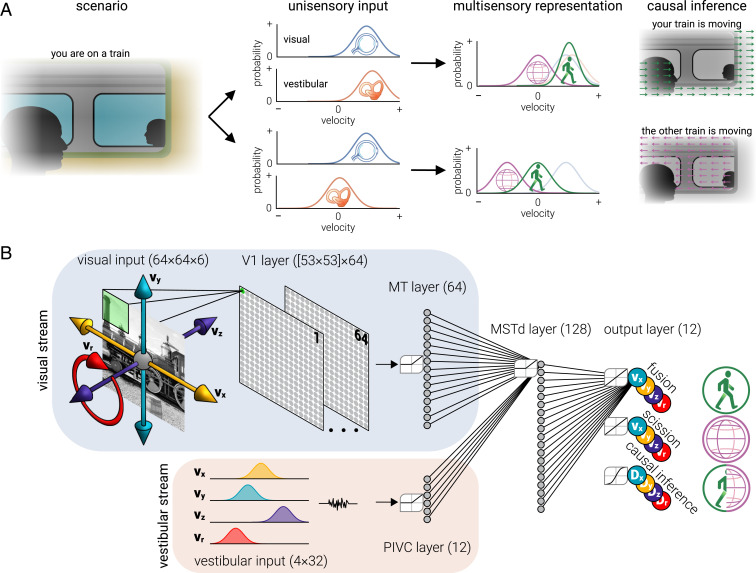
Sitting in a static railway carriage can produce illusory self-motion if the train on an adjoining track moves off. While our visual system registers motion, vestibular signals indicate that we are stationary. The brain is faced with a difficult challenge: is there a single cause of sensations (I am moving) or two causes (I am static, another train is moving)? If a single cause, integrating signals produces a more precise estimate of self-motion, but if not, one cue should be ignored. In many cases, this process of causal inference works without error, but how does the brain achieve it? Electrophysiological recordings show that the macaque medial superior temporal area contains many neurons that encode combinations of vestibular and visual motion cues. Some respond best to vestibular and visual motion in the same direction ("congruent" neurons), while others prefer opposing directions ("opposite" neurons). Congruent neurons could underlie cue integration, but the function of opposite neurons remains a puzzle. Here, we seek to explain this computational arrangement by training a neural network model to solve causal inference for motion estimation. Like biological systems, the model develops congruent and opposite units and recapitulates known behavioral and neurophysiological observations. We show that all units (both congruent and opposite) contribute to motion estimation. Importantly, however, it is the balance between their activity that distinguishes whether visual and vestibular cues should be integrated or separated. This explains the computational purpose of puzzling neural representations and shows how a relatively simple feedforward network can solve causal inference.
Overview
CoChat Summary
TL;DR
A neural network trained to combine or separate visual and vestibular signals for self- and scene-motion estimation recapitulates key multisensory neural and behavioral signatures, including congruent/opposite units and reliability-based cue weighting. Its causal inference is solved by the balance of activity between congruent and opposite MSTd-like units, with both contributing to motion estimates.
Key findings
- MultiNet achieved high correspondence between actual and estimated self- and scene-motion velocities (all r > 0.95) and causal-inference accuracy of ∼85% across movement directions (chance = 50%).
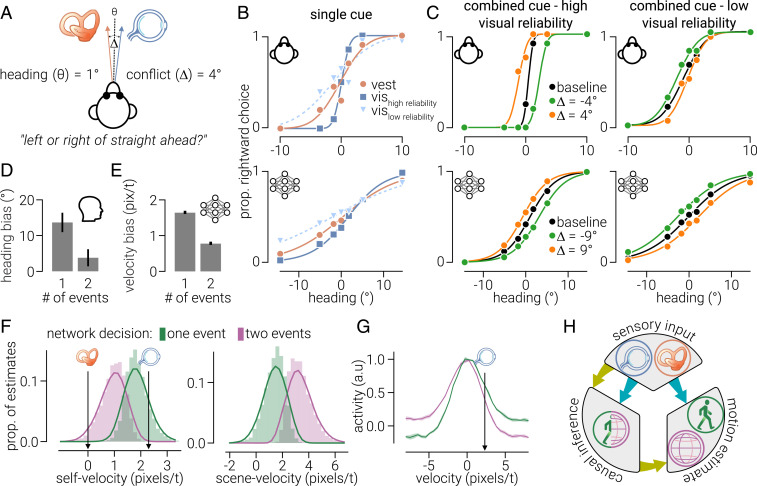
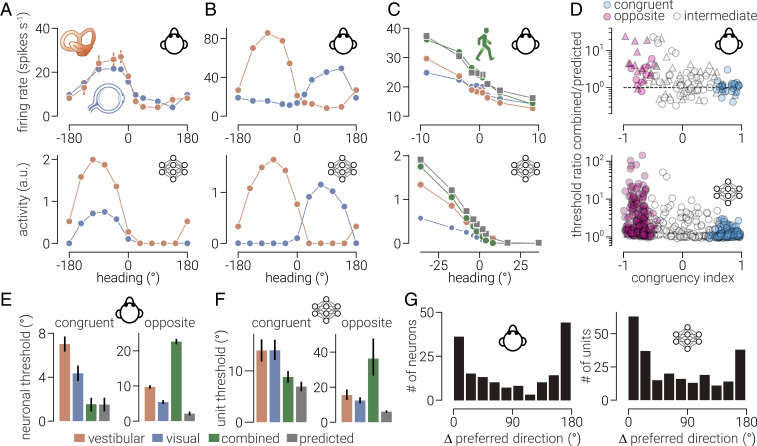
- The network developed congruent and opposite MSTd-like units; the distribution of preferred visual–vestibular direction differences was bimodal with peaks at 0° and 180°, similar to macaque MSTd, and congruent but not opposite unit thresholds were near optimal.
- It reproduced reliability-based cue weighting and causal-inference-related judgment biases: self-motion estimates were biased toward the more reliable cue, and on one-event trials were more biased by visual input, with the opposite pattern for scene-motion on two-event trials.
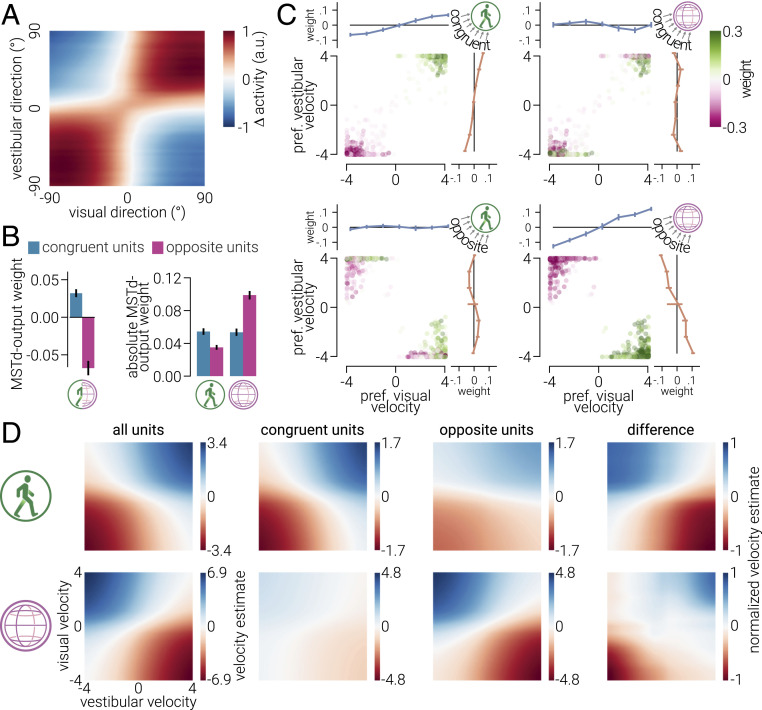
- Congruent units primarily promoted combine decisions and self-motion estimates, while opposite units primarily promoted separate decisions and scene-motion estimates; both contributed to both estimates, with cue-sensitivity asymmetries correlating with congruent-scission weights (r = 0.54, CI95% = [0.48, 0.60]) and opposite-fusion weights (r = 0.39, CI95% = [0.34, 0.45]).
Methods
- MultiNet had visual and vestibular streams: visual input passed through a convolutional V1 layer and fully connected MT layer; vestibular input passed through a fully connected PIVC layer; both converged on a fully connected MSTd layer, decoded by eight fusion/scission regression units and four binary causal-inference units for vx, vy, vz, and vr.
- Training used 64,000 randomly generated visual–vestibular input combinations over 50 epochs, with a 75/25 train/test split, minibatch gradient descent (batch size 32, learning rate 1.0 × 10⁻⁴); visual input was natural image sequences (64 × 64 × 6 pixels, ±4 pixels/frame) and vestibular input was four noisy Gaussian distributions.
- Analyses compared network outputs to extracted/replotted macaque and human data, used bootstrapping (50,000 iterations) for 95% CIs, Pearson correlations, ROC/sigmoid threshold estimation, and artificial lesion decoding.
Limitations
- Stated: biological and artificial systems differ greatly; the model covers only a small portion of one sensory hierarchy, is optimized for a single task, lacks meaningful energy constraints, and uses artificial neurons that are radically simpler than biological neurons.
- Stated: vestibular signals were abstracted and defined by velocity even though biological vestibular systems are sensitive to acceleration; visual input comprised whole-field self- and scene-motion contributions, not spatially localized scene motion; generality to other sensory pairings remains untested.
- Evident: the architecture is exclusively feedforward, so it cannot directly test feedback accounts of causal inference; causal-inference outputs were interpreted as binary above/below 0.5, and comparisons to biology rely on previously published data rather than new biological experiments.
Model-written summary. Check it against the paper before relying on it.
Integrity signals
Registry
Cites
Statistics
Figures
Verification
Claims the paper makes
17 Valid · 3 Not valid · 4 Not checked · 63 Own results and interpretations
Some cited sources support this claim and some don’t — read each source’s verdict below.
In the paper
“Congruent neurons appear to combine vestibular–visual signals in a way that assumes a common cause, and their activity is highly predictive of behavioral choice on vestibular–visual combination tasks (8–10).”
§ How multisensory neurons solve causal inference > Abstract
What the sources say
- Supportedcites [8] Y. Gu, D. E. Angelaki, G. C. Deangelis, Neural correlates of multisensory cue integration in macaque MSTd. Nat. Neurosci. 11, 1201– 1210 (2008). 18776893 PMC2713666 source
The Results section, “Correlations between neural activity and behavior” (page unavailable), reports that congruent cells had a mean choice probability of 0.58 during combined vestibular–visual stimulation, significantly above chance. The authors describe these cells as strongly coupled to perceptual decisions under cue combination. (LLM, conf=0.92)
- Supportedcites [9] C. R. Fetsch, A. Pouget, G. C. DeAngelis, D. E. Angelaki, Neural correlates of reliability-based cue weighting during multisensory integration. Nat. Neurosci. 15, 146– 154 (2011). 22101645 PMC3398428 source
In Results, under “Decoding summary and the effect of tuning congruency” (page unavailable), decoding congruent MSTd neurons reproduced cue reweighting and improved thresholds, matching the monkeys’ behavioral results quite well. The Introduction also reports trial-by-trial correlations between MSTd activity and perceptual decisions. (LLM, conf=0.88)
- Disputedcites [10] M. L. Morgan, G. C. Deangelis, D. E. Angelaki, Multisensory integration in macaque visual cortex depends on cue reliability. Neuron 59, 662– 673 (2008). 18760701 PMC2601653 sourceExperimental — accuracy not yet measured
The Discussion’s “Modulation depth and discrimination threshold” section reports improved neural discriminability for congruent cells under aligned visual–vestibular stimulation, but explicitly says that a parallel improvement in behavioral sensitivity during multimodal discrimination remains to be demonstrated. It does not establish that their activity is highly predictive of behavioral choice. The indexed passages provide no page numbers. (LLM, conf=0.86)
Checked by a reasoning model — may be wrong.
hedgedstates an association- Asserted: passes — The authors put it forward as true.
- Checkable: passes — It can be checked against evidence.
- Load-bearing: passes — The paper’s conclusions depend on it.
- Based: passes — The paper gives a reason why it holds.
- Supported
The cited sources support only part of this claim — read each source’s verdict below.
In the paper
“Congruent neurons appear to combine vestibular–visual signals in a way that assumes a common cause, and their activity is highly predictive of behavioral choice on vestibular–visual combination tasks (8–10).”
§ How multisensory neurons solve causal inference > Abstract
What the sources say
- Partly supportedcites [8] Y. Gu, D. E. Angelaki, G. C. Deangelis, Neural correlates of multisensory cue integration in macaque MSTd. Nat. Neurosci. 11, 1201– 1210 (2008). 18776893 PMC2713666 sourceExperimental — accuracy not yet measured
The Discussion (page not specified) reports that congruent MSTd cells improve their sensitivity when visual and vestibular cues are combined, supporting the cue-combination part of the claim. The Results section on linear summation (page not specified) says congruent and opposite cells use the same linear weighting of those inputs. The paper does not establish that congruent cells assume a common cause for the signals. (LLM, conf=0.83)
- Partly supportedcites [9] C. R. Fetsch, A. Pouget, G. C. DeAngelis, D. E. Angelaki, Neural correlates of reliability-based cue weighting during multisensory integration. Nat. Neurosci. 15, 146– 154 (2011). 22101645 PMC3398428 sourceExperimental — accuracy not yet measured
The Results section reports that congruent MSTd neurons gain heading sensitivity when visual and vestibular cues are combined. The Online Methods say the cue conflict was kept small enough to discourage inference of separate causes, but the paper does not establish that the neurons themselves assume a common cause. (LLM, conf=0.78)
- Partly supportedcites [10] M. L. Morgan, G. C. Deangelis, D. E. Angelaki, Multisensory integration in macaque visual cortex depends on cue reliability. Neuron 59, 662– 673 (2008). 18760701 PMC2601653 sourceExperimental — accuracy not yet measured
The Results describe congruent MSTd neurons combining visual and vestibular inputs, and the Discussion reports that weighted linear sums describe bimodal responses. The paper does not establish that these neurons assume a common cause; its Results also say the monkeys only maintained fixation, so it does not test whether neural activity predicts behavioral choice. (LLM, conf=0.84)
hedgedstates an association- Asserted: passes — The authors put it forward as true.
- Checkable: passes — It can be checked against evidence.
- Load-bearing: passes — The paper’s conclusions depend on it.
- Based: passes — The paper gives a reason why it holds.
- Partly supported
The sources with a verdict support this claim; the rest weren’t checked yet, have no full text we could read, or their verdicts aren’t rated yet.
In the paper
“Further, the network exhibits key “behavioural” characteristics observed in human and primate studies, such as reliability-based cue weighting (9, 17) and self-motion estimation biased by causal inference (18).”
§ How multisensory neurons solve causal inference > Abstract
What the sources say
- Supportedcites [9] C. R. Fetsch, A. Pouget, G. C. DeAngelis, D. E. Angelaki, Neural correlates of reliability-based cue weighting during multisensory integration. Nat. Neurosci. 15, 146– 154 (2011). 22101645 PMC3398428 source
The Introduction reports that monkeys, like humans, reweight sensory cues according to their reliability. It also reports that MSTd neuronal activity predicts this behavioural reweighting. The citing authors’ statement about their own network is not a finding attributed to this source. (LLM, conf=0.92)
- Not checked — no full text of the sourcecites [17] M. O. Ernst, M. S. Banks, Humans integrate visual and haptic information in a statistically optimal fashion. Nature 415, 429– 433 (2002). 11807554 source
plainstates an association- Asserted: passes — The authors put it forward as true.
- Checkable: passes — It can be checked against evidence.
- Load-bearing: passes — The paper’s conclusions depend on it.
- Based: passes — The paper gives a reason why it holds.
- Supported
The cited sources support only part of this claim — read each source’s verdict below.
In the paper
“Studies of vestibular–visual integration have identified two types of multisensory neurons with similar prevalence in MSTd and VIP; those that are tuned to vestibular and visual motion in the same direction (congruent neurons) and those that prefer opposite directions (opposite neurons) (6, 8, 11).”
§ How multisensory neurons solve causal inference > Abstract
What the sources say
- Partly supportedcites [6] Y. Gu, P. V. Watkins, D. E. Angelaki, G. C. DeAngelis, Visual and nonvisual contributions to three-dimensional heading selectivity in the medial superior temporal area. J. Neurosci. 26, 73– 85 (2006). 16399674 PMC1538979 sourceExperimental — accuracy not yet measured
The Results (Fig. 2A) describe a congruent MSTd neuron with similar visual and vestibular heading preferences. The Abstract says aligned and opposite preferences were about equally frequent in MSTd. The paper does not establish these neuron types or their prevalence in VIP, so it cannot support the comparison between MSTd and VIP. (LLM, conf=0.89)
- Partly supportedcites [8] Y. Gu, D. E. Angelaki, G. C. Deangelis, Neural correlates of multisensory cue integration in macaque MSTd. Nat. Neurosci. 11, 1201– 1210 (2008). 18776893 PMC2713666 sourceExperimental — accuracy not yet measured
The Results (Neuronal sensitivity during cue combination; page unavailable) identify MSTd congruent neurons whose visual and vestibular heading preferences align, and the Methods (Data analysis; page unavailable) distinguish congruent from opposite tuning. The paper does not report corresponding neurons in VIP or establish similar prevalence in MSTd and VIP. (LLM, conf=0.88)
- Partly supportedcites [11] K. Takahashi., Multimodal coding of three-dimensional rotation and translation in area MSTd: Comparison of visual and vestibular selectivity. J. Neurosci. 27, 9742– 9756 (2007). 17804635 PMC2587312 sourceExperimental — accuracy not yet measured
The ‘Relationship between vestibular and visual tuning’ section (page not provided) reports approximately equal numbers of congruent and opposite MSTd neurons for translational motion. The paper does not establish the claimed prevalence in VIP, and its Discussion says MSTd visual and vestibular preferences for rotation were not congruent. (LLM, conf=0.88)
plainstates an association- Asserted: passes — The authors put it forward as true.
- Checkable: passes — It can be checked against evidence.
- Load-bearing: passes — The paper’s conclusions depend on it.
- Based: passes — The paper gives a reason why it holds.
- Partly supported
The cited sources support only part of this claim — read each source’s verdict below.
In the paper
“Studies of vestibular–visual integration have identified two types of multisensory neurons with similar prevalence in MSTd and VIP; those that are tuned to vestibular and visual motion in the same direction (congruent neurons) and those that prefer opposite directions (opposite neurons) (6, 8, 11).”
§ How multisensory neurons solve causal inference > Abstract
What the sources say
- Partly supportedcites [6] Y. Gu, P. V. Watkins, D. E. Angelaki, G. C. DeAngelis, Visual and nonvisual contributions to three-dimensional heading selectivity in the medial superior temporal area. J. Neurosci. 26, 73– 85 (2006). 16399674 PMC1538979 sourceExperimental — accuracy not yet measured
The Results section describes MSTd neurons whose preferred vestibular heading was nearly opposite to their preferred visual heading, and the Abstract says opposite preferences were as frequent as aligned ones in MSTd. This paper does not establish that VIP contains such neurons or that the two types have similar prevalence in VIP; those parts of the citing sentence are not supported by this source. (LLM, conf=0.88)
- Partly supportedcites [8] Y. Gu, D. E. Angelaki, G. C. Deangelis, Neural correlates of multisensory cue integration in macaque MSTd. Nat. Neurosci. 11, 1201– 1210 (2008). 18776893 PMC2713666 sourceExperimental — accuracy not yet measured
The Methods (Data analysis; page unavailable) define MSTd neurons with opposing visual and vestibular tuning as CI-opposite cells, supporting the MSTd portion. The paper does not establish that VIP contains these neurons or that the two cell types have similar prevalence in MSTd and VIP. (LLM, conf=0.86)
- Partly supportedcites [11] K. Takahashi., Multimodal coding of three-dimensional rotation and translation in area MSTd: Comparison of visual and vestibular selectivity. J. Neurosci. 27, 9742– 9756 (2007). 17804635 PMC2587312 sourceExperimental — accuracy not yet measured
The Relationship between visual and vestibular responses section reports both congruent and opposite visual–vestibular preferences for translation in MSTd neurons. The Relationship between vestibular and visual tuning section says these occur in approximately equal numbers in MSTd. The cited paper does not establish the corresponding pattern or prevalence in VIP. (LLM, conf=0.86)
plainstates an association- Asserted: passes — The authors put it forward as true.
- Checkable: passes — It can be checked against evidence.
- Load-bearing: unclear — It is unclear whether the paper’s conclusions depend on it.
- Based: passes — The paper gives a reason why it holds.
- Partly supported
56 more claims · 6 with their cited sources checked
Create a free account to see all 87 claims and to verify the 1 reference still open.
- Probably not a substantial claim. 12
- It may state two separate claims as one. 16
Self-check
Percentages, sums and reported differences re-computed from the paper’s own numbers.
Rated minor: it would not touch a result — a value no result rests on, a p-value that stays on the same side of the significance level, or a conflict that is clerical, resolved elsewhere in the paper, or outside its own findings.
In the paper
“Finally, an output layer (768 connections, 64 for each of the eight regression and four binary units, resulting in 832 parameters including the eight offset terms) mapped activities from the fully connected layer to eight regression units”
§ How multisensory neurons solve causal inference > Methods > Network Architecture.
Reported 832 · recomputed 776
Citations
Cites
Deep Residual Learning for Image Recognition
He, K., Zhang, X., Ren, S., & Sun, J. (2016) · 2016 IEEE Conference on Computer Vision and Pattern Recognition (CVPR) · doi:10.1109/cvpr.2016.90 · Cited by 235,474 · cited 1×
“Recent advances in machine learning have produced deep neural networks comprising many layers that surpass human performance on many tasks (e.g., object recognition) (37, 38).”
ImageNet Large Scale Visual Recognition Challenge
Russakovsky, O., Deng, J., Su, H., Krause, J., Satheesh, S., Ma, S., Huang, Z., Karpathy, A., Khosla, A., Bernstein, M., et al. (2015) · International Journal of Computer Vision · doi:10.1007/s11263-015-0816-y · Cited by 39,380 · cited 1×
“Recent advances in machine learning have produced deep neural networks comprising many layers that surpass human performance on many tasks (e.g., object recognition) (37, 38).”
Brainard, D. H. (1997) · Spatial Vision · doi:10.1163/156856897x00357 · Cited by 19,702 · cited 1×
“Image translation, motion-in-depth, and rotation were performed in MATAB using Psychtoolbox version 3.0.11 subpixel rendering extensions (41, 42) (http://psychtoolbox.org/).”
InfluentialThe VideoToolbox software for visual psychophysics: transforming numbers into movies
Pelli, D. G. (1997) · Spatial Vision · doi:10.1163/156856897x00366 · Cited by 11,098 · cited 1×
“Image translation, motion-in-depth, and rotation were performed in MATAB using Psychtoolbox version 3.0.11 subpixel rendering extensions (41, 42) (http://psychtoolbox.org/).”
InfluentialHumans integrate visual and haptic information in a statistically optimal fashion
Ernst, M. O., & Banks, M. S. (2002) · Nature · doi:10.1038/415429a · Cited by 4,844 · cited 2×
“Further, the network exhibits key “behavioural” characteristics observed in human and primate studies, such as reliability-based cue weighting (9, 17) and selfmotion estimation biased by causal inference (18).”
Deep Residual Learning for Image Recognition
He, K., Zhang, X., Ren, S., & Sun, J. (2015) · arXiv · doi:10.48550/arxiv.1512.03385 · Cited by 4,196
Perception of the Visual World
(1952) · Archives of Ophthalmology · doi:10.1001/archopht.1952.01700030123016 · Cited by 3,732
The analysis of visual motion: a comparison of neuronal and psychophysical performance
Britten, K., Shadlen, M., Newsome, W., & Movshon, J. (1992) · The Journal of Neuroscience · doi:10.1523/jneurosci.12-12-04745.1992 · Cited by 1,958
The Perception of the Visual World
Gibson, J. J. (1951) · The American Journal of Psychology · doi:10.2307/1419017 · Cited by 1,145
Causal Inference in Multisensory Perception
Körding, K. P., Beierholm, U., Ma, W. J., Quartz, S., Tenenbaum, J. B., & Shams, L. (2007) · PLoS ONE · doi:10.1371/journal.pone.0000943 · Cited by 1,069
Cited by
Multimodal Dynamics: Dynamical Fusion for Trustworthy Multimodal Classification
Han, Z., Yang, F., Huang, J., Zhang, C., & Yao, J. (2022) · 2022 IEEE/CVF Conference on Computer Vision and Pattern Recognition (CVPR) · doi:10.1109/cvpr52688.2022.02005 · Cited by 188
“For multimodal data, the informativeness of a modality is basically not fixed for different samples [28, 49].”
BackgroundCausal Inference Meets Deep Learning: A Comprehensive Survey
Jiao, L., Wang, Y., Liu, X., Li, L., Liu, F., Ma, W., Guo, Y., Chen, P., Yang, S., & Hou, B. (2024) · Research · doi:10.34133/research.0467 · Cited by 188
“Researchers have conducted many relevant experiments [91,92] on multimodal inference in complex environments to explore the principles of neural computation.”
BackgroundAre Deep Neural Networks Adequate Behavioral Models of Human Visual Perception?
Wichmann, F. A., & Geirhos, R. (2023) · Annual Review of Vision Science · doi:10.1146/annurev-vision-120522-031739 · Cited by 70
“Another exploratory aspect of DNNs is the generation of new hypotheses: In beautiful work [102] used a neural network to find a causal role for neurones in the macaque medial superior temporal (MST) area whose tuning properties had hitherto been regarded as puzzling.”
BackgroundBrain-Inspired Remote Sensing Foundation Models and Open Problems: A Comprehensive Survey
Jiao, L.-C., Huang, Z., Lu, X., Liu, X., Yang, Y.-T., Zhao, J.-X., Zhang, J.-Y., Hou, B., Yang, S.-Y., Liu, F., et al. (2023) · IEEE Journal of Selected Topics in Applied Earth Observations and Remote Sensing · doi:10.1109/jstars.2023.3316302 · Cited by 43
“Reuben et al. [296] show how interactions between different types of neurons lead to optimal integration and causal inference.”
BackgroundTian, F., Zhang, L., Zhu, L., Zhao, M., Liu, J., Dong, Q., & Zhao, Q. (2024) · IEEE Transactions on Computational Social Systems · doi:10.1109/tcss.2024.3420445 · Cited by 33
Luo, T., He, Z., Cai, C., Han, T., Pan, Z., & Tian, F. (2022) · ACM Symposium on User Interface Software and Technology (UIST) · doi:10.1145/3526113.3545692 · Cited by 25
“Ultimately, the brain optimizes information from these diferent perception channels based on experience, intention, etc., to improve cognitive accuracy [54, 79].”
BackgroundCausal inference during closed-loop navigation: parsing of self- and object-motion
Noel, J., Bill, J., Ding, H., Vastola, J. J., DeAngelis, G. C., Angelaki, D. E., & Drugowitsch, J. (2023) · Philosophical Transactions of the Royal Society B Biological Sciences · doi:10.1098/rstb.2022.0344 · Cited by 22
The macaque ventral intraparietal area has expanded into three homologue human parietal areas
Foster, C., Sheng, W.-A., Heed, T., & Ben Hamed, S. (2022) · Progress in Neurobiology · doi:10.1016/j.pneurobio.2021.102185 · Cited by 20
Dynamic changes of brain networks during standing balance control under visual conflict
Wang, G., Yang, Y., Wang, J., Hao, Z., Luo, X., & Liu, J. (2022) · Frontiers in Neuroscience · doi:10.3389/fnins.2022.1003996 · Cited by 22
“In contrast, when opposite cells are more active, they are attributed to different events for independent multisensory processing (Zhang et al., 2019; Badde et al., 2021; Rideaux et al., 2021).”
BackgroundBio‐Plausible Multimodal Learning with Emerging Neuromorphic Devices
Sun, H., Tian, H., Hu, Y., Cui, Y. L., Chen, X., Xu, M., Wang, X., & Zhou, T. (2024) · Advanced Science · doi:10.1002/advs.202406242 · Cited by 20
Luo, T., Cai, C., Zhao, Y., Fan, Y., Pan, Z., Han, T., & Tian, F. (2023) · ACM Symposium on User Interface Software and Technology (UIST) · doi:10.1145/3586183.3606714 · Cited by 22
“This sensorimotor information is interpreted by the brain based on daily life experience to conclude fnal perceptive results [53, 73].”
BackgroundDPNET: Dynamic Poly-attention Network for Trustworthy Multi-modal Classification
Zou, X. G., Tang, C., Zheng, X. X., Li, Z., He, X., An, S., & Liu, X. (2023) · ACM International Conference on Multimedia (ACM MM) · doi:10.1145/3581783.3612652 · Cited by 36
“In multi-modal classification, the confidence of a modality for different samples is not static [30], the perception of confidence variation is important to a model.”
BackgroundA neural mechanism for detecting object motion during self-motion
Kim, H. R., Angelaki, D. E., & DeAngelis, G. C. (2022) · eLife · doi:10.7554/elife.74971 · Cited by 19
Cortical Mechanisms of Multisensory Linear Self-motion Perception
Zhou, L., & Gu, Y. (2022) · Neuroscience Bulletin · doi:10.1007/s12264-022-00916-8 · Cited by 22
“Thus, under conditions when vision motion is inconsistent with self-motion [46, 68], opposite neurons are presumably activated, and whether they would exhibit trial-to-trial covariation with the behavior remains an interesting question in need of further study.”
BackgroundExploring the Effects of Sensory Conflicts on Cognitive Fatigue in VR Remappings
Luo, T., Chen, G., Wen, Y., Wang, P., Fan, Y., Han, T., & Tian, F. (2024) · ACM Symposium on User Interface Software and Technology (UIST) · doi:10.1145/3654777.3676439 · Cited by 19
“The brain optimizes the integration of these sensory channels by considering experience, memory, and intention to enhance cognitive precision [56, 84].”
Causal inference and the evolution of opposite neurons
Badde, S., Hong, F., & Landy, M. S. (2021) · Proceedings of the National Academy of Sciences · doi:10.1073/pnas.2112686118 · Cited by 17
Feel the thrill: Exploring how sensory experiences drive positive emotions on themed tours
Jiang, C., Zhang, K., Zhi, Y., & Zeng, Y. (2025) · Tourism Management · doi:10.1016/j.tourman.2025.105247 · Cited by 12
Wang, G., Yang, Y., Dong, K., Hua, A., Wang, J., & Liu, J. (2023) · Neuroscience Bulletin · doi:10.1007/s12264-023-01143-5 · Cited by 13
“Our results revealed that, during sensory conflict, information interaction in the multisensory integration network, centered on the PPC and SMC, is generally decreased and the processing of multisensory information shifted from integration to separation, which aligns with previous studies [50].”
Exploring Experience Gaps Between Active and Passive Users During Multi-user Locomotion in VR
Luo, T., Lu, F., Lv, J., Tan, X., Liu, C. K., Yan, F., Huang, J., Yu, C., Han, T., & Tian, F. (2024) · CHI Conference on Human Factors in Computing Systems · doi:10.1145/3613904.3641975 · Cited by 14
“Ultimately, the brain optimizes sensory information by taking into account locomotion intention and life experience, etc., to enhance cognitive accuracy [59, 76].”
BackgroundRobust multimodal sentiment analysis via double information bottleneck
Huang, H., Gong, T., He, K., Wu, J., Cambria, E., & Feng, M. (2025) · Information Fusion · doi:10.1016/j.inffus.2025.103964 · Cited by 25
Nonlinear fusion is optimal for a wide class of multisensory tasks
Ghosh, M., Béna, G., Bormuth, V., & Goodman, D. F. M. (2024) · PLoS Computational Biology · doi:10.1371/journal.pcbi.1012246 · Cited by 8
“Relaxing this assumption and extending our work to consider causal inference is an exciting future direction [Körding et al., 2007, Zhang et al., 2019, Rideaux et al., 2021].”
BackgroundMetacognition and Causal Inference in Audiovisual Speech
Kimmet, F., Pedersen, S., Cardenas, V., Rubiera, C., Johnson, G., Sans, A., Baldwin, M. W., & Odegaard, B. (2023) · Multisensory Research · doi:10.1163/22134808-bja10094 · Cited by 6
Xavier, F., Chouin, E., Tighilet, B., Chabbert, C., & Besnard, S. (2024) · Frontiers in Rehabilitation Sciences · doi:10.3389/fresc.2024.1414198 · Cited by 6
“Rideaux et al. (24) delve into the impact of peripheral VES on sensory integration, demonstrating how it leads to sensory reweighting and in fl uences the activity balance between congruent and opposite neurons.”
BackgroundSolving the causal inference problem
Noppeney, U. (2021) · Trends in Cognitive Sciences · doi:10.1016/j.tics.2021.09.004 · Cited by 7
Zhao, H., Shi, Z., Gong, Z., & He, S. (2022) · Entropy · doi:10.3390/e25010051 · Cited by 6
“Furthermore, several researchers have made use of the structural features found in biological neural networks to design deep-learning architectures and algorithms for performing approximate-similarity (or nearest-neighbor) searches in machine learning [29], causal inference for motor estimation [30], natural language…”
BackgroundZhang, J., Gu, Y., Chen, A., & Yu, Y. (2022) · Research · doi:10.34133/2022/9787040 · Cited by 7
“However, there are also 573 works demonstrating that congruent neurons can perform separation, and opposite neurons can 574 perform integration (Rideaux et al. 2021).”
BackgroundExploring the Remapping Impact of Spatial Head-hand Relations in Immersive Telesurgery
Luo, T., Ke, Z., Wang, P., Chang, S.-T., Chen, G., Zhang, H., Tan, X., Wang, Q., Han, T., & Tian, F. (2025) · CHI Conference on Human Factors in Computing Systems · doi:10.1145/3706598.3714285 · Cited by 6
“The brain combines these sensory inputs based on reliability to form accurate perceptions [55], factoring in past experiences and intentions for decision-making [71].”
Multisensory Integration in Body Representation
Fang, W., Liu, Y., & Wang, L. (2024) · Advances in Experimental Medicine and Biology · doi:10.1007/978-981-99-7611-9_5 · Cited by 5
Temporal and spatial properties of vestibular signals for perception of self-motion
Liu, B., Shan, J., & Gu, Y. (2023) · Frontiers in Neurology · doi:10.3389/fneur.2023.1266513 · Cited by 7
“The exact functions of this type of neuron require future studies with some proposed functions, including (1) distinguishing object motion and self-motion (74, 103, 104) and (2) serving as computational units for causal inference between multisensory integration and segregation (105).”
Neuromorphic multisensory inference using mixed-plasticity artificial synaptic cluster
Jiang, C., Xu, H., Wang, W., Lu, Y., Liu, J., Ni, Y., Ye, X., Zhang, Y., Zou, T., Takei, K., et al. (2025) · Device · doi:10.1016/j.device.2025.100897 · Cited by 6
Paredes, R., Ferri, F., Romei, V., & Seriès, P. (2025) · Schizophrenia Research · doi:10.1016/j.schres.2025.06.007 · Cited by 4
The macaque ventral intraparietal area has expanded into three homologue human parietal areas.Preprint
Foster, C., Sheng, W.-A., Heed, T., & Hamed, S. B. (2021) · Progress in neurobiology · doi:10.31219/osf.io/6meyw · Cited by 17
Buhmann, Z., Robinson, A. K., Mattingley, J. B., & Rideaux, R. (2024) · eLife · doi:10.7554/elife.97230.1 · Cited by 5
Self-citationHu, Z., Tran, D. M. D., & Rideaux, R. (2025) · bioRxiv (Cold Spring Harbor Laboratory) · doi:10.1101/2025.03.22.644773 · Cited by 4
Self-citationSMILE: Semi-supervised multi-view classification based on dynamical fusion
Yang, H., Kang, L., & Che, X. (2025) · PLoS ONE · doi:10.1371/journal.pone.0320831 · Cited by 3
“In multi-view data, the informativeness of each view of different samples is invariant [41,42], therefore, understanding the variation of the informativeness for different samples is the key to multi-view classification, which is related to the ability of the model to adapt to the quality of the…”
Jia, S., Zhang, T., Zuo, R., & Xu, B. (2023) · Frontiers in Neuroscience · doi:10.3389/fnins.2023.1132269 · Cited by 3
“Many researchers attempt have tried to understand the biological nature of efficient multi-sensory integration by focusing on the visual and auditory pathways in biological brains (Rideaux et al., 2021).”
BackgroundInterhemispheric multisensory perception and Bayesian causal inference
Huo, H., Liu, X., Tang, Z., Dong, Y., Zhao, D., Chen, D., Tang, M., Qiao, X., Du, X., Guo, J., et al. (2023) · iScience · doi:10.1016/j.isci.2023.106706 · Cited by 5
“The brain may then perceive these sensory signals as independent sources and segregate multisensory cues responding to the conflict.(11,18,19) Recently, Bayesian causal inference (BCI) models were used to account for an observer’s uncertainty that whether sensory signals come from common or independent sources.”
BackgroundVahagn: VisuAl Haptic Attention Gate Net for slip detection
Wang, J., Ji, Y., & Hongyu, Y. (2024) · Frontiers in Neurorobotics · doi:10.3389/fnbot.2024.1484751 · Cited by 4
Cong, S., Fan, Z., Liu, H., Zhang, Y., Wang, X. Y., Luo, H., & Yao, X. (2024) · IEEE International Conference on Bioinformatics and Biomedicine (BIBM) · doi:10.1109/bibm62325.2024.10822319 · Cited by 4
“Evidence has shown that the informativeness of a modality typically varies across different samples [18], which motivates efforts to model modality informativeness to enhance fusion effectiveness [19]–[21].”
Humans use underestimates of auditory spatial and temporal uncertainty for perceptual inference
Hong, F., Xu, J., Landy, M. S., & Badde, S. (2025) · Proceedings of the Royal Society B Biological Sciences · doi:10.1098/rspb.2024.2880 · Cited by 5
Buhmann, Z., Robinson, A. K., Mattingley, J. B., & Rideaux, R. (2024) · eLife · doi:10.7554/elife.97230.2 · Cited by 2
Self-citationHuman shape perception spontaneously discovers the biological origin of novel, but natural, stimuli
Dehn, K. I., Maiello, G., Hartmann, F., et al. (2025) · Journal of The Royal Society Interface · doi:10.1098/rsif.2024.0931 · Cited by 2
Self-citationThe Intrinsic Similarity of Topological Structure in Biological Neural Networks
Zhao, H., Shao, C., Shi, Z., He, S., & Gong, Z. (2023) · IEEE Transactions on Computational Biology and Bioinformatics · doi:10.1109/tcbb.2023.3279443 · Cited by 2
“simple feedforward network integrating visual and vestibular signals can solve causal inference [49].”
Multi-modal Dynamic Information Selection Pyramid Network for Alzheimer’s Disease Classification
Ma, Y., Chen, Y., Liu, Y., Chen, J., & Jiang, B. (2025) · Lecture notes in computer science · doi:10.1007/978-981-96-2885-8_1 · Cited by 2
Causal inference during closed-loop navigation: parsing of self- and object-motionPreprint
Noel, J., Bill, J., Ding, H., et al. (2023) · bioRxiv (Cold Spring Harbor Laboratory) · doi:10.1101/2023.01.27.525974 · Cited by 2
“For instance, while feedforward-only mechanistic models of CI may account for decisions during two-alternative forced choice tasks [20], our brains are (i) decidedly recurrent, and (ii) largely dictate the timing, content, and relative resolution of sensory input via motor output (i.”
BackgroundBuhmann, Z., Robinson, A. K., Mattingley, J. B., & Rideaux, R. (2026) · eLife · doi:10.7554/elife.97230.3 · Cited by 11
“…stimuli can be predicted by MLE, and single neuron responses follow the principles of inverse effectiveness and super-additivity, among others ( Rideaux et al., 2021 ), how audiovisual super-additivity manifests within populations of neurons is comparatively unclear given the mixed findings…”
Self-citationThe effect of posture on virtual walking experience using foot vibrations
Nakamura, J., & Kitazaki, M. (2024) · Scientific Reports · doi:10.1038/s41598-024-70229-5 · Cited by 1
Zhaoping, L. (2024) · Vision Research · doi:10.1016/j.visres.2024.108489 · Cited by 1
“In particular, this encoding is before the decision on whether the visual and vestibular cues should be integrated or segregated for specific perceptual or motor task (such as in e.g., Rideaux et al., 2021; Zhang et al., 2019).”
Energy efficiency and sensitivity benefits in a motion processing adaptive recurrent neural network
Mohan, V., & Rideaux, R. (2025) · Neural Networks · doi:10.1016/j.neunet.2025.107834 · Cited by 3
Self-citationMetacognition and Causal Inference in Audiovisual SpeechPreprint
Kimmet, F., Pedersen, S. M. B., Cardenas, V., et al. (2022) · doi:10.31234/osf.io/u9ad6 · Cited by 1
Hong, F., Xu, J., Landy, M. S., & Badde, S. (2024) · bioRxiv (Cold Spring Harbor Laboratory) · doi:10.1101/2024.12.01.626278 · Cited by 1
Modelling Audio-Visual Reaction Time with Recurrent Mean-Field NetworksPreprint
Brady, R. M., & Butler, J. S. (2025) · bioRxiv (Cold Spring Harbor Laboratory) · doi:10.1101/2025.05.29.656149 · Cited by 2
Exploring the Impact of Sensory Conflict on State Mindfulness in VR Meditation Training
Chang, S., Luo, T., Wang, P., Sun, B., Tang, X., Chen, G., Gao, B., Wang, Q., Han, T., Fan, Y., et al. (2026) · CHI Conference on Human Factors in Computing Systems · doi:10.1145/3772318.3791394
“…103], in which the brain dynamically adjusts integration weights across modalities according to signal reliability, task demands, and bodily state [12, 31], and further optimizes by incorporating intention and past experience [97] to form coherent and stable spatial perception and body awareness.”
InfluentialA neural mechanism for detecting object motion during self-motionPreprint
Kim, H. R., Angelaki, D. E., & DeAngelis, G. C. (2021) · bioRxiv (Cold Spring Harbor Laboratory) · doi:10.1101/2021.11.16.468843
“tion consisting of a mixture of congruent and opposite cells provides a useful sensory substrate for causal inference (Rideaux et al., 2021).”
BackgroundZhang, J., Huang, M., Gu, Y., Chen, A., & Yu, Y. (2022) · Brain Sciences · doi:10.3390/brainsci12101387
“trained an artificial network to perform causal inference and showed that a feedforward network can estimate the visual-vestibular motion by reading out the activity from neurons tuned to congruent and opposite directions [23].”
BackgroundNonlinear fusion is optimal for a wide class of multisensory tasksPreprint
Ghosh, M., Béna, G., Bormuth, V., et al. (2023) · bioRxiv (Cold Spring Harbor Laboratory) · doi:10.1101/2023.07.24.550311
Buhmann, Z., Robinson, A. K., Mattingley, J. B., et al. (2024) · bioRxiv (Cold Spring Harbor Laboratory) · doi:10.1101/2024.02.15.580589
Self-citationParedes, R., Ferri, F., Romei, V., et al. (2024) · bioRxiv (Cold Spring Harbor Laboratory) · doi:10.1101/2024.05.29.596551
“To our knowledge, biologically plausible neural network models of multisensory causal inference (Cuppini et al., 2017; Fang et al., 2019; Rideaux et al., 2021) have not yet been used to explore the neural mechanisms behind the proneness to experience audiovisual illusions in individuals in the…”
Energy efficiency and sensitivity benefits in a motion processing adaptive recurrent neural networkPreprint
Mohan, V., & Rideaux, R. (2024) · bioRxiv (Cold Spring Harbor Laboratory) · doi:10.1101/2024.12.20.629845
“Extending the networks’ input space to include more complex and varied stimuli like 3D motion could highlight other domains where adaptation influences sensory processing and perception (Idrees et al., 2024; Latimer et al., 2019; Rideaux et al., 2021).”
Self-citationHuman shape perception spontaneously discovers the biological origin of novel, but natural, stimuliPreprint
Dehn, K. I., Maiello, G., Hartmann, F., et al. (2024) · bioRxiv (Cold Spring Harbor Laboratory) · doi:10.1101/2024.12.21.629735
Self-citationComputational models and neural mechanisms of causal inference in multisensory integration
Cheng, Y., Yuan, X., Jiang, Y., & Cao, Y. (2025) · Scientia Sinica Vitae · doi:10.1360/ssv-2024-0160
Scikit-NeuroMSI: A Generalized Framework for Modeling Multisensory IntegrationPreprint
Paredes, R., Cabral, J., & Seriès, P. (2025) · bioRxiv (Cold Spring Harbor Laboratory) · doi:10.1101/2025.05.26.656124
Scikit-NeuroMSI: A Generalized Framework for Modeling Multisensory Integration
Paredes, R., Cabral, J., & Seriès, P. (2025) · Neuroinformatics · doi:10.1007/s12021-025-09738-1 · Cited by 1
“Recently, neural network models have been proposed as an alternative to model causal inference in multisensory integration paradigms (Cup-pini et al., 2017; Fang et al., 2019; Rideaux et al., 2021), providing a low-level description of such a mechanism.”
A Deep Neural Network Model of Audiovisual Speech Recognition Reports the McGurk EffectPreprint
Ma, H., Wang, Z., Zhang, X., et al. (2025) · bioRxiv (Cold Spring Harbor Laboratory) · doi:10.1101/2025.08.20.671347
Modeling of Biological Neural Networks Based on Neuronal Functions and Connectivity Patterns
Zhao, H., yuhang, Z., Huang, Y., & Liu, Y. (2026) · Computation · doi:10.3390/computation14070151
Hu, Z., Tran, D. M. D., & Rideaux, R. (2025) · Imaging Neuroscience · doi:10.1162/imag.a.152 · Cited by 9
“…has been used extensively to study how the brain integrates low-level features ( Alais & Burr, 2004; Buhmann et al., 2024; Rideaux & Welchman, 2018; Rideaux et al., 2021; Stanford et al., 2005; Stein & Stanford, 2008), it has not yet been implemented within the context of predictive processing,…”
Self-citationEnvironmental motion presented ahead of self-motion modulates heading direction estimation
Saftari, L. N., Moon, J., & Kwon, O. (2025) · PLoS Computational Biology · doi:10.1371/journal.pcbi.1013571
“Its neural correlates have been also actively investigated [23,41–49].”
A Theoretical Proof of Dynamic Multimodal Fusion Exacerbates Modality Greedy
Ding, X., Ma, H., & Zhang, C. (2025) · ACM International Conference on Multimedia (ACM MM) · doi:10.1145/3746027.3754820 · Cited by 5
“The world around us is inherently multimodal, and we perceive it through various informational modalities [1, 25, 27].”
A dynamic causal inference framework for perception–action loopsPreprint
Cooke, J. R. H., & Medendorp, W. P. (2025) · bioRxiv (Cold Spring Harbor Laboratory) · doi:10.1101/2025.11.13.688198
Engaging Mind and Body: An Immersive BCI Paradigm with Motion-Panoramic Virtual Reality
Zhang, L., Lei, M., Zhang, J., Huang, Z., Huang, R., & Cheng, H. M. (2025) · IEEE/RSJ International Conference on Intelligent Robots and Systems (IROS) · doi:10.1109/iros60139.2025.11247199
A deep neural network model of audiovisual speech recognition reports the McGurk effect
Ma, H., Wang, Z., Zhang, X., Magnotti, J. F., & Beauchamp, M. S. (2026) · Psychonomic Bulletin & Review · doi:10.3758/s13423-025-02846-8 · Cited by 1
“Of course, the many possible methodological confounds in comparisons between DNN/CNNs and human brains warrant careful consideration (Dujmovic et al., 2024; Hadidi et al., 2025) and emphasize the diversity of possible neural network architectures (Rideaux et al., 2021).”
Lin, Y., Liu, J., He, L., Liu, L., & Zhang, J. (2026) · Multimedia Systems · doi:10.1007/s00530-026-02526-0
“For multi-modal data, the amount of information in different modalities across samples is generally not fixed, as discussed in [ 11] and [12].”
Lv, Z., & Gu, Y. (2026) · Neuroscience Bulletin · doi:10.1007/s12264-026-01723-1
Decoding self-motion: insights into visual-vestibular causal inference
Sun, H., Chen, A., & Zeng, F. (2026) · Frontiers in Human Neuroscience · doi:10.3389/fnhum.2026.1879282
Metadata
- Authors
- Rideaux, R., Storrs, K. R., Maiello, G., & Welchman, A. E.
- Affiliations
- The University of Queensland (AU)
- Justus-Liebig-Universität Gießen (DE)
- University of Cambridge (GB)
- Corresponding author
- Rideaux, Reuben
- Venue
- Proceedings of the National Academy of Sciences
- Publisher
- National Academy of Sciences
- Published
- 2021-08-04
- Volume
- 118
- Issue
- 32
- ISSN
- 0027-8424 (ISSN-L)
- 1091-6490
- PMC
- PMC8364184
- OpenAlex
- W3192206917
- Cited by
- 65
- References
- 48
- Citations by year
- 2026: 9 · 2025: 18 · 2024: 16 · 2023: 11 · 2022: 8 · 2021: 3
- FWCI
- 9.17
- Type
- journal article
- Language
- en
- Open access
- hybrid
- doi.org
- Licence
- Locations
- Proceedings of the National Academy of Sciences (publishedVersion, cc-by)
- PubMed Central (publishedVersion, cc-by)
- PubMed (publishedVersion)
- University of Birmingham Research Portal (University of Birmingham) (publishedVersion, cc-by)
- ePrints Soton (University of Southampton) (acceptedVersion)
- OSF Preprints (OSF Preprints) (submittedVersion)
- Apollo (University of Cambridge) (submittedVersion, cc-by)
- Apollo (cc-by)
- Funders
- Australian Research Council (DE210100790)
- Leverhulme Trust (ECF-2017-573)
- Isaac Newton Trust (17.08(o))
- Deutsche Forschungsgemeinschaft (SFB-TRR-135)
- Alexander von Humboldt-Stiftung (#)
- Topics
- Social Sciences › Psychology › Experimental and Cognitive Psychology › Multisensory perception and integration
- Life Sciences › Neuroscience › Cognitive Neuroscience › Visual perception and processing mechanisms
- Life Sciences › Neuroscience › Neurology › Vestibular and auditory disorders
- Keywords
- causal inference, multisensory integration, self-motion perception, illusory self-motion, medial superior temporal area, neural network model, feedforward neural networks, cue integration, macaque
- MeSH terms
- Animals, Cues, Macaca mulatta, Motion Perception, Photic Stimulation, Sensory Receptor Cells, Temporal Lobe, Neural Networks, Computer
About these checks
Registry, retraction, Cites and statistics results are computed, not judged, with one exception: a printed reference that no index lists is read once by a model before it counts as a citation error. Claims are extracted by a model and kept only when their quote appears verbatim in the text; each cited source is then checked, with a model’s help, for whether it says what the claim relies on. Those verdicts can be wrong — read the claim’s quote and the cited source before relying on one.
The claim verdicts this report counts are experimental: their accuracy is not yet measured.
A language model drew the claims from the paper on 2026-10-10, under version 3 of the claim definition (model deepseek-v4.1-flash, prompt extract-v3).
A second model labelled each claim on 2026-10-10 (model jev-1.13-20260917, definition revision gold-guideline-v0.2).
Cited sources are checked with a language model’s help (gpt-6-sol).
Statistics and arithmetic are recomputed, not judged.
Confidence bands are shown only for fields calibrated on our annotated test set. None is calibrated yet, so no band is shown.
What counts as a claim ›How we measure confidence ›How we check this ›
Are you an author, or do you see a problem with this page? Request a review
Data sources
Bibliographic data: Semantic Scholar, OpenAlex, Crossref.
Contains information from the Semantic Scholar Academic Graph Datasets, made available under the ODC Attribution License (ODC-BY 1.0).
Semantic Scholar’s data is described in: Kinney, R., et al. (2023). The Semantic Scholar Open Data Platform. arXiv:2301.10140.
