

A neural network solves, explains, and generates university math problems by program synthesis and few-shot learning at human level
Open accessThe DOI matches its Crossref record; 21 of the 21 references it cites were found in a registry or an index.
Abstract
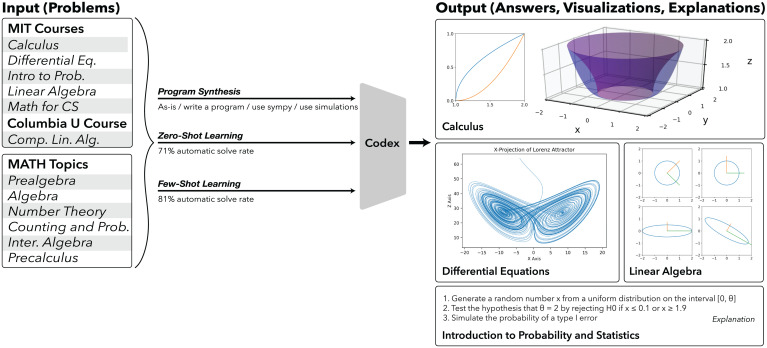
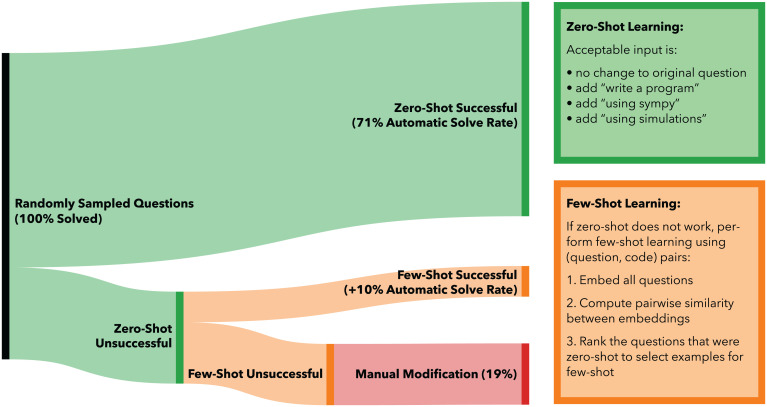
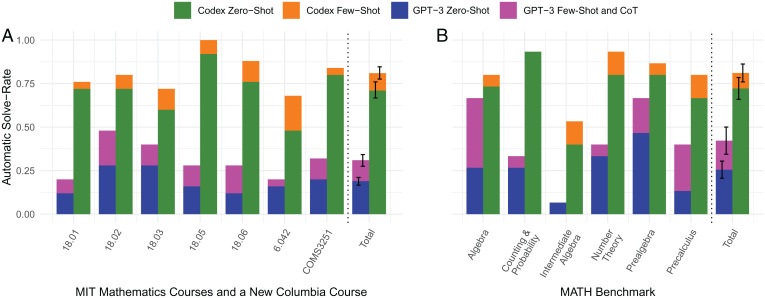
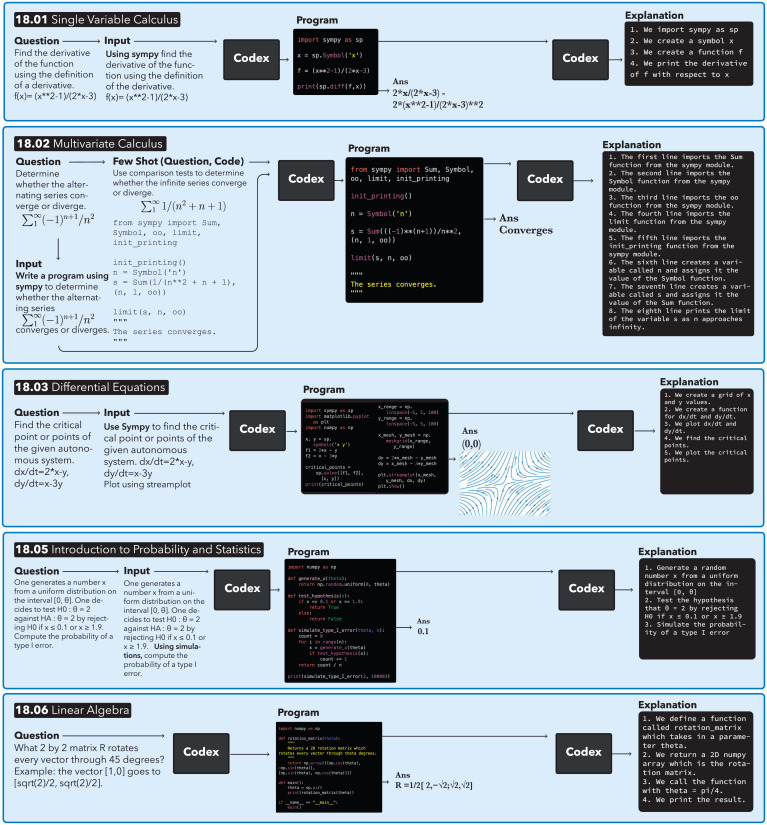
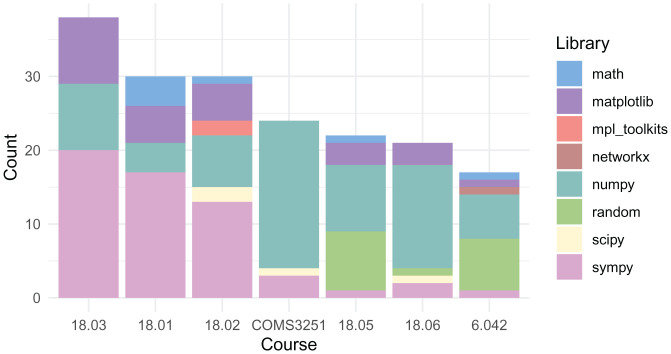
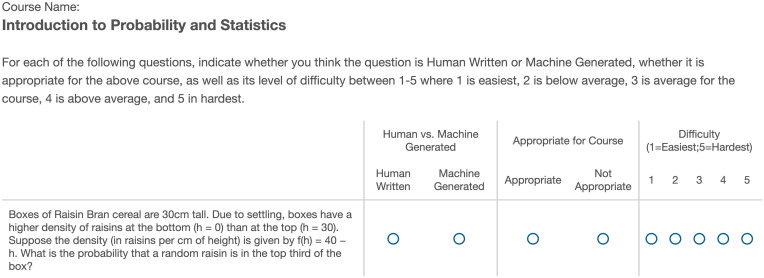
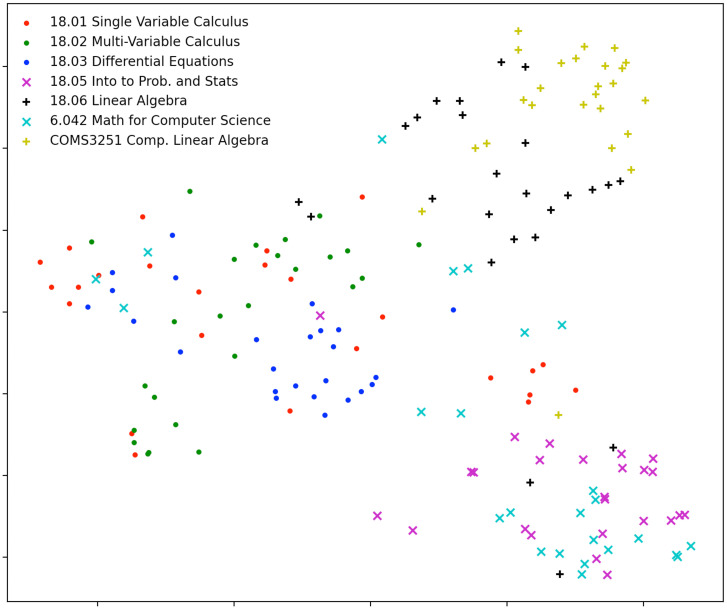
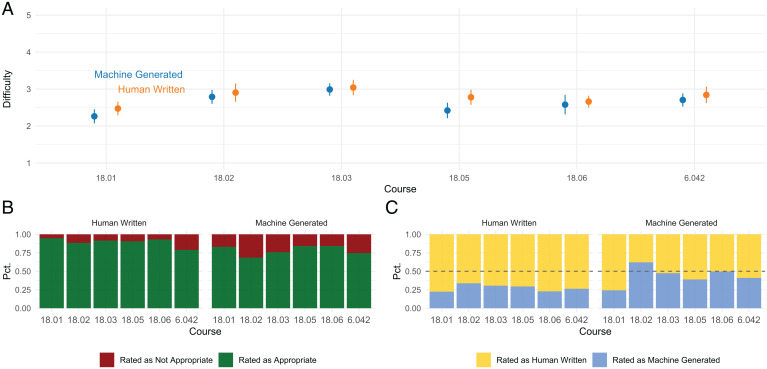
We demonstrate that a neural network pretrained on text and fine-tuned on code solves mathematics course problems, explains solutions, and generates questions at a human level. We automatically synthesize programs using few-shot learning and OpenAI’s Codex transformer and execute them to solve course problems at 81% automatic accuracy. We curate a dataset of questions from Massachusetts Institute of Technology (MIT)’s largest mathematics courses (Single Variable and Multivariable Calculus, Differential Equations, Introduction to Probability and Statistics, Linear Algebra, and Mathematics for Computer Science) and Columbia University’s Computational Linear Algebra. We solve questions from a MATH dataset (on Prealgebra, Algebra, Counting and Probability, Intermediate Algebra, Number Theory, and Precalculus), the latest benchmark of advanced mathematics problems designed to assess mathematical reasoning. We randomly sample questions and generate solutions with multiple modalities, including numbers, equations, and plots. The latest GPT-3 language model pretrained on text automatically solves only 18.8% of these university questions using zero-shot learning and 30.8% using few-shot learning and the most recent chain of thought prompting. In contrast, program synthesis with few-shot learning using Codex fine-tuned on code generates programs that automatically solve 81% of these questions. Our approach improves the previous state-of-the-art automatic solution accuracy on the benchmark topics from 8.8 to 81.1%. We perform a survey to evaluate the quality and difficulty of generated questions. This work automatically solves university-level mathematics course questions at a human level and explains and generates university-level mathematics course questions at scale, a milestone for higher education.
Overview
The claims and statistics of this paper haven’t been checked yet.
Free: it reads the open-access text and checks the first 5 claims that cite a source we can check. Create a free account to check every claim.
Integrity signals
Registry
Cites
Statistics
Figures
Verification
Claims the paper makes
The claims and statistics of this paper haven’t been checked yet.
Free: it reads the open-access text and checks the first 5 claims that cite a source we can check. Create a free account to check every claim.
Claims other papers make about this one
Each is checked against this paper’s own text: does it say what the citing paper says it does?
The cited source doesn’t support the claim as written.
In the citing paper
“Specifically, GPT-2 and GPT-3 have performed better than BERT-based models in content generation and evaluation tasks, such as generating university math problems (Drori et al., 2022) and evaluating the quality of student-generated short answer questions (Moore et al., 2022).”
From Practical and ethical challenges of large language models in education: A systematic scoping review (2024) · cites this paper as Drori et al., 2022
Checked by a reasoning model — may be wrong.
Experimental — accuracy not yet measuredThe source backs part of the claim, not all of it — or backs it for a different population, condition or comparison.
In the citing paper
“Natural science education: LLM-based agents can communicate with humans fluently, often being utilized to develop agent-based educational tools [115,117-119].”
From A survey on large language model based autonomous agents (2024) · cites this paper as [118]
Experimental — accuracy not yet measuredThe source backs part of the claim, not all of it — or backs it for a different population, condition or comparison.
In the citing paper
“Educational technologies developed by fine-tuning Codex also demonstrated the capability of resolving 81% of the advanced mathematics problems (Drori et al., 2022).”
From Practical and ethical challenges of large language models in education: A systematic scoping review (2024) · cites this paper as Drori et al., 2022
Experimental — accuracy not yet measuredThe cited source says what the claim attributes to it.
In the citing paper
“Large language models (LLMs) have demonstrated astounding capabilities in educational assessments (e.g., Drori et al. 2022, Terwiesch 2023).”
From AI Meets the Classroom: When Do Large Language Models Harm Learning? (2024) · cites this paper as Drori et al. 2022
Self-check
Percentages, sums and reported differences re-computed from the paper’s own numbers.
The self-check needs the paper’s full text.
Citations
Cites
Language Models are Few-Shot Learners
Brown, T. B., Mann, B., Ryder, N., Subbiah, M., Kaplan, J., Dhariwal, P., Neelakantan, A., Shyam, P., Sastry, G., Askell, A., et al. (2020) · arXiv · doi:10.48550/arxiv.2005.14165 · Cited by 23,372
UMAP: Uniform Manifold Approximation and Projection
McInnes, L., Healy, J., Saul, N., & Großberger, L. (2018) · Journal of Open Source Software · doi:10.21105/joss.00861 · Cited by 9,826
UMAP: Uniform Manifold Approximation and Projection for Dimension Reduction
McInnes, L., Healy, J., & Melville, J. (2018) · arXiv · doi:10.48550/arxiv.1802.03426 · Cited by 7,101
Large Language Models are Zero-Shot Reasoners
Kojima, T., Gu, S. S., Reid, M., Matsuo, Y., & Iwasawa, Y. (2022) · arXiv · doi:10.48550/arxiv.2205.11916 · Cited by 2,013
Large language models are zero-shot reasoners
Kojima, T., Gu, S. (., Reid, M., Matsuo, Y., & Iwasawa, Y. (2022) · Advances in Neural Information Processing Systems 35 · doi:10.52202/068431-1613 · Cited by 2,013
Evaluating Large Language Models Trained on Code
Chen, M., Tworek, J., Jun, H., Yuan, Q., Pinto, H. P. D. O., Kaplan, J., Edwards, H., Burda, Y., Joseph, N., Brockman, G., et al. (2021) · arXiv · doi:10.48550/arxiv.2107.03374 · Cited by 1,436
Training Verifiers to Solve Math Word Problems
Cobbe, K., Kosaraju, V., Bavarian, M., Chen, M., Jun, H., Kaiser, L., Plappert, M., Tworek, J., Hilton, J., Nakano, R., et al. (2021) · arXiv · doi:10.48550/arxiv.2110.14168 · Cited by 575
Socratic guiding questions in synthetic arithmetic data: matched LoRA runs (revision v2)
O'Grady, J., Gürhan, A. I., Chee, F. T., & Ramlan, E. I. (2026) · Zenodo (CERN European Organization for Nuclear Research) · doi:10.5281/zenodo.23236017 · Cited by 462
Measuring Mathematical Problem Solving With the MATH Dataset
Hendrycks, D., Burns, C., Kadavath, S., Arora, A., Basart, S., Tang, E., Song, D., & Steinhardt, J. (2021) · arXiv · doi:10.48550/arxiv.2103.03874 · Cited by 306
Measuring Massive Multitask Language Understanding
Hendrycks, D., Burns, C., Basart, S., Zou, A., Mazeika, M., Song, D., & Steinhardt, J. (2020) · arXiv · doi:10.48550/arxiv.2009.03300 · Cited by 291
Research works printed but not linked: 3
- A. Vaswani, “Attention is all you need” in Proceedings of Advances in Neural Information Processing Systems (2017), eds. I Guyon, et al. (Curran Associates, Inc., Long Beach, CA), vol. 30.
- I. Drori et al., Github repository for A neural network solves, explains, and generates university math problems by program synthesis and few-shot learning at human level (2022) https://github.com/idrori/mathQ. PMC9371704 35917350
- I. Drori, A neural network solves, explains, and generates university math problems by program synthesis and few-shot learning at human level. arXiv e-prints (2022) https://arxiv.org/abs/2112.15594 (accessed: May 30, 2022). PMC9371704 35917350 · arXiv
Cited by
Items 101–200 of 237
University students’ perceptions and adoptions of AI: a cross-national study
Marmolejo‐Ramos, F., Abadia, R., Karakale, Ö., Barrera-Causil, C., Männikkö, N., Ghorbani, B. D., Strzelecki, A., Nwizu, S. C., Tavares, C. R. G., Castillo, M., et al. (2026) · Discover Artificial Intelligence · doi:10.1007/s44163-026-01042-4 · Cited by 7
NeuroSynt: A Neuro-symbolic Portfolio Solver for Reactive Synthesis
Cosler, M., Hahn, C., Omar, A. Z., & Schmitt, F. (2024) · Lecture notes in computer science · doi:10.1007/978-3-031-57256-2_3 · Cited by 10
Li, X. R., Tang, H., Chen, S., Wang, Z., Chen, R., & Abram, M. (2024) · arXiv (Cornell University) · doi:10.48550/arxiv.2407.02028 · Cited by 9
Should Artificial Intelligence Play a Durable Role in Biomedical Research and Practice?
Bongrand, P. (2024) · International Journal of Molecular Sciences · doi:10.3390/ijms252413371 · Cited by 5
Leveraging LLMs and MLPs in Designing a Computer Science Placement Test System
Li, Y., Zhang, R., Qu, D., & Samary, M. M. (2023) · International Conference on Computational Science and Computational Intelligence (CSCI) · doi:10.1109/csci62032.2023.00276 · Cited by 4
Mathematical Problem Solving in Arabic: Assessing Large Language Models
Mahgoub, A., Khoriba, G. A., & ElSabry, E. A. (2024) · Procedia Computer Science · doi:10.1016/j.procs.2024.10.181 · Cited by 10
A Dataset for Learning University STEM Courses at Scale and Generating Questions at a Human Level
Drori, I., Zhang, S., Chin, Z., Shuttleworth, R., Lu, A., Chen, L., Birbo, B., He, M., Lantigua, P., Tran, S., et al. (2023) · Proceedings of the AAAI Conference on Artificial Intelligence · doi:10.1609/aaai.v37i13.27091 · Cited by 6
Self-citationResolviendo ecuaciones diferenciales ordinarias con Symbolic Math Toolbox™ (Matlab) y SymPy (Python)
Capetillo, G. M. O., & Herrera, R. I. P. D. L. C. (2023) · Revista Mexicana de Física E · doi:10.31349/revmexfis.20.020209 · Cited by 4
“Esto último abre la posibilidad de desarrollar asistentes automatizados que guien de manera individual a los alumnos en los procesos de aprendizaje [31].”
Ma, S., Chen, M., Ma, Y., Li, W., Chen, Y., & Li, S. (2026) · Developments in the Built Environment · doi:10.1016/j.dibe.2026.100850 · Cited by 3
Jufriansah, A., Akib, I., Ishartono, N., Khusnani, A., Rahmawati, T. D., Malahina, E. A. U., Maure, O. P., & Romadloni, N. T. (2026) · Jurnal Penelitian Sains Teknologi · doi:10.23917/saintek.v2i1.15728 · Cited by 6
“According to Drori et al. [12], the manual solution of mathematical problems is time-consuming and susceptible to human error.”
Wei, Q., Chen, D., & Yuan, B. (2025) · IEEE Transactions on Image Processing · doi:10.1109/tip.2025.3530260 · Cited by 3
“Noteworthy endeavors encompass, but not limited to, visual question answering [9], [10], versatile application of language models [11], [12], [13], and abstract reasoning problems [14], [15], [16].”
Decomposed Prompting to Answer Questions on a Course Discussion Board
Jaipersaud, B., Zhang, P., Ba, J. L., Petersen, A., Zhang, L., & Zhang, M. R. (2023) · Communications in computer and information science · doi:10.1007/978-3-031-36336-8_33 · Cited by 3
“While GPT-3 has been used in education to adapt assignments [6, 7] and explanations [1], we are not aware of work using LLMs for course Q&A.”
MethodShnaider, P., Chernysheva, A., Говоров, А. И., Khlopotov, M., & Nikiforova, A. E. (2024) · Conference of Open Innovations Association (FRUCT) · doi:10.23919/fruct64283.2024.10749916 · Cited by 4
Laz, S. T. C., Erazo, O., Lindao, V. D. T., & Casanova, G. J. B. (2026) · Multidisciplinary Collaborative Journal · doi:10.70881/mcj/v4/n1/132 · Cited by 2
“Desde una perspectiva técnica, estudios que utilizan modelos como Codex demuestran que la combinación de generación de código y razonamiento matemático permite resolver y explicar problemas universitarios con niveles de precisión cercanos al desempeño humano (Drori et al., 2022).”
Large language model-based multi-agent systems for financial markets simulation: a survey
Liu, Q., Yao, L., Wang, Z., Yang, Y., Tang, Y. J., Cheng, D., & Jiang, C. (2026) · Science China Information Sciences · doi:10.1007/s11432-026-4986-x · Cited by 4
“In education, they have been used as specialized tutors across domains such as science [173], mathematics [174], and programming [175], thereby providing personalized support and automated feedback [176].”
Charting the Ethical Course: Navigating AI Advancements in Communication Education
Le-Nguyen, H.-T., & Tran, T. T. (2024) · Advances in educational technologies and instructional design book series · doi:10.4018/979-8-3693-0831-8.ch011 · Cited by 5
Impacto de la inteligencia artificial en la enseñanza y aprendizaje de las matemáticas
Cortez, J. L. P., Castillo, E., Baloy, A., Campos, J., & Rodríguez, L. A. C. (2025) · InnovaSciT · doi:10.70577/innovascit.v3i2.95 · Cited by 2
“Estudios recientes demuestran que estos modelos alcanzan una precisión significativamente superior a los métodos tradicionales, lo que confirma su potencial para fortalecer las habilidades analíticas y operacionales de los estudiantes en contextos educativos (Drori et al., 2021).”
Kah, T. A. (2026) · Advancements in health research. · doi:10.4081/ahr.2026.131 · Cited by 2
Higher Cognition: A Mechanical Perspective
Friedman, R. (2022) · Encyclopedia · doi:10.3390/encyclopedia2030102 · Cited by 3
“It seems a valid hypothesis that there is at least some overlap in the use of abstract reasoning between these visual puzzles and the synthesis of knowledge from other abstract objects and their interactions [50], such as in solving problems by the use of mathematical symbols and their operators [55,56].”
BackgroundContext Matters: Data-Efficient Augmentation of Large Language Models for Scientific ApplicationsPreprint
Li, X., Tang, H., Chen, S., Wang, Z., Maravi, A., & Abram, M. (2023) · arXiv (Cornell University) · doi:10.48550/arxiv.2312.07069 · Cited by 2
“Drori et al. [2022] employed OpenAI’s Codex to tackle University Math Problems, achieving human-level performance and elevating benchmark accuracy from 18 .”
BackgroundOlaGPT: Empowering LLMs With Human-like Problem-Solving Abilities
Xie, Y., Xie, T., Lin, M., Wei, W., Li, C., Kong, B., Chen, L., Zhuo, C., Hu, B., & Li, Z. (2023) · arXiv · doi:10.48550/arxiv.2305.16334 · Cited by 1
“Similarly, [7] prompts Codex[5] to generate executable code-based solutions to university-level problems.”
BackgroundSelf-citationDRM LISTS CREATED WITH CHATGPT: ANALYSING RECOGNITION MEMORY WITH CLIMATE-CHANGE THEMED LISTS
Şahin, G. (2024) · Öneri Dergisi · doi:10.14783/maruoneri.1363643 · Cited by 1
LLM-BASED GENERATION OF EXAMINATION AND PRACTICE TASKS – A SYSTEMATIC LITERATURE ANALYSIS
Lettow, N., Pantani, K., & Littkemann, J. (2025) · Journal of Convergence in Technology and Management Global Nexus · doi:10.70965/jctmgn.vol.1.issue2.6 · Cited by 1
“The evaluators consisted of both domain experts, typically educators (Cheung et al. , 2023) and members of the target audience (Drori et al. , 2022), such as students, for whom the generated tasks were intended.”
Students' Learning Math With the Aid of AI and the Need of Shifting Classroom Instructions
Jackaria, P. M., Sali, A.-A. G., Alvarado, H. A. L., Jiripa, R. H. M., & Sahijuan, A.-S. Y. (2025) · Advances in computational intelligence and robotics book series · doi:10.4018/979-8-3373-0847-0.ch002 · Cited by 1
Hwang, W., Nguyen, Q.-V., & Sun, M.-T. (2025) · Expert Systems with Applications · doi:10.1016/j.eswa.2025.129939 · Cited by 3
Ghosh, S., & Konar, A. (2025) · Applied Soft Computing · doi:10.1016/j.asoc.2025.114291 · Cited by 1
Artificial Intelligence in Mathematics Education
Danış, B. (2025) · ASES EDUSCI (INTERNATIONAL JOURNAL OF EDUCATIONAL SCIENCES) · doi:10.5281/zenodo.18002662 · Cited by 1
Health or taste? Investigating food decision-making patterns in humans and large language models
Lyu, M., & Huang, J. (2026) · Appetite · doi:10.1016/j.appet.2026.108512 · Cited by 1
AI direct tests: LNE and NIST evaluations
Messina, E. R., Avrin, G., & Ribeiro, S. (2023) · Educational research and innovation · doi:10.1787/982e32ab-en · Cited by 1
Assessing AI capabilities on occupational tests
Kalamova, M. (2023) · Educational research and innovation · doi:10.1787/4bd0d136-en · Cited by 1
Implications of evolving AI capabilities for employment and education
OECD (2023) · Educational research and innovation · doi:10.1787/ed919621-en · Cited by 1
Artificial Intelligence in Math Education of Engineers
Schönle, M. (2025) · IEEE Global Engineering Education Conference (EDUCON) · doi:10.1109/educon62633.2025.11016373 · Cited by 1
Transformers to Predict the Applicability of Symbolic Integration Routines
Barket, R., Shafiq, U., England, M., & Gerhard, J. (2024) · Pure (Coventry University) · doi:10.48550/arxiv.2410.23948 · Cited by 6
“More generally, there has been work developing a single LLM to perform a variety of mathematical reasoning tasks including (in)definite integration such as (Drori et al. [2022], Hendrycks et al. [2021]).”
BackgroundBenchmarking Large Language Models for Calculus Problem-Solving: A Comparative AnalysisPreprint
Moon, I. H. (2025) · arXiv (Cornell University) · doi:10.48550/arxiv.2504.13187 · Cited by 1
Math Word Problem Solver using Machine Learning
Patil, B., Mahore, G., Kumar, A., Varule, S., & Pawar, P. L. (2023) · International Journal of Advanced Research in Science Communication and Technology · doi:10.48175/ijarsct-9661
Kilin, G. A., Кавалеров, Б. В., Suslov, A., & Tyatenkov, I. (2023) · E3S Web of Conferences · doi:10.1051/e3sconf/202341101007
Learn With Martian: A Tool For Creating Assignments That Can Write And Re-Write Themselves
Upadhyay, S., Callison-Burch, C., & Ginsberg, E. (2023) · Conference of the European Chapter of the Association for Computational Linguistics · doi:10.18653/v1/2023.eacl-demo.30
The effect of incentives on the final response rate
OECD (2023) · Educational research and innovation · doi:10.1787/fb761a19-en
Eliciting expert knowledge: Methods and challenges
Baret, A., Révai, N., Rowe, G., & Bolger, F. (2023) · Educational research and innovation · doi:10.1787/4b900c5c-en
Rater values selection on consistency facets for eight evaluation campaigns by NIST and LNE
OECD (2023) · Educational research and innovation · doi:10.1787/0f08767a-en
Share of questions that receive more than 20% of uncertain ratings in different assessments
OECD (2023) · Educational research and innovation · doi:10.1787/ddf4ae3c-en
Project goals, constraints and next steps
Elliott, S. W. (2023) · Educational research and innovation · doi:10.1787/e0f758b7-en
Rater values selection on validity facets for eight evaluation campaigns by NIST and LNE
OECD (2023) · Educational research and innovation · doi:10.1787/837e11ea-en
AI capability expert ratings, by task
OECD (2023) · Educational research and innovation · doi:10.1787/a5af2dd6-en
Experts' ratings of AI and GPT-3.5 performance on PISA science questions
OECD (2023) · Educational research and innovation · doi:10.1787/968ed16a-en
A framework for characterising evaluation instruments of AI performance
Cohn, A. G., & Hernández‐Orallo, J. (2023) · Educational research and innovation · doi:10.1787/f585066f-en
OECD (2023) · Educational research and innovation · doi:10.1787/924ba903-en
OECD (2023) · Educational research and innovation · doi:10.1787/62ff4d1d-en
AI capability expert ratings and their comparison to the ratings of the first study
OECD (2023) · Educational research and innovation · doi:10.1787/90706fb4-en
Towards a synthesis of language capability in humans and AI
Graham, Y. (2023) · Educational research and innovation · doi:10.1787/436a79da-en
AI numeracy performance in 2016 and 2021, by question difficulty
OECD (2023) · Educational research and innovation · doi:10.1787/ec49abf8-en
Rater value selection on validity facets
OECD (2023) · Educational research and innovation · doi:10.1787/9bf0a992-en
Raters value selection on fairness facets
OECD (2023) · Educational research and innovation · doi:10.1787/4aec8859-en
Raters value selection on consistency facets
OECD (2023) · Educational research and innovation · doi:10.1787/5aee1acd-en
Distribution of expert ratings of AI and robotics performance on entire task
OECD (2023) · Educational research and innovation · doi:10.1787/4cdef7cc-en
Staneva, M., Rüschoff, B., & Ackerman, P. L. (2023) · Educational research and innovation · doi:10.1787/70bf5ebf-en
Average AI and robotics performance, by expert and expertise
OECD (2023) · Educational research and innovation · doi:10.1787/36f314ec-en
Assessing AI capabilities with education tests
Staneva, M., Baret, A., Aso-Mollar, Á., Blass, J. A., Carrión, S., Conitzer, V., Cortés, U., Dasigi, P., de Paula, A., Galindo, C., et al. (2023) · Educational research and innovation · doi:10.1787/bbdeb1e0-en
AI and robotics performance in broad capability domains, by task and expertise
OECD (2023) · Educational research and innovation · doi:10.1787/31548862-en
Divergence in experts’ evaluations in different assessments
OECD (2023) · Educational research and innovation · doi:10.1787/c08cd12e-en
AI and robotics performance on entire task, by task format
OECD (2023) · Educational research and innovation · doi:10.1787/ad5d585d-en
OECD (2023) · Educational research and innovation · doi:10.1787/303c00ee-en
Rater agreement across all facets
OECD (2023) · Educational research and innovation · doi:10.1787/866a2f89-en
Rater values selection on fairness facets for eight evaluation campaigns by NIST and LNE
OECD (2023) · Educational research and innovation · doi:10.1787/aaa8a5bb-en
Gupta, V., & Varma, S. (2023) · arXiv (Cornell University) · doi:10.48550/arxiv.2311.15194
“Current research is using LLMs to solve much more difficult mathematical problems Drori et al. (2022); Zhang, Collins, Weller, and Tenenbaum (2023).”
Threats or Opportunities? Enhancing Firm Performance in the Era of Generative AIPreprint
Lee, S. J., Lehmann, J., Chae, H., Shin, D.-H., Auh, S., & Han, S. P. (2024) · SSRN Electronic Journal · doi:10.2139/ssrn.4771103
Next Generation Digital Health Monitoring System Using Artificial Neural Network
Kadayat, Y., Sharma, S., & Painuly, S. (2024) · International Conference on Recent Trends in Computer Science and Technology (ICRTCST) · doi:10.1109/icrtcst61793.2024.10578496
AI literacy performance in 2016 and 2021, counting Maybe as 50%-Yes
OECD (2023) · Educational research and innovation · doi:10.1787/088b753a-en
OECD (2023) · Educational research and innovation · doi:10.1787/36fe3671-en
AI numeracy performance by questions and difficulty levels
OECD (2023) · Educational research and innovation · doi:10.1787/07646886-en
AI literacy performance using questions with high certainty
OECD (2023) · Educational research and innovation · doi:10.1787/772b64b3-en
Proportion of workers with a well-balanced skill set
OECD (2023) · Educational research and innovation · doi:10.1787/04cafd18-en
AI numeracy performance by expert group
OECD (2023) · Educational research and innovation · doi:10.1787/247d9b1b-en
Numeracy proficiency levels of the working population, ALL and PIAAC
OECD (2023) · Educational research and innovation · doi:10.1787/7c1ddcdc-en
Average expert ratings in literacy in 2016 and 2021
OECD (2023) · Educational research and innovation · doi:10.1787/90fb6678-en
Numeracy performance of AI and adults of different proficiency
OECD (2023) · Educational research and innovation · doi:10.1787/cd40ce20-en
OECD (2023) · Educational research and innovation · doi:10.1787/8dc29260-it
OECD (2023) · Educational research and innovation · doi:10.1787/85f9c2d2-de
AI numeracy performance in 2016 and 2021 according to experts who participated in both assessments
OECD (2023) · Educational research and innovation · doi:10.1787/d1ca7693-en
Daily use of literacy and numeracy practices at work
OECD (2023) · Educational research and innovation · doi:10.1787/5a20875f-en
Daily use of literacy and numeracy at work together with other skills
OECD (2023) · Educational research and innovation · doi:10.1787/3195a267-en
OECD (2023) · Educational research and innovation · doi:10.1787/4d420b4c-en
OECD (2024) · Educational research and innovation · doi:10.1787/6b3eb336-fr
OECD (2024) · Educational research and innovation · doi:10.1787/2713e65f-fr
OECD (2024) · Educational research and innovation · doi:10.1787/da5313b2-de
OECD (2024) · Educational research and innovation · doi:10.1787/c2b59fc2-de
Literacy performance of AI and average adults
OECD (2023) · Educational research and innovation · doi:10.1787/d53da908-en
AI numeracy performance by expert
OECD (2023) · Educational research and innovation · doi:10.1787/c71dfab7-en
AI literacy performance according to different computation methods
OECD (2023) · Educational research and innovation · doi:10.1787/10b05e2c-en
Methodology for assessing AI capabilities using the Survey of Adult Skills (PIAAC)
OECD (2023) · Educational research and innovation · doi:10.1787/b70b1373-en
AI literacy performance by questions and difficulty levels
OECD (2023) · Educational research and innovation · doi:10.1787/bbb45887-en
Success rate of AI in PIAAC according to experts' assessments
OECD (2023) · Educational research and innovation · doi:10.1787/f2850ba5-en
Share of literacy questions that receive three or more uncertain ratings in 2016 and 2021
OECD (2023) · Educational research and innovation · doi:10.1787/6aedb2ca-en
AI numeracy performance using questions with high certainty
OECD (2023) · Educational research and innovation · doi:10.1787/cd2e6456-en
AI literacy performance in 2016 and 2021, by question difficulty
OECD (2023) · Educational research and innovation · doi:10.1787/a151e67b-en
Numeracy performance of AI and average adults
OECD (2023) · Educational research and innovation · doi:10.1787/08077ac4-en
Long-term trends in average reading proficiency of 15-year-olds
OECD (2023) · Educational research and innovation · doi:10.1787/01ebf592-en
Average majority size in rating literacy questions in 2016 and 2021
OECD (2023) · Educational research and innovation · doi:10.1787/1a0db47c-en
Share of numeracy questions that receive three or more uncertain ratings in 2016 and 2021
OECD (2023) · Educational research and innovation · doi:10.1787/c9c87fc3-en
Changes in AI capabilities in literacy and numeracy between 2016 and 2021
OECD (2023) · Educational research and innovation · doi:10.1787/4301a378-en
Metadata
- Authors
- Drori, I., Zhang, S., Shuttleworth, R., Tang, L., Lu, A., Ke, E., Liu, K., Chen, L., Tran, S., Cheng, N., Wang, R., Singh, N., Patti, T. L., Lynch, J., Shporer, A., Verma, N., Wu, E., & Strang, G.
- Affiliations
- Massachusetts Institute of Technology (US)
- Harvard University (US)
- Columbia University (US)
- MIT Media Lab (US)
- University of Waterloo (CA)
- Corresponding author
- Drori, Iddo
- ORCID
- Venue
- Proceedings of the National Academy of Sciences
- Publisher
- National Academy of Sciences
- Published
- 2022-08-02
- Volume
- 119
- Issue
- 32
- Pages
- e2123433119-e2123433119
- ISSN
- 0027-8424 (ISSN-L)
- 1091-6490
- PMC
- PMC9371704
- OpenAlex
- W4289523162
- Semantic Scholar
- 257aee73d83a87921fd2d56b524de394dcf6a264
- Cited by
- 187
- References
- 19
- Citations by year
- 2026: 17 · 2025: 27 · 2024: 35 · 2023: 104 · 2022: 4
- FWCI
- 13.99
- Type
- journal article
- Language
- en
- Open access
- hybrid
- doi.org
- Licence
- Locations
- Proceedings of the National Academy of Sciences (publishedVersion, cc-by)
- PubMed Central (publishedVersion, cc-by)
- PubMed (publishedVersion)
- arXiv (Cornell University) (submittedVersion)
- arXiv (Cornell University) (cc-by)
- Topics
- Physical Sciences › Computer Science › Artificial Intelligence › Topic Modeling
- Social Sciences › Education › Artificial Intelligence in Education
- Physical Sciences › Computer Science › Computational Theory and Mathematics › Mathematics, Computing, and Information Processing
- Keywords
- program synthesis, few-shot learning, codices, automated problem solving, mathematics education, question generation, MATH benchmark, university mathematics courses, code generation, mathematical reasoning
- MeSH terms
- Humans, Massachusetts, Mathematics, Problem Solving, Universities, Neural Networks, Computer
About these checks
Registry, retraction, Cites and statistics results are computed, not judged, with one exception: a printed reference that no index lists is read once by a model before it counts as a citation error. Claims are extracted by a model and kept only when their quote appears verbatim in the text; each cited source is then checked, with a model’s help, for whether it says what the claim relies on. Those verdicts can be wrong — read the claim’s quote and the cited source before relying on one.
Statistics and arithmetic are recomputed, not judged.
Confidence bands are shown only for fields calibrated on our annotated test set. None is calibrated yet, so no band is shown.
What counts as a claim ›How we measure confidence ›How we check this ›
Are you an author, or do you see a problem with this page? Request a review
Data sources
Bibliographic data: Semantic Scholar, OpenAlex, Crossref.
Contains information from the Semantic Scholar Academic Graph Datasets, made available under the ODC Attribution License (ODC-BY 1.0).
Semantic Scholar’s data is described in: Kinney, R., et al. (2023). The Semantic Scholar Open Data Platform. arXiv:2301.10140.
