

The Bering Strait was flooded 10,000 years before the Last Glacial Maximum
Open accessThe DOI matches its Crossref record; 72 of the 72 references it cites were found in a registry or an index; none of the 101 sources its claims cite is checked for support yet.
Abstract
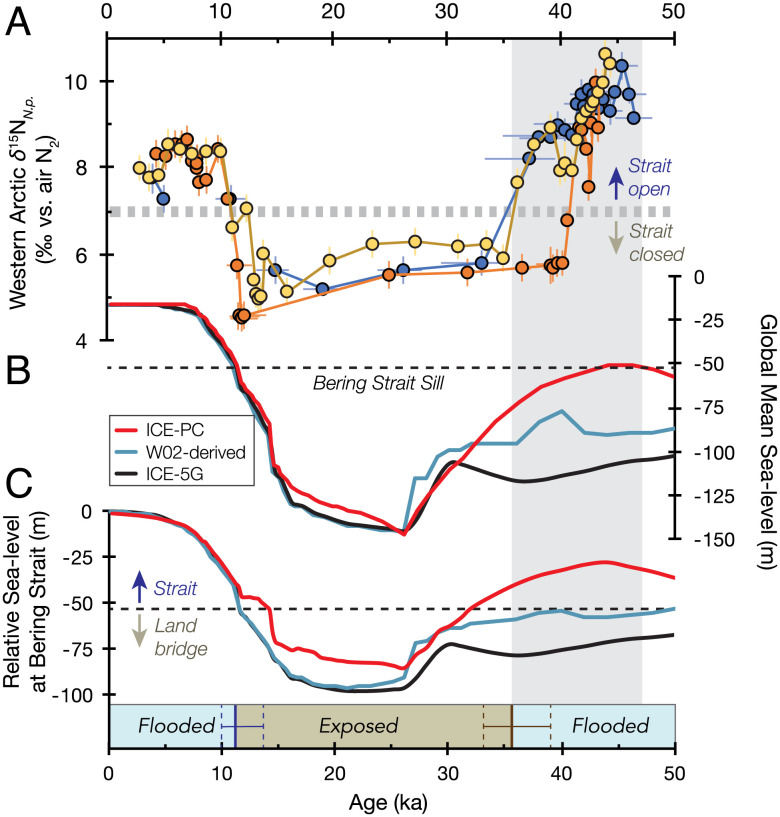
The cyclic growth and decay of continental ice sheets can be reconstructed from the history of global sea level. Sea level is relatively well constrained for the Last Glacial Maximum (LGM, 26,500 to 19,000 y ago, 26.5 to 19 ka) and the ensuing deglaciation. However, sea-level estimates for the period of ice-sheet growth before the LGM vary by > 60 m, an uncertainty comparable to the sea-level equivalent of the contemporary Antarctic Ice Sheet. Here, we constrain sea level prior to the LGM by reconstructing the flooding history of the shallow Bering Strait since 46 ka. Using a geochemical proxy of Pacific nutrient input to the Arctic Ocean, we find that the Bering Strait was flooded from the beginning of our records at 46 ka until 35.7 - 2.4 + 3.3 ka. To match this flooding history, our sea-level model requires an ice history in which over 50% of the LGM’s global peak ice volume grew after 46 ka. This finding implies that global ice volume and climate were not linearly coupled during the last ice age, with implications for the controls on each. Moreover, our results shorten the time window between the opening of the Bering Land Bridge and the arrival of humans in the Americas.
Overview
CoChat Summary
TL;DR
The Bering Strait was flooded from at least 46,000 until 35,700 y ago, so the Bering Land Bridge formed only after ~36 ka, within 10,000 y of the Last Glacial Maximum. This requires rapid ice growth into the LGM and implies humans migrated to the Americas as soon as the land bridge allowed passage.
Key findings
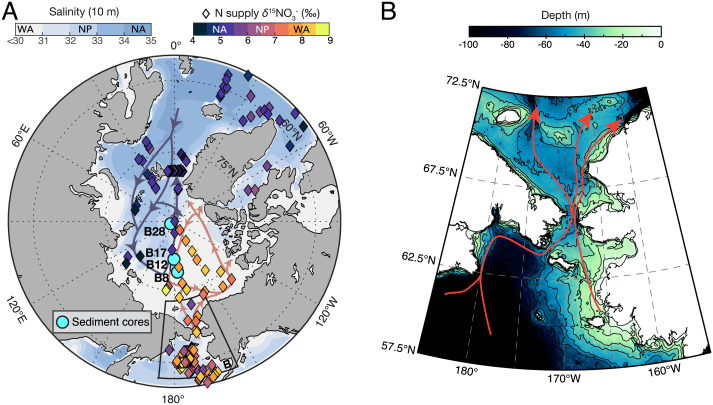
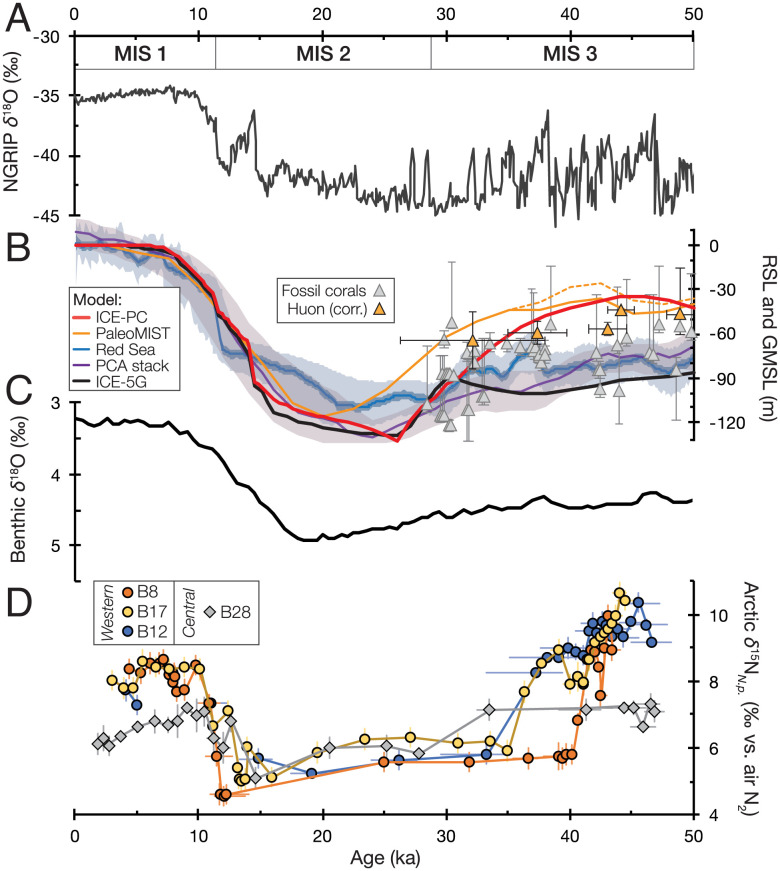
- Western Arctic foraminifera-bound δ15N (δ15NN.p.) was 8–10.5‰ before 35–40 ka, equal to or higher than Holocene values and 2–3.5‰ higher than the central Arctic; after ~36 ka it declined by ~3‰ to 4.5–6‰, interpreted as Bering Strait closure. The transition is assigned a median age of 35.7 −2.4/+3.3 ka.
- Glacial isostatic adjustment simulations with the ICE-PC intermediate Cordilleran Ice Sheet history give mid-MIS 3 relative sea level at the Bering Strait of −11 to −20 m (water depth 33–42 m), indicating flooding until after ~34 ka. A fully flooded MIS 3 Bering Strait requires MIS 3 ice volume <50% (and for ICE-PC, <30%) of MIS 2; canonical ICE-5G and W02-derived histories instead predict an exposed Bering Strait.
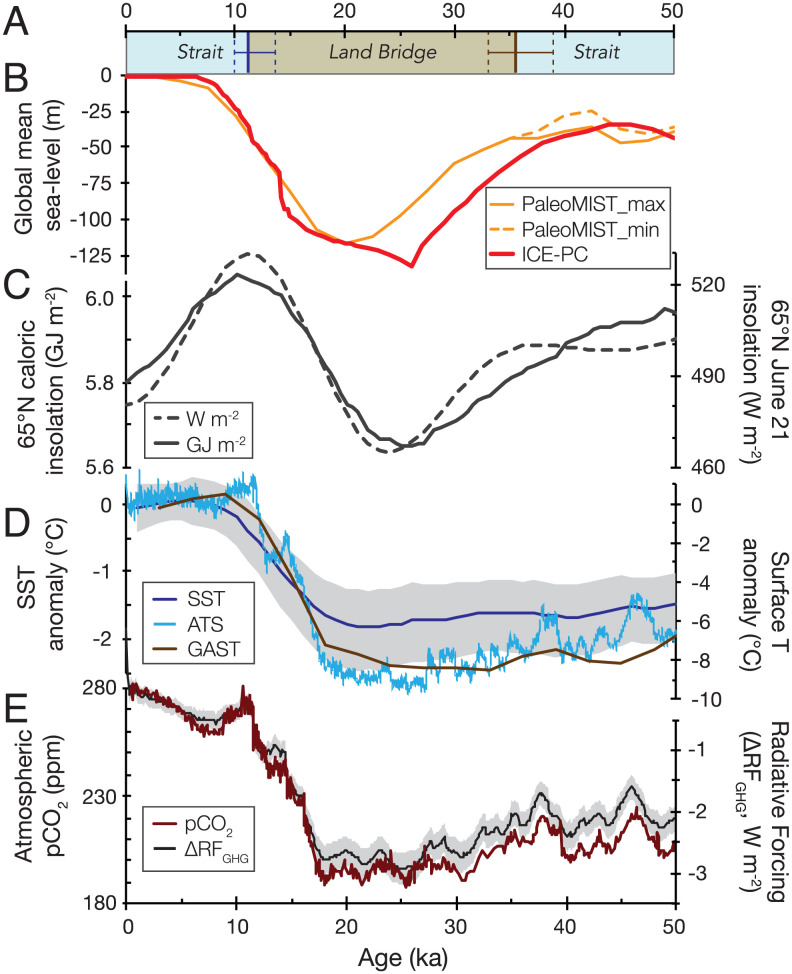
- Millennial-scale climate and ocean circulation variability occurred both when the Bering Strait was flooded (46–36 ka) and exposed (36–11.5 ka), so closure was not required for that variability. The reconstructed flooding history also suggests humans migrated into the Americas as soon as the Bering Land Bridge allowed passage.
Methods
- Three western Arctic sediment cores from Mendeleev Ridge—Site B8 (78.13°N, 176.74°W, 1,031 m), B12 (79.99°N, 174.29°W, 1,609 m), and B17 (81.27°N, 178.97°E, 2,217 m)—plus central Arctic control Site B28 from Lomonosov Ridge (88.87°N, 140.18°E, 1,990 m). Samples were taken every 1 cm; ~1,500 Neogloboquadrina pachyderma sinistral tests (5–7 mg) were picked from the 150–300 µm fraction for foraminifera-bound δ15N analysis. Analytical precision was <±0.30‰ (1sd), and full procedural replicate δ15NN.p. precision averaged ±0.22‰ (1sd, n = 42).
- Gravitationally self-consistent glacial isostatic adjustment/relative sea-level simulations used spherical harmonic truncation at degree and order 256, an Earth model with 48 km lithospheric thickness and upper/lower mantle viscosities of 0.5 × 10^21 and 5 × 10^21 Pa s, and three ice histories: ICE-5G, ICE-PC, and W02-derived. Three Cordilleran Ice Sheet geometries (small, intermediate, large) were tested.
Limitations
- The paper states age model uncertainties up to ±3 ka (95% CI), potential bioturbation effects at low sedimentation rates, poor field constraints on MIS 3 Cordilleran Ice Sheet extent, and the assumption that the modern Bering Strait sill depth (−53 m) has not substantially changed since 50 ka. It also states that current data do not distinguish among explanations for higher western Arctic δ15NN.p. between 40 and 46 ka than during the Holocene, and that limited archaeological records preclude identifying key factors controlling human migration.
- Evident from the text: radiocarbon dating limits the records to ~50 ka; the western Arctic reconstruction relies on three proximal cores within 360 km of one another plus one central Arctic control core; and the proxy interpretation depends on assumptions about nitrate sources, nitrate consumption, and coupled nitrification-denitrification.
Model-written summary. Check it against the paper before relying on it.
Integrity signals
Registry
Cites
Statistics
Figures
Verification
Claims the paper makes
0 Valid · 0 Not valid · 52 Not checked · 51 Own results and interpretations
A result the paper reports from its own data — it cites no other source for it, so there is none to check. The quote shows it is in the paper.
In the paper
“Results exhibit three distinct intervals separated by two rapid transitions.”
§ The Bering Strait was flooded 10,000 years before the Last Glacial Maximum > Abstract
plain- Asserted: passes — The authors put it forward as true.
- Checkable: passes — It can be checked against evidence.
- Load-bearing: passes — The paper’s conclusions depend on it.
- Based: passes — The paper gives a reason why it holds.
A result the paper reports from its own data — it cites no other source for it, so there is none to check. The quote shows it is in the paper.
In the paper
“Moreover, western Arctic δ15NN.p.values are 2 to 3.5‰ higher than those measured in the central Arctic before 35 to 40 ka (Fig. 2D).”
§ The Bering Strait was flooded 10,000 years before the Last Glacial Maximum > Abstract
plainstates an association- Asserted: passes — The authors put it forward as true.
- Checkable: passes — It can be checked against evidence.
- Load-bearing: passes — The paper’s conclusions depend on it.
- Based: passes — The paper gives a reason why it holds.
A result the paper reports from its own data — it cites no other source for it, so there is none to check. The quote shows it is in the paper.
In the paper
“Western and central Arctic δ15NN.p.values converge after 35 ka, with similar δ15NN.p. values (of 4.5 to 6‰) lasting in both regions until 11 ka.”
§ The Bering Strait was flooded 10,000 years before the Last Glacial Maximum > Abstract
plainstates an association- Asserted: passes — The authors put it forward as true.
- Checkable: passes — It can be checked against evidence.
- Load-bearing: passes — The paper’s conclusions depend on it.
- Based: passes — The paper gives a reason why it holds.
A result the paper reports from its own data — it cites no other source for it, so there is none to check. The quote shows it is in the paper.
In the paper
“Instead, all the three western Arctic sites show high δ15NN.p. values of 8 to 10.5‰ prior to 35 to 40 ka; these values are equivalent to or higher than Holocene δ15NN.p. at these locations.”
§ The Bering Strait was flooded 10,000 years before the Last Glacial Maximum > Abstract
plain- Asserted: passes — The authors put it forward as true.
- Checkable: passes — It can be checked against evidence.
- Load-bearing: passes — The paper’s conclusions depend on it.
- Based: passes — The paper gives a reason why it holds.
A result the paper reports from its own data — it cites no other source for it, so there is none to check. The quote shows it is in the paper.
In the paper
“It is noteworthy that western Arctic δ15NN.p. is higher between 40 and 46 ka than during the Holocene.”
§ The Bering Strait was flooded 10,000 years before the Last Glacial Maximum > Abstract
plainstates an association- Asserted: passes — The authors put it forward as true.
- Checkable: passes — It can be checked against evidence.
- Load-bearing: passes — The paper’s conclusions depend on it.
- Based: passes — The paper gives a reason why it holds.
57 more claims
Create a free account to see all 103 claims and to verify the 101 references still open.
- It may state two separate claims as one. 27
- Probably not a substantial claim. 21
Claims other papers make about this one
Each is checked against this paper’s own text: does it say what the citing paper says it does?
In the citing paper
“Effective moisture changes are also evident in the lithostratigraphy of a sediment-core transect taken at Burial Lake, where relatively high lake levels at ca. 37, 000 cal yr BP were followed by a major lowering of lake level between ca.32,000 and 26,000 cal yr BP (Finkenbinder et al., 2015), shortly after the establishment of the Bering Land Bridge ca.35,000 cal yr BP (Farmer et al., 2023).”
From Late Quaternary environmental change in eastern Beringia (2025) · cites this paper as Farmer et al., 2023
In the citing paper
“Changes in these controls coincided with falling sea levels, which exposed greater areas of the Bering Land Bridge (established ca.35,000 cal yr BP; Farmer et al., 2023), and advances in the Laurentide ice sheet (Mann and Gaglioti, 2024).”
From Late Quaternary environmental change in eastern Beringia (2025) · cites this paper as Farmer et al., 2023
Self-check
Percentages, sums and reported differences re-computed from the paper’s own numbers.
Each contradiction between two passages listed here was confirmed by an independent check.
Rated minor: it would not touch a result — a value no result rests on, a p-value that stays on the same side of the significance level, or a conflict that is clerical, resolved elsewhere in the paper, or outside its own findings.
In the paper
§ The Bering Strait was flooded 10,000 years before the Last Glacial Maximum > Materials and Methods
“the deglacial ice sheet history is identical to the ICE-5G deglacial history (26 ka to 0 ka, ref. 15)”
§ The Bering Strait was flooded 10,000 years before the Last Glacial Maximum > Materials and Methods
“The ICE-5G ice history is from ref. (19).”
Rated minor: it would not touch a result — a value no result rests on, a p-value that stays on the same side of the significance level, or a conflict that is clerical, resolved elsewhere in the paper, or outside its own findings.
In the paper
§ The Bering Strait was flooded 10,000 years before the Last Glacial Maximum > Abstract
“a stacked sea-level equivalent oxygen isotope record (21) (blue line, Fig. 2B)”
§ The Bering Strait was flooded 10,000 years before the Last Glacial Maximum > Abstract
“stacked oxygen isotope-based sea-level reconstructions (21) (purple with purple shading)”
Rated minor: it would not touch a result — a value no result rests on, a p-value that stays on the same side of the significance level, or a conflict that is clerical, resolved elsewhere in the paper, or outside its own findings.
In the paper
§ The Bering Strait was flooded 10,000 years before the Last Glacial Maximum > Abstract
“ice margin constraints (24) (gray line, Fig. 2B)”
§ The Bering Strait was flooded 10,000 years before the Last Glacial Maximum > Abstract
“PaleoMIST (24) (orange, dashed line is minimal MIS 3 GMSL scenario)”
Citations
Cites
Clark, P. U., Dyke, A. S., Shakun, J. D., Carlson, A. E., Clark, J., Wohlfarth, B., Mitrovica, J. X., Hostetler, S. W., & McCabe, A. M. (2009) · Science · doi:10.1126/science.1172873 · Cited by 3,277
High-resolution record of Northern Hemisphere climate extending into the last interglacial period
North Greenland Ice Core Project members (2004) · Nature · doi:10.1038/nature02805 · Cited by 3,170
Sea level and global ice volumes from the Last Glacial Maximum to the Holocene
Lambeck, K., Rouby, H., Purcell, A., Sun, Y., & Sambridge, M. (2014) · Proceedings of the National Academy of Sciences · doi:10.1073/pnas.1411762111 · Cited by 2,922 · cited 1×
“3B), consistent with previous findings (23, 45).”
Sea-level and deep water temperature changes derived from benthic foraminifera isotopic records
Waelbroeck, C., Labeyrie, L., Michel, E., Duplessy, J. C., McManus, J. F., Lambeck, K., Balbon, E., & Labracherie, M. (2002) · Quaternary Science Reviews · doi:10.1016/s0277-3791(01)00101-9 · Cited by 2,213
Bedmap2: improved ice bed, surface and thickness datasets for Antarctica
Fretwell, P., Pritchard, H. D., Vaughan, D. G., Bamber, J. L., Barrand, N. E., Bell, R., Bianchi, C., Bingham, R. G., Blankenship, D. D., Casassa, G., et al. (2013) · The Cryosphere · doi:10.5194/tc-7-375-2013 · Cited by 2,085
A Bacterial Method for the Nitrogen Isotopic Analysis of Nitrate in Seawater and Freshwater
Sigman, D. M., Casciotti, K. L., Andreani, M., Barford, C., Galanter, M., & Böhlke, J. K. (2001) · Analytical Chemistry · doi:10.1021/ac010088e · Cited by 1,956
Self-citationCasciotti, K. L., Sigman, D. M., Hastings, M. G., Böhlke, J. K., & Hilkert, A. (2002) · Analytical Chemistry · doi:10.1021/ac020113w · Cited by 1,595
Self-citationSpace geodesy constrains ice age terminal deglaciation: The global ICE‐6G_C (VM5a) model
Peltier, W. R., Argus, D. F., & Drummond, R. (2015) · Journal of Geophysical Research: Solid Earth · doi:10.1002/2014jb011176 · Cited by 1,470
Peltier, W. R., & Fairbanks, R. G. (2006) · Quaternary Science Reviews · doi:10.1016/j.quascirev.2006.04.010 · Cited by 1,012
A Late Pleistocene sea level stack
Spratt, R. M., & Lisiecki, L. E. (2016) · Climate of the Past · doi:10.5194/cp-12-1079-2016 · Cited by 844
Sedimentary nitrogen isotopic ratio as a recorder for surface ocean nitrate utilization
Altabet, M. A., & Francois, R. (1994) · Global Biogeochemical Cycles · doi:10.1029/93gb03396 · Cited by 792 · cited 1×
“…δ 15 N (such as δ 15 N N.p. ) reflects the δ 15 N of organic matter produced in surface waters (8, 37), which depends on the δ 15 N of the subsurface nitrate supply and the degree of nitrate consumption, that is, the summertime drawdown of nitrate as a proportion of annual nitrate supply (38).”
BackgroundRapid coupling between ice volume and polar temperature over the past 150,000 years
Grant, K. M., Rohling, E. J., Bar-Matthews, M., Ayalon, A., Medina-Elizalde, M., Ramsey, C. B., Satow, C., & Roberts, A. P. (2012) · Nature · doi:10.1038/nature11593 · Cited by 626
The configuration of Northern Hemisphere ice sheets through the Quaternary
Batchelor, C. L., Margold, M., Krapp, M., Murton, D. K., Dalton, A. S., Gibbard, P. L., Stokes, C. R., Murton, J. B., & Manica, A. (2019) · Nature Communications · doi:10.1038/s41467-019-11601-2 · Cited by 484
Woodgate, R. A. (2018) · Progress in Oceanography · doi:10.1016/j.pocean.2017.12.007 · Cited by 482
A new global interior ocean mapped climatology: the 1° × 1° GLODAP version 2
Lauvset, S. K., Key, R. M., Olsen, A., van Heuven, S., Velo, A., Lin, X., Schirnick, C., Kozyr, A., Tanhua, T., Hoppema, M., et al. (2016) · Earth System Science Data · doi:10.5194/essd-8-325-2016 · Cited by 473
Kendall, R. A., Mitrovica, J. X., & Milne, G. A. (2005) · Geophysical Journal International · doi:10.1111/j.1365-246x.2005.02553.x · Cited by 461
Knapp, A. N., Sigman, D. M., & Lipschultz, F. (2005) · Global Biogeochemical Cycles · doi:10.1029/2004gb002320 · Cited by 419
Self-citationThe population history of northeastern Siberia since the Pleistocene
Sikora, M., Pitulko, V. V., Sousa, V. C., Allentoft, M. E., Vinner, L., Rasmussen, S., Margaryan, A., de Barros Damgaard, P., de la Fuente, C., Renaud, G., et al. (2019) · Nature · doi:10.1038/s41586-019-1279-z · Cited by 389
Monnin, E., Steig, E. J., Siegenthaler, U., Kawamura, K., Schwander, J., Stauffer, B., Stocker, T. F., Morse, D. L., Barnola, J.-M., Bellier, B., et al. (2004) · Earth and Planetary Science Letters · doi:10.1016/j.epsl.2004.05.007 · Cited by 372
Synchronous Change of Atmospheric CO 2 and Antarctic Temperature During the Last Deglacial Warming
Parrenin, F., Masson-Delmotte, V., Köhler, P., Raynaud, D., Paillard, D., Schwander, J., Barbante, C., Landais, A., Wegner, A., & Jouzel, J. (2013) · Science · doi:10.1126/science.1226368 · Cited by 367
Technical Updates to the Bacterial Method for Nitrate Isotopic Analyses
McIlvin, M. R., & Casciotti, K. L. (2011) · Analytical Chemistry · doi:10.1021/ac1028984 · Cited by 348
Evolution of global temperature over the past two million years
Snyder, C. W. (2016) · Nature · doi:10.1038/nature19798 · Cited by 343
Köhler, P., Nehrbass-Ahles, C., Schmitt, J., Stocker, T. F., & Fischer, H. (2017) · Earth System Science Data · doi:10.5194/essd-9-363-2017 · Cited by 319 · cited 1×
“(E) Atmospheric CO2 concentration (54, 55) (dark red) and cumulative greenhouse gas (CO2, CH4, and N2O) radiative forcing (56) (∆RFGHG; black, shading is ±1sd).”
BackgroundTerminal Pleistocene Alaskan genome reveals first founding population of Native Americans
Moreno-Mayar, J. V., Potter, B. A., Vinner, L., Steinrücken, M., Rasmussen, S., Terhorst, J., Kamm, J. A., Albrechtsen, A., Malaspinas, A.-S., Sikora, M., et al. (2018) · Nature · doi:10.1038/nature25173 · Cited by 316
Updates to instrumentation and protocols for isotopic analysis of nitrate by the denitrifier method
Weigand, M. A., Foriel, J., Barnett, B., Oleynik, S., & Sigman, D. M. (2016) · Rapid Communications in Mass Spectrometry · doi:10.1002/rcm.7570 · Cited by 270
Self-citationParticulate organic carbon and nitrogen export from major Arctic rivers
McClelland, J. W., Holmes, R. M., Peterson, B. J., Raymond, P. A., Striegl, R. G., Zhulidov, A. V., Zimov, S. A., Zimov, N., Tank, S. E., Spencer, R. G. M., et al. (2016) · Global Biogeochemical Cycles · doi:10.1002/2015gb005351 · Cited by 265
Orbital tuning chronology for the Vostok climate record supported by trapped gas composition
Bender, M. L. (2002) · Earth and Planetary Science Letters · doi:10.1016/s0012-821x(02)00980-9 · Cited by 258
Regional and global benthic δ18O stacks for the last glacial cycle: Last Glacial Cycle Benthic δ18O
Lisiecki, L. E., & Stern, J. V. (2016) · Paleoceanography · doi:10.1002/2016pa003002 · Cited by 246
Evidence of humans in North America during the Last Glacial Maximum
Bennett, M. R., Bustos, D., Pigati, J. S., Springer, K. B., Urban, T. M., Holliday, V. T., Reynolds, S. C., Budka, M., Honke, J. S., Hudson, A. M., et al. (2021) · Science · doi:10.1126/science.abg7586 · Cited by 239
An 800-kyr record of global surface ocean δ18O and implications for ice volume-temperature coupling
Shakun, J. D., Lea, D. W., Lisiecki, L. E., & Raymo, M. E. (2015) · Earth and Planetary Science Letters · doi:10.1016/j.epsl.2015.05.042 · Cited by 239
A new global ice sheet reconstruction for the past 80 000 years
Gowan, E. J., Zhang, X., Khosravi, S., Rovere, A., Stocchi, P., Hughes, A. L. C., Gyllencreutz, R., Mangerud, J., Svendsen, J.-I., & Lohmann, G. (2021) · Nature Communications · doi:10.1038/s41467-021-21469-w · Cited by 237
The rotational stability of an ice-age earth
Mitrovica, J. X., Wahr, J., Matsuyama, I., & Paulson, A. (2005) · Geophysical Journal International · doi:10.1111/j.1365-246x.2005.02609.x · Cited by 214
On the reconstruction of palaeo-ice sheets: Recent advances and future challenges
Stokes, C. R., Tarasov, L., Blomdin, R., Cronin, T. M., Fisher, T. G., Gyllencreutz, R., Hättestrand, C., Heyman, J., Hindmarsh, R. C. A., Hughes, A. L. C., et al. (2015) · Quaternary Science Reviews · doi:10.1016/j.quascirev.2015.07.016 · Cited by 203
Self-citationCoral indicators of past sea-level change: A global repository of U-series dated benchmarks
Hibbert, F. D., Rohling, E. J., Dutton, A., Williams, F. H., Chutcharavan, P. M., Zhao, C., & Tamisiea, M. E. (2016) · Quaternary Science Reviews · doi:10.1016/j.quascirev.2016.04.019 · Cited by 202
Foraminiferal Isotope Evidence of Reduced Nitrogen Fixation in the Ice Age Atlantic Ocean
Ren, H., Sigman, D. M., Meckler, A. N., Plessen, B., Robinson, R. S., Rosenthal, Y., & Haug, G. H. (2009) · Science · doi:10.1126/science.1165787 · Cited by 195
Self-citationA simple rule to determine which insolation cycles lead to interglacials
Tzedakis, P. C., Crucifix, M., Mitsui, T., & Wolff, E. W. (2017) · Nature · doi:10.1038/nature21364 · Cited by 183
Danielson, S. L., Weingartner, T. J., Hedstrom, K. S., Aagaard, K., Woodgate, R., Curchitser, E., & Stabeno, P. J. (2014) · Progress in Oceanography · doi:10.1016/j.pocean.2014.04.006 · Cited by 182
The effect of spatially non-uniform water loads on prediction of sea-level change
Johnston, P. (1993) · Geophysical Journal International · doi:10.1111/j.1365-246x.1993.tb06992.x · Cited by 178
Water-load definition in the glacio-hydro-isostatic sea-level equation
Lambeck, K., Purcell, A., Johnston, P., Nakada, M., & Yokoyama, Y. (2003) · Quaternary Science Reviews · doi:10.1016/s0277-3791(02)00142-7 · Cited by 166
Jakobsson, M., Pearce, C., Cronin, T. M., Backman, J., Anderson, L. G., Barrientos, N., Björk, G., Coxall, H., de Boer, A., Mayer, L. A., et al. (2017) · Climate of the Past · doi:10.5194/cp-13-991-2017 · Cited by 163
Self-citationAbrupt changes in the global carbon cycle during the last glacial period
Bauska, T., Marcott, S. A., & Brook, E. J. (2021) · Nature Geoscience · doi:10.1038/s41561-020-00680-2 · Cited by 163
Early human presence in the Arctic: Evidence from 45,000-year-old mammoth remains
Pitulko, V. V., Tikhonov, A. N., Pavlova, E. Y., Nikolskiy, P. A., Kuper, K. E., & Polozov, R. N. (2016) · Science · doi:10.1126/science.aad0554 · Cited by 155
Milne, G. A., & Mitrovica, J. X. (1996) · Geophysical Journal International · doi:10.1111/j.1365-246x.1996.tb04691.x · Cited by 152
Near-field hydro-isostasy: the implementation of a revised sea-level equation
Milne, G. A., Mitrovica, J. X., & Davis, J. L. (1999) · Geophysical Journal International · doi:10.1046/j.1365-246x.1999.00971.x · Cited by 141
Hopkins, D. M. (1959) · Science · doi:10.1126/science.129.3362.1519 · Cited by 137
Granger, J., Prokopenko, M. G., Sigman, D. M., Mordy, C. W., Morse, Z. M., Morales, L. V., Sambrotto, R. N., & Plessen, B. (2011) · Journal of Geophysical Research: Oceans · doi:10.1029/2010jc006751 · Cited by 134
Self-citationPan-Arctic Ocean Primary Production Constrained by Turbulent Nitrate Fluxes
Randelhoff, A., Holding, J., Janout, M., Sejr, M. K., Babin, M., Tremblay, J.-É., & Alkire, M. B. (2020) · Frontiers in Marine Science · doi:10.3389/fmars.2020.00150 · Cited by 134
Brunelle, B. G., Sigman, D. M., Cook, M. S., Keigwin, L. D., Haug, G. H., Plessen, B., Schettler, G., & Jaccard, S. L. (2007) · Paleoceanography · doi:10.1029/2005pa001205 · Cited by 133
Self-citationNitrogen balance and Arctic throughflow
Yamamoto-Kawai, M., Carmack, E., & McLaughlin, F. (2006) · Nature · doi:10.1038/443043a · Cited by 131
The Canada Basin, 1989–1995: Upstream events and far‐field effects of the Barents Sea
McLaughlin, F. A., Carmack, E. C., Macdonald, R. W., Weaver, A. J., & Smith, J. N. (2002) · Journal of Geophysical Research Atmospheres · doi:10.1029/2001jc000904 · Cited by 114
Sea Level History in Beringia During the Past 250,000 Years
Hopkins, D. M. (1973) · Quaternary Research · doi:10.1016/0033-5894(73)90029-x · Cited by 112
Jahn, A., & Holland, M. M. (2013) · Geophysical Research Letters · doi:10.1002/grl.50183 · Cited by 98
Was the Laurentide Ice Sheet significantly reduced during Marine Isotope Stage 3?
Dalton, A. S., Finkelstein, S. A., Forman, S. L., Barnett, P. J., Pico, T., & Mitrovica, J. X. (2019) · Geology · doi:10.1130/g45335.1 · Cited by 98
Self-citationChanges in North Atlantic nitrogen fixation controlled by ocean circulation
Straub, M., Sigman, D. M., Ren, H., Martínez-García, A., Meckler, A. N., Hain, M. P., & Haug, G. H. (2013) · Nature · doi:10.1038/nature12397 · Cited by 96
Self-citationPico, T., Creveling, J. R., & Mitrovica, J. X. (2017) · Nature Communications · doi:10.1038/ncomms15612 · Cited by 95
Self-citationHu, A., Meehl, G. A., Han, W., Timmermann, A., Otto-Bliesner, B., Liu, Z., Washington, W. M., Large, W., Abe-Ouchi, A., Kimoto, M., et al. (2012) · Proceedings of the National Academy of Sciences · doi:10.1073/pnas.1116014109 · Cited by 93
Nitrogen isotopic composition of planktonic foraminifera from the modern ocean and recent sediments
Ren, H., Sigman, D. M., Thunell, R. C., & Prokopenko, M. G. (2012) · Limnology and Oceanography · doi:10.4319/lo.2012.57.4.1011 · Cited by 92
Self-citationLehmann, M. F., Sigman, D. M., McCorkle, D. C., Brunelle, B. G., Hoffmann, S., Kienast, M., Cane, G., & Clement, J. (2005) · Global Biogeochemical Cycles · doi:10.1029/2005gb002508 · Cited by 87
Self-citationSuwa, M., & Bender, M. L. (2008) · Quaternary Science Reviews · doi:10.1016/j.quascirev.2008.02.017 · Cited by 82
Pico, T., Mitrovica, J. X., Ferrier, K. L., & Braun, J. (2016) · Quaternary Science Reviews · doi:10.1016/j.quascirev.2016.09.012 · Cited by 82
Self-citationThe Bering Strait's grip on the northern hemisphere climate
De Boer, A. M., & Nof, D. (2004) · Deep Sea Research Part I: Oceanographic Research Papers · doi:10.1016/j.dsr.2004.05.003 · Cited by 73
Aspects of the marine nitrogen cycle of the Chukchi Sea shelf and Canada Basin
Brown, Z. W., Casciotti, K. L., Pickart, R. S., Swift, J. H., & Arrigo, K. R. (2015) · Deep Sea Research Part II: Topical Studies in Oceanography · doi:10.1016/j.dsr2.2015.02.009 · Cited by 73
Pico, T., Mitrovica, J. X., & Mix, A. C. (2020) · Science Advances · doi:10.1126/sciadv.aay2935 · Cited by 66
Self-citationNumerical simulations of the Cordilleran ice sheet through the last glacial cycle
Seguinot, J., Rogozhina, I., Stroeven, A. P., Margold, M., & Kleman, J. (2016) · The Cryosphere · doi:10.5194/tc-10-639-2016 · Cited by 61
Arctic Ocean stratification set by sea level and freshwater inputs since the last ice age
Farmer, J. R., Sigman, D. M., Granger, J., Underwood, O. M., Fripiat, F., Cronin, T. M., Martínez-García, A., & Haug, G. H. (2021) · Nature Geoscience · doi:10.1038/s41561-021-00789-y · Cited by 57
Self-citationGranger, J., Sigman, D. M., Gagnon, J., Tremblay, J., & Mucci, A. (2018) · Journal of Geophysical Research: Oceans · doi:10.1029/2018jc014110 · Cited by 55
Self-citationFripiat, F., Declercq, M., Sapart, C. J., Anderson, L. G., Bruechert, V., Deman, F., Fonseca‐Batista, D., Humborg, C., Roukaerts, A., Semiletov, I. P., et al. (2018) · Limnology and Oceanography · doi:10.1002/lno.10930 · Cited by 36
Self-citationNitrogen dynamic in Eurasian coastal Arctic ecosystem: Insight from nitrogen isotope
Thibodeau, B., Bauch, D., & Voss, M. (2017) · Global Biogeochemical Cycles · doi:10.1002/2016gb005593 · Cited by 34
High interstadial sea levels over the past 420ka from the Huon Peninsula, Papua New Guinea
de Gelder, G., Husson, L., Pastier, A.-M., Fernández-Blanco, D., Pico, T., Chauveau, D., Authemayou, C., & Pedoja, K. (2022) · Communications Earth & Environment · doi:10.1038/s43247-022-00583-7 · Cited by 33
Self-citationDanielson, S., Dobbins, E., Jakobsson, M., Johnson, M., Weingartner, T., Williams, W., & Zarayskaya, Y. (2015) · Eos · doi:10.1029/2015eo040975 · Cited by 22
Pico, T., Robel, A., Powell, E., Mix, A. C., & Mitrovica, J. X. (2019) · Geophysical Research Letters · doi:10.1029/2019gl084789 · Cited by 7
Self-citationLiautaud, P., & Huybers, P. (2021) · Journal of Climate · doi:10.1175/jcli-d-21-0192.1 · Cited by 2
Cited by
Analytical improvements and assessment of long‐term performance of the oxidation–denitrifier method
Moretti, S., Duprey, N., Foreman, A., Arns, A. I., Brömme, S., Jung, J., Ai, X. E., Auderset, A., Bieler, A. L., Eck, C., et al. (2023) · Rapid Communications in Mass Spectrometry · doi:10.1002/rcm.9650 · Cited by 20
Self-citationNorth Pacific Perspectives On The Arctic: Looking Far North in Turbulent Times
Young, O. R., & Kim, J. D. (2024) · Edward Elgar Publishing eBooks · doi:10.4337/9781035344956 · Cited by 19
The Coupled Ice Sheet–Earth System Model Bern3D v3.0
Pöppelmeier, F., Joos, F., & Stocker, T. F. (2023) · Journal of Climate · doi:10.1175/jcli-d-23-0104.1 · Cited by 18
Glacial erosion and Quaternary landscape development of the Eurasian Arctic
Patton, H., Alexandropoulou, N., Lasabuda, A., Knies, J. M., Andreassen, K., Winsborrow, M., Laberg, J. S., & Hubbard, A. (2024) · Earth-Science Reviews · doi:10.1016/j.earscirev.2024.104936 · Cited by 18
Mann, D. H., & Gaglioti, B. V. (2024) · Earth-Science Reviews · doi:10.1016/j.earscirev.2024.104782 · Cited by 17
Metadata
- Authors
- Farmer, J. R., Pico, T., Underwood, O. M., Cleveland Stout, R., Granger, J., Cronin, T. M., Fripiat, F., Martínez-García, A., Haug, G. H., & Sigman, D. M.
- Affiliations
- Princeton University (US)
- University of California, Santa Cruz (US)
- Department of Earth and Planetary Sciences, Harvard University, Cambridge, MA 02138
- University of Connecticut (US)
- United States Geological Survey (US)
- Université Libre de Bruxelles (BE)
- Max Planck Institute for Chemistry, Mainz 55128, Germany
- University of Washington (US)
- Corresponding author
- Farmer, Jesse R.
- Pico, Tamara
- ORCID
- Venue
- Proceedings of the National Academy of Sciences
- Publisher
- National Academy of Sciences
- Published
- 2022-12-27
- Volume
- 120
- Issue
- 1
- Pages
- e2206742119-e2206742119
- ISSN
- 0027-8424 (ISSN-L)
- 1091-6490
- PMC
- PMC9910591
- OpenAlex
- W4313251910
- Semantic Scholar
- 8036e4048cb04b2c3caa105807c221075bc3f557
- Cited by
- 69
- References
- 72
- Citations by year
- 2026: 16 · 2025: 25 · 2024: 19 · 2023: 9
- FWCI
- 4.32
- Type
- journal article
- Language
- en
- Update notices
- correction (2023-02-06)
- Open access
- hybrid
- doi.org
- Licence
- Locations
- Proceedings of the National Academy of Sciences (publishedVersion, cc-by-nc-nd)
- PubMed Central (publishedVersion, cc-by-nc-nd)
- PubMed (publishedVersion)
- Repository for Publications and Research Data (ETH Zurich) (publishedVersion, cc-by-nc-nd)
- Dépôt institutionnel de l'Université libre de Bruxelles (Université Libre de Bruxelles) (submittedVersion, other-oa)
- ETH Zürich Research Collection
- Funders
- National Science Foundation (OCE-2054780, OCE-2054757)
- DOI | U.S. Geological Survey (Climate Research and Development Program)
- Max-Planck-Institut für Chemie (n/a)
- Topics
- Physical Sciences › Earth and Planetary Sciences › Atmospheric Science › Geology and Paleoclimatology Research
- Physical Sciences › Earth and Planetary Sciences › Oceanography › Marine and environmental studies
- Physical Sciences › Earth and Planetary Sciences › Earth-Surface Processes › Geological formations and processes
- Keywords
- Last Glacial Maximum, global sea level, ice sheet growth, deglaciation, Bering Land Bridge, Arctic Ocean, ice volume, Pleistocene
- MeSH terms
- Antarctic Regions, Arctic Regions, Climate, Humans, Ice Cover
About these checks
Registry, retraction, Cites and statistics results are computed, not judged, with one exception: a printed reference that no index lists is read once by a model before it counts as a citation error. Claims are extracted by a model and kept only when their quote appears verbatim in the text; each cited source is then checked, with a model’s help, for whether it says what the claim relies on. Those verdicts can be wrong — read the claim’s quote and the cited source before relying on one.
A language model drew the claims from the paper on 2026-11-24, under version 3 of the claim definition (model deepseek-v4.1-flash, prompt extract-v3).
A second model labelled each claim on 2026-11-24 (model jev-1.13-20260917, definition revision gold-guideline-v0.2).
Statistics and arithmetic are recomputed, not judged.
Confidence bands are shown only for fields calibrated on our annotated test set. None is calibrated yet, so no band is shown.
What counts as a claim ›How we measure confidence ›How we check this ›
Are you an author, or do you see a problem with this page? Request a review
Data sources
Bibliographic data: Semantic Scholar, OpenAlex, Crossref.
Contains information from the Semantic Scholar Academic Graph Datasets, made available under the ODC Attribution License (ODC-BY 1.0).
Semantic Scholar’s data is described in: Kinney, R., et al. (2023). The Semantic Scholar Open Data Platform. arXiv:2301.10140.
