

Aqueous microdroplets enable abiotic synthesis and chain extension of unique peptide isomers from free amino acids
Open accessThe DOI matches its Crossref record; 100 of the 101 references it cites were found in a registry or an index.
Abstract
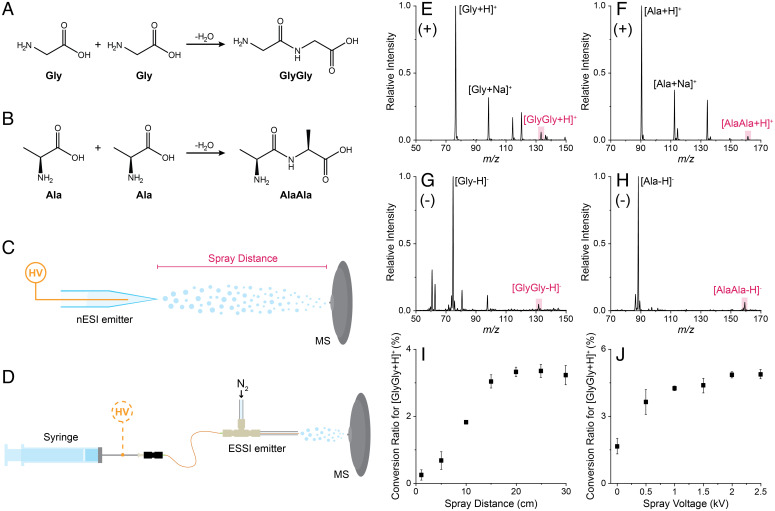
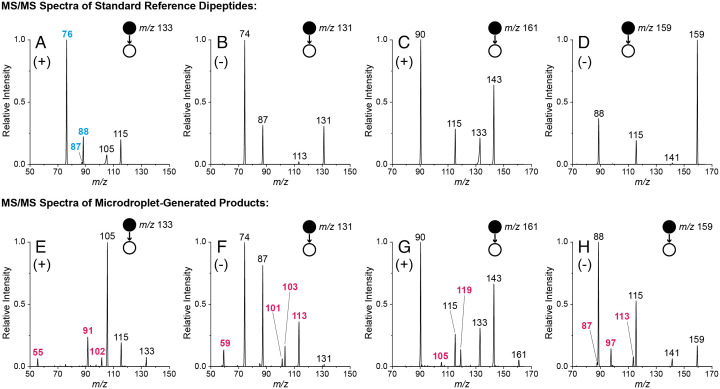
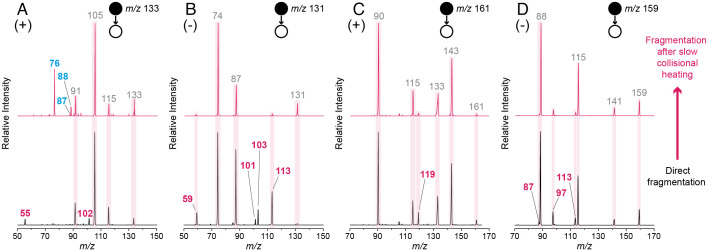
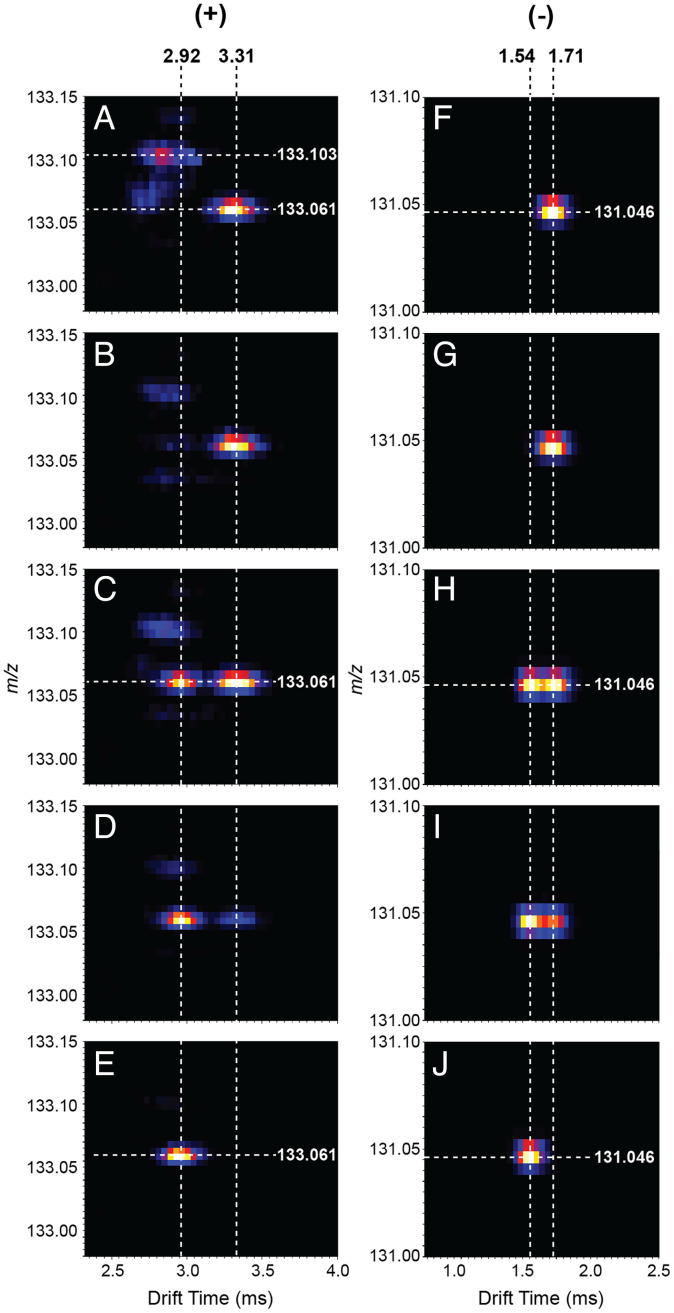
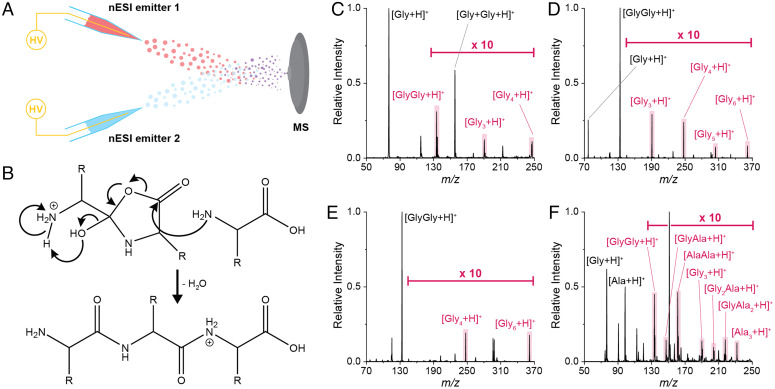
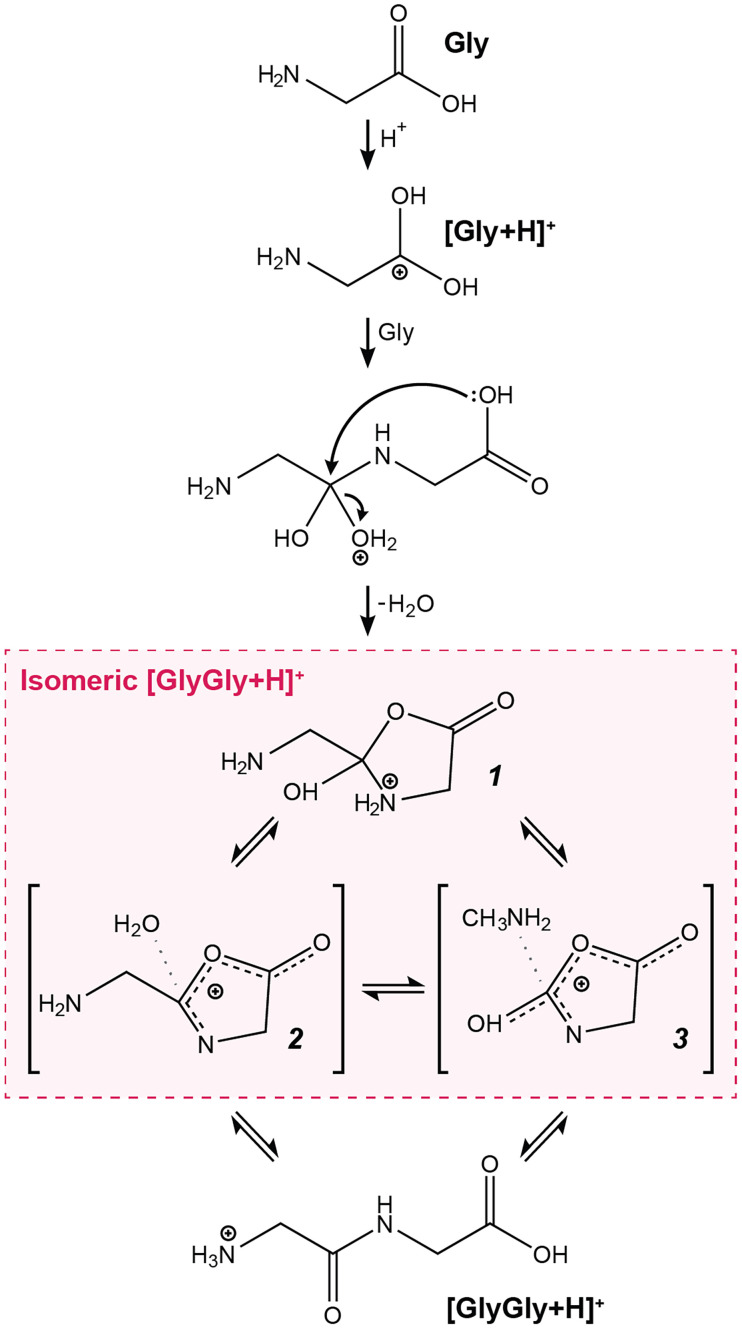
Amide bond formation, the essential condensation reaction underlying peptide synthesis, is hindered in aqueous systems by the thermodynamic constraints associated with dehydration. This represents a key difficulty for the widely held view that prebiotic chemical evolution leading to the formation of the first biomolecules occurred in an oceanic environment. Recent evidence for the acceleration of chemical reactions at droplet interfaces led us to explore aqueous amino acid droplet chemistry. We report the formation of dipeptide isomer ions from free glycine or L-alanine at the air–water interface of aqueous microdroplets emanating from a single spray source (with or without applied potential) during their flight toward the inlet of a mass spectrometer. The proposed isomeric dipeptide ion is an oxazolidinone that takes fully covalent and ion-neutral complex forms. This structure is consistent with observed fragmentation patterns and its conversion to authentic dipeptide ions upon gentle collisions and for its formation from authentic dipeptides at ultra-low concentrations. It also rationalizes the results of droplet fusion experiments that show that the dipeptide isomer facilitates additional amide bond formation events, yielding authentic tri- through hexapeptides. We propose that the interface of aqueous microdroplets serves as a drying surface that shifts the equilibrium between free amino acids in favor of dehydration via stabilization of the dipeptide isomers. These findings offer a possible solution to the water paradox of biopolymer synthesis in prebiotic chemistry.
Overview
The claims and statistics of this paper haven’t been checked yet.
Free: it reads the open-access text and checks the first 5 claims that cite a source we can check. Create a free account to check every claim.
Integrity signals
Registry
Cites
Statistics
Figures
Verification
Claims the paper makes
The claims and statistics of this paper haven’t been checked yet.
Free: it reads the open-access text and checks the first 5 claims that cite a source we can check. Create a free account to check every claim.
Claims other papers make about this one
Each is checked against this paper’s own text: does it say what the citing paper says it does?
The cited source says what the claim attributes to it.
In the citing paper
“This result implies that the previous findings on oxazolidinone chemistry (31), including dipeptide and higher-order peptide formation, extend also to the synthesized oxazolone intermediate.”
From Oxazolone mediated peptide chain extension and homochirality in aqueous microdroplets (2024) · cites this paper as [31]
The cited source says what the claim attributes to it.
In the citing paper
“It’s notable that under these conditions, the dipeptides 8a and 8b rather than their oxazolidinone isomers were produced and compared to the previous study (31); no external collisional heating was required to form the peptides.”
From Oxazolone mediated peptide chain extension and homochirality in aqueous microdroplets (2024) · cites this paper as [31]
Self-check
Percentages, sums and reported differences re-computed from the paper’s own numbers.
The self-check needs the paper’s full text.
Citations
Cites
HMDB 5.0: the Human Metabolome Database for 2022
Wishart, D. S., Guo, A., Oler, E., Wang, F., Anjum, A., Peters, H., Dizon, R., Sayeeda, Z., Tian, S., Lee, B. L., et al. (2022) · Nucleic Acids Research · doi:10.1093/nar/gkab1062 · Cited by 2,519 · cited 1×
“Similarly, protonated authentic AlaAla fragmented as expected (73) (Fig.”
Spontaneous Generation of Hydrogen Peroxide from Aqueous Microdroplets
Lee, J. K., Walker, K. L., Han, H. S., Kang, J., Prinz, F. B., Waymouth, R. M., Nam, H. G., & Zare, R. N. (2019) · Proceedings of the National Academy of Sciences · doi:10.1073/pnas.1911883116 · Cited by 717
Accelerated Reaction Kinetics in Microdroplets: Overview and Recent Developments
Wei, Z., Li, Y., Cooks, R. G., & Yan, X. (2020) · Annual Review of Physical Chemistry · doi:10.1146/annurev-physchem-121319-110654 · Cited by 631
Self-citationPolypeptides and 100 Years of Chemistry of α‐Amino Acid N‐Carboxyanhydrides
Kricheldorf, H. R. (2006) · Angewandte Chemie International Edition · doi:10.1002/anie.200600693 · Cited by 628
Organic Reactions in Microdroplets: Reaction Acceleration Revealed by Mass Spectrometry
Yan, X., Bain, R. M., & Cooks, R. G. (2016) · Angewandte Chemie International Edition · doi:10.1002/anie.201602270 · Cited by 583
Self-citationStrong Electric Field Observed at the Interface of Aqueous Microdroplets
Xiong, H., Lee, J. K., Zare, R. N., & Min, W. (2020) · The Journal of Physical Chemistry Letters · doi:10.1021/acs.jpclett.0c02061 · Cited by 485 · cited 1×
“We suggest that the compact cyclic structures are favored at the air–water interface where compounds with larger dipole moments can be stabilized through alignment with the high surface electric field (79, 88), another factor that favors the oxazolidinone ions (SI Appendix, Table S5 and Fig.”
BackgroundThe Hot Spring Hypothesis for an Origin of Life
Damer, B., & Deamer, D. (2020) · Astrobiology · doi:10.1089/ast.2019.2045 · Cited by 478 · cited 1×
“A suite of geochemical scenarios has been proposed to address the entropic difficulties associated with chemical synthesis starting with low concentration precursors; they include hydrothermal vents (3–5), drying beaches (6), hot springs (7), meteorites or icy bodies (8–11), atmospheric aerosols (12, 13), and mineral…”
BackgroundGirod, M., Moyano, E., Campbell, D. I., & Cooks, R. G. (2011) · Chem. Sci. · doi:10.1039/c0sc00416b · Cited by 419
Self-citationMolecular reactions at aqueous interfaces
Ruiz-Lopez, M. F., Francisco, J. S., Martins-Costa, M. T. C., & Anglada, J. M. (2020) · Nature Reviews Chemistry · doi:10.1038/s41570-020-0203-2 · Cited by 411
Can electric fields drive chemistry for an aqueous microdroplet?
Hao, H., Leven, I., & Head-Gordon, T. (2022) · Nature Communications · doi:10.1038/s41467-021-27941-x · Cited by 400 · cited 3×
“We suggest that the compact cyclic structures are favored at the air–water interface where compounds with larger dipole moments can be stabilized through alignment with the high surface electric field (79, 88), another factor that favors the oxazolidinone ions (SI Appendix, Table S5 and Fig.”
Background
Research works printed but not linked: 1
- M. J. Russell, A. J. Hall, A. J. Boyce, A. E. Fallick, 100th anniversary special paper: On hydrothermal convection systems and the emergence of life. Econ. Geol. 100, 259– 270 (2005).
Cited by
Items 101–147 of 147
Bocanegra, E. L., Rana, A., McCoy, A. B., & Johnson, M. A. (2025) · The Journal of Chemical Physics · doi:10.1063/5.0269798 · Cited by 3
He, Z., He, L., Wang, L., Wang, W. M., Ma, D., Yao, Q., & Sun, M. (2025) · Journal of environmental chemical engineering · doi:10.1016/j.jece.2025.116189 · Cited by 3
Water’s Electric Imprint on Earth
Galembeck, F., Santos, L. P., Burgo, T. A. L., Dias, C. E. Q., & Galembeck, A. (2025) · Water · doi:10.3390/w17243510 · Cited by 2
The proteomic origin of the genetic code
Caetano‐Anollés, G. (2026) · Expert Review of Proteomics · doi:10.1080/14789450.2026.2646677 · Cited by 2
“Microdroplet water–air interfaces similarly act as transient ‘drying surfaces’ enabling millisecond peptide synthesis without catalysts or radiation [9].”
Aqueous Microdroplets Catalyze Groebke–Blackburn–Bienaymé Reactions
Qi, Z., Dai, C., Luo, Q., Ye, M., & Cheng, H. (2026) · Langmuir · doi:10.1021/acs.langmuir.6c00260 · Cited by 2
Charged Microdroplets Enable Surfactant‐Free Janus Nanoparticles from Homogeneous Precursors
Gupta, S., Sankar, R. B., Som, A., Unni, K., Manna, S., Patidar, P., Sarkar, D., & Pradeep, T. (2026) · Small Structures · doi:10.1002/sstr.70414 · Cited by 2
“In recent years, ambient charged microdroplets have emerged as a powerful platform for organic and nanomaterial synthesis, offering unprecedented control over reaction environments [10 – 14].”
Murri, M., Bossi, A., Recca, T., & Campione, M. (2023) · Icarus · doi:10.1016/j.icarus.2023.115727 · Cited by 2
Sano, M., Kamei, K., Yatsuhashi, T., & Sakota, K. (2024) · The Journal of Physical Chemistry Letters · doi:10.1021/acs.jpclett.4c01819 · Cited by 2
Kauffmann, P. J., Blanco-Combariza, C. A., & Dick, J. E. (2024) · The Analyst · doi:10.1039/d4an01200c · Cited by 2
Khuu, T., Takematsu, K., & Dawlaty, J. M. (2025) · The Journal of Physical Chemistry A · doi:10.1021/acs.jpca.5c01424 · Cited by 3
Microdroplet-Controlled Divergent Reactivity at a Gas-Organic InterfacePreprint
Zheng, B., Dai, L., Xue, L., Xu, Q., Sun, J., Liu, J., Zeng, X., Zhong, G., & Cheng, H. (2023) · ChemRxiv · doi:10.26434/chemrxiv-2023-x4xht · Cited by 1
Ma, Y., Yu, S., Li, W., Chen, D., Zheng, Z., Mao, L., Yang, X., Wang, W., & Liu, P. (2024) · Angewandte Chemie · doi:10.1002/ange.202416980 · Cited by 1
Liu, Y., Jiang, J., Ju, Y., He, J. F., Zhang, H., Zhao, J., & Qiao, L. (2025) · Colloids and Surfaces A Physicochemical and Engineering Aspects · doi:10.1016/j.colsurfa.2025.138671 · Cited by 3
Distinct Oligomerization of Lactic Acid in Aqueous Microdroplets
Roy, T. K., Yang, S., Li, M., Kumar, S., Dutcher, C. S., & Grassian, V. H. (2025) · The Journal of Physical Chemistry A · doi:10.1021/acs.jpca.5c04592 · Cited by 1
Catalyst-Free C–N Coupling under Ambient Conditions via High-Throughput Microdroplet Reactions
Li, J., Aikonen, S., Morato, N. M., Hao, B. N., Shi, Z., Strambeanu, I. I., & Cooks, R. G. (2025) · The Journal of Organic Chemistry · doi:10.1021/acs.joc.5c02022 · Cited by 1
Self-citationShira, B. A., Herndon, E. C., DeMauro, J. E., Giuliano, M. W., & Forsythe, J. G. (2025) · Journal of the American Society for Mass Spectrometry · doi:10.1021/jasms.5c00371 · Cited by 1
Vannoy, K. J., Dick, J. E., & Koper, M. T. M. (2026) · Angewandte Chemie International Edition · doi:10.1002/anie.1113423 · Cited by 1
“Cooks and coworkers have used electrospray to create droplets, where they have shown reaction acceleration and the microdroplet’s ability to act as a scaffold to make peptides from free amino acids [ 2 ].”
Rubrene–Oxalate Electrochemiluminescence Reveals Physicochemical Properties of Triphasic Boundaries
Hill, M. L., Stockwell, M., & Dick, J. E. (2026) · Chemical & Biomedical Imaging · doi:10.1021/cbmi.5c00295 · Cited by 2
Three-Component Synthesis of Imidazopyridine Heterocyclic Compounds in Aqueous Microdroplets
Dai, C., Qi, Z., 冶美英, & Cheng, H. (2026) · The Journal of Organic Chemistry · doi:10.1021/acs.joc.6c00347 · Cited by 1
The origin of spontaneous oxidation in a floating oil nanofilm
Herchenbach, P. J., & Dick, J. E. (2026) · Proceedings of the National Academy of Sciences · doi:10.1073/pnas.2606865123 · Cited by 2
Lin, M., Yi, R., Fahrenbach, A. C., Cleaves, H. J., & Xu, Y. (2026) · Fundamental Research · doi:10.1016/j.fmre.2026.07.007 · Cited by 1
“Other prebiotically relevant reactions facilitated by microdroplet chemistry include CO 2 fixation [ 24 ], sugar phosphorylation [ 25 ], and peptide bond formation [ 26 ], highlighting the role of these microenvironments in promoting key reduction and dehydration processes.”
Mass Spectrometry in Chiral Analysis and Synthesis
Shira, B. A., Shahi, M., & Cooks, R. G. (2026) · Chirality · doi:10.1002/chir.70126 · Cited by 1
Self-citationPhotochemically Driven Peptide Formation in Supersaturated Aerosol Droplets
Logozzo, A., Vennes, B., Kohli, R. K., Davies, J. F., Castillo‐Pazos, D. J., LI, C. ‐., Neish, C. D., & Preston, T. C. (2024) · Angewandte Chemie · doi:10.1002/ange.202409788
Charged Microdroplets Deposition for Nanostructured-Based Electrode Surface Modification
Zumpano, R., Agostini, M., Mazzei, F., Troiani, A., Salvitti, C., Managò, M., Noi, A. D., Ricci, A., & Pepi, F. (2024) · Surfaces · doi:10.3390/surfaces7040052 · Cited by 3
Sithamparam, M., He, M.-J., Tharumen, N., Afrin, R., Ding, N., Chen, C., Yi, R., Wang, P., Jia, T. Z., & Chandru, K. (2025) · Polymer Journal · doi:10.1038/s41428-025-01048-2 · Cited by 1
“However, such polymerization and MMD assembly could still be possible in primitive aqueous micro-environments such as rock pores [81], atmospheric aerosols [82], or even sea spray [83], which possibly existed at the scale of a few microlitres.”
Review: Origins of life: First came evolutionary dynamics — R0/PR1
Kocher, C. D., & Dill, K. A. (2023) · QRB Discovery · doi:10.1017/qrd.2023.2.pr1
Review: Origins of life: First came evolutionary dynamics — R0/PR2
Kocher, C. D., & Dill, K. A. (2023) · QRB Discovery · doi:10.1017/qrd.2023.2.pr2
Recommendation: Origins of life: First came evolutionary dynamics — R0/PR3
Kocher, C. D., & Dill, K. A. (2023) · QRB Discovery · doi:10.1017/qrd.2023.2.pr3
Recommendation: Origins of life: First came evolutionary dynamics — R1/PR4
Kocher, C. D., & Dill, K. A. (2023) · QRB Discovery · doi:10.1017/qrd.2023.2.pr4
Evaluation of the Impact of HIFU on Peptide Bond Formation: A Study Using SPE‐LC‐MS/MS Methodology
Liu, J., Yuan, R., Wang, Q., Qiao, H., Yang, Y., Yang, S., Zhang, H., & Chen, C. (2025) · Biomedical Chromatography · doi:10.1002/bmc.6067
López-García, A., Armada, M. P. G., de la Fuente, J. L., & Ruiz‐Bermejo, M. (2025) · Polymer · doi:10.1016/j.polymer.2025.128481
Gluconeogenesis in Aqueous Microdroplets: Non-Enzymatic Generation of GlucosePreprint
Ko, J., Kim, Y., Lee, J., & Lee, J. K. (2025) · bioRxiv (Cold Spring Harbor Laboratory) · doi:10.1101/2025.06.17.660170
Morato, N. M. (2022) · The Conversation · doi:10.64628/aai.7m97q35pw
Self-citationMicrodroplets Catalyze C( sp 2 )–H Nitration Reactions
Chen, S., Qi, Z., Dong, K., Su, X., & Cheng, H. (2025) · Organic Letters · doi:10.1021/acs.orglett.5c04486
Polykontexturale Grundpfeiler für eine transkulturelle Philosophie des kosmischen Lebens
Bartosch, D. (2025) · Springer eBooks · doi:10.1007/978-981-97-9987-9_7
Research Progress of Plasma Discharge in the Chemical Evolution of Life
Gan, D., Zhou, R., Ying, J., & Zhou, R. (2026) · 化学学报 · doi:10.6023/a25090309
Vannoy, K. J., Dick, J. E., & Koper, M. T. M. (2026) · Angewandte Chemie · doi:10.1002/ange.1113423
Prebiotic Organic Chemistry of Diketopiperazines
Ohata, J. (2026) · Asian Journal of Organic Chemistry · doi:10.1002/ajoc.70395
Dai, C., Qi, Z., & Cheng, H. (2026) · The Journal of Organic Chemistry · doi:10.1021/acs.joc.6c00174
Koons, J. F., Hill, M. L., Clarke, T. B., Cullom, S. C., & Dick, J. E. (2026) · The Journal of Physical Chemistry Letters · doi:10.1021/acs.jpclett.6c00613 · Cited by 2
Exploring Multiphase Environments with Electrochemiluminescence
Layman, B. R., Hill, M. L., Carrel, D. M., & Dick, J. E. (2026) · Springer eBooks · doi:10.1007/978-3-032-14602-1_10
The Proteomic and Coevolutionary Roots of the Genetic Code
Caetano‐Anollés, G. (2026) · Springer eBooks · doi:10.1007/978-3-032-24295-2_17
Microdroplets Co-catalyze Nitro Hydrogenation in Organic and Pharmaceutical Application
Su, X., Zhu, S., Hu, H., & Cheng, H. (2026) · Organic Letters · doi:10.1021/acs.orglett.6c01784
Dong, H., Wang, X., Dai, B., Yao, Y., Lou, X., & Chen, Q. (2026) · Langmuir · doi:10.1021/acs.langmuir.6c04722
Yang, D.-B., Chen, X., Trabelsi, T., & Francisco, J. S. (2026) · Journal of the American Chemical Society · doi:10.1021/jacs.6c14162
Recent Advances in the Synthesis of Therapeutic Peptides and Oligonucleotides
Ramesh, A., Behera, P., Siddija, R., Ghosh, S., & Tiwari, O. S. (2026) · Organic Process Research & Development · doi:10.1021/acs.oprd.6c00322
Water–Organic Interfaces Drive Molecular Evolution from Squalene to Steroids
Lyu, L., Xu, J., Qian, N., Zhang, B., Min, W., Song, X., & Zare, R. N. (2026) · Journal of the American Chemical Society · doi:10.1021/jacs.6c16394
Metadata
- Authors
- Holden, D. T., Morato, N. M., & Cooks, R. G.
- Affiliations
- Purdue University West Lafayette (US)
- Corresponding author
- Cooks, R. Graham
- Venue
- Proceedings of the National Academy of Sciences
- Publisher
- National Academy of Sciences
- Published
- 2022-10-03
- Volume
- 119
- Issue
- 42
- Pages
- e2212642119-e2212642119
- ISSN
- 0027-8424 (ISSN-L)
- 1091-6490
- PMC
- PMC9586328
- OpenAlex
- W4300594519
- Semantic Scholar
- 75c42488e2f5b6a7b817e572b23ea692c6e280a1
- Cited by
- 147
- References
- 101
- Citations by year
- 2026: 24 · 2025: 42 · 2024: 46 · 2023: 33 · 2022: 2
- FWCI
- 12.30
- Type
- journal article
- Language
- en
- Open access
- hybrid
- doi.org
- Licence
- Locations
- Proceedings of the National Academy of Sciences (publishedVersion, cc-by-nc-nd)
- PubMed Central (publishedVersion, cc-by-nc-nd)
- PubMed (publishedVersion)
- Funders
- National Science Foundation (CHE1905087)
- Multi-University Research Initiative (FA9550-21-1-0170)
- Waters Corporation (40002775)
- National Science Foundation Graduate Research Fellowship (DGE-1842166)
- Topics
- Physical Sciences › Physics and Astronomy › Astronomy and Astrophysics › Origins and Evolution of Life
- Physical Sciences › Chemistry › Spectroscopy › Mass Spectrometry Techniques and Applications
- Physical Sciences › Chemistry › Organic Chemistry › Chemical Synthesis and Analysis
- Keywords
- aqueous microdroplets, amide synthesis, peptide isomers, oxazolidinones, glycine, L-alanine, air-water interface, prebiotic chemistry, dehydration, droplet fusion, ion-neutral complexes, collision-induced dissociation
- MeSH terms
- Alanine, Amides, Amino Acids, Biopolymers, Dehydration, Dipeptides, Glycine, Humans, Peptides, Water, Oxazolidinones
About these checks
Registry, retraction, Cites and statistics results are computed, not judged, with one exception: a printed reference that no index lists is read once by a model before it counts as a citation error. Claims are extracted by a model and kept only when their quote appears verbatim in the text; each cited source is then checked, with a model’s help, for whether it says what the claim relies on. Those verdicts can be wrong — read the claim’s quote and the cited source before relying on one.
Statistics and arithmetic are recomputed, not judged.
Confidence bands are shown only for fields calibrated on our annotated test set. None is calibrated yet, so no band is shown.
What counts as a claim ›How we measure confidence ›How we check this ›
Are you an author, or do you see a problem with this page? Request a review
Data sources
Bibliographic data: Semantic Scholar, OpenAlex, Crossref.
Contains information from the Semantic Scholar Academic Graph Datasets, made available under the ODC Attribution License (ODC-BY 1.0).
Semantic Scholar’s data is described in: Kinney, R., et al. (2023). The Semantic Scholar Open Data Platform. arXiv:2301.10140.
