

Aqueous microdroplets enable abiotic synthesis and chain extension of unique peptide isomers from free amino acids
Open accessThe DOI matches its Crossref record; 100 of the 101 references it cites were found in a registry or an index.
Abstract
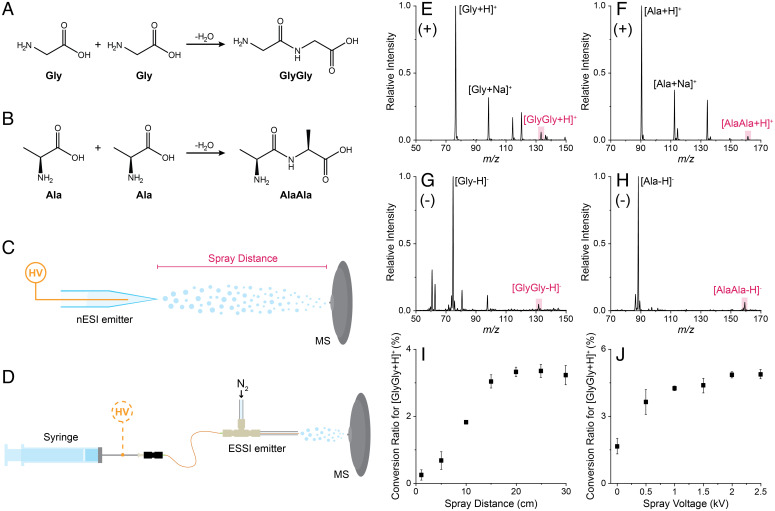
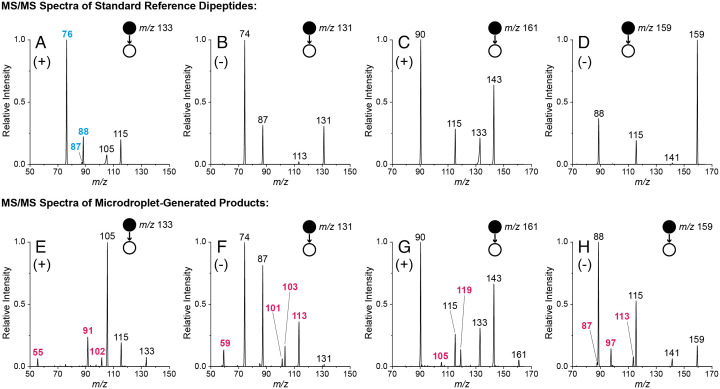
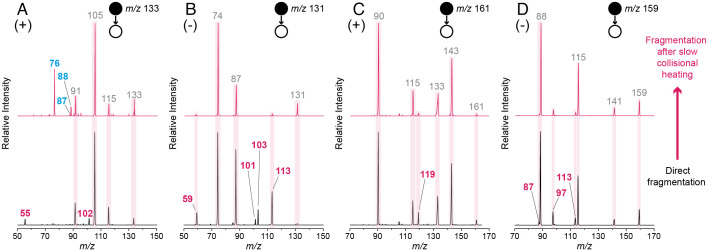
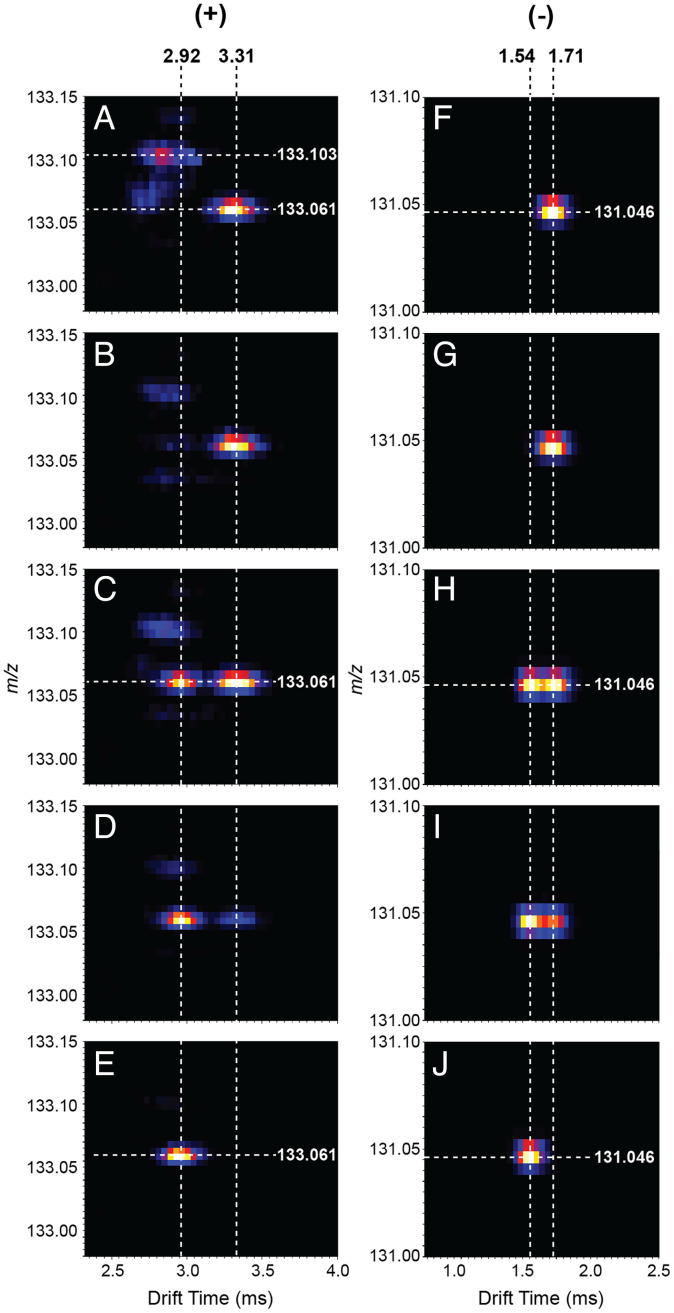
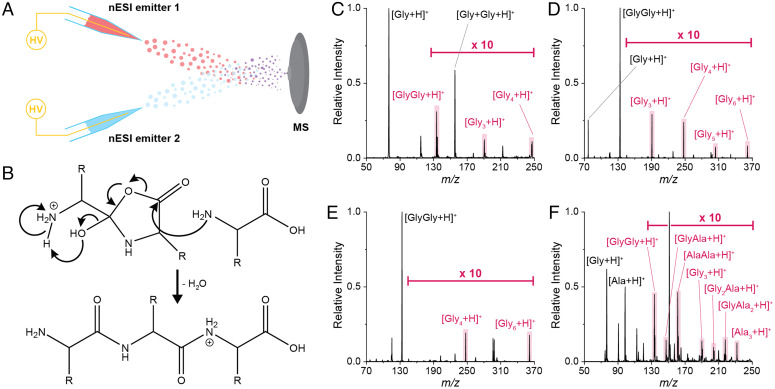
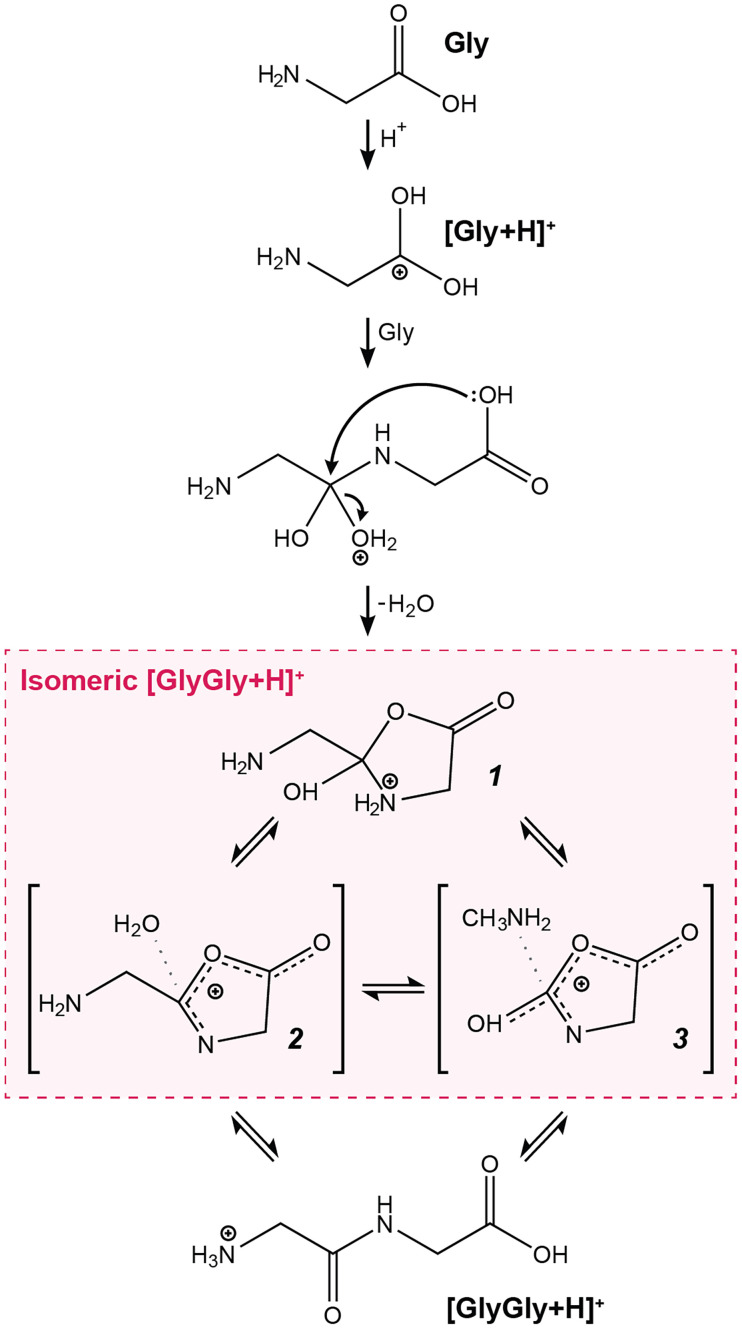
Amide bond formation, the essential condensation reaction underlying peptide synthesis, is hindered in aqueous systems by the thermodynamic constraints associated with dehydration. This represents a key difficulty for the widely held view that prebiotic chemical evolution leading to the formation of the first biomolecules occurred in an oceanic environment. Recent evidence for the acceleration of chemical reactions at droplet interfaces led us to explore aqueous amino acid droplet chemistry. We report the formation of dipeptide isomer ions from free glycine or L-alanine at the air–water interface of aqueous microdroplets emanating from a single spray source (with or without applied potential) during their flight toward the inlet of a mass spectrometer. The proposed isomeric dipeptide ion is an oxazolidinone that takes fully covalent and ion-neutral complex forms. This structure is consistent with observed fragmentation patterns and its conversion to authentic dipeptide ions upon gentle collisions and for its formation from authentic dipeptides at ultra-low concentrations. It also rationalizes the results of droplet fusion experiments that show that the dipeptide isomer facilitates additional amide bond formation events, yielding authentic tri- through hexapeptides. We propose that the interface of aqueous microdroplets serves as a drying surface that shifts the equilibrium between free amino acids in favor of dehydration via stabilization of the dipeptide isomers. These findings offer a possible solution to the water paradox of biopolymer synthesis in prebiotic chemistry.
Overview
The claims and statistics of this paper haven’t been checked yet.
Free: it reads the open-access text and checks the first 5 claims that cite a source we can check. Create a free account to check every claim.
Integrity signals
Registry
Cites
Statistics
Figures
Verification
Claims the paper makes
The claims and statistics of this paper haven’t been checked yet.
Free: it reads the open-access text and checks the first 5 claims that cite a source we can check. Create a free account to check every claim.
Claims other papers make about this one
Each is checked against this paper’s own text: does it say what the citing paper says it does?
The cited source says what the claim attributes to it.
In the citing paper
“This result implies that the previous findings on oxazolidinone chemistry (31), including dipeptide and higher-order peptide formation, extend also to the synthesized oxazolone intermediate.”
From Oxazolone mediated peptide chain extension and homochirality in aqueous microdroplets (2024) · cites this paper as [31]
The cited source says what the claim attributes to it.
In the citing paper
“It’s notable that under these conditions, the dipeptides 8a and 8b rather than their oxazolidinone isomers were produced and compared to the previous study (31); no external collisional heating was required to form the peptides.”
From Oxazolone mediated peptide chain extension and homochirality in aqueous microdroplets (2024) · cites this paper as [31]
Self-check
Percentages, sums and reported differences re-computed from the paper’s own numbers.
The self-check needs the paper’s full text.
Citations
Cites
HMDB 5.0: the Human Metabolome Database for 2022
Wishart, D. S., Guo, A., Oler, E., Wang, F., Anjum, A., Peters, H., Dizon, R., Sayeeda, Z., Tian, S., Lee, B. L., et al. (2022) · Nucleic Acids Research · doi:10.1093/nar/gkab1062 · Cited by 2,519 · cited 1×
“Similarly, protonated authentic AlaAla fragmented as expected (73) (Fig.”
Spontaneous Generation of Hydrogen Peroxide from Aqueous Microdroplets
Lee, J. K., Walker, K. L., Han, H. S., Kang, J., Prinz, F. B., Waymouth, R. M., Nam, H. G., & Zare, R. N. (2019) · Proceedings of the National Academy of Sciences · doi:10.1073/pnas.1911883116 · Cited by 717
Accelerated Reaction Kinetics in Microdroplets: Overview and Recent Developments
Wei, Z., Li, Y., Cooks, R. G., & Yan, X. (2020) · Annual Review of Physical Chemistry · doi:10.1146/annurev-physchem-121319-110654 · Cited by 631
Self-citationPolypeptides and 100 Years of Chemistry of α‐Amino Acid N‐Carboxyanhydrides
Kricheldorf, H. R. (2006) · Angewandte Chemie International Edition · doi:10.1002/anie.200600693 · Cited by 628
Organic Reactions in Microdroplets: Reaction Acceleration Revealed by Mass Spectrometry
Yan, X., Bain, R. M., & Cooks, R. G. (2016) · Angewandte Chemie International Edition · doi:10.1002/anie.201602270 · Cited by 583
Self-citationStrong Electric Field Observed at the Interface of Aqueous Microdroplets
Xiong, H., Lee, J. K., Zare, R. N., & Min, W. (2020) · The Journal of Physical Chemistry Letters · doi:10.1021/acs.jpclett.0c02061 · Cited by 485 · cited 1×
“We suggest that the compact cyclic structures are favored at the air–water interface where compounds with larger dipole moments can be stabilized through alignment with the high surface electric field (79, 88), another factor that favors the oxazolidinone ions (SI Appendix, Table S5 and Fig.”
BackgroundThe Hot Spring Hypothesis for an Origin of Life
Damer, B., & Deamer, D. (2020) · Astrobiology · doi:10.1089/ast.2019.2045 · Cited by 478 · cited 1×
“A suite of geochemical scenarios has been proposed to address the entropic difficulties associated with chemical synthesis starting with low concentration precursors; they include hydrothermal vents (3–5), drying beaches (6), hot springs (7), meteorites or icy bodies (8–11), atmospheric aerosols (12, 13), and mineral…”
BackgroundGirod, M., Moyano, E., Campbell, D. I., & Cooks, R. G. (2011) · Chem. Sci. · doi:10.1039/c0sc00416b · Cited by 419
Self-citationMolecular reactions at aqueous interfaces
Ruiz-Lopez, M. F., Francisco, J. S., Martins-Costa, M. T. C., & Anglada, J. M. (2020) · Nature Reviews Chemistry · doi:10.1038/s41570-020-0203-2 · Cited by 411
Can electric fields drive chemistry for an aqueous microdroplet?
Hao, H., Leven, I., & Head-Gordon, T. (2022) · Nature Communications · doi:10.1038/s41467-021-27941-x · Cited by 400 · cited 3×
“We suggest that the compact cyclic structures are favored at the air–water interface where compounds with larger dipole moments can be stabilized through alignment with the high surface electric field (79, 88), another factor that favors the oxazolidinone ions (SI Appendix, Table S5 and Fig.”
BackgroundBurton, A. S., Stern, J. C., Elsila, J. E., Glavin, D. P., & Dworkin, J. P. (2012) · Chemical Society Reviews · doi:10.1039/c2cs35109a · Cited by 398
Micrometer-Sized Water Droplets Induce Spontaneous Reduction
Lee, J. K., Samanta, D., Nam, H. G., & Zare, R. N. (2019) · Journal of the American Chemical Society · doi:10.1021/jacs.9b03227 · Cited by 397 · cited 1×
“This interfacial acceleration phenomenon has been reported for prebiotically relevant reactions including condensation (12, 21, 29, 49–53), redox (54, 55), nucleophilic addition (41, 43), and ultraviolet-initiated photopolymerization reactions (56).”
BackgroundLahav, N., White, D., & Chang, S. (1978) · Science · doi:10.1126/science.663639 · Cited by 381
Elongation of Oligopeptides in a Simulated Submarine Hydrothermal System
Imai, E.-I., Honda, H., Hatori, K., Brack, A., & Matsuno, K. (1999) · Science · doi:10.1126/science.283.5403.831 · Cited by 356
Acceleration of reaction in charged microdroplets
Lee, J. K., Banerjee, S., Nam, H. G., & Zare, R. N. (2015) · Quarterly Reviews of Biophysics · doi:10.1017/s0033583515000086 · Cited by 317 · cited 2×
“Increased collisions could also provide enough turbulent force to perturb the droplet surface (without fission) thereby enabling a greater degree of solvent evaporation, which is typically negligible during the flight time of aqueous microdroplets (72, 78).”
BackgroundFallah-Araghi, A., Meguellati, K., Baret, J.-C., Harrak, A. E., Mangeat, T., Karplus, M., Ladame, S., Marques, C. M., & Griffiths, A. D. (2014) · Physical Review Letters · doi:10.1103/physrevlett.112.028301 · Cited by 301 · cited 1×
“Other factors such as high degrees of mass transfer and mixing (62–64), ordered molecular orientation (38, 65), extremes in surface pH (41, 43, 66, 67), and increased reagent confinement (63, 68) might also contribute to the observed reaction acceleration in special cases.”
BackgroundAtmospheric aerosols as prebiotic chemical reactors
Dobson, C. M., Ellison, G. B., Tuck, A. F., & Vaida, V. (2000) · Proceedings of the National Academy of Sciences · doi:10.1073/pnas.200366897 · Cited by 270 · cited 2×
“A suite of geochemical scenarios has been proposed to address the entropic difficulties associated with chemical synthesis starting with low concentration precursors; they include hydrothermal vents (3–5), drying beaches (6), hot springs (7), meteorites or icy bodies (8–11), atmospheric aerosols (12, 13), and mineral…”
BackgroundMicrodroplet fusion mass spectrometry for fast reaction kinetics
Lee, J. K., Kim, S., Nam, H. G., & Zare, R. N. (2015) · Proceedings of the National Academy of Sciences · doi:10.1073/pnas.1503689112 · Cited by 268 · cited 2×
“Increased collisions could also provide enough turbulent force to perturb the droplet surface (without fission) thereby enabling a greater degree of solvent evaporation, which is typically negligible during the flight time of aqueous microdroplets (72, 78).”
BackgroundMethodAbiotic production of sugar phosphates and uridine ribonucleoside in aqueous microdroplets
Nam, I., Lee, J. K., Nam, H. G., & Zare, R. N. (2017) · Proceedings of the National Academy of Sciences · doi:10.1073/pnas.1714896114 · Cited by 262 · cited 3×
“and/or addition of high concentrations of phosphoric acid (49, 51, 52, 70).”
BackgroundBowen, R. D. (1991) · Accounts of Chemical Research · doi:10.1021/ar00012a002 · Cited by 258
Spontaneous formation of gold nanostructures in aqueous microdroplets
Lee, J. K., Samanta, D., Nam, H. G., & Zare, R. N. (2018) · Nature Communications · doi:10.1038/s41467-018-04023-z · Cited by 253
Syntheses of Isoquinoline and Substituted Quinolines in Charged Microdroplets
Banerjee, S., & Zare, R. N. (2015) · Angewandte Chemie International Edition · doi:10.1002/anie.201507805 · Cited by 230
Bouillant, A., Mouterde, T., Bourrianne, P., Lagarde, A., Clanet, C., & Quéré, D. (2018) · Nature Physics · doi:10.1038/s41567-018-0275-9 · Cited by 215
Redox and pH gradients drive amino acid synthesis in iron oxyhydroxide mineral systems
Barge, L. M., Flores, E., Baum, M. M., VanderVelde, D. G., & Russell, M. J. (2019) · Proceedings of the National Academy of Sciences · doi:10.1073/pnas.1812098116 · Cited by 203 · cited 1×
“This interfacial acceleration phenomenon has been reported for prebiotically relevant reactions including condensation (12, 21, 29, 49–53), redox (54, 55), nucleophilic addition (41, 43), and ultraviolet-initiated photopolymerization reactions (56).”
BackgroundArmentrout, P. B. (2002) · Journal of the American Society for Mass Spectrometry · doi:10.1016/s1044-0305(02)00347-1 · Cited by 191
A Hydrothermal-Sedimentary Context for the Origin of Life
Westall, F., Hickman-Lewis, K., Hinman, N., Gautret, P., Campbell, K. A., Bréhéret, J. G., Foucher, F., Hubert, A., Sorieul, S., Dass, A. V., et al. (2018) · Astrobiology · doi:10.1089/ast.2017.1680 · Cited by 189
In situ observation of peptide bond formation at the water-air interface
Griffith, E. C., & Vaida, V. (2012) · Proceedings of the National Academy of Sciences · doi:10.1073/pnas.1210029109 · Cited by 184 · cited 2×
“acid esters (29), stabilization using divalent metal cations (29, 52),”
BackgroundHuang, K.-H., Wei, Z., & Cooks, R. G. (2021) · Chemical Science · doi:10.1039/d0sc05625a · Cited by 176
Self-citationFetsch, C., Grossmann, A., Holz, L., Nawroth, J. F., & Luxenhofer, R. (2011) · Macromolecules · doi:10.1021/ma201015y · Cited by 174
Synthesis of Polypeptides by Ring-Opening Polymerization of α-Amino Acid N-Carboxyanhydrides
Cheng, J., & Deming, T. J. (2011) · Topics in Current Chemistry · doi:10.1007/128_2011_173 · Cited by 169
Accelerated Chemical Reactions and Organic Synthesis in Leidenfrost Droplets
Bain, R. M., Pulliam, C. J., Thery, F., & Cooks, R. G. (2016) · Angewandte Chemie International Edition · doi:10.1002/anie.201605899 · Cited by 159
Self-citationReaction Acceleration Promoted by Partial Solvation at the Gas/Solution Interface
Qiu, L., Wei, Z., Nie, H., & Cooks, R. G. (2021) · ChemPlusChem · doi:10.1002/cplu.202100373 · Cited by 159 · cited 2×
“The observed rate constant is associated with high surface-to-volume ratios, and it has been attributed to the partial solvation of species at the interface (47, 48, 57, 58) along with the high electric field at the air–solvent interface (55, 59–61).”
BackgroundSelf-citationAbiotic synthesis of purine and pyrimidine ribonucleosides in aqueous microdroplets
Nam, I., Nam, H. G., & Zare, R. N. (2018) · Proceedings of the National Academy of Sciences · doi:10.1073/pnas.1718559115 · Cited by 157 · cited 3×
“and/or addition of high concentrations of phosphoric acid (49, 51, 52, 70).”
BackgroundBasuri, P., Gonzalez, L. E., Morato, N. M., Pradeep, T., & Cooks, R. G. (2020) · Chemical Science · doi:10.1039/d0sc02467h · Cited by 155
Self-citationSynthesis of polypeptides via bioinspired polymerization of in situ purified N -carboxyanhydrides
Song, Z., Fu, H., Wang, J., Hui, J., Xue, T., Pacheco, L. A., Yan, H., Baumgartner, R., Wang, Z., Xia, Y., et al. (2019) · Proceedings of the National Academy of Sciences · doi:10.1073/pnas.1901442116 · Cited by 146
Mineral surface chemistry control for origin of prebiotic peptides
Erastova, V., Degiacomi, M. T., G. Fraser, D., & Greenwell, H. C. (2017) · Nature Communications · doi:10.1038/s41467-017-02248-y · Cited by 145
Gao, D., Jin, F., Lee, J. K., & Zare, R. N. (2019) · Chemical Science · doi:10.1039/c9sc05112k · Cited by 139
Prebiotic condensation through wet–dry cycling regulated by deliquescence
Campbell, T. D., Febrian, R., McCarthy, J. T., Kleinschmidt, H. E., Forsythe, J. G., & Bracher, P. J. (2019) · Nature Communications · doi:10.1038/s41467-019-11834-1 · Cited by 136
Ultrafast enzymatic digestion of proteins by microdroplet mass spectrometry
Zhong, X., Chen, H., & Zare, R. N. (2020) · Nature Communications · doi:10.1038/s41467-020-14877-x · Cited by 131
ON THE FORMATION OF DIPEPTIDES IN INTERSTELLAR MODEL ICES
Kaiser, R. I., Stockton, A. M., Kim, Y. S., Jensen, E. C., & Mathies, R. A. (2013) · The Astrophysical Journal · doi:10.1088/0004-637x/765/2/111 · Cited by 112
Fluorescence Polarization Anisotropy in Microdroplets
Zhou, Z., Yan, X., Lai, Y.-H., & Zare, R. N. (2018) · The Journal of Physical Chemistry Letters · doi:10.1021/acs.jpclett.8b01129 · Cited by 110 · cited 1×
“Other factors such as high degrees of mass transfer and mixing (62–64), ordered molecular orientation (38, 65), extremes in surface pH (41, 43, 66, 67), and increased reagent confinement (63, 68) might also contribute to the observed reaction acceleration in special cases.”
BackgroundWhere’s the Charge? Protonation Sites in Gaseous Ions Change with Hydration
Chang, T. M., Prell, J. S., Warrick, E. R., & Williams, E. R. (2012) · Journal of the American Chemical Society · doi:10.1021/ja304929h · Cited by 109 · cited 1×
“amine) due to partial solvation (97) and should facilitate dehydration reactions between surface-active compounds.”
BackgroundTheta-Glass Capillaries in Electrospray Ionization: Rapid Mixing and Short Droplet Lifetimes
Mortensen, D. N., & Williams, E. R. (2014) · Analytical Chemistry · doi:10.1021/ac502545r · Cited by 106
Deal, A. M., Rapf, R. J., & Vaida, V. (2021) · The Journal of Physical Chemistry A · doi:10.1021/acs.jpca.1c02864 · Cited by 105
Prebiotic chemistry in eutectic solutions at the water–ice matrix
Menor-Salván, C., & Marín-Yaseli, M. R. (2012) · Chemical Society Reviews · doi:10.1039/c2cs35060b · Cited by 101
Nie, H., Wei, Z., Qiu, L., Chen, X., Holden, D. T., & Cooks, R. G. (2020) · Chemical Science · doi:10.1039/c9sc06265c · Cited by 101
Self-citationReaction Acceleration in Electrospray Droplets: Size, Distance, and Surfactant Effects
Marsh, B. M., Iyer, K., & Cooks, R. G. (2019) · Journal of the American Society for Mass Spectrometry · doi:10.1007/s13361-019-02264-w · Cited by 97
Self-citationA microdroplet-accelerated Biginelli reaction: mechanisms and separation of isomers using IMS-MS
Sahota, N., AbuSalim, D. I., Wang, M. L., Brown, C. J., Zhang, Z., El-Baba, T. J., Cook, S. P., & Clemmer, D. E. (2019) · Chemical Science · doi:10.1039/c9sc00704k · Cited by 94
Uncatalyzed peptide bond formation in the gas phase
Jensen, J. H., Baldridge, K. K., & Gordon, M. S. (1992) · The Journal of Physical Chemistry · doi:10.1021/j100200a025 · Cited by 92
Do Cellular Condensates Accelerate Biochemical Reactions? Lessons from Microdroplet Chemistry
Stroberg, W., & Schnell, S. (2018) · Biophysical Journal · doi:10.1016/j.bpj.2018.05.023 · Cited by 90 · cited 1×
“Interfacial chemistry appears to play a crucial role in facilitating biomolecule transformations in aqueous environments, as has been demonstrated in biphasic systems (91), cell condensates, and subcompartments (98), as well as in microdroplets (12, 13, 21, 29, 42, 51–53, 99, 100).”
BackgroundDong, J., Fischer, R. A., Stixrude, L. P., & Lithgow‐Bertelloni, C. R. (2021) · AGU Advances · doi:10.1029/2020av000323 · Cited by 87 · cited 2×
“neutral is either water (2) or methylamine (3).”
BackgroundPrebiotic Chemistry: What We Know, What We Don’t
Cleaves, H. J. (2012) · Evolution: Education and Outreach · doi:10.1007/s12052-012-0443-9 · Cited by 75
A comparative study of the catalysis of peptide bond formation by oxide surfaces
Lambert, J., Jaber, M., Georgelin, T., & Stievano, L. (2013) · Physical Chemistry Chemical Physics · doi:10.1039/c3cp51282g · Cited by 73
Role of Mineral Surfaces in Prebiotic Chemical Evolution. In Silico Quantum Mechanical Studies
Rimola, A., Sodupe, M., & Ugliengo, P. (2019) · Life · doi:10.3390/life9010010 · Cited by 72
Organic Reactions of Ionic Intermediates Promoted by Atmospheric‐Pressure Thermal Activation
Chen, H., Eberlin, L. S., Nefliu, M., Augusti, R., & Cooks, R. G. (2008) · Angewandte Chemie International Edition · doi:10.1002/anie.200800072 · Cited by 70
Self-citationHydrophobic and Ionic Interactions in Nanosized Water Droplets
Vaitheeswaran, S., & Thirumalai, D. (2006) · Journal of the American Chemical Society · doi:10.1021/ja063445h · Cited by 68 · cited 1×
“The observed rate constant is associated with high surface-to-volume ratios, and it has been attributed to the partial solvation of species at the interface (47, 48, 57, 58) along with the high electric field at the air–solvent interface (55, 59–61).”
BackgroundSpontaneous Water Radical Cation Oxidation at Double Bonds in Microdroplets
Qiu, L., Morato, N. M., Huang, K., & Cooks, R. G. (2022) · Frontiers in Chemistry · doi:10.3389/fchem.2022.903774 · Cited by 66
Self-citationQuantum Mechanical Modeling of Reaction Rate Acceleration in Microdroplets
Narendra, N., Chen, X., Wang, J., Charles, J., Cooks, R. G., & Kubis, T. (2020) · The Journal of Physical Chemistry A · doi:10.1021/acs.jpca.0c03225 · Cited by 65 · cited 1×
“Other factors such as high degrees of mass transfer and mixing (62–64), ordered molecular orientation (38, 65), extremes in surface pH (41, 43, 66, 67), and increased reagent confinement (63, 68) might also contribute to the observed reaction acceleration in special cases.”
BackgroundSelf-citationSpontaneous Oxidation of Aromatic Sulfones to Sulfonic Acids in Microdroplets
Qiu, L., Psimos, M. D., & Cooks, R. G. (2022) · Journal of the American Society for Mass Spectrometry · doi:10.1021/jasms.2c00029 · Cited by 65
Self-citationWei, Z., Zhang, X., Wang, J., Zhang, S., Zhang, X., & Cooks, R. G. (2018) · Chemical Science · doi:10.1039/c8sc03382j · Cited by 61
Self-citationThe role of ion–neutral complexes in the reactions of onium ions and related species
Bowen, R. D. (1993) · Organic Mass Spectrometry · doi:10.1002/oms.1210281234 · Cited by 61 · cited 1×
“Two ion-neutral complexes 2 and 3 (83, 84) are accessible from fully covalent oxazolidinone ion 1.”
BackgroundRimola, A., Civalleri, B., & Ugliengo, P. (2008) · Langmuir · doi:10.1021/la8029352 · Cited by 61
Prebiotic phosphorylation enabled by microdroplets
Vaida, V. (2017) · Proceedings of the National Academy of Sciences · doi:10.1073/pnas.1717373114 · Cited by 56
On the possible role of montmorillonites in prebiotic peptide formation
Bujdák, J., Slosiariková, H., Texler, N. R., Schwendinger, M. G., & Rode, B. M. (1994) · Monatshefte für Chemie - Chemical Monthly · doi:10.1007/bf00811510 · Cited by 55
Accelerated Forced Degradation of Pharmaceuticals in Levitated Microdroplet Reactors
Li, Y., Liu, Y., Gao, H., Helmy, R., Wuelfing, W. P., Welch, C. J., & Cooks, R. G. (2018) · Chemistry – A European Journal · doi:10.1002/chem.201801176 · Cited by 53
Self-citationHoehn, R. D., Carignano, M. A., Kais, S., Zhu, C., Zhong, J. P., Zeng, X. C., Francisco, J. S., & Gladich, I. (2016) · The Journal of Chemical Physics · doi:10.1063/1.4950951 · Cited by 47 · cited 1×
“This stabilizing effect can be further enhanced through favorable hydrogen bonding interactions in specific surface-aligned conformations (89, 90).”
BackgroundLee, J. K., Nam, H. G., & Zare, R. N. (2017) · Quarterly Reviews of Biophysics · doi:10.1017/s0033583517000014 · Cited by 46 · cited 1×
“This technique has been implemented previously to study acidinduced unfolding and hydrogen–deuterium exchange of proteins in microdroplets (78), as well as demetallation reactions (37).”
MethodGibbs Free Energy and Reaction Rate Acceleration in and on Microdroplets
Tuck, A. F. (2019) · Entropy · doi:10.3390/e21111044 · Cited by 46 · cited 1×
“are negative when reagents are at the surface of the droplet, leading to spontaneous conversion (49, 51, 71).”
BackgroundWater Microdroplets Allow Spontaneously Abiotic Production of Peptides
Wang, W., Qiao, L., He, J. F., Ju, Y., Yu, K., Kan, G., Guo, C., Zhang, H., & Jiang, J. (2021) · The Journal of Physical Chemistry Letters · doi:10.1021/acs.jpclett.1c01083 · Cited by 42 · cited 3×
“and/or addition of high concentrations of phosphoric acid (49, 51, 52, 70).”
BackgroundZhu, C., Zeng, X. C., Francisco, J. S., & Gladich, I. (2020) · Journal of the American Chemical Society · doi:10.1021/jacs.9b09870 · Cited by 41
Local Ice-like Structure at the Liquid Water Surface
Odendahl, N., & Geissler, P. L. (2022) · Journal of the American Chemical Society · doi:10.1021/jacs.2c01827 · Cited by 41 · cited 1×
“ice-like state, denoted by a distinctive molecular density gradient and perpendicular orientation at the interface (95).”
BackgroundFraser, D. G., Fitz, D., Jakschitz, T., & Rode, B. M. (2011) · Phys. Chem. Chem. Phys. · doi:10.1039/c0cp01388a · Cited by 39
Feng, L., Yin, X., Tan, S., Li, C., Gong, X., Fang, X., & Pan, Y. (2021) · Analytical Chemistry · doi:10.1021/acs.analchem.1c03954 · Cited by 39 · cited 1×
“The initial condensation reaction is likely driven by the extremely low interfacial pH of the microdroplet surface, as previously suggested for the condensation of o-phenyl diamines and carboxylic acids to form benzimidazoles and for the sequestration of carbon dioxide as the carbamic acids using free amines (41, 43,…”
BackgroundFedick, P. W., Iyer, K., Wei, Z., Avramova, L. V., Capek, G. O., & Cooks, R. G. (2019) · Journal of the American Society for Mass Spectrometry · doi:10.1007/s13361-019-02287-3 · Cited by 37
Self-citationWincel, H., Fokkens, R. H., & Nibbering, N. M. M. (2000) · Rapid Communications in Mass Spectrometry · doi:10.1002/(sici)1097-0231(20000215)14:3<135::aid-rcm851>3.0.co;2-m · Cited by 37
Li, Y., Mehari, T. F., Wei, Z., Liu, Y., & Cooks, R. G. (2021) · Journal of Mass Spectrometry · doi:10.1002/jms.4585 · Cited by 36
Self-citationReaction of chloroauric acid with histidine in microdroplets yields a catalytic Au–(His) 2 complex
Luo, K., Li, J. X., Cao, Y., Liu, C., Ge, J., Chen, H., & Zare, R. N. (2020) · Chemical Science · doi:10.1039/c9sc06221a · Cited by 34 · cited 1×
“Other factors such as high degrees of mass transfer and mixing (62–64), ordered molecular orientation (38, 65), extremes in surface pH (41, 43, 66, 67), and increased reagent confinement (63, 68) might also contribute to the observed reaction acceleration in special cases.”
BackgroundKumar, J. K., & Oliver, J. S. (2002) · Journal of the American Chemical Society · doi:10.1021/ja0175237 · Cited by 32
Locating Protonated Amines in Clathrates
Chang, T. M., Cooper, R. J., & Williams, E. R. (2013) · Journal of the American Chemical Society · doi:10.1021/ja407414d · Cited by 28 · cited 1×
“importance of both the number and orientation of hydrogen bonds on the surface activity of ions (96).”
BackgroundEfficient and directed peptide bond formation in the gas phase via ion/ion reactions
McGee, W. M., & McLuckey, S. A. (2014) · Proceedings of the National Academy of Sciences · doi:10.1073/pnas.1317914111 · Cited by 27
Comments on `Concentration by Evaporation and the Prebiotic Synthesis of Cytosine'
Shapiro, R. (2002) · Origins of Life and Evolution of Biospheres · doi:10.1023/a:1016582308525 · Cited by 26 · cited 1×
“A suite of geochemical scenarios has been proposed to address the entropic difficulties associated with chemical synthesis starting with low concentration precursors; they include hydrothermal vents (3–5), drying beaches (6), hot springs (7), meteorites or icy bodies (8–11), atmospheric aerosols (12, 13), and mineral…”
BackgroundSchwartz, A. W. (1998) · The Molecular Origins of Life · doi:10.1017/cbo9780511626180.013 · Cited by 26
HETEROCYCLIC ANIONS OF ASTROBIOLOGICAL INTEREST
Cole, C. A., Demarais, N. J., Yang, Z., Snow, T. P., & Bierbaum, V. M. (2013) · The Astrophysical Journal · doi:10.1088/0004-637x/779/2/181 · Cited by 24
Wysocki, V. H., & Kenttämaa, H. I. (1990) · Journal of the American Chemical Society · doi:10.1021/ja00169a019 · Cited by 23
Aqueous-Microdroplet-Driven Abiotic Synthesis of Ribonucleotides
Ju, Y., Zhang, H., Wang, W., Liu, Q., Yu, K., Kan, G., Liu, L., & Jiang, J. (2022) · The Journal of Physical Chemistry Letters · doi:10.1021/acs.jpclett.1c03486 · Cited by 20 · cited 2×
“and/or addition of high concentrations of phosphoric acid (49, 51, 52, 70).”
BackgroundChemistry in Prebiotic Aerosols: A Mechanism for the Origin of Life
Tervahattu, H., Tuck, A. F., & Vaida, V. (2004) · Cellular origin and life in extreme habitats · doi:10.1007/1-4020-2522-x_10 · Cited by 18
Basuri, P., Kumar, J. S., Das, S., & Pradeep, T. (2022) · ACS Sustainable Chemistry & Engineering · doi:10.1021/acssuschemeng.2c02070 · Cited by 18
Effects of stepwise excitation on fragmentation of gas phase ions: An especially striking case
Kenttämaa, H. I. (1985) · Organic Mass Spectrometry · doi:10.1002/oms.1210201202 · Cited by 17
Water-Mediated Peptide Bond Formation in the Gas Phase: A Model Prebiotic Reaction.
Gale, A., Odbadrakh, T., Ball, B. T., & Shields, G. (2020) · Journal of Physical Chemistry A · doi:10.1021/acs.jpca.0c02906 · Cited by 15
Biosphere origin and evolution
(2008) · Choice Reviews Online · doi:10.5860/choice.45-5557 · Cited by 15
Proline Behavior in Model Prebiotic Peptides Formed by Wet–Dry Cycling
Ervin, J. N., Bouza, M., Fernández, F. M., & Forsythe, J. G. (2020) · ACS Earth and Space Chemistry · doi:10.1021/acsearthspacechem.0c00119 · Cited by 14
Gas Phase Reactions of the Cyclic Ethylenehalonium Ions (CH2)2X+ (X = Cl, Br) with Glycine1
O’Hair, R. A. J., Freitas, M. A., & Williams, T. D. (1996) · The Journal of Organic Chemistry · doi:10.1021/jo951960k · Cited by 13
Peptide Isomerization is Suppressed at the Air–Water Interface
Singh, A. N., & Limmer, D. T. (2022) · The Journal of Physical Chemistry Letters · doi:10.1021/acs.jpclett.1c03837 · Cited by 13 · cited 1×
“The isomerization step of this proposed mechanism is consistent with a recent molecular dynamics study that found that particular metastable conformations of AlaAla are favored at the air–water interface due to greater intramolecular stabilization when the dipeptide is partially desolvated (80).”
ResultBiegajski, J. E., Cadenhead, D. A., & Prasad, P. N. (1991) · Macromolecules · doi:10.1021/ma00001a045 · Cited by 11
Evidence of isomerization during ion isolation in the quadrupole ion trap
Hart, K. J., McLuckey, S. A., & Glish, G. L. (1992) · Journal of the American Society for Mass Spectrometry · doi:10.1016/1044-0305(92)85010-h · Cited by 10
Comets, carbonaceous meteorites, and the origin of the biospherePreprint
Hoover, R. B. (2006) · doi:10.5194/bgd-3-23-2006 · Cited by 10
Accelerated synthesis of energetic precursor cage compounds using confined volume systems
Brown, H. M., Doppalapudi, K. R., & Fedick, P. W. (2021) · Scientific Reports · doi:10.1038/s41598-021-02945-1 · Cited by 9
Zhong, X., Chen, H., & Zare, R. N. (2021) · QRB Discovery · doi:10.1017/qrd.2021.2 · Cited by 6
Cai, T., Zhou, J., Jiang, Y., Xie, K., Fang, D., Qi, H., & Wu, Z. (2018) · Journal of Mass Spectrometry · doi:10.1002/jms.4208 · Cited by 5 · cited 1×
“The coexistence of covalent and ion-neutral forms of an ion has been implicated in gas-phase reactions of Gly (85), as well as the hydroxyl-amino exchange in protonated arginine (86), an isomerization process similar to that proposed here.”
Experimental and computational evidence for C=O π-bonding in [CH 2 OH] + and related oxonium ions
Bowen, R. D., Martin, W. H. C., Hudson, C. E., & McAdoo, D. J. (2020) · European Journal of Mass Spectrometry · doi:10.1177/1469066719894969 · Cited by 2
Research works printed but not linked: 1
- M. J. Russell, A. J. Hall, A. J. Boyce, A. E. Fallick, 100th anniversary special paper: On hydrothermal convection systems and the emergence of life. Econ. Geol. 100, 259– 270 (2005).
Cited by
Spontaneous Oxidation in Aqueous Microdroplets: Water Radical Cation as Primary Oxidizing Agent
Qiu, L., & Cooks, R. G. (2024) · Angewandte Chemie International Edition · doi:10.1002/anie.202400118 · Cited by 137
Self-citationDesorption Electrospray Ionization Mass Spectrometry: 20 Years
Morato, N. M., & Cooks, R. G. (2023) · Accounts of Chemical Research · doi:10.1021/acs.accounts.3c00382 · Cited by 119
Self-citationMass spectrometry using electrospray ionization
Prabhu, G. R. D., Williams, E. R., Wilm, M. S., & Urban, P. L. (2023) · Nature Reviews Methods Primers · doi:10.1038/s43586-023-00203-4 · Cited by 148
Chemical Kinetics in Microdroplets
Wilson, K. R., & Prophet, A. M. (2024) · Annual Review of Physical Chemistry · doi:10.1146/annurev-physchem-052623-120718 · Cited by 131
Size-dependent charge transfer between water microdroplets
Lin, S., Cao, L. N. Y., Tang, Z. A., & Wang, Z. L. (2023) · Proceedings of the National Academy of Sciences · doi:10.1073/pnas.2307977120 · Cited by 107
Metadata
- Authors
- Holden, D. T., Morato, N. M., & Cooks, R. G.
- Affiliations
- Purdue University West Lafayette (US)
- Corresponding author
- Cooks, R. Graham
- Venue
- Proceedings of the National Academy of Sciences
- Publisher
- National Academy of Sciences
- Published
- 2022-10-03
- Volume
- 119
- Issue
- 42
- Pages
- e2212642119-e2212642119
- ISSN
- 0027-8424 (ISSN-L)
- 1091-6490
- PMC
- PMC9586328
- OpenAlex
- W4300594519
- Semantic Scholar
- 75c42488e2f5b6a7b817e572b23ea692c6e280a1
- Cited by
- 147
- References
- 101
- Citations by year
- 2026: 24 · 2025: 42 · 2024: 46 · 2023: 33 · 2022: 2
- FWCI
- 12.30
- Type
- journal article
- Language
- en
- Open access
- hybrid
- doi.org
- Licence
- Locations
- Proceedings of the National Academy of Sciences (publishedVersion, cc-by-nc-nd)
- PubMed Central (publishedVersion, cc-by-nc-nd)
- PubMed (publishedVersion)
- Funders
- National Science Foundation (CHE1905087)
- Multi-University Research Initiative (FA9550-21-1-0170)
- Waters Corporation (40002775)
- National Science Foundation Graduate Research Fellowship (DGE-1842166)
- Topics
- Physical Sciences › Physics and Astronomy › Astronomy and Astrophysics › Origins and Evolution of Life
- Physical Sciences › Chemistry › Spectroscopy › Mass Spectrometry Techniques and Applications
- Physical Sciences › Chemistry › Organic Chemistry › Chemical Synthesis and Analysis
- Keywords
- aqueous microdroplets, amide synthesis, peptide isomers, oxazolidinones, glycine, L-alanine, air-water interface, prebiotic chemistry, dehydration, droplet fusion, ion-neutral complexes, collision-induced dissociation
- MeSH terms
- Alanine, Amides, Amino Acids, Biopolymers, Dehydration, Dipeptides, Glycine, Humans, Peptides, Water, Oxazolidinones
About these checks
Registry, retraction, Cites and statistics results are computed, not judged, with one exception: a printed reference that no index lists is read once by a model before it counts as a citation error. Claims are extracted by a model and kept only when their quote appears verbatim in the text; each cited source is then checked, with a model’s help, for whether it says what the claim relies on. Those verdicts can be wrong — read the claim’s quote and the cited source before relying on one.
Statistics and arithmetic are recomputed, not judged.
Confidence bands are shown only for fields calibrated on our annotated test set. None is calibrated yet, so no band is shown.
What counts as a claim ›How we measure confidence ›How we check this ›
Are you an author, or do you see a problem with this page? Request a review
Data sources
Bibliographic data: Semantic Scholar, OpenAlex, Crossref.
Contains information from the Semantic Scholar Academic Graph Datasets, made available under the ODC Attribution License (ODC-BY 1.0).
Semantic Scholar’s data is described in: Kinney, R., et al. (2023). The Semantic Scholar Open Data Platform. arXiv:2301.10140.
