

Superhuman artificial intelligence can improve human decision-making by increasing novelty
Open accessPublished version of a preprint
The DOI matches its Crossref record; 32 of the 33 references it cites were found in a registry or an index.
Abstract
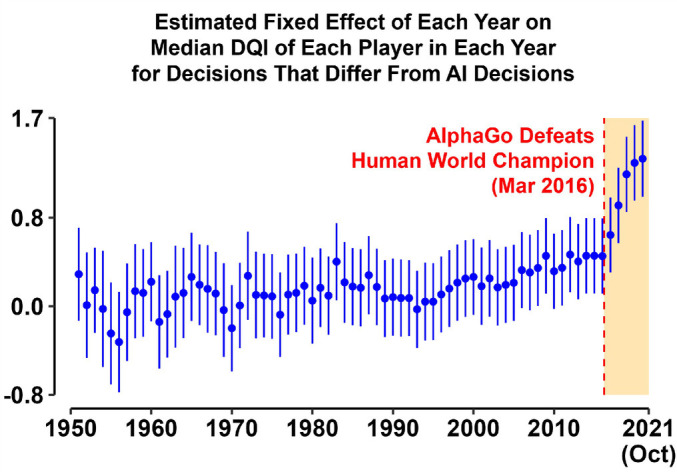
How will superhuman artificial intelligence (AI) affect human decision-making? And what will be the mechanisms behind this effect? We address these questions in a domain where AI already exceeds human performance, analyzing more than 5.8 million move decisions made by professional Go players over the past 71 y (1950 to 2021). To address the first question, we use a superhuman AI program to estimate the quality of human decisions across time, generating 58 billion counterfactual game patterns and comparing the win rates of actual human decisions with those of counterfactual AI decisions. We find that humans began to make significantly better decisions following the advent of superhuman AI. We then examine human players' strategies across time and find that novel decisions (i.e., previously unobserved moves) occurred more frequently and became associated with higher decision quality after the advent of superhuman AI. Our findings suggest that the development of superhuman AI programs may have prompted human players to break away from traditional strategies and induced them to explore novel moves, which in turn may have improved their decision-making.
Overview
The claims and statistics of this paper haven’t been checked yet.
Free: it reads the open-access text and checks the first 5 claims that cite a source we can check. Create a free account to check every claim.
Integrity signals
Registry
Cites
Statistics
Figures


Verification
Claims the paper makes
The claims and statistics of this paper haven’t been checked yet.
Free: it reads the open-access text and checks the first 5 claims that cite a source we can check. Create a free account to check every claim.
Claims other papers make about this one
Each is checked against this paper’s own text: does it say what the citing paper says it does?
The source backs part of the claim, not all of it — or backs it for a different population, condition or comparison.
In the citing paper
“A similar pattern was previously observed for AlphaGo, which has led humans to become better players in the board game Go (Shin et al. 2023).”
From Generative AI (2024) · cites this paper as Shin et al. 2023
Experimental — accuracy not yet measuredIn the citing paper
“The innovations generated by AlphaGo and AlphaGo Zero soon entered human culture, as shown by research comparing human gameplay before and after the algorithms' introduction 31 .”
From Machine culture (2023) · cites this paper as [31]
Self-check
Percentages, sums and reported differences re-computed from the paper’s own numbers.
The self-check needs the paper’s full text.
Citations
Cites
LeCun, Y., Bengio, Y., & Hinton, G. (2015) · Nature · doi:10.1038/nature14539 · Cited by 84,126
Highly accurate protein structure prediction with AlphaFold
Jumper, J., Evans, R., Pritzel, A., Green, T., Figurnov, M., Ronneberger, O., Tunyasuvunakool, K., Bates, R., Žídek, A., Potapenko, A., et al. (2021) · Nature · doi:10.1038/s41586-021-03819-2 · Cited by 43,764
Language Models are Few-Shot Learners
Brown, T. B., Mann, B., Ryder, N., Subbiah, M., Kaplan, J., Dhariwal, P., Neelakantan, A., Shyam, P., Sastry, G., Askell, A., et al. (2020) · arXiv · doi:10.48550/arxiv.2005.14165 · Cited by 23,372 · cited 1×
“, ChatGPT based on GPT-3) (4), and natural sciences (e.”
Kaugeranna, R., Kaugeranna, E., & Aion, (. S. 4. 6. (2023) · DROPS (Schloss Dagstuhl – Leibniz Center for Informatics) · doi:10.4230/lipics.giscience.2023.43 · Cited by 13,690
Mastering the game of Go without human knowledge
Silver, D., Schrittwieser, J., Simonyan, K., Antonoglou, I., Huang, A., Guez, A., Hubert, T., Baker, L., Lai, M., Bolton, A., et al. (2017) · Nature · doi:10.1038/nature24270 · Cited by 9,084 · cited 1×
“human decisions are available and where the advent of superhuman AI (7) can be connected to a”
Not by Genes Alone: How Culture Transformed Human Evolution
Levinson, M. H. (2006) · ETC.: A Review of General Semantics · doi:10.66774/etc_6303_351 · Cited by 3,553 · cited 1×
“This literature shows that there is no guarantee that human decision-making will improve in response to innovations, despite the human ability to accumulate knowledge within and across generations (8, 9).”
International evaluation of an AI system for breast cancer screening
McKinney, S. M., Sieniek, M., Godbole, V., Godwin, J., Antropova, N., Ashrafian, H., Back, T., Chesus, M., Corrado, G. S., Darzi, A., et al. (2020) · Nature · doi:10.1038/s41586-019-1799-6 · Cited by 3,287 · cited 2×
“, diagnosing diseases) (2), transportation (e.”
The cultural niche: Why social learning is essential for human adaptation
Boyd, R., Richerson, P. J., & Henrich, J. (2011) · Proceedings of the National Academy of Sciences · doi:10.1073/pnas.1100290108 · Cited by 1,303
Creativity and artificial intelligence
Boden, M. A. (1998) · Artificial Intelligence · doi:10.1016/s0004-3702(98)00055-1 · Cited by 846
Why Copy Others? Insights from the Social Learning Strategies Tournament
Rendell, L., Boyd, R., Cownden, D., Enquist, M., Eriksson, K., Feldman, M. W., Fogarty, L., Ghirlanda, S., Lillicrap, T., & Laland, K. N. (2010) · Science · doi:10.1126/science.1184719 · Cited by 811 · cited 1×
“Often, cumulative cultural evolution does occur, as superior forms of decision-making are transferred from one group of individuals to another (10, 11).”
Inflexibility of experts—Reality or myth? Quantifying the Einstellung effect in chess masters
Bilalić, M., McLeod, P., & Gobet, F. (2008) · Cognitive Psychology · doi:10.1016/j.cogpsych.2007.02.001 · Cited by 229
Iterated learning: Intergenerational knowledge transmission reveals inductive biases
Kalish, M. L., Griffiths, T. L., & Lewandowsky, S. (2007) · Psychonomic Bulletin & Review · doi:10.3758/bf03194066 · Cited by 220
Self-citationCumulative cultural learning: Development and diversity
Legare, C. H. (2017) · Proceedings of the National Academy of Sciences · doi:10.1073/pnas.1620743114 · Cited by 173
Accelerating Self-Play Learning in GoPreprint
Wu, D. (2019) · arXiv (Cornell University) · doi:10.48550/arxiv.1902.10565 · Cited by 122
Does Explainable Artificial Intelligence Improve Human Decision-Making?
Alufaisan, Y., Marusich, L. R., Bakdash, J. Z., Zhou, Y., & Kantarcioglu, M. (2021) · Proceedings of the AAAI Conference on Artificial Intelligence · doi:10.1609/aaai.v35i8.16819 · Cited by 106
Superhuman Artificial Intelligence Can Improve Human Decision Making by Increasing Novelty
Shin, M., Kim, J., van Opheusden, B., & Griffiths, T. L. (2023) · doi:10.31234/osf.io/rn3vx · Cited by 106
Self-citationHow Does AI Improve Human Decision-Making? Evidence from the AI-Powered Go Program
Choi, S., Kang, H., Kim, N., & Kim, J. (2021) · Strategic Management Journal · doi:10.1002/smj.3694 · Cited by 104
Self-citationCascetta, E., Cartenì, A., & Francesco, L. D. (2021) · Transportation Research Part C Emerging Technologies · doi:10.1016/j.trc.2021.103499 · Cited by 90
Artificial intelligence can improve decision-making in infection management
Rawson, T. M., Ahmad, R., Toumazou, C., Georgiou, P., & Holmes, A. H. (2019) · Nature Human Behaviour · doi:10.1038/s41562-019-0583-9 · Cited by 74
(1993) · Choice Reviews Online · doi:10.5860/choice.30-4160 · Cited by 68
How Artificial Intelligence Can Help Us Understand Human Creativity
Gobet, F., & Sala, G. (2019) · Frontiers in Psychology · doi:10.3389/fpsyg.2019.01401 · Cited by 58
Leveraging artificial intelligence to improve people’s planning strategies
Callaway, F., Jain, Y., van Opheusden, B., Das, P., Iwama, G., Gul, S., Krueger, P. M., Becker, F., Griffiths, T. L., & Lieder, F. (2022) · Proceedings of the National Academy of Sciences · doi:10.1073/pnas.2117432119 · Cited by 43
Self-citationStrategic social learning and the population dynamics of human behavior: the game of Go
Beheim, B., Thigpen, C. G., & McElreath, R. L. (2014) · Evolution and Human Behavior · doi:10.1016/j.evolhumbehav.2014.04.001 · Cited by 42
Chassy, P., & Gobet, F. R. (2011) · PLoS ONE · doi:10.1371/journal.pone.0026692 · Cited by 41 · cited 1×
“As is commonly done in the chess community (19), we can find in each game the first move that makes the game’s move sequence historically novel (20, 21).”
Human biases limit cumulative innovation
Thompson, B., & Griffiths, T. L. (2021) · Proceedings of the Royal Society B: Biological Sciences · doi:10.1098/rspb.2020.2752 · Cited by 40 · cited 1×
“However, at times, intrinsic biases and frictions in human learning can delay or derail such process (12, 13).”
Self-citationBoosting Human Decision-making with AI-Generated Decision Aids
Becker, F., Skirzyński, J., van Opheusden, B., & Lieder, F. (2022) · Computational Brain & Behavior · doi:10.1007/s42113-022-00149-y · Cited by 34
Does Explainable Artificial Intelligence Improve Human Decision-Making?
Alufaisan, Y., Marusich, L. R., Bakdash, J. Z., Zhou, Y., & Kantarcioglu, M. (2020) · doi:10.31234/osf.io/d4r9t · Cited by 30
How Does AI Improve Human Decision-Making? Evidence from the AI-Powered Go Program
Choi, S., Kim, N., Kim, J., & Kang, H. (2021) · SSRN Electronic Journal · doi:10.2139/ssrn.3893835 · Cited by 30
Self-citationHybrid social learning in human-algorithm cultural transmission
Brinkmann, L., Gezerli, D., Kleist, K. V., Müller, T. F., Rahwan, I., & Pescetelli, N. (2022) · Philosophical Transactions of the Royal Society A: Mathematical, Physical and Engineering Sciences · doi:10.1098/rsta.2020.0426 · Cited by 24
What does AI’s success playing complex board games tell brain scientists?
Purves, D. (2019) · Proceedings of the National Academy of Sciences · doi:10.1073/pnas.1909565116 · Cited by 8 · cited 1×
“The increasing availability of superhuman AI systems opens exciting new frontiers for studying human cognition (28).”
kim: A Toolkit for Behavioral Scientists
Kim, J. (2020) · doi:10.32614/cran.package.kim · Cited by 4
Self-citationGriffiths, T. L., Shin, M., Kim, J., & van Opheusden, B. (2023) · OSF Preprints (OSF Preprints) · doi:10.17605/osf.io/5cdma · Cited by 1
Self-citation
Research works printed but not linked: 2
- G. Burgess, The Mammoth Book of Chess (Constable& Robinson, Ltd., 2009), pp. 924–929.
- M. Shin, J. Kim, M. Kim, “Human learning from artificial intelligence: Evidence from human Go players’ decisions after AlphaGo” in Proceedings of the Annual Meeting of the Cognitive Science Society (2021), vol. 43.
Cited by
Feuerriegel, S., Hartmann, J., Janiesch, C., & Zschech, P. (2024) · Business & Information Systems Engineering · doi:10.1007/s12599-023-00834-7 · Cited by 2,267
“A similar pattern was previously observed for AlphaGo, which has led humans to become better players in the board game Go (Shin et al., 2023).”
Generative artificial intelligence, human creativity, and art
Zhou, E., & Lee, D. (2024) · PNAS Nexus · doi:10.1093/pnasnexus/pgae052 · Cited by 459
Extending Minds with Generative AI
Clark, A. (2025) · Nature Communications · doi:10.1038/s41467-025-59906-9 · Cited by 174
Brinkmann, L., Baumann, F., Bonnefon, J.-F., Derex, M., Müller, T. F., Nussberger, A.-M., Czaplicka, A., Acerbi, A., Griffiths, T. L., Henrich, J., et al. (2023) · Nature Human Behaviour · doi:10.1038/s41562-023-01742-2 · Cited by 132
“The innovations generated by AlphaGo and AlphaGo Zero soon entered human culture, as shown by research comparing human gameplay before and after the algorithms’ introduction 31 .”
BackgroundSelf-citationA new sociology of humans and machines
Tsvetkova, M., Yasseri, T., Pescetelli, N., & Werner, T. (2024) · Nature Human Behaviour · doi:10.1038/s41562-024-02001-8 · Cited by 188
“An analysis of professional Go players’ moves over 71 years suggests that AlphaGo, the AI program Google DeepMind introduced in 2016, led human players to new strategies and improved their decision-making 138–140 .”
Metadata
- Authors
- Shin, M., Kim, J., van Opheusden, B., & Griffiths, T. L.
- Affiliations
- City University of Hong Kong (HK)
- Tongji University (CN)
- Department of Psychology, Princeton University, Princeton, NJ 08540
- Princeton University (US)
- Corresponding author
- Shin, Minkyu
- Kim, Jin
- Venue
- Proceedings of the National Academy of Sciences
- Publisher
- National Academy of Sciences
- Published
- 2023-03-13
- Volume
- 120
- Issue
- 12
- Pages
- e2214840120-e2214840120
- ISSN
- 0027-8424 (ISSN-L)
- 1091-6490
- PMC
- PMC10041097
- OpenAlex
- W4324028585
- Cited by
- 106
- References
- 33
- Citations by year
- 2026: 30 · 2025: 37 · 2024: 25 · 2023: 14
- FWCI
- 9.99
- Type
- journal article
- Language
- en
- Open access
- hybrid
- doi.org
- Licence
- Locations
- Proceedings of the National Academy of Sciences (publishedVersion, cc-by-nc-nd)
- PubMed Central (publishedVersion, cc-by-nc-nd)
- PubMed (publishedVersion)
- RePEc: Research Papers in Economics (submittedVersion)
- arXiv (Cornell University) (submittedVersion)
- CityU Scholars (submittedVersion, cc-by-nc-nd)
- PsyArXiv (OSF Preprints) (submittedVersion, cc-by)
- PsyArXiv (OSF Preprints) (submittedVersion)
- arXiv (Cornell University)
- Topics
- Physical Sciences › Computer Science › Artificial Intelligence › Artificial Intelligence in Games
- Physical Sciences › Computer Science › Artificial Intelligence › Artificial Intelligence Applications
- Social Sciences › Psychology › Developmental and Educational Psychology › Sport Psychology and Performance
- Keywords
- human decision-making, Go, novelty, counterfactual analysis, human-AI interaction, professional Go players, game strategy
- MeSH terms
- Artificial Intelligence, Decision Making, Humans
About these checks
Registry, retraction, Cites and statistics results are computed, not judged, with one exception: a printed reference that no index lists is read once by a model before it counts as a citation error. Claims are extracted by a model and kept only when their quote appears verbatim in the text; each cited source is then checked, with a model’s help, for whether it says what the claim relies on. Those verdicts can be wrong — read the claim’s quote and the cited source before relying on one.
Statistics and arithmetic are recomputed, not judged.
Confidence bands are shown only for fields calibrated on our annotated test set. None is calibrated yet, so no band is shown.
What counts as a claim ›How we measure confidence ›How we check this ›
Are you an author, or do you see a problem with this page? Request a review
Data sources
Bibliographic data: Semantic Scholar, OpenAlex, Crossref.
Contains information from the Semantic Scholar Academic Graph Datasets, made available under the ODC Attribution License (ODC-BY 1.0).
Semantic Scholar’s data is described in: Kinney, R., et al. (2023). The Semantic Scholar Open Data Platform. arXiv:2301.10140.
