

Superhuman artificial intelligence can improve human decision-making by increasing novelty
Open accessPublished version of a preprint
The DOI matches its Crossref record; 32 of the 33 references it cites were found in a registry or an index.
Abstract
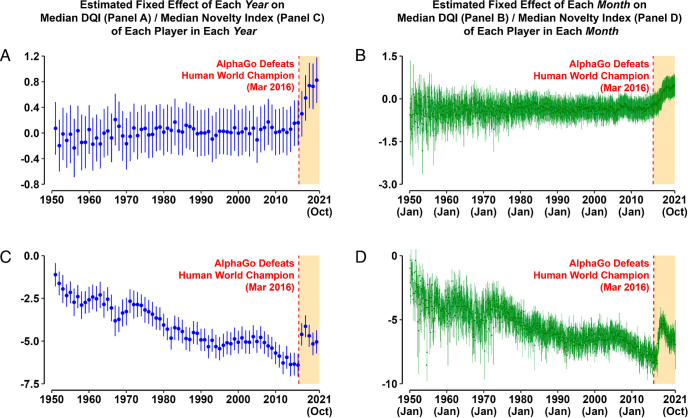
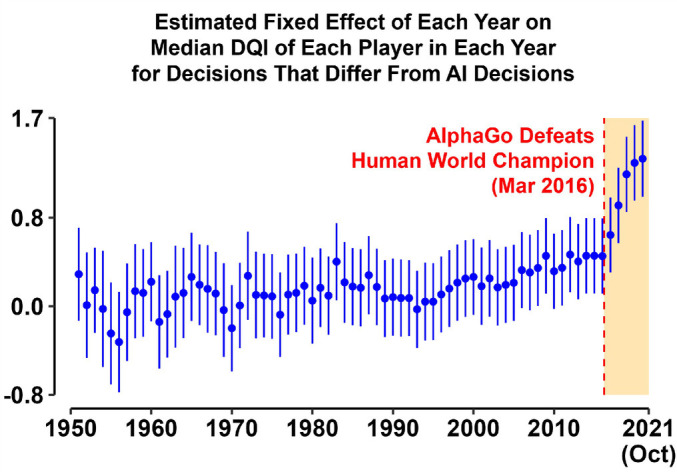
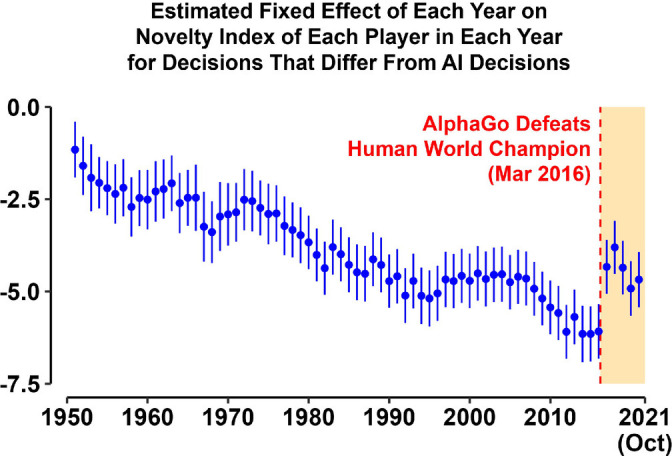
How will superhuman artificial intelligence (AI) affect human decision-making? And what will be the mechanisms behind this effect? We address these questions in a domain where AI already exceeds human performance, analyzing more than 5.8 million move decisions made by professional Go players over the past 71 y (1950 to 2021). To address the first question, we use a superhuman AI program to estimate the quality of human decisions across time, generating 58 billion counterfactual game patterns and comparing the win rates of actual human decisions with those of counterfactual AI decisions. We find that humans began to make significantly better decisions following the advent of superhuman AI. We then examine human players' strategies across time and find that novel decisions (i.e., previously unobserved moves) occurred more frequently and became associated with higher decision quality after the advent of superhuman AI. Our findings suggest that the development of superhuman AI programs may have prompted human players to break away from traditional strategies and induced them to explore novel moves, which in turn may have improved their decision-making.
Overview
The claims and statistics of this paper haven’t been checked yet.
Free: it reads the open-access text and checks the first 5 claims that cite a source we can check. Create a free account to check every claim.
Integrity signals
Registry
Cites
Statistics
Figures
Verification
Claims the paper makes
The claims and statistics of this paper haven’t been checked yet.
Free: it reads the open-access text and checks the first 5 claims that cite a source we can check. Create a free account to check every claim.
Claims other papers make about this one
Each is checked against this paper’s own text: does it say what the citing paper says it does?
The source backs part of the claim, not all of it — or backs it for a different population, condition or comparison.
In the citing paper
“A similar pattern was previously observed for AlphaGo, which has led humans to become better players in the board game Go (Shin et al. 2023).”
From Generative AI (2024) · cites this paper as Shin et al. 2023
Experimental — accuracy not yet measuredIn the citing paper
“The innovations generated by AlphaGo and AlphaGo Zero soon entered human culture, as shown by research comparing human gameplay before and after the algorithms' introduction 31 .”
From Machine culture (2023) · cites this paper as [31]
Self-check
Percentages, sums and reported differences re-computed from the paper’s own numbers.
The self-check needs the paper’s full text.
Citations
Cites
LeCun, Y., Bengio, Y., & Hinton, G. (2015) · Nature · doi:10.1038/nature14539 · Cited by 84,126
Highly accurate protein structure prediction with AlphaFold
Jumper, J., Evans, R., Pritzel, A., Green, T., Figurnov, M., Ronneberger, O., Tunyasuvunakool, K., Bates, R., Žídek, A., Potapenko, A., et al. (2021) · Nature · doi:10.1038/s41586-021-03819-2 · Cited by 43,764
Language Models are Few-Shot Learners
Brown, T. B., Mann, B., Ryder, N., Subbiah, M., Kaplan, J., Dhariwal, P., Neelakantan, A., Shyam, P., Sastry, G., Askell, A., et al. (2020) · arXiv · doi:10.48550/arxiv.2005.14165 · Cited by 23,372 · cited 1×
“, ChatGPT based on GPT-3) (4), and natural sciences (e.”
Kaugeranna, R., Kaugeranna, E., & Aion, (. S. 4. 6. (2023) · DROPS (Schloss Dagstuhl – Leibniz Center for Informatics) · doi:10.4230/lipics.giscience.2023.43 · Cited by 13,690
Mastering the game of Go without human knowledge
Silver, D., Schrittwieser, J., Simonyan, K., Antonoglou, I., Huang, A., Guez, A., Hubert, T., Baker, L., Lai, M., Bolton, A., et al. (2017) · Nature · doi:10.1038/nature24270 · Cited by 9,084 · cited 1×
“human decisions are available and where the advent of superhuman AI (7) can be connected to a”
Not by Genes Alone: How Culture Transformed Human Evolution
Levinson, M. H. (2006) · ETC.: A Review of General Semantics · doi:10.66774/etc_6303_351 · Cited by 3,553 · cited 1×
“This literature shows that there is no guarantee that human decision-making will improve in response to innovations, despite the human ability to accumulate knowledge within and across generations (8, 9).”
International evaluation of an AI system for breast cancer screening
McKinney, S. M., Sieniek, M., Godbole, V., Godwin, J., Antropova, N., Ashrafian, H., Back, T., Chesus, M., Corrado, G. S., Darzi, A., et al. (2020) · Nature · doi:10.1038/s41586-019-1799-6 · Cited by 3,287 · cited 2×
“, diagnosing diseases) (2), transportation (e.”
The cultural niche: Why social learning is essential for human adaptation
Boyd, R., Richerson, P. J., & Henrich, J. (2011) · Proceedings of the National Academy of Sciences · doi:10.1073/pnas.1100290108 · Cited by 1,303
Creativity and artificial intelligence
Boden, M. A. (1998) · Artificial Intelligence · doi:10.1016/s0004-3702(98)00055-1 · Cited by 846
Why Copy Others? Insights from the Social Learning Strategies Tournament
Rendell, L., Boyd, R., Cownden, D., Enquist, M., Eriksson, K., Feldman, M. W., Fogarty, L., Ghirlanda, S., Lillicrap, T., & Laland, K. N. (2010) · Science · doi:10.1126/science.1184719 · Cited by 811 · cited 1×
“Often, cumulative cultural evolution does occur, as superior forms of decision-making are transferred from one group of individuals to another (10, 11).”
Research works printed but not linked: 2
- G. Burgess, The Mammoth Book of Chess (Constable& Robinson, Ltd., 2009), pp. 924–929.
- M. Shin, J. Kim, M. Kim, “Human learning from artificial intelligence: Evidence from human Go players’ decisions after AlphaGo” in Proceedings of the Annual Meeting of the Cognitive Science Society (2021), vol. 43.
Cited by
Feuerriegel, S., Hartmann, J., Janiesch, C., & Zschech, P. (2024) · Business & Information Systems Engineering · doi:10.1007/s12599-023-00834-7 · Cited by 2,267
“A similar pattern was previously observed for AlphaGo, which has led humans to become better players in the board game Go (Shin et al., 2023).”
Generative artificial intelligence, human creativity, and art
Zhou, E., & Lee, D. (2024) · PNAS Nexus · doi:10.1093/pnasnexus/pgae052 · Cited by 459
Extending Minds with Generative AI
Clark, A. (2025) · Nature Communications · doi:10.1038/s41467-025-59906-9 · Cited by 174
Brinkmann, L., Baumann, F., Bonnefon, J.-F., Derex, M., Müller, T. F., Nussberger, A.-M., Czaplicka, A., Acerbi, A., Griffiths, T. L., Henrich, J., et al. (2023) · Nature Human Behaviour · doi:10.1038/s41562-023-01742-2 · Cited by 132
“The innovations generated by AlphaGo and AlphaGo Zero soon entered human culture, as shown by research comparing human gameplay before and after the algorithms’ introduction 31 .”
BackgroundSelf-citationA new sociology of humans and machines
Tsvetkova, M., Yasseri, T., Pescetelli, N., & Werner, T. (2024) · Nature Human Behaviour · doi:10.1038/s41562-024-02001-8 · Cited by 189
“An analysis of professional Go players’ moves over 71 years suggests that AlphaGo, the AI program Google DeepMind introduced in 2016, led human players to new strategies and improved their decision-making 138–140 .”
Huang, Y., Gomaa, A., Semrau, S., Haderlein, M., Lettmaier, S., Weissmann, T., Grigo, J., Tkhayat, H. B., Frey, B., Gaipl, U., et al. (2023) · Frontiers in Oncology · doi:10.3389/fonc.2023.1265024 · Cited by 112
“Therefore, such general artificial intelligence like ChatGPT can in turn improve human decisionmaking by increasing novelty (48).”
BackgroundTraining with AI: Evidence from chess computers
Gaessler, F., & Piezunka, H. (2023) · Strategic Management Journal · doi:10.1002/smj.3512 · Cited by 97
“Actors learn from competitors (Posen et al., 2023; Ross & Sharapov, 2015), peers (Hallen et al., 2020; Tortoriello et al., 2012), teammates (Kim et al., 2023), partners (Ahuja, 2000; Powell et al., 1996), and others.”
BackgroundMethodSchrier, J., Norquist, A. J., Buonassisi, T., & Brgoch, J. (2023) · Journal of the American Chemical Society · doi:10.1021/jacs.3c04783 · Cited by 118
A new sociology of humans and machines
Tsvetkova, M., Yasseri, T., Pescetelli, N., & Werner, T. (2024) · arXiv · doi:10.48550/arxiv.2402.14410 · Cited by 83
“An analysis of professional Go players’ moves over 71 years suggests that AlphaGo, the AI program Google DeepMind introduced in 2016, led human players to new strategies and improved their decision-making 138–140 .”
Ideation with Generative AI—in Consumer Research and Beyond
Freitas, J. D., Nave, G., & Puntoni, S. (2025) · Journal of Consumer Research · doi:10.1093/jcr/ucaf012 · Cited by 90
The Roles of Artificial Intelligence in Teaching Anatomy: A Systematic Review
Joseph, T. S., Gowrie, S., Montalbano, M. J., Bandelow, S., Clunes, M. T., Dumont, A. S., Iwanaga, J., Tubbs, R. S., & Loukas, M. (2025) · Clinical Anatomy · doi:10.1002/ca.24272 · Cited by 73
THE IMPACT OF ARTIFICIAL INTELLIGENCE IN DECISION MAKING: A COMPREHENSIVE REVIEW
Balbaa, M. E., & Abdurashidova, M. S. (2024) · EPRA International Journal of Economics Business and Management Studies · doi:10.36713/epra15747 · Cited by 92
Humanoid Robots and Humanoid AI: Review, Perspectives and Directions
Cao, L. (2025) · ACM Computing Surveys · doi:10.1145/3770574 · Cited by 90
Nigar, M., Juli, J. F., Golder, U., Alam, M., & Hossain, M. K. (2025) · Journal of Open Innovation Technology Market and Complexity · doi:10.1016/j.joitmc.2025.100607 · Cited by 68
The Responsible Development of Automated Student Feedback with Generative AI
Lindsay, E. D., Zhang, M., Johri, A., & Bjerva, J. (2025) · IEEE Global Engineering Education Conference (EDUCON) · doi:10.1109/educon62633.2025.11016572 · Cited by 53
“Interestingly, [44] find that access to superhuman AIs drastically changed the playing field among professional Go players, based on data from the 20th and 21st centuries.”
Palacios‐Huerta, I. (2025) · Journal of Economic Literature · doi:10.1257/jel.20241616 · Cited by 45
Zhang, Y., & Pan, W. (2025) · Interactive Learning Environments · doi:10.1080/10494820.2025.2468972 · Cited by 32
Chen, L., Zhang, Y., Feng, J., Chai, H., Zhang, H., Fan, B., Ma, Y., Zhang, S., Li, N., Liu, T., et al. (2026) · Humanities and Social Sciences Communications · doi:10.1057/s41599-026-07316-7 · Cited by 37
“In chess games, when AI agents are evolving by training on human responses, human strategy evolution has also been accelerated through exposure to AI innovations [137].”
A large-scale comparison of divergent creativity in humans and large language models
Wang, D., Huang, D., Shen, H., & Uzzi, B. (2025) · Nature Human Behaviour · doi:10.1038/s41562-025-02331-1 · Cited by 47
Hafez, M. B., Immisch, T., Weber, T., & Wermter, S. (2023) · Frontiers in Neurorobotics · doi:10.3389/fnbot.2023.1127642 · Cited by 28
“Furthermore, it has been shown that superhuman artificial intelligence programs built using these newer algorithms contribute to improvements in human decision-making by encouraging novelty in human decisions (Shin et al., 2023).”
BackgroundHuman-AI cognitive teaming: using AI to support state-level decision making on the resort to force
Vold, K. (2024) · Australian Journal Of International Affairs · doi:10.1080/10357718.2024.2327383 · Cited by 26
Replace, augment, disrupt: AI & organizational decision-making
Page, S. E., & Kallapur, A. (2025) · Journal of Organization Design · doi:10.1007/s41469-025-00194-4 · Cited by 25
“Once human players understood those strategies, humans were able to refine them and create even more novel moves (Shin et al. 2023).”
Generative AI, Human Creativity, and Art
Zhou, E., & Lee, D. (2023) · doi:10.2139/ssrn.4594824 · Cited by 19
Fundamental Components of Deep Learning: A category-theoretic approachPreprint
Gavranović, B. (2024) · arXiv (Cornell University) · doi:10.48550/arxiv.2403.13001 · Cited by 24
Keep the Faith: Faithful Explanations in Convolutional Neural Networks for Case-Based Reasoning
Wolf, T. N., Bongratz, F., Rickmann, A.-M., Pölsterl, S., & Wachinger, C. (2024) · Proceedings of the AAAI Conference on Artificial Intelligence · doi:10.1609/aaai.v38i6.28406 · Cited by 28
AI-induced hyper-learning in humans
Glickman, M., & Sharot, T. (2024) · Current Opinion in Psychology · doi:10.1016/j.copsyc.2024.101900 · Cited by 23
Vicente, L., Matute, H., Fregosi, C., & Cabitza, F. (2025) · International Journal of Human-Computer Studies · doi:10.1016/j.ijhcs.2025.103474 · Cited by 18
Zhang, C., Shan, G., Roh, B., & Jiang, J. (2025) · IEEE Transactions on Consumer Electronics · doi:10.1109/tce.2025.3603592 · Cited by 21
“In addition, how to effectively personalize and optimize large models while guaranteeing privacy is still an unsolved problem [39].”
Who expands the human creative frontier with generative AI: Hive minds or masterminds?
Zhou, E., Lee, D., & Gu, B. (2025) · Science Advances · doi:10.1126/sciadv.adu5800 · Cited by 28
Outperformed by AI: Interacting with Superhuman AI Changes the Way We Perceive Ourselves
Schaap, G., van de Sande, Y., & Schraffenberger, H. (2024) · CHI Conference Extended Abstracts on Human Factors in Computing Systems (CHI EA) · doi:10.1145/3613905.3650961 · Cited by 17
“Recent research also hints advances in AI are not only a threat to humans, as the advent of superhuman AI may have led to improved human decision-making [41].”
BackgroundRomero, P., Fitz, S., & Nakatsuma, T. (2023) · Research Square · doi:10.21203/rs.3.rs-2717108/v1 · Cited by 17
“…“who” [16] a LLM is into “how many” [25], which hopefully will contribute to our understanding of human beings, as happened with Go players, who learned from AlphaGo’s overwhelming victory, and became better players subsequently [44], thus contributing to the advent of substrate-free psychometrics.”
Generative AI and collaboration: opportunities for cultivating collective intelligence
Woolley, A. W. (2025) · Journal of Organization Design · doi:10.1007/s41469-025-00199-z · Cited by 13
“This capacity creates opportunities for teams to innovate and solve problems more effectively (Shin et al. 2023).”
Artificial intelligence and corporate innovation: A perspective based on supply chain resilience
Cao, M., Li, Y., & Chen, L. (2025) · International Review of Financial Analysis · doi:10.1016/j.irfa.2025.104720 · Cited by 16
Migliorini, S. (2024) · European Journal of Risk Regulation · doi:10.1017/err.2024.4 · Cited by 13
The Impact of Artificial Intelligence on Small and Medium Enterprises in Yogyakarta
Mariyana, A. L. D., Annaufal, A. I., & Roostika, R. (2024) · Emerald Group Publishing Limited eBooks · doi:10.1108/s1479-351220240000036031 · Cited by 12
Dynamic Reinforcement Learning for Optimal Go AI Training: Adaptive Adjustment and Optimization
Zhang, C., Shan, G., Lim, J., & Roh, B. (2024) · IEEE Transactions on Consumer Electronics · doi:10.1109/tce.2024.3487141 · Cited by 15
“For instance, the top-5 accuracy is more over twice as high as [29], even though the inception-V1 parameters are just 5 million, or 1/12 of AlexNet.”
Computers and chess masters: The role of AI in transforming elite human performance
Bilalić, M., Graf, M., & Vaci, N. (2024) · British Journal of Psychology · doi:10.1111/bjop.12750 · Cited by 15
“These effects were certainly less pronounced than those observed in Go studies (Choi et al., 2023; Shin et al., 2021, 2023), where the impact of freely available engines based on AlphaZero was quite dramatic immediately following their release.”
InfluentialA Survey of Human Intelligence Augmented Artificial Intelligence: An Autonomous Driving Perspective
Li, S., Yuan, K., Tang, Z., Zhang, Y., Ji, P., Ge, Q., Du, S., Huang, Y., & Chen, H. (2025) · Automotive Innovation · doi:10.1007/s42154-025-00361-z · Cited by 15
“Superhuman AI [210, 211] has been impactful in domains such as chess.”
Song, X., Xu, L., Peng, C., Pan, S., Adibi, A., Wang, X., & Lu, Z. (2025) · Behaviour and Information Technology · doi:10.1080/0144929x.2025.2459267 · Cited by 17
Yu, H., Evans, J. A., & Varshney, L. R. (2023) · Journal of Artificial Intelligence Research · doi:10.1613/jair.1.14277 · Cited by 15
“Algorithmic insights gained can not only provide data scientists and engineers with more guidance in tuning a black-box model to its best performance, but also enable people to learn from high-performance AIs, such as acquiring new wisdom from AlphaGo (Shin et al., 2023).”
Generative AI, Platform Stances, and Content Creator Behavior
Huang, H., Fu, R., & Ghose, A. (2026) · Information Systems Research · doi:10.1287/isre.2025.2155 · Cited by 14
The dual edges of AI: Advancing knowledge while reducing diversity
Choi, S., Kang, H., Kim, N., & Kim, J. (2025) · PNAS Nexus · doi:10.1093/pnasnexus/pgaf138 · Cited by 11
“Third, our paper reveals implications for scientists in effectively utilizing AI, particularly in the realm of “artificial superintelli-gence” — an area where AI’s capabilities surpass human performance in complex cognitive tasks (28 – 30 , 36).”
Self-citationZhang, S., Qian, Y., Yao, Z., Ni, Z., & Zhang, Y. (2025) · Telematics and Informatics · doi:10.1016/j.tele.2025.102313 · Cited by 10
Generative AI adoption in human creative tasks: Experimental evidence
Zhu, F., & Zou, W. (2026) · Journal of Economic Behavior & Organization · doi:10.1016/j.jebo.2026.107414 · Cited by 9
Decoding university–industry collaboration: A SEM-ANN quadruple helix approach
Hossen, M. A., Misbauddin, S. M., Molla, C., Nabi, M. N. U., & Sakib, N. (2025) · Future Business Journal · doi:10.1186/s43093-025-00655-y · Cited by 9
“[69] measured the performance of quadruple helix approach in Finnish research sector by examining the research outputs by focusing on Altmetrics.”
AI agents are ‘aeroplanes for the mind’: five ways to ensure that scientists are responsible pilots
Wang, D. (2026) · Nature · doi:10.1038/d41586-026-00665-y · Cited by 8
Overconfident AI: how artificial intelligence navigates risk and uncertainty
Hong, S., & Lee, S. (2025) · Journal of Psychology and AI · doi:10.1080/29974100.2025.2486974 · Cited by 9
Sheng, Y. (2024) · Applied and Computational Engineering · doi:10.54254/2755-2721/34/20230290 · Cited by 7
Mutual benefits of social learning and algorithmic mediation for cumulative culture
Czaplicka, A., Baumann, F., & Rahwan, I. (2025) · Journal of The Royal Society Interface · doi:10.1098/rsif.2024.0686 · Cited by 7
“Previous research has found strong support for the ability of machines to also take part in the innovation process [61, 62], which future models of cultural evolution should take into account.”
Revealing Kinetic Features of a Macrocyclization Reaction Using Machine‐Learning‐Augmented Data
Isobe, H., Xiao, X., Fukunaga, T., & Ikemoto, K. (2025) · Angewandte Chemie International Edition · doi:10.1002/anie.202501365 · Cited by 6
The use of artificial intelligence in enhancing the quality of decisions in healthcare institutions
Durrah, O., Tawfik, O. I., & Aldhmour, F. M. (2024) · Elsevier eBooks · doi:10.1016/b978-0-443-21598-8.00017-8 · Cited by 6
Gouiaa, R., & Bazarna, A. (2023) · Corporate Governance and Organizational Behavior Review · doi:10.22495/cgobrv7i4sip4 · Cited by 5
“The political approach to the decision-making process in ITG, as opposed to the rational approach, relies primarily on the personal characteristics of the decision-maker (Shin et al., 2023).”
BackgroundOpening strategies in the game of go from feudalism to superhuman AI
Beheim, B. (2025) · Evolutionary Human Sciences · doi:10.1017/ehs.2025.10016 · Cited by 7
Dong, A., Li, P., Chen, Y., Gibson, S., Zhao, L., & He, M. (2026) · Sustainability · doi:10.3390/su18115313 · Cited by 9
Tong, J., Wang, S., Wang, G., Wang, Y., & Moraros, J. (2026) · npj Urban Sustainability · doi:10.1038/s42949-026-00377-2 · Cited by 6
Califano, G., & Caracciolo, F. (2026) · Food Quality and Preference · doi:10.1016/j.foodqual.2026.105930 · Cited by 5
Dream content discovery from social media using natural language processing
Das, A., Šćepanović, S., Aiello, L. M., Mallett, R., Barrett, D., & Quercia, D. (2025) · EPJ Data Science · doi:10.1140/epjds/s13688-025-00554-w · Cited by 5
Augmenting military decision making with artificial intelligence
Vold, K. (2025) · Cambridge Forum on AI Law and Governance · doi:10.1017/cfl.2025.10022 · Cited by 5
“…awareness of this gap, researchers have begun to think more about how AI-driven systems can support human decision making across a variety of domains (e.g., Becker et al., 2022; Choi, Kim, Kim & Kang, 2021; Echterhoff, Melkote, Kancherla & McAuley, 2024; Shin, Kim, van Opheusden & Griffiths, 2023).”
Go and the Brain: Cognitive and Neural Impacts of Training
Kim, K. W. (2025) · Psychiatry Investigation · doi:10.30773/pi.2024.0387 · Cited by 4
Open-Endedness is Essential for Artificial Superhuman Intelligence
Hughes, E., Dennis, M., Parker-Holder, J., Behbahani, F., Mavalankar, A., Shi, Y., Schaul, T., & Rocktaschel, T. (2024) · arXiv · doi:10.48550/arxiv.2406.04268 · Cited by 4
Dominitz, J., & Manski, C. F. (2026) · Theory and Decision · doi:10.1007/s11238-026-10150-7 · Cited by 3
“Much past research has described so-called superhuman artificial intelligence (AI) systems in specific contexts, such as a “superhuman AI program” for playing Go (Silver et al., 2017; Shin et al., 2023) and a “superhuman AI” poker player (Brown and Sandholm, 2019).”
Grundlagen der Künstlichen Intelligenz (KI)
Mockenhaupt, A. (2024) · Springer eBooks · doi:10.1007/978-3-658-41935-6_3 · Cited by 3
Abrar, M. M., Jia, X., & Chi, Y. (2025) · Physics in Medicine and Biology · doi:10.1088/1361-6560/ae2561 · Cited by 4
“Meanwhile, as demonstrated in the game of Go, the DRL-based AlphaGo Zero agent not only defeated top human players but also played an educational role by helping human players develop novel moves in challenging games (Shin et al 2023).”
Co-creative learning via Metropolis–Hastings interaction between humans and AI
Okumura, R., Taniguchi, T., Taniguchi, A., & Hagiwara, Y. (2026) · Advanced Robotics · doi:10.48550/arxiv.2506.15468 · Cited by 3
“We then test this formulation empirically through a case study involving a JA-NG where human-robot pairs categorize partially observable stimuli.”
Generative AI in Higher Education
Wrench, J. S., & Elmoudden, S. (2024) · Advances in educational technologies and instructional design book series · doi:10.4018/979-8-3693-0831-8.ch001 · Cited by 5
Farhadi, A. (2024) · Qeios · doi:10.32388/5k6umy · Cited by 3
The Proficiency Paradox: Generative AI, Governance Capacity, and Knowledge-Sharing SystemsPreprint
Shankar, R., & Sim, J. (2024) · SSRN Electronic Journal · doi:10.2139/ssrn.4867815 · Cited by 4
Learning from rewards and social information in naturalistic strategic behaviorPreprint
Kuperwajs, I., van Opheusden, B., Russek, E. M., & Griffiths, T. L. (2024) · PsyArXiv (OSF Preprints) · doi:10.31234/osf.io/d8zje · Cited by 4
Self-citationAI Finds A WayPreprint
Dharna, A., Lu, C., Sullivan, R., Lehman, J., Krakovna, V., & Clune, J. (2026) · arXiv (Cornell University) · doi:10.48550/arxiv.2608.23875 · Cited by 3
Cabitza, F., & Vicente, L. (2026) · International Journal of Human-Computer Studies · doi:10.1016/j.ijhcs.2026.103855 · Cited by 3
Public perceptions of AI energy consumption: Awareness, responsibility attribution, and strategies
Klesel, M., & Messer, U. (2026) · Electronic Markets · doi:10.1007/s12525-026-00908-w · Cited by 2
“…(GenAI), particularly multimodal systems like ChatGPT, is widely used in the gig economy and is rapidly proliferating across diverse sectors (Shin et al., 2023; Humlum & Vestergaard, 2025), offering remarkable performance that can enhance human productivity (Noy & Zhang, 2023; Brynjolfsson…”
Khairy, H. A., & Salama, W. (2026) · Discover Sustainability · doi:10.1007/s43621-026-03417-0 · Cited by 2
“First, existing studies predominantly emphasize negative employee reactions to AI adoption, including stress, job insecurity, and resistance [24, 46, 50].”
Taniguchi, T., Hayashi, Y., Hirose, M., Oka, M., Suzuki, K., Witkowski, O., & Tang, A. (2026) · Artificial Life · doi:10.1162/artl.a.475 · Cited by 2
Turing tests in chess: An experiment revealing the role of human subjectivity
Eisma, Y. B., Koerts, R., & de Winter, J. (2024) · Computers in Human Behavior Reports · doi:10.1016/j.chbr.2024.100496 · Cited by 3
Revealing Kinetic Features of a Macrocyclization Reaction Using Machine‐Learning‐Augmented Data
Isobe, H., Xiao, X., Fukunaga, T., & Ikemoto, K. (2025) · Angewandte Chemie · doi:10.1002/ange.202501365 · Cited by 2
Tracing the Thought of a Grandmaster-level Chess-Playing TransformerPreprint
Lin, R., Jin, Z., Zhou, G., Ge, X., Shu, W., Wu, J., Wang, J., He, Z., Zhang, J., & Qiu, X. (2026) · arXiv (Cornell University) · doi:10.48550/arxiv.2604.10158 · Cited by 2
“Our findings in LC0 also provide critical insight into superhuman reasoning systems and how humans might extract knowledge from inside (Shin et al., 2023).”
Cheney-Lippold, J. (2024) · Public Culture · doi:10.1215/08992363-11158965 · Cited by 1
Vicente, L., & Cabitza, F. (2025) · Lecture notes in computer science · doi:10.1007/978-3-031-93838-2_5 · Cited by 5
Farhadi, A. (2025) · Current Psychology · doi:10.1007/s12144-025-08072-8 · Cited by 1
Creativity, Imagination, and Artificial Intelligence
Langland‐Hassan, P. (2026) · Oxford University Press eBooks · doi:10.1093/9780197694855.003.0036 · Cited by 2
Meaningful Long-Term Thought Partnerships of Minds and Machines
Collins, K. M., Wong, L., Tenenbaum, J. B., & Fan, J. E. (2026) · Current Directions in Psychological Science · doi:10.1177/09637214251412712 · Cited by 3
“Herein, AI systems offer tremendous potential as new kinds of collaborators that can shape new strategies for thinking, such as how AI gameplay is influencing human-human gameplay strategies (Shin et al., 2023).”
Sailing forward: A review of contrasts and synergies between racing and robotic sailing
An, Y., Souppez, J.-B. R. G., Ge, Z., Peng, B., Zhang, M., Xu, G., & Ren, Z. (2026) · Journal of Ocean Engineering and Science · doi:10.1016/j.joes.2026.03.008 · Cited by 1
Stochastic parrot or not, it is less of a turkey than the colleague two desks over
Falegnami, A., Tomassi, A., Levorato, M., & Costantino, F. (2026) · AI & Society · doi:10.1007/s00146-026-03095-6 · Cited by 2
“The mechanism is cognitive provocation within the joint system (Shin et al. 2023).”
Propagation and preservation of AI-discovered problem-solving strategies in human culture
Brinkmann, L. U. L., Müller, T. F., Nußberger, A.-M., Derex, M., Bonati, S., Chirkov, V., & Rahwan, I. (2026) · Nature Communications · doi:10.1038/s41467-026-76113-2 · Cited by 3
“Recent evidence suggests that humans have signi fi cantly improved their own Go-play as a result of this innovation 4 , while more subtle shifts that appear less "alien" when viewed in historical context are also evident in Go opening moves 5 .”
Invariant Core, Changing Times: Rethinking Faculty Development for Teaching in the Generative AI Era
Ho, S. Y. (2026) · Frontiers of digital education. · doi:10.1007/s44366-027-0116-4 · Cited by 1
“An analysis of 5.8 million professional moves across seven decades found that the quality of human play improved after the advent of superhuman AI (Shin et al., 2023).”
InfluentialImagination, Creativity, and Artificial Intelligence
Langland‐Hassan, P. (2024) · PhilPapers (PhilPapers Foundation) · Cited by 2
Shin, M., Kim, J., & Shin, J. (2024) · PsyArXiv (OSF Preprints) · doi:10.31234/osf.io/fdzqg · Cited by 1
Self-citationLarge Language Models as symbolic DNA of cultural dynamicsPreprint
Pourdavood, P., Jacob, M., & Deacon, T. W. (2025) · arXiv (Cornell University) · doi:10.48550/arxiv.2506.21606 · Cited by 3
Use and Effects of LLMs in Peer Review: A Randomized Experiment and Survey at ICML 2026
Kim, S. S. Y., Deng, W. H., Vaughan, J. W., Su, B., Su, W., Agarwal, A., Li, S., Jaggi, M., Goldstein, D. G., Shah, N. B., et al. (2026) · arXiv · doi:10.48550/arxiv.2609.19420 · Cited by 6
“At the same time, other work suggests that AI assistance can, in some settings, help people make better judgments [79], or support learning and expertise development [30, 60, 86].”
Fairness and Bargaining Efficiency Under Deadlines: Experimental EvidencePreprint
Yoshida, M. (2023) · SSRN Electronic Journal · doi:10.2139/ssrn.4444042
Awareness-based Choice Selection: Improving Decision-making Efficiency by Using Known InformationPreprint
Farhadi, A. (2024) · Research Square · doi:10.21203/rs.3.rs-3824813/v1
Lei, Y. A. N. G., Weiyang, C. H. E. N., Zhu, Q., & Zhong, N. (2024) · Advances in Psychological Science · doi:10.3724/sp.j.1042.2024.00965
Beyond the Binary: AI, Ethics, and Liability in the Legal Landscape
Gunn-Rosas, C. L. (2024) · Texas A&M Journal of Property Law · doi:10.37419/jpl.v10.i3.2
Dalakoti, M., Wong, S., & Foo, R. (2024) · The Lancet Regional Health - Western Pacific · doi:10.1016/j.lanwpc.2024.101146
Comparative Study Between Team Decision Making and AI Decision Making: Implications for the Future
Szalay, Z. G., & Munnisunker, S. (2025) · Journal of Agricultural Informatics · doi:10.17700/jai.2025.16.1.754
Artificial Intelligence Upskills Human-Centric and Fundamental Computer Science KnowledgePreprint
Masi, P., Liu, Y., & Liu, C. (2025) · SSRN Electronic Journal · doi:10.2139/ssrn.5378737
How organizational AI adoption profits top leaders’ self-concept and behavior
Duan, J., Yao, X., Peluso, A. M., & Li, S. (2025) · European Management Journal · doi:10.1016/j.emj.2025.12.003
Multimorbidity measurement strategies for predicting hospital visits
Neves, B. D., Moreira, J. M., Gonçalves, S., Cerejo, J., Mota, I., Silva, N. A., Leite, F., & Silva, M. J. (2025) · BMC Health Services Research · doi:10.1186/s12913-025-13817-z
Herencia del sesgo: influencia de los sesgos de la Inteligencia Artificial en las decisiones humanas
Vicente Holgado, L. (2024) · Basque Digital Memory (Vital Foundation) · Cited by 1
Metadata
- Authors
- Shin, M., Kim, J., van Opheusden, B., & Griffiths, T. L.
- Affiliations
- City University of Hong Kong (HK)
- Tongji University (CN)
- Department of Psychology, Princeton University, Princeton, NJ 08540
- Princeton University (US)
- Corresponding author
- Shin, Minkyu
- Kim, Jin
- Venue
- Proceedings of the National Academy of Sciences
- Publisher
- National Academy of Sciences
- Published
- 2023-03-13
- Volume
- 120
- Issue
- 12
- Pages
- e2214840120-e2214840120
- ISSN
- 0027-8424 (ISSN-L)
- 1091-6490
- PMC
- PMC10041097
- OpenAlex
- W4324028585
- Cited by
- 106
- References
- 33
- Citations by year
- 2026: 30 · 2025: 37 · 2024: 25 · 2023: 14
- FWCI
- 9.99
- Type
- journal article
- Language
- en
- Open access
- hybrid
- doi.org
- Licence
- Locations
- Proceedings of the National Academy of Sciences (publishedVersion, cc-by-nc-nd)
- PubMed Central (publishedVersion, cc-by-nc-nd)
- PubMed (publishedVersion)
- RePEc: Research Papers in Economics (submittedVersion)
- arXiv (Cornell University) (submittedVersion)
- CityU Scholars (submittedVersion, cc-by-nc-nd)
- PsyArXiv (OSF Preprints) (submittedVersion, cc-by)
- PsyArXiv (OSF Preprints) (submittedVersion)
- arXiv (Cornell University)
- Topics
- Physical Sciences › Computer Science › Artificial Intelligence › Artificial Intelligence in Games
- Physical Sciences › Computer Science › Artificial Intelligence › Artificial Intelligence Applications
- Social Sciences › Psychology › Developmental and Educational Psychology › Sport Psychology and Performance
- Keywords
- human decision-making, Go, novelty, counterfactual analysis, human-AI interaction, professional Go players, game strategy
- MeSH terms
- Artificial Intelligence, Decision Making, Humans
About these checks
Registry, retraction, Cites and statistics results are computed, not judged, with one exception: a printed reference that no index lists is read once by a model before it counts as a citation error. Claims are extracted by a model and kept only when their quote appears verbatim in the text; each cited source is then checked, with a model’s help, for whether it says what the claim relies on. Those verdicts can be wrong — read the claim’s quote and the cited source before relying on one.
Statistics and arithmetic are recomputed, not judged.
Confidence bands are shown only for fields calibrated on our annotated test set. None is calibrated yet, so no band is shown.
What counts as a claim ›How we measure confidence ›How we check this ›
Are you an author, or do you see a problem with this page? Request a review
Data sources
Bibliographic data: Semantic Scholar, OpenAlex, Crossref.
Contains information from the Semantic Scholar Academic Graph Datasets, made available under the ODC Attribution License (ODC-BY 1.0).
Semantic Scholar’s data is described in: Kinney, R., et al. (2023). The Semantic Scholar Open Data Platform. arXiv:2301.10140.
