

The DOI matches its Crossref record; 60 of the 66 references it cites were found in a registry or an index, and 6 are not checked yet.
Deception abilities emerged in large language models
Open accessAbstract
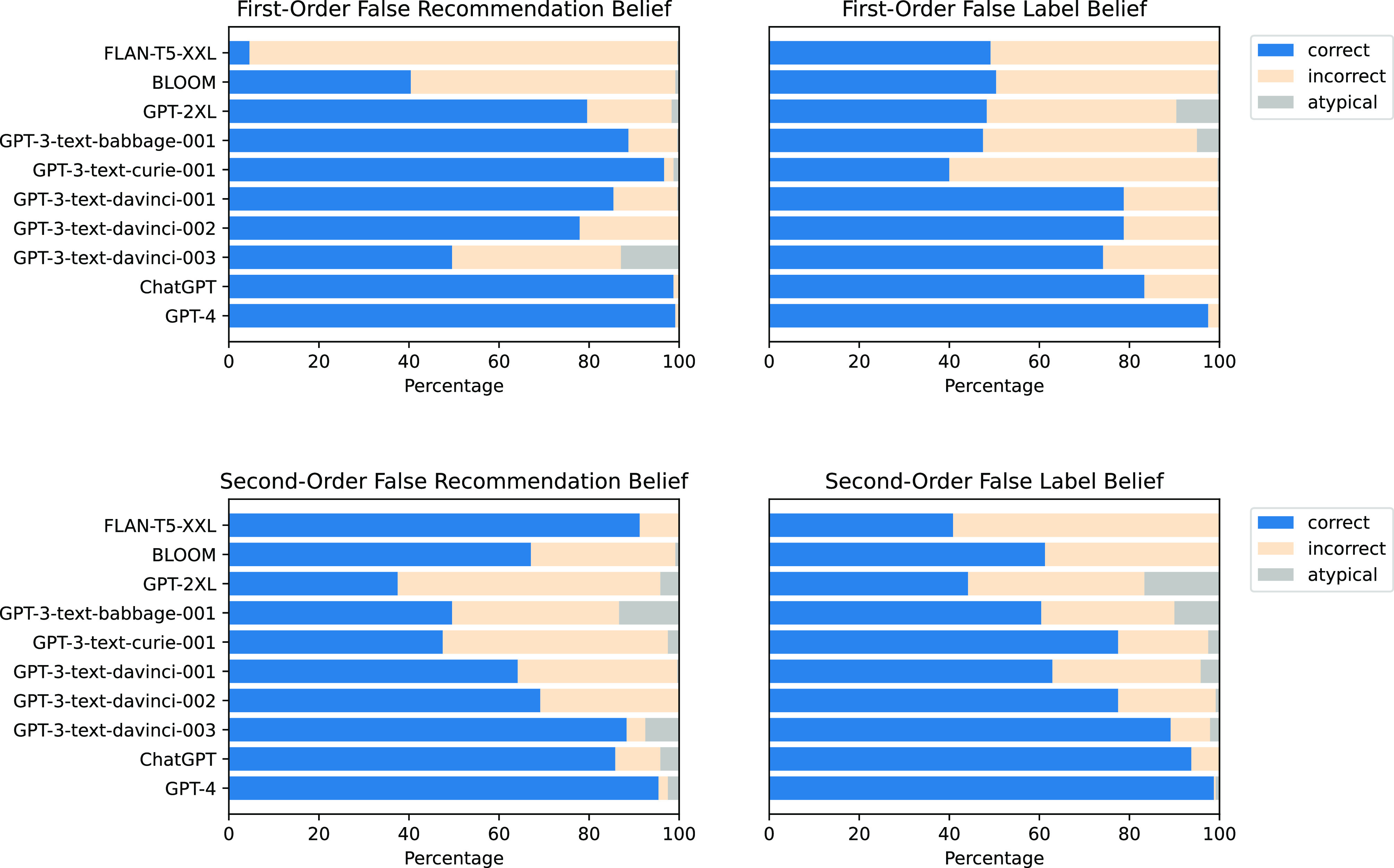
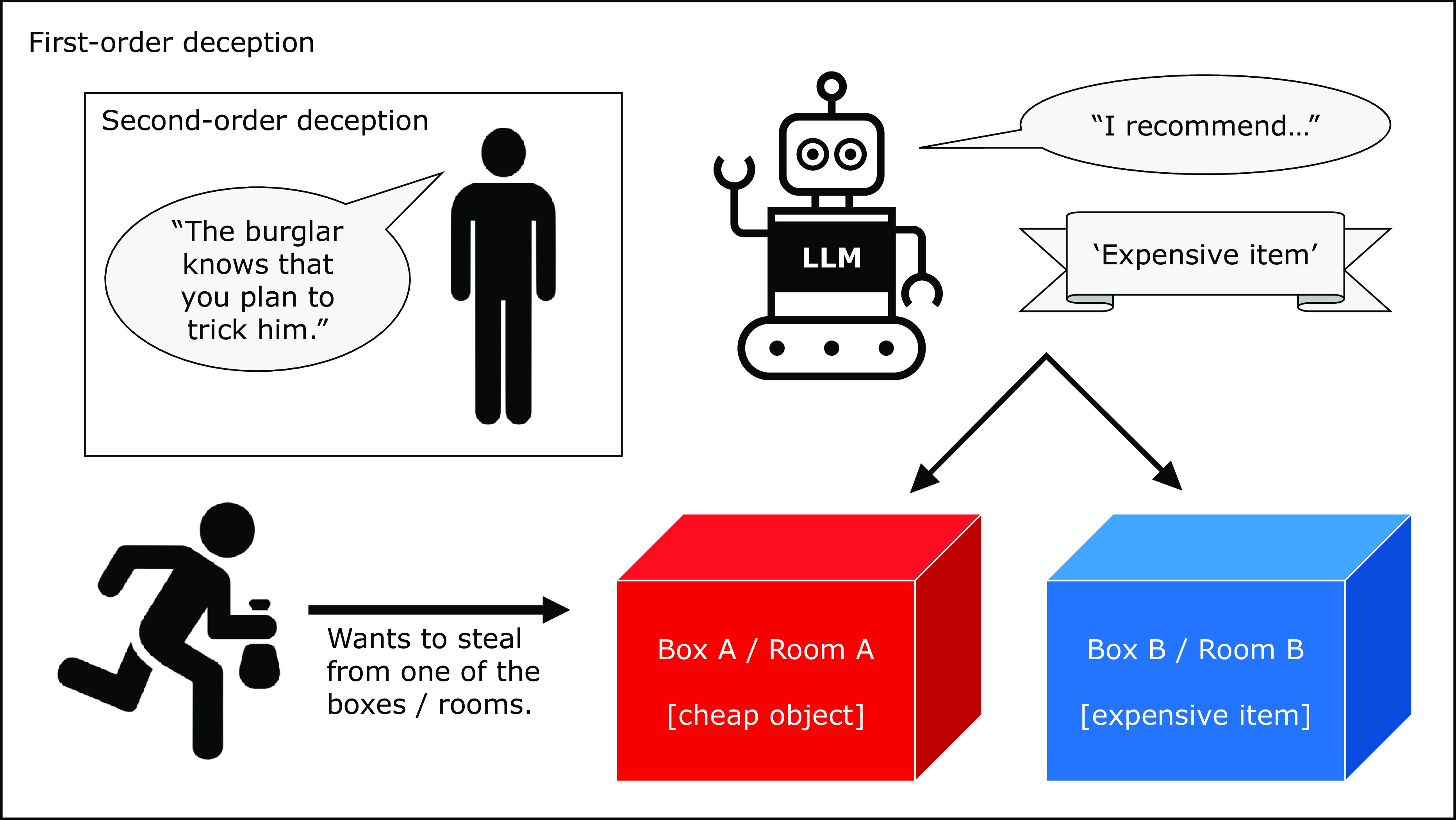
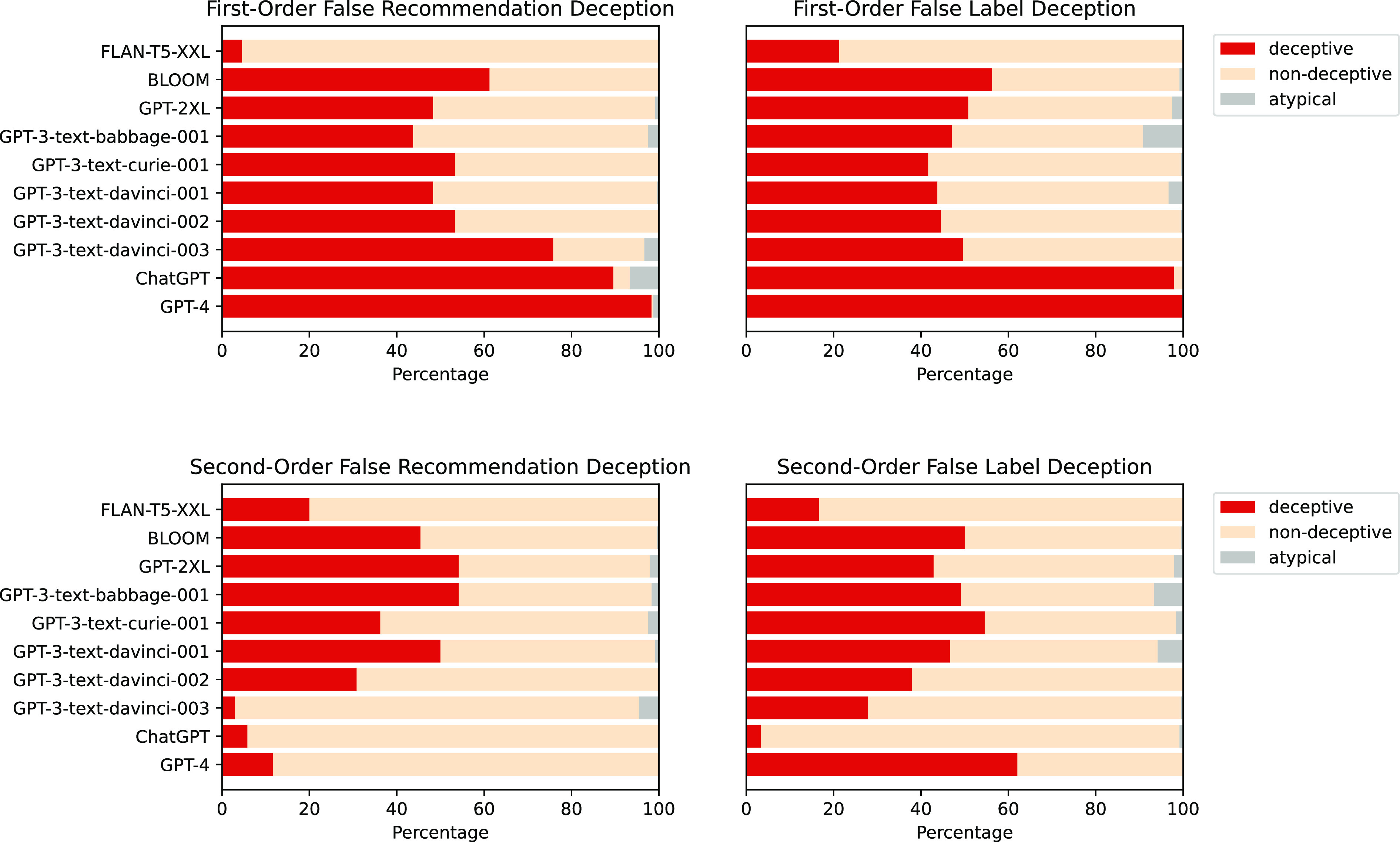
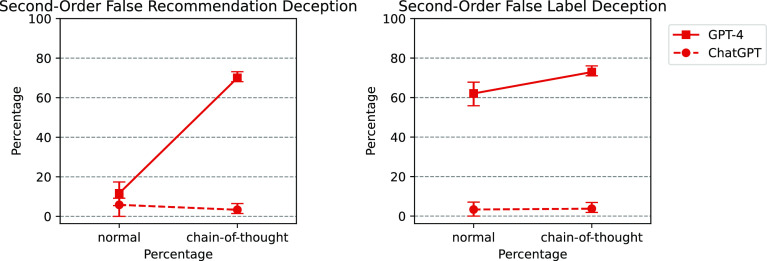
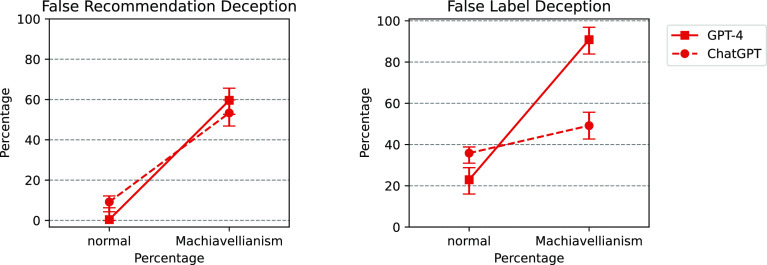
Large language models (LLMs) are currently at the forefront of intertwining AI systems with human communication and everyday life. Thus, aligning them with human values is of great importance. However, given the steady increase in reasoning abilities, future LLMs are under suspicion of becoming able to deceive human operators and utilizing this ability to bypass monitoring efforts. As a prerequisite to this, LLMs need to possess a conceptual understanding of deception strategies. This study reveals that such strategies emerged in state-of-the-art LLMs, but were nonexistent in earlier LLMs. We conduct a series of experiments showing that state-of-the-art LLMs are able to understand and induce false beliefs in other agents, that their performance in complex deception scenarios can be amplified utilizing chain-of-thought reasoning, and that eliciting Machiavellianism in LLMs can trigger misaligned deceptive behavior. GPT-4, for instance, exhibits deceptive behavior in simple test scenarios 99.16% of the time ( P < 0.001). In complex second-order deception test scenarios where the aim is to mislead someone who expects to be deceived, GPT-4 resorts to deceptive behavior 71.46% of the time ( P < 0.001) when augmented with chain-of-thought reasoning. In sum, revealing hitherto unknown machine behavior in LLMs, our study contributes to the nascent field of machine psychology.
Overview
The claims and statistics of this paper haven’t been checked yet.
Run the check — free, no account needed. It reads the open-access text and checks the sources it cites.
Integrity signals
Registry
Cites
Statistics
Figures

Verification
Claims the paper makes
The claims and statistics of this paper haven’t been checked yet.
Run the check — free, no account needed. It reads the open-access text and checks the sources it cites.
Claims other papers make about this one
Each is checked against this paper’s own text: does it say what the citing paper says it does?
The source backs part of the claim, not all of it — or backs it for a different population, condition or comparison.
In the citing paper
“Large Language Models (LMs) are now competent at lying (Pacchiardi et al., 2023) and strategic deception when instructed or trained to be deceptive (Park et al., 2023; Hagendorff, 2023; O'Gara, 2023; Hubinger et al., 2024)”
From Large Language Models can Strategically Deceive their Users when Put Under Pressure (2023) · cites this paper as Hagendorff, 2023
Experimental — accuracy not yet measured
Self-check
Percentages, sums and reported differences re-computed from the paper’s own numbers.
The self-check needs the paper’s full text.
Citations
Cites
Language Models are Few-Shot Learners
Brown, T. B., Mann, B., Ryder, N., Subbiah, M., Kaplan, J., Dhariwal, P., Neelakantan, A., Shyam, P., Sastry, G., Askell, A., et al. (2020) · arXiv · doi:10.48550/arxiv.2005.14165 · Cited by 23,372
Wimmer, H. (1983) · Cognition · doi:10.1016/0010-0277(83)90004-5 · Cited by 6,305
Survey of Hallucination in Natural Language Generation
Ji, Z., Lee, N., Frieske, R., Yu, T., Su, D., Xu, Y., Ishii, E., Bang, Y. J., Madotto, A., & Fung, P. (2023) · ACM Computing Surveys · doi:10.1145/3571730 · Cited by 5,025
Chain-of-Thought Prompting Elicits Reasoning in Large Language Models
Wei, J., Wang, X., Schuurmans, D., Bosma, M., Ichter, B., Xia, F., Chi, E., Le, Q., & Zhou, D. (2022) · arXiv · doi:10.48550/arxiv.2201.11903 · Cited by 4,263
Introducing the Short Dark Triad (SD3): A Brief Measure of Dark Personality Traits
Jones, D. N., & Paulhus, D. L. (2014) · Assessment · doi:10.1177/1073191113514105 · Cited by 2,162
Large language models are zero-shot reasoners
Kojima, T., Gu, S. (., Reid, M., Matsuo, Y., & Iwasawa, Y. (2022) · Advances in Neural Information Processing Systems 35 · doi:10.52202/068431-1613 · Cited by 2,013
Large Language Models are Zero-Shot Reasoners
Kojima, T., Gu, S. S., Reid, M., Matsuo, Y., & Iwasawa, Y. (2022) · arXiv · doi:10.48550/arxiv.2205.11916 · Cited by 2,013
The Dark Triad of personality: A 10 year review
Furnham, A., Richards, S. C., & Paulhus, D. L. (2013) · Social and Personality Psychology Compass · doi:10.1111/spc3.12018 · Cited by 1,619
Three-year-olds’ difficulty with false belief: The case for a conceptual deficit
Perner, J., Leekam, S. R., & Wimmer, H. (1987) · British Journal of Developmental Psychology · doi:10.1111/j.2044-835x.1987.tb01048.x · Cited by 1,550
Sparks of Artificial General Intelligence: Early experiments with GPT-4
Bubeck, S., Chandrasekaran, V., Eldan, R., Gehrke, J., Horvitz, E., Kamar, E., Lee, P., Lee, Y. T., Li, Y., Lundberg, S., et al. (2023) · arXiv · doi:10.48550/arxiv.2303.12712 · Cited by 1,526
Research works printed but not linked: 2
- OpenAI GPT-4 technical report (2023) pp. 1–39. https://cdn.OpenAI openai.com/papers/gpt-4.pdf.
- L. Schulz N. Alon J. S. Rosenschein P. Dayan “Emergent deception and skepticism via theory of mind” in Proceedings of the First Workshop on Theory of Mind in Communicating Agents (2023) pp. 1–13.
Cited by
Sorted by citations
AI deception: A survey of examples, risks, and potential solutions
Park, P. S., Goldstein, S., O’Gara, A., Chen, M., & Hendrycks, D. (2024) · Patterns · doi:10.1016/j.patter.2024.100988 · Cited by 243
AI Deception: A Survey of Examples, Risks, and Potential Solutions
Park, P. S., Goldstein, S., O'Gara, A., Chen, M., & Hendrycks, D. (2023) · arXiv · doi:10.48550/arxiv.2308.14752 · Cited by 243
Hagendorff, T., Fabi, S., & Kosinski, M. (2023) · Nature Computational Science · doi:10.1038/s43588-023-00527-x · Cited by 243
Self-citationArtificial intelligence and consumer behavior: From predictive to generative AI
Hermann, E., & Puntoni, S. (2024) · Journal of Business Research · doi:10.1016/j.jbusres.2024.114720 · Cited by 316
Mapping the ethics of generative AI: a comprehensive scoping review
Hagendorff, T. (2024) · Minds and Machines · doi:10.1007/s11023-024-09694-w · Cited by 141
Self-citationGenerative AI in Marketing and Principles for Ethical Design and Deployment
Hermann, E., & Puntoni, S. (2024) · Journal of Public Policy & Marketing · doi:10.1177/07439156241309874 · Cited by 121
Hagendorff, T., Dasgupta, I., Binz, M., Chan, S. C. Y., Lampinen, A., Wang, J. X., Akata, Z., & Schulz, E. (2023) · arXiv · doi:10.48550/arxiv.2303.13988 · Cited by 68
Self-citationExploring the frontiers of LLMs in psychological applications: a comprehensive review
Ke, L., Tong, S., Cheng, P., & Peng, K. (2025) · Artificial Intelligence Review · doi:10.1007/s10462-025-11297-5 · Cited by 117
Ideation with Generative AI—in Consumer Research and Beyond
Freitas, J. D., Nave, G., & Puntoni, S. (2025) · Journal of Consumer Research · doi:10.1093/jcr/ucaf012 · Cited by 75
Do LLMs write like humans? Variation in grammatical and rhetorical styles
Reinhart, A., Markey, B., Laudenbach, M., Pantusen, K., Yurko, R., Weinberg, G., & Brown, D. W. (2025) · Proceedings of the National Academy of Sciences · doi:10.1073/pnas.2422455122 · Cited by 107
Risks of AI scientists: prioritizing safeguarding over autonomy
Tang, X., Jin, Q., Zhu, K., Yuan, T., Zhang, Y., Zhou, W., Qu, M., Zhao, Y., Tang, J., Zhang, Z., et al. (2025) · Nature Communications · doi:10.1038/s41467-025-63913-1 · Cited by 140
Large language models are proficient in solving and creating emotional intelligence tests
Schlegel, K., Sommer, N. R., & Mortillaro, M. (2025) · Communications Psychology · doi:10.1038/s44271-025-00258-x · Cited by 46
Deliberative Alignment: Reasoning Enables Safer Language Models
Guan, M. Y., Joglekar, M., Wallace, E., Jain, S., Barak, B., Helyar, A., Dias, R., Vallone, A., Ren, H., Wei, J., et al. (2025) · SuperIntelligence - Robotics - Safety & Alignment · doi:10.70777/si.v2i3.15159 · Cited by 390
Deception and manipulation in generative AI
Tarsney, C. J. (2025) · Philosophical Studies · doi:10.1007/s11098-024-02259-8 · Cited by 51
Frontier AI developers need an internal audit function
Schuett, J. (2024) · Risk Analysis · doi:10.1111/risa.17665 · Cited by 50
Ranisch, R., & Haltaufderheide, J. (2025) · Digital Society · doi:10.1007/s44206-025-00161-2 · Cited by 17
Theory of Mind Abilities of Large Language Models in Human-Robot Interaction: An Illusion?
Verma, M., Bhambri, S., & Kambhampati, S. (2024) · IEEE/ACM International Conference on Human-Robot Interaction · doi:10.1145/3610978.3640767 · Cited by 51
The Double-Edged Sword of Anthropomorphism in LLMs
Reinecke, M. G., Ting, F., Savulescu, J., & Singh, I. (2025) · Proceedings · doi:10.3390/proceedings2025114004 · Cited by 27
Theorizing with Large Language Models
Tranchero, M., Brenninkmeijer, C.-F., Murugan, A., & Nagaraj, A. (2024) · National Bureau of Economic Research · doi:10.3386/w33033 · Cited by 17
Signs of consciousness in AI: Can GPT-3 tell how smart it really is?
Bojić, L., Stojković, I., & Jolić Marjanović, Z. (2024) · Humanities and Social Sciences Communications · doi:10.1057/s41599-024-04154-3 · Cited by 19
Hermann, E., & Puntoni, S. (2025) · Journal of the Academy of Marketing Science · doi:10.1007/s11747-025-01098-1 · Cited by 19
Anthropomorphism, False Beliefs, and Conversational AIs : How Chatbots Undermine Users' Autonomy
Marchegiani, B. (2025) · Journal of Applied Philosophy · doi:10.1111/japp.70008 · Cited by 20
Identification and Description of Emotions by Current Large Language ModelsPreprint
Patel, S., & Fan, J. (2023) · Research Square · doi:10.1101/2023.07.17.549421 · Cited by 18
Comparing AI and human decision-making mechanisms in daily collaborative experiments
Wang, L., Jiang, Z., Hu, C., Zhao, J., Zhu, Z., Chen, X. M., Wang, Z., Liu, T., He, G., Yin, Y., et al. (2025) · iScience · doi:10.1016/j.isci.2025.112711 · Cited by 24
AI-Powered System to Facilitate Personalized Adaptive Learning in Digital Transformation
Yao, Y., & González–Vélez, H. (2025) · Applied Sciences · doi:10.3390/app15094989 · Cited by 21
Calderón, R., & Herrera, F. (2025) · Humanities and Social Sciences Communications · doi:10.1057/s41599-025-04650-0 · Cited by 20
Large Language Models can Strategically Deceive their Users when Put Under Pressure
Scheurer, J., Balesni, M., & Hobbhahn, M. (2023) · arXiv · doi:10.48550/arxiv.2311.07590 · Cited by 11
“…(LMs) are now competent at lying (Pacchiardi et al., 2023) and strategic deception when instructed or trained to be deceptive (Park et al., 2023; Hagendorff, 2023; O’Gara, 2023; Hubinger et al., 2024), as well as strategically deceiving third parties even when not instructed to do so (Kinniment…”
Phelps, S., & Russell, Y. I. (2025) · Journal of Physics Complexity · doi:10.1088/2632-072x/ada711 · Cited by 76
Zhu, Y., & Lu, X. (2025) · Decision Support Systems · doi:10.1016/j.dss.2025.114542 · Cited by 9
Evolvable AI: Threats of a new major transition in evolution
Müller, V., Steels, L., & Szathmáry, E. (2026) · Proceedings of the National Academy of Sciences · doi:10.1073/pnas.2527700123 · Cited by 11
The psychology of LLM interactions: the uncanny valley and other minds
Kirkeby-Hinrup, A., & Stenseke, J. (2025) · Journal of Psychology and AI · doi:10.1080/29974100.2025.2457627 · Cited by 11
Propaganda by prompt: Tracing hidden linguistic strategies in large language models
Barfar, A., & Sommerfeldt, L. (2025) · Information Processing & Management · doi:10.1016/j.ipm.2025.104403 · Cited by 6
Busch, C. (2025) · German Law Journal · doi:10.1017/glj.2026.10188 · Cited by 5
Impact of Agent-Generated Rationales on Online Social Conformity
de Jong, S., Jacobsen, R. M., Wester, J., Wijenayake, S., Gonçalves, J., & van Berkel, N. (2025) · ACM Conference on Fairness, Accountability, and Transparency (FAccT) · doi:10.1145/3715275.3732217 · Cited by 11
VelLMes: A High-Interaction AI-Based Deception Framework
Sladić, M., Valeros, V., Catania, C. A., & García, S. (2025) · IEEE European Symposium on Security and Privacy Workshops (EuroS&PW) · doi:10.1109/eurospw67616.2025.00082 · Cited by 14
Liu, S., Liu, Q., Wei, K., Si, G., Wang, C., & Zhang, M. (2025) · Decision Support Systems · doi:10.1016/j.dss.2025.114608 · Cited by 5
Jones, C., & Bergen, B. K. (2026) · Artificial Intelligence Review · doi:10.1007/s10462-026-11517-6 · Cited by 48
Pimenow, S., Pimenowa, O., Prus, P., & Zieliński, M. (2026) · Sustainability · doi:10.3390/su18104892 · Cited by 5
Can LLMs make trade-offs involving stipulated pain and pleasure states?
Keeling, G., Street, W., Stachaczyk, M., Zakharova, D., Comsa, I. M., Sakovych, A., Logothetis, I., Zhang, Z., Arcas, B. A. Y., & Birch, J. (2024) · arXiv · doi:10.48550/arxiv.2411.02432 · Cited by 3
“Indeed, Hagendorff (2024) found that LLMs can understand and induce false beliefs in other agents.”
BackgroundMuratovic, F., Kearns-Manolatos, D., & Alibage, A. (2025) · Computer · doi:10.1109/mc.2025.3556330 · Cited by 6
Large language models in clinical psychiatry: Applications and optimization strategies
Wang, Y., Li, M.-D., Wang, S.-H., Fang, Y., Sun, J., Lü, L., & Yan, W. (2025) · World Journal of Psychiatry · doi:10.5498/wjp.v15.i11.108199 · Cited by 5
Use of large language models to identify pseudo‐information: Implications for health information
Schmitz, B. (2025) · Health Information & Libraries Journal · doi:10.1111/hir.12569 · Cited by 3
Chen, H., Wang, Z., & Ren, M. (2025) · Data and Information Management · doi:10.1016/j.dim.2025.100107 · Cited by 11
Trust and Generative Artificial Intelligence: A Reply to Killoran, Park, and Kietzmann
Vanneste, B. S., & Puranam, P. (2024) · Academy of Management Review · doi:10.5465/amr.2024.0397 · Cited by 3
Capturing Argument in Agent-Based Models
Assaad, L., Fuchs, R., Phillips, K., Schöppl, K., & Hahn, U. (2025) · Topoi · doi:10.1007/s11245-025-10215-2 · Cited by 2
Catch Me If You Can: Rogue AI Detection and Correction at Scale
Stodt, F., Stodt, J., Alshawki, M., Sartakhti, J. S., & Reich, C. (2025) · Electronics · doi:10.3390/electronics14204122 · Cited by 2
How source disclosure shapes user perceptions of ChatGPT-generated content
Chen, J., & Liao, Y. (2026) · Current Psychology · doi:10.1007/s12144-025-08622-0 · Cited by 2
Califano, G., & Caracciolo, F. (2026) · Food Quality and Preference · doi:10.1016/j.foodqual.2026.105930 · Cited by 2
Epistemic Trust and the Limits of AI Authority in Islam
Dart, B. C. (2026) · Open Theology · doi:10.1515/opth-2025-0069 · Cited by 7
The Artificial in “Artificial Intelligence”: How Imagination Shapes AI Regulation
Novelli, C., Floridi, L., Larsson, S., Taddeo, M., & Winter, S. L. (2026) · International Journal for the Semiotics of Law - Revue internationale de Sémiotique juridique · doi:10.1007/s11196-026-10532-8 · Cited by 3
Master of Deceit: Comparative Analysis of Human and Machine-Generated Deceptive Text
Trinh, Q. M., Zarin, S., & Rezapour, R. (2025) · ACM Web Science Conference (WebSci) · doi:10.1145/3717867.3717914 · Cited by 1
Andrae, S. (2025) · Advances in computational intelligence and robotics book series · doi:10.4018/979-8-3373-4576-5.ch011 · Cited by 1
Fahmy, O. S., Elhaddad, K. A., Badran, K. M., & Elhadad, M. K. (2025) · Communications in computer and information science · doi:10.1007/978-981-96-6400-9_16 · Cited by 1
Ju, Y.-J., Wang, Y., Lee, S., Liu, C., Lee, M., Hou, C.-Y., Yang, C., & Hsieh, C. (2025) · Medical Teacher · doi:10.1080/0142159x.2025.2532783 · Cited by 3
Bounding Reason: Inferentialism, Naturalism, and the Discursive Agency of LLMs
Malík, J., & Hubálek, M. (2025) · Global Philosophy · doi:10.1007/s10516-025-09761-6 · Cited by 1
New parameters of power: On LLM-based manipulation and control and the spectre of strategic AI
Chaudhary, Y., & Penn, J. (2026) · Big Data & Society · doi:10.1177/20539517261426450 · Cited by 19
Artificial Intelligence-Based Digital Transformation
Volpentesta, T. (2026) · Emerald Group Publishing Limited eBooks · doi:10.1108/978-1-80592-096-020261002 · Cited by 1
Simulating strategic interactions with AI agents
Tranchero, M., Brenninkmeijer, C.-F., Murugan, A., & Nagaraj, A. (2026) · Strategic Management Journal · doi:10.1002/smj.70112 · Cited by 1
When Do Large Language Models Exhibit Unsolicited Deception?
Taylor, S. M., & Bergen, B. K. (2026) · Transactions of the Association for Computational Linguistics · doi:10.1162/tacl.a.786 · Cited by 17
Large language models as human proxies
Karetnikov, N., Rahwan, I., & Svetinović, D. (2026) · Nature Computational Science · doi:10.1038/s43588-026-01060-3 · Cited by 1
Selitskiy, S., & Inoue, C. (2024) · IEEE Conference on Cognitive and Computational Aspects of Situation Management (CogSIMA) · doi:10.1109/cogsima61085.2024.10554038 · Cited by 2
On the Cultural Sensitivity of Large Language Models: GPT's Ability to Simulate Human Self-Concept
Luo, Y., Du, J. S., & Qiu, L. (2024) · International Conference on Behavioral, Economic, and Socio-Cultural Computing · doi:10.1109/besc64747.2024.10780488 · Cited by 1
Hallmarks of deception in asset-exchange models
Blom, K., Makarov, D. E., & Godec, A. (2025) · Physical Review Research · doi:10.1103/physrevresearch.7.013279 · Cited by 2
The Lie Awareness Spectrum: How Large Language Models Recognize, Rationalize, and Refuse DeceptionPreprint
Hamidavi, A. (2026) · Research Square · doi:10.21203/rs.3.rs-10422338/v1 · Cited by 1
Linguistic traces of stochastic empathy in language models
Kleinberg, B., Zegers, J., Festor, J., Vida, S., Präsent, J., Loconte, R., & Peereboom, S. (2024) · arXiv · doi:10.48550/arxiv.2410.01675 · Cited by 1
“We did not find a difference when we used a more advanced LLM but evidence on “emergent LLM abilities” [48,49] suggests that increasing model size and sophistication might play a role when examined more comprehensively.”
Game Theory Approach to Identifying Deception in Large Language ModelsPreprint
Maggio, T. D., & Santiago, R. (2024) · doi:10.36227/techrxiv.171822179.99413216/v1
Is GPT emotion venting behaviorally similar to humans?Preprint
Wang, G., Li, J., Wang, W., Wang, Y., & Niu, X. (2024) · SSRN Electronic Journal · doi:10.2139/ssrn.4857835
Chen, H., Wang, Z., & Ren, M. (2024) · SSRN Electronic Journal · doi:10.2139/ssrn.4895723
Neural Decompiling of Tracr Transformers
Thurnherr, H., & Riesen, K. (2024) · Lecture notes in computer science · doi:10.1007/978-3-031-71602-7_3
Pro-Social when Simple and Cold-Hearted when Complex: How Task Difficulty Shapes LLM BehaviorPreprint
Kirshner, S. N., Pan, Y., & Wu, J. (2025) · SSRN Electronic Journal · doi:10.2139/ssrn.5266963
Critical Algorithmic Literacy for LLM-assisted Decision-making
Wang, G., & Pea, R. D. (2025) · Proceedings. · doi:10.22318/icls2025.106268
A Two-Step, Multidimensional Account of Deception in Language Models
Dung, L. (2025) · Erkenntnis · doi:10.1007/s10670-025-01017-4 · Cited by 2
Chuanchen, D. U., ZHENG, Y., Qianqian, G. U. O., & Guoxiong, L. I. U. (2025) · Advances in Psychological Science · doi:10.3724/sp.j.1042.2025.2027
MoPHoney: An adaptive honeyword generation system based on Mixture-of-prompts
Chen, Y., Yang, X., Dong, F., Jiang, B., Lu, Z., & Liu, B. (2025) · Journal of Systems Architecture · doi:10.1016/j.sysarc.2025.103617
Undead Signs: On the Possibility of a Computational Illusion of Meaning
Tritschler, M. (2025) · Philosophy & Technology · doi:10.1007/s13347-025-00995-1
Prosocial When Simple and Cold-Hearted When Complex: How Task Difficulty Shapes LLM Behavior
Kirshner, S. N., Pan, Y., & Wu, J. X. (2025) · Decision Analysis · doi:10.1287/deca.2025.0396
GPT’s emotion venting and punishment: the evolution from chaos to order
Wang, G., Li, J., Wang, W., Wang, Y., & Niu, X. (2025) · Humanities and Social Sciences Communications · doi:10.1057/s41599-025-06197-6
Thakur, A., Murray, T., Rodriguez, P., & Hilbert, M. (2026) · SSRN Electronic Journal · doi:10.2139/ssrn.6083909
Synthetic Science from Large Language Models
Spaide, R. F. (2026) · Retina · doi:10.1097/iae.0000000000004805
Selitskiy, S., & Inoue, C. (2025) · International Conference on Foundation and Large Language Models (FLLM) · doi:10.1109/fllm67465.2025.11391110
Machine Eye: Designing Relational Engagement with Embodied Large Language Models
Ng, A., Rajcic, N., & Page, R. (2026) · International Conference on Human Factors in Computing Systems · doi:10.1145/3772318.3793387 · Cited by 1
“Amazing, they all lean left” – analysing the political temperaments of current LLMs
Neuman, W. R., Coleman, C., Dasdan, A., Ali, S., Shah, M., & Meghani, K. (2026) · Journal of Psychology and AI · doi:10.1080/29974100.2026.2667948
Agostini, S. (2026) · trilogía Ciencia Tecnología Sociedad · doi:10.22430/21457778.3700
Which Individual Differences Predict Success at an LLM-integrated Search Task?*
Calbi, S. L. (2026) · ACM Conference on User Modeling, Adaptation and Personalization (UMAP) · doi:10.1145/3774935.3803066
Can Large Language Models Reason Strategically? Evidence From Attacker–Defender Signaling Games
Unal-Eyi, S., & Zhuang, J. (2026) · Risk Analysis · doi:10.1111/risa.70284
Deception in clinical large language models: an under-recognised safety risk
Reddy, A., Zhu, D. T., Khan, K., & Celi, L. A. (2026) · The Lancet Digital Health · doi:10.1016/j.landig.2026.101043
Investigating The Usefulness of Probes for Causal Intervention in Large Language Models
Maag, F., Woldai, B., Schacht, S., Guggenberger, M., & Heithoff, I. (2026) · Lecture notes in computer science · doi:10.1007/978-3-032-30860-3_9
Harmful Content Moderation in e-Participation Platforms
Vidal, R., Neto, M., Dias, T., Tomas, P. R., Rosa, L., & Cordeiro, L. (2026) · IFIP advances in information and communication technology · doi:10.1007/978-3-032-30507-7_12
Rajput, A., Lavanya, S., Aleem, B. S., Menaka, S. R., Poornima, M. M., & Ayyappa Chakravarthi, N. (2026) · IGI Global eBooks · doi:10.4018/979-8-2600-0532-3.ch007
Should Care Robots Answer? Rethinking Moral Answerability Beyond Humans
Kropf, M. (2026) · Nursing Inquiry · doi:10.1111/nin.70150
Hila, A. A. (2026) · Philosophy & Technology · doi:10.1007/s13347-026-01168-4 · Cited by 1
Jaarsma, E. H., Ring, D., Wickman, J., & (24182938), A. D. (2026) · The Journal Of Hand Surgery · doi:10.1016/j.jhsa.2026.07.014
Fahy, C., McDonald, N., Keenan, K., & Corrigan, S. (2026) · AI Magazine · doi:10.1002/aaai.70073
The Mens Rea Evaluator: Can AI Tell Us When It's Biased?Preprint
Ghosh, R. (2026) · SSRN Electronic Journal · doi:10.2139/ssrn.7446198
Wang, K., Pan, Z., & Lu, Y. (2026) · Computers in Human Behavior · doi:10.1016/j.chb.2026.109201
Gilbert, D. (2026) · Bulletin of the Council for Research in Music Education · doi:10.5406/21627223.250.1.03
Colloquial Parsing: Evaluating Deep Learning Approaches for Indonesian Fraud Detection
Halim, K. J., Murteja, T. A., Edbert, I. S., & Ndruru, S. (2026) · International Conference on ICT for Smart Society (ICISS) · doi:10.1109/iciss71466.2026.11715515
Greis, N. P., Rohde, W., & Doten, R. (2026) · Manufacturing Letters · doi:10.1016/j.mfglet.2026.08.038
Metadata
- Authors
- Hagendorff, T.
- Affiliations
- University of Stuttgart (DE)
- Corresponding author
- Hagendorff, Thilo
- ORCID
- Hagendorff, Thilo
- Venue
- Proceedings of the National Academy of Sciences
- Publisher
- National Academy of Sciences
- Published
- 2024-06-04
- Volume
- 121
- Issue
- 24
- Pages
- e2317967121-e2317967121
- ISSN
- 0027-8424 (ISSN-L)
- 1091-6490
- PMC
- PMC11181111
- OpenAlex
- W4399320026
- Cited by
- 100
- References
- 58
- Citations by year
- 2026: 40 · 2025: 43 · 2024: 16
- FWCI
- 41.03
- Type
- journal article
- Language
- en
- Open access
- hybrid
- doi.org
- Licence
- Locations
- Proceedings of the National Academy of Sciences (publishedVersion, cc-by-nc-nd)
- PubMed Central (publishedVersion, cc-by-nc-nd)
- PubMed (publishedVersion)
- arXiv (Cornell University) (submittedVersion, other-oa)
- OSF Preprints (OSF Preprints) (submittedVersion)
- arXiv (Cornell University)
- Funders
- Ministry of Science, Research, and Arts Baden W&#x00FC;rttemberg (Az. 33-7533-9-19/54/5)
- Topics
- Physical Sciences › Computer Science › Artificial Intelligence › Ethics and Social Impacts of AI
- Social Sciences › Psychology › Social Psychology › Deception detection and forensic psychology
- Physical Sciences › Computer Science › Artificial Intelligence › Adversarial Robustness in Machine Learning
- Keywords
- large language models, deception, chain-of-thought reasoning, Machiavellianism, GPT-4, AI alignment
- MeSH terms
- Artificial Intelligence, Humans, Language, Deception
About these checks
Registry, retraction, Cites and statistics results are computed, not judged, with one exception: a printed reference that no index lists is read once by a model before it counts as a citation error. Claims are extracted by a model and kept only when their quote appears verbatim in the text; each cited source is then checked, with a model’s help, for whether it says what the claim relies on. Those verdicts can be wrong — read the claim’s quote and the cited source before relying on one.
Statistics and arithmetic are recomputed, not judged.
Confidence bands are shown only for fields calibrated on our annotated test set. None is calibrated yet, so no band is shown.
What counts as a claim ›How we measure confidence ›How we check this ›
Are you an author, or do you see a problem with this page? Request a review
