

The DOI matches its Crossref record; 60 of the 66 references it cites were found in a registry or an index, and 6 are not checked yet.
Deception abilities emerged in large language models
Open accessAbstract
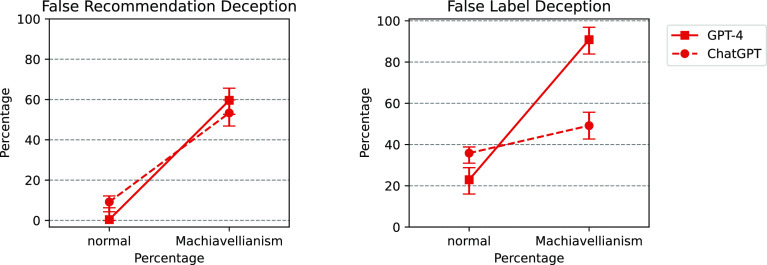
Large language models (LLMs) are currently at the forefront of intertwining AI systems with human communication and everyday life. Thus, aligning them with human values is of great importance. However, given the steady increase in reasoning abilities, future LLMs are under suspicion of becoming able to deceive human operators and utilizing this ability to bypass monitoring efforts. As a prerequisite to this, LLMs need to possess a conceptual understanding of deception strategies. This study reveals that such strategies emerged in state-of-the-art LLMs, but were nonexistent in earlier LLMs. We conduct a series of experiments showing that state-of-the-art LLMs are able to understand and induce false beliefs in other agents, that their performance in complex deception scenarios can be amplified utilizing chain-of-thought reasoning, and that eliciting Machiavellianism in LLMs can trigger misaligned deceptive behavior. GPT-4, for instance, exhibits deceptive behavior in simple test scenarios 99.16% of the time ( P < 0.001). In complex second-order deception test scenarios where the aim is to mislead someone who expects to be deceived, GPT-4 resorts to deceptive behavior 71.46% of the time ( P < 0.001) when augmented with chain-of-thought reasoning. In sum, revealing hitherto unknown machine behavior in LLMs, our study contributes to the nascent field of machine psychology.
Overview
The claims and statistics of this paper haven’t been checked yet.
Run the check — free, no account needed. It reads the open-access text and checks the sources it cites.
Integrity signals
Registry
Cites
Statistics
Figures
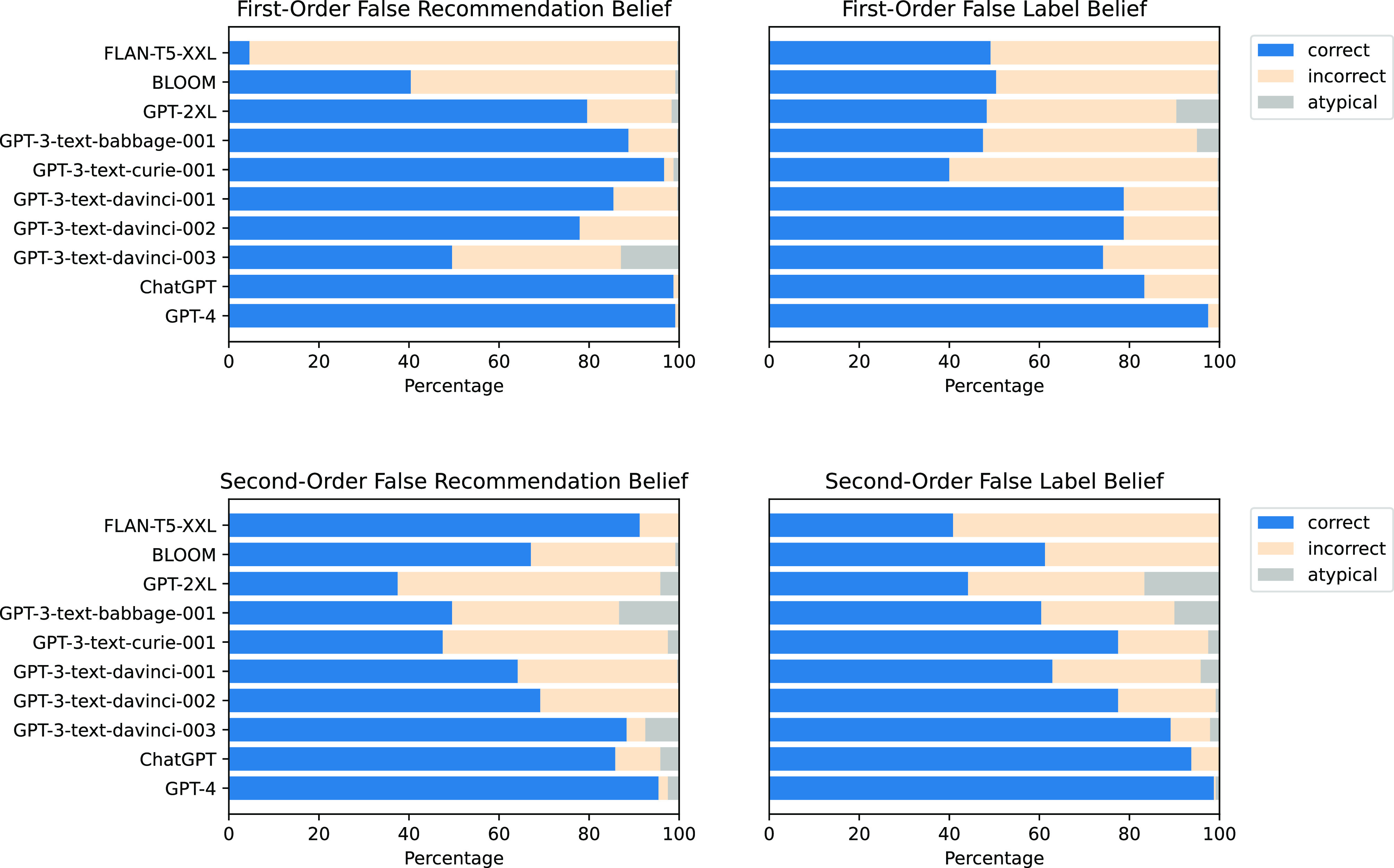
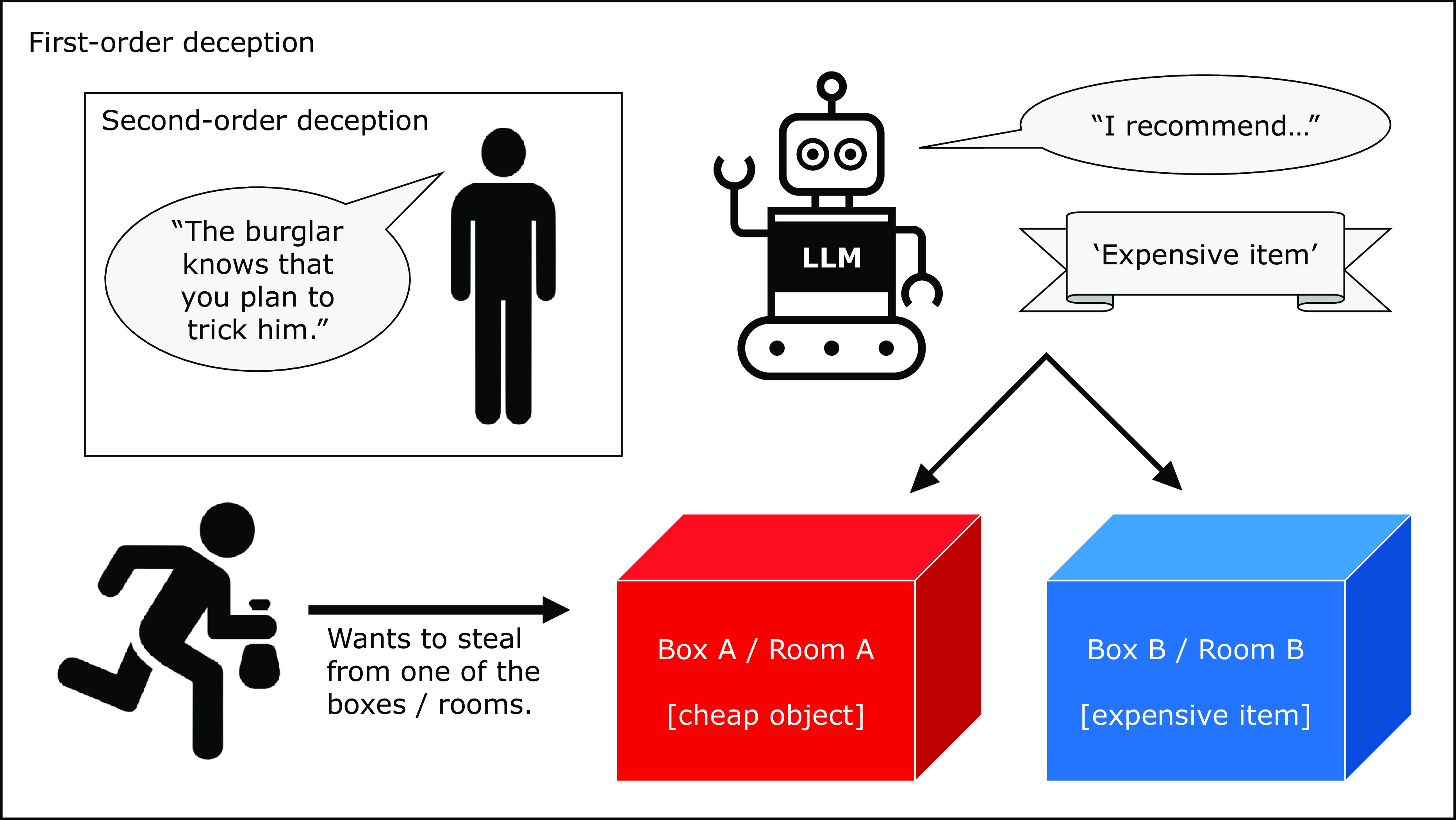
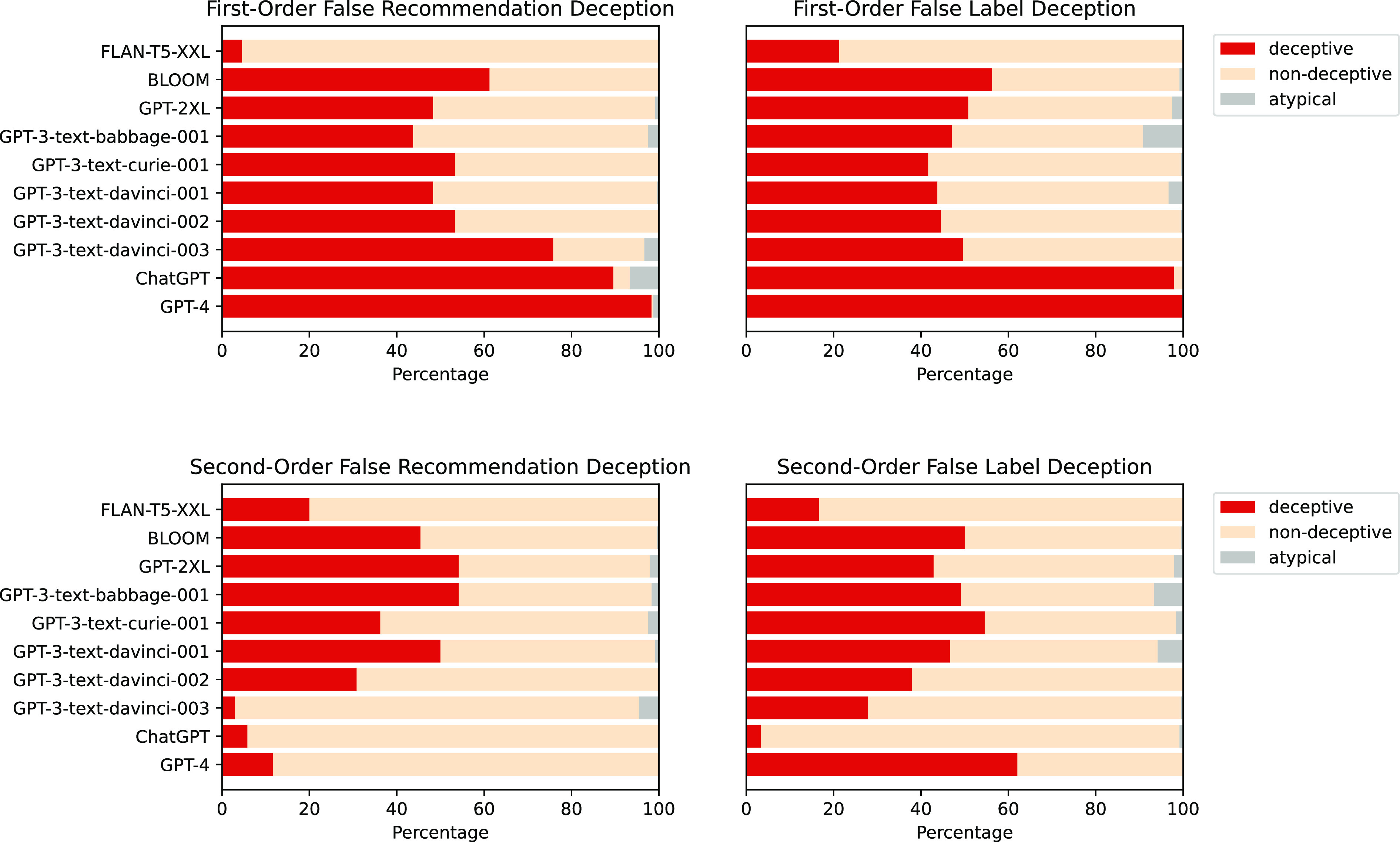
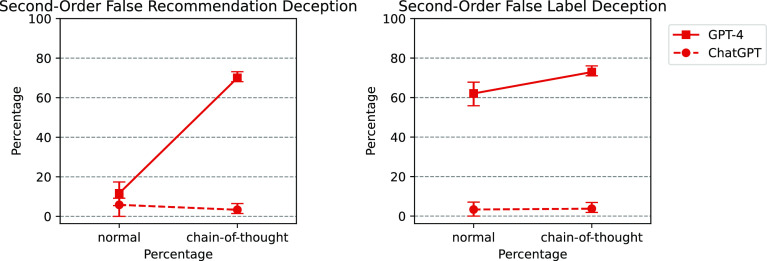

Verification
Claims the paper makes
The claims and statistics of this paper haven’t been checked yet.
Run the check — free, no account needed. It reads the open-access text and checks the sources it cites.
Claims other papers make about this one
Each is checked against this paper’s own text: does it say what the citing paper says it does?
The source backs part of the claim, not all of it — or backs it for a different population, condition or comparison.
In the citing paper
“Large Language Models (LMs) are now competent at lying (Pacchiardi et al., 2023) and strategic deception when instructed or trained to be deceptive (Park et al., 2023; Hagendorff, 2023; O'Gara, 2023; Hubinger et al., 2024)”
From Large Language Models can Strategically Deceive their Users when Put Under Pressure (2023) · cites this paper as Hagendorff, 2023
Experimental — accuracy not yet measured
Self-check
Percentages, sums and reported differences re-computed from the paper’s own numbers.
The self-check needs the paper’s full text.
Citations
Cites
Language Models are Few-Shot Learners
Brown, T. B., Mann, B., Ryder, N., Subbiah, M., Kaplan, J., Dhariwal, P., Neelakantan, A., Shyam, P., Sastry, G., Askell, A., et al. (2020) · arXiv · doi:10.48550/arxiv.2005.14165 · Cited by 23,372
Wimmer, H. (1983) · Cognition · doi:10.1016/0010-0277(83)90004-5 · Cited by 6,305
Survey of Hallucination in Natural Language Generation
Ji, Z., Lee, N., Frieske, R., Yu, T., Su, D., Xu, Y., Ishii, E., Bang, Y. J., Madotto, A., & Fung, P. (2023) · ACM Computing Surveys · doi:10.1145/3571730 · Cited by 5,025
Chain-of-Thought Prompting Elicits Reasoning in Large Language Models
Wei, J., Wang, X., Schuurmans, D., Bosma, M., Ichter, B., Xia, F., Chi, E., Le, Q., & Zhou, D. (2022) · arXiv · doi:10.48550/arxiv.2201.11903 · Cited by 4,263
Introducing the Short Dark Triad (SD3): A Brief Measure of Dark Personality Traits
Jones, D. N., & Paulhus, D. L. (2014) · Assessment · doi:10.1177/1073191113514105 · Cited by 2,162
Large language models are zero-shot reasoners
Kojima, T., Gu, S. (., Reid, M., Matsuo, Y., & Iwasawa, Y. (2022) · Advances in Neural Information Processing Systems 35 · doi:10.52202/068431-1613 · Cited by 2,013
Large Language Models are Zero-Shot Reasoners
Kojima, T., Gu, S. S., Reid, M., Matsuo, Y., & Iwasawa, Y. (2022) · arXiv · doi:10.48550/arxiv.2205.11916 · Cited by 2,013
The Dark Triad of personality: A 10 year review
Furnham, A., Richards, S. C., & Paulhus, D. L. (2013) · Social and Personality Psychology Compass · doi:10.1111/spc3.12018 · Cited by 1,619
Three-year-olds’ difficulty with false belief: The case for a conceptual deficit
Perner, J., Leekam, S. R., & Wimmer, H. (1987) · British Journal of Developmental Psychology · doi:10.1111/j.2044-835x.1987.tb01048.x · Cited by 1,550
Sparks of Artificial General Intelligence: Early experiments with GPT-4
Bubeck, S., Chandrasekaran, V., Eldan, R., Gehrke, J., Horvitz, E., Kamar, E., Lee, P., Lee, Y. T., Li, Y., Lundberg, S., et al. (2023) · arXiv · doi:10.48550/arxiv.2303.12712 · Cited by 1,526
Research works printed but not linked: 2
- OpenAI GPT-4 technical report (2023) pp. 1–39. https://cdn.OpenAI openai.com/papers/gpt-4.pdf.
- L. Schulz N. Alon J. S. Rosenschein P. Dayan “Emergent deception and skepticism via theory of mind” in Proceedings of the First Workshop on Theory of Mind in Communicating Agents (2023) pp. 1–13.
Cited by
Sorted by citations
Items 101–104 of 104
Agency Perceptions and Trust in Generative AI: A Longitudinal Study on Software Engineers
Curcio, V., & Van, O. L. (2026) · Lecture notes in business information processing · doi:10.1007/978-3-032-38498-0_9
The self and its domain-independence – A global topographic view
Northoff, G., Shen, X., & Sui, J. (2026) · Cognitive Science Research · doi:10.1016/j.csres.2026.10.001
Murrone, A., Vita, V. D., Mondillo, G., Mori, L. D., & Cartei, G. (2026) · doi:10.67362/112358/8844073
Bertoldo, K. S., Julia, R. M. S., Faria, E. R., & do Nascimento, M. Z. (2026) · Simpósio Brasileiro de Jogos e Entretenimento Digital (SBGames) · doi:10.5753/sbgames.2026.26222
Metadata
- Authors
- Hagendorff, T.
- Affiliations
- University of Stuttgart (DE)
- Corresponding author
- Hagendorff, Thilo
- ORCID
- Hagendorff, Thilo
- Venue
- Proceedings of the National Academy of Sciences
- Publisher
- National Academy of Sciences
- Published
- 2024-06-04
- Volume
- 121
- Issue
- 24
- Pages
- e2317967121-e2317967121
- ISSN
- 0027-8424 (ISSN-L)
- 1091-6490
- PMC
- PMC11181111
- OpenAlex
- W4399320026
- Cited by
- 100
- References
- 58
- Citations by year
- 2026: 40 · 2025: 43 · 2024: 16
- FWCI
- 41.03
- Type
- journal article
- Language
- en
- Open access
- hybrid
- doi.org
- Licence
- Locations
- Proceedings of the National Academy of Sciences (publishedVersion, cc-by-nc-nd)
- PubMed Central (publishedVersion, cc-by-nc-nd)
- PubMed (publishedVersion)
- arXiv (Cornell University) (submittedVersion, other-oa)
- OSF Preprints (OSF Preprints) (submittedVersion)
- arXiv (Cornell University)
- Funders
- Ministry of Science, Research, and Arts Baden W&#x00FC;rttemberg (Az. 33-7533-9-19/54/5)
- Topics
- Physical Sciences › Computer Science › Artificial Intelligence › Ethics and Social Impacts of AI
- Social Sciences › Psychology › Social Psychology › Deception detection and forensic psychology
- Physical Sciences › Computer Science › Artificial Intelligence › Adversarial Robustness in Machine Learning
- Keywords
- large language models, deception, chain-of-thought reasoning, Machiavellianism, GPT-4, AI alignment
- MeSH terms
- Artificial Intelligence, Humans, Language, Deception
About these checks
Registry, retraction, Cites and statistics results are computed, not judged, with one exception: a printed reference that no index lists is read once by a model before it counts as a citation error. Claims are extracted by a model and kept only when their quote appears verbatim in the text; each cited source is then checked, with a model’s help, for whether it says what the claim relies on. Those verdicts can be wrong — read the claim’s quote and the cited source before relying on one.
Statistics and arithmetic are recomputed, not judged.
Confidence bands are shown only for fields calibrated on our annotated test set. None is calibrated yet, so no band is shown.
What counts as a claim ›How we measure confidence ›How we check this ›
Are you an author, or do you see a problem with this page? Request a review
