

The entities enabling scientific fraud at scale are large, resilient, and growing rapidly
Open accessThe DOI matches its Crossref record; 86 of the 87 references it cites were found in a registry or an index; 26 of the 76 sources its claims cite were checked for support.
Abstract
Science is characterized by collaboration and cooperation, but also by uncertainty, competition, and inequality. While there has always been some concern that these pressures may compel some to defect from the scientific research ethos—i.e., fail to make genuine contributions to the production of knowledge or to the training of an expert workforce—the focus has largely been on the actions of lone individuals. Recently, however, reports of coordinated scientific fraud activities have increased. Some suggest that the ease of communication provided by the internet and open-access publishing have created the conditions for the emergence of entities—paper mills (i.e., sellers of mass-produced low quality and fabricated research), brokers (i.e., conduits between producers and publishers of fraudulent research), predatory journals, who do not conduct any quality controls on submissions—that facilitate systematic scientific fraud. Here, we demonstrate through case studies that i) individuals have cooperated to publish papers that were eventually retracted in a number of journals, ii) brokers have enabled publication in targeted journals at scale, and iii), within a field of science, not all subfields are equally targeted for scientific fraud. Our results reveal some of the strategies that enable the entities promoting scientific fraud to evade interventions. Our final analysis suggests that this ability to evade interventions is enabling the number of fraudulent publications to grow at a rate far outpacing that of legitimate science.
Overview
CoChat Summary
TL;DR
This paper maps footprints of large-scale scientific fraud beyond paper mills, identifying coordinated networks of editors, authors, brokers, and journal-targeting entities. It finds that suspected paper-mill products are growing much faster than legitimate publications and that current integrity measures such as retractions and deindexing are far outpaced by the problem.
Key findings
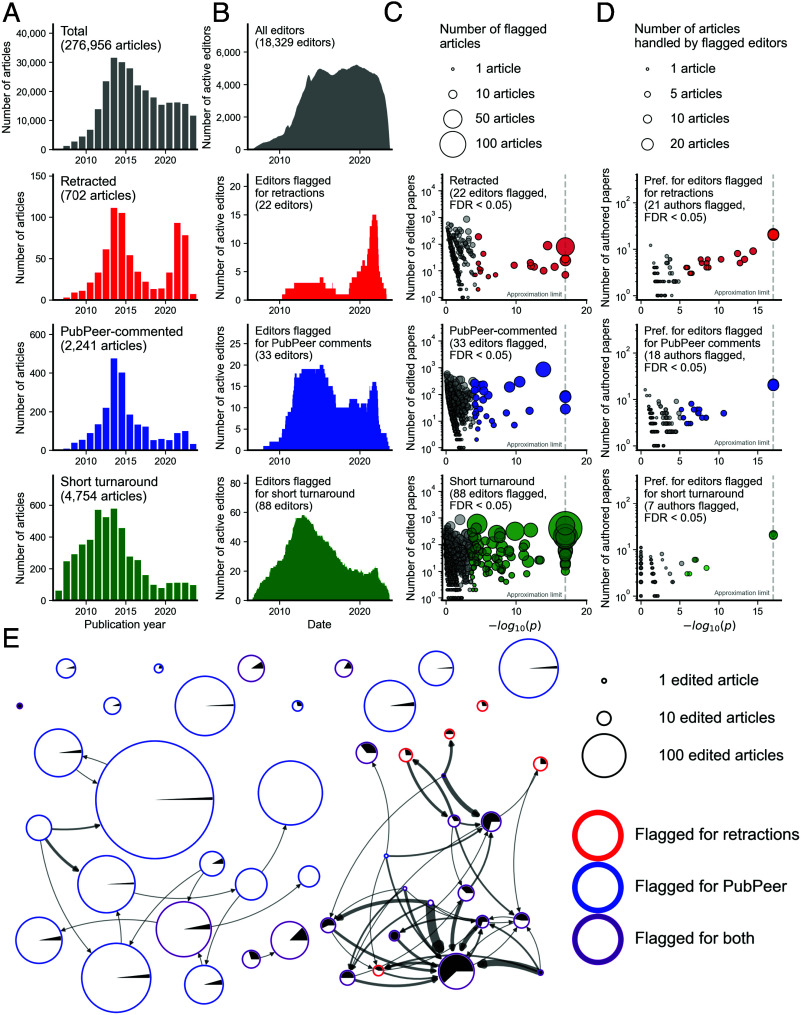
- In PLOS ONE, 45 flagged editors—0.25% of all editors—handled 1.3% of published articles but 30.2% of retracted articles; 22 editors anomalously accepted later-retracted articles, 33 accepted later-PubPeer-commented articles, and 88 accepted articles with short turnaround, with 21, 18, and 7 authors respectively showing anomalous assignment to those flagged editors.
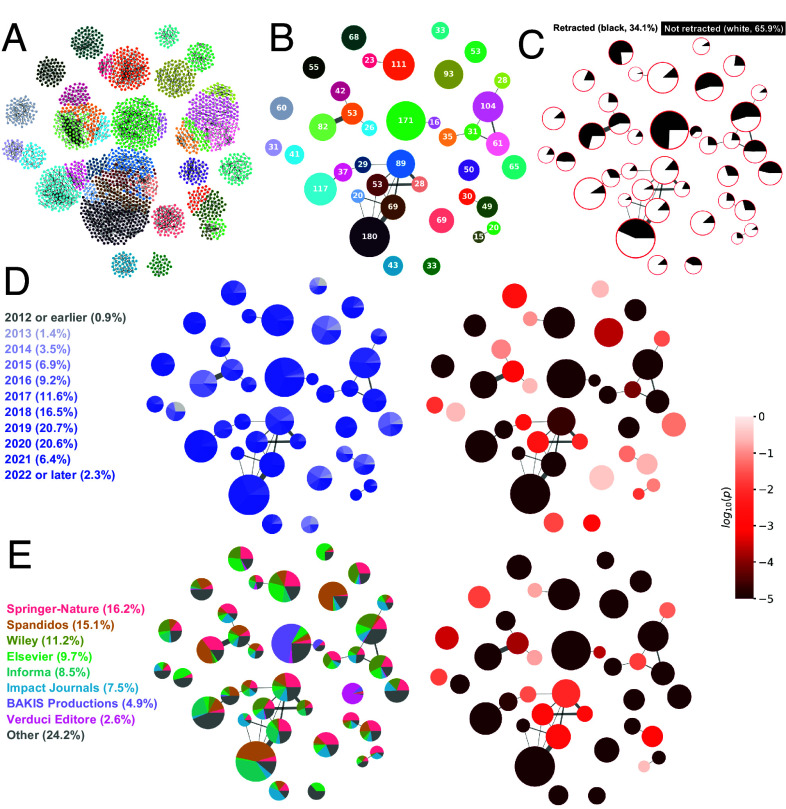
- A network of 2,213 articles connected by 4,188 image-duplication edges formed 20 connected components (maximum 622 articles); only 34.1% of these articles had been retracted, and modules were strongly concentrated by publisher and publication year.
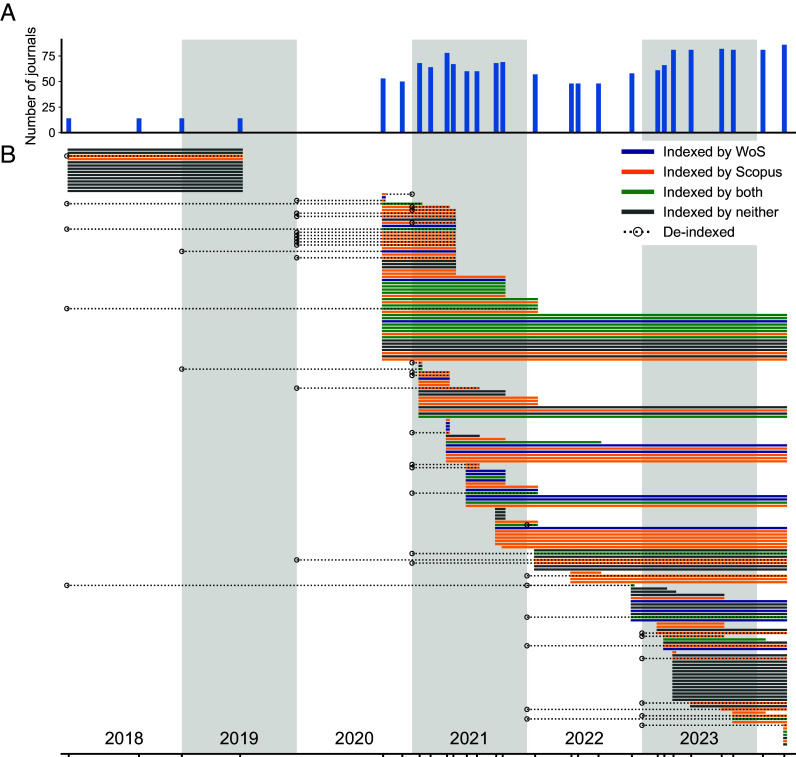
- ARDA listed 188 unique journals since January 2018, including 106 Scopus-indexed, 51 WoS-indexed, 29 indexed by both, and 2 MEDLINE-indexed; 17 (9.0%) were suspected hijacked journals, and 13 of 39 (33.3%) Scopus-indexed journals listed by ARDA in 2020 were later deindexed versus 147 of 27,197 (0.5%) Scopus-indexed journals active in 2020 (P < 0.0001).
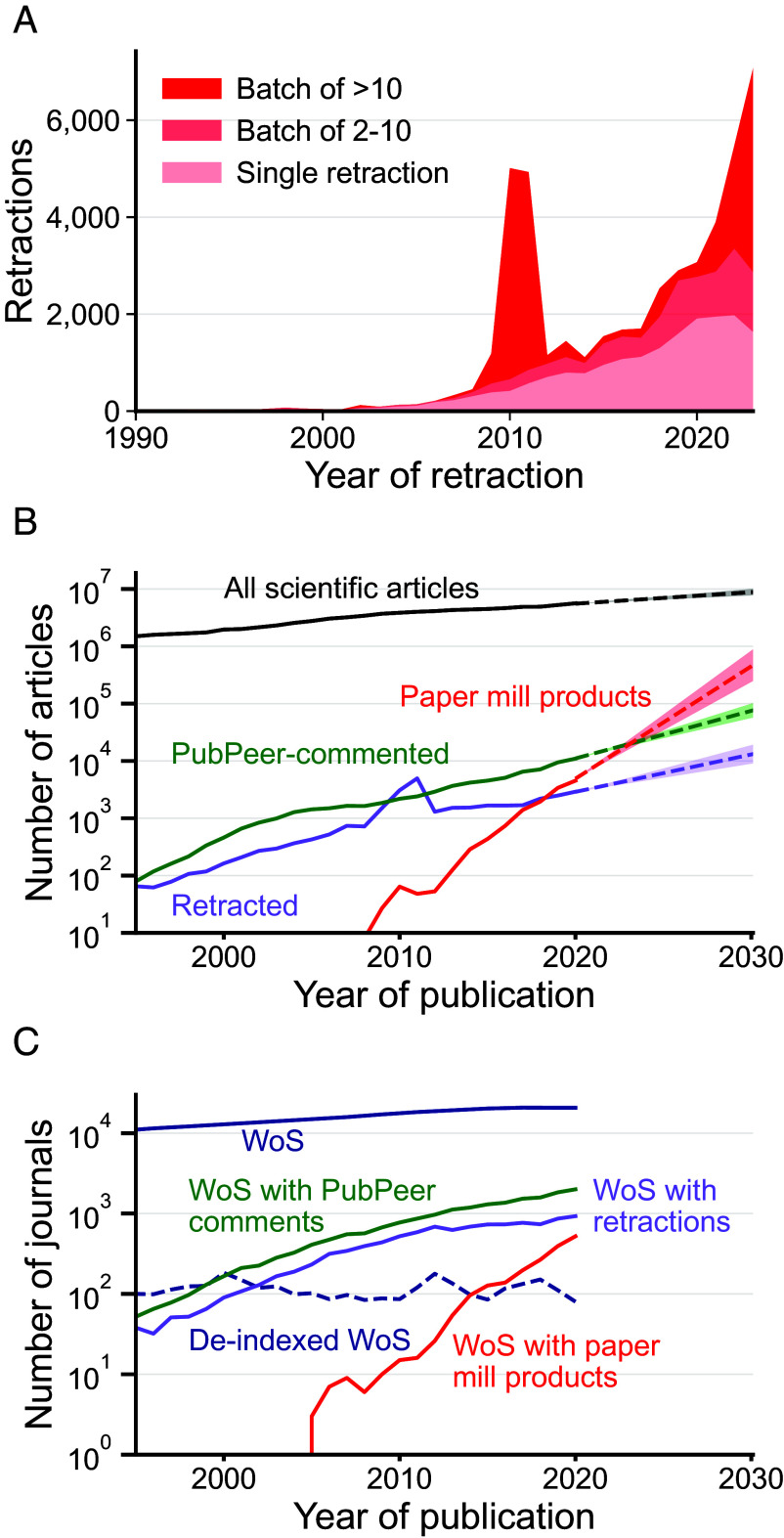
- Suspected paper-mill products doubled every 1.5 years, compared with 3.3 years for retracted articles, 3.6 years for PubPeer-commented articles, and 15.0 years for total publications; only 8,589 of 29,956 suspected paper-mill products with an OpenAlex record had been retracted (28.7%), with projections that only ~25% will ever be retracted and ~10% will ever reside in a deindexed journal.
Methods
- The authors combined bibliometric and integrity data from Web of Science, Scopus, PubMed/MEDLINE, OpenAlex, Retraction Watch (47,387 unique retraction records), PubPeer comments on 105,325 articles, the Problematic Paper Screener (32,786 unique suspected paper-mill articles), PLOS ONE and Hindawi article metadata, IEEE conference proceedings, and ARDA website snapshots via the Wayback Machine.
- They used Poisson binomial tests with Benjamini–Hochberg false-discovery-rate control at 0.05 to flag editors and authors with anomalous retraction, PubPeer-comment, or short-turnaround rates; built and analyzed an image-duplication network with connected components and stochastic block modeling; used Shannon entropy to test concentration of modules by publisher and year; and extrapolated log-linear trends.
- Key samples included 276,956 PLOS ONE articles since 2006 (702 retracted, 2,241 PubPeer-commented) and 18,329 PLOS ONE editors; ten Hindawi journals; 2,294,067 IEEE conference articles from 19,969 conferences since 2003; and 20,638 documents from five ARDA-listed journals, with author nationality imputed for 13,288 (64.4%).
Limitations
- The paper states that its analyses rely on reported instances of fraud, that many fields and journals are likely underrepresented, that the vast majority of paper-mill products are thought to remain undetected, and that some case studies focus on particular disciplines and may not generalize.
- The paper also states that temporal changes in detection effort or attention could produce spurious trends, and that it cannot determine whether observations reflect commercial paper mills or less formal noncommercial peer networks.
- Evident from the text: editor disambiguation required exact full-name matches, ORCiD identifiers were unavailable for 91.2% of named authors, 39.8% of PLOS ONE articles had no identifiable author, and editor tenures were right-censored because articles under review were unavailable.
Model-written summary. Check it against the paper before relying on it.
Integrity signals
Registry
Cites
Statistics
Figures
Verification
Claims the paper makes
14 Valid · 3 Not valid · 13 Not checked · 90 Own results and interpretations
The cited sources support only part of this claim — read each source’s verdict below.
In the paper
“Because of the increasing complexity of the knowledge being created and increased specialization, the system relies on the good-faith assumption of genuine contributions by all participants (7–10).”
§ The entities enabling scientific fraud at scale are large, resilient, and growing rapidly > Abstract
What the sources say
- Not checked — no full text of the sourcecites [7] H. K. Erben, Carelessness, or good faith? Science 245, 1165– 1166 (1989).2781274 source
- Partly supportedcites [8] E. M. McNally, Conflicting interests: When whistleblowers profit from allegations of scientific misconduct. J. Clin. Investig. 132, e166176 (2022). 36317633 PMC9621127 sourceExperimental — accuracy not yet measured
In the main text (page not specified), McNally says journals must trust investigators to represent their data truthfully. That supports the good-faith premise, but the paper does not extend it to genuine contributions by all participants in the scientific system. (LLM, conf=0.83)
- Not checked — no full text of the sourcecites [9] J. Bohannon, Who’s afraid of peer review? Science 342, 60-65 (2013). 24092725 source
- Partly supportedcites [10] J. P. Tennant, T. Ross-Hellauer, The limitations to our understanding of peer review. Res. Integr. Peer Rev. 5, 6 (2020). 32368354 PMC7191707 sourceExperimental — accuracy not yet measured
In Results and discussion, under “Role of reviewers in peer review” (page not provided), the paper says manuscript assessment involves trusting that methods and protocols were carried out correctly and in good faith. That supports a good-faith assumption in peer review, but not the broader claim about genuine contributions by all participants or the proposed link to increasing complexity and specialization. (LLM, conf=0.82)
plain- Asserted: passes — The authors put it forward as true.
- Checkable: passes — It can be checked against evidence.
- Load-bearing: passes — The paper’s conclusions depend on it.
- Based: passes — The paper gives a reason why it holds.
The cited sources support only part of this claim — read each source’s verdict below.
In the paper
“Due to the increasing scale and scope of the scientific enterprise, the degree to which stakeholders contribute to the system is now increasingly evaluated by potentially misleading proxies (12, 13) such as the h-index (14), journal impact factor, university rankings, and scientific prizes.”
§ The entities enabling scientific fraud at scale are large, resilient, and growing rapidly > Abstract
What the sources say
- Partly supportedcites [12] C. W. Belter, Bibliometric indicators: Opportunities and limits. J. Med. Libr. Assoc. 103, 219 (2015). 26512227 PMC4613388 sourceExperimental — accuracy not yet measured
In “Bibliometric indicators: opportunities and limits” (page not provided), Belter says reviewers and policymakers increasingly use indicators such as the h-index and journal impact factor, and warns that indicators can be misleading when misapplied. The paper does not identify university rankings or scientific prizes as examples of those proxies. (LLM, conf=0.85)
- Not checked — no full text of the sourcecites [13] K. Siler, V. Larivière, Who games metrics and rankings? Institutional niches and journal impact factor inflation Res. Policy 51, 104608 (2022). source
- Supportedcites [14] J. E. Hirsch, An index to quantify an individual’s scientific research output. Proc. Natl. Acad. Sci. U.S.A. 102, 16569– 16572 (2005). 16275915 PMC1283832 source
Citation (14) is attached specifically to the h-index, not to the other listed proxies. Hirsch proposes the h-index as a measure for evaluating researchers’ scientific output (p. 1) and cautions that a single number gives only a rough approximation of an individual’s accomplishments (p. 4). (LLM, conf=0.94)
plainstates a cause- Asserted: passes — The authors put it forward as true.
- Checkable: passes — It can be checked against evidence.
- Load-bearing: passes — The paper’s conclusions depend on it.
- Based: passes — The paper gives a reason why it holds.
- Partly supported
Every source the paper cites for this claim was checked and supports it.
In the paper
“In a 2022–2023 survey of medical residents at tertiary hospitals in southwest China, 46.7% of respondents self-reported buying and selling papers, letting other people write papers, or writing papers for others (27).”
§ The entities enabling scientific fraud at scale are large, resilient, and growing rapidly > Abstract
What the sources say
- Supportedcites [27] L. Chen, Knowledge, attitudes and practices about research misconduct among medical residents in southwest china: A cross-sectional study. BMC Med. Educ. 24, 284 (2024). 38486182 PMC10941492 source
The Methods describe a survey conducted from November 2022 through March 2023 among residents at 17 tertiary hospitals in southwest China. Results Table 4 reports that 2,897 of 6,200 residents (46.7%) self-reported buying or selling papers, having others write papers, or writing papers for others. (LLM, conf=0.95)
plain- Asserted: passes — The authors put it forward as true.
- Checkable: passes — It can be checked against evidence.
- Load-bearing: passes — The paper’s conclusions depend on it.
- Based: passes — The paper gives a reason why it holds.
- Supported
The cited sources support only part of this claim — read each source’s verdict below.
In the paper
“However, the evidence suggests that these mechanisms have not yet been successful in stemming the tide of defections (24–33).”
§ The entities enabling scientific fraud at scale are large, resilient, and growing rapidly > Abstract
What the sources say
- Partly supportedcites [24] E. M. Bik, A. Casadevall, F. C. Fang, The prevalence of inappropriate image duplication in biomedical research publications. MBio 7, 10– 1128 (2016). PMC4941872 27273827 sourceExperimental — accuracy not yet measured
The Discussion (page unavailable) reports that inappropriate image duplication rose in 2003 and remained high, supporting the narrower point that problematic research practices persisted. The paper does not assess whether formal or informal punishment mechanisms were used or whether they failed to deter misconduct. (LLM, conf=0.82)
- Partly supportedcites [25] J. A. Byrne, Protection of the human gene research literature from contract cheating organizations known as research paper mills. Nucleic Acids Res. 50, 12058– 12070 (2022). 36477580 PMC9757046 sourceExperimental — accuracy not yet measured
The 'Deterring Future Submissions from Paper Mills' section says some journal requirements have not proved effective or can be gamed, and that paper mills can adapt to detection. This supports a narrower claim about efforts to deter paper-mill submissions, but not the broader claim that formal and informal punishment mechanisms have failed to stem defections generally. The indexed passages provide no page numbers. (LLM, conf=0.82)
- Not matchedcites [26] COPE and STM, “Paper mills - research report from cope and stem” (Committee on Publication Ethics, 2022).
Its entry has no title and year that we can search by.
- Could not verifycites [27] L. Chen, Knowledge, attitudes and practices about research misconduct among medical residents in southwest china: A cross-sectional study. BMC Med. Educ. 24, 284 (2024). 38486182 PMC10941492 sourceExperimental — accuracy not yet measured
The Results report research misconduct among medical residents and an association between misconduct and perceived consequences, but do not evaluate formal or informal punishment mechanisms. The Methods describe a cross-sectional survey, not a test of whether punishment has reduced defections over time; searches for punishment and deterrence found no such finding in our copy. (LLM, conf=0.73)
- Not checked yetcites [28] I. Oransky, Up to one in seven submissions to hundreds of Wiley journals flagged by new paper mill tool. Retraction Watch (2024). https://retractionwatch.com/2024/03/14/up-to-one-in-seven-of-submissions-to-hundreds-of-wiley-journals-show-signs-of-paper-mill-activity/. Accessed 7 July 2025.
- Not checked — no full text of the sourcecites [29] F. Joelving, Paper trail. Science 383, 252– 255 (2024). 38236982 source
- Not checked — no full text of the sourcecites [30] B. A. Sabel, E. Knaack, G. Gigerenzer, M. Bilc, Fake publications in biomedical science: Red-flagging method indicates mass production. medRxiv [Preprint] (2023). 10.1101/2023.05.06.23289563 (Accessed 18 October 2023). PMC12901079 40991025 source
- Could not verifycites [31] A. Abalkina, Detecting a network of hijacked journals by its archive. Scientometrics 126, 7123– 7148 (2021). sourceExperimental — accuracy not yet measured
The Literature review (p. 5) discusses punishment as a potential cost of fraud, and the Argument (p. 7) says journal hijackers face a low risk of punishment. Neither passage assesses whether formal or informal punishment mechanisms have failed to stem defections; searches for those terms and for deterrence found no such assessment in our copy. (LLM, conf=0.73)
- Could not verifycites [32] A. Abalkina, Challenges posed by hijacked journals in Scopus. J. Assoc. Inf. Sci. Technol. 75, 395– 422 (2023). sourceExperimental — accuracy not yet measured
Section 6 (p. 23) says Scopus’s measures are insufficient to prevent hijacked-journal fraud, but it does not discuss formal or informal punishment mechanisms or defections. Searches for those terms found no passage addressing the attributed claim. (LLM, conf=0.76)
- Not matchedcites [33] I. Oransky, The retraction watch hijacked journal checker. https://retractionwatch.com/the-retraction-watchhijacked-journal-checker/. Accessed 4 March 2024.
Its entry has no title and year that we can search by.
hedged- Asserted: passes — The authors put it forward as true.
- Checkable: passes — It can be checked against evidence.
- Load-bearing: passes — The paper’s conclusions depend on it.
- Based: passes — The paper gives a reason why it holds.
- Partly supported
The cited sources that could be checked couldn’t confirm or dispute this claim.
In the paper
“Seventeen (9.0%) of these journals are suspected to be “hijacked journals,” where a journal was once legitimate but a paper mill has gained complete editorial control over the journal and its indexed content (31–33).”
§ The entities enabling scientific fraud at scale are large, resilient, and growing rapidly > Results > Evidence of Journal Targeting and “Journal Hopping”.
What the sources say
- Could not verifycites [31] A. Abalkina, Detecting a network of hijacked journals by its archive. Scientometrics 126, 7123– 7148 (2021). sourceExperimental — accuracy not yet measured
The Results (p. 10) report 57 hijacked journals detected through analysis of their archives, but do not identify an ARDA list or report that 17 (9.0%) of its journals were suspected hijacks. Searches for ARDA and the stated count found no passage addressing that claim. (LLM, conf=0.76)
- Could not verifycites [32] A. Abalkina, Challenges posed by hijacked journals in Scopus. J. Assoc. Inf. Sci. Technol. 75, 395– 422 (2023). sourceExperimental — accuracy not yet measured
Section 5.2 (p. 18) reports 17 hijacked journals from China, not 17 journals listed by ARDA. The Conclusions (p. 25) give Scopus counts, but our copy does not mention ARDA or a 9.0% figure; it therefore does not verify the attributed count. (LLM, conf=0.76)
- Not matchedcites [33] I. Oransky, The retraction watch hijacked journal checker. https://retractionwatch.com/the-retraction-watchhijacked-journal-checker/. Accessed 4 March 2024.
Its entry has no title and year that we can search by.
plain- Asserted: passes — The authors put it forward as true.
- Checkable: passes — It can be checked against evidence.
- Load-bearing: unclear — It is unclear whether the paper’s conclusions depend on it.
- Based: passes — The paper gives a reason why it holds.
- Could not verify
75 more claims
Create a free account to see all 120 claims and to verify the 6 references still open.
- It may state two separate claims as one. 20
- Probably not a substantial claim. 21
Self-check
Percentages, sums and reported differences re-computed from the paper’s own numbers.
Each contradiction between two passages listed here was confirmed by an independent check.
Rated minor: it would not touch a result — a value no result rests on, a p-value that stays on the same side of the significance level, or a conflict that is clerical, resolved elsewhere in the paper, or outside its own findings.
In the paper
§ The entities enabling scientific fraud at scale are large, resilient, and growing rapidly > Results > Differential Prevalence of Fraud Within Disciplinary Subfields.
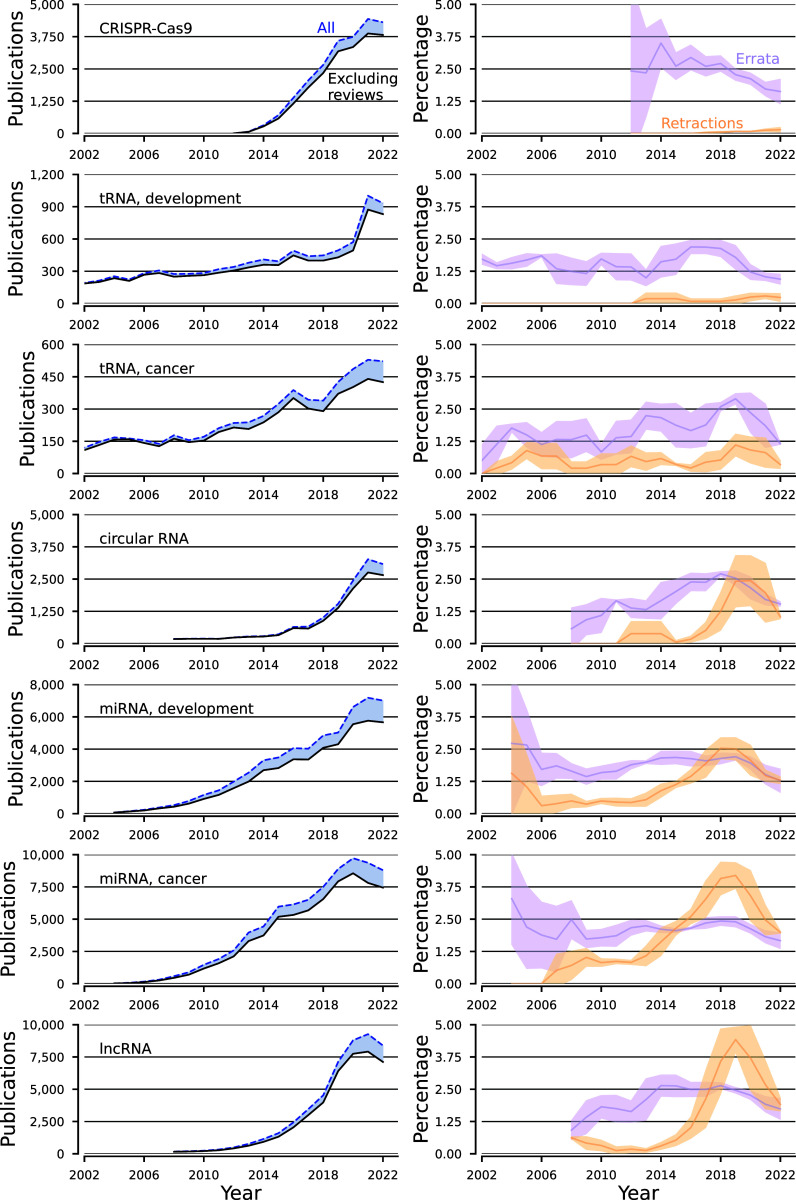
“We further restrict our attention to six subfields of interest to RNA biologists”
§ The entities enabling scientific fraud at scale are large, resilient, and growing rapidly > Results > Differential Prevalence of Fraud Within Disciplinary Subfields.
“namely CRISPR-Cas9, transfer RNAS (tRNAs) and development, tRNAs and cancer, circular RNAs, micro-RNAs (miRNAs) and development, miRNAs and cancer, and long noncoding RNAs (lncRNAs)”
Cited works that were retracted
Works this paper cites that were later retracted, from the retraction notices publishers deposit. Major when the notice came out before this paper was published.
A note, not an issue: for example, a cited work that was retracted only after this paper was published, which its authors could not have known.
In the paper
“T. P. O. Editors Retraction: Effect of temperature & humdity on population dynamics of insects’ pest complex of cotton crop. PLoS One 17 1–1 (2022).”
Cited work 10.1371/journal.pone.0274235 · retraction date not known · this paper published 2025-08-04
A note, not an issue: for example, a cited work that was retracted only after this paper was published, which its authors could not have known.
In the paper
“10.1002/leap.1574”
Cited work 10.1002/leap.1574 · retracted 2026-11-13 · notice 10.1155/jfpp/9803281 · this paper published 2025-08-04
Citations
Cites
2 retracted
Abalkina, A. (2023) · Learned Publishing · doi:10.1002/leap.1574 · Cited by 101
RetractedEditors, T. P. O. (2022) · PLOS ONE · doi:10.1371/journal.pone.0274235 · Cited by 1
RetractedControlling the False Discovery Rate: A Practical and Powerful Approach to Multiple Testing
Benjamini, Y., & Hochberg, Y. (1995) · Journal of the Royal Statistical Society Series B: Statistical Methodology · doi:10.1111/j.2517-6161.1995.tb02031.x · Cited by 109,482
An index to quantify an individual’s scientific research output
Hirsch, J. E. (2005) · Proceedings of the National Academy of Sciences · doi:10.1073/pnas.0507655102 · Cited by 11,669
Cooperation and Punishment in Public Goods Experiments
Fehr, E., & Gächter, S. (2000) · American Economic Review · doi:10.1257/aer.90.4.980 · Cited by 4,547
Etzkowitz, H., & Leydesdorff, L. (1995) · UvA-DARE (University of Amsterdam) · Cited by 2,791
The Group Engagement Model: Procedural Justice, Social Identity, and Cooperative Behavior
Tyler, T. R., & Blader, S. L. (2003) · Personality and Social Psychology Review · doi:10.1207/s15327957pspr0704_07 · Cited by 2,208
Sustaining cooperation in laboratory public goods experiments: a selective survey of the literature
Chaudhuri, A. (2011) · Experimental Economics · doi:10.1007/s10683-010-9257-1 · Cited by 1,445
Social Preferences, Beliefs, and the Dynamics of Free Riding in Public Goods Experiments
Fischbacher, U., & Gächter, S. (2010) · American Economic Review · doi:10.1257/aer.100.1.541 · Cited by 1,316
The scientific impact of nations
King, D. A. (2004) · Nature · doi:10.1038/430311a · Cited by 1,245
Research works printed but not linked: 6
- I. Oransky, Up to one in seven submissions to hundreds of Wiley journals flagged by new paper mill tool. Retraction Watch (2024). https://retractionwatch.com/2024/03/14/up-to-one-in-seven-of-submissions-to-hundreds-of-wiley-journals-show-signs-of-paper-mill-activity/. Accessed 7 July 2025.
- I. Oransky, The retraction watch hijacked journal checker. https://retractionwatch.com/the-retraction-watchhijacked-journal-checker/. Accessed 4 March 2024.
- Pubmed. https://pubmed.ncbi.nlm.nih.gov. Accessed 27 February 2023.
- Openalex. https://www.openalex.org. Accessed 27 February 2023.
- Medline currently and previously indexed titles. https://www.ncbi.nlm.nih.gov/nlmcatalog/?term=reportedmedline[All+Fields]. Accessed 27 February 2023.
- Plos text and data mining. https://plos.org/text-and-data-mining/. Accessed 8 November 2023.
Cited by
The IUPHAR/BPS Guide to PHARMACOLOGY in 2026
Harding, S. D., Armstrong, J. F., Faccenda, E., Southan, C., Alexander, S. P. H., Davenport, A. P., Spedding, M., & Davies, J. A. (2025) · Nucleic Acids Research · doi:10.1093/nar/gkaf1067 · Cited by 48
“A recent publication entitled “The entities enabling scientific fraud at scale are large, re-silient, and growing rapidly”[ 21 ] also brings the problem into sharp perspective.”
Lumbard, H., & Routledge, D. (2025) · PLoS Medicine · doi:10.1371/journal.pmed.1004774 · Cited by 18
“Together with the development of more sophisticated detection tools, this heightened vigilance has already led to the identification and retraction of thousands of fraudulent articles across multiple publishers [11,12].”
Dramatic increases in redundant publications in the Generative AI era
Maupin, D. J., Suchak, T., Barnett, A. G., & Spick, M. P. (2025) · BMC Medicine · doi:10.1186/s12916-025-04569-y · Cited by 33
Reformation of science publishing: the Stockholm Declaration
Sabel, B. A., & Larhammar, D. (2025) · Royal Society Open Science · doi:10.1098/rsos.251805 · Cited by 36
Estimating the predictability of questionable open-access journals
Zhuang, H., Liang, L., & Acuna, D. E. (2025) · Science Advances · doi:10.1126/sciadv.adt2792 · Cited by 17
“Alongside paper mills [e.g., see Richardson et al. ( 4 )], questionable journals have become an existential issue in academia since the inception of open-access publishing.”
Khairil, L., Benny, K. H. S., Jerry, J., Khatib, F. M., Ramli, M. D. C., & Kumar, S. (2026) · Pharmaceuticals · doi:10.3390/ph19060916 · Cited by 11
“A recent analysis suggests that this ability to evade interventions is enabling the number of fraudulent publications to grow at a rate far outpacing that of legitimate science [120].”
An audit of machine learning experiments on software defect prediction
Destefanis, G., Yousefi, L., Shepperd, M., Tucker, A., Swift, S., Counsell, S., & Arzoky, M. (2026) · Empirical Software Engineering · doi:10.1007/s10664-025-10797-w · Cited by 15
“Typically, these tactics are deployed by “paper mills” or other “bad actors” to create fake scientific papers [53].”
Reckoning with Retractions in Research Funding Reviews: The Case of China
Xu, S. B., & Hu, G. (2025) · Publications · doi:10.3390/publications13030041 · Cited by 9
“For instance, the number of institutional investigations reported to the Office of Research Integrity (ORI) remained notably low (Titus et al., 2008), and scientific fraud has become a rapidly growing industry (Richardson et al., 2025).”
Robot pen pals: a multidisciplinary analysis of recent trends in scientific correspondencePreprint
Chaccour, C., Arrondo, G., Cancellario, T., et al. (2025) · Research Square · doi:10.21203/rs.3.rs-7992675/v1 · Cited by 5
Dramatic increases in redundant publications in the Generative AI eraPreprint
Maupin, D. J., Suchak, T., Barnett, A. G., & Spick, M. P. (2025) · medRxiv · doi:10.1101/2025.09.09.25335401 · Cited by 5
Smothers, C. G., Gandhi, S., Chang, J. H., Tahir, S. M., Kelley, J., Wang, E. Q., Fareed, K., Mack, H., Dong, C., Witort, M., et al. (2026) · Nature Communications · doi:10.1038/s41467-026-71329-8 · Cited by 5
A Typed, Dynamic, No-Meta Theory of Autonomous Research Claim Certification and ReleasePreprint
Takahashi, K. (2026) · Zenodo (CERN European Organization for Nuclear Research) · doi:10.5281/zenodo.19427818 · Cited by 2
An Updated Assessment of Reinforcement Learning for Macro Placement
Cheng, C.-K., Kahng, A. B., Kundu, S., Wang, Y., & Wang, Z. (2025) · IEEE Transactions on Computer-Aided Design of Integrated Circuits and Systems · doi:10.1109/tcad.2025.3644293 · Cited by 14
Aveyard, B., & Asbridge, S. C. M. (2025) · Future Healthcare Journal · doi:10.1016/j.fhj.2025.100487 · Cited by 5
Knowing is not enough; we must apply: the case for rigorous microRNA annotation standards
Hackenberg, M., Kalogeropoulos, P., Peterson, K. J., Friedländer, M. R., & Fromm, B. (2025) · Nucleic Acids Research · doi:10.1093/nar/gkaf1049 · Cited by 6
“Previous studies have emphasized the need for rigor in microRNA research [ 40 ], as well as the challenges and opportunities within the field [ 8 , 41 ] particularly in cancer research [ 15 , 42 ].”
Storm over science: predatory practices and the fight for research reliability
de Lorenzo, V., Rainey, P. B., Williams, P. M., Karahan, Z. C., López‐García, P., Jonjić, S., & Timmis, K. N. (2025) · microLife · doi:10.1093/femsml/uqaf029 · Cited by 7
“Predictably, once a manuscript is submitted, acceptance is virtually guaranteed after passing—if any—a superficial and rarely critical perusal by benevolent or even non-existent referees (Richardson et al. 2025 ).”
Why can’t epidemiology be automated (yet)?
Bann, D., Lowther, E., Wright, L., & Kovalchuk, Y. (2026) · International Journal of Epidemiology · doi:10.1093/ije/dyaf210 · Cited by 9
“We live in an era that incentivizes scientists to produce masses of papers of questionable quality, including their direct purchase online [48]; this is a human, not an AI, problem.”
AI and the Future of Publishing: Not Detection, but Answerability
Floridi, L. (2026) · Philosophy & Technology · doi:10.1007/s13347-026-01148-8 · Cited by 8
“Organised paper-mill networks have been documented, placing fraudulent products in major journals at an industrial scale (Richardson et al., 2025).”
Suspected distortion of citations in high-impact cancer journalsPreprint
Scancar, B., Byrne, J. A., Causeur, D., & Barnett, A. G. (2026) · bioRxiv (Cold Spring Harbor Laboratory) · doi:10.64898/2026.05.25.727627 · Cited by 4
“Considering that paper mills are known to target non-coding RNA research (16, 27) – a subfield known to be associated with elevated citation counts (40) – we tested whether this topic could confound the differences observed between flagged and non-flagged papers.”
Self-citationCementing JM ’s Impact on the Marketing Ecosystem: Empirical Execution
Steenkamp, J. B. E. M., Fischer, M., Haws, K. L., Scott, M. L., & Slotegraaf, R. J. (2026) · Journal of Marketing · doi:10.1177/00222429261426047 · Cited by 9
Seeing Is Believing? Scientific Misconduct and the Detection of Problematic Images
Bik, E. M. (2026) · Anesthesia & Analgesia · doi:10.1213/ane.0000000000008033 · Cited by 4
Research Requirements for Residency Applicants Need to Be Reconsidered
Pin, P. G. (2025) · Aesthetic Surgery Journal · doi:10.1093/asj/sjaf270 · Cited by 3
An evaluation system for scientific journals
Tautz, D., & Rainey, P. B. (2025) · EMBO Reports · doi:10.1038/s44319-025-00649-5 · Cited by 3
WHO said what? Non-robust standards in citing WHO and EPA drinking water guidelines
Pollard, B. L., Thanusing, M. K., & Connal, L. A. (2025) · Molecular Systems Design & Engineering · doi:10.1039/d5me00181a · Cited by 3
Artificial intelligence: The good, the bad, and the ugly
Elston, D. M. (2025) · Journal of the American Academy of Dermatology · doi:10.1016/j.jaad.2025.08.039 · Cited by 3
AI will reorganize science. Will research remain a human enterprise?
Hochberg, M., & Thrall, P. H. (2026) · Proceedings of the National Academy of Sciences · doi:10.1073/pnas.2610088123 · Cited by 5
“By contrast, editorial and peer - review labor remains slow and effort - intensive ( 6 ).”
InfluentialPublication fraud in the era of generative artificial intelligence
van der Heyden, M. A. G., Engh, M. A., Whalley, C., et al. (2026) · British Journal of Pharmacology · doi:10.1111/bph.70550 · Cited by 2
“Scientific publishing is currently heavily plagued with ‘ bad actors ’ or commercial entities, such as paper mills, producing vast amounts of fraudulent manuscripts and manipulating processes to get these published (Richardson et al., 2025).”
Spick, M. (2026) · Octopus · doi:10.57874/5v0d-jf31 · Cited by 1
The crushing weight of fake papers
Hu, G. (2026) · Journal of English for Academic Purposes · doi:10.1016/j.jeap.2026.101688 · Cited by 2
Maupin, D. J., Suchak, T., Sengupta, A., Marra, M., Geifman, N., & Spick, M. P. (2026) · medRxiv · doi:10.64898/2026.01.13.26343992 · Cited by 2
The emerging submission crisis in behavioral science
Spitzer, M. (2026) · Trends in Neuroscience and Education · doi:10.1016/j.tine.2026.100276 · Cited by 5
Tasker, R. C. (2026) · Pediatric Critical Care Medicine · doi:10.1097/pcc.0000000000003875 · Cited by 4
Joo, H. J., Radnaabaatar, M., & Jung, J. (2026) · Journal of Korean Medical Science · doi:10.3346/jkms.2026.41.e306 · Cited by 10
Bhargava, H. K., Bana, S., Zhang, Z., Brandimarte, L., Choudhary, V., Li, J. F., Loupos, P., & Zantedeschi, D. (2026) · Management Science · doi:10.1287/mnsc.2026.00184 · Cited by 10
Publication integrity and industry influences on the editorial process: a case study
Kharasch, E. D., Todd, M. M., Pittet, J., & Lanier, W. L. (2026) · Research Integrity and Peer Review · doi:10.1186/s41073-026-00216-z · Cited by 3
“Myriad problems attending the scientific research and scholarly publication enterprise are being identified and publicized with increasing frequency, attention, and concern [43, 44].”
Misuse of Generative AI in Academic and Research Publishing
Tang, B. L. (2026) · Publishing Research Quarterly · doi:10.1007/s12109-026-10074-8 · Cited by 1
Why the Stockholm Declaration will never work
Szabo, C. (2026) · Royal Society Open Science · doi:10.1098/rsos.252165 · Cited by 2
Is it plagiarism if the material was previously published by a third party?
Seeman, J. I., & House, M. C. (2026) · Accountability in Research · doi:10.1080/08989621.2026.2652499 · Cited by 1
“…Coudert 2019; Kahr, McHenry, and Hollingsworth 2019; Kampa et al. 2025; Matusz, Abalkina, and Bishop 2025; McCabe 2005; Pupovac and Fanelli 2015; Richardson et al. 2025; Sevryugina and Jimenez 2023) and within the broader educational, political, and social communities (Chang 2023; Krishna…”
Evidence contamination: what it is and why it matters
Xu, C., Furuya‐Kanamori, L., Gu, Z., Loke, Y. K., Lin, L., Stone, J., Fan, Z., Golder, S., Qin, Z., Guan, X., et al. (2026) · BMJ Evidence-Based Medicine · doi:10.1136/bmjebm-2025-114305 · Cited by 1
[English traslation] Science fatigue
Vargas, L. F. A. (2026) · Pensar en Movimiento Revista de Ciencias del Ejercicio y la Salud · doi:10.15517/z62fzv35 · Cited by 1
Gray, A. D. (2026) · Bulletin of the Atomic Scientists · doi:10.1080/00963402.2026.2628491 · Cited by 2
DEPower : approximate power analysis with DESeq2Preprint
Gorin, G., Guruge, D., & Goodman, L. (2026) · bioRxiv (Cold Spring Harbor Laboratory) · doi:10.64898/2026.02.05.704084 · Cited by 1
The role of society journals in protecting the scientific record
Russo, C. A. M., & Gaut, B. S. (2026) · Molecular Biology and Evolution · doi:10.1093/molbev/msag022 · Cited by 2
Navigating the new frontier: growth, integrity, and our vision for 2026
Lalwani, N. (2026) · Abdominal Radiology · doi:10.1007/s00261-025-05350-8 · Cited by 1
Designing a national benefit–cost analysis system
Whittington, D. (2025) · Annals of Public and Cooperative Economics · doi:10.1111/apce.70031 · Cited by 1
Bias, accuracy, and trust: no GenAI in peer reviewing
Salem, D. B., Barrat, J., Ammari, S., Lojo‐Lendoiro, S., Belaid, A., Attyé, A., Ducloyer, M., Edjlali, M., Boutet, C., & Ognard, J. (2025) · Journal of Neuroradiology · doi:10.1016/j.neurad.2025.101411 · Cited by 4
Chang, S. M. (2025) · Neuro-Oncology · doi:10.1093/neuonc/noaf278 · Cited by 1
Reviewers are better equipped to detect fraud than editors
Neveu, R., & Neveu, A. (2025) · Proceedings of the National Academy of Sciences · doi:10.1073/pnas.2522791122 · Cited by 2
Krystal, J. H., Barch, D. M., Bugno, R., & Carter, C. S. (2025) · Biological Psychiatry · doi:10.1016/j.biopsych.2025.11.017 · Cited by 2
The Ongoing Assault on Science and Truth
COHEN, A. B. (2025) · Milbank Quarterly · doi:10.1111/1468-0009.70054 · Cited by 1
Liu, J., He, Y., Zheng, Z., Bu, Y., & Ni, C. (2025) · arXiv · doi:10.48550/arxiv.2511.15872 · Cited by 1
“Excessive automation could flood editorial systems with low-quality or redundant submissions (35, 36), as illustrated by the recent NIH decision to limit individual investigators to six annual grant applications after reports of AI-generated proposals (37).”
Medical Journal Editors as Guardrails in Ensuring Research Integrity and Trust in Science
Mainous, A. G., McCarthy, M., Durden, B., Freedman, E., Gazze, S. L. A., & Costello, G. (2026) · Journal of Hospital Librarianship · doi:10.1080/15323269.2026.2734717
The End of Science? Agnosis and American Fascism
Edwards, P. N. (2026) · Science Technology & Human Values · doi:10.1177/01622439261474980
Ponce, C. J. (2026) · Observatorio Económico · doi:10.11565/oe.v1i214.629
Authors, reviewers, editors… smitten and bitten by the artificial intelligence (AI) bug!
Kurdi, M. S., Gangakhedkar, G. R., & Sasidharan, S. (2026) · Indian Journal of Anaesthesia · doi:10.4103/ija.ija_1374_26
Editorial Conflicts of Interest in Elite Peer Review
Mindel, V., & Ciriello, R. (2026) · Journal of Business Ethics · doi:10.1007/s10551-026-06441-2 · Cited by 8
Science and Communication as the Foundation of Food Safety
Diaz‐Amigo, C., Pino, L. E. B. D., Fattori, V., & Bessy, C. (2026) · Journal of Food Protection · doi:10.1016/j.jfp.2026.100905
Heikkilä, T. (2026) · Public Understanding of Science · doi:10.1177/09636625261470329 · Cited by 2
Degen, P. M., Riebler, A., & Held, L. (2026) · Journal of Clinical Epidemiology · doi:10.1016/j.jclinepi.2026.112464 · Cited by 1
Hans, M., Greczyński, G., Rebholz, C., Ulrich, S., Fleischmann, C., Pedersen, H., Sundgren, J. ‐., & Mitterer, C. (2026) · Surface and Coatings Technology · doi:10.1016/j.surfcoat.2026.133826
PaperRepro: Automated Computational Reproducibility Assessment for Social Science Papers
Zhang, L., Xia, T., Piao, J., & Cui, L. (2026) · Proceedings of the 32nd ACM SIGKDD Conference on Knowledge Discovery and Data Mining V.2 · doi:10.1145/3770855.3818943
Herrmann, P. (2026) · Die Dermatologie · doi:10.1007/s00105-026-05715-0
Aquarius, R., van Reijmersdal, V. P. A., Kuster, C., Konijnenberg, L. S. F., Nijveldt, R., & Wever, K. E. (2026) · Canadian Journal of Cardiology · doi:10.1016/j.cjca.2026.07.375
Scancar, B., & Causeur, D. (2026) · médecine/sciences · doi:10.1051/medsci/2026131
Begagić, E., Skenderi, F., & Vranić, S. (2026) · Journal of Clinical Epidemiology · doi:10.1016/j.jclinepi.2026.112429 · Cited by 2
The landscape of problematic papers in the field of non-coding RNA
Lou, Y., Zhou, Z., Wang, G., Shen, Z., & Li, M. (2026) · Journal of Informetrics · doi:10.1016/j.joi.2026.101851 · Cited by 1
“In general, most studies focus on analyzing retracted papers, with relatively few investigations examining those discussed on PubPeer [32].”
InfluentialStrengthening Australia's research integrity system
Anderson, W. P., & Breen, K. (2026) · Internal Medicine Journal · doi:10.1111/imj.70474
Growth without dilution: impact, integrity, and the next phase of abdominal radiology
Lalwani, N. (2026) · Abdominal Radiology · doi:10.1007/s00261-026-05669-w
“Scientific publishing faces increasing pressure from volume, speed, artificial intelligence, paper mills, citation manipulation, and metric-driven behavior [ 9 ].”
The Challenges of Scientific Publishing: An Editor‐In‐Chief's Perspective
Zimmer, L., & Bousquet, P. (2026) · Fundamental and Clinical Pharmacology · doi:10.1111/fcp.70105
Herrmann, P. (2026) · Die Ophthalmologie · doi:10.1007/s00347-026-02437-5
Herrmann, P. (2026) · Zeitschrift für Herz- Thorax- und Gefäßchirurgie · doi:10.1007/s00398-026-00772-y
Herrmann, P. (2026) · Zeitschrift für Rheumatologie · doi:10.1007/s00393-026-01828-y
Mañana-Rodríguez, J., Granadino-Goenechea, B., & Bautista-Puig, N. (2026) · Scientometrics · doi:10.1007/s11192-026-05668-0 · Cited by 2
“Richardson et al. (2025) shows that scientific fraud is increasingly driven by coordinated editorial and author behaviour rather than isolated misconduct.”
Curbing the tide of “paper mills”: A risk-based integrated governance for public health databases
Wang, J., & Wu, Y. (2026) · The Innovation · doi:10.1016/j.xinn.2026.101455
Herrmann, P. (2026) · Die Unfallchirurgie · doi:10.1007/s00113-026-01711-0
Herrmann, P. (2026) · Knie Journal · doi:10.1007/s43205-026-00383-5
A New Paradigm for Scientific Publishing, Peer Review, and Impact Assessment
Argibay, N., Rowland, L., Rock, J., & McDermott, E. (2026) · The Scientific Review · doi:10.67486/tsr.2026.1
Merriman, T., Pascart, T., & Danila, M. I. (2026) · Arthritis & Rheumatology · doi:10.1002/art.70190
Generative AI and project scholarship: The collision is coming fast
Pinto, J. K. (2026) · International Journal of Project Management · doi:10.1016/j.ijproman.2026.102858
Unintentional disinformation: A cautionary tale for scientific publishing
Burton, G. A. (2026) · Environmental Toxicology and Chemistry · doi:10.1093/etojnl/vgag101
Conclusions and Recommendations
(2026) · IGI Global eBooks · doi:10.4018/979-8-3373-8830-4.ch012
Superretractors as Superspreaders in the Evidence Ecosystem—The Virus of Research Misconduct
Xu, C., Mol, B. W., & Doi, S. A. R. (2026) · JAMA Network Open · doi:10.1001/jamanetworkopen.2026.7429
Ursić, L., Campbell, H., & Rudan, I. (2026) · Journal of Global Health · doi:10.7189/jogh.16.01003
“It is, therefore, unsurprising that some of these paper mills proliferate through a network of authors, brokers, and even journal editors [ 11 ].”
Translating Rigorous Science Into Effective Policy: Bridging the Gap
Haridopolos, S. (2026) · Public Health Reports · doi:10.1177/00333549261432086 · Cited by 1
De deugdzame onderzoeker: een Christelijk deugdethisch perspectief op wetenschappelijke integriteit
Broer, N. A., der Walt, J. L. V., & Wolhuter, C. C. (2026) · Koers - Bulletin for Christian Scholarship · doi:10.19108/koers.91.1.2644
Sogi, G. M. (2026) · Contemporary Clinical Dentistry · doi:10.4103/ccd.ccd_345_26
Herrmann, P. (2026) · Die Chirurgie · doi:10.1007/s00104-026-02480-7
Improving peer review capacity and integrity in forestry journals
Russell, M. B., & Weiskittel, A. R. (2026) · Forest Ecosystems · doi:10.1016/j.fecs.2026.100455 · Cited by 2
Invited: Benchmarker: A Web-Based System for Tracking Experimental Results
Rana, R., Bachhav, T., Dhumal, A., Pareek, A., Korrapolu, R. S. A., Prabhala, S. S. R., Bhatnagar, D., & Madden, P. H. (2026) · International Symposium on Physical Design · doi:10.1145/3764386.3790088
“Across many fields, there is concern regarding academic misconduct or outright fraud[35].”
Why does research integrity affect us all?
Funck‐Brentano, C., & Filliatreau, G. (2026) · European Heart Journal - Cardiovascular Pharmacotherapy · doi:10.1093/ehjcvp/pvag015
[Original en español] La fatiga de la ciencia
Vargas, L. F. A. (2026) · Pensar en Movimiento Revista de Ciencias del Ejercicio y la Salud · doi:10.15517/b7ydz650
Kidney International Case Reports: The Launch of a New Journal
Hiremath, S. S., McDonald, J.-P., & Conjeevaram, A. (2026) · Kidney International Case Reports · doi:10.1016/j.kintcr.2026.100001
AI-Facilitated Contamination of the Literature as a Threat to Open Science and Public Trust
Spick, M. (2026) · Octopus · doi:10.57874/ehgd-q209
Trials and tribulations of responsible people trying to uphold scientific standards
Sitte, H. H., Hübner, J., Aust, N., Weisshäupl, V., & Ernst, E. (2026) · Research Integrity and Peer Review · doi:10.1186/s41073-026-00191-5
“As the recent study [34] shows, organized fraud is expanding rapidly; only decisive editorial vigilance can prevent it from also hijacking reputable journals.”
The sophist in the server: Rhetoric, Reasoning and Scientific Judgment in the Age of LLMs
Colangelo, M. T., & Galli, C. (2026) · EMBO Reports · doi:10.1038/s44319-026-00711-w
“This attitude is reinforced by well-publicized cases of paper mills and research malpractice (Richardson et al, 2025).”
Can ISO / IEC 17025 serve as a tool to prevent scientific fraud in chemical research laboratories?
Gutierrez‐Alcantara, F. M. (2026) · The Canadian Journal of Chemical Engineering · doi:10.1002/cjce.70283
Rondon, L. A. (2026) · Revista Digital de Educación Discimus · doi:10.61447/20260130/edit
TRACES: A Benchmark for Epistemic Reliability in Scientific Reasoning by LLMs
Rodionov, V., & Assylbekov, S. (2026) · arXiv · doi:10.48550/arxiv.2608.11415
“Paper mills, citation brokers, and predatory venues have organized into resilient networks that output fraud at rates outpacing the growth of legitimate science [3, 4].”
Metadata
- Authors
- Richardson, R. A. K., Hong, S. S., Byrne, J. A., Stoeger, T., & Amaral, L. A. N.
- Affiliations
- Northwestern University (US)
- The University of Sydney (AU)
- Department of Engineering Sciences and Applied Mathematics
- Corresponding author
- Byrne, Jennifer A.
- Stoeger, Thomas
- Venue
- Proceedings of the National Academy of Sciences
- Publisher
- National Academy of Sciences
- Published
- 2025-08-04
- Volume
- 122
- Issue
- 32
- Pages
- e2420092122-e2420092122
- ISSN
- 0027-8424 (ISSN-L)
- 1091-6490
- PMC
- PMC12358853
- OpenAlex
- W4412934489
- Cited by
- 129
- References
- 81
- Citations by year
- 2026: 88 · 2025: 41
- FWCI
- 132.76
- Type
- journal article
- Language
- en
- Open access
- hybrid
- doi.org
- Licence
- Locations
- Proceedings of the National Academy of Sciences (publishedVersion, cc-by-nc-nd)
- Europe PMC (PubMed Central) (publishedVersion, cc-by-nc-nd)
- PubMed (publishedVersion)
- PubMed Central (publishedVersion, cc-by-nc-nd)
- Funders
- HHS | National Institutes of Health (T32GM008449, R00AG068544, AI135964)
- Northwestern University (John N Nicholson Fellowship, Ryan Fellowship)
- Federal Government | DHAC | National Health and Medical Research Council (APP1184263)
- National Science Foundation (1956338, 2410335)
- Topics
- Social Sciences › Education › Academic integrity and plagiarism
- Social Sciences › Library and Information Sciences › Academic Publishing and Open Access
- Social Sciences › Library and Information Sciences › scientometrics and bibliometrics research
- Keywords
- scientific fraud, paper mills, predatory journals, brokers, open access publishing, online communication, scientific research integrity
- MeSH terms
- Fraud, Humans, Periodicals as Topic, Publishing, Scientific Misconduct
About these checks
Registry, retraction, Cites and statistics results are computed, not judged, with one exception: a printed reference that no index lists is read once by a model before it counts as a citation error. Claims are extracted by a model and kept only when their quote appears verbatim in the text; each cited source is then checked, with a model’s help, for whether it says what the claim relies on. Those verdicts can be wrong — read the claim’s quote and the cited source before relying on one.
The claim verdicts this report counts are experimental: their accuracy is not yet measured.
A language model drew the claims from the paper on 2026-10-01, under version 3 of the claim definition (model deepseek-v4.1-flash, prompt extract-v3).
A second model labelled each claim on 2026-10-01 (model jev-1.13-20260917, definition revision gold-guideline-v0.2).
Cited sources are checked with a language model’s help (gpt-6-sol).
Statistics and arithmetic are recomputed, not judged.
Confidence bands are shown only for fields calibrated on our annotated test set. None is calibrated yet, so no band is shown.
What counts as a claim ›How we measure confidence ›How we check this ›
Are you an author, or do you see a problem with this page? Request a review
Data sources
Bibliographic data: Semantic Scholar, OpenAlex, Crossref.
Contains information from the Semantic Scholar Academic Graph Datasets, made available under the ODC Attribution License (ODC-BY 1.0).
Semantic Scholar’s data is described in: Kinney, R., et al. (2023). The Semantic Scholar Open Data Platform. arXiv:2301.10140.
