

Substrate and climate determine terrestrial litter decomposition
Open accessThe DOI matches its Crossref record; 70 of the 70 references it cites were found in a registry or an index; 7 of the 25 sources its claims cite were checked for support.
Abstract
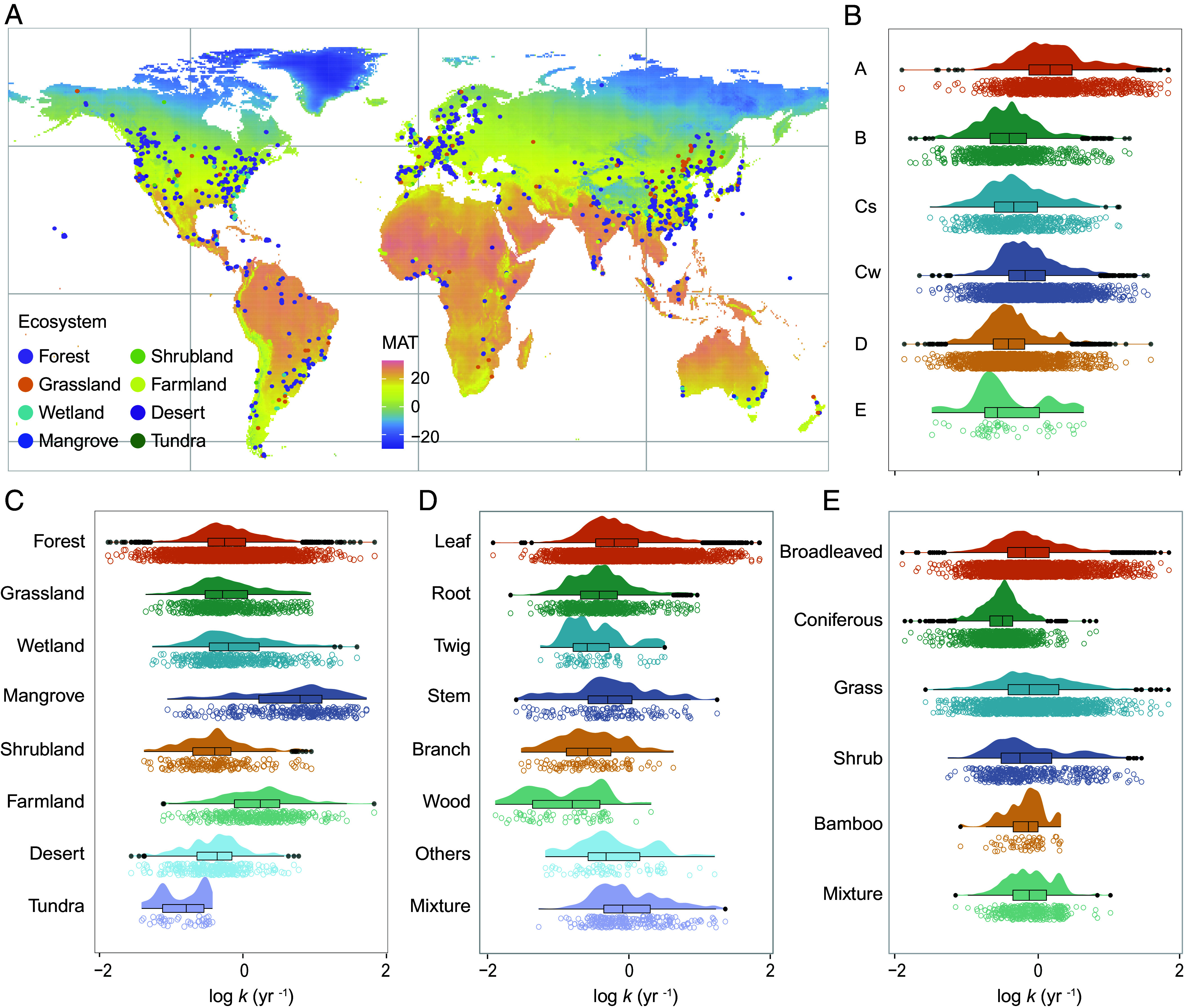
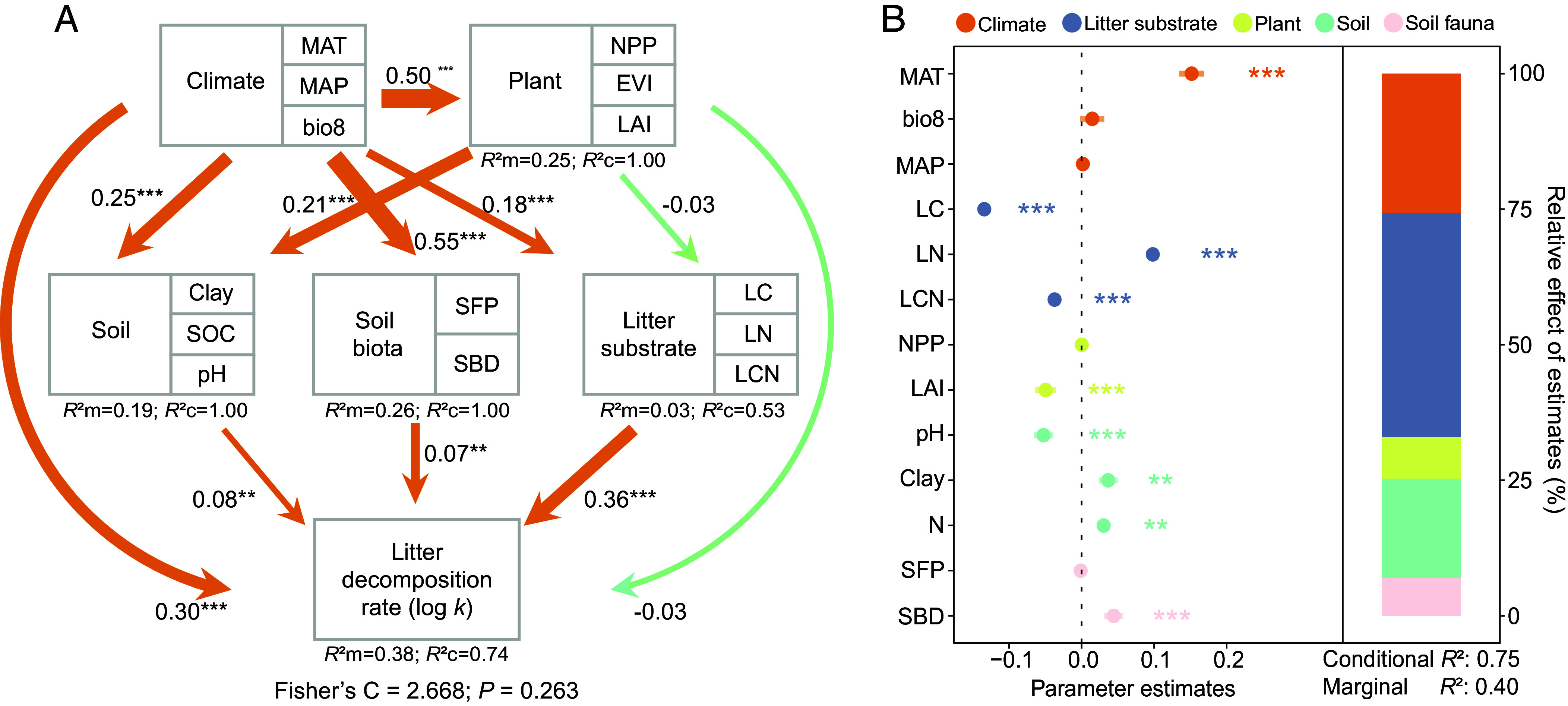
Litter decomposition is a fundamental biogeochemical process for carbon flux and nutrient cycling in terrestrial ecosystems, yet the global variation in decomposition rates and their covariations with climate and substrate are not fully understood. Here, we synthesized a global dataset of 6,733 independent observations across six continents to illustrate the climatic and substrate controls over litter decomposition. The average decomposition rates of various litter types ranged from 0.74 to 4.01 y −1 across polar to tropics, showing a large geographical span. Litter substrate and climate directly explained 36 and 30% of the variations in decomposition rates, with the carbon-to-nitrogen ratio identified as the best predictor. In the absence of climate variables, litter substrate can effectively explain the variation, while the model’s predictive capacity decreased significantly after litter substrate was excluded. Our synthesis highlights that a fundamental constraint on litter substrate leads to predictable global-scale patterns of terrestrial litter decomposition rates. Integrating litter chemistry parameters should be prioritized for parameter optimization in Earth system models.
Overview
CoChat Summary
TL;DR
Integrating 6,733 litter decomposition observations from 1,432 terrestrial sites with machine learning, this study finds that litter substrate and climate jointly determine decomposition rates, with substrate having a stronger direct effect. Future climate change is projected to accelerate leaf litter decomposition, especially outside low latitudes.
Key findings
- Litter substrate directly explained 36% of variation in decomposition rate (k), while climate directly explained 30%; climate’s total effect, including indirect pathways, reached 41%.
- Decomposition rates varied strongly by climate and ecosystem: tropical climates peaked at 4.01 y−1 and polar climates were lowest at 0.74 y−1; mangroves reached 9.59 y−1 and agricultural ecosystems 2.95 y−1, whereas deserts and tundra were 0.58 and 0.17 y−1.
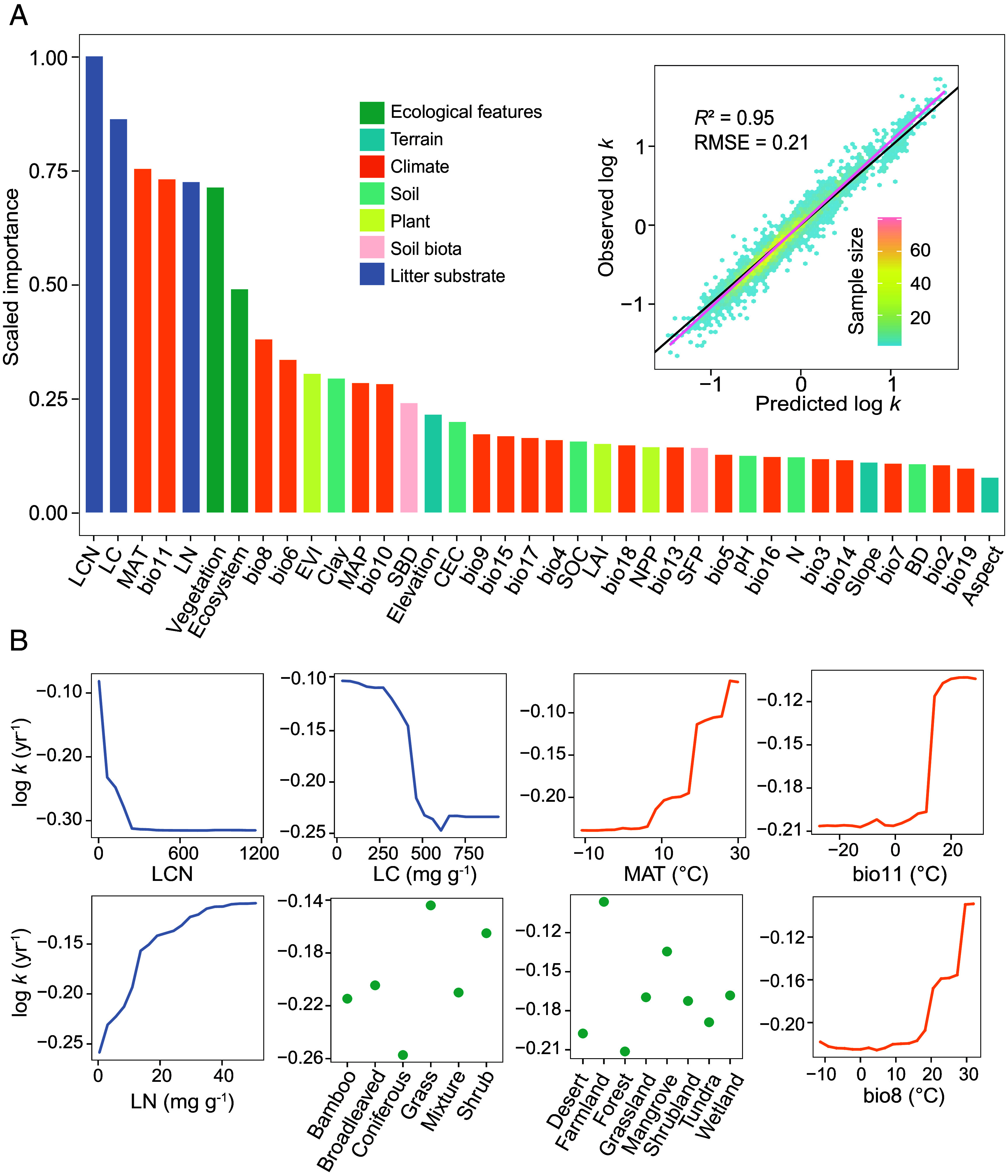
- Substrate type mattered: leaves decomposed at 1.65 y−1, woody litter at 0.24 y−1, recalcitrant litter at 0.48 y−1, broadleaved species at 1.77 y−1 versus coniferous species at 0.38 y−1, and grasses at 1.95 y−1. The initial litter C/N ratio was the most critical predictor in the random forest model, which explained 95% of variation.
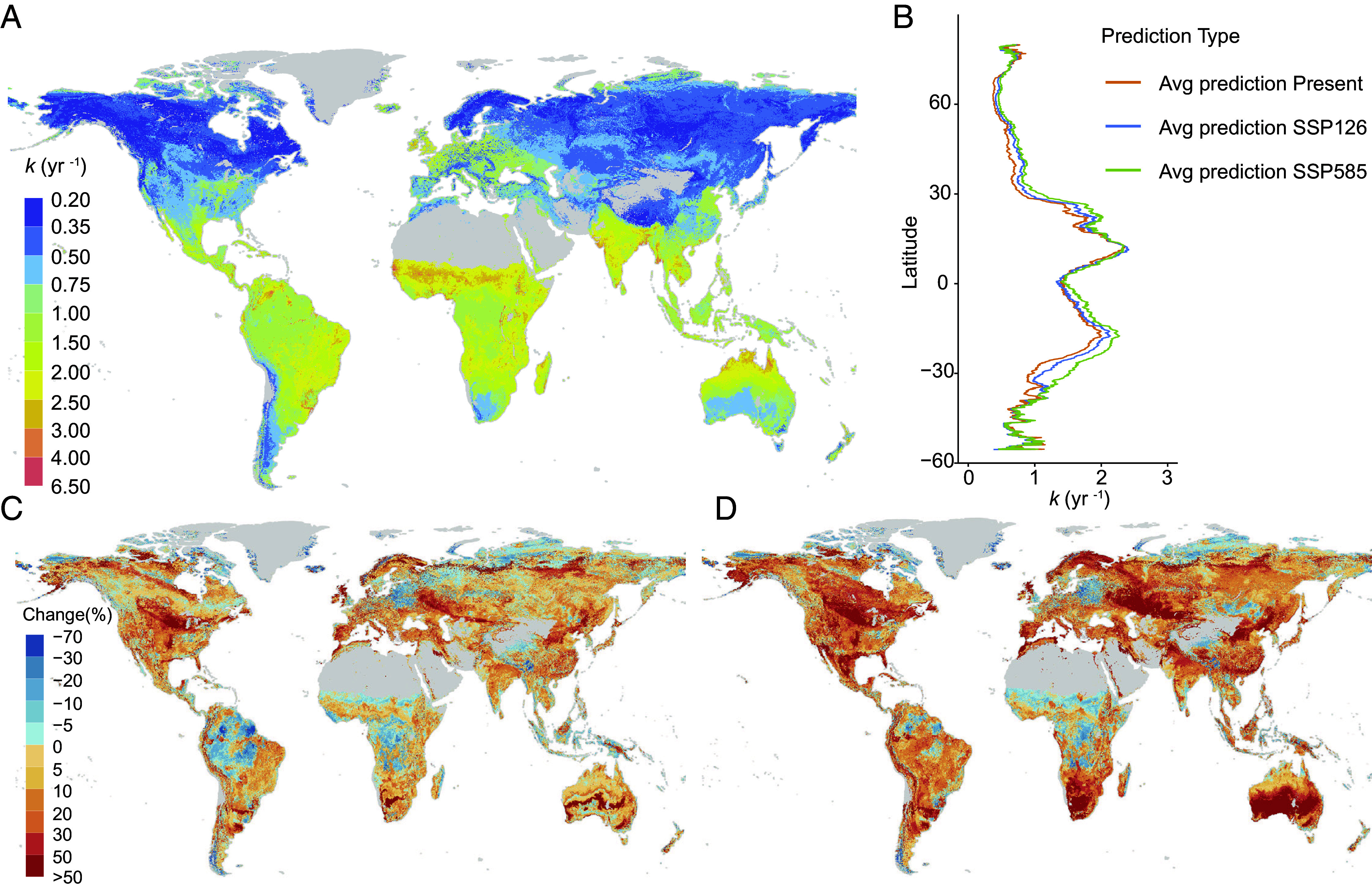
- Under future scenarios, global leaf litter decomposition is projected to increase by 10.42% under SSP126 and 21.56% under SSP585 during 2070–2100, with the smallest changes in low-latitude regions.
Methods
- Compiled a global dataset of 6,733 independent observations from 1,204 articles at 1,432 terrestrial sites across six continents, restricted to in situ litter decomposition experiments without artificial manipulations; k was estimated with a first-order exponential model.
- Used piecewise structural equation modeling, multimodel selection, and random forest models with 38 variables to assess direct and indirect effects of climate, litter substrate, vegetation, edaphic factors, and soil biota on k.
- For global prediction, focused only on leaf litter because other litter types had limited sample sizes; predicted global litter substrate first (R2 = 0.59 for C, 0.51 for N), then predicted leaf litter k with random forest (R2 = 0.82), and projected future changes under SSP126 and SSP585 using averaged climate models, with boosted regression trees as a comparison (R2 = 0.76).
Limitations
- The paper states that future projections quantify only the direct effect of climate change on litter decomposition, keeping vegetation, soil, and soil biota variables constant, so the overall climate change impact may be underestimated.
- The paper states that sample sizes were limited for root, stem, branch, wood, and other litter types, so global mapping was restricted to leaf litter; edaphic and substrate data availability was also limited, leading the authors to rely on global databases rather than site-provided values.
- Evident from the text: the analysis is observational and correlational, and global substrate fields were themselves predicted before k was modeled, so uncertainty in those intermediate predictions propagates into the final maps.
Model-written summary. Check it against the paper before relying on it.
Integrity signals
Registry
Cites
Statistics
Figures
Verification
Claims the paper makes
5 Valid · 0 Not valid · 7 Not checked · 69 Own results and interpretations
The cited sources support only part of this claim — read each source’s verdict below.
In the paper
“The direct effect of climate on litter decomposition rate is primarily attributed to photodegradation by solar radiation and leaching from rainfall, which either dissolves low-molecular-weight organic matter or breaks lignin compounds down (17, 34).”
§ Substrate and climate determine terrestrial litter decomposition > Climate Effect on Litter Decomposition Rates.
What the sources say
- Not checked — no full text of the sourcecites [17] B. Berg, C. McClaugherty, Plant Litter: Decomposition, Humus Formation, Carbon Sequestration (Springer, Berlin Heidelberg, 2014), 10.1007/978-3-642-38821-7. source
- Partly supportedcites [34] A. T. Austin, M. S. Méndez, C. L. Ballaré, Photodegradation alleviates the lignin bottleneck for carbon turnover in terrestrial ecosystems. Proc. Natl. Acad. Sci. 113, 4392– 4397 (2016). 27044070 PMC4843460 sourceExperimental — accuracy not yet measured
Our copy supports the photodegradation half of the claim: the Introduction (p. 1) records losses of volatile carbon from litter 'linked to photochemical degradation of cellulose and partial or complete degradation of lignin', and the Discussion (Photodegradation Facilitates Access... section) states that 'photodegradation can directly reduce lignin concentration' and 'essentially reduces the bottleneck imposed by lignin in secondary cell walls'. However, no passage in our copy mentions leaching by rainfall or dissolution of low-molecular-weight organic matter as a direct climatic pathway (searched: leaching, rainfall, dissolved organic matter, water-soluble; precipitation appears only in reference titles), so that component is unsupported. The 'primarily attributed' framing also overstates the paper: the Results/Discussion state that the direct effect of photodegradation was generally small (range 1.5-4.5%) compared with biotic decomposition (4-65%), and that the principal, quantitatively most important effect is photopriming rather than direct solar-driven loss. (LLM, conf=0.78)
plainstates a cause- Asserted: passes — The authors put it forward as true.
- Checkable: passes — It can be checked against evidence.
- Load-bearing: unclear — It is unclear whether the paper’s conclusions depend on it.
- Based: passes — The paper gives a reason why it holds.
The cited sources support only part of this claim — read each source’s verdict below.
In the paper
“Climate is coupled with other factors, such as litter carbon and nitrogen contents (35), soil cation exchange capacity (CEC), and soil bacterial and fungal diversity (10), in explaining decomposition rates, showing distinct distribution trends with latitude.”
§ Substrate and climate determine terrestrial litter decomposition > Climate Effect on Litter Decomposition Rates.
What the sources say
- Partly supportedcites [35] J. Yuan, Global spectra of plant litter carbon, nitrogen and phosphorus concentrations and returning amounts. J. Ecol. 112, 717– 729 (2024). sourceExperimental — accuracy not yet measured
The Discussion (Section 4) of Yuan et al. (2024) does state that 'the plant litter initial nutrient concentration is an important factor influencing litter decomposition, while environmental factors are of secondary importance' and that globally decomposition is faster near the equator because high-nutrient, low-C litter decomposes more rapidly — but that decomposition-rate hierarchy is credited there to Ball et al. 2022, García-Palacios et al. 2013, Freschet et al. 2012 and Zhang et al. 2008, with the paper's own models (Results 3.2; Conclusions) predicting litter initial C, N and P concentrations from climate and soil (isothermality the top predictor) and their latitudinal gradients (C rising, N and P declining with latitude). So the litter C/N–climate coupling and the latitudinal trends are in our copy, but the paper does not itself model or quantify decomposition rates, and it ranks environmental/climate factors as secondary rather than 'coupled' with litter quality. (LLM, conf=0.72)
- Partly supportedcites [10] K. Yu, The biogeography of relative abundance of soil fungi versus bacteria in surface topsoil. Earth Syst. Sci. Data 14, 4339– 4350 (2022). sourceExperimental — accuracy not yet measured
Our copy supports the climate–latitude–microbial-composition–decomposition thread: the Abstract states 'striking latitudinal trends where fungal dominance increases in cold and high-latitude environments' driven nonlinearly by MAT and NPP, and Section 3.2 links this fast/slow fungal-bacterial channel to soil C decomposition (citing Wang et al., 2018 for a latitudinal Q10 trend). But the element this citation is attached to — soil bacterial and fungal *diversity* — is not the paper's subject: it maps fungal proportion (fungi/[fungi+bacteria]) as relative abundance, and its Introduction attributes the diversity statement to another work (Bahram et al., 2018). No passage in our copy tests decomposition rates against litter carbon and nitrogen contents or soil cation exchange capacity (searched: CEC/cation exchange, litter C:N, diversity as predictor of decomposition); the drivers it examines are MAT, NPP, soil pH and soil C:N (Sects. 2.2–2.3, 3.2). (LLM, conf=0.68)
plainstates an association- Asserted: passes — The authors put it forward as true.
- Checkable: passes — It can be checked against evidence.
- Load-bearing: passes — The paper’s conclusions depend on it.
- Based: passes — The paper gives a reason why it holds.
- Partly supported
The cited sources support only part of this claim — read each source’s verdict below.
In the paper
“only the averages of aggregated microenvironmental variables can support the hypothesis that climate is the primary control over decomposition rate (19).”
§ Substrate and climate determine terrestrial litter decomposition > Multiscale Patterns and Drivers of Litter Decompositions.
What the sources say
- Partly supportedcites [19] M. A. Bradford, B. Berg, D. S. Maynard, W. R. Wieder, S. A. Wood, Understanding the dominant controls on litter decomposition. J. Ecol. 104, 229– 238 (2016). sourceExperimental — accuracy not yet measured
The “Grouped vs. individual data” section says site-level means can exaggerate climate’s apparent importance: mean annual temperature explains 86% of variation in grouped data, versus 71% in individual observations. But the claim’s “only” overstates the result, since individual observations still show a substantial climate association. The paper analyzes site-level climate measures, not averages of measured microenvironmental variables; the “The data set” section says climate was not measured at the litterbag scale. (LLM, conf=0.87)
plainstates a cause- Asserted: passes — The authors put it forward as true.
- Checkable: passes — It can be checked against evidence.
- Load-bearing: passes — The paper’s conclusions depend on it.
- Based: passes — The paper gives a reason why it holds.
- Partly supported
The cited sources support only part of this claim — read each source’s verdict below.
In the paper
“By contrast, litter substrate retains a strong explanatory power at regional or smaller scales due to its direct association with decomposer activity, allowing for direct prediction of litter decomposition rates (42, 43).”
§ Substrate and climate determine terrestrial litter decomposition > Multiscale Patterns and Drivers of Litter Decompositions.
What the sources say
- Not checked — no full text of the sourcecites [42] B. G. Waring, A meta-analysis of climatic and chemical controls on leaf litter decay rates in tropical forests. Ecosystems 15, 999– 1009 (2012). source
- Partly supportedcites [43] S. Hoeber, P. Fransson, M. Weih, S. Manzoni, Leaf litter quality coupled to Salix variety drives litter decomposition more than stand diversity or climate. Plant Soil 453, 313– 328 (2020). sourceExperimental — accuracy not yet measured
The discussion (p. 12) says litter chemical properties are important drivers of decomposition within a climate region, and the leaf-level results (p. 9) identify some traits as predictors. But the paper does not establish that this explanatory power comes from a direct association with decomposer activity, and it reports low predictive power for several tested relationships (p. 9). The claim therefore overstates how directly litter properties predict decomposition rates. (LLM, conf=0.84)
plainstates a cause- Asserted: passes — The authors put it forward as true.
- Checkable: passes — It can be checked against evidence.
- Load-bearing: passes — The paper’s conclusions depend on it.
- Based: passes — The paper gives a reason why it holds.
A result the paper reports from its own data — it cites no other source for it, so there is none to check. The quote shows it is in the paper.
In the paper
“The impact of future climate change on litter decomposition rates is not uniform, showing significant regional variability (SI Appendix, Fig. S18).”
§ Substrate and climate determine terrestrial litter decomposition > Future Climate Change Accelerates Litter Decomposition Rates.
plain- Asserted: passes — The authors put it forward as true.
- Checkable: passes — It can be checked against evidence.
- Load-bearing: passes — The paper’s conclusions depend on it.
- Based: passes — The paper gives a reason why it holds.
45 more claims
Create a free account to see all 81 claims and to verify the 3 references still open.
- Probably not a substantial claim. 11
- It may state two separate claims as one. 23
Citations
Cites
Fitting Linear Mixed-Effects Models Using lme4
Bates, D., Mächler, M., Bolker, B., & Walker, S. (2015) · Journal of Statistical Software · doi:10.18637/jss.v067.i01 · Cited by 86,835
Classification and Regression by randomForest
Liaw, A. I., & Wiener, M. C. (2007) · Cited by 18,594
The worldwide leaf economics spectrum
Wright, I. J., Reich, P. B., Westoby, M., Ackerly, D. D., Baruch, Z., Bongers, F., Cavender-Bares, J., Chapin, T., Cornelissen, J. H. C., Diemer, M., et al. (2004) · Nature · doi:10.1038/nature02403 · Cited by 9,021
piecewiseSEM: Piecewise structural equation modelling in r for ecology, evolution, and systematics
Lefcheck, J. S. (2016) · Methods in Ecology and Evolution · doi:10.1111/2041-210x.12512 · Cited by 4,845
Bartoń, K. (2010) · CRAN: Contributed Packages · doi:10.32614/cran.package.mumin · Cited by 4,829
SoilGrids250m: Global gridded soil information based on machine learning
Hengl, T., Mendes de Jesus, J., Heuvelink, G. B. M., Ruiperez Gonzalez, M., Kilibarda, M., Blagotić, A., Shangguan, W., Wright, M. N., Geng, X., Bauer-Marschallinger, B., et al. (2017) · PLOS ONE · doi:10.1371/journal.pone.0169748 · Cited by 4,733
Energy Storage and the Balance of Producers and Decomposers in Ecological Systems
Olson, J. S. (1963) · Ecology · doi:10.2307/1932179 · Cited by 3,810
Cotrufo, M. F., Wallenstein, M. D., Boot, C. M., Denef, K., & Paul, E. (2013) · Global Change Biology · doi:10.1111/gcb.12113 · Cited by 3,552
raster: Geographic Data Analysis and Modeling
Hijmans, R. J. (2010) · CRAN: Contributed Packages · doi:10.32614/cran.package.raster · Cited by 2,907
Cornwell, W. K., Cornelissen, J. H. C., Amatangelo, K., Dorrepaal, E., Eviner, V. T., Godoy, O., Hobbie, S. E., Hoorens, B., Kurokawa, H., Pérez‐Harguindeguy, N., et al. (2008) · Ecology Letters · doi:10.1111/j.1461-0248.2008.01219.x · Cited by 2,855 · cited 1×
“…may be overestimated ( 18 – 20 ), and several studies have found that the chemical composition of litter substrate is more important in explaining large - scale litter decomposition rate than climate does ( 21 – 23 ), although this understanding is not yet ubiquitously illustrated ( 24 – 26 ).”
Research works printed but not linked: 2
- D. Lawrence, CLM5 Documentation (National Center for Atmospheric Research, Boulder, CO, 2019).
- R Core Team, A Language and Environment for Statistical Computing (R Foundation for Statistical Computing, Vienna, Austria, 2024).
Cited by
Luo, L., Sun, T., Pan, Z., Lv, J., Peñuelas, J., Sardans, J., Xiao, K., Liu, Z., & Zhu, Y. (2025) · Global Change Biology · doi:10.1111/gcb.70319 · Cited by 46
“They can only explain 36% of the decomposition rate variations and stability of organic inputs in soil according to a recent global survey (Wu et al. 2025).”
Chen, W., Wang, Y., Peng, X., Wu, Q., Peñuelas, J., Peng, Y., Li, Z., Hědenec, P., Yuan, C., Wu, F., et al. (2025) · Journal of Hydrology · doi:10.1016/j.jhydrol.2025.133272 · Cited by 13
Self-citationSubstantial forest soil carbon accrual from absorptive fine roots over decadal timescales
Ma, N., Li, S., McCormack, M., Freschet, G. T., Ciais, P., Wang, H., Niu, S., Reich, P. B., Zhang, M., Zhao, R.-L., et al. (2025) · Nature Geoscience · doi:10.1038/s41561-025-01790-5 · Cited by 12
“73, and the annual leaf litter productivity was calculated as the proportion of leaf litter in the total litterfall 74 multiplied by the ‘average aboveground litterfall flux over 1982–2013’ 75,76 according to the corresponding biome.”
Zhang, Z., Dong, K., Li, T., Zhang, Y., Hu, R., Fu, Z., Lu, Z., & Sun, J. (2026) · Ecological Indicators · doi:10.1016/j.ecolind.2026.114759 · Cited by 9
Self-citationCellulase Dominates Soil Organic Carbon Dynamics Under Plant Detritus Input in Forest Ecosystems
Men, X., Zhai, D., Huang, B., Long, C., Wu, M., Bao, Y., Liao, C., Yan, Z., Duan, X., & Cheng, X. (2026) · Ecology Letters · doi:10.1111/ele.70347 · Cited by 13
Mai, J., Chen, Y., Song, Q., Xu, Z., Lu, D., & Luo, G. (2025) · Agricultural and Forest Meteorology · doi:10.1016/j.agrformet.2025.110830 · Cited by 7
Meng, Q., Wang, J., Shi, Z., et al. (2026) · New Phytologist · doi:10.1111/nph.70911 · Cited by 4
“S6) (Wu et al ., 2025).”
Self-citationDing, Z., Wang, P., Fu, L., & Chen, S.-D. (2025) · Forests · doi:10.3390/f16101548 · Cited by 3
Guo, M., Zhang, H., Tan, J., Liu, Y., Chen, S., Lei, H., & Shi, Y. (2025) · Journal of Forestry Research · doi:10.1007/s11676-025-01962-4 · Cited by 5
“( Chang et al. 2025; Wu et al. 2025a), regulating biogeochemical cycles and contributing to the long-term stability of forest ecosystem(Liu et al. 2024; You et al. 2017; Zhang et al. 2025a).”
Yi, S., Ma, B., Berg, B., Zhao, C., Xu, W., Ge, J., & Xie, Z. X. Z. (2026) · BMC Plant Biology · doi:10.1186/s12870-025-07932-6 · Cited by 4
Self-citationLiu, Y., Wang, Y., Yan, K., Wu, J., Yin, Q., Yang, J., Wang, Y., Jiang, L., Zhang, H., Sun, O. J., et al. (2025) · Soil and Tillage Research · doi:10.1016/j.still.2025.106800 · Cited by 3
Pan, L., Gao, Y., Zhao, D., & Wang, X. (2025) · Plant and Soil · doi:10.1007/s11104-025-07857-x · Cited by 2
Wang, X., Lu, C., Wang, J., Jiang, L., Zhou, H., Wang, H., & Liu, H. (2025) · CATENA · doi:10.1016/j.catena.2025.109621 · Cited by 2
Fan, D., Jiang, R., Song, D., Xue, W., Zhang, L., Wang, M., Jia, Z., Zou, G., & He, W. (2026) · Agronomy · doi:10.3390/agronomy16050588 · Cited by 2
Zhao, J., Hu, Y., Yang, L., Meng, J., & Dong, H. (2026) · Plant and Soil · doi:10.1007/s11104-026-08687-1 · Cited by 2
Ecological theory matters when linking plant functional traits and ecosystem carbon cycles
Cui, E. (2025) · Journal of Plant Ecology · doi:10.1093/jpe/rtaf111 · Cited by 3
Zhang, Y., Zheng, Z., He, G., Zhang, J., Li, Z., Yang, L., Chen, C., Tao, X., Chen, L., Sun, H., et al. (2025) · Trees Forests and People · doi:10.1016/j.tfp.2025.100986 · Cited by 1
Self-citationWang, Z., Lin, Y., Wang, K., et al. (2025) · Microorganisms · doi:10.3390/microorganisms13102359 · Cited by 1
“Despite these insights, most existing studies have predominantly focused on the individual effects of soil properties on microbial communities [22].”
Water Availability Weakens the Forest Litter Carbon Sink
Zhao, X. L., Zhao, H., Chen, J. W., Chen, H. L., Yu, X. Y., Jia, W., Chen, G., Xu, T. T., Yao, Y., & Tang, X. (2026) · Global Biogeochemical Cycles · doi:10.1029/2025gb008731 · Cited by 1
Self-citationCai, M., Zhang, C., Chen, H. Y. H., et al. (2026) · Journal of Applied Ecology · doi:10.1111/1365-2664.70310 · Cited by 1
Disentangling organic matter inputs and outputs during litter decomposition using C4-plant teabags
Guidi, C., Hagedorn, F., Blume‐Werry, G., Krab, E. J., Lett, S., Monteux, S., Pedersen, E. P., Väisänen, M., & Gavazov, K. (2026) · Soil Biology and Biochemistry · doi:10.1016/j.soilbio.2026.110151 · Cited by 1
Wang, S., Du, J., Kang, W., Ouyang, S., Hu, X., Zhou, Q., & Zhou, R. (2026) · Chemical Engineering Journal · doi:10.1016/j.cej.2026.176197 · Cited by 1
Ma, F., Jiang, L., Hao, Y., Luo, S., Tong, F., Zhao, X., Liu, L., & Lu, X. (2025) · Plant and Soil · doi:10.1007/s11104-025-07651-9 · Cited by 3
“N, P, K, S, and micronutrients) are released into the soil then consumed by plants and microbes again (Klemmed-son 1992; Parton et al. 2007; Wu et al. 2025).”
Zhang, S., Zhang, Y., Lin, Y., Wang, M., Xu, G., & Ma, K. (2025) · Forests · doi:10.3390/f16040584
Self-citationGeng, X.-M., & He, W. (2025) · CATENA · doi:10.1016/j.catena.2025.109153 · Cited by 1
Siebenhart, I. A., Tognetti, P. M., Sarquis, A., Biancari, L., Ballaré, C. L., & Austin, A. T. (2025) · bioRxiv (Cold Spring Harbor Laboratory) · doi:10.1101/2025.05.28.655532
“Nevertheless, our global model detours substantially from other models (Djukic et al., 2018; Wu et al., 2025; Zhao et al., 2025), identifying new insights into the linkages between climatic predictors and ecosystem functioning as well as litter quality relationships in dryland ecosystems.”
InfluentialMa, J., Chen, Y., Wang, S., Zeng, J., Liu, C., & Bu, Z. (2025) · Ecology and Evolution · doi:10.1002/ece3.71758
The role of light on litter degradation in different ecosystemsPreprint
Shi, Y., Li, Q., & Tian, X. (2025) · Research Square · doi:10.21203/rs.3.rs-7075113/v1
Agashe, M., Biswas, A., & Karanth, K. P. (2025) · bioRxiv (Cold Spring Harbor Laboratory) · doi:10.1101/2025.10.23.684092 · Cited by 1
“…like temperature, precipitation, and seasonality impose physiological constraints (Bennett et al., 2021; Hartill et al., 2023) and influence ecological opportunities by determining which microhabitats are accessible and how traits function within them (Gaudichet et al., 2024; Wu et al., 2025).”
Plant Growth Form Shapes the Global Biogeography of Mycorrhizal Symbioses
Pu, X., Jiang, F., Luo, A., Song, W., Luo, Y., Xu, X., & Wang, Z. (2025) · Global Ecology and Biogeography · doi:10.1111/geb.70151
Variations and drivers of biomass and soil carbon stocks in planted forests across India
Bania, J. K., Nath, A., Sileshi, G. W., Paul, A., Kumari, T., Das, A. K., & Nath, A. J. (2025) · Environmental and Sustainability Indicators · doi:10.1016/j.indic.2025.101101
Feng, J., You, L., Gao, X., Liu, M., Zhao, W., wu, Y., Cui, X., Wu, M., & Wei, L. (2026) · Marine Pollution Bulletin · doi:10.1016/j.marpolbul.2026.119306 · Cited by 1
The intrinsic coordination of tree growth strategy and wood decomposability
Wu, D., Seibold, S., Chen, Y., Shao, Z., Wang, Y., Chu, C., & Yu, M. (2026) · Journal of Ecology · doi:10.1111/1365-2745.70252
“Plant functional traits are commonly used to predict live processes (e.g. growth and mortality rates (Báez & Homeier, 2018 ; Wright et al., 2010 )) and afterlife processes (e.g. leaf or wood decom - position (Cornwell et al., 2009; Hu et al., 2018; Pietsch et al., 2014 ; Wu, Ni, et al., 2025 )).”
Lu, M., Tian, Q., Zhao, R., Chen, L., Yang, M., He, Q., & Liu, F. (2026) · Tree Physiology · doi:10.1093/treephys/tpag023 · Cited by 1
“While climate (temperature and humidity) is a dominant driver of litter decomposition at the global scale, recent studies highlight the importance of litter quality, micr oclimate and decomposer community at the local scale (Zhang et al. 2008, Midgley et al. 2015, Yates et al. 2024, Wu et al. 2025).”
王娇娇, Zang, F., Wang, R., Wei, S., Zeng, W., Hu, H., & Zhao, C. (2026) · Plant and Soil · doi:10.1007/s11104-026-08450-6
Siegfried, L., Bayon, R. L., Verrecchia, É. P., et al. (2026) · Wetlands · doi:10.1007/s13157-026-02039-6
Liu, Y., Wu, J., Wang, Y., Yang, J., Zhang, H., Wei, L., Yin, Q., Wang, Y., Wang, X., Jiang, L., et al. (2026) · Soil Biology and Biochemistry · doi:10.1016/j.soilbio.2026.110159
Identifying the environmental drivers of the distribution of carbon isotopes in global inland waters
Shi, J., Ni, L., Liu, J., et al. (2026) · Water Research · doi:10.1016/j.watres.2026.125869
Mapping the controls and climate-induced vulnerability of forest litter decomposition in China
Lei, H., Zhang, H., Chen, S., Yang, J., Tan, J., Guo, M., Shi, Y., & Liu, Y. (2026) · Ecological Informatics · doi:10.1016/j.ecoinf.2026.103734 · Cited by 1
Ge, J., Berg, B., Dong, L., & Sun, T. (2026) · BMC Plant Biology · doi:10.1186/s12870-026-08711-7
“…degradable carbohydrates, and largely ignored the long-term dynamics of litter decomposition, in which more recalcitrant compounds, such as lignin, often analyzed as acid-unhydrolyzed residue (AUR), accumulate and increasingly regulate the final, slowest stages of decomposition rates [3, 9].”
Self-citationFan, L., Wang, W., Zhang, B., Xiao, Q., Liu, X., & Su, Y. (2026) · Plant and Soil · doi:10.1007/s11104-026-08567-8
“However, the influence of other factors, such as MAT and MAP, on the root diameter effects on root litter decomposition rate should also be considered (Wu et al. 2025).”
InfluentialZheng, W., Yu, X. H., Wu, M., Zhao, J., Zheng, X., Su, H., Kuang, K., & Wu, F. (2026) · Forests · doi:10.3390/f17050539
Self-citationProCarbon‐Soil: A dynamic model for improved model‐data compatibility in carbon farming
Barioni, L. G., Valladão, B. A., Mourão, V. H. M., Ewing, R., Karatay, Y. N., Damian, J. M., Melício, V. D. C., Rejaili, R. P. A., & Silva, R. D. O. (2026) · Soil Science Society of America Journal · doi:10.1002/saj2.70218
Lu, Q., Cai, X., Zeng, X., Chen, J., Chang, F., Jing, G., Guo, J., Zhou, S., Chen, Z., Jia, L., et al. (2026) · Forests · doi:10.3390/f17050622
Self-citationSpatial Clustering of Termites but Not Fungi at Site‐Scale Drive Global Wood Decay Patterns
Wu, D., Chu, C., Seibold, S., Luo, Y., Eisenhauer, N., Mathieu, J., & Yu, M. (2026) · Global Change Biology · doi:10.1111/gcb.70923
“…in climate and wood characteristics have long been considered the major factors causing variation in wood decomposition rates (Hu et al. 2018; Wu, Ni, et al. 2025), it is increasingly recognized that decomposer activities, both of termites and fungi, are significant contributors to variation…”
Yang, X., Duan, P., Nottingham, A. T., Wanek, W., Hicks, L. C., Domeignoz‐Horta, L. A., Hu, P., Xiao, K., He, X., Wang, K., et al. (2026) · Functional Ecology · doi:10.1111/1365-2435.70366 · Cited by 3
Ros, L. D., Bortolazzi, A., Panzacchi, P., et al. (2026) · Ecosystems · doi:10.1007/s10021-026-01072-0
Fan, J., Yang, X., Wang, B., Zhang, H., & Chen, D. (2026) · Rhizosphere · doi:10.1016/j.rhisph.2026.101403
Rethinking Plant Litter Decomposition Across Global Drylands
Siebenhart, I. A., Tognetti, P. M., Sarquis, A., Biancari, L., Ballaré, C. L., & Austin, A. T. (2026) · Global Change Biology · doi:10.1111/gcb.70966 · Cited by 2
“Our global model highlights differences from other analyses that included dryland ecosystems (Djukic et al. 2018; Wu et al. 2025; Zhao et al. 2025), identifying new insights into the linkages between climatic predictors and ecosystem functioning as well as litter quality relationships in drylands.”
InfluentialShift in Soil Fauna Feeding Mode With Litter Quality Across Forest Biomes
Tsurikov, S. M., Barnes, A. D., Brose, U., Crotty, F., Goncharov, A. A., Gorbunova, A. Y., Hyodo, F., Jochum, M., Klarner, B., Korobushkin, D. I., et al. (2026) · Ecology Letters · doi:10.1111/ele.70421 · Cited by 1
Self-citationChen, S., Liu, J., Jian, Z., et al. (2026) · All Earth · doi:10.1080/27669645.2026.2692779
Dong, K., Zhang, Q., Zhao, C., Zhu, X.-L., Zhang, X., & Wang, J. (2026) · Plant and Soil · doi:10.1007/s11104-026-08841-9
“Temperature is a fundamental regulator of substrate decomposition and its conversion into MAOC (Zhao et al 2024a; Lyu et al 2025; Wu et al 2025).”
Yang, X., Ding, C., Liang, X., et al. (2026) · Plant and Soil · doi:10.1007/s11104-026-08866-0
“In addition, N-induced leaf acidification in grasses may act as a potential driver of the reduced decomposition observed under N addition (Zhang et al. 2016; Zheng et al. 2023), as acidic compounds could inhibit litter decomposition (Hät-tenschwiler and Vitousek 2000; Wu et al. 2025).”
Gao, S., Jia, X., Liang, K., Bourque, C. P. ‐., Tsetsegmaa, G., Liu, P. N., Tian, Y., Chen, W., & Zha, T. (2026) · Plant and Soil · doi:10.1007/s11104-026-08873-1
“This process is jointly regulated by climatic conditions, soil properties, litter traits, and decomposer communities (Bradford et al. 2016; Wu et al. 2025), whose relative contributions have been shown to change over the course of decomposition (Canessa et al. 2021; García-Palacios et al. 2016;…”
Zhou, S., Zou, X., Wan, R., Liang, Z., Xiao, L., Pan, K., Hu, J., & Huang, C. (2026) · Frontiers in Forests and Global Change · doi:10.3389/ffgc.2026.1923667
Topography Dependence of Terrestrial Litter‐Derived Soil Respiration
Tan, S., Chen, J. M., Huang, X., Li, A., Peñuelas, J., Vallicrosa, H., Wu, F., Zhao, Y., Zheng, M., Zhu, J., et al. (2026) · Global Change Biology · doi:10.1111/gcb.71011
“…evidence shows that litter traits associated with evergreen versus deciduous species and coniferous versus broadleaved species substantially influence the biochemical composition of decomposing litter, including its C/N ratio, lignin content and proportion of readily degradable C (Wu et al. 2025).”
Self-citationDisproportionately negative human-soil carbon association across one-tenth of global landscapes
Kebonye, N. M., Panagos, P., & Scholten, T. (2026) · Environmental and Sustainability Indicators · doi:10.1016/j.indic.2026.101447
Zhang, J., Liu, J., Li, X., & Gou, X. (2026) · CATENA · doi:10.1016/j.catena.2026.110614
Future Litter Decomposition Research Should Prioritize the Litter to Soil Flux
Bai, E., & Fan, X. (2026) · Global Change Biology · doi:10.1111/gcb.71116
“However, many litter-soil C modules in current Earth system models (ESMs) still largely inherit the classical CENTURY framework (Wu, Ni, et al. 2025), representing litter decomposition using first-order kinetics (Parton et al. 1987, 1993; Wieder et al. 2013; Wu, Ni, et al. 2025) and describing…”
InfluentialYang, J., Dong, Q., Wang, Q., Yang, H., Yang, Y., & 吴庆贵 (2026) · Frontiers in Soil Science · doi:10.3389/fsoil.2026.1929672
Yang, R., Jianguo, T., Duan, Q., Zhou, H., Tang, L., Xu, L., Yue, L., Chen, Z., Ji, L., Longlong, X., et al. (2026) · Geoderma · doi:10.1016/j.geoderma.2026.118072
Self-citationContrasting litter-layer biomass and thickness following wildfire in a southwestern Amazon forest
Barreto, I. M., Costa, K. F., Araújo, I., de Oliveira, F. N., Martins, J. A. M., Diniz, M. V. M., & Reis, S. M. (2026) · Forest Ecology and Management · doi:10.1016/j.foreco.2026.124302
Metadata
- Authors
- Wu, Q., Ni, X., Sun, X., Chen, Z., Hong, S., Berg, B., Zheng, M., Chen, J., Zhu, J., Ai, L., Zhang, Y., & Wu, F.
- Affiliations
- Fujian Normal University (CN)
- Peking University (CN)
- University of Helsinki (FI)
- Chinese Academy of Sciences (CN)
- Corresponding author
- Ni, Xiangyin
- Wu, Fuzhong
- ORCID
- Venue
- Proceedings of the National Academy of Sciences
- Publisher
- National Academy of Sciences
- Published
- 2025-02-11
- Volume
- 122
- Issue
- 7
- Pages
- e2420664122-e2420664122
- ISSN
- 0027-8424 (ISSN-L)
- 1091-6490
- PMC
- PMC11848321
- OpenAlex
- W4407370378
- Cited by
- 67
- References
- 68
- Citations by year
- 2026: 46 · 2025: 21
- FWCI
- 33.44
- Type
- journal article
- Language
- en
- Open access
- hybrid
- doi.org
- Licence
- Locations
- Proceedings of the National Academy of Sciences (publishedVersion, cc-by-nc-nd)
- PubMed Central (publishedVersion, cc-by-nc-nd)
- PubMed (publishedVersion)
- Työväentutkimus Vuosikirja (submittedVersion)
- Funders
- MOST | National Key Research and Development Program of China (2023YFF1305500)
- MOST | National Natural Science Foundation of China (32471834, 32022056)
- Topics
- Life Sciences › Agricultural and Biological Sciences › Soil Science › Soil Carbon and Nitrogen Dynamics
- Physical Sciences › Environmental Science › Ecology › Environmental and biological studies
- Physical Sciences › Environmental Science › Ecology › Peatlands and Wetlands Ecology
- Keywords
- litter decomposition, terrestrial ecosystems, climate effects on decomposition, C/N ratio, litter chemistry, decomposition rate, global patterns, carbon cycle, nutrient cycling
About these checks
Registry, retraction, Cites and statistics results are computed, not judged, with one exception: a printed reference that no index lists is read once by a model before it counts as a citation error. Claims are extracted by a model and kept only when their quote appears verbatim in the text; each cited source is then checked, with a model’s help, for whether it says what the claim relies on. Those verdicts can be wrong — read the claim’s quote and the cited source before relying on one.
The claim verdicts this report counts are experimental: their accuracy is not yet measured.
A language model drew the claims from the paper on 2026-10-10, under version 3 of the claim definition (model deepseek-v4.1-flash, prompt extract-v3).
A second model labelled each claim on 2026-10-10 (model jev-1.13-20260917, definition revision gold-guideline-v0.2).
Cited sources are checked with a language model’s help (qwen3.8-omni-flash and gpt-6-sol).
Statistics and arithmetic are recomputed, not judged.
Confidence bands are shown only for fields calibrated on our annotated test set. None is calibrated yet, so no band is shown.
What counts as a claim ›How we measure confidence ›How we check this ›
Are you an author, or do you see a problem with this page? Request a review
Data sources
Bibliographic data: Semantic Scholar, OpenAlex, Crossref.
Contains information from the Semantic Scholar Academic Graph Datasets, made available under the ODC Attribution License (ODC-BY 1.0).
Semantic Scholar’s data is described in: Kinney, R., et al. (2023). The Semantic Scholar Open Data Platform. arXiv:2301.10140.
