

The DOI matches its Crossref record; 3 of the 3 references it cites were found in a registry or an index.
Role of the Low Density Lipoprotein (LDL) Receptor Pathway in the Metabolism of Chylomicron Remnants
Overview
The claims and statistics of this paper haven’t been checked yet.
Run the check — free, no account needed. It reads the open-access text and checks the sources it cites.
Integrity signals
Registry
Cites
Statistics
Figures
Verification
Claims the paper makes
The claims and statistics of this paper haven’t been checked yet.
Run the check — free, no account needed. It reads the open-access text and checks the sources it cites.
Claims other papers make about this one
Each is checked against this paper’s own text: does it say what the citing paper says it does?
The cited source doesn’t support the claim as written.
In the citing paper
“Earlier studies established that 25%-50% of CR particles are cleared by LDLR, depending on the methods used (13).”
From Liver heparan sulfate proteoglycans mediate clearance of triglyceride-rich lipoproteins independently of LDL receptor family members (2007) · cites this paper as [13]
Checked by a reasoning model — may be wrong.
Experimental — accuracy not yet measuredThe source backs part of the claim, not all of it — or backs it for a different population, condition or comparison.
In the citing paper
“In the intestine, [3H]retinol is converted to fatty acid esters and incorporated into newly made chylomicrons, and its only route of removal is through clearance in the liver (24).”
From Syndecan-1 is the primary heparan sulfate proteoglycan mediating hepatic clearance of triglyceride-rich lipoproteins in mice (2009) · cites this paper as [24]
Experimental — accuracy not yet measuredThe source backs part of the claim, not all of it — or backs it for a different population, condition or comparison.
In the citing paper
“However, clearance of TRLs occurs normally in humans, WHHL rabbits, and mice deficient in LDLR (11)(12)(13).”
From Liver heparan sulfate proteoglycans mediate clearance of triglyceride-rich lipoproteins independently of LDL receptor family members (2007) · cites this paper as [13]
Experimental — accuracy not yet measuredIn the citing paper
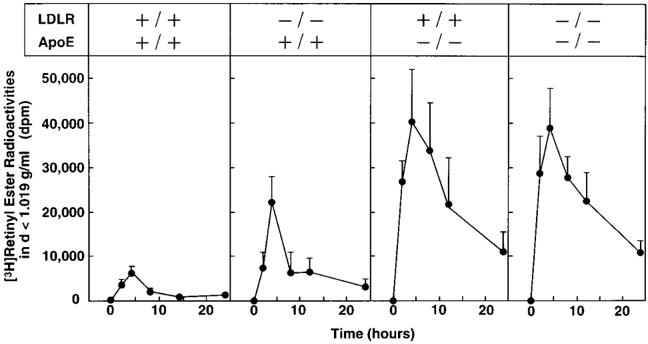
“HS and LDLR represent parallel systems for CR clearance, since the long delay in removal of dietary triglycerides in compound mutants mimics the delay seen in apoE-deficient mice (13).”
From Liver heparan sulfate proteoglycans mediate clearance of triglyceride-rich lipoproteins independently of LDL receptor family members (2007) · cites this paper as [13]
Self-check
Percentages, sums and reported differences re-computed from the paper’s own numbers.
The self-check needs the paper’s full text.
Citations
Cites
Plump, A. S., Smith, J. D., Hayek, T., Aalto-Setälä, K., Walsh, A., Verstuyft, J. G., Rubin, E. M., & Breslow, J. L. (1992) · Cell · doi:10.1016/0092-8674(92)90362-g · Cited by 2,263
Familial apolipoprotein E deficiency.
Schaefer, E. J., Gregg, R. E., Ghiselli, G., Forte, T. M., Ordovas, J. M., Zech, L. A., & Brewer, H. B. (1986) · Journal of Clinical Investigation · doi:10.1172/jci112704 · Cited by 313
Windler, E. E. T., Greeve, J., Daerr, W. H., & Greten, H. (1988) · Biochemical Journal · doi:10.1042/bj2520553 · Cited by 67
Research works printed but not linked: 41
- Havel, 1995, Curr. Opin. Lipidol., 6, 312, 10.1097/00041433-199510000-00011 · DOI
- Herz, 1993, Curr. Opon. Lipidol., 4, 107, 10.1097/00041433-199304000-00006 · DOI
- Ji, 1994, J. Biol. Chem., 269, 2764, 10.1016/S0021-9258(17)42009-6 · DOI
- Ji, 1995, Arterioscler. Thromb., 14, 2025, 10.1161/01.ATV.14.12.2025 · DOI
- Sultan, 1990, Biochim. Biophys. Acta, 1042, 150, 10.1016/0005-2760(90)90071-5 · DOI
- Shafi, 1994, J. Lipid Res., 35, 709, 10.1016/S0022-2275(20)41185-X · DOI
- Hamilton, 1990, J. Lipid Res., 31, 1589, 10.1016/S0022-2275(20)42343-0 · DOI · Paper page
- Shimano, 1994, J. Clin. Invest., 93, 2215, 10.1172/JCI117218 · DOI
- Mabuchi, 1989, Metabolism, 38, 115, 10.1016/0026-0495(89)90249-7 · DOI · Paper page
- Zhang, 1992, Science, 258, 458
- Kita, 1982, Proc. Natl. Acad. Sci. U. S. A., 79, 3623, 10.1073/pnas.79.11.3623 · DOI · Paper page
- Rubinsztein, 1990, J. Clin. Invest., 86, 1306, 10.1172/JCI114839 · DOI · Paper page
- Wade, 1986, Eur. J. Biochem., 159, 333, 10.1111/j.1432-1033.1986.tb09872.x · DOI
- Nagata, 1988, J. Biol. Chem., 263, 15151, 10.1016/S0021-9258(18)68158-X · DOI · Paper page
- Choi, 1991, J. Clin. Invest., 88, 1173, 10.1172/JCI115419 · DOI
- Jackle, 1992, J. Lipid Res., 33, 419, 10.1016/S0022-2275(20)41532-9 · DOI
- Beaumont, 1990, Atherosclerosis, 85, 103, 10.1016/0021-9150(90)90102-O · DOI
- Bowler, 1991, Biochem. J., 276, 381, 10.1042/bj2760381 · DOI
- Demacker, 1992, Biochem. J., 285, 641, 10.1042/bj2850641 · DOI
- Ishibashi, 1993, J. Clin. Invest., 92, 883, 10.1172/JCI116663 · DOI · Paper page
- Ishibashi, 1994, Proc. Natl. Acad. Sci. U. S. A., 91, 4431, 10.1073/pnas.91.10.4431 · DOI · Paper page
- Redgrave, 1979, J. Lipid Res., 20, 217, 10.1016/S0022-2275(20)40633-9 · DOI
- Kris-Etherton, 1980, J. Lipid Res., 21, 435, 10.1016/S0022-2275(20)39793-5 · DOI
- Goldstein, 1983, Methods Enzymol., 98, 241, 10.1016/0076-6879(83)98152-1 · DOI
- Wilson, 1987, Biochim. Biophys. Acta, 922, 247, 10.1016/0005-2760(87)90047-6 · DOI
- Herz, 1995, Proc. Natl. Acad. Sci. U. S. A., 92, 4611, 10.1073/pnas.92.10.4611 · DOI
- Willnow, 1994, Science, 264, 1471, 10.1126/science.7515194 · DOI
- Yamada, 1988, J. Clin. Invest., 82, 2106, 10.1172/JCI113832 · DOI
- Matthews, 1957, Phys. Med. Biol., 2, 36, 10.1088/0031-9155/2/1/305 · DOI
- Hussain, 1995, J. Biol. Chem., 270, 8578, 10.1074/jbc.270.15.8578 · DOI
- Ji, 1995, J. Lipid Res., 36, 583, 10.1016/S0022-2275(20)39892-8 · DOI
- Willnow, 1992, J. Biol. Chem., 267, 26172, 10.1016/S0021-9258(18)35732-6 · DOI
- Hussain, 1991, J. Biol. Chem., 266, 13936, 10.1016/S0021-9258(18)92792-4 · DOI
- Choi, 1993, J. Biol. Chem., 268, 15804, 10.1016/S0021-9258(18)82326-2 · DOI
- Battey, 1994, J. Biol. Chem., 269, 23268, 10.1016/S0021-9258(17)31648-4 · DOI · Paper page
- Mokuno, 1994, J. Biol. Chem., 269, 13238, 10.1016/S0021-9258(17)36824-2 · DOI
- Medh, 1995, J. Biol. Chem., 270, 536, 10.1074/jbc.270.2.536 · DOI · Paper page
- Kounnas, 1992, J. Biol. Chem., 267, 21162, 10.1016/S0021-9258(19)36811-5 · DOI · Paper page
- Orlando, 1993, Proc. Natl. Acad. Sci. U. S. A., 89, 6698, 10.1073/pnas.89.15.6698 · DOI
- Ji, 1993, J. Biol. Chem., 268, 10160, 10.1016/S0021-9258(18)82186-X · DOI · Paper page
- Willnow, 1995, Proc. Natl. Acad. Sci. U. S. A., 92, 4537, 10.1073/pnas.92.10.4537 · DOI · Paper page
Cited by
Sorted by citations
Chylomicrons promote intestinal absorption of lipopolysaccharides
Ghoshal, S., Witta, J., Zhong, J., de Villiers, W., & Eckhardt, E. (2009) · Journal of Lipid Research · doi:10.1194/jlr.m800156-jlr200 · Cited by 662
Hepatic uptake of chylomicron remnants
Cooper, A. D. (1997) · Journal of Lipid Research · doi:10.1016/s0022-2275(20)34932-4 · Cited by 499
Stanford, K. I., Bishop, J. R., Foley, E. M., Gonzales, J. C., Niesman, I. R., Witztum, J. L., & Esko, J. D. (2009) · Journal of Clinical Investigation · doi:10.1172/jci38251 · Cited by 226
MacArthur, J. M., Bishop, J. R., Stanford, K. I., Wang, L., Bensadoun, A., Witztum, J. L., & Esko, J. D. (2007) · Journal of Clinical Investigation · doi:10.1172/jci29154 · Cited by 216
Mahley, R. W., & Huang, Y. (2007) · Journal of Clinical Investigation · doi:10.1172/jci30889 · Cited by 159
Effects of APOC3 Heterozygous Deficiency on Plasma Lipid and Lipoprotein Metabolism
Reyes-Soffer, G., Sztalryd, C., Horenstein, R. B., Holleran, S., Matveyenko, A., Thomas, T., Nandakumar, R., Ngai, C., Karmally, W., Ginsberg, H. N., et al. (2019) · Arteriosclerosis, Thrombosis, and Vascular Biology · doi:10.1161/atvbaha.118.311476 · Cited by 97
Recent insights into factors affecting remnant lipoprotein uptake
Williams, K. J., & Chen, K. (2010) · Current Opinion in Lipidology · doi:10.1097/mol.0b013e328338cabc · Cited by 91
Apolipoprotein E Is Resistant to Intracellular Degradation in Vitro and in Vivo
Rensen, P. C. N., Jong, M. C., van Vark, L. C., van der Boom, H., Hendriks, W. L., van Berkel, T. J. C., Biessen, E. A. L., & Havekes, L. M. (2000) · Journal of Biological Chemistry · doi:10.1074/jbc.275.12.8564 · Cited by 86
Foley, E. M., Gordts, P. L. S. M., Stanford, K. I., Gonzales, J. C., Lawrence, R., Stoddard, N., & Esko, J. D. (2013) · Arteriosclerosis, Thrombosis, and Vascular Biology · doi:10.1161/atvbaha.113.301637 · Cited by 77
Vitamin A Transport Mechanism of the Multitransmembrane Cell-Surface Receptor STRA6
Kawaguchi, R., Zhong, M., Kassai, M., Ter-Stepanian, M., & Sun, H. (2015) · Membranes · doi:10.3390/membranes5030425 · Cited by 75
Metadata
- Authors
- Ishibashi, S., Perrey, S., Chen, Z., Osuga, J.-I., Shimada, M., Ohashi, K., Harada, K., Yazaki, Y., & Yamada, N.
- Venue
- Journal of Biological Chemistry
- Publisher
- Elsevier BV
- Published
- 1996-09
- Volume
- 271
- Issue
- 37
- Pages
- 22422-22427
- ISSN
- 0021-9258
- Cited by
- 106
- References
- 3
- Language
- en
About these checks
Registry, retraction, Cites and statistics results are computed, not judged, with one exception: a printed reference that no index lists is read once by a model before it counts as a citation error. Claims are extracted by a model and kept only when their quote appears verbatim in the text; each cited source is then checked, with a model’s help, for whether it says what the claim relies on. Those verdicts can be wrong — read the claim’s quote and the cited source before relying on one.
Statistics and arithmetic are recomputed, not judged.
Confidence bands are shown only for fields calibrated on our annotated test set. None is calibrated yet, so no band is shown.
What counts as a claim ›How we measure confidence ›How we check this ›
Are you an author, or do you see a problem with this page? Request a review
