

The PEA3 Ets Transcription Factor Comprises Multiple Domains That Regulate Transactivation and DNA Binding
Open accessThe DOI matches its Crossref record; 41 of the 41 references it cites were found in a registry or an index.
Abstract
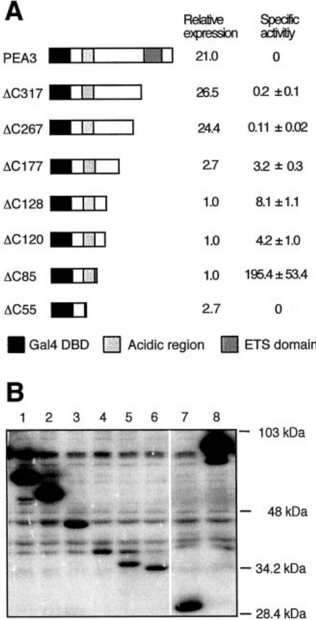
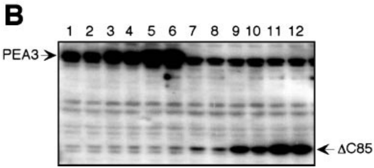
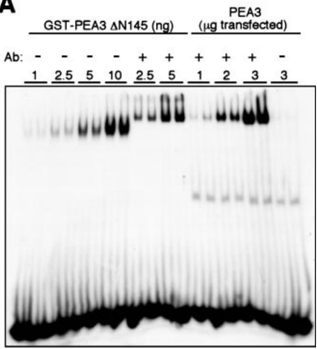
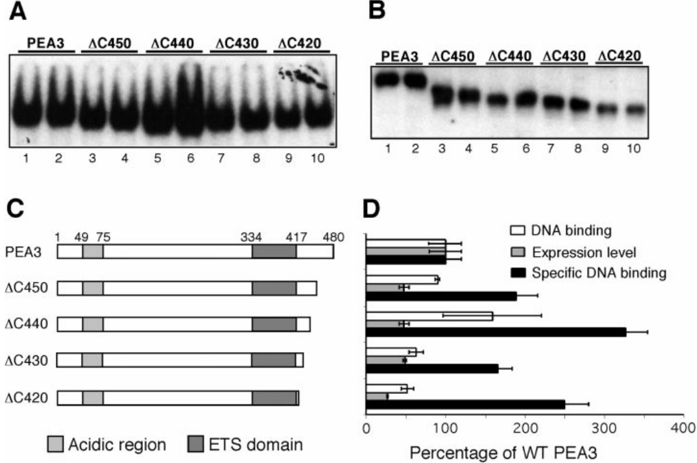
PEA3, a member of the Ets family of transcription factors, is a nuclear phosphoprotein capable of activating transcription. Mouse PEA3 comprises 480 amino acids and bears an approximately 85-amino acid ETS domain near its carboxyl terminus. Whereas analyses of bacterially expressed PEA3 revealed that the ETS domain is required for sequence-specific DNA binding, little is known of the functional domains in the protein required for its activity in mammalian cells. To this end, we defined the location of the PEA3 functional domains in COS cells. PEA3 bears a strong activation domain near its amino terminus, which is flanked by two regions that independently negatively regulate its activity. PEA3 expressed in COS cells was incapable of binding to DNA in vitro. However, DNA binding activity could be unmasked by incubation with a PEA3-specific antibody. Analyses of the DNA binding activity of PEA3 deletion mutants revealed that two regions flanking the ETS domain independently inhibited DNA binding; deletion of both regions was required to detect DNA binding in the absence of a PEA3-specific antibody. Under these conditions, the ETS domain was sufficient for sequence-specific DNA binding. These findings suggest that the activity of PEA3 is exquisitely controlled at multiple functional levels.
Overview
The claims and statistics of this paper haven’t been checked yet.
Free: it reads the open-access text and checks the first 5 claims that cite a source we can check. Create a free account to check every claim.
Integrity signals
Registry
Cites
Statistics
Figures







Verification
Claims the paper makes
The claims and statistics of this paper haven’t been checked yet.
Free: it reads the open-access text and checks the first 5 claims that cite a source we can check. Create a free account to check every claim.
Claims other papers make about this one
Each is checked against this paper’s own text: does it say what the citing paper says it does?
The cited source says what the claim attributes to it.
In the citing paper
“Members of the PEA3 subfamily, including ETV4 (12, 84) and ETV5 (85), contain autoinhibitory sequences appended to both sides of their ETS domains.”
From Genomic and biochemical insights into the specificity of ETS transcription factors (2011) · cites this paper as [12]
In the citing paper
“Although examined in only a few cases by biophysical methods (12–15), the remaining regions of the ETS factors, including those functioning as transactivation domains, likely display minimal stable secondary or tertiary structure.”
From Genomic and biochemical insights into the specificity of ETS transcription factors (2011) · cites this paper as [12]
Self-check
Percentages, sums and reported differences re-computed from the paper’s own numbers.
The self-check needs the paper’s full text.
Citations
Cites
Schreiber, E., Matthias, P., Müller, M. M., & Schaffner, W. (1989) · Nucleic Acids Research · doi:10.1093/nar/17.15.6419 · Cited by 4,179
Prediction of Protein Secondary Structure at Better than 70% Accuracy
Rost, B., & Sander, C. (1993) · Journal of Molecular Biology · doi:10.1006/jmbi.1993.1413 · Cited by 2,910
Gene fusion with an ETS DNA-binding domain caused by chromosome translocation in human tumours
Delattre, O., Zucman, J., Plougastel, B., Desmaze, C., Melot, T., Peter, M., Kovar, H., Joubert, I., de Jong, P., Rouleau, G., et al. (1992) · Nature · doi:10.1038/359162a0 · Cited by 1,907
Structural features in eukaryotic mRNAs that modulate the initiation of translation.
Kozak, M. (1991) · Journal of Biological Chemistry · doi:10.1016/s0021-9258(18)54860-2 · Cited by 1,836
Combining evolutionary information and neural networks to predict protein secondary structure
Rost, B., & Sander, C. (1994) · Proteins: Structure, Function, and Bioinformatics · doi:10.1002/prot.340190108 · Cited by 1,452
At least six nucleotides preceding the AUG initiator codon enhance translation in mammalian cells
Kozak, M. (1987) · Journal of Molecular Biology · doi:10.1016/0022-2836(87)90418-9 · Cited by 1,182
Transcription activation by the adenovirus E1a protein
Lillie, J. W., & Green, M. R. (1989) · Nature · doi:10.1038/338039a0 · Cited by 632
May, W. A., Gishizky, M. L., Lessnick, S. L., Lunsford, L. B., Lewis, B. C., Delattre, O., Zucman, J., Thomas, G., & Denny, C. T. (1993) · Proceedings of the National Academy of Sciences · doi:10.1073/pnas.90.12.5752 · Cited by 574
A vector for expressing GAL4(1–147) fusions tn mammalian cells
Sadowski, I., & Ptashne, M. (1989) · Nucleic Acids Research · doi:10.1093/nar/17.18.7539 · Cited by 542
The ETS-domain: a new DNA-binding motif that recognizes a purine-rich core DNA sequence.
Karim, F. D., Urness, L. D., Thummel, C. S., Klemsz, M. J., McKercher, S. R., Celada, A., Van Beveren, C., Maki, R. A., Gunther, C. V., & Nye, J. A. (1990) · Genes & Development · doi:10.1101/gad.4.9.1451 · Cited by 499
Research works printed but not linked: 9
- Jeon, I. S., Davis, J. N., Braun, B. S., Sublett, J. E., Roussel, M. F., Denny, C. T., and Shapiro, D. N. (1995) Oncogene 10, 1229 -1234
- Monte, D., Coutte, L., Baert, J. L., Angeli, I., Stehelin, D., and de Launoit, Y. (1995) Oncogene 11, 771-779
- Monte, D., Baert, J. L., Defossez, P. A., de Launoit, Y., and Stehelin, D. (1994) Oncogene 9, 1397-1406
- Trimble, M. S., Xin, J. H., Guy, C. T., Muller, W. J., and Hassell, J. A. (1993) Oncogene 8, 3037-3042
- Bailly, R. A., Bosselut, R., Zucman, J., Cormier, F., Delattre, O., Roussel, M., Thomas, G., and Ghysdael, J. (1994) Mol. Cell. Biol. 14, 3230 -3241
- May, W. A., Lessnick, S. L., Braun, B. S., Klemsz, M., Lewis, B. C., Lunsford, L. B., Hromas, R., and Denny, C. T. (1993) Mol. Cell. Biol. 13, 7393-7398
- Lessnick, S. L., Braun, B. S., Denny, C. T., and May, W. A. (1995) Oncogene 10, 423-431
- Laget, M. P., Defossez, P. A., Albagli, O., Baert, J. L., Dewitte, F., Stehelin, D., and de Launoit, Y. (1996) Oncogene 12, 1325-1336
- Janknecht, R., Zinck, R., Ernst, W. H., and Nordheim, A. (1994) Oncogene 9, 1273-1278
Cited by
A Developmental Switch in the Response of DRG Neurons to ETS Transcription Factor Signaling
Hippenmeyer, S., Vrieseling, E., Sigrist, M., Portmann, T., Laengle, C., Ladle, D. R., & Arber, S. (2005) · PLoS Biology · doi:10.1371/journal.pbio.0030159 · Cited by 1,088
“(J) Transcriptional transactivation of luciferase expression from a minimal reporter construct containing five consensus ETS DNA-binding sites (GCCGGAAGC; [18,19]) and a minimal TK promoter upon transient transfection of Er81 (n 7; 3.”
BackgroundMethodGenomic and biochemical insights into the specificity of ETS transcription factors
Hollenhorst, P. C., McIntosh, L. P., & Graves, B. J. (2011) · Annual Review of Biochemistry · doi:10.1146/annurev.biochem.79.081507.103945 · Cited by 490
“Chromosomal rearrangements that result in the overexpression of members of the PEA3 subfamily (ETV1, ETV4, or ETV5) are found less frequently (36, 170, 171).”
InfluentialETV1, 4 and 5: An oncogenic subfamily of ETS transcription factors
Oh, S., Shin, S., & Janknecht, R. (2012) · Biochimica et Biophysica Acta (BBA) - Reviews on Cancer · doi:10.1016/j.bbcan.2012.02.002 · Cited by 249
“The N-terminal activation domain appears to be more potent than the C-terminal one and sequences flanking both sides of the N-terminal acidic domain of ETV4 inhibit its activity [12].”
BackgroundInfluentialAutoinhibitory Domains: Modular Effectors of Cellular Regulation
Pufall, M. A., & Graves, B. J. (2002) · Annual Review of Cell and Developmental Biology · doi:10.1146/annurev.cellbio.18.031502.133614 · Cited by 236
“The PEA3 Ets transcription factor comprises multiple domains that regulate transactivation and DNA binding.”
BackgroundBrent, A. E., & Tabin, C. J. (2004) · Development · doi:10.1242/dev.01275 · Cited by 202
“Two out of the four FGF receptors are expressed in the somite at the time of Scx induction: Fgfr1, which is expressed broadly throughout the somite, slightly reduced in the myotome and slightly increased at the site of Scxexpression (Fig.”
BackgroundInfluentialThompson, H. G. R., Harris, J. W., Wold, B. J., Lin, F., & Brody, J. P. (2003) · Oncogene · doi:10.1038/sj.onc.1206325 · Cited by 181
“For example, DNA binding by PEA3, the mouse homolog of the ETS-domain protein E1A-F, is inhibited by two short amino-acid motifs located on either side of the ETS DNA-binding domain (Bojovic and Hassell, 2001).”
BackgroundEWS–ETS oncoproteins: The linchpins of Ewing tumors
Janknecht, R. (2005) · Gene · doi:10.1016/j.gene.2005.08.007 · Cited by 173
When Ets transcription factors meet their partners
Verger, A., & Duterque‐Coquillaud, M. (2002) · BioEssays · doi:10.1002/bies.10068 · Cited by 134
The pea3 subfamily ets genes are required for HER2/Neu-mediated mammary oncogenesis
Shepherd, T. G., Kockeritz, L. K., Szrajber, M. R., Muller, W. J., & Hassell, J. A. (2001) · Current Biology · doi:10.1016/s0960-9822(01)00536-x · Cited by 149
Self-citationRole for ETS domain transcription factors Pea3/Erm in mouse lung development
Liu, Y., Jiang, H., Crawford, H. C., & Hogan, B. L. M. (2003) · Developmental Biology · doi:10.1016/s0012-1606(03)00359-2 · Cited by 128
The Ets transcription factors of the PEA3 group: Transcriptional regulators in metastasis
de Launoit, Y., Baert, J., Chotteau‐Lelièvre, A., Monté, D., Coutte, L., Mauën, S., Firlej, V., Degerny, C., & Verreman, K. (2006) · Biochimica et Biophysica Acta (BBA) - Reviews on Cancer · doi:10.1016/j.bbcan.2006.02.002 · Cited by 129
Hasegawa, H., Ashigaki, S., Takamatsu, M., Suzuki-Migishima, R., Ohbayashi, N., Itoh, N., Takada, S., & Tanabe, Y. (2004) · Journal of Neuroscience · doi:10.1523/jneurosci.3070-04.2004 · Cited by 108
“pGL3-promoter vector (Promega) was used to construct the Pea3Ets transcription factor-responsive reporter, in which five repeats of an optimal Pea3 binding site juxtaposed to SV40 promoter were incorporated as a synthetic promoter, as described previously (Bojovic and Hassell, 2001).”
MethodDowdy, S. C., Mariani, A., & Janknecht, R. (2003) · Journal of Biological Chemistry · doi:10.1074/jbc.m307202200 · Cited by 95
Elevated β1,4-Galactosyltransferase I in Highly Metastatic Human Lung Cancer Cells
Zhu, X., Jiang, J., Shen, H., Wang, H., Zong, H., Li, Z., Yang, Y., Niu, Z., Liu, W., Chen, X., et al. (2004) · Journal of Biological Chemistry · doi:10.1074/jbc.m413631200 · Cited by 91
Structural Analysis of the Autoinhibition of Ets-1 and Its Role in Protein Partnerships
Garvie, C. W., Pufall, M. A., Graves, B. J., & Wolberger, C. (2002) · Journal of Biological Chemistry · doi:10.1074/jbc.m206327200 · Cited by 86
Wiebe, M. S., Nowling, T. K., & Rizzino, A. (2003) · Journal of Biological Chemistry · doi:10.1074/jbc.m212211200 · Cited by 79
DNA Binding by the ETS Protein TEL (ETV6) Is Regulated by Autoinhibition and Self-association
Green, S. M., Coyne, H. J., McIntosh, L. P., & Graves, B. J. (2010) · Journal of Biological Chemistry · doi:10.1074/jbc.m109.096958 · Cited by 69
Autocrine BMP4 signalling regulates ID3 proto-oncogene expression in human ovarian cancer cells
Shepherd, T. G., Thériault, B. L., & Nachtigal, M. W. (2008) · Gene · doi:10.1016/j.gene.2008.02.015 · Cited by 79
The LIM Domain Protein LPP Is a Coactivator for the ETS Domain Transcription Factor PEA3
Guo, B., Sallis, R. E., Greenall, A., Petit, M. M. R., Jansen, E., Young, L. S., de Ven, W. J. M. V., & Sharrocks, A. D. (2006) · Molecular and Cellular Biology · doi:10.1128/mcb.01667-05 · Cited by 76
“virus major late promoter [2]) luciferase reporter genes were described previ-”
Function of PEA3 Ets Transcription Factors in Mammary Gland Development and Oncogenesis
Kurpios, N. A., Sabolic, N. A., Shepherd, T. G., Fidalgo, G. M., & Hassell, J. A. (2003) · Journal of Mammary Gland Biology and Neoplasia · doi:10.1023/a:1025948823955 · Cited by 77
“For example, the activation domain of the PEA3 subfamily proteins and of Elk-1 are juxtaposed to negative regulatory regions that suppress their activity (4,6) (Fig.”
BackgroundSelf-citationThe ETS Domain Transcription Factor Elk-1 Contains a Novel Class of Repression Domain
Yang, S.-H., Bumpass, D. C., Perkins, N. D., & Sharrocks, A. D. (2002) · Molecular and Cellular Biology · doi:10.1128/mcb.22.14.5036-5046.2002 · Cited by 60
“GAL-Elk(1-206)] (39), pAS1561 [pCMV-GAL-Elk(1-428)] (39), pCMV-GAL-”
BackgroundInfluentialStructures of the Ets Protein DNA-binding Domains of Transcription Factors Etv1, Etv4, Etv5, and Fev
Cooper, C. D. O., Newman, J. A., Aitkenhead, H., Allerston, C. K., & Gileadi, O. (2015) · Journal of Biological Chemistry · doi:10.1074/jbc.m115.646737 · Cited by 62
Gwynne, W. D., Hallett, R. M., Girgis-Gabardo, A., Bojović, B., Dvorkin‐Gheva, A., Aarts, C. W., Dias, K., Bane, A. L., & Hassell, J. A. (2017) · Oncotarget · doi:10.18632/oncotarget.16646 · Cited by 61
“The proteins in tumor cell lysates were resolved by electrophoresis in denaturing conditions in 5-15% gradient polyacrylamide gels and immunoblots were carried out as described [71].”
MethodSelf-citationKopp, J. L., Wilder, P. J., Desler, M. M., Kim, J., Hou, J., Nowling, T. K., & Rizzino, A. (2004) · Journal of Biological Chemistry · doi:10.1074/jbc.m314115200 · Cited by 56
Regulation of Her2/neu promoter activity by the ETS transcription factor, ER81
Bosc, D. G., & Janknecht, R. (2002) · Journal of Cellular Biochemistry · doi:10.1002/jcb.10205 · Cited by 57
Haro, L. D. (2002) · Nucleic Acids Research · doi:10.1093/nar/gkf390 · Cited by 47
“More drastically, deleting the C-terminal amino acids 316–336 almost abolished the DNA binding activity of ER71, in stark contrast to observations made with the ETS factors Ets-1 and PEA3, where either truncation of amino acids C-terminal of the ETS domain or incubation with an antibody directed towards this region en…”
Hakuma, N., Kinoshita, I., Shimizu, Y., Yamazaki, K., Yoshida, K., Nishimura, M., & Dosaka‐Akita, H. (2005) · Cancer Research · doi:10.1158/0008-5472.can-05-0060 · Cited by 47
“Bojovic and Hassell (43) noted that the expression of these same genes is inhibited when E1AF protein is expressed at very high levels and suggested that transcriptional squelching accounts for these observations.”
BackgroundWang, H., McIntosh, L. P., & Graves, B. J. (2002) · Journal of Biological Chemistry · doi:10.1074/jbc.m109430200 · Cited by 43
Cooper, C. D. O., Newman, J. A., & Gileadi, O. (2014) · Biochemical Society Transactions · doi:10.1042/bst20130227 · Cited by 49
Autoinhibition of ETV6 (TEL) DNA Binding: Appended Helices Sterically Block the ETS Domain
Coyne, H. J., De, S., Okon, M., Green, S. M., Bhachech, N., Graves, B. J., & McIntosh, L. P. (2012) · Journal of Molecular Biology · doi:10.1016/j.jmb.2012.05.010 · Cited by 40
“For example, members of the PEA3 subfamily have inhibitory sequences flanking their ETS domains.(36) However, these appended regulatory elements do not appear to be helical as judged by proline-scanning mutagenesis.”
Verger, A., Baert, J., Verreman, K., Dewitte, F., Ferreira, E., Lens, Z., de Launoit, Y., Villeret, V., & Monté, D. (2013) · Nucleic Acids Research · doi:10.1093/nar/gkt199 · Cited by 41
“38-72 + 354-510 ΔNt (87-510) ΔCt (1-449) + 1-38 -”
BackgroundInfluentialKurpios, N. A., MacNeil, L. T., Shepherd, T. G., Gludish, D. W., Giacomelli, A. O., & Hassell, J. A. (2008) · Developmental Biology · doi:10.1016/j.ydbio.2008.09.033 · Cited by 41
Self-citationCurrie, S. L., Lau, D., Doane, J. J., Whitby, F. G., Okon, M., McIntosh, L. P., & Graves, B. J. (2017) · Nucleic Acids Research · doi:10.1093/nar/gkx068 · Cited by 40
“Previous studies suggested that the ETV1 / 4 / 5 subfamily also displays autoinhibition of DNA binding (13,23,24); however, detailed characterization, including structural mapping of inhibitory elements and mechanistic insights are lacking.”
Transcription Factor Ets-1 Regulates Gelatinase A Gene Expression in Mesangial Cells
Reisdorff, J., En‐Nia, A., Stefanidis, I., Floege, J., Lovett, D. H., & Mertens, P. R. (2002) · Journal of the American Society of Nephrology · doi:10.1097/01.asn.0000015617.39974.fb · Cited by 34
“The PEA3/Ets-1 probe harboring the sequence 5'-GATCTCGAGCAGGAAGTTCGA-3' contains an Ets-1 consensus binding site (15).”
BackgroundA positive role of DBC1 in PEA3-mediated progression of estrogen receptor-negative breast cancer
Kim, H. J., Kim, S.-H., Yu, E. J., Seo, W.-Y., & Kim, J. H. (2014) · Oncogene · doi:10.1038/onc.2014.381 · Cited by 33
Activation of the Murine Type II Transforming Growth Factor-β Receptor Gene
Kim, J.-H., Wilder, P. J., Hou, J., Nowling, T. K., & Rizzino, A. (2002) · Journal of Biological Chemistry · doi:10.1074/jbc.m110434200 · Cited by 31
Guo, B., Panagiotaki, N., Warwood, S., & Sharrocks, A. D. (2011) · Nucleic Acids Research · doi:10.1093/nar/gkr267 · Cited by 36
Pea3 expression is regulated by FGF signaling in developing retina
McCabe, K. L., McGuire, C. R., & Reh, T. A. (2005) · Developmental Dynamics · doi:10.1002/dvdy.20631 · Cited by 34
“4D).”
BackgroundKopp, J. L., Wilder, P. J., Desler, M. M., Kinarsky, L., & Rizzino, A. (2006) · Journal of Biological Chemistry · doi:10.1074/jbc.m609907200 · Cited by 30
Fauquette, V., Perrais, M., Cerulis, S., Jonckheere, N., Ducourouble, M., Aubert, J., Pigny, P., & SEUNINGEN, I. V. (2005) · Biochemical Journal · doi:10.1042/bj20040706 · Cited by 31
Activation of the WT1 tumor suppressor gene promoter by Pea3
Discenza, M. T., Vaz, D., Hassell, J. A., & Pelletier, J. (2004) · FEBS Letters · doi:10.1016/s0014-5793(04)00104-8 · Cited by 27
Self-citationPEA3 Transactivates the Muc4/Sialomucin Complex Promoter in Mammary Epithelial and Tumor Cells
Perez, A., Barco, R., Fernandez, I., Price‐Schiavi, S. A., & Carraway, K. L. (2003) · Journal of Biological Chemistry · doi:10.1074/jbc.m300264200 · Cited by 24
Pea3 Transcription Factors and Wnt1-Induced Mouse Mammary Neoplasia
Baker, R., Kent, C. V., Silbermann, R. A., Hassell, J. A., Young, L. J. T., & Howe, L. R. (2010) · PLoS ONE · doi:10.1371/journal.pone.0008854 · Cited by 25
“domains [6–14].”
Self-citationMunoz, W. A., Lee, M., Miller, R. K., Ahmed, Z., Ji, H. L., Link, T. M., Lee, G. R., Kloc, M., Ladbury, J. E., & McCrea, P. D. (2014) · PLoS ONE · doi:10.1371/journal.pone.0086784 · Cited by 23
“Work from others has shown that when this region is bound by an antibody, the DNA binding region is unmasked and more readily binds DNA [73].”
Kathuria, H., Cao, Y. X., Hinds, A., Ramirez, M. I., & Williams, M. C. (2007) · Journal of Cellular Biochemistry · doi:10.1002/jcb.21270 · Cited by 18
Bojović, B., & Hassell, J. A. (2008) · DNA and Cell Biology · doi:10.1089/dna.2007.0680 · Cited by 18
Self-citationZhang, F., Wang, S., & Zhu, J. (2020) · Journal of Biological Chemistry · doi:10.1074/jbc.ra119.012130 · Cited by 15
“The ETS family TFs are characterized by their Ets DNAbinding domains (DBDs).”
BackgroundDegerny, C., de Launoit, Y., & Baert, J. (2008) · Biochimica et Biophysica Acta (BBA) - Gene Regulatory Mechanisms · doi:10.1016/j.bbagrm.2008.01.002 · Cited by 15
Pastorcic, M., & Das, H. K. (2007) · FEBS Journal · doi:10.1111/j.1742-4658.2007.05684.x · Cited by 11
Park, S., Do, H., Choi, W., Song, H., Chung, H., & Kim, J. (2017) · Biochemical and Biophysical Research Communications · doi:10.1016/j.bbrc.2017.04.059 · Cited by 11
Park, S., Do, H., Ha, W. T., Han, M., Park, K., Song, H., Kim, N., & Kim, J. (2014) · FEBS Letters · doi:10.1016/j.febslet.2014.06.052 · Cited by 8
“Furthermore, OCT4 promoter activation was PEA3-specific, as revealed by the effect of co-transfection of DN PEA3 lacking the N-terminal transactivation domain (TAD; amino acids 49–80) [9].”
BackgroundZhang, Y., & Shi, W. (2018) · Biochemistry and Cell Biology · doi:10.1139/bcb-2018-0114 · Cited by 7
“5×PEA3 RE-Luc plasmid (5×PEA3/ETS binding sites) was constructed by Biogot following previously described (Bojovic and Hassell 2001).”
MethodInfluentialIdentification and characterization of novel ETV4 splice variants in prostate cancer
Cosi, I., Moccia, A., Pescucci, C., Munagala, U., Giorgio, S. D., Sineo, I., Conticello, S. G., Notaro, R., & Angioletti, M. D. (2023) · Scientific Reports · doi:10.1038/s41598-023-29484-1 · Cited by 7
ETV4 Mutation in a Patient with Congenital Anomalies of the Kidney and Urinary Tract
Chen, J., van der Ven, A. T., Newman, J. A., Vivante, A., Mann, N., Aitkenhead, H., Shril, S., Ityel, H., Schulz, J., Schmidt, J. M., et al. (2016) · International Journal of Pediatrics and Child Health · doi:10.12974/2311-8687.2016.04.02.1 · Cited by 6
“The pGL3-5xETV4-Luc reporter plasmid (kindly provided by Andrew Sharrocks [22]), contains 5 copies of ETV4/ETS binding sites and AdML promoter, and has been described previously [23].”
MethodExpression, purification, and structural prediction of the Ets transcription factor ERM
Mauën, S., Huvent, I., Raussens, V., Demonté, D., Baert, J., Tricot, C., Ruysschaert, J., Lint, C. M. V., Moguilevsky, N., & de Launoit, Y. (2006) · Biochimica et Biophysica Acta (BBA) - General Subjects · doi:10.1016/j.bbagen.2006.03.007 · Cited by 5
“However, in mouse and Zebrafish PEA3 as in ERM, this DNA-binding-inhibiting domain maps downstream from the only putative helix located at the edge of the ETSdomain (residues 450–468 in ERM) [19,20].”
BackgroundGangwar, S. P., Dey, S., & Saxena, A. K. (2012) · PLoS ONE · doi:10.1371/journal.pone.0039850 · Cited by 4
“In case of ERM and PEA3 transcription factors, two main domains located at N- and C-terminal with respect to their ETSdomain inhibiting DNA binding affinity [35–38].”
BackgroundDevelopment of innovative marker detection methods for high-fertility ducks (Anas plastyrhynchos)
Huang, H.-L., Liu, H.-L., & Cheng, Y. (2022) · Theriogenology · doi:10.1016/j.theriogenology.2022.12.007 · Cited by 2
Autoinhibitory mechanisms of ERG studied by molecular dynamics simulations
Lü, Y., & Salsbury, F. R. (2015) · AIP Advances · doi:10.1063/1.4906572 · Cited by 1
McFaul, M. E., Hart, N., & Draper, B. W. (2020) · bioRxiv (Cold Spring Harbor Laboratory) · doi:10.1101/2020.09.04.283804 · Cited by 1
Clementz, A. G. (2010) · Loyola eCommons (Loyola University of Chicago)
DEVELOPMENTAL AND MOLECULAR FUNCTIONS OF PLAKOPHILIN-3
Muñoz, W. A. (2013) · Digital Commons-TMC (Texas Medical Center)
Unraveling of the major genetic defects in prostate cancer
Hermans, K. G. (2009) · EUR Research Repository (Erasmus University Rotterdam)
Assembly of sensory-motor connectivity in the spinal cord of mice
Pecho‐Vrieseling, E. (2007) · edoc (University of Basel) · doi:10.5451/unibas-004355201
“Er81, Pea3 and Erm constitute the Pea3 subfamily of ETS transcription factors, show a high degree of amino acid identity and bind to very similar DNA target sequences (Bojovic and Hassell, 2001; de Launoit et al., 1997; Mo et al., 1998).”
BackgroundMethodPhenotypic Impact of ETV4 overxpression in prostate carcinogenesis
Mesquita, D. S. (2012) · Portuguese National Funding Agency for Science, Research and Technology (RCAAP Project by FCT) · doi:10.34626/1hfs-sz79
AUTOINHIBITORY DOMAINS: Modular Effectors
Pufall, M. A., & Graves, B. J. (2002)
Identification et caractérisation de nouveaux partenaires du facteur de transcription ERM
Verreman, K. (2009) · theses.fr (ABES) · doi:10.70675/bf47548ezef04z448az86a3zbfc948ca93fe
Ladam, F. (2010) · theses.fr (ABES) · doi:10.70675/e175f6dbz92dez451cza5a0z5ba11dc8c915
Roos‐Weil, D. (2018) · theses.fr (ABES) · doi:10.70675/1030cb13z12b8z4f7cz8f8az165206a6209a
Metadata
- Authors
- Bojović, B. B., & Hassell, J. A.
- Affiliations
- McMaster University (CA)
- Corresponding author
- Hassell, John A.
- Venue
- Journal of Biological Chemistry
- Publisher
- Elsevier BV
- Published
- 2001-02
- Volume
- 276
- Issue
- 6
- Pages
- 4509-4521
- ISSN
- 0021-9258 (ISSN-L)
- OpenAlex
- W2076111240
- Cited by
- 68
- References
- 41
- Citations by year
- 2023: 1 · 2022: 1 · 2020: 2 · 2018: 2 · 2017: 3 · 2016: 1 · 2015: 2 · 2014: 4 · 2013: 2 · 2012: 4
- FWCI
- 2.54
- Type
- journal article
- Language
- en
- Open access
- hybrid
- doi.org
- Licence
- cc-by-nc-nd
- www.elsevier.com/tdm/userlicense/1.0/ (tdm)
- creativecommons.org/licenses/by/4.0/ (vor, 7193 d)
- Locations
- Journal of Biological Chemistry (publishedVersion, cc-by-nc-nd)
- PubMed (publishedVersion)
- Radboud Repository (Radboud University) (submittedVersion)
- TSpace (University of Toronto) (submittedVersion)
- Radboud Repository (Radboud University) (submittedVersion, other-oa)
- Funders
- Canadian Institutes of Health Research
- National Cancer Institute
- Topics
- Life Sciences › Biochemistry, Genetics and Molecular Biology › Molecular Biology › Genomics and Chromatin Dynamics
- Life Sciences › Biochemistry, Genetics and Molecular Biology › Endocrinology › Estrogen and related hormone effects
- Life Sciences › Biochemistry, Genetics and Molecular Biology › Molecular Biology › Protein Structure and Dynamics
- Keywords
- PEA3, ETS transcription factors, ETS domain, functional domains, transcriptional activation, DNA binding, transactivation domain, negative regulation, deletion mutants, transcriptional regulation
- MeSH terms
- Animals, Base Sequence, DNA, DNA-Binding Proteins, Fungal Proteins, Protein Binding, Recombinant Fusion Proteins, Transcription Factors, Transcriptional Activation, Mutagenesis, Sequence Deletion, DNA Primers, COS Cells, Saccharomyces cerevisiae Proteins, Mice
About these checks
Registry, retraction, Cites and statistics results are computed, not judged, with one exception: a printed reference that no index lists is read once by a model before it counts as a citation error. Claims are extracted by a model and kept only when their quote appears verbatim in the text; each cited source is then checked, with a model’s help, for whether it says what the claim relies on. Those verdicts can be wrong — read the claim’s quote and the cited source before relying on one.
Statistics and arithmetic are recomputed, not judged.
Confidence bands are shown only for fields calibrated on our annotated test set. None is calibrated yet, so no band is shown.
What counts as a claim ›How we measure confidence ›How we check this ›
Are you an author, or do you see a problem with this page? Request a review
Data sources
Bibliographic data: Semantic Scholar, OpenAlex, Crossref.
Contains information from the Semantic Scholar Academic Graph Datasets, made available under the ODC Attribution License (ODC-BY 1.0).
Semantic Scholar’s data is described in: Kinney, R., et al. (2023). The Semantic Scholar Open Data Platform. arXiv:2301.10140.
