

The DOI matches its Crossref record; 54 of the 55 references it cites were found in a registry or an index.
Interleukin-4 Reversibly Inhibits Osteoclastogenesis via Inhibition of NF-κB and Mitogen-activated Protein Kinase Signaling
Open accessAbstract
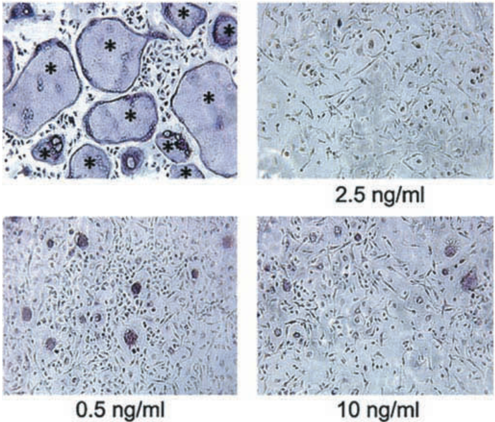
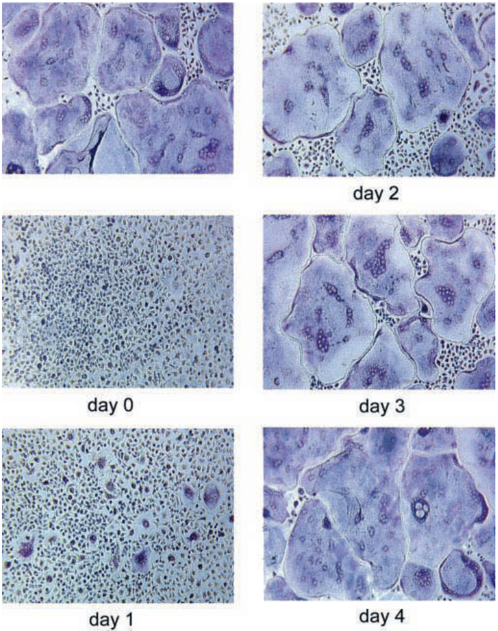
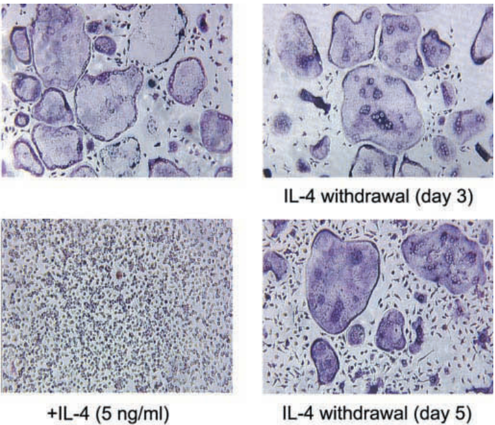
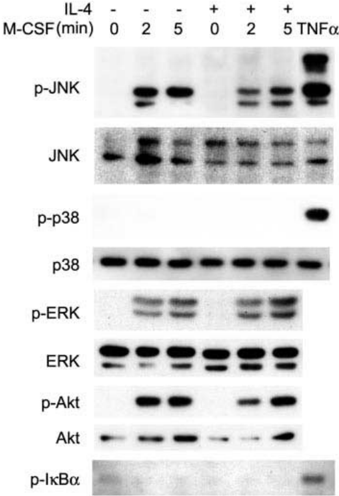
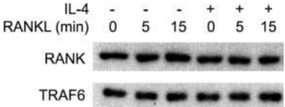
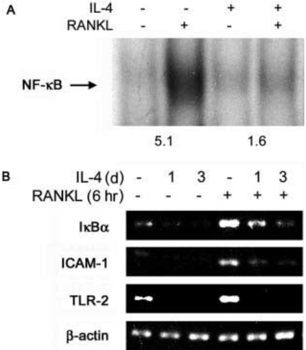
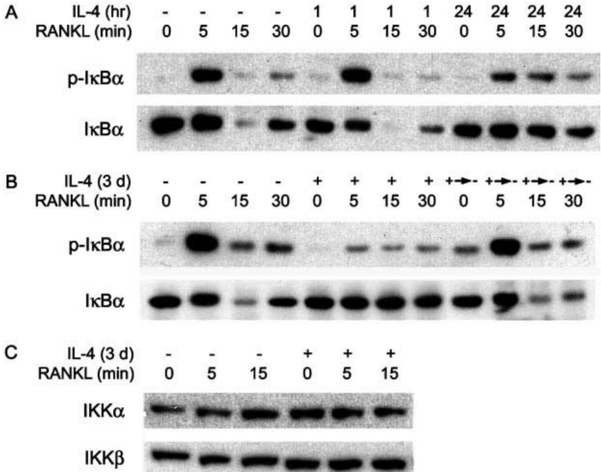
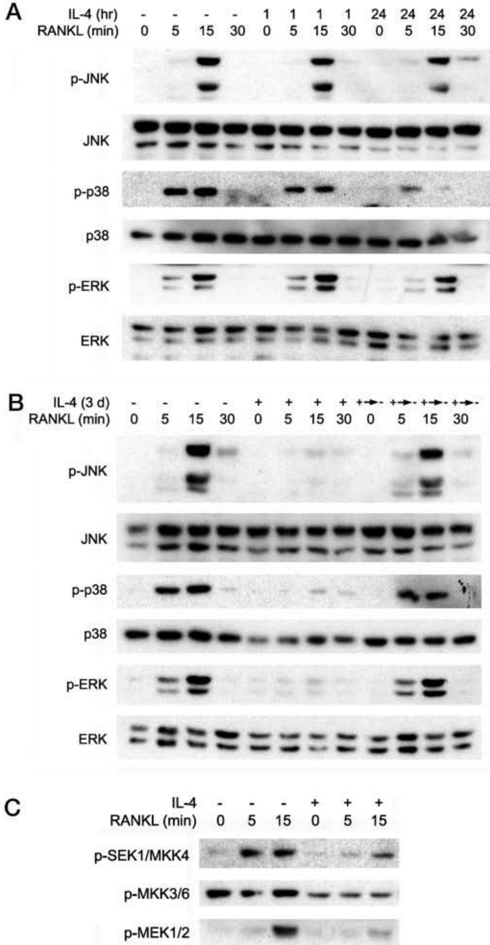
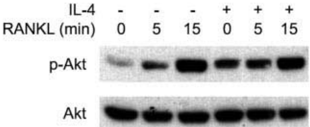
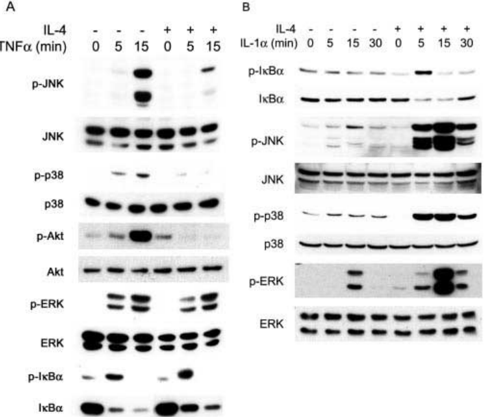
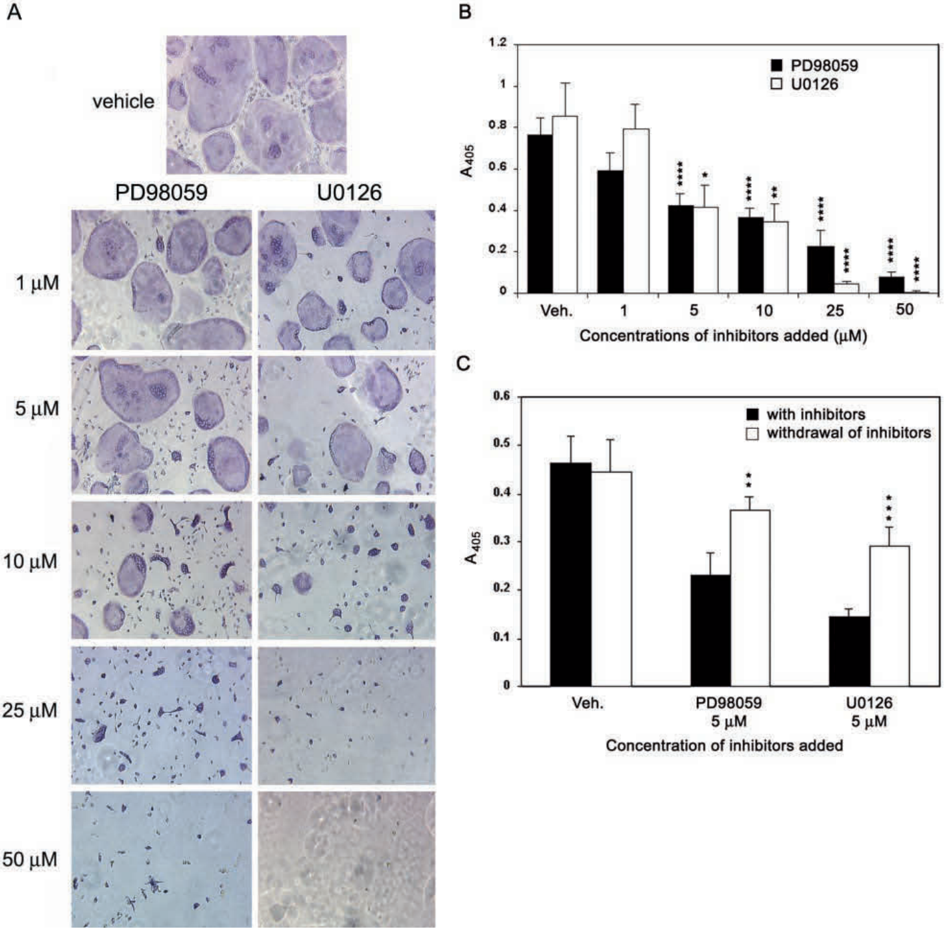
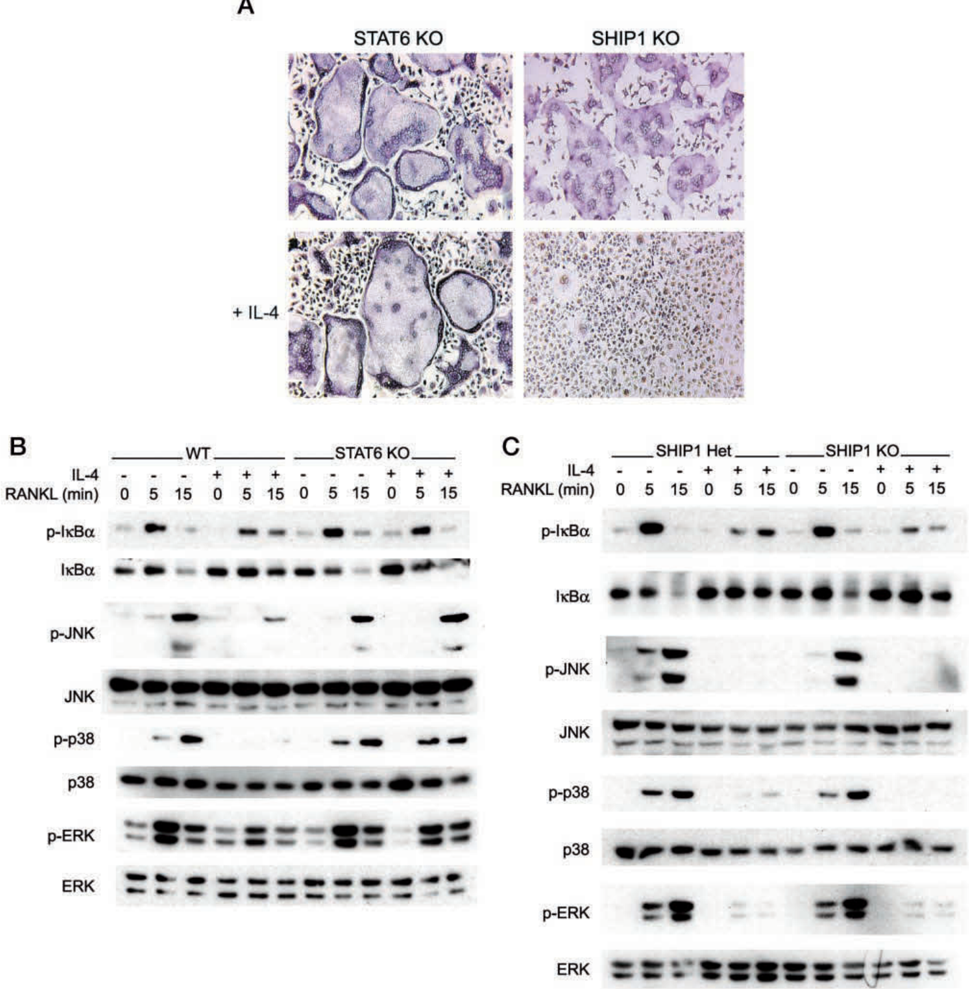
To define the molecular mechanism(s) by which interleukin (IL)-4 reversibly inhibits formation of osteoclasts (OCs) from bone marrow macrophages (BMMs), we examined the capacity of this T cell-derived cytokine to impact signals known to modulate osteoclastogenesis, which include those initiated by macrophage colony-stimulating factor (M-CSF), receptor for activation of NF-kappa B ligand (RANKL), tumor necrosis factor (TNF), and IL-1. We find that although pretreatment of BMMs with IL-4 does not alter M-CSF signaling, it reversibly blocks RANKL-dependent activation of the NF-kappa B, JNK, p38, and ERK signals. IL-4 also selectively inhibits TNF signaling, while enhancing that of IL-1. Contrary to previous reports, we find that MEK inhibitors dose-dependently inhibit OC differentiation. To identify more proximal signals mediating inhibition of OC formation by IL-4, we used mice lacking STAT6 or SHIP1, two adapter proteins that bind the IL-4 receptor. IL-4 fails to inhibit RANKL/M-CSF-induced osteoclastogenesis by BMMs derived from STAT6-, but not SHIP1-, knockout mice. Consistent with this observation, the inhibitory effects of IL-4 on RANKL-induced NF-kappa B and mitogen-activated protein kinase activation are STAT6-dependent. We conclude that IL-4 reversibly arrests osteoclastogenesis in a STAT6-dependent manner by 1) preventing I kappa B phosphorylation and thus NF-kappa B activation, and 2) blockade of the JNK, p38, and ERK mitogen-activated protein kinase pathways.
Overview
The claims and statistics of this paper haven’t been checked yet.
Run the check — free, no account needed. It reads the open-access text and checks the sources it cites.
Integrity signals
Registry
Cites
Statistics
Figures
Verification
Claims the paper makes
The claims and statistics of this paper haven’t been checked yet.
Run the check — free, no account needed. It reads the open-access text and checks the sources it cites.
Claims other papers make about this one
Each is checked against this paper’s own text: does it say what the citing paper says it does?
The source backs part of the claim, not all of it — or backs it for a different population, condition or comparison.
In the citing paper
“Wei and associates found that IL-4 inhibited osteoclastogenesis by blocking the JNK, p38, and ERK protein kinase pathways, which are upstream of NFATc1 [40].”
From Osteoclasts and Microgravity (2020) · cites this paper as [40]
Experimental — accuracy not yet measured
Self-check
Percentages, sums and reported differences re-computed from the paper’s own numbers.
The self-check needs the paper’s full text.
Citations
Cites
Osteoprotegerin ligand is a cytokine that regulates osteoclast differentiation and activation.
Lacey, D. L., Timms, E., Tan, H.-L., Kelley, M. J., Dunstan, C. R., Burgess, T., Elliott, R., Colombero, A., Elliott, G., Scully, S., et al. (1998) · Cell · doi:10.1016/s0092-8674(00)81569-x · Cited by 5,439
Osteoprotegerin: a novel secreted protein involved in the regulation of bone density.
Simonet, W. S., Lacey, D. L., Dunstan, C. R., Kelley, M., Chang, M.-S., Lüthy, R., Nguyen, H. Q., Wooden, S., Bennett, L., Boone, T., et al. (1997) · Cell · doi:10.1016/s0092-8674(00)80209-3 · Cited by 5,130
Phosphorylation meets ubiquitination: the control of NF-κB activity
Karin, M., & Ben-Neriah, Y. (2000) · Annual Review of Immunology · doi:10.1146/annurev.immunol.18.1.621 · Cited by 4,766
Yasuda, H., Shima, N., Nakagawa, N., Yamaguchi, K., Kinosaki, M., Mochizuki, S.-I., Tomoyasu, A., Yano, K., Goto, M., Murakami, A., et al. (1998) · Proceedings of the National Academy of Sciences · doi:10.1073/pnas.95.7.3597 · Cited by 4,224
Bone Resorption by Osteoclasts
Teitelbaum, S. L. (2000) · Science · doi:10.1126/science.289.5484.1504 · Cited by 3,962
Self-citationA homologue of the TNF receptor and its ligand enhance T-cell growth and dendritic-cell function.
Anderson, D. M., Maraskovsky, E., Billingsley, W. L., Dougall, W. C., Tometsko, M. E., Roux, E. R., Teepe, M. C., DuBose, R. F., Cosman, D., & Galibert, L. (1997) · Nature · doi:10.1038/36593 · Cited by 2,290
The IL-4 receptor: signaling mechanisms and biologic functions
Nelms, K., Keegan, A. D., Zamorano, J., Ryan, J. J., & Paul, W. E. (1999) · Annual Review of Immunology · doi:10.1146/annurev.immunol.17.1.701 · Cited by 1,545
Lam, J., Takeshita, S., Barker, J. E., Kanagawa, O., Ross, F. P., & Teitelbaum, S. L. (2000) · Journal of Clinical Investigation · doi:10.1172/jci11176 · Cited by 1,440
Self-citationKobayashi, K., Takahashi, N., Jimi, E., Udagawa, N., Takami, M., Kotake, S., Nakagawa, N., Kinosaki, M., Yamaguchi, K., Shima, N., et al. (2000) · The Journal of Experimental Medicine · doi:10.1084/jem.191.2.275 · Cited by 1,309
TRAF6 is a signal transducer for interleukin-1
Cao, Z., Xiong, J., Takeuchi, M., Kurama, T., & Goeddel, D. V. (1996) · Nature · doi:10.1038/383443a0 · Cited by 1,305
Research works printed but not linked: 1
- McNally, 1995, Am. J. Pathol., 147, 1487
Cited by
Sorted by citations
Osteoclast differentiation and activation
Boyle, W. J., Simonet, W. S., & Lacey, D. L. (2003) · Nature · doi:10.1038/nature01658 · Cited by 6,670
Genetic regulation of osteoclast development and function
Teitelbaum, S. L., & Ross, F. P. (2003) · Nature Reviews Genetics · doi:10.1038/nrg1122 · Cited by 1,720
Self-citationIL-1 mediates TNF-induced osteoclastogenesis
Shi, W., Kitaura, H., Zhou, P., Ross, F. P., & Teitelbaum, S. L. (2005) · Journal of Clinical Investigation · doi:10.1172/jci23394 · Cited by 805
Self-citationTheoleyre, S., Wittrant, Y., Tat, S. K., Fortun, Y., Redini, F., & Heymann, D. (2004) · Cytokine & Growth Factor Reviews · doi:10.1016/j.cytogfr.2004.06.004 · Cited by 663
Osteoimmunology: Interactions of the Bone and Immune System
Lorenzo, J., Horowitz, M. C., & Choi, Y. (2008) · Endocrine Reviews · doi:10.1210/er.2007-0038 · Cited by 576
Metadata
- Authors
- Wei, S., Wang, M. W.-H., Teitelbaum, S. L., & Ross, F. P.
- Affiliations
- Washington University in St. Louis (US)
- Corresponding author
- Ross, F. Patrick
- Venue
- Journal of Biological Chemistry
- Publisher
- Elsevier BV
- Published
- 2002-02
- Volume
- 277
- Issue
- 8
- Pages
- 6622-6630
- ISSN
- 0021-9258 (ISSN-L)
- OpenAlex
- W1998128158
- Cited by
- 202
- References
- 55
- Citations by year
- 2026: 3 · 2025: 3 · 2024: 4 · 2023: 7 · 2022: 4 · 2021: 3 · 2020: 15 · 2019: 3 · 2018: 9 · 2017: 5 · 2016: 7 · 2015: 6 · 2014: 3 · 2013: 10 · 2012: 5
- FWCI
- 5.55
- Type
- journal article
- Language
- en
- Open access
- hybrid
- doi.org
- Licence
- Locations
- Journal of Biological Chemistry (publishedVersion, cc-by)
- PubMed (publishedVersion)
- Topics
- Life Sciences › Biochemistry, Genetics and Molecular Biology › Molecular Biology › Bone Metabolism and Diseases
- Life Sciences › Immunology and Microbiology › Immunology › Cytokine Signaling Pathways and Interactions
- Health Sciences › Medicine › Rheumatology › Rheumatoid Arthritis Research and Therapies
- Keywords
- IL-4, osteoclastogenesis, NF-κB signaling, mitogen-activated protein kinase, STAT6, SHIP1, RANKL, macrophage colony-stimulating factor, TNF signaling, IL-1 signaling, MEK inhibitors, bone marrow-derived macrophages
- MeSH terms
- Animals, Bone Marrow Cells, Carrier Proteins, Cells, Cultured, Gene Expression Regulation, Kinetics, Macrophages, Membrane Glycoproteins, Mice, Inbred C57BL, Osteoclasts, Osteogenesis, Signal Transduction, Interleukin-4, Macrophage Colony-Stimulating Factor, NF-kappa B, Cell Culture Techniques, Reverse Transcriptase Polymerase Chain Reaction, MAP Kinase Signaling System, Mice, RANK Ligand, Receptor Activator of Nuclear Factor-kappa B
About these checks
Registry, retraction, Cites and statistics results are computed, not judged, with one exception: a printed reference that no index lists is read once by a model before it counts as a citation error. Claims are extracted by a model and kept only when their quote appears verbatim in the text; each cited source is then checked, with a model’s help, for whether it says what the claim relies on. Those verdicts can be wrong — read the claim’s quote and the cited source before relying on one.
Statistics and arithmetic are recomputed, not judged.
Confidence bands are shown only for fields calibrated on our annotated test set. None is calibrated yet, so no band is shown.
What counts as a claim ›How we measure confidence ›How we check this ›
Are you an author, or do you see a problem with this page? Request a review
