

The DOI matches its Crossref record; 44 of the 44 references it cites were found in a registry or an index.
Glycomics Profiling of Chinese Hamster Ovary Cell Glycosylation Mutants Reveals N-Glycans of a Novel Size and Complexity
Open accessAbstract
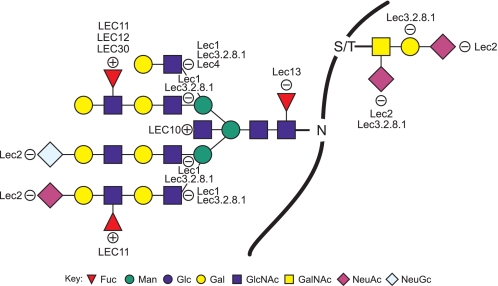
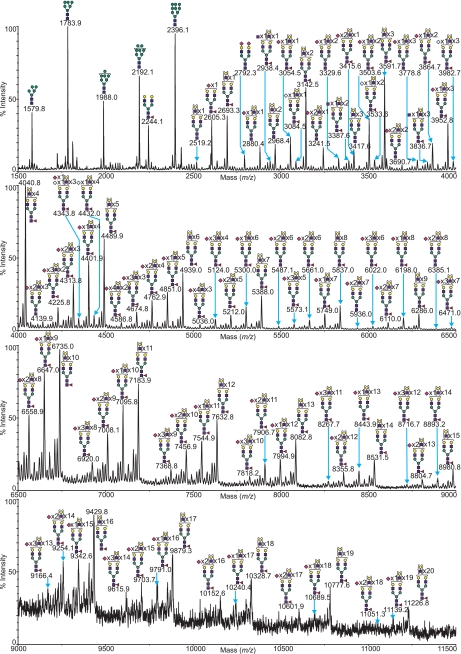
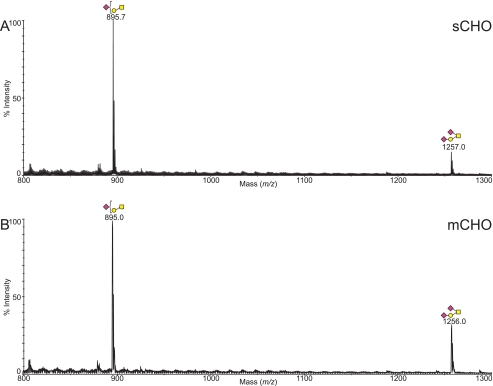
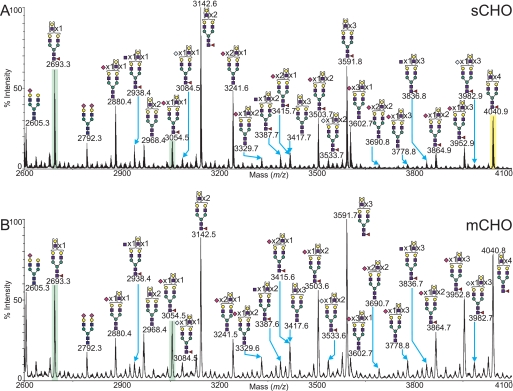
Identifying biological roles for mammalian glycans and the pathways by which they are synthesized has been greatly facilitated by investigations of glycosylation mutants of cultured cell lines and model organisms. Chinese hamster ovary (CHO) glycosylation mutants isolated on the basis of their lectin resistance have been particularly useful for glycosylation engineering of recombinant glycoproteins. To further enhance the application of these mutants, and to obtain insights into the effects of altering one specific glycosyltransferase or glycosylation activity on the overall expression of cellular glycans, an analysis of the N-glycans and major O-glycans of a panel of CHO mutants was performed using glycomic analyses anchored by matrix-assisted laser desorption ionization-time of flight/time of flight mass spectrometry. We report here the complement of the major N-glycans and O-glycans present in nine distinct CHO glycosylation mutants. Parent CHO cells grown in monolayer versus suspension culture had similar profiles of N- and O-GalNAc glycans, although the profiles of glycosylation mutants Lec1, Lec2, Lec3.2.8.1, Lec4, LEC10, LEC11, LEC12, Lec13, and LEC30 were consistent with available genetic and biochemical data. However, the complexity of the range of N-glycans observed was unexpected. Several of the complex N-glycan profiles contained structures of m/z approximately 13,000 representing complex N-glycans with a total of 26 N-acetyllactosamine (Gal beta1-4GlcNAc)(n) units. Importantly, the LEC11, LEC12, and LEC30 CHO mutants exhibited unique complements of fucosylated complex N-glycans terminating in Lewis(x) and sialyl-Lewis(x) determinants. This analysis reveals the larger-than-expected complexity of N-glycans in CHO cell mutants that may be used in a broad variety of functional glycomics studies and for making recombinant glycoproteins.
Overview
The claims and statistics of this paper haven’t been checked yet.
Run the check — free, no account needed. It reads the open-access text and checks the sources it cites.
Integrity signals
Registry
Cites
Statistics
Figures
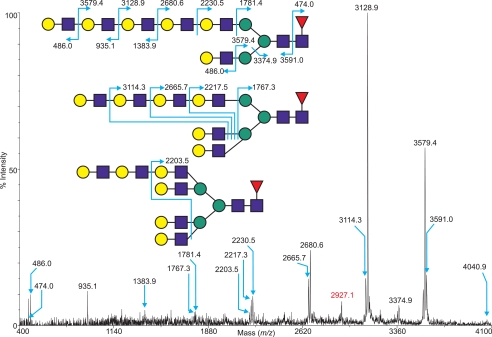
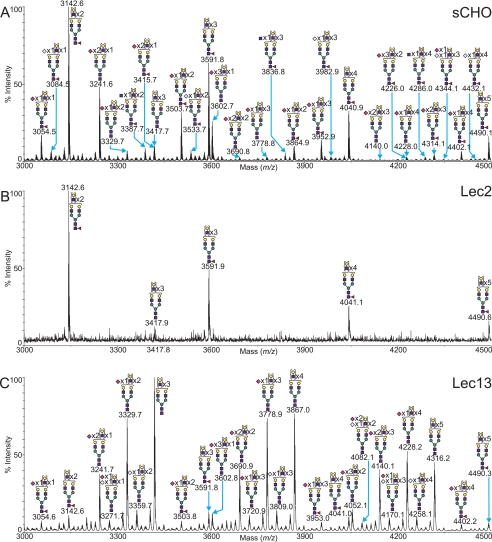
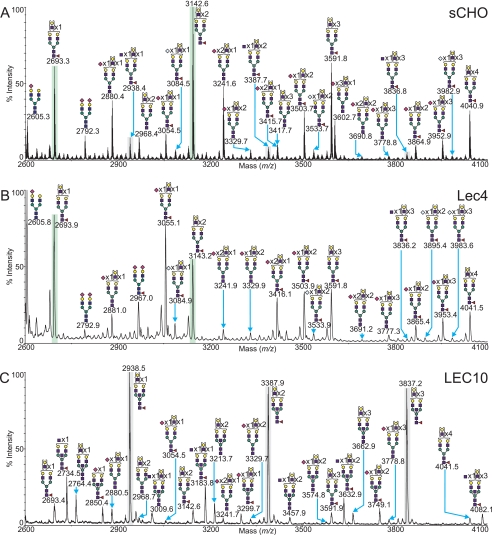
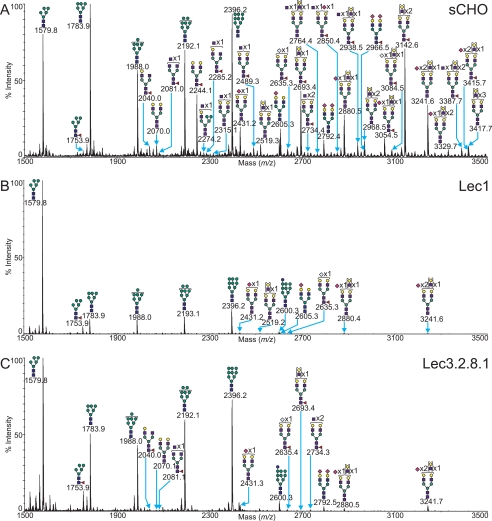
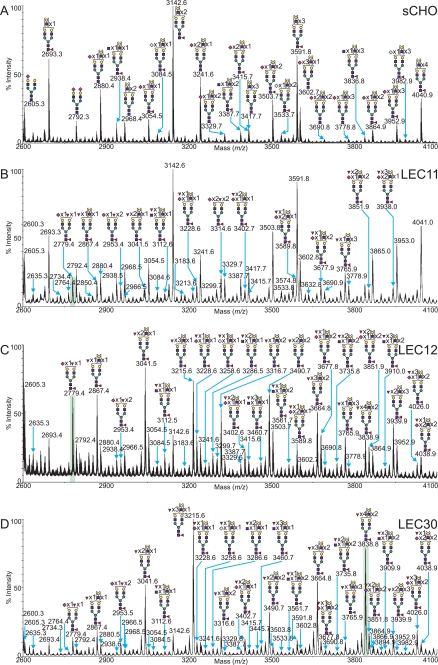
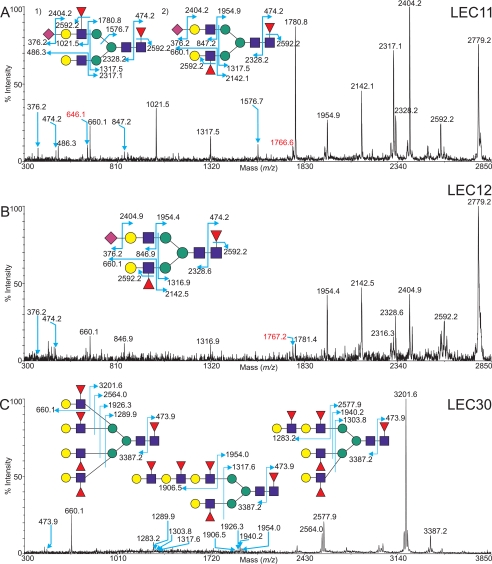
Verification
Claims the paper makes
The claims and statistics of this paper haven’t been checked yet.
Run the check — free, no account needed. It reads the open-access text and checks the sources it cites.
Claims other papers make about this one
Each is checked against this paper’s own text: does it say what the citing paper says it does?
The source backs part of the claim, not all of it — or backs it for a different population, condition or comparison.
In the citing paper
“Advances in various omics technologies have significantly improved our understanding of CHO cells at different levels and enabled the rational targeting of glycosylation effectors for improved biopharmaceutical production [27,71,72,150–152].”
From Glycoengineering Chinese hamster ovary cells: a short history (2021) · cites this paper as [27]
Experimental — accuracy not yet measuredThe source backs part of the claim, not all of it — or backs it for a different population, condition or comparison.
In the citing paper
“when NeuAc is α2,3-linked (main sialylated species in CHO-derived glycoproteins) the conformational stability of the CH2 domain of IgG can be reduced, most likely a result of a steric effect between the protein backbone and the α2,3-sialylated 6-arm [27,28].”
From Glycoengineering Chinese hamster ovary cells: a short history (2021) · cites this paper as [27]
Experimental — accuracy not yet measuredThe check wasn’t confident either way, so it gives no verdict — never disputed.
In the citing paper
“CHO cells do not express alpha-1,3-galactosyltransferases, which produce the immunogenic alpha-galactosyl epitope (although they have the gene), and the expression of CMP-N-acetylneuraminic acid hydroxylase, which produces CMP-NeuGc, is virtually absent [27,71,72].”
From Glycoengineering Chinese hamster ovary cells: a short history (2021) · cites this paper as [27]
Experimental — accuracy not yet measured
Self-check
Percentages, sums and reported differences re-computed from the paper’s own numbers.
The self-check needs the paper’s full text.
Citations
Cites
A method for the analysis of sugars in plant cell-wall polysaccharides by gas-liquid chromatography
Albersheim, P., Nevins, D. J., English, P. D., & Karr, A. L. (1967) · Carbohydrate Research · doi:10.1016/s0008-6215(00)80510-8 · Cited by 1,648
Monoclonal antibody defining a stage-specific mouse embryonic antigen (SSEA-1).
Solter, D., & Knowles, B. B. (1978) · Proceedings of the National Academy of Sciences · doi:10.1073/pnas.75.11.5565 · Cited by 1,295
GlycoWorkbench: A Tool for the Computer-Assisted Annotation of Mass Spectra of Glycans
Ceroni, A., Maaß, K., Geyer, H., Geyer, R., Dell, A., & Haslam, S. M. (2008) · Journal of Proteome Research · doi:10.1021/pr7008252 · Cited by 1,055
Self-citationSialic acids in human health and disease
Varki, A. P. (2008) · Trends in Molecular Medicine · doi:10.1016/j.molmed.2008.06.002 · Cited by 1,032
Fucose: biosynthesis and biological function in mammals
Becker, D. J., & Lowe, J. B. (2003) · Glycobiology · doi:10.1093/glycob/cwg054 · Cited by 931
Glycomics: an integrated systems approach to structure-function relationships of glycans
Raman, R., Raguram, S., Venkataraman, G., Paulson, J. C., & Sasisekharan, R. (2005) · Nature Methods · doi:10.1038/nmeth807 · Cited by 443
Wada, Y., Azadi, P., Costello, C. E., Dell, A., Dwek, R. A., Geyer, H., Geyer, R., Kakehi, K., Karlsson, N. G., Kato, K., et al. (2007) · Glycobiology · doi:10.1093/glycob/cwl086 · Cited by 400
Self-citationBardor, M., Nguyen, D., Diaz, S. L., & Varki, A. P. (2004) · Journal of Biological Chemistry · doi:10.1074/jbc.m412040200 · Cited by 390
Moloney, D. J., Shair, L. H., Lu, F. M., Xia, J. L., Locke, R. D., Matta, K. L., & Haltiwanger, R. S. (2000) · Journal of Biological Chemistry · doi:10.1074/jbc.275.13.9604 · Cited by 348
Structure of a Heterophilic Adhesion Complex between the Human CD2 and CD58 (LFA-3) Counterreceptors
Wang, J., Smolyar, A., Tan, K., Liu, J., Kim, M., Sun, Z., Wagner, G., & Reinherz, E. L. (1999) · Cell · doi:10.1016/s0092-8674(00)80790-4 · Cited by 245
Research works printed but not linked: 1
- Stanley, 1989, Mol. Cell. Biol., 9, 377
Cited by
Sorted by citations
Unravelling the Role of O-glycans in Influenza A Virus Infection
Mayr, J., Lau, K., Lai, J. C. C., Gagarinov, I. A., Shi, Y. Y., McAtamney, S., Chan, R. W. Y., Nicholls, J. M., von Itzstein, M., & Haselhorst, T. (2018) · Scientific Reports · doi:10.1038/s41598-018-34175-3 · Cited by 1,068
Precision Mapping of an In Vivo N-Glycoproteome Reveals Rigid Topological and Sequence Constraints
Zielinska, D. F., Gnad, F., Wiśniewski, J. R., & Mann, M. (2010) · Cell · doi:10.1016/j.cell.2010.04.012 · Cited by 905
Cell surface protein glycosylation in cancer
Christiansen, M. N., Chik, J., Lee, L., Anugraham, M., Abrahams, J. L., & Packer, N. H. (2014) · PROTEOMICS · doi:10.1002/pmic.201300387 · Cited by 518
Golgi GlycosylationPreprint
Stanley, P. (2011) · Cold Spring Harbor Perspectives in Biology · doi:10.1101/cshperspect.a005199 · Cited by 462
Self-citationGalectin-3 Coordinates a Cellular System for Lysosomal Repair and Removal
Jia, J., Claude-Taupin, A., Gu, Y., Choi, S. W., Peters, R., Bissa, B., Mudd, M. H., Allers, L., Pallikkuth, S., Lidke, K. A., et al. (2020) · Developmental Cell · doi:10.1016/j.devcel.2019.10.025 · Cited by 434
Metadata
- Authors
- North, S. J., Huang, H.-H., Sundaram, S., Jang-Lee, J., Etienne, A. T., Trollope, A., Chalabi, S., Dell, A., Stanley, P., & Haslam, S. M.
- Affiliations
- Imperial College London (GB)
- Albert Einstein College of Medicine (US)
- Corresponding author
- Stanley, Pamela
- Haslam, Stuart M.
- Venue
- Journal of Biological Chemistry
- Publisher
- Elsevier BV
- Published
- 2010-02
- Volume
- 285
- Issue
- 8
- Pages
- 5759-5775
- ISSN
- 0021-9258 (ISSN-L)
- PMC
- PMC2820803
- OpenAlex
- W2033604747
- Cited by
- 207
- References
- 44
- Citations by year
- 2026: 5 · 2025: 7 · 2024: 8 · 2023: 6 · 2022: 10 · 2021: 12 · 2020: 11 · 2019: 15 · 2018: 17 · 2017: 16 · 2016: 8 · 2015: 11 · 2014: 21 · 2013: 17 · 2012: 13
- FWCI
- 5.78
- Type
- journal article
- Language
- en
- Open access
- hybrid
- doi.org
- Licence
- Locations
- Journal of Biological Chemistry (publishedVersion, cc-by)
- PubMed Central (publishedVersion, cc-by-nc)
- PubMed (publishedVersion)
- Funders
- Wellcome Trust
- National Institutes of Health
- Directorate for Biological Sciences
- U.S. Public Health Service (NCI RO1-36434)
- Biotechnology and Biological Sciences Research Council (BB/F008309/1, B19088)
- National Cancer Institute
- National Institute of General Medical Sciences (GM 62116, U54GM062116)
- Topics
- Life Sciences › Biochemistry, Genetics and Molecular Biology › Molecular Biology › Glycosylation and Glycoproteins Research
- Life Sciences › Biochemistry, Genetics and Molecular Biology › Molecular Biology › Viral Infectious Diseases and Gene Expression in Insects
- Physical Sciences › Chemistry › Organic Chemistry › Carbohydrate Chemistry and Synthesis
- Keywords
- glycosylation mutants, CHO cells, N-glycans, O-glycans, glycomics, lectin resistance, glycosyltransferases, N-acetyllactosamine, fucosylated N-glycans, CD15, sialyl Lewis X
- MeSH terms
- Animals, Carbohydrate Sequence, Cricetulus, Glycosylation, Cricetinae, Mutation, Polysaccharides, CHO Cells
About these checks
Registry, retraction, Cites and statistics results are computed, not judged, with one exception: a printed reference that no index lists is read once by a model before it counts as a citation error. Claims are extracted by a model and kept only when their quote appears verbatim in the text; each cited source is then checked, with a model’s help, for whether it says what the claim relies on. Those verdicts can be wrong — read the claim’s quote and the cited source before relying on one.
Statistics and arithmetic are recomputed, not judged.
Confidence bands are shown only for fields calibrated on our annotated test set. None is calibrated yet, so no band is shown.
What counts as a claim ›How we measure confidence ›How we check this ›
Are you an author, or do you see a problem with this page? Request a review
