

Role of the Ada2 and Ada3 transcriptional coactivators in histone acetylation.
Open accessThe DOI matches its Crossref record; 38 of the 38 references it cites were found in a registry or an index.
Abstract
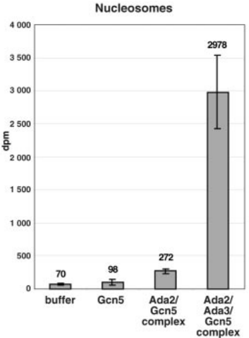
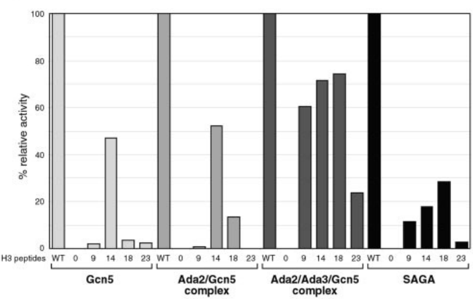
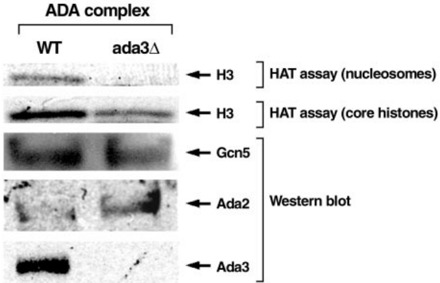
Previous studies have shown that the transcriptional coactivator protein Gcn5 functions as a catalytic histone acetyltransferase (HAT). In this work, we examine the roles of the Ada2 and Ada3 coactivator proteins that are functionally linked to Gcn5. We show that yeast Ada2, Ada3, and Gcn5 form a catalytic core of the ADA and Spt-Ada-Gcn5-acetyltransferase HAT complexes, which is necessary and sufficient in vitro for nucleosomal HAT activity and lysine specificity of the intact HAT complexes. We also demonstrate that Ada3 is necessary for Gcn5-dependent nucleosomal HAT activity in yeast extracts. Our results suggest that Ada2 potentiates the Gcn5 catalytic activity and that Ada3 facilitates nucleosomal acetylation and an expanded lysine specificity.
Overview
The claims and statistics of this paper haven’t been checked yet.
Free: it reads the open-access text and checks the first 5 claims that cite a source we can check. Create a free account to check every claim.
Integrity signals
Registry
Cites
Statistics
Figures
Verification
Claims the paper makes
The claims and statistics of this paper haven’t been checked yet.
Free: it reads the open-access text and checks the first 5 claims that cite a source we can check. Create a free account to check every claim.
Self-check
Percentages, sums and reported differences re-computed from the paper’s own numbers.
The self-check needs the paper’s full text.
Citations
Cites
Crystal structure of the nucleosome core particle at 2.8 Å resolution
Luger, K., Mäder, A. W., Richmond, R. K., Sargent, D. F., & Richmond, T. J. (1997) · Nature · doi:10.1038/38444 · Cited by 9,466
Calculation of protein extinction coefficients from amino acid sequence data
Gill, S. C., & von Hippel, P. H. (1989) · Analytical Biochemistry · doi:10.1016/0003-2697(89)90602-7 · Cited by 5,283
Acetylation of Histones and Transcription-Related Factors
Sterner, D. E., & Berger, S. L. (2000) · Microbiology and Molecular Biology Reviews · doi:10.1128/mmbr.64.2.435-459.2000 · Cited by 1,780
Brownell, J. E., Zhou, J., Ranalli, T., Kobayashi, R., Edmondson, D. G., Roth, S. Y., & Allis, C. D. (1996) · Cell · doi:10.1016/s0092-8674(00)81063-6 · Cited by 1,640
ALTERATION OF NUCLEOSOME STRUCTURE AS A MECHANISM OF TRANSCRIPTIONAL REGULATION
Workman, J. L., & Kingston, R. E. (1998) · Annual Review of Biochemistry · doi:10.1146/annurev.biochem.67.1.545 · Cited by 1,129
Grant, P. A., Duggan, L., Côté, J., Roberts, S. M., Brownell, J. E., Candau, R., Ohba, R., Owen-Hughes, T., Allis, C. D., Winston, F., et al. (1997) · Genes & Development · doi:10.1101/gad.11.13.1640 · Cited by 1,085
Self-citationUse of bacteriophage T7 lysozyme to improve an inducible T7 expression system
Studier, F. W. (1991) · Journal of Molecular Biology · doi:10.1016/0022-2836(91)90855-z · Cited by 802
Transcription-linked acetylation by Gcn5p of histones H3 and H4 at specific lysines
Kuo, M.-H., Brownell, J. E., Sobel, R. E., Ranalli, T. A., Cook, R. G., Edmondson, D. G., Roth, S. Y., & Allis, C. D. (1996) · Nature · doi:10.1038/383269a0 · Cited by 596
The histone tails of the nucleosome
Luger, K., & Richmond, T. J. (1998) · Current Opinion in Genetics & Development · doi:10.1016/s0959-437x(98)80134-2 · Cited by 521
Transcription-linked acetylation by Gcn5p of histones H3 and H4 at specific lysines
Otte, A. P. (1997) · UvA-DARE (University of Amsterdam) · Cited by 480
Research works printed but not linked: 2
- van Holde, K. E. (1989) Chromatin (Rich, A., series ed) Springer-Verlag, New York
- Pina, B., Berger, S., Marcus, G. A., Silverman, N., Agapite, J., and Guarente, L. (1993) Mol. Cell. Biol. 13, 5981-5989
Cited by
Functions of Site-Specific Histone Acetylation and Deacetylation
Shahbazian, M. D., & Grunstein, M. (2007) · Annual Review of Biochemistry · doi:10.1146/annurev.biochem.76.052705.162114 · Cited by 1,635
The General Transcription Machinery and General Cofactors
Thomas, M. C., & Chiang, C.-M. (2006) · Critical Reviews in Biochemistry and Molecular Biology · doi:10.1080/10409230600648736 · Cited by 925
“Clearly, Ada proteins and ataxin-7 facilitate the access of GCN5L to the activator-occupied chromatin template, allowing acetylation of nucleosomal core histones (Balasubramanian et al., 2002; Palhan et al., 2005).”
BackgroundCai, L., Sutter, B. M., Li, B., & Tu, B. P. (2011) · Molecular Cell · doi:10.1016/j.molcel.2011.05.004 · Cited by 701
“…of SAGA components Spt7p and Sgf73p is dependent on Ada3p (Figure 2D) suggest the possibility that acetylation of SAGA could function to stimulate its nucleosomal acetyltransferase activity and perhaps its activation or recruitment to growth genes (Balasubramanian et al., 2002; Wu et al., 1999).”
The diverse functions of histone acetyltransferase complexes
Carrozza, M. J., Utley, R. T., Workman, J. L., & Côté, J. (2003) · Trends in Genetics · doi:10.1016/s0168-9525(03)00115-x · Cited by 487
Papillomavirus E6 oncoproteins
Vande Pol, S. B., & Klingelhutz, A. J. (2013) · Virology · doi:10.1016/j.virol.2013.04.026 · Cited by 346
Metadata
- Authors
- Balasubramanian, R., Pray-Grant, M. G., Selleck, W., Grant, P. A., & Tan, S.
- Affiliations
- Pennsylvania State University (US)
- University of Virginia (US)
- Corresponding author
- Tan, Song
- ORCID
- Tan, Song
- Venue
- Journal of Biological Chemistry
- Publisher
- Elsevier BV
- Published
- 2002-03
- Volume
- 277
- Issue
- 10
- Pages
- 7989-7995
- ISSN
- 0021-9258 (ISSN-L)
- OpenAlex
- W2077026916
- Cited by
- 233
- References
- 38
- Citations by year
- 2026: 4 · 2025: 6 · 2024: 8 · 2023: 11 · 2022: 8 · 2021: 6 · 2020: 13 · 2019: 9 · 2018: 9 · 2017: 7 · 2016: 9 · 2015: 4 · 2014: 10 · 2013: 16 · 2012: 8
- FWCI
- 4.53
- Type
- journal article
- Language
- en
- Open access
- hybrid
- doi.org
- Licence
- cc-by
- www.elsevier.com/tdm/userlicense/1.0/ (tdm)
- creativecommons.org/licenses/by/4.0/ (vor, 6788 d)
- Locations
- Journal of Biological Chemistry (publishedVersion, cc-by)
- PubMed (publishedVersion)
- Funders
- National Institutes of Health
- National Institute of General Medical Sciences (GM-60489, R01GM060489)
- National Institute of Diabetes and Digestive and Kidney Diseases (R01DK058646, DK-58646-01)
- Topics
- Life Sciences › Biochemistry, Genetics and Molecular Biology › Molecular Biology › Genomics and Chromatin Dynamics
- Life Sciences › Biochemistry, Genetics and Molecular Biology › Molecular Biology › Histone Deacetylase Inhibitors Research
- Life Sciences › Biochemistry, Genetics and Molecular Biology › Molecular Biology › Nuclear Structure and Function
- Keywords
- ADA2, ADA3, GCN5, histone acetylation, histone acetyltransferase, transcriptional coactivator, catalytic core, Saccharomyces cerevisiae
- MeSH terms
- p300-CBP-Associated Factor, Acetyltransferases, Catalysis, Chromatin, Chromatography, Ion Exchange, DNA-Binding Proteins, Electrophoresis, Polyacrylamide Gel, Fungal Proteins, Histones, Lysine, Nucleosomes, Peptides, Protein Binding, Protein Kinases, Proteins, Recombinant Proteins, Transcription Factors, Protein Structure, Tertiary, Saccharomyces cerevisiae Proteins, Histone Acetyltransferases
About these checks
Registry, retraction, Cites and statistics results are computed, not judged, with one exception: a printed reference that no index lists is read once by a model before it counts as a citation error. Claims are extracted by a model and kept only when their quote appears verbatim in the text; each cited source is then checked, with a model’s help, for whether it says what the claim relies on. Those verdicts can be wrong — read the claim’s quote and the cited source before relying on one.
Statistics and arithmetic are recomputed, not judged.
Confidence bands are shown only for fields calibrated on our annotated test set. None is calibrated yet, so no band is shown.
What counts as a claim ›How we measure confidence ›How we check this ›
Are you an author, or do you see a problem with this page? Request a review
How to cite
Cite CoChat for the checks on this page, and the paper for its own findings.
- This page
- CoChat. (2026). Citation check: Role of the Ada2 and Ada3 transcriptional coactivators in histone acetylation. https://app.cochat.ai/papers/10.1074/jbc.m110849200
- The paper
- Balasubramanian, R., Pray-Grant, M. G., Selleck, W., Grant, P. A., & Tan, S. (2002). Role of the Ada2 and Ada3 transcriptional coactivators in histone acetylation. Journal of Biological Chemistry. https://doi.org/10.1074/jbc.m110849200
Data sources
Bibliographic data: Semantic Scholar, OpenAlex, Crossref.
Contains information from the Semantic Scholar Academic Graph Datasets, made available under the ODC Attribution License (ODC-BY 1.0).
Semantic Scholar’s data is described in: Kinney, R., et al. (2023). The Semantic Scholar Open Data Platform. arXiv:2301.10140.
