

Diffusion and Directed Movement
Open accessThe DOI matches its Crossref record; 47 of the 47 references it cites were found in a registry or an index; 8 of the 39 sources its claims cite were checked for support.
Abstract
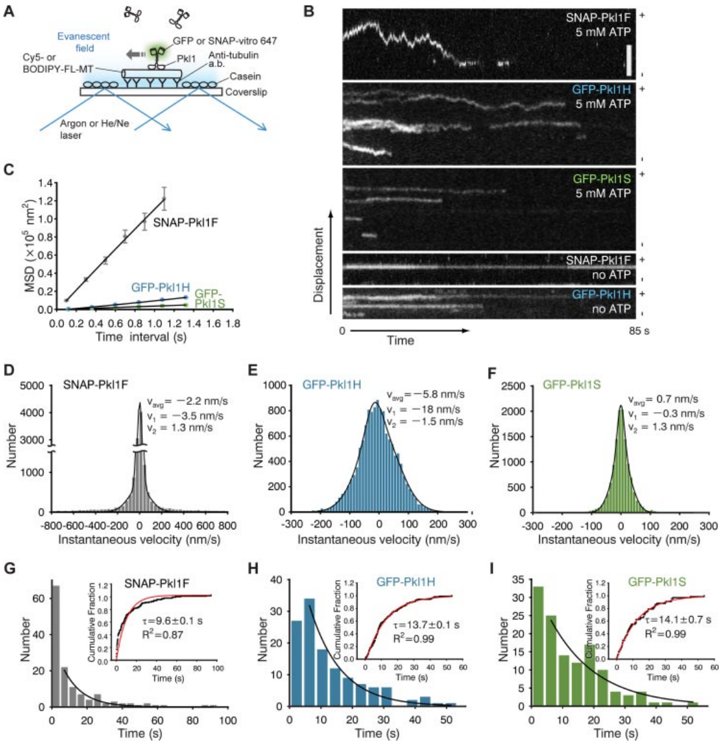
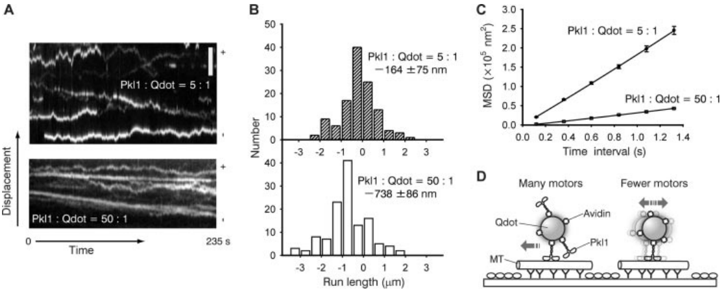
Fission yeast Pkl1 is a kinesin-14A family member that is known to be localized at the cellular spindle and is capable of hydrolyzing ATP. However, its motility has not been detected. Here, we show that Pkl1 is a slow, minus end-directed microtubule motor with a maximum velocity of 33+/-9 nm/s. The Km,MT value of steady-state ATPase activity of Pkl1 was as low as 6.4+/-1.1 nM, which is 20-30 times smaller than that of kinesin-1 and another kinesin-14A family member, Ncd, indicating a high affinity of Pkl1 for microtubules. However, the duty ratio of 0.05 indicates that Pkl1 spends only a small fraction of the ATPase cycle strongly associated with a microtubule. By using total internal reflection fluorescence microscopy, we demonstrated that single molecules of Pkl1 were not highly processive but only exhibited biased one-dimensional diffusion along microtubules, whereas several molecules of Pkl1, probably fewer than 10 molecules, cooperatively moved along microtubules and substantially reduced the diffusive component in the movement. Our results suggest that Pkl1 molecules work in groups to move and generate forces in a cooperative manner for their mitotic functions.
Overview
CoChat Summary
TL;DR
Pkl1, a fission yeast kinesin-14A, is a slow minus-end-directed microtubule motor with high MT affinity but a low duty ratio. Single Pkl1 molecules diffuse along MTs with a minus-end bias, whereas groups of fewer than 10 molecules move cooperatively and more processively.
Key findings
- Pkl1H supported microtubule gliding at a maximum average velocity of 33 ± 9 nm/s with 5 mM ATP; GFP-Pkl1H gliding had Vmax = 42 ± 4 nm/s and Km,ATP = 1,100 ± 240 µM. Pkl1 was minus-end-directed (62 of 62 polarity-marked MTs).
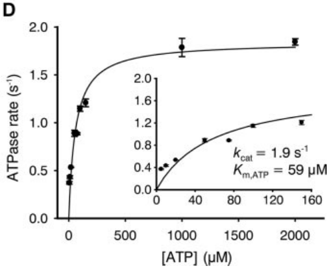
- Steady-state ATPase of GFP-Pkl1H had kcat = 2.0 ± 0.1 s−1 per head, Km,MT = 6.4 ± 1.1 nM, and Km,ATP = 59 ± 12 µM; the calculated duty ratio was 0.05, indicating nonprocessive behavior.
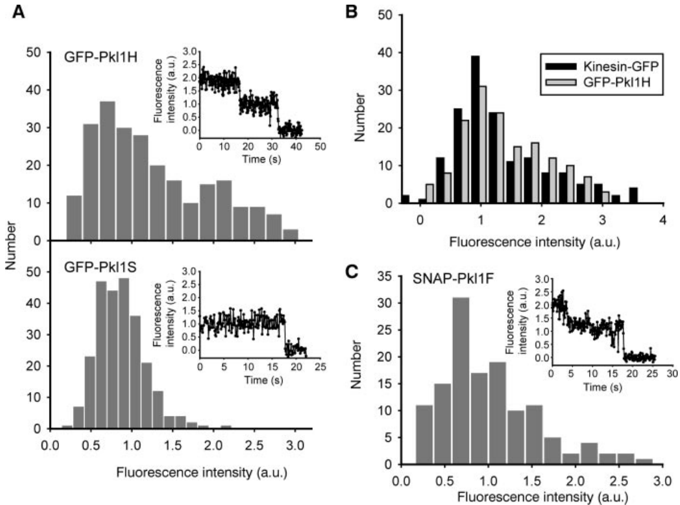
- Single-molecule TIRF showed one-dimensional diffusion along MTs. GFP-Pkl1H dimers had a clear minus-end bias with ATP (p < 0.0001) and no bias without ATP (p = 0.24); bias was not conclusive for SNAP-Pkl1F (p = 0.1539) or GFP-Pkl1S (p = 0.0536).
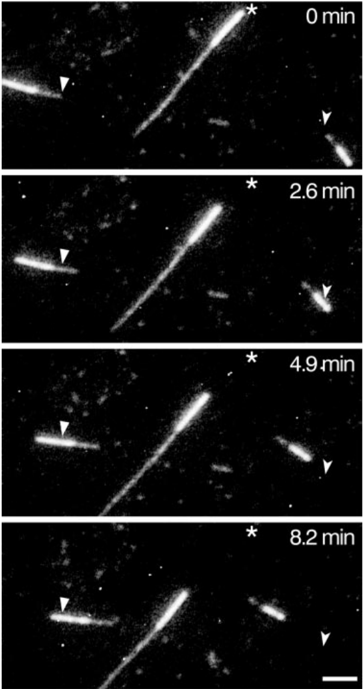
- Qdot assays with multiple Pkl1 molecules showed cooperative movement: at 50:1 Pkl1/Qdot, run length was −740 ± 90 nm and diffusion coefficient 0.13 ± 0.01 × 10⁴ nm²/s, versus −160 ± 80 nm and 0.88 ± 0.02 × 10⁴ nm²/s at 5:1; the number of transporting Pkl1 molecules was estimated as fewer than 10.
Methods
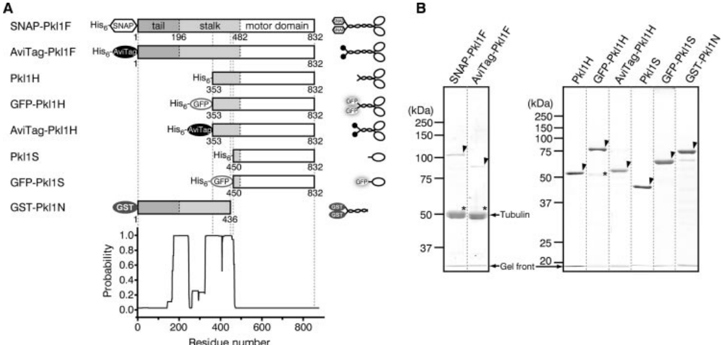
- Recombinant Pkl1 constructs (Pkl1F, Pkl1H, Pkl1S; SNAP, GFP, or AviTag fusions) were expressed in E. coli and purified; oligomeric states were assessed by sucrose density gradient centrifugation and gel filtration.
- In vitro microtubule gliding assays with polarity-marked MTs and steady-state ATPase assays were used to measure velocity, kcat, Km,ATP, Km,MT, and duty ratio.
- Single-molecule motility was observed by total internal reflection fluorescence microscopy; MSD plots were fitted to extract diffusion coefficients and drift velocities, and Qdot multiple-molecule assays were performed at 5:1 and 50:1 Pkl1/Qdot ratios.
Limitations
- Stated: the precise role of Pkl1 remains uncertain and further studies are required; SNAP-Pkl1F labeling ratio was low (15–20%), so its fluorescence distribution does not necessarily prove dimerization, only that obvious aggregates were absent; drift-velocity significance was not high except for GFP-Pkl1H, and directional bias was not conclusive for SNAP-Pkl1F or GFP-Pkl1S.
- Stated: full-length Pkl1 was degraded in host cells, requiring a SNAP tag; some constructs had low purity or tubulin contamination (SNAP-Pkl1F 6.4%, AviTag-Pkl1F 2.2%).
- Evident: all motility and ATPase measurements are in vitro with purified proteins, artificial surfaces, and Qdots; the cooperative force generation and mitotic function are inferred, not directly tested in vivo, and the Qdot motor number relies on the manufacturer’s estimate of 5–10 streptavidins per Qdot.
Model-written summary. Check it against the paper before relying on it.
Integrity signals
Registry
Cites
Statistics
Figures
Verification
Claims the paper makes
7 Valid · 2 Not valid · 13 Not checked · 71 Own results and interpretations
Every source the paper cites for this claim was checked and supports it.
In the paper
“It has also been shown that Pkl1 is functionally related to ␥-tubulin in the microtubule-organizing center (14)”
§ Diffusion and Directed Movement IN VITRO MOTILE PROPERTIES OF FISSION YEAST KINESIN-14 Pkl1 * □ S > Abstract
What the sources say
- Supportedcites [14] 14. Paluh, J. L., Nogales, E., Oakley, B. R., McDonald, K., Pidoux, A. L., and Cande, W. Z. (2000) Mol. Biol. Cell 11, 1225-1239 source
The Introduction says that two mutants suggest Pkl1p and a subset of γ-tubulin functions are closely linked, and identifies γ-tubulin’s role at the microtubule-organizing center (MTOC). The Discussion reports synthetic lethality between loss of Pkl1p and a γ-tubulin mutation, supporting the claimed functional relationship without requiring a direct physical interaction. (LLM, conf=0.90)
plainstates an association- Asserted: passes — The authors put it forward as true.
- Checkable: passes — It can be checked against evidence.
- Load-bearing: unclear — It is unclear whether the paper’s conclusions depend on it.
- Based: passes — The paper gives a reason why it holds.
- Supported
The sources with a verdict support this claim; the rest weren’t checked yet, have no full text we could read, or their verdicts aren’t rated yet.
In the paper
“The second role is to organize spindle MTs at MT minus ends and focus them into spindle poles (5)(6)(7).”
§ Diffusion and Directed Movement IN VITRO MOTILE PROPERTIES OF FISSION YEAST KINESIN-14 Pkl1 * □ S > Abstract
What the sources say
- Not checked — no full text of the sourcecites [5] 5. Hatsumi, M., and Endow, S. A. (1992) J. Cell Sci. 103, 1013-1020 source
- Not checked — no full text of the sourcecites [6] 6. Walczak, C. E., Vernos, I., Mitchison, T. J., Karsenti, E., and Heald, R. (1998) Curr. Biol. 8, 903-913 source
- Supportedcites [7] 7. Goshima, G., Nedelec, F., and Vale, R. D. (2005) J. Cell Biol. 171, 229 -240 source
The Introduction says kinesin-14 motors such as Ncd are implicated in spindle pole focusing and that their cross-bridging activity can collect microtubule minus ends. The Discussion’s three-step model identifies Ncd as the predominant motor for inter–K-fiber cross-linking in S2 cells, supporting the attributed organizing and focusing role. (LLM, conf=0.91)
plainstates a cause- Asserted: passes — The authors put it forward as true.
- Checkable: passes — It can be checked against evidence.
- Load-bearing: unclear — It is unclear whether the paper’s conclusions depend on it.
- Based: passes — The paper gives a reason why it holds.
A result the paper reports from its own data — it cites no other source for it, so there is none to check. The quote shows it is in the paper.
In the paper
“which is 20 -30 times smaller than that of kinesin-1 and another kinesin-14A family member, Ncd”
§ Diffusion and Directed Movement IN VITRO MOTILE PROPERTIES OF FISSION YEAST KINESIN-14 Pkl1 * □ S > Abstract
plain- Asserted: passes — The authors put it forward as true.
- Checkable: passes — It can be checked against evidence.
- Load-bearing: passes — The paper’s conclusions depend on it.
- Based: passes — The paper gives a reason why it holds.
A result the paper states — it cites no source for it, so there is none to check. The quote shows it is in the paper.
In the paper
“Pkl1 has a predicted coiled-coil region at amino acid residues 196 -481”
§ Diffusion and Directed Movement IN VITRO MOTILE PROPERTIES OF FISSION YEAST KINESIN-14 Pkl1 * □ S > Oligomeric State of the Pkl1
plain- Asserted: passes — The authors put it forward as true.
- Checkable: passes — It can be checked against evidence.
- Load-bearing: passes — The paper’s conclusions depend on it.
- Based: passes — The paper gives a reason why it holds.
A result the paper reports from its own data — it cites no other source for it, so there is none to check. The quote shows it is in the paper.
In the paper
“The calculated molecular mass shows that SNAP-Pkl1F forms a dimer in solution (Table 1).”
§ Diffusion and Directed Movement IN VITRO MOTILE PROPERTIES OF FISSION YEAST KINESIN-14 Pkl1 * □ S > Oligomeric State of the Pkl1
plain- Asserted: passes — The authors put it forward as true.
- Checkable: passes — It can be checked against evidence.
- Load-bearing: passes — The paper’s conclusions depend on it.
- Based: passes — The paper gives a reason why it holds.
41 more claims
Create a free account to see all 93 claims and every source verdict.
- Probably not a substantial claim. 12
- It may state two separate claims as one. 38
- The quote only partly states this claim. 3
- Borderline: one of the tests for a substantial claim is unclear. 1
Citations
Cites
A protein factor essential for microtubule assembly
Weingarten, M. D., Lockwood, A. H., Hwo, S. Y., & Kirschner, M. W. (1975) · Proceedings of the National Academy of Sciences · doi:10.1073/pnas.72.5.1858 · Cited by 3,089
Mechanics of Motor Proteins and the Cytoskeleton
Howard, & Clark (2002) · Applied Mechanics Reviews · doi:10.1115/1.1451234 · Cited by 2,909 · cited 2×
“The calculation relies only on the difference in time to wait for ATP binding between the process of ATP hydrolysis and that of mechanical force generation (37).”
BackgroundSpragg, S. P. (1979) · Nature · doi:10.1038/278085a0 · Cited by 1,707
Single particle tracking. Analysis of diffusion and flow in two-dimensional systems
Qian, H., Sheetz, M. P., & Elson, E. L. (1991) · Biophysical Journal · doi:10.1016/s0006-3495(91)82125-7 · Cited by 1,174
Movement of microtubules by single kinesin molecules
Howard, J., Hudspeth, A. J., & Vale, R. D. (1989) · Nature · doi:10.1038/342154a0 · Cited by 885
[39] Preparation of modified tubulins
Hyman, A., Drechsel, D., Kellogg, D., Salser, S., Sawin, K., Steffen, P., Wordeman, L., & Mitchison, T. (1991) · Methods in Enzymology · doi:10.1016/0076-6879(91)96041-o · Cited by 732
Direct observation of single kinesin molecules moving along microtubules
Vale, R. D., Funatsu, T., Pierce, D. W., Romberg, L., Harada, Y., & Yanagida, T. (1996) · Nature · doi:10.1038/380451a0 · Cited by 711
Estimation of Molecular Size and Molecular Weights of Biological Compounds by Gel Filtration
Andrew, P. (1970) · Methods of Biochemical Analysis · doi:10.1002/9780470110362.ch1 · Cited by 638
[30] Prediction and analysis of coiled-coil structures
Lupas, A. (1996) · Methods in Enzymology · doi:10.1016/s0076-6879(96)66032-7 · Cited by 575
Mechanochemical coupling in actomyosin energy transduction studied by in vitro movement assay
Harada, Y., Sakurada, K., Aoki, T., Thomas, D. D., & Yanagida, T. (1990) · Journal of Molecular Biology · doi:10.1016/s0022-2836(05)80060-9 · Cited by 522
Cited by
Traffic control: regulation of kinesin motors
Verhey, K. J., & Hammond, J. W. (2009) · Nature Reviews Molecular Cell Biology · doi:10.1038/nrm2782 · Cited by 546
Shahpasand, K., Uemura, I., Saito, T., Asano, T., Hata, K., Shibata, K., Toyoshima, Y., Hasegawa, M., & Hisanaga, S.-I. (2012) · The Journal of Neuroscience · doi:10.1523/jneurosci.5927-11.2012 · Cited by 206
“Kinesin RK430-AviTag-KRC-His6 was expressed and purified from E. coli as described (Furuta et al., 2008), except that ATP was not added to the preparation buffers.”
MethodSelf-citationMicrotubule organization by the antagonistic mitotic motors kinesin-5 and kinesin-14
Hentrich, C., & Surrey, T. (2010) · The Journal of Cell Biology · doi:10.1083/jcb.200910125 · Cited by 167
Tau protein diffuses along the microtubule lattice
Hinrichs, M. H., Jalal, A., Brenner, B., Mandelkow, E., Kumar, S., & Scholz, T. (2012) · Journal of Biological Chemistry · doi:10.1074/jbc.m112.369785 · Cited by 141
Molecular mechanisms of kinesin-14 motors in spindle assembly and chromosome segregation
She, Z., & Yang, W.-X. (2017) · Journal of Cell Science · doi:10.1242/jcs.200261 · Cited by 134
Hutterer, A., Glotzer, M., & Mishima, M. (2009) · Current Biology · doi:10.1016/j.cub.2009.10.050 · Cited by 107
Mechanism and regulation of kinesin motors.
Yildiz, A. (2025) · Nature reviews. Molecular cell biology · doi:10.1038/s41580-024-00780-6 · Cited by 88
Mitotic Microtubule Crosslinkers: Insights from Mechanistic Studies
Peterman, E. J. G., & Scholey, J. M. (2009) · Current Biology · doi:10.1016/j.cub.2009.10.047 · Cited by 90
The Msd1–Wdr8–Pkl1 complex anchors microtubule minus ends to fission yeast spindle pole bodies
Yukawa, M., Ikebe, C., & Toda, T. (2015) · The Journal of Cell Biology · doi:10.1083/jcb.201412111 · Cited by 60
Hiyama, S., Moritani, Y., Gojo, R., Takeuchi, S., & Sutoh, K. (2010) · Lab on a Chip · doi:10.1039/c004615a · Cited by 79
Olmsted, Z. T., Colliver, A. G., Riehlman, T. D., & Paluh, J. L. (2014) · Nature Communications · doi:10.1038/ncomms6339 · Cited by 57
Torisawa, T., Nakayama, A., Furuta, K., Yamada, M., Hirotsune, S., & Toyoshima, Y. Y. (2010) · Journal of Biological Chemistry · doi:10.1074/jbc.m110.169847 · Cited by 62
Self-citationSyrovatkina, V., & Tran, P. T. (2015) · Nature Communications · doi:10.1038/ncomms8322 · Cited by 49
The mitotic kinesin-14 KlpA contains a context-dependent directionality switch
Popchock, A. R., Tseng, K., Wang, P., Popchock, A. R., Xiang, X., & Qiu, W. (2017) · Nature Communications · doi:10.1038/ncomms13999 · Cited by 52
Kinesin’s light chains inhibit the head- and microtubule-binding activity of its tail
Wong, Y. L., & Rice, S. E. (2010) · Proceedings of the National Academy of Sciences · doi:10.1073/pnas.1005854107 · Cited by 53
Yukawa, M., Yamada, Y., Yamauchi, T., & Toda, T. (2018) · Journal of Cell Science · doi:10.1242/jcs.210740 · Cited by 48
Diffusive Movement of Processive Kinesin‐1 on Microtubules
Lu, H., Ali, M. Y., Bookwalter, C. S., Warshaw, D. M., & Trybus, K. M. (2009) · Traffic · doi:10.1111/j.1600-0854.2009.00964.x · Cited by 48
Shapira, O., & Gheber, L. (2016) · Scientific Reports · doi:10.1038/srep25597 · Cited by 38
Pivoting of microtubules driven by minus-end-directed motors leads to spindle assembly
Winters, L., Ban, I., Prelogović, M., Kalinina, I. M., Pavin, N., & Tolić, I. M. (2019) · BMC Biology · doi:10.1186/s12915-019-0656-2 · Cited by 32
Distinct roles of 1α and 1β heavy chains of the inner arm dynein I1 ofChlamydomonasflagella
Toba, S., Fox, L. A., Sakakibara, H., Porter, M. E., Oiwa, K., & Sale, W. S. (2010) · Molecular Biology of the Cell · doi:10.1091/mbc.e10-10-0806 · Cited by 39
Friel, C. T., & Howard, J. (2012) · Journal of Muscle Research and Cell Motility · doi:10.1007/s10974-012-9289-6 · Cited by 33
Yukawa, M., Teratani, Y., & Toda, T. (2020) · Cells · doi:10.3390/cells9051154 · Cited by 23
Molecular properties of the N-terminal extension of the fission yeast kinesin-5, Cut7
Edamatsu, M. (2016) · Genetics and Molecular Research · doi:10.4238/gmr.15017799 · Cited by 18
“Motile velocities of the truncated Cut7 constructs calculated from mean square displacement plots of Cut7 spots, as previously described (Furuta et al., 2008).”
MethodSelf-citationRegulation of ciliary homeostasis by intraflagellar transport-independent kinesins
Li, L., & Ran, J. (2024) · Cell Death and Disease · doi:10.1038/s41419-024-06428-9 · Cited by 29
Amin, M. A., Agarwal, S., & Varma, D. (2019) · Cytoskeleton · doi:10.1002/cm.21559 · Cited by 18
Yukawa, M., Yamada, Y., & Toda, T. (2019) · G3 Genes Genomes Genetics · doi:10.1534/g3.118.200896 · Cited by 19
Kinesin-14 Pkl1 targets γ-tubulin for release from the γ-tubulin ring complex (γ-TuRC)
Olmsted, Z. T., Riehlman, T. D., Branca, C. N., Colliver, A. G., Cruz, L. O., & Paluh, J. L. (2013) · Cell Cycle · doi:10.4161/cc.23822 · Cited by 19
Kinesin's Light Chains Inhibit the Head- and Microtubule-Binding Activity of its Tail
Wong, Y. L., & Rice, S. E. (2010) · Biophysical Journal · doi:10.1016/j.bpj.2009.12.2000 · Cited by 17
A Single Protofilament Is Sufficient to Support Unidirectional Walking of Dynein and Kinesin
Shibata, K., Miura, M., Watanabe, Y., Saito, K., Nishimura, A., Furuta, K., & Toyoshima, Y. Y. (2012) · PLoS ONE · doi:10.1371/journal.pone.0042990 · Cited by 19
Self-citationHysteresis-Based Mechanism for the Directed Motility of the Ncd Motor
Lakkaraju, S. K., & Hwang, W. (2011) · Biophysical Journal · doi:10.1016/j.bpj.2011.07.017 · Cited by 13
Kinesin-14 HSET and KlpA are non-processive microtubule motors with load-dependent power strokes
Liu, X., Rao, L., Qiu, W., Berger, F., & Gennerich, A. (2024) · Nature Communications · doi:10.1038/s41467-024-50990-x · Cited by 9
Winters, L., Ban, I., Prelogović, M., et al. (2018) · bioRxiv (Cold Spring Harbor Laboratory) · doi:10.1101/347831 · Cited by 6
The Kinesin Superfamily Handbook: Transporter, Creator, Destroyer
Friel, C. T. (2020) · CRC Press eBooks · doi:10.1201/9780429491559 · Cited by 5
The mitotic kinesin-14 KlpA contains a context-dependent directionality switchPreprint
Popchock, A. R., Tseng, K., Wang, P., et al. (2016) · bioRxiv (Cold Spring Harbor Laboratory) · doi:10.1101/058602 · Cited by 3
Biased movement of monomeric kinesin-3 KLP-6 explained by a symmetric Brownian ratchet model
Kita, T., Sasaki, K., & Niwa, S. (2024) · Biophysical Journal · doi:10.1016/j.bpj.2024.11.3312 · Cited by 2
Yukawa, M., Yamada, Y., & Toda, T. (2018) · bioRxiv (Cold Spring Harbor Laboratory) · doi:10.1101/380493 · Cited by 2
Yukawa, M., Yamada, Y., Yamauchi, T., et al. (2017) · bioRxiv (Cold Spring Harbor Laboratory) · doi:10.1101/205815 · Cited by 2
“Like HSET, Pkl1 possesses minus end-directed motility (DeLuca et al., 2001; Furuta et al., 2008).”
BackgroundThe kinesin–tubulin complex: considerations in structural and functional complexity
Paluh, J. L., Colliver, A. G., & Olmsted, Z. T. (2015) · Cell Health and Cytoskeleton · doi:10.2147/chc.s75310 · Cited by 3
Ems-McClung, S. C., Cassity, M., Prasannajith, A., & Walczak, C. (2025) · Molecular Biology of the Cell · doi:10.1091/mbc.e25-02-0083 · Cited by 3
Developmental Downregulation of LIS1 Expression Limits Axonal Extension and Allows Axon PruningPreprint
Kumamoto, K., Iguchi, T., Uemura, T., et al. (2017) · bioRxiv (Cold Spring Harbor Laboratory) · doi:10.1101/109132 · Cited by 1
Decoration of microtubules in solution by the kinesin-14, Ncd
Hjelm, R. P., Stone, D. B., Fletterick, R. J., & Mendelson, R. A. (2010) · Acta Crystallographica Section D Biological Crystallography · doi:10.1107/s0907444910021323 · Cited by 1
“Cooperative binding may have implications for the motive mechanism of Ncd (Furuta & Toyoshima, 2008; Furuta et al., 2008) and for Ncd function in spindle fiber contraction.”
Background(2009) · Yeast · doi:10.1002/yea.1621 · Cited by 1
Guesdon, A., Simon, V., Siaden-Ortega, R., van Dijk, J., Marcoux, J., Delaval, B., & Vitre, B. (2026) · Communications Biology · doi:10.1038/s42003-026-10007-3
Ems-McClung, S. C., Cassity, M., Prasannajith, A., et al. (2025) · bioRxiv (Cold Spring Harbor Laboratory) · doi:10.1101/2025.02.25.640188
TinA enables kinesin-14/KlpA to exhibit processive minus-end-directed motilityPreprint
Visootsat, A., Popchock, A. R., Gao, Y., & Qiu, W. (2025) · bioRxiv (Cold Spring Harbor Laboratory) · doi:10.1101/2025.02.11.636922
Processivity of the monomeric KLP-6 kinesin and a Brownian ratchet model with symmetric potentialsPreprint
Kita, T., Sasaki, K., & Niwa, S. (2024) · bioRxiv · doi:10.1101/2024.08.06.606760 · Cited by 1
Kinesin-14 HSET and KlpA are non-processive microtubule motors with load-dependent power strokesPreprint
Liu, X., Rao, L., Qiu, W., et al. (2023) · bioRxiv (Cold Spring Harbor Laboratory) · doi:10.1101/2023.06.09.544415
Mechanisms of anaphase B spindle elongation & scaling in Schizosaccharomyzes pombe
Krüger, L. K. (2021) · theses.fr (ABES) · doi:10.70675/a459f5f9z4497z4db2z839bzbef32939f2ee
Metadata
- Authors
- Furuta, K., Edamatsu, M., Maeda, Y., & Toyoshima, Y. Y.
- Affiliations
- The University of Tokyo (JP)
- Corresponding author
- Toyoshima, Yoko Y.
- ORCID
- Furuta, Ken'ya
- Venue
- Journal of Biological Chemistry
- Publisher
- Elsevier BV
- Published
- 2008-12
- Volume
- 283
- Issue
- 52
- Pages
- 36465-36473
- ISSN
- 0021-9258 (ISSN-L)
- PMC
- PMC2662305
- OpenAlex
- W2053280019
- Cited by
- 43
- References
- 47
- Citations by year
- 2026: 1 · 2025: 2 · 2024: 5 · 2022: 1 · 2021: 1 · 2020: 2 · 2019: 2 · 2018: 2 · 2017: 3 · 2016: 2 · 2015: 3 · 2014: 1 · 2013: 1 · 2012: 4
- FWCI
- 1.89
- Type
- journal article
- Language
- en
- Open access
- hybrid
- doi.org
- Licence
- cc-by
- www.elsevier.com/tdm/userlicense/1.0/ (tdm)
- creativecommons.org/licenses/by/4.0/ (vor, 4303 d)
- Locations
- Journal of Biological Chemistry (publishedVersion, cc-by)
- PubMed Central (publishedVersion)
- PubMed (publishedVersion)
- Funders
- Japan Society for the Promotion of Science
- Japan Science and Technology Agency
- Core Research for Evolutional Science and Technology
- Topics
- Life Sciences › Biochemistry, Genetics and Molecular Biology › Cell Biology › Microtubule and mitosis dynamics
- Life Sciences › Biochemistry, Genetics and Molecular Biology › Biophysics › Advanced Fluorescence Microscopy Techniques
- Physical Sciences › Physics and Astronomy › Atomic and Molecular Physics, and Optics › Force Microscopy Techniques and Applications
- Keywords
- microtubule motor proteins, minus-end-directed motility, ATPase activity, duty cycle, processivity, biased diffusion, Schizosaccharomyces pombe, mitotic spindle, single-molecule motility
- MeSH terms
- Adenosine Triphosphatases, Cloning, Molecular, Diffusion, Dose-Response Relationship, Drug, Kinetics, Microscopy, Fluorescence, Microtubules, Mitosis, Models, Biological, Protein Conformation, Schizosaccharomyces, Oncogene Proteins, Gene Expression Regulation, Fungal, Kinesins, Protein Structure, Tertiary
About these checks
Registry, retraction, Cites and statistics results are computed, not judged, with one exception: a printed reference that no index lists is read once by a model before it counts as a citation error. Claims are extracted by a model and kept only when their quote appears verbatim in the text; each cited source is then checked, with a model’s help, for whether it says what the claim relies on. Those verdicts can be wrong — read the claim’s quote and the cited source before relying on one.
The claim verdicts this report counts are experimental: their accuracy is not yet measured.
A language model drew the claims from the paper on 2026-10-11, under version 3 of the claim definition (model deepseek-v4.1-flash, prompt extract-v3).
A second model labelled each claim on 2026-10-11 (model jev-1.13-20260917, definition revision gold-guideline-v0.2).
Cited sources are checked with a language model’s help (gpt-6-sol).
Statistics and arithmetic are recomputed, not judged.
Confidence bands are shown only for fields calibrated on our annotated test set. None is calibrated yet, so no band is shown.
What counts as a claim ›How we measure confidence ›How we check this ›
Are you an author, or do you see a problem with this page? Request a review
Data sources
Bibliographic data: Semantic Scholar, OpenAlex, Crossref.
Contains information from the Semantic Scholar Academic Graph Datasets, made available under the ODC Attribution License (ODC-BY 1.0).
Semantic Scholar’s data is described in: Kinney, R., et al. (2023). The Semantic Scholar Open Data Platform. arXiv:2301.10140.
