

Diffusion and Directed Movement
Open accessThe DOI matches its Crossref record; 47 of the 47 references it cites were found in a registry or an index; 8 of the 39 sources its claims cite were checked for support.
Abstract
Fission yeast Pkl1 is a kinesin-14A family member that is known to be localized at the cellular spindle and is capable of hydrolyzing ATP. However, its motility has not been detected. Here, we show that Pkl1 is a slow, minus end-directed microtubule motor with a maximum velocity of 33+/-9 nm/s. The Km,MT value of steady-state ATPase activity of Pkl1 was as low as 6.4+/-1.1 nM, which is 20-30 times smaller than that of kinesin-1 and another kinesin-14A family member, Ncd, indicating a high affinity of Pkl1 for microtubules. However, the duty ratio of 0.05 indicates that Pkl1 spends only a small fraction of the ATPase cycle strongly associated with a microtubule. By using total internal reflection fluorescence microscopy, we demonstrated that single molecules of Pkl1 were not highly processive but only exhibited biased one-dimensional diffusion along microtubules, whereas several molecules of Pkl1, probably fewer than 10 molecules, cooperatively moved along microtubules and substantially reduced the diffusive component in the movement. Our results suggest that Pkl1 molecules work in groups to move and generate forces in a cooperative manner for their mitotic functions.
Overview
CoChat Summary
TL;DR
Pkl1, a fission yeast kinesin-14A, is a slow minus-end-directed microtubule motor with high MT affinity but a low duty ratio. Single Pkl1 molecules diffuse along MTs with a minus-end bias, whereas groups of fewer than 10 molecules move cooperatively and more processively.
Key findings
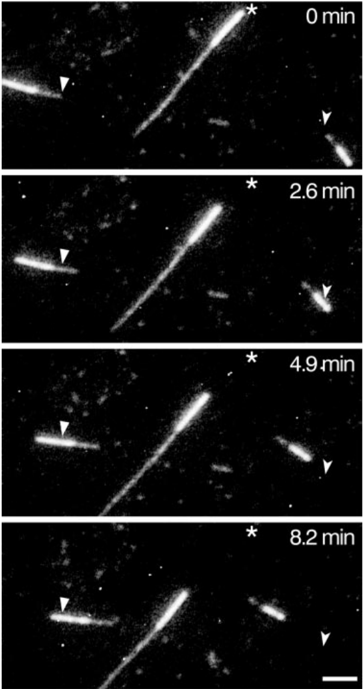
- Pkl1H supported microtubule gliding at a maximum average velocity of 33 ± 9 nm/s with 5 mM ATP; GFP-Pkl1H gliding had Vmax = 42 ± 4 nm/s and Km,ATP = 1,100 ± 240 µM. Pkl1 was minus-end-directed (62 of 62 polarity-marked MTs).
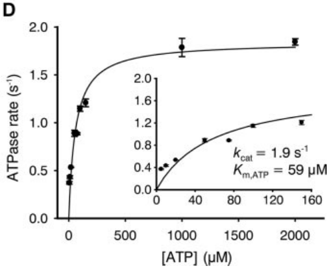
- Steady-state ATPase of GFP-Pkl1H had kcat = 2.0 ± 0.1 s−1 per head, Km,MT = 6.4 ± 1.1 nM, and Km,ATP = 59 ± 12 µM; the calculated duty ratio was 0.05, indicating nonprocessive behavior.
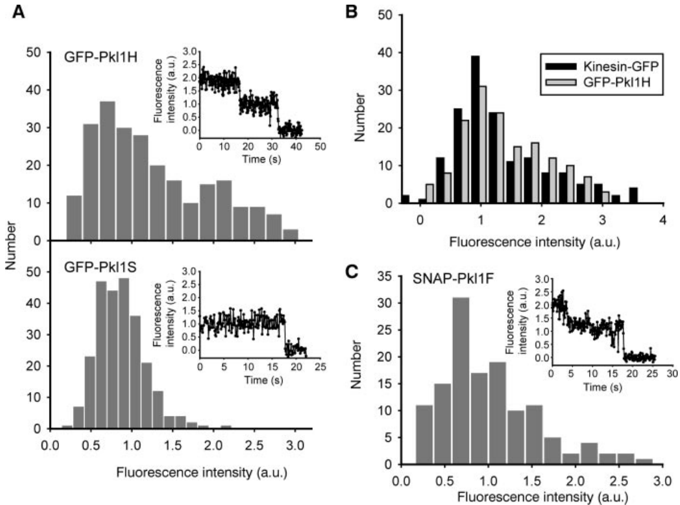
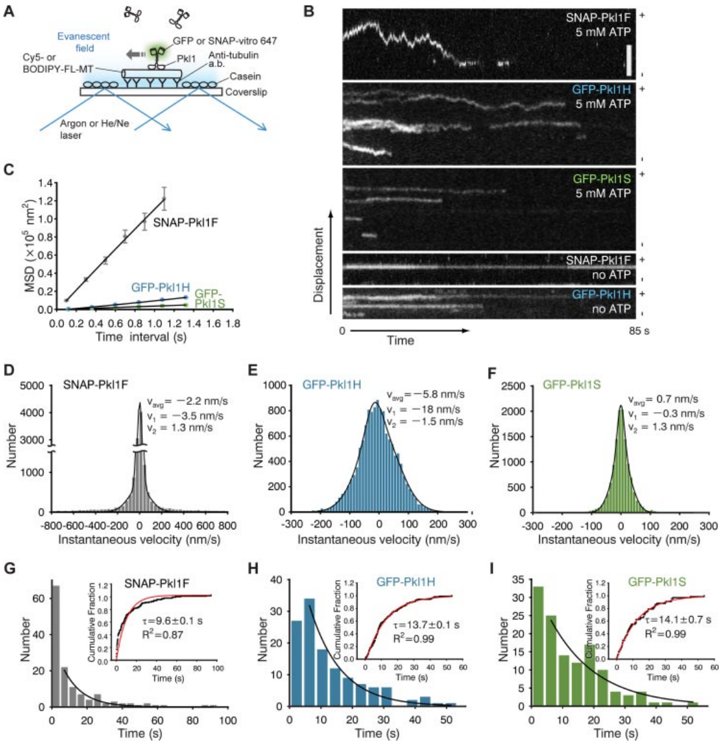
- Single-molecule TIRF showed one-dimensional diffusion along MTs. GFP-Pkl1H dimers had a clear minus-end bias with ATP (p < 0.0001) and no bias without ATP (p = 0.24); bias was not conclusive for SNAP-Pkl1F (p = 0.1539) or GFP-Pkl1S (p = 0.0536).
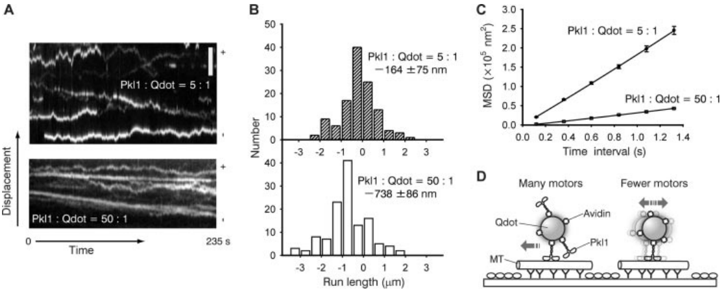
- Qdot assays with multiple Pkl1 molecules showed cooperative movement: at 50:1 Pkl1/Qdot, run length was −740 ± 90 nm and diffusion coefficient 0.13 ± 0.01 × 10⁴ nm²/s, versus −160 ± 80 nm and 0.88 ± 0.02 × 10⁴ nm²/s at 5:1; the number of transporting Pkl1 molecules was estimated as fewer than 10.
Methods
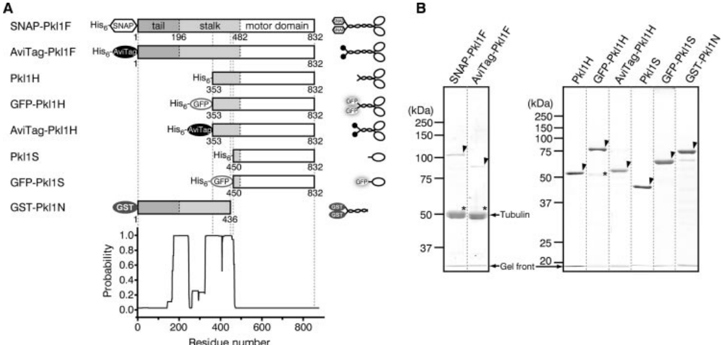
- Recombinant Pkl1 constructs (Pkl1F, Pkl1H, Pkl1S; SNAP, GFP, or AviTag fusions) were expressed in E. coli and purified; oligomeric states were assessed by sucrose density gradient centrifugation and gel filtration.
- In vitro microtubule gliding assays with polarity-marked MTs and steady-state ATPase assays were used to measure velocity, kcat, Km,ATP, Km,MT, and duty ratio.
- Single-molecule motility was observed by total internal reflection fluorescence microscopy; MSD plots were fitted to extract diffusion coefficients and drift velocities, and Qdot multiple-molecule assays were performed at 5:1 and 50:1 Pkl1/Qdot ratios.
Limitations
- Stated: the precise role of Pkl1 remains uncertain and further studies are required; SNAP-Pkl1F labeling ratio was low (15–20%), so its fluorescence distribution does not necessarily prove dimerization, only that obvious aggregates were absent; drift-velocity significance was not high except for GFP-Pkl1H, and directional bias was not conclusive for SNAP-Pkl1F or GFP-Pkl1S.
- Stated: full-length Pkl1 was degraded in host cells, requiring a SNAP tag; some constructs had low purity or tubulin contamination (SNAP-Pkl1F 6.4%, AviTag-Pkl1F 2.2%).
- Evident: all motility and ATPase measurements are in vitro with purified proteins, artificial surfaces, and Qdots; the cooperative force generation and mitotic function are inferred, not directly tested in vivo, and the Qdot motor number relies on the manufacturer’s estimate of 5–10 streptavidins per Qdot.
Model-written summary. Check it against the paper before relying on it.
Integrity signals
Registry
Cites
Statistics
Figures
Verification
Claims the paper makes
7 Valid · 2 Not valid · 13 Not checked · 71 Own results and interpretations
Every source the paper cites for this claim was checked and supports it.
In the paper
“It has also been shown that Pkl1 is functionally related to ␥-tubulin in the microtubule-organizing center (14)”
§ Diffusion and Directed Movement IN VITRO MOTILE PROPERTIES OF FISSION YEAST KINESIN-14 Pkl1 * □ S > Abstract
What the sources say
- Supportedcites [14] 14. Paluh, J. L., Nogales, E., Oakley, B. R., McDonald, K., Pidoux, A. L., and Cande, W. Z. (2000) Mol. Biol. Cell 11, 1225-1239 source
The Introduction says that two mutants suggest Pkl1p and a subset of γ-tubulin functions are closely linked, and identifies γ-tubulin’s role at the microtubule-organizing center (MTOC). The Discussion reports synthetic lethality between loss of Pkl1p and a γ-tubulin mutation, supporting the claimed functional relationship without requiring a direct physical interaction. (LLM, conf=0.90)
plainstates an association- Asserted: passes — The authors put it forward as true.
- Checkable: passes — It can be checked against evidence.
- Load-bearing: unclear — It is unclear whether the paper’s conclusions depend on it.
- Based: passes — The paper gives a reason why it holds.
- Supported
The sources with a verdict support this claim; the rest weren’t checked yet, have no full text we could read, or their verdicts aren’t rated yet.
In the paper
“The second role is to organize spindle MTs at MT minus ends and focus them into spindle poles (5)(6)(7).”
§ Diffusion and Directed Movement IN VITRO MOTILE PROPERTIES OF FISSION YEAST KINESIN-14 Pkl1 * □ S > Abstract
What the sources say
- Not checked — no full text of the sourcecites [5] 5. Hatsumi, M., and Endow, S. A. (1992) J. Cell Sci. 103, 1013-1020 source
- Not checked — no full text of the sourcecites [6] 6. Walczak, C. E., Vernos, I., Mitchison, T. J., Karsenti, E., and Heald, R. (1998) Curr. Biol. 8, 903-913 source
- Supportedcites [7] 7. Goshima, G., Nedelec, F., and Vale, R. D. (2005) J. Cell Biol. 171, 229 -240 source
The Introduction says kinesin-14 motors such as Ncd are implicated in spindle pole focusing and that their cross-bridging activity can collect microtubule minus ends. The Discussion’s three-step model identifies Ncd as the predominant motor for inter–K-fiber cross-linking in S2 cells, supporting the attributed organizing and focusing role. (LLM, conf=0.91)
plainstates a cause- Asserted: passes — The authors put it forward as true.
- Checkable: passes — It can be checked against evidence.
- Load-bearing: unclear — It is unclear whether the paper’s conclusions depend on it.
- Based: passes — The paper gives a reason why it holds.
A result the paper reports from its own data — it cites no other source for it, so there is none to check. The quote shows it is in the paper.
In the paper
“which is 20 -30 times smaller than that of kinesin-1 and another kinesin-14A family member, Ncd”
§ Diffusion and Directed Movement IN VITRO MOTILE PROPERTIES OF FISSION YEAST KINESIN-14 Pkl1 * □ S > Abstract
plain- Asserted: passes — The authors put it forward as true.
- Checkable: passes — It can be checked against evidence.
- Load-bearing: passes — The paper’s conclusions depend on it.
- Based: passes — The paper gives a reason why it holds.
A result the paper states — it cites no source for it, so there is none to check. The quote shows it is in the paper.
In the paper
“Pkl1 has a predicted coiled-coil region at amino acid residues 196 -481”
§ Diffusion and Directed Movement IN VITRO MOTILE PROPERTIES OF FISSION YEAST KINESIN-14 Pkl1 * □ S > Oligomeric State of the Pkl1
plain- Asserted: passes — The authors put it forward as true.
- Checkable: passes — It can be checked against evidence.
- Load-bearing: passes — The paper’s conclusions depend on it.
- Based: passes — The paper gives a reason why it holds.
A result the paper reports from its own data — it cites no other source for it, so there is none to check. The quote shows it is in the paper.
In the paper
“The calculated molecular mass shows that SNAP-Pkl1F forms a dimer in solution (Table 1).”
§ Diffusion and Directed Movement IN VITRO MOTILE PROPERTIES OF FISSION YEAST KINESIN-14 Pkl1 * □ S > Oligomeric State of the Pkl1
plain- Asserted: passes — The authors put it forward as true.
- Checkable: passes — It can be checked against evidence.
- Load-bearing: passes — The paper’s conclusions depend on it.
- Based: passes — The paper gives a reason why it holds.
41 more claims
Create a free account to see all 93 claims and every source verdict.
- Probably not a substantial claim. 12
- It may state two separate claims as one. 38
- The quote only partly states this claim. 3
- Borderline: one of the tests for a substantial claim is unclear. 1
Citations
Cites
A protein factor essential for microtubule assembly
Weingarten, M. D., Lockwood, A. H., Hwo, S. Y., & Kirschner, M. W. (1975) · Proceedings of the National Academy of Sciences · doi:10.1073/pnas.72.5.1858 · Cited by 3,089
Mechanics of Motor Proteins and the Cytoskeleton
Howard, & Clark (2002) · Applied Mechanics Reviews · doi:10.1115/1.1451234 · Cited by 2,909 · cited 2×
“The calculation relies only on the difference in time to wait for ATP binding between the process of ATP hydrolysis and that of mechanical force generation (37).”
BackgroundSpragg, S. P. (1979) · Nature · doi:10.1038/278085a0 · Cited by 1,707
Single particle tracking. Analysis of diffusion and flow in two-dimensional systems
Qian, H., Sheetz, M. P., & Elson, E. L. (1991) · Biophysical Journal · doi:10.1016/s0006-3495(91)82125-7 · Cited by 1,174
Movement of microtubules by single kinesin molecules
Howard, J., Hudspeth, A. J., & Vale, R. D. (1989) · Nature · doi:10.1038/342154a0 · Cited by 885
[39] Preparation of modified tubulins
Hyman, A., Drechsel, D., Kellogg, D., Salser, S., Sawin, K., Steffen, P., Wordeman, L., & Mitchison, T. (1991) · Methods in Enzymology · doi:10.1016/0076-6879(91)96041-o · Cited by 732
Direct observation of single kinesin molecules moving along microtubules
Vale, R. D., Funatsu, T., Pierce, D. W., Romberg, L., Harada, Y., & Yanagida, T. (1996) · Nature · doi:10.1038/380451a0 · Cited by 711
Estimation of Molecular Size and Molecular Weights of Biological Compounds by Gel Filtration
Andrew, P. (1970) · Methods of Biochemical Analysis · doi:10.1002/9780470110362.ch1 · Cited by 638
[30] Prediction and analysis of coiled-coil structures
Lupas, A. (1996) · Methods in Enzymology · doi:10.1016/s0076-6879(96)66032-7 · Cited by 575
Mechanochemical coupling in actomyosin energy transduction studied by in vitro movement assay
Harada, Y., Sakurada, K., Aoki, T., Thomas, D. D., & Yanagida, T. (1990) · Journal of Molecular Biology · doi:10.1016/s0022-2836(05)80060-9 · Cited by 522
KAR3, a kinesin-related gene required for yeast nuclear fusion
Meluh, P. (1990) · Cell · doi:10.1016/0092-8674(90)90351-e · Cited by 503
A Processive Single-Headed Motor: Kinesin Superfamily Protein KIF1A
Okada, Y., & Hirokawa, N. (1999) · Science · doi:10.1126/science.283.5405.1152 · Cited by 468
Yeast kinesin-8 depolymerizes microtubules in a length-dependent manner
Varga, V., Helenius, J., Tanaka, K., Hyman, A. A., Tanaka, T. U., & Howard, J. (2006) · Nature Cell Biology · doi:10.1038/ncb1462 · Cited by 445
Walczak, C. E., Vernos, I., Mitchison, T. J., Karsenti, E., & Heald, R. (1998) · Current Biology · doi:10.1016/s0960-9822(07)00370-3 · Cited by 396
Novel potential mitotic motor protein encoded by the fission yeast cut7+ gene
Hagan, I., & Yanagida, M. (1990) · Nature · doi:10.1038/347563a0 · Cited by 353
Kinesin׳s tail domain is an inhibitory regulator of the motor domain
Coy, D. L., Hancock, W. O., Wagenbach, M., & Howard, J. (1999) · Nature Cell Biology · doi:10.1038/13001 · Cited by 329
Opposing motor activities are required for the organization of the mammalian mitotic spindle pole.
Gaglio, T., Saredi, A., Bingham, J. B., Hasbani, M. J., Gill, S. R., Schroer, T. A., & Compton, D. A. (1996) · The Journal of cell biology · doi:10.1083/jcb.135.2.399 · Cited by 290
Molecular mechanisms of kinetochore capture by spindle microtubules
Tanaka, K., Mukae, N., Dewar, H., van Breugel, M., James, E. K., Prescott, A. R., Antony, C., & Tanaka, T. U. (2005) · Nature · doi:10.1038/nature03483 · Cited by 281
Engineering the Processive Run Length of the Kinesin Motor
Thorn, K. S., Ubersax, J. A., & Vale, R. D. (2000) · The Journal of Cell Biology · doi:10.1083/jcb.151.5.1093 · Cited by 279
Endow, S. A., Kang, S. J., Satterwhite, L. L., Rose, M. D., Skeen, V. P., & Salmon, E. D. (1994) · The EMBO Journal · doi:10.1002/j.1460-2075.1994.tb06561.x · Cited by 264
Mechanisms for focusing mitotic spindle poles by minus end–directed motor proteins
Goshima, G., Nédélec, F., & Vale, R. D. (2005) · The Journal of Cell Biology · doi:10.1083/jcb.200505107 · Cited by 259
Antagonistic microtubule-sliding motors position mitotic centrosomes in Drosophila early embryos
Sharp, D. J., Yu, K. R., Sisson, J. C., Sullivan, W., & Scholey, J. M. (1999) · Nature Cell Biology · doi:10.1038/9025 · Cited by 235
Highly processive microtubule-stimulated ATP hydrolysis by dimeric kinesin head domains
Hackney, D. D. (1995) · Nature · doi:10.1038/377448a0 · Cited by 177
Saunders, W., Lengyel, V, & Hoyt, M. A. (1997) · Molecular Biology of the Cell · doi:10.1091/mbc.8.6.1025 · Cited by 160
Garcia, M. A., Koonrugsa, N., & Toda, T. (2002) · Current Biology · doi:10.1016/s0960-9822(02)00761-3 · Cited by 156
Microtubule cross-linking triggers the directional motility of kinesin-5
Kapitein, L. C., Kwok, B. H., Weinger, J. S., Schmidt, C. F., Kapoor, T. M., & Peterman, E. J. G. (2008) · The Journal of Cell Biology · doi:10.1083/jcb.200801145 · Cited by 143
Kim, Y., Heuser, J. E., Waterman, C. M., & Cleveland, D. W. (2008) · The Journal of Cell Biology · doi:10.1083/jcb.200802189 · Cited by 140
A Homotetrameric Kinesin-5, KLP61F, Bundles Microtubules and Antagonizes Ncd in Motility Assays
Tao, L., Mogilner, A., Civelekoglu-Scholey, G., Wollman, R., Evans, J., Stahlberg, H., & Scholey, J. M. (2006) · Current Biology · doi:10.1016/j.cub.2006.09.064 · Cited by 140
O'Connell, M. J., Meluh, P. B., Rose, M. D., & Morris, N. R. (1993) · The Journal of cell biology · doi:10.1083/jcb.120.1.153 · Cited by 135
Paluh, J. L., Nogales, E., Oakley, B. R., McDonald, K., Pidoux, A. L., & Cande, W. Z. (2000) · Molecular Biology of the Cell · doi:10.1091/mbc.11.4.1225 · Cited by 125
Analysis of kinesin motor function at budding yeast kinetochores
Tytell, J. D., & Sorger, P. K. (2006) · The Journal of Cell Biology · doi:10.1083/jcb.200509101 · Cited by 116
Fission yeast pkl1 is a kinesin-related protein involved in mitotic spindle function.
Pidoux, A. L., LeDizet, M., & Cande, W. Z. (1996) · Molecular Biology of the Cell · doi:10.1091/mbc.7.10.1639 · Cited by 115
Allosteric inhibition of kinesin-5 modulates its processive directional motility
Kwok, B. H., Kapitein, L. C., Kim, J. H., Peterman, E. J. G., Schmidt, C. F., & Kapoor, T. M. (2006) · Nature Chemical Biology · doi:10.1038/nchembio812 · Cited by 108
Troxell, C. L., Sweezy, M. A., West, R. R., Reed, K. D., Carson, B. D., Pidoux, A. L., Cande, W. Z., & McIntosh, J. R. (2001) · Molecular Biology of the Cell · doi:10.1091/mbc.12.11.3476 · Cited by 106
Furuta, K., & Toyoshima, Y. Y. (2008) · Current Biology · doi:10.1016/j.cub.2007.12.056 · Cited by 102
Self-citationThe Drosophila ncd microtubule motor protein is spindle-associated in meiotic and mitotic cells
Hatsumi, M., & Endow, S. A. (1992) · Journal of Cell Science · doi:10.1242/jcs.103.4.1013 · Cited by 92
Identification of Microtubule Binding Sites in the Ncd Tail Domain
Karabay, A., & Walker, R. A. (1999) · Biochemistry · doi:10.1021/bi981850i · Cited by 82
KIF1D is a fast non‐processive kinesin that demonstrates novel K‐loop‐dependent mechanochemistry
Rogers, K. R., Weiss, S., Crevel, I., Brophy, P. J., Geeves, M., & Cross, R. (2001) · The EMBO Journal · doi:10.1093/emboj/20.18.5101 · Cited by 73
Single-Molecule Behavior of Monomeric and Heteromeric Kinesins
Pierce, D. W., Hom-Booher, N., Otsuka, A. J., & Vale, R. D. (1999) · Biochemistry · doi:10.1021/bi9830009 · Cited by 68
Motility of Dimeric Ncd on a Metal-Chelating Surfactant: Evidence That Ncd Is Not Processive
deCastro, M. J., Ho, C.-H., & Stewart, R. J. (1999) · Biochemistry · doi:10.1021/bi9829175 · Cited by 64
Motility of Single One-Headed Kinesin Molecules Along Microtubules
Inoue, Y., Iwane, A. H., Miyai, T., Muto, E., & Yanagida, T. (2001) · Biophysical Journal · doi:10.1016/s0006-3495(01)75925-5 · Cited by 61
The Kinesin Klp2 Mediates Polarization of Interphase Microtubules in Fission Yeast
Carazo-Salas, R. E., Antony, C., & Nurse, P. (2005) · Science · doi:10.1126/science.1113465 · Cited by 54
Single Fungal Kinesin Motor Molecules Move Processively along Microtubules
Lakämper, S., Kallipolitou, A., Woehlke, G., Schliwa, M., & Meyhöfer, E. (2003) · Biophysical Journal · doi:10.1016/s0006-3495(03)74991-1 · Cited by 44
Grishchuk, E. L., Spiridonov, I. S., & McIntosh, J. R. (2007) · Molecular Biology of the Cell · doi:10.1091/mbc.e06-11-0987 · Cited by 44
Protein complexes at the microtubule organizing center regulate bipolar spindle assembly
Rodriguez, A. S., Killilea, A. N., Batac, J., Filopei, J., Simeonov, D., Lin, I., & Paluh, J. L. (2008) · Cell Cycle · doi:10.4161/cc.7.9.5808 · Cited by 38
Stock, M. F., Chu, J., & Hackney, D. D. (2003) · Journal of Biological Chemistry · doi:10.1074/jbc.m309419200 · Cited by 31
Kinetic and Mechanistic Basis of the Nonprocessive Kinesin-3 Motor NcKin3
Adio, S., Bloemink, M., Hartel, M., Leier, S., Geeves, M. A., & Woehlke, G. (2006) · Journal of Biological Chemistry · doi:10.1074/jbc.m605061200 · Cited by 29
Cited by
Traffic control: regulation of kinesin motors
Verhey, K. J., & Hammond, J. W. (2009) · Nature Reviews Molecular Cell Biology · doi:10.1038/nrm2782 · Cited by 546
Shahpasand, K., Uemura, I., Saito, T., Asano, T., Hata, K., Shibata, K., Toyoshima, Y., Hasegawa, M., & Hisanaga, S.-I. (2012) · The Journal of Neuroscience · doi:10.1523/jneurosci.5927-11.2012 · Cited by 206
“Kinesin RK430-AviTag-KRC-His6 was expressed and purified from E. coli as described (Furuta et al., 2008), except that ATP was not added to the preparation buffers.”
MethodSelf-citationMicrotubule organization by the antagonistic mitotic motors kinesin-5 and kinesin-14
Hentrich, C., & Surrey, T. (2010) · The Journal of Cell Biology · doi:10.1083/jcb.200910125 · Cited by 167
Tau protein diffuses along the microtubule lattice
Hinrichs, M. H., Jalal, A., Brenner, B., Mandelkow, E., Kumar, S., & Scholz, T. (2012) · Journal of Biological Chemistry · doi:10.1074/jbc.m112.369785 · Cited by 141
Molecular mechanisms of kinesin-14 motors in spindle assembly and chromosome segregation
She, Z., & Yang, W.-X. (2017) · Journal of Cell Science · doi:10.1242/jcs.200261 · Cited by 134
Metadata
- Authors
- Furuta, K., Edamatsu, M., Maeda, Y., & Toyoshima, Y. Y.
- Affiliations
- The University of Tokyo (JP)
- Corresponding author
- Toyoshima, Yoko Y.
- ORCID
- Furuta, Ken'ya
- Venue
- Journal of Biological Chemistry
- Publisher
- Elsevier BV
- Published
- 2008-12
- Volume
- 283
- Issue
- 52
- Pages
- 36465-36473
- ISSN
- 0021-9258 (ISSN-L)
- PMC
- PMC2662305
- OpenAlex
- W2053280019
- Cited by
- 43
- References
- 47
- Citations by year
- 2026: 1 · 2025: 2 · 2024: 5 · 2022: 1 · 2021: 1 · 2020: 2 · 2019: 2 · 2018: 2 · 2017: 3 · 2016: 2 · 2015: 3 · 2014: 1 · 2013: 1 · 2012: 4
- FWCI
- 1.89
- Type
- journal article
- Language
- en
- Open access
- hybrid
- doi.org
- Licence
- cc-by
- www.elsevier.com/tdm/userlicense/1.0/ (tdm)
- creativecommons.org/licenses/by/4.0/ (vor, 4303 d)
- Locations
- Journal of Biological Chemistry (publishedVersion, cc-by)
- PubMed Central (publishedVersion)
- PubMed (publishedVersion)
- Funders
- Japan Society for the Promotion of Science
- Japan Science and Technology Agency
- Core Research for Evolutional Science and Technology
- Topics
- Life Sciences › Biochemistry, Genetics and Molecular Biology › Cell Biology › Microtubule and mitosis dynamics
- Life Sciences › Biochemistry, Genetics and Molecular Biology › Biophysics › Advanced Fluorescence Microscopy Techniques
- Physical Sciences › Physics and Astronomy › Atomic and Molecular Physics, and Optics › Force Microscopy Techniques and Applications
- Keywords
- microtubule motor proteins, minus-end-directed motility, ATPase activity, duty cycle, processivity, biased diffusion, Schizosaccharomyces pombe, mitotic spindle, single-molecule motility
- MeSH terms
- Adenosine Triphosphatases, Cloning, Molecular, Diffusion, Dose-Response Relationship, Drug, Kinetics, Microscopy, Fluorescence, Microtubules, Mitosis, Models, Biological, Protein Conformation, Schizosaccharomyces, Oncogene Proteins, Gene Expression Regulation, Fungal, Kinesins, Protein Structure, Tertiary
About these checks
Registry, retraction, Cites and statistics results are computed, not judged, with one exception: a printed reference that no index lists is read once by a model before it counts as a citation error. Claims are extracted by a model and kept only when their quote appears verbatim in the text; each cited source is then checked, with a model’s help, for whether it says what the claim relies on. Those verdicts can be wrong — read the claim’s quote and the cited source before relying on one.
The claim verdicts this report counts are experimental: their accuracy is not yet measured.
A language model drew the claims from the paper on 2026-10-11, under version 3 of the claim definition (model deepseek-v4.1-flash, prompt extract-v3).
A second model labelled each claim on 2026-10-11 (model jev-1.13-20260917, definition revision gold-guideline-v0.2).
Cited sources are checked with a language model’s help (gpt-6-sol).
Statistics and arithmetic are recomputed, not judged.
Confidence bands are shown only for fields calibrated on our annotated test set. None is calibrated yet, so no band is shown.
What counts as a claim ›How we measure confidence ›How we check this ›
Are you an author, or do you see a problem with this page? Request a review
Data sources
Bibliographic data: Semantic Scholar, OpenAlex, Crossref.
Contains information from the Semantic Scholar Academic Graph Datasets, made available under the ODC Attribution License (ODC-BY 1.0).
Semantic Scholar’s data is described in: Kinney, R., et al. (2023). The Semantic Scholar Open Data Platform. arXiv:2301.10140.
