

An Improved Model for Prediction of Retention Times of Tryptic Peptides in Ion Pair Reversed-phase HPLC
Open accessThe DOI matches its Crossref record, with a small difference in title or year; 48 of the 48 references it cites were found in a registry or an index.
Abstract
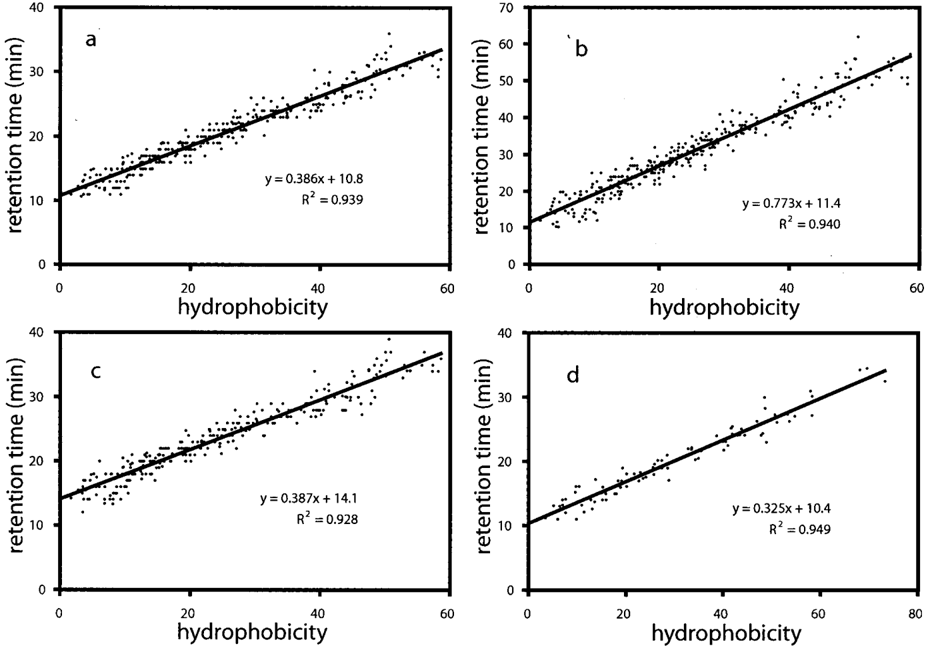
The proposed model is based on the measurement of the retention times of 346 tryptic peptides in the 560- to 4,000-Da mass range, derived from a mixture of 17 protein digests. These peptides were measured in HPLC-MALDI MS runs, with peptide identities confirmed by MS/MS. The model relies on summation of the retention coefficients of the individual amino acids, as in previous approaches, but additional terms are introduced that depend on the retention coefficients for amino acids at the N-terminal of the peptide. In the 17-protein mixture, optimization of two sets of coefficients, along with additional compensation for peptide length and hydrophobicity, yielded a linear dependence of retention time on hydrophobicity, with an R2 value about 0.94. The predictive capability of the model was used to distinguish peptides with close m/z values and for detailed peptide mapping of selected proteins. Its applicability was tested on columns of different sizes, from nano- to narrow-bore, and for direct sample injection, or injection via a pre-column. It can be used for accurate prediction of retention times for tryptic peptides on reversed-phase (300-A pore size) columns of different sizes with a linear water-ACN gradient and with TFA as the ion-pairing modifier.
Overview
The claims and statistics of this paper haven’t been checked yet.
Free: it reads the open-access text and checks the first 5 claims that cite a source we can check. Create a free account to check every claim.
Integrity signals
Registry
Cites
Statistics
Figures
Verification
Claims the paper makes
The claims and statistics of this paper haven’t been checked yet.
Free: it reads the open-access text and checks the first 5 claims that cite a source we can check. Create a free account to check every claim.
Claims other papers make about this one
Each is checked against this paper’s own text: does it say what the citing paper says it does?
The cited source says what the claim attributes to it.
In the citing paper
“Using the SSRC algorithm to determine the hydrophobicity coefficient of peptides de novo (Krokhin et al., 2004), we found that the peptides also eluted at the expected retention time based on their assigned sequences (Figure 4F).”
From Splice-Junction-Based Mapping of Alternative Isoforms in the Human Proteome (2019) · cites this paper as Krokhin et al., 2004
Self-check
Percentages, sums and reported differences re-computed from the paper’s own numbers.
The self-check needs the paper’s full text.
Citations
Cites
Electrospray Ionization for Mass Spectrometry of Large Biomolecules
Fenn, J. B., Mann, M., Meng, C. K., Wong, S. F., & Whitehouse, C. M. (1989) · Science · doi:10.1126/science.2675315 · Cited by 7,634 · cited 5×
“However, the optimum conditions for operation of the HPLC and the mass spectrometer are usually different, so on-line coupling of the HPLC to the mass spectrometer, as commonly used for ESI, may require undesirable compromises for both approaches, as well as requiring strict time constraints.”
BackgroundInfluentialLaser desorption ionization of proteins with molecular masses exceeding 10,000 daltons
Karas, M., & Hillenkamp, F. (1988) · Analytical Chemistry · doi:10.1021/ac00171a028 · Cited by 5,637 · cited 1×
“MALDI (2, 3) and ESI (4), as well as improved instrumentation.”
BackgroundQuantitative analysis of complex protein mixtures using isotope-coded affinity tags
Gygi, S. P., Rist, B., Gerber, S. A., Turecek, F., Gelb, M. H., & Aebersold, R. (1999) · Nature Biotechnology · doi:10.1038/13690 · Cited by 4,683
Direct analysis of protein complexes using mass spectrometry
Link, A. J., Eng, J., Schieltz, D. M., Carmack, E., Mize, G. J., Morris, D. R., Garvik, B. M., & Yates, J. R. (1999) · Nature Biotechnology · doi:10.1038/10890 · Cited by 2,237 · cited 4×
“large-scale high-throughput proteomics (9, 10), because of its”
BackgroundInfluentialMatrix-assisted laser desorption/ionization mass spectrometry of biopolymers.
Hillenkamp, F., Karas, M., Beavis, R. C., & Chait, B. T. (1991) · Analytical Chemistry · doi:10.1021/ac00024a716 · Cited by 1,930 · cited 2×
“9 5% (3) 5% (3) Glyceraldehyde-3-phosphate dehydrogenase (rabbit) 35.”
BackgroundSelf-citationMass Spectrometry in Proteomics
Aebersold, R., & Goodlett, D. R. (2001) · Chemical Reviews · doi:10.1021/cr990076h · Cited by 1,238 · cited 1×
“large-scale high-throughput proteomics (9, 10), because of its”
BackgroundAnalysis of Proteins and Proteomes by Mass Spectrometry
Mann, M., Hendrickson, R. C., & Pandey, A. (2001) · Annual Review of Biochemistry · doi:10.1146/annurev.biochem.70.1.437 · Cited by 1,219 · cited 2×
“molecules, such as membrane proteins (1) or species with”
BackgroundProteolytic 18O Labeling for Comparative Proteomics: Model Studies with Two Serotypes of Adenovirus
Yao, X., Freas, A., Ramirez, J., Demirev, P. A., & Fenselau, C. (2001) · Analytical Chemistry · doi:10.1021/ac001404c · Cited by 759 · cited 1×
“9 81% (12) 77% (9) -Lactalbumin (bovine) 14.”
Verma, R., Chen, S., Feldman, R., Schieltz, D., Yates, J., Dohmen, J., & Deshaies, R. J. (2000) · Molecular Biology of the Cell · doi:10.1091/mbc.11.10.3425 · Cited by 540 · cited 2×
“6 40% (8) 35% (6) Ribonuclease A (bovine) 14.”
Medzihradszky, K. F., Campbell, J. M., Baldwin, M. A., Falick, A. M., Juhasz, P., Vestal, M. L., & Burlingame, A. L. (2000) · Analytical Chemistry · doi:10.1021/ac990809y · Cited by 531
Research works printed but not linked: 4
- Krokhin, O., Cheng, K., Bykova, N., Ens, W., and Standing, K. G. (2003) An (off-line HPLC)-(orthogonal injection MALDI)-(QqTOFMS) instrument par- ticularly useful for the analysis of post-translational modifications. Exam- ples: I. Identification of two phosphorylated sites in tryptic peptides from the ABRF PRG03 sample (bovine protein disulphide isomerase). II. De novo sequencing and analysis of post-translational modifications on SARS viral proteins. 51 th ASMS Conference on Mass Spectrometry and Allied Topics, Montreal, June 8 -12
- Hu, P., Rejtar, T., Preisler, J., and Karger B. L. (2001) LC-MALDI/TOF MS analysis of complex peptide mixtures using vacuum deposition interface. 49th ASMS Conference on Mass Spectrometry and Allied Topics, Chi- cago, IL, May 27-31
- Rejtar, T., Chen, H., Moskovets, E., Li, L., Andreev, V., and Karger B. L. (2003) Universal deposition device for off-line coupling of LC to MALDI MS and MS/MS. 51th ASMS Conference on Mass Spectrometry and Allied Topics, Montreal, June 8 -12
- Krokhin, O., Qian, Y., McNabb, J. R., Spicer, V., Ens, W., and Standing, K. G. (2002) An off-line interface for HPLC and orthogonal MALDI TOF. 50th ASMS Conference on Mass Spectrometry and Allied Topics, Or- lando, FL, June 2-6
Cited by
Skyline: an open source document editor for creating and analyzing targeted proteomics experiments
MacLean, B., Tomazela, D. M., Shulman, N., Chambers, M., Finney, G. L., Frewen, B., Kern, R., Tabb, D. L., Liebler, D. C., & MacCoss, M. J. (2010) · Bioinformatics · doi:10.1093/bioinformatics/btq054 · Cited by 4,697
Gillet, L. C., Navarro, P., Tate, S., Röst, H., Selevsek, N., Reiter, L., Bonner, R., & Aebersold, R. (2012) · Molecular & Cellular Proteomics · doi:10.1074/mcp.o111.016717 · Cited by 2,877
“The retention times of the peptides were computed using the SSRCalc algorithm (50).”
MethodSelected reaction monitoring for quantitative proteomics: a tutorial
Lange, V., Picotti, P., Domon, B., & Aebersold, R. (2008) · Molecular Systems Biology · doi:10.1038/msb.2008.61 · Cited by 1,407
“times can be derived from previous experiments or they might be predicted by tools like SSRCalc (http://hs2.proteome.ca/ SSRCalc/SSRCalc.html) ( Krokhin et al, 2004 ) if the HPLC system is first calibrated.”
MethodQuantitative mass spectrometric multiple reaction monitoring assays for major plasma proteins
Anderson, L., & Hunter, C. L. (2006) · Molecular & Cellular Proteomics · doi:10.1074/mcp.m500331-mcp200 · Cited by 1,230
“amino acid composition, peptide mass, Hopp-Woods hydrophilicity (21), and predicted retention time in reversed-phase (C18) chromatography (22).”
BackgroundUsing i RT, a normalized retention time for more targeted measurement of peptides
Escher, C., Reiter, L., MacLean, B., Ossola, R., Herzog, F., Chilton, J., MacCoss, M. J., & Rinner, O. (2012) · PROTEOMICS · doi:10.1002/pmic.201100463 · Cited by 600
“Correlation between the RT predicted with the SSRCalc linear equation and measured RT was 0.9246 (average deviation was 2.4 min), and correlation between the RT predicted with the iRT linear equation and the actual measured RT was 0.9970 (average deviation was 0.8 min; see Fig.”
MethodInfluential
Metadata
- Authors
- Krokhin, O. V., Craig, R., Spicer, V., Ens, W., Standing, K. G., Beavis, R. C., & Wilkins, J. A.
- Affiliations
- University of Manitoba (CA)
- Corresponding author
- Krokhin, O.V.
- Venue
- Molecular & Cellular Proteomics
- Publisher
- Elsevier BV
- Published
- 2004-09
- Volume
- 3
- Issue
- 9
- Pages
- 908-919
- ISSN
- 1535-9476 (ISSN-L)
- OpenAlex
- W2133258252
- Cited by
- 284
- References
- 46
- Citations by year
- 2026: 6 · 2025: 6 · 2024: 6 · 2023: 9 · 2022: 13 · 2021: 12 · 2020: 9 · 2019: 7 · 2018: 5 · 2017: 15 · 2016: 9 · 2015: 6 · 2014: 14 · 2013: 15 · 2012: 22
- FWCI
- 5.58
- Type
- journal article
- Language
- en
- Open access
- hybrid
- doi.org
- Licence
- cc-by
- www.elsevier.com/tdm/userlicense/1.0/ (tdm)
- www.elsevier.com/legal/tdmrep-license (tdm)
- creativecommons.org/licenses/by/4.0/ (vor, 5852 d)
- Locations
- Molecular & Cellular Proteomics (publishedVersion, cc-by)
- PubMed (publishedVersion)
- Funders
- University of Manitoba
- National Institutes of Health
- Canadian Institutes of Health Research
- Natural Sciences and Engineering Research Council of Canada
- National Institute of General Medical Sciences (R01GM059240, GM 59240)
- Topics
- Physical Sciences › Chemistry › Spectroscopy › Advanced Proteomics Techniques and Applications
- Physical Sciences › Chemistry › Spectroscopy › Mass Spectrometry Techniques and Applications
- Physical Sciences › Chemistry › Analytical Chemistry › Analytical Chemistry and Chromatography
- Keywords
- retention time prediction, tryptic peptides, ion-pair reversed-phase HPLC, hydrophobicity, N-terminal amino acids, peptide length, peptide mapping, protein digests
- MeSH terms
- Amino Acid Sequence, Animals, Chromatography, High Pressure Liquid, Humans, Models, Theoretical, Molecular Sequence Data, Molecular Weight, Peptide Fragments, Peptide Mapping, Trypsin, Neural Networks, Computer, Spectrometry, Mass, Matrix-Assisted Laser Desorption-Ionization, Proteomics, Hydrophobic and Hydrophilic Interactions
About these checks
Registry, retraction, Cites and statistics results are computed, not judged, with one exception: a printed reference that no index lists is read once by a model before it counts as a citation error. Claims are extracted by a model and kept only when their quote appears verbatim in the text; each cited source is then checked, with a model’s help, for whether it says what the claim relies on. Those verdicts can be wrong — read the claim’s quote and the cited source before relying on one.
Statistics and arithmetic are recomputed, not judged.
Confidence bands are shown only for fields calibrated on our annotated test set. None is calibrated yet, so no band is shown.
What counts as a claim ›How we measure confidence ›How we check this ›
Are you an author, or do you see a problem with this page? Request a review
Data sources
Bibliographic data: Semantic Scholar, OpenAlex, Crossref.
Contains information from the Semantic Scholar Academic Graph Datasets, made available under the ODC Attribution License (ODC-BY 1.0).
Semantic Scholar’s data is described in: Kinney, R., et al. (2023). The Semantic Scholar Open Data Platform. arXiv:2301.10140.
