

The DOI matches its Crossref record; 27 of the 27 references it cites were found in a registry or an index.
Detection of Proteome Diversity Resulted from Alternative Splicing is Limited by Trypsin Cleavage Specificity
Open accessAbstract
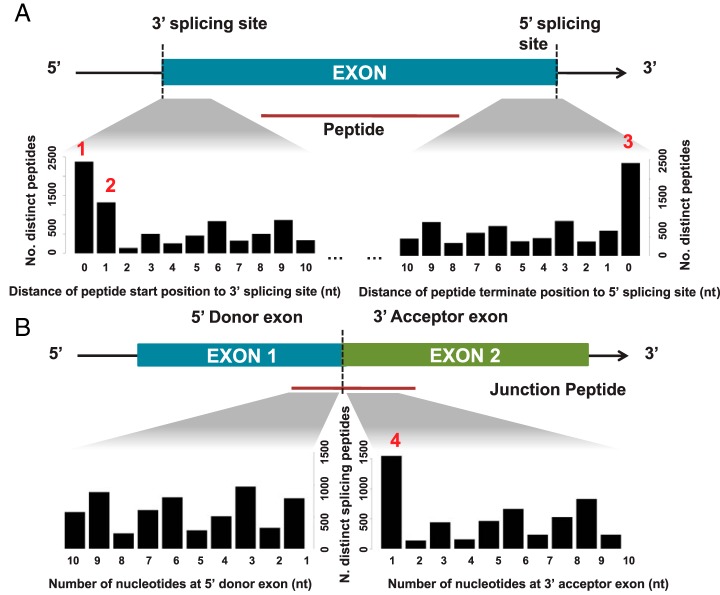
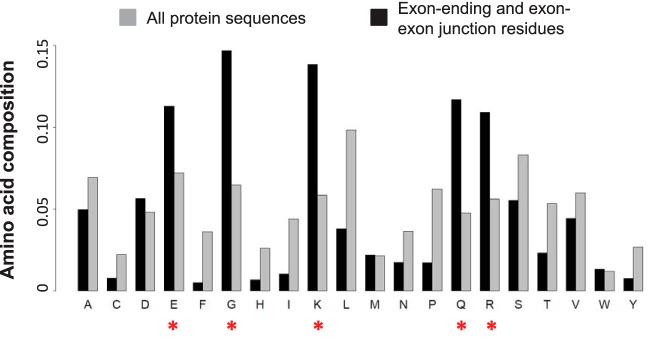
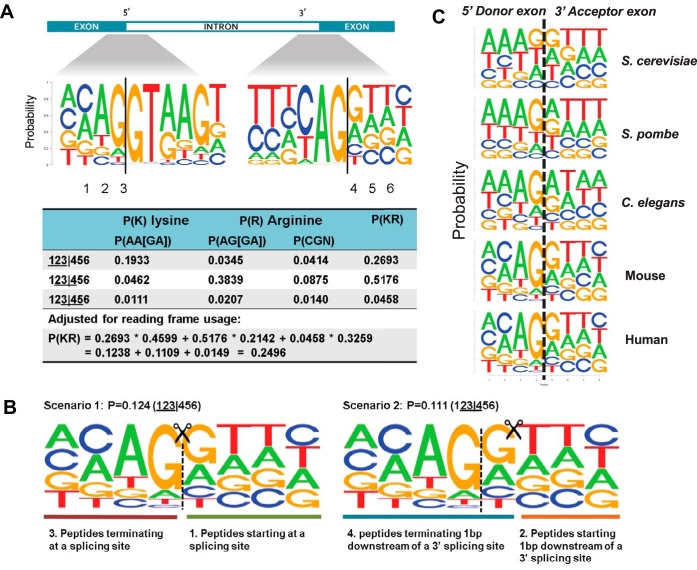
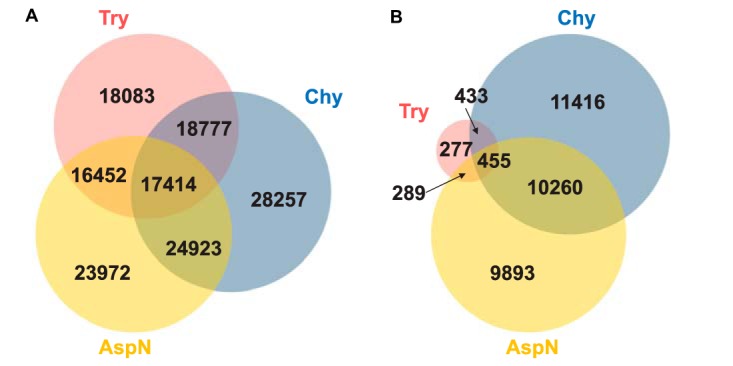
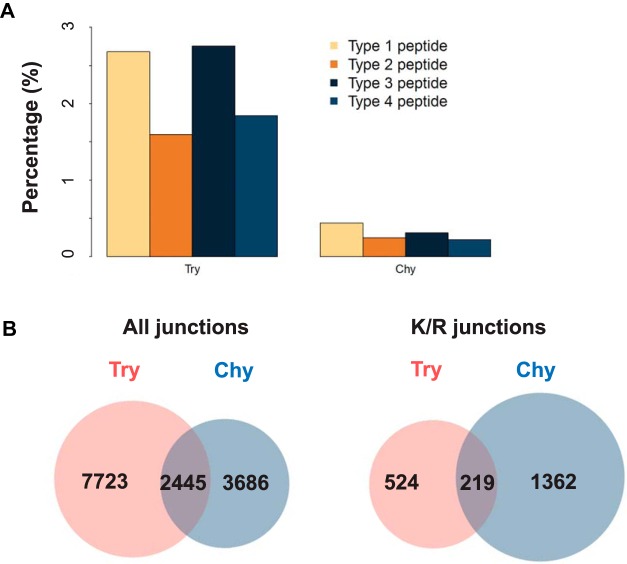
Alternative splicing dramatically increases transcriptome complexity but its contribution to proteome diversity remains controversial. Exon-exon junction spanning peptides provide direct evidence for the translation of specific splice isoforms and are critical for delineating protein isoform complexity. Here we found that junction-spanning peptides are underrepresented in publicly available mass spectrometry-based shotgun proteomics data sets. Further analysis showed that evolutionarily conserved preferential nucleotide usage at exon boundaries increases the occurrence of lysine- and arginine-coding triplets at the end of exons. Because both lysine and arginine residues are cleavage sites of trypsin, the nearly exclusive use of trypsin as the protein digestion enzyme in shotgun proteomic analyses hinders the detection of junction-spanning peptides. To study the impact of enzyme selection on splice junction detectability, we performed in-silico digestion of the human proteome using six proteases. The six enzymes created a total of 161,125 detectable junctions, and only 1,029 were common across all enzyme digestions. Chymotrypsin digestion provided the largest number of detectable junctions. Our experimental results further showed that combination of a chymotrypsin-based human proteome analysis with a trypsin-based analysis increased detection of junction-spanning peptides by 37% over the trypsin-only analysis and identified over a thousand junctions that were undetectable in fully tryptic digests. Our study demonstrates that detection of proteome diversity resulted from alternative splicing is limited by trypsin cleavage specificity, and that complementary digestion schemes will be essential to comprehensively analyze the translation of alternative splicing isoforms.
Overview
The claims and statistics of this paper haven’t been checked yet.
Run the check — free, no account needed. It reads the open-access text and checks the sources it cites.
Integrity signals
Registry
Cites
Statistics
Figures
Verification
Claims the paper makes
The claims and statistics of this paper haven’t been checked yet.
Run the check — free, no account needed. It reads the open-access text and checks the sources it cites.
Claims other papers make about this one
Each is checked against this paper’s own text: does it say what the citing paper says it does?
In the citing paper
“despite the fact that the number of peptides containing exon-exon splice junctions are reduced with trypsin digestion due to the overabundance of basic amino acid residues at splice junctions [51].”
From Deep proteomic network analysis of Alzheimer’s disease brain reveals alterations in RNA binding proteins and RNA splicing associated with disease (2018) · cites this paper as [51]
Self-check
Percentages, sums and reported differences re-computed from the paper’s own numbers.
The self-check needs the paper’s full text.
Citations
Cites
Alternative isoform regulation in human tissue transcriptomes
Wang, E. T., Sandberg, R., Luo, S., Khrebtukova, I., Zhang, L., Mayr, C., Kingsmore, S. F., Schroth, G. P., & Burge, C. B. (2008) · Nature · doi:10.1038/nature07509 · Cited by 5,181
A cross-platform toolkit for mass spectrometry and proteomics
Chambers, M., MacLean, B., Burke, R., Amodei, D., Ruderman, D., Neumann, S., Gatto, L., Fischer, B., Pratt, B. S., Egertson, J. D., et al. (2012) · Nature Biotechnology · doi:10.1038/nbt.2377 · Cited by 4,189
Self-citationMass-spectrometry-based draft of the human proteome
Wilhelm, M., Schlegl, J., Hahne, H., Gholami, A. M., Lieberenz, M., Savitski, M. M., Ziegler, E., Butzmann, L., Gessulat, S., Marx, H., et al. (2014) · Nature · doi:10.1038/nature13319 · Cited by 1,820
Proteogenomic characterization of human colon and rectal cancer
CPTAC, T. N., Zhang, B., Wang, J., Wang, X., Zhu, J., Liu, Q., Shi, Z., Chambers, M. C., Zimmerman, L. J., Shaddox, K. F., et al. (2014) · Nature · doi:10.1038/nature13438 · Cited by 1,462
Self-citationTrypsin Cleaves Exclusively C-terminal to Arginine and Lysine Residues
Olsen, J. V., Ong, S., & Mann, M. (2004) · Molecular & Cellular Proteomics · doi:10.1074/mcp.t400003-mcp200 · Cited by 1,309
MS-GF+ makes progress towards a universal database search tool for proteomics
Kim, S., & Pevzner, P. A. (2014) · Nature Communications · doi:10.1038/ncomms6277 · Cited by 1,098
Tabb, D. L., Fernando, C., & Chambers, M. (2007) · Journal of Proteome Research · doi:10.1021/pr0604054 · Cited by 550
Self-citationHow did alternative splicing evolve?
Ast, G. (2004) · Nature Reviews Genetics · doi:10.1038/nrg1451 · Cited by 544
Glatter, T., Ludwig, C., Ahrné, E., Aebersold, R. H., Heck, A. J. R., & Schmidt, A. (2012) · Journal of Proteome Research · doi:10.1021/pr300273g · Cited by 364
Alternative Splicing May Not Be the Key to Proteome Complexity
Tress, M. L., Abascal, F., & Valencia, A. (2016) · Trends in Biochemical Sciences · doi:10.1016/j.tibs.2016.08.008 · Cited by 341
Cited by
Sorted by citations
Comprehensive Analysis of Alternative Splicing Across Tumors from 8,705 Patients
Kahles, A., Lehmann, K.-V., Toussaint, N. C., Hüser, M., Stark, S. G., Sachsenberg, T. T., Stegle, O., Kohlbacher, O., Sander, C., Johnson, R., et al. (2018) · Cancer Cell · doi:10.1016/j.ccell.2018.07.001 · Cited by 914
“Furthermore, a recent study showed that junction-spanning peptides resulting from alternative splicing are underrepresented in protein MS datasets due to the cleavage specificity of trypsin (Wang et al., 2017).”
BackgroundAlternative Splicing Regulatory Networks: Functions, Mechanisms, and Evolution
Ule, J., & Blencowe, B. J. (2019) · Molecular Cell · doi:10.1016/j.molcel.2019.09.017 · Cited by 780
“, based on an in silico analysis) to miss detection of the majority of splice junction-spanning peptides (Wang et al., 2018), and mass spectrometry (MS) analysis methods, such as those employed by Tress et al.”
MethodAlternative mRNA splicing in cancer immunotherapy
Frankiw, L., Baltimore, D., & Li, G. (2019) · Nature reviews. Immunology · doi:10.1038/s41577-019-0195-7 · Cited by 253
Pervasive translation of circular RNAs driven by short IRES-like elements
Fan, X., Yang, Y., Chen, C., & Wang, Z. (2022) · Nature Communications · doi:10.1038/s41467-022-31327-y · Cited by 241
Johnson, E. C. B., Dammer, E. B., Duong, D. M., Yin, L., Thambisetty, M., Troncoso, J. C., Lah, J. J., Levey, A. I., & Seyfried, N. T. (2018) · Molecular Neurodegeneration · doi:10.1186/s13024-018-0282-4 · Cited by 225
Metadata
- Authors
- Wang, X., Codreanu, S. G., Wen, B., Li, K., Chambers, M. C., Liebler, D. C., & Zhang, B.
- Affiliations
- Baylor College of Medicine (US)
- Vanderbilt University (US)
- BGI Group (China) (CN)
- Corresponding author
- Zhang, Bing
- ORCID
- Venue
- Molecular & Cellular Proteomics
- Publisher
- Elsevier BV
- Published
- 2018-03
- Volume
- 17
- Issue
- 3
- Pages
- 422-430
- ISSN
- 1535-9476 (ISSN-L)
- PMC
- PMC5836368
- OpenAlex
- W2773925504
- Cited by
- 97
- References
- 27
- Citations by year
- 2026: 10 · 2025: 6 · 2024: 11 · 2023: 13 · 2022: 13 · 2021: 11 · 2020: 11 · 2019: 11 · 2018: 10
- FWCI
- 4.45
- Type
- journal article
- Language
- en
- Open access
- hybrid
- doi.org
- Licence
- Locations
- Molecular & Cellular Proteomics (publishedVersion, cc-by)
- PubMed Central (publishedVersion, cc-by)
- PubMed (publishedVersion)
- Funders
- HHS NIH National Cancer Institute (NCI) (U24CA159988, U24CA210954)
- Cancer Prevention and Research Institute of Texas (CPRIT) (RR160027)
- Topics
- Physical Sciences › Chemistry › Spectroscopy › Advanced Proteomics Techniques and Applications
- Physical Sciences › Chemistry › Spectroscopy › Mass Spectrometry Techniques and Applications
- Life Sciences › Biochemistry, Genetics and Molecular Biology › Molecular Biology › RNA Research and Splicing
- Keywords
- alternative splicing, proteome diversity, protease selection, chymotrypsin digestion, protein isoforms, in silico digestion, human proteome
- MeSH terms
- Exons, Humans, Neoplasm Proteins, Neoplasms, Peptide Hydrolases, Peptides, Alternative Splicing, Proteome, Cell Line, Tumor
About these checks
Registry, retraction, Cites and statistics results are computed, not judged, with one exception: a printed reference that no index lists is read once by a model before it counts as a citation error. Claims are extracted by a model and kept only when their quote appears verbatim in the text; each cited source is then checked, with a model’s help, for whether it says what the claim relies on. Those verdicts can be wrong — read the claim’s quote and the cited source before relying on one.
Statistics and arithmetic are recomputed, not judged.
Confidence bands are shown only for fields calibrated on our annotated test set. None is calibrated yet, so no band is shown.
What counts as a claim ›How we measure confidence ›How we check this ›
Are you an author, or do you see a problem with this page? Request a review
