

The Beginning of the Middle Bronze Age in the Levant: New Evidence from Megiddo
Open accessThe DOI matches its Crossref record; 60 of the 63 references it cites were found in a registry or an index, and 3 are not checked yet; none of the 108 sources its claims cite is checked for support yet.
Abstract
This article presents new stratigraphic, ceramic, and radiocarbon data from the recently excavated Area S at Megiddo, providing a refined absolute chronology for the early Middle Bronze Age (MB I) in the southern Levant. Excavations were conducted behind the Stratum XIII fortifications, in the northwestern sector of the mound, initially exposed by the University of Chicago. The aim was to clarify the complex architectural sequence of the MB I gate and fortification systems and establish a well-dated sequence for the late third and early second millennia bce.The secure, stratified contexts from Area S provide a ceramic sequence beginning in the Intermediate Bronze Age and extending into the Aphek-based MB I Phases 1, 2, and 3. The accompanying radiocarbon dataset of short-lived samples originating in occupation debris and two destruction layers enables construction of a new absolute chronology of MB I at Megiddo and beyond. Bayesian modeling suggests that MB I began in the late twenty-first or the beginning of the twentieth century bce, predating some traditional chronologies. The Megiddo dataset, as well as dates from other sites in the southern Levant, reflect also on the chronology of the later part of the Intermediate Bronze Age.These findings contribute to broader discussions on the transition from the Intermediate Bronze Age to the Middle Bronze Age, the rise of urbanisation in the region, and the synchronisation of Levantine chronologies with Egypt and Syro-Mesopotamia.
Checked 2026-11-23 · 3 references not checked yet
Overview
CoChat Summary
TL;DR
New stratigraphic, ceramic, and radiocarbon evidence from Area S at Megiddo provides a refined absolute chronology for early MB I in the southern Levant, with Bayesian modeling placing the beginning of MB I in the late twenty-first or early twentieth century BCE. The sequence also suggests the final IBA remnants ended around 2050–2000 BCE and that MB I Phase 2 began in the final quarter of the twentieth century BCE.
Key findings
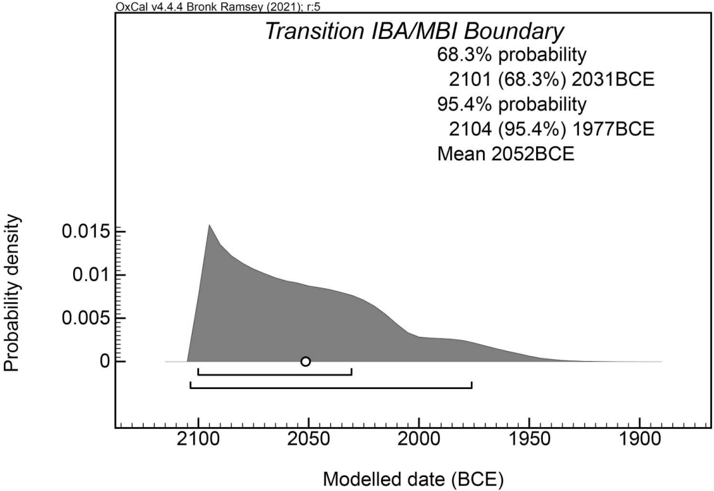
- Bayesian modeling (OxCal 4.4, IntCal20) with the IBA–MB I transition constrained after 2100 BCE gives the beginning of MB I at 68.3% 2101–2031 BCE and 95.4% 2104–1977 BCE; with a suggested eastern Mediterranean offset, the result is 68.3% 2102–2011 BCE and 95.4% 2104–1947 BCE.
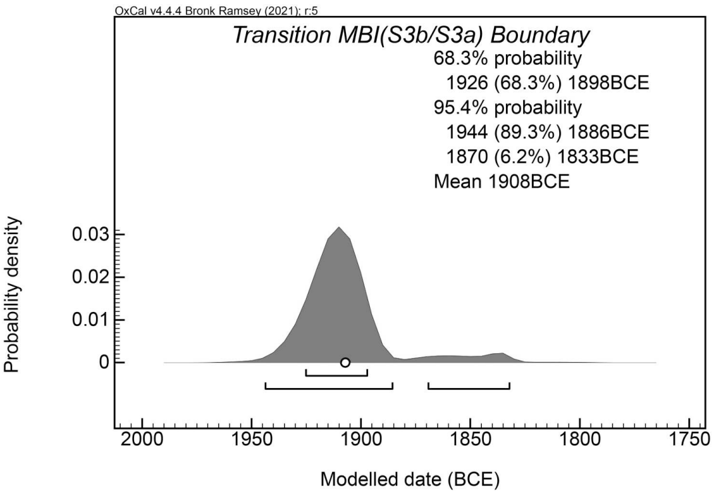
- MB I Phase 1 (Level S-4) began no later than the beginning of the twentieth century BCE, possibly toward the end of the twenty-first; the Phase 1–2 transition (S-3b to S-3a) is modeled at 68.3% 1926–1898 BCE (89.3% 1942–1886 BCE), and Level S-3a (Phase 2) is estimated at 1918–1886 cal BCE.
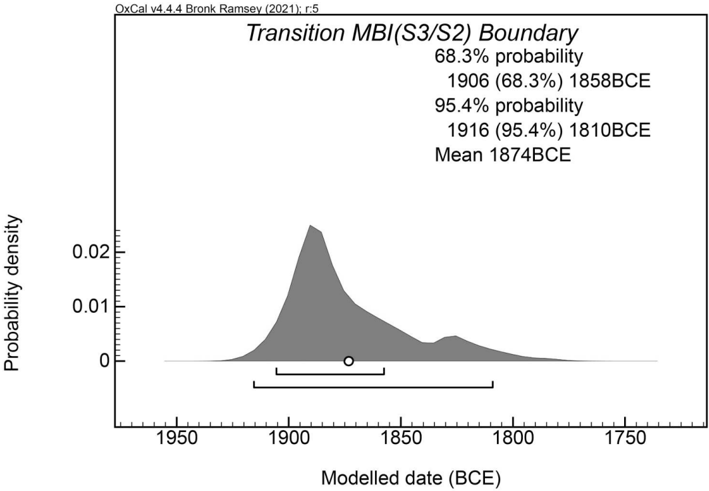
- The end of MB I Phase 2 (S-3a to S-2) falls in 68.3% 1906–1858 BCE and 95.4% 1916–1810 BCE; MB I Phase 3 began c. 1850 BCE, and the paper states the MB I–II transition appears to have taken place c. 1750 BCE or slightly earlier, while a later discussion cites c. 1800 BCE.
- The IBA ended c. 2100 BCE, with limited continuity beyond; the authors propose 2050–2000 BCE for final IBA remnants in the southern Levant. Level S-5 is late IBA, and the S-5 to S-4 ceramic shift shows little or no continuity apart from possible goblets and open carinated bowls.
Methods
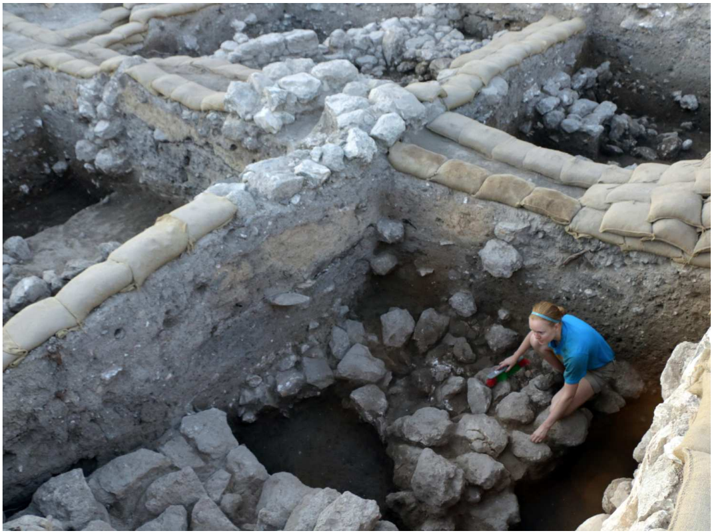
- Excavations in Area S, behind the University of Chicago Stratum XIII fortifications in Megiddo’s northwestern sector, exposed Levels S-5 to S-1, spanning late IBA through MB I, with architecture, floors, destruction deposits, and ceramic assemblages.
- The radiocarbon dataset comprises 16 samples, all published here for the first time; sampling targeted secure contexts (floor accumulations, destruction debris, kilns) and short-lived samples/clusters. Bayesian modeling used OxCal 4.4 and IntCal20, with two sequences (stratigraphic levels and ceramic phases) synchronized via cross-reference; constraints set the IBA–MB I transition after 2100 BCE and the end of MB I before 1750 BCE.
- Ceramic assemblages were compared with Aphek, Tel Ifshar, Tell el-Hayyat, and other southern Levantine sequences to assign MB I phases.
Limitations
- The paper states that direct synchronization with Egyptian chronology is lacking, radiocarbon data for the earliest MB I and latest IBA are scarce, and there is a data gap in the twenty-first and twentieth centuries BCE; it also notes a possible brief occupational gap between Levels S-5 and S-4.
- The paper states that no radiocarbon determinations are available for Level S-1 because remains lay too close to the surface, and that using IntCal20 without a regional correction may produce slightly older modeled ages, though it reports the offset does not change the overall result for the beginning of MB I.
- Evident from the text: the chronology relies on Bayesian constraints (IBA–MB I after 2100 BCE; end MB I before 1750 BCE) and on cross-site ceramic parallels; the S-3a destruction is not directly linked by text or archaeology to an Egyptian attack.
Model-written summary. Check it against the paper before relying on it.
Integrity signals
Registry
Cites
Statistics
Figures


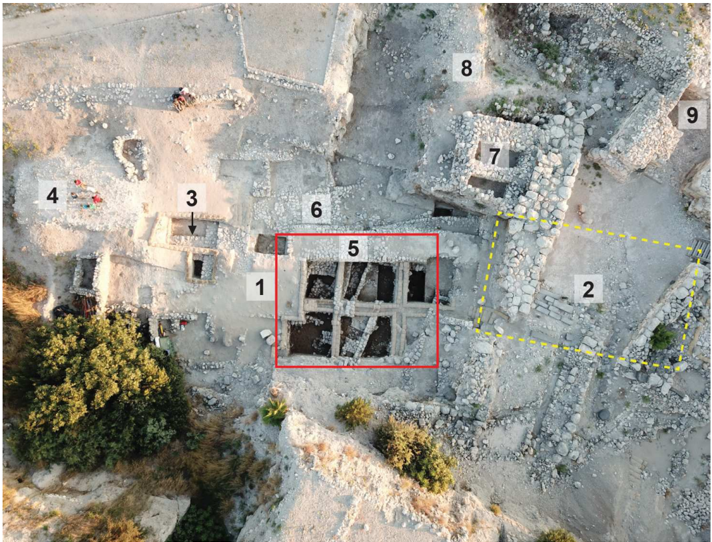
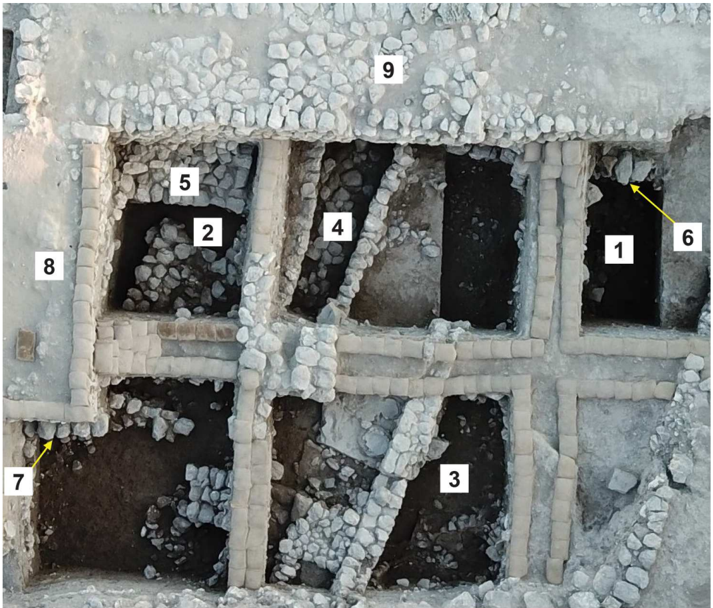
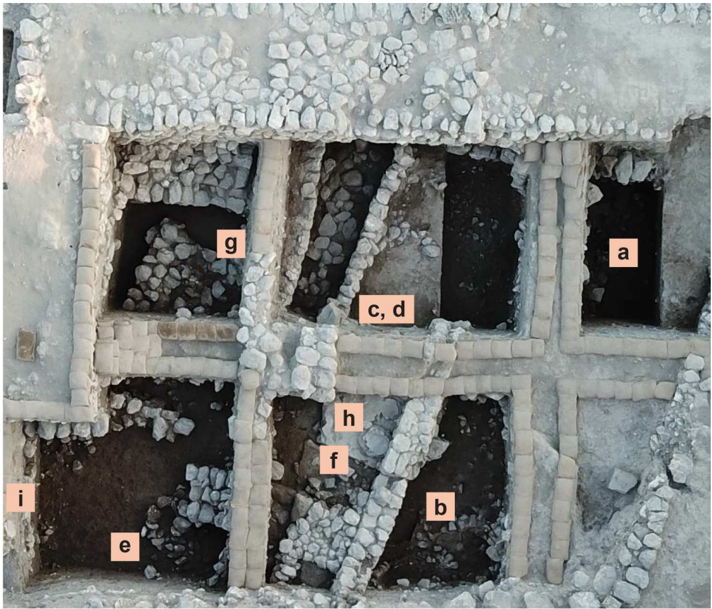

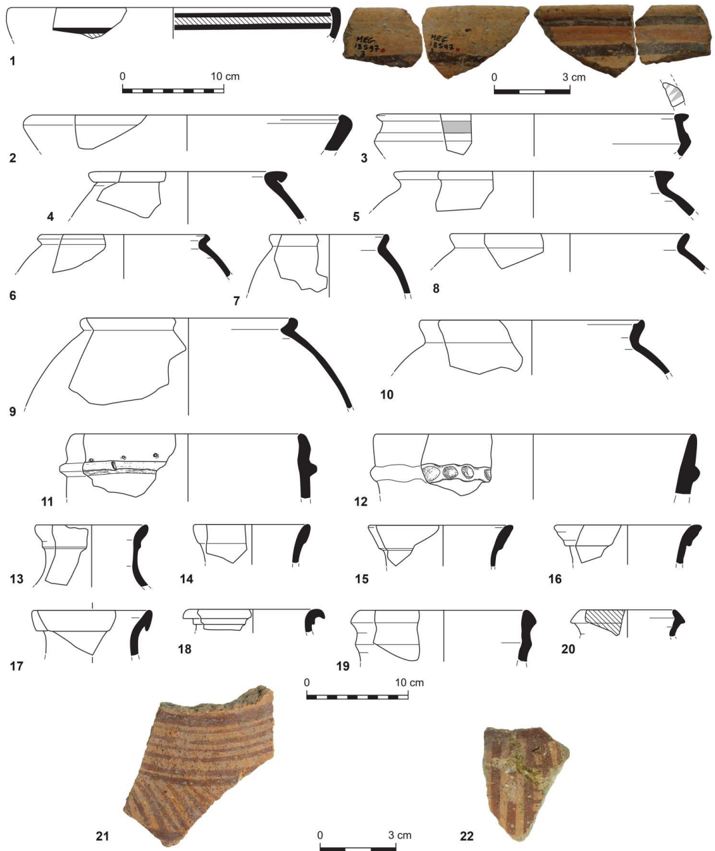
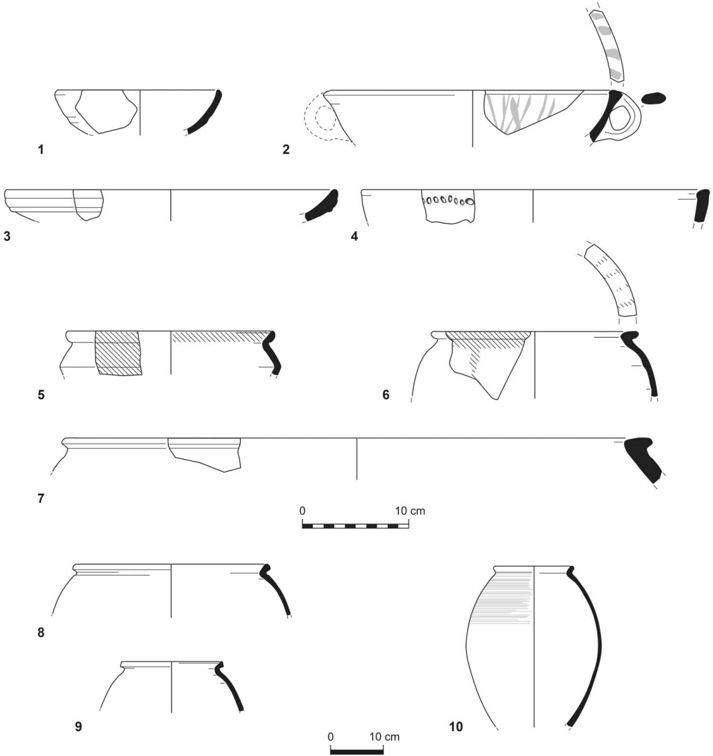
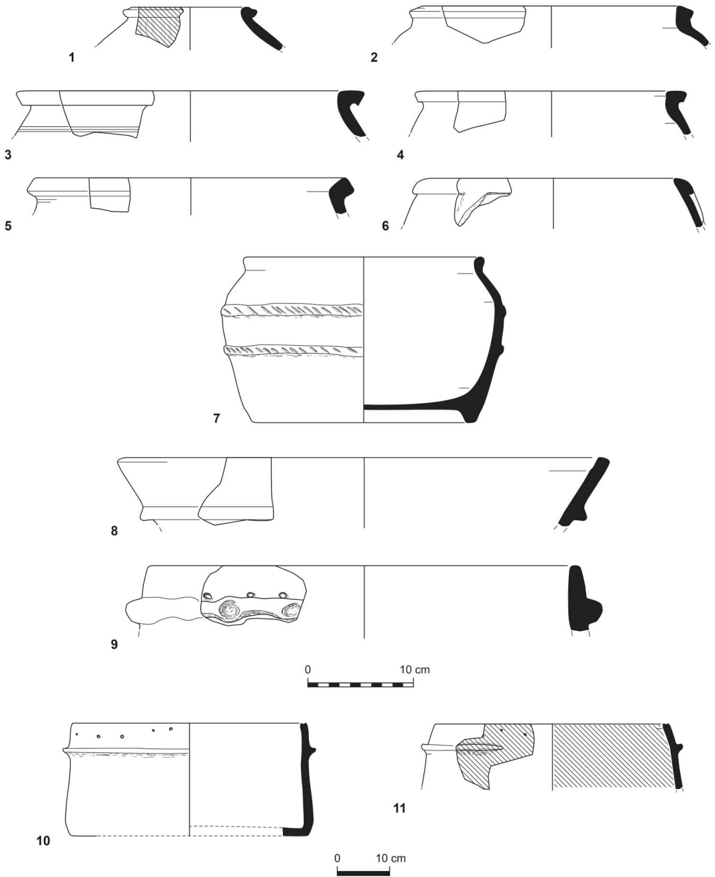
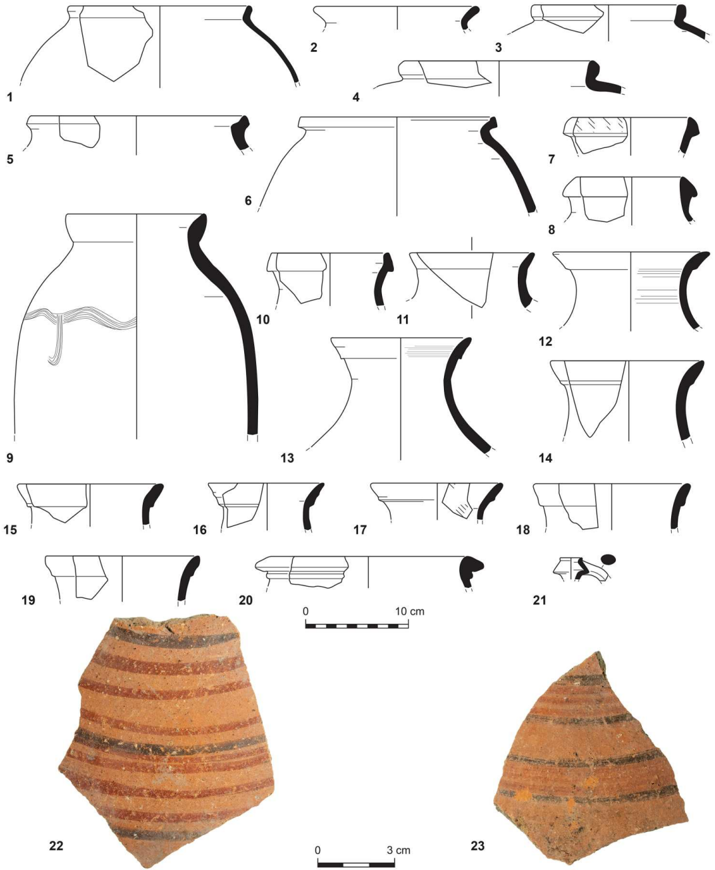

Verification
Claims the paper makes
0 Valid · 1 Not valid · 67 Not checked · 89 Own results and interpretations
A result the paper reports from its own data — it cites no other source for it, so there is none to check. The quote shows it is in the paper.
In the paper
“The secure, stratified contexts from Area S provide a ceramic sequence beginning in the Intermediate Bronze Age and extending into the Aphek-based MB I Phases 1, 2, and 3.”
§ The Beginning of the Middle Bronze Age in the Levant: New Evidence from Megiddo > Abstract
plain- Asserted: passes — The authors put it forward as true.
- Checkable: passes — It can be checked against evidence.
- Load-bearing: passes — The paper’s conclusions depend on it.
- Based: passes — The paper gives a reason why it holds.
A result the paper reports from its own data — it cites no other source for it, so there is none to check. The quote shows it is in the paper.
In the paper
“The end of MB I Phase 2 is modeled at the transition from S-3a to S-2, falling within the 68.3% range of 1906-1858 BCE and the 95.4% range of 1916-1810 BCE (Fig. 16).”
§ The Beginning of the Middle Bronze Age in the Levant: New Evidence from Megiddo > Level S-3
plain- Asserted: passes — The authors put it forward as true.
- Checkable: passes — It can be checked against evidence.
- Load-bearing: passes — The paper’s conclusions depend on it.
- Based: passes — The paper gives a reason why it holds.
A result the paper reports from its own data — it cites no other source for it, so there is none to check. The quote shows it is in the paper.
In the paper
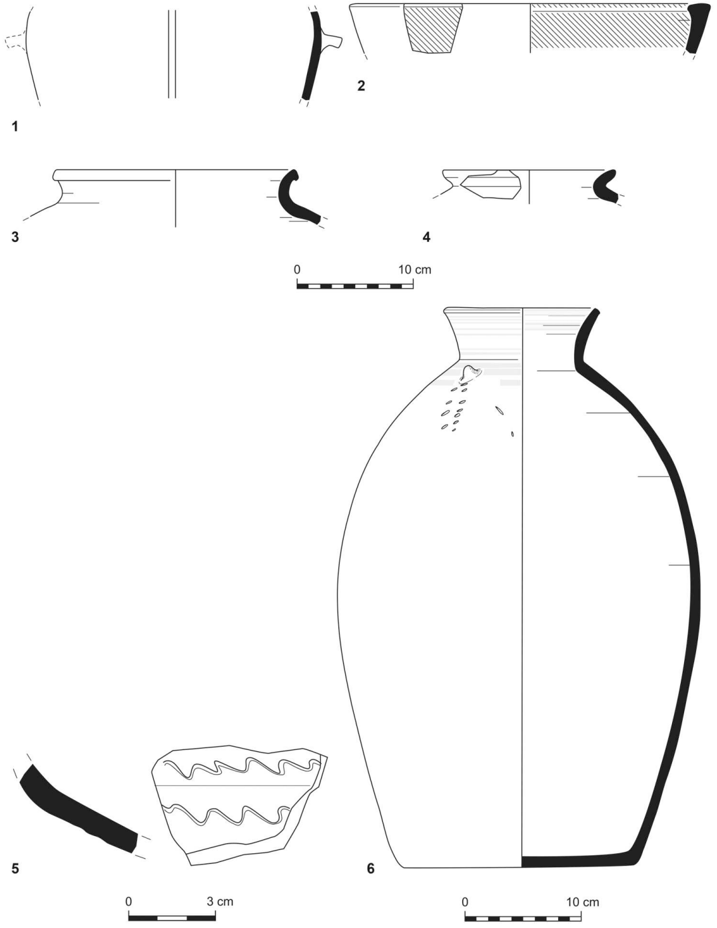
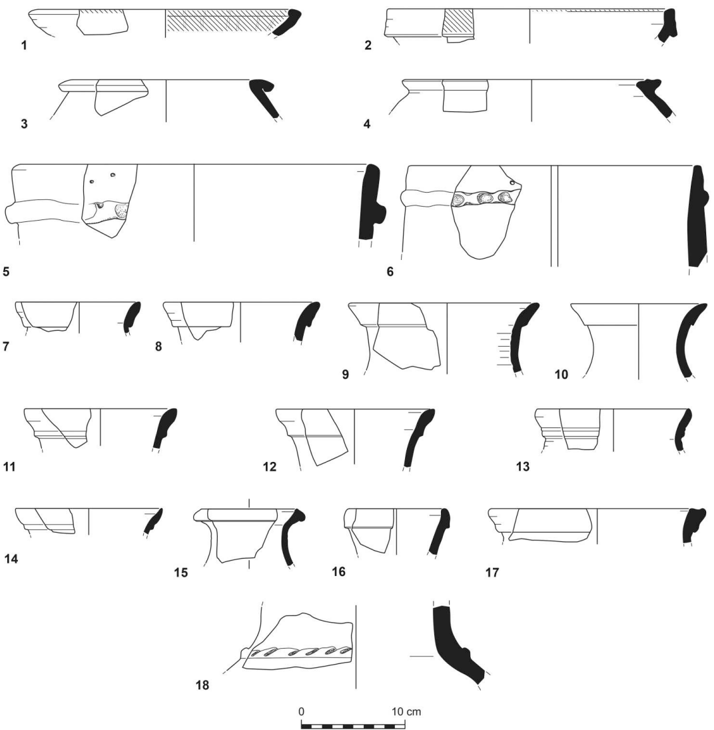
“Other new types include handle-less elongated oval storage jars with externally thickened rims (Fig. 11:9).”
§ The Beginning of the Middle Bronze Age in the Levant: New Evidence from Megiddo > Level S-3
plain- Asserted: passes — The authors put it forward as true.
- Checkable: passes — It can be checked against evidence.
- Load-bearing: unclear — It is unclear whether the paper’s conclusions depend on it.
- Based: passes — The paper gives a reason why it holds.
A result the paper reports from its own data — it cites no other source for it, so there is none to check. The quote shows it is in the paper.
In the paper
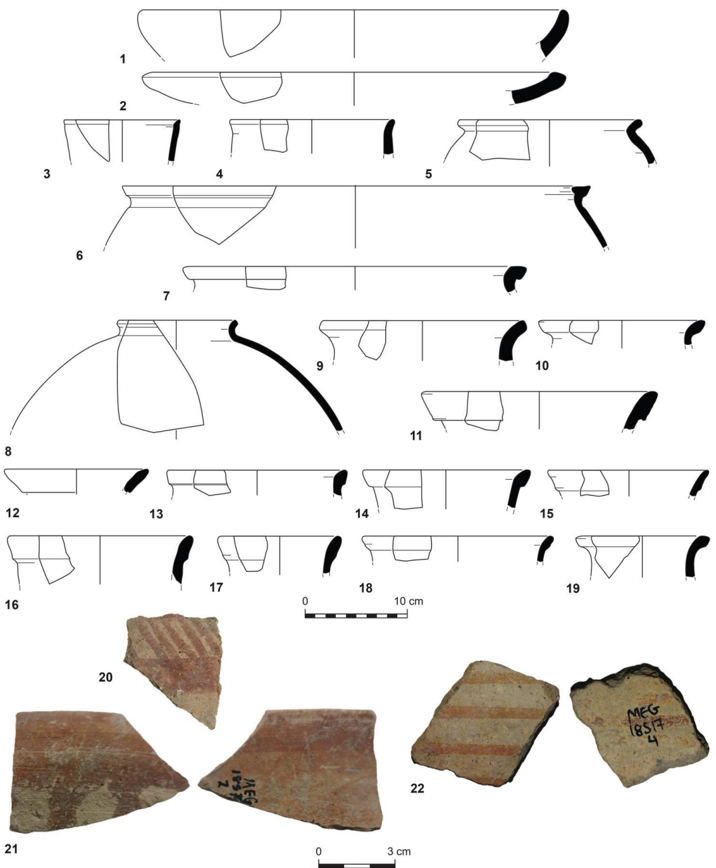
“LPW with bichrome decoration continues to appear (Figs.9:2, 6; 11: 22, 23).”
§ The Beginning of the Middle Bronze Age in the Levant: New Evidence from Megiddo > Level S-3
plain- Asserted: passes — The authors put it forward as true.
- Checkable: passes — It can be checked against evidence.
- Load-bearing: unclear — It is unclear whether the paper’s conclusions depend on it.
- Based: passes — The paper gives a reason why it holds.
A result the paper states — it cites no source for it, so there is none to check. The quote shows it is in the paper.
In the paper
“Particularly, the Coastal Plain and Jezreel Valley, which present the earliest MB I habitation, have not yet produced dates indicating IBA settlement in the twenty-first century BCE.”
§ The Beginning of the Middle Bronze Age in the Levant: New Evidence from Megiddo > Discussion
plain- Asserted: passes — The authors put it forward as true.
- Checkable: passes — It can be checked against evidence.
- Load-bearing: unclear — It is unclear whether the paper’s conclusions depend on it.
- Based: passes — The paper gives a reason why it holds.
79 more claims
Create a free account to see all 157 claims and to verify the 69 references still open.
- It may state two separate claims as one. 64
- Probably not a substantial claim. 13
Self-check
Percentages, sums and reported differences re-computed from the paper’s own numbers.
Each contradiction between two passages listed here was confirmed by an independent check.
Rated major: it would touch a result — a value a result rests on, reported and recomputed p-values on opposite sides of the significance level, two passages that conflict with no sign which is right, or a cited work retracted before this paper was published.
In the paper
§ The Beginning of the Middle Bronze Age in the Levant: New Evidence from Megiddo > Summary
“| S-1 | XII-X | - | MB II-III |”
§ The Beginning of the Middle Bronze Age in the Levant: New Evidence from Megiddo > Level S-1
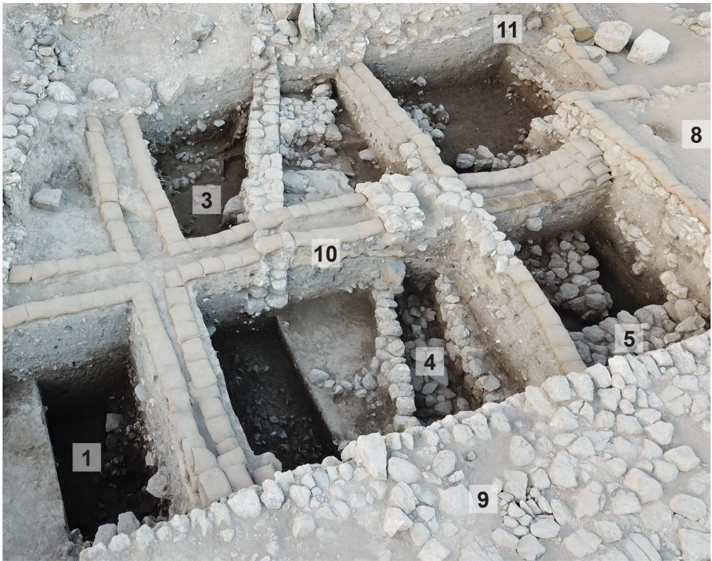
“The elements of the University of Chicago's Stratum XIII (Loud 1948, Fig. 378), dating, according to our work, to the late MB I, postdate Level S-1.”
Rated major: it would touch a result — a value a result rests on, reported and recomputed p-values on opposite sides of the significance level, two passages that conflict with no sign which is right, or a cited work retracted before this paper was published.
In the paper
§ The Beginning of the Middle Bronze Age in the Levant: New Evidence from Megiddo > Summary
“(4) rampart of Level S-2 and later phases of the MB I-II fortification system;”
§ The Beginning of the Middle Bronze Age in the Levant: New Evidence from Megiddo > Level S-1
“The rampart seen slightly to the west (Fig. 1:4) also belongs to this post-Level S-1 system.”
Rated minor: it would not touch a result — a value no result rests on, a p-value that stays on the same side of the significance level, or a conflict that is clerical, resolved elsewhere in the paper, or outside its own findings.
In the paper
§ The Beginning of the Middle Bronze Age in the Levant: New Evidence from Megiddo > Level S-3
“Sub-Level S-3c: 22/S/47/LB3, AA11160;”
§ The Beginning of the Middle Bronze Age in the Levant: New Evidence from Megiddo > Summary
“AA | 116063”
Rated minor: it would not touch a result — a value no result rests on, a p-value that stays on the same side of the significance level, or a conflict that is clerical, resolved elsewhere in the paper, or outside its own findings.
In the paper
§ The Beginning of the Middle Bronze Age in the Levant: New Evidence from Megiddo > Level S-3
“With this constraint applied, the model yields a 68.3% range of 2101-2031 BCE and a 95.4% range of 2104-1977 BCE for the beginning of MB I (Fig. 14)”
§ The Beginning of the Middle Bronze Age in the Levant: New Evidence from Megiddo > Summary
“Figure 14.Transition from Sub-Level S-3b to Sub-Level S-3a (end of MB I Phase 1).”
Citations
Cites
Bayesian Analysis of Radiocarbon Dates
Bronk Ramsey, C. (2009) · Radiocarbon · doi:10.1017/s0033822200033865 · Cited by 8,725
The IntCal20 Northern Hemisphere Radiocarbon Age Calibration Curve (0–55 cal kBP)
Reimer, P. J., Austin, W. E. N., Bard, E., Bayliss, A., Blackwell, P. G., Bronk Ramsey, C., Butzin, M., Cheng, H., Edwards, R. L., Friedrich, M., et al. (2020) · Radiocarbon · doi:10.1017/rdc.2020.41 · Cited by 7,900
Radiocarbon-Based Chronology for Dynastic Egypt
Ramsey, C. B., Dee, M. W., Rowland, J. M., Higham, T. F. G., Harris, S. A., Brock, F., Quiles, A., Wild, E. M., Marcus, E. S., & Shortland, A. J. (2010) · Science · doi:10.1126/science.1189395 · Cited by 282
Chronology of the Early Bronze Age in the Southern Levant: New Analysis for a High Chronology
Regev, J., De Miroschedji, P., Greenberg, R., Braun, E., Greenhut, Z., & Boaretto, E. (2012) · Radiocarbon · doi:10.1017/s003382220004724x · Cited by 233
Langgut, D., Finkelstein, I., Litt, T., Harald Neumann, F., & Stein, M. (2015) · Radiocarbon · doi:10.2458/azu_rc.57.18555 · Cited by 134
Self-citationThe Archaeology of the Bronze Age Levant
Greenberg, R. (2019) · doi:10.1017/9781316275993 · Cited by 110
Amenemhet II and the Sea: Maritime Aspects of the Mit Rahina (Memphis) Inscription
Marcus, E. S. (2008) · Ägypten und Levante · doi:10.1553/aeundl17s137 · Cited by 96
Early Bronze Age Chronology: Radiocarbon Dates and Chronological Models from Tel Yarmuth (Israel)
Regev, J., De Miroschedji, P., & Boaretto, E. (2012) · Radiocarbon · doi:10.1017/s0033822200047238 · Cited by 64
Dead Sea Levels during the Bronze and Iron Ages
Joy Kagan, E., Langgut, D., Boaretto, E., Herald Neumann, F., & Stein, M. (2015) · Radiocarbon · doi:10.2458/azu_rc.57.18560 · Cited by 58
Finkelstein, I., & Langgut, D. (2014) · Journal of Near Eastern Studies · doi:10.1086/677300 · Cited by 54
Self-citation
Research works printed but not linked: 31
- Adams, M. J., and Dunseth, Z., forthcoming. 'Area S: the 2012-2022 seasons', in I.
- Altenmüller, H., and Moussa, A. M., 1991. 'Die Inschrift Amenemhets II. aus dem Ptah-Tempel von Memphis: Vorbericht', Studien zur altägyptischen Kultur 18, 1-48.
- Beck, P., 2000b. 'Area B: pottery: Middle Bronze Age IIA', in M. Kochavi, P. Beck, and E. Yadin (eds) Aphek-Antipatris I: Excavation of Areas A and B. The 1972-1976 Seasons, Sonia and Marco Nadler Institute of Archaeology Monograph Series 19, Tel Aviv: Emery and Claire Yass Publications in Archaeology, Tel Aviv University, 112-33.
- Beck, P., 2000a. 'Area A: Middle Bronze IIA pottery', in M. Kochavi, P. Beck, and E. Yadin (eds), Aphek-Antipatris I: Excavation of Areas A and B. The 1972-1976 Seasons, Sonia and Marco Nadler Institute of Archaeology Monograph Series 19, Tel Aviv: Emery and Claire Yass Publications in Archaeology, Tel Aviv University, 173-238.
- Ben-Dor, I., 1950. 'A Middle Bronze Age temple at Nahariya', QDAP 14, 1-41.
- Bietak, M., 2002. 'Relative and absolute chronology of the Middle Bronze Age: comments on the present state of research', in M. Bietak (ed.), The Middle Bronze Age in the Levant: Proceedings of an International Conference on MB IIA Ceramic Material, Contributions to the Chronology of the Eastern Mediterranean 3, Vienna: Österreichische Akademie der Wissenschaften, 29-42.
- Bietak, M., 2010. 'From where came the Hyksos and where did they go?', in M. Marée (ed.), The Second Intermediate Period (Thirteenth-Seventeenth Dynasties), Leuven: Peeters, 139-81.
- Bourke, S., Sparks, R., and Schroder, M., 2006. 'Pella in the Middle Bronze Age', in P. M. Fischer (ed.), The Chronology of the Jordan Valley during the Middle and Late Bronze Ages: Pella, Tell Abu Al- Kharaz, and Tell Deir 'Alla. Vienna: Österreichische Akademie Der Wissenschaften, 9-59.
- Cohen, S. L., 2014. 'The southern Levant (Cisjordan) during the Middle Bronze Age', in M. L. Steiner, and A. E. Killebrew (eds), The Oxford Handbook of the Archaeology of the Levant: c. 8000-332 BCE, Oxford: Oxford University Press, 451-64.
- Covello-Paran, K., 2011. 'Nein-'En Ha-More (N)', Hadashot Arkheologiyot-Excavations and Surveys in Israel 123 <https://hadashot.iaa.org.il/report_detail_eng.aspx?id=1645&mag_id= 118> [accessed 1 March 2026].
- Covello-Paran, K., 2015. The Jezreel Valley during the Intermediate Bronze Age: Social and Cultural Landscapes (unpublished doctoral thesis), Tel Aviv University, Tel Aviv.
- Garfinkel, Y., and Cohen, S., 2007. 'The burials', in Y. Garfinkel and, S. Cohen (eds), The Middle Bronze Age IIA Cemetery at Gesher: Final Report, Boston: American Schools of Oriental Research, 15-68.
- Genz, H., 2017. 'The transition from the third to the second millennium B.C. in the coastal plain of Lebanon: continuity or break?', in F. Höflmayer (ed.), The Late Third Millennium in the Ancient Near East: Chronology, C14, and Climate Change, Oriental Institute Seminars 11, Chicago: The Oriental Institute, 73-86.
- Greenberg, R. et al., 1998. 'A sounding at Tel Na'ama in the H . ula Valley', ʽAtiqot 35, 9-35 <http:// www.jstor.org/stable/23458511> [accessed on 16 November 2025].
- Guy, P. L. O., 1938. Megiddo Tombs, Oriental Institute Publications 33, Chicago: The University of Chicago Press.
- Höflmayer, F., 2015. 'Carbone-14 comparé: Middle Bronze Age I (IIA) chronology, Tell el-Dabʿa and radiocarbon data', in J. Mynářová, P. Onderka, and P. Pavúk (eds), There and Back Again: The Crossroads II. Proceedings of an International Conference Held in Prague, September 15-18, 2014, Prague: Charles University, Faculty of Arts, 265-95.
- Ilan, D., 1995. 'The dawn of internationalism: the Middle Bronze Age', in T. E. Levy (ed.), The Archaeology of Society in the Holy Land, London: Leicester University Press, 297-319.
- Ilan D., and Marcus E., 2019. 'Middle Bronze Age IIA,' in S. Gitin (ed.), The Ancient Pottery of Israel and Its Neighbors: From the Middle Bronze Age through the Late Bronze Age 3, Jerusalem: Israel Exploration Society/W.F. Albright Institute of Archaeological Research/ Israel Antiquities Authority/American Schools of Oriental Research, 9-76.
- Jüngling, J., and Höflmayer, F., 2023. 'Early Dynastic/Old Kingdom Egypt and the Early Bronze Age Levant: the history of the 3 rd and 4 th Dynasties and new radiocarbon dates in dialogue', Journal of Ancient Egyptian Interconnections 37, 191-222.
- Kempinski, A., Gershuny, L., and Scheftelowitz, N., 2002. 'Pottery: Middle Bronze Age', in Kempinski, A., Tel Kabri: The 1986-1993 Excavation Seasons, Sonia and Marco Nadler Institute of Archaeology Monograph Series 20, Tel Aviv: Emery and Claire Yass Publications in Archaeology, Tel Aviv University, 109-75.
- Koch, O. Lipschits, and O. Sergi (eds), From Nomadism to Monarchy? Revisiting the Early Iron Age Southern Levant, University Park, PA: Eisenbrauns, 7-26.
- Livneh, A., 2005. 'The pottery of the Middle Bronze Age', in A. Ben-Tor, D. Ben-Ami, and A. Livneh (eds), Yoqneʿam III: The Middle and Late Bronze Ages. Final Report of the Archaeological Excavations (1977-1988), Qedem Reports 7, Jerusalem: Institute of Archaeology, the Hebrew University of Jerusalem, 41-140.
- Loud, G., 1948. Megiddo II: Seasons of 1935-39, Chicago: University of Chicago Press.
- Martin, M. A. S., 2022 'The MBIII-LBIII pottery from Areas K (Level K-10 to K-8) and H (Levels H-15 to H-13)', in I.
- Morandi Bonacossi, D., 2014. 'The northern Levant (Syria) in the Middle Bronze Age', in M. L. Steiner, and A. E. Killebrew (eds), The Oxford Handbook of the Archaeology of the Levant: c. 8000-332 BCE, Oxford: Oxford University Press, 414-33.
- Ogden, A., 2004. 'Animal bone deposit under Sidon's 'Minoan cup': C14 analysis', Archaeology and History in the Lebanon 20, 60.
- Paley, S. M., and Porath, Y., 1997. 'Early Middle Bronze Age IIa remains at Tel el-Ifshar, Israel: a preliminary report', in E. D. Oren (ed.), The Hyksos: New Historical and Archaeological Perspectives, Philadelphia: The University Museum, 369-79.
- Roth, H., 2025. Social and Economic Growth in the Judean Highlands during the Intermediate and Middle Bronze Ages (unpublished doctoral thesis), Tel Aviv University, Tel Aviv.
- Stager, L. E., and Voss, R. J., 2018. 'The Middle Bronze Age pottery of Ashkelon', in L. E. Stager, J. D. Schloen, and R. J. Voss (eds), Ashkelon 6: The Middle Bronze Age Ramparts and Gates of the North Slope and Later Fortifications. University Park: Eisenbrauns, 117-208.
- Yadin, E., 2009. 'Middle Bronze Age pottery', in Y. Gadot, and E. Yadin (eds.), Aphek-Antipatris II: The Remains of the Acropolis. The Moshe Kochavi and Pirhiya Beck Excavations, Sonia and Marco Nadler Institute of Archaeology Monograph Series 27, Tel Aviv: Emery and Claire Yass Publications in Archaeology, Tel Aviv University, 111-81.
- Yasur-Landau, A., 2012. 'The Middle Bronze Age pottery of Strata VII-V: typology and chronol- ogy', in Y. Gadot, and A. Yasur-Landau, Qiryat Shemona (S): Fort and Village in the Hula Valley, Tel Aviv: Emery and Claire Yass Publications in Archaeology, Tel Aviv University, 39-75.
Cited by
Still being checked.
Metadata
- Authors
- Yasur-Landau, A., Piasetzky, E., Adams, M. J., Roth, H., Dunseth, Z., & Finkelstein, I.
- Affiliations
- University of Haifa
- Tel Aviv University (IL)
- The Center for the Mediterranean World
- University of Haifa (IL)
- University of California San Diego (US)
- ORCID
- Venue
- Palestine Exploration Quarterly
- Publisher
- Informa UK Limited
- Published
- 2026-10-22
- Pages
- 1-38
- ISSN
- 0031-0328 (ISSN-L)
- 1743-1301
- OpenAlex
- W7223236969
- Cited by
- 0
- References
- 60
- FWCI
- 0.00
- Type
- journal article
- Language
- en
- Open access
- hybrid
- doi.org
- Licence
- cc-by-nc-nd
- creativecommons.org/licenses/by-nc-nd/4.0/ (vor)
- doi.org/10.1080/policies-text-data-mining (tdm)
- Locations
- Palestine Exploration Quarterly (publishedVersion, cc-by-nc-nd)
- Funders
- Mr. Jacques Chahine, the Dan David Foundation and the Shmunis Family Foundation
- Topics
- Social Sciences › Arts and Humanities › Archeology (arts and humanities) › Ancient Mediterranean Archaeology and History
- Social Sciences › Arts and Humanities › Religious studies › Biblical Studies and Interpretation
- Social Sciences › Archeology › Archaeology and ancient environmental studies
- Keywords
- Megiddo, radiocarbon dating, ceramic sequence, Intermediate Bronze Age, fortification systems, gate architecture, Bayesian chronology, urbanization, destruction layers
About these checks
Registry, retraction, Cites and statistics results are computed, not judged, with one exception: a printed reference that no index lists is read once by a model before it counts as a citation error. Claims are extracted by a model and kept only when their quote appears verbatim in the text; each cited source is then checked, with a model’s help, for whether it says what the claim relies on. Those verdicts can be wrong — read the claim’s quote and the cited source before relying on one.
A language model drew the claims from the paper on 2026-11-23, under version 3 of the claim definition (model deepseek-v4.1-flash, prompt extract-v3).
A second model labelled each claim on 2026-11-23 (model jev-1.13-20260917, definition revision gold-guideline-v0.2).
Statistics and arithmetic are recomputed, not judged.
Confidence bands are shown only for fields calibrated on our annotated test set. None is calibrated yet, so no band is shown.
What counts as a claim ›How we measure confidence ›How we check this ›
Are you an author, or do you see a problem with this page? Request a review
How to cite
Cite CoChat for the checks on this page, and the paper for its own findings.
- This page
- CoChat. (2026). Citation check: The Beginning of the Middle Bronze Age in the Levant: New Evidence from Megiddo. https://app.cochat.ai/papers/10.1080/00310328.2026.2736989
- The paper
- Yasur-Landau, A., Piasetzky, E., Adams, M. J., Roth, H., Dunseth, Z., & Finkelstein, I. (2026). The Beginning of the Middle Bronze Age in the Levant: New Evidence from Megiddo. Palestine Exploration Quarterly. https://doi.org/10.1080/00310328.2026.2736989
Data sources
Bibliographic data: Semantic Scholar, OpenAlex, Crossref.
Contains information from the Semantic Scholar Academic Graph Datasets, made available under the ODC Attribution License (ODC-BY 1.0).
Semantic Scholar’s data is described in: Kinney, R., et al. (2023). The Semantic Scholar Open Data Platform. arXiv:2301.10140.
