

The limited effect of increasing educational attainment on childlessness trends in twentieth-century Europe, women born 1916–65
Open accessThe DOI matches its Crossref record; 95 of the 97 references it cites were found in a registry or an index.
Abstract
During the twentieth century, trends in childlessness varied strongly across European countries while educational attainment grew continuously across them. Using census and large-scale survey data from 13 European countries, we investigated the relationship between these two factors among women born between 1916 and 1965. Up to the 1940 birth cohort, the share of women childless at age 40+ decreased universally. Afterwards, the trends diverged across countries. The results suggest that the overall trends were related mainly to changing rates of childlessness within educational groups and only marginally to changes in the educational composition of the population. Over time, childlessness levels of the medium-educated and high-educated became closer to those of the low-educated, but the difference in level between the two better educated groups remained stable in Western and Southern Europe and increased slightly in the East.
Overview
The claims and statistics of this paper haven’t been checked yet.
Free: it reads the open-access text and checks the first 5 claims that cite a source we can check. Create a free account to check every claim.
Integrity signals
Registry
Cites
Statistics
Figures
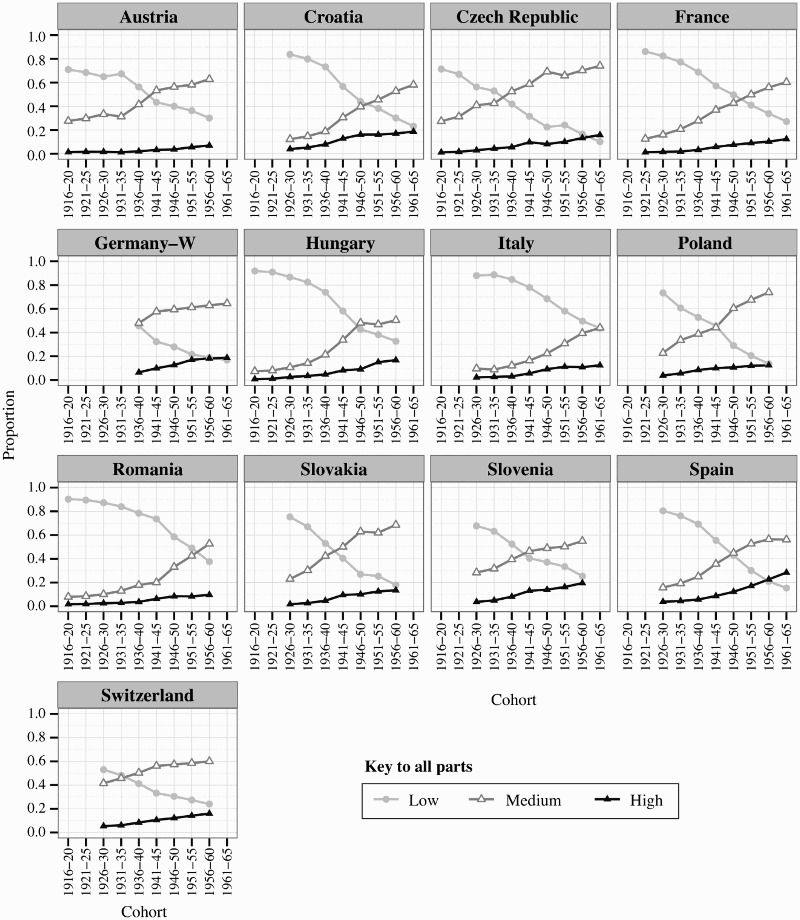
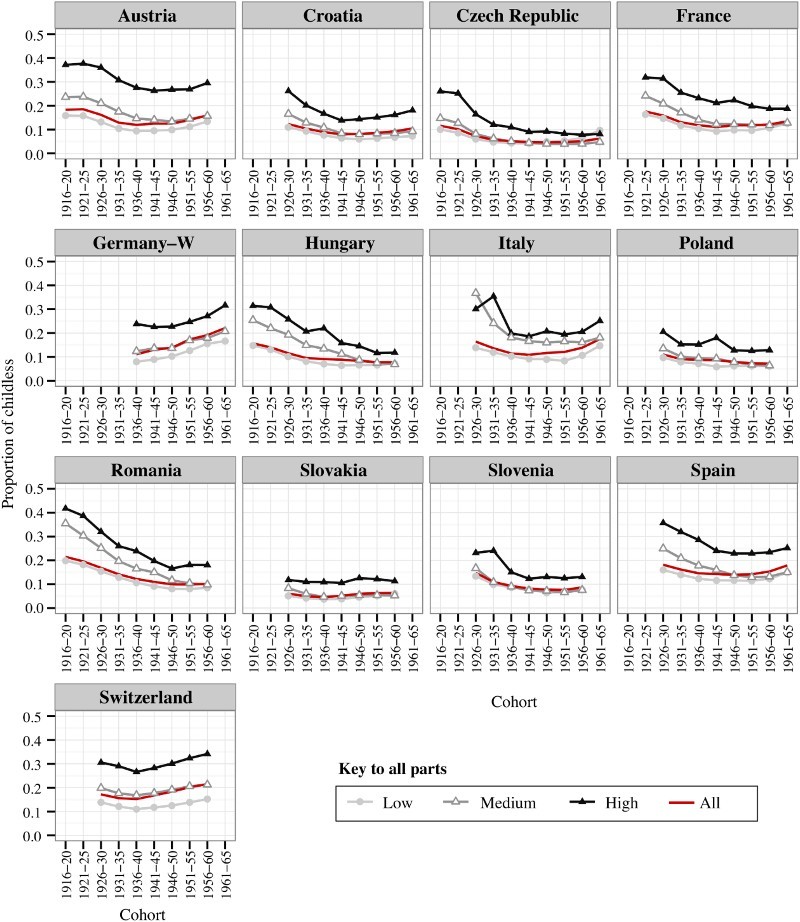
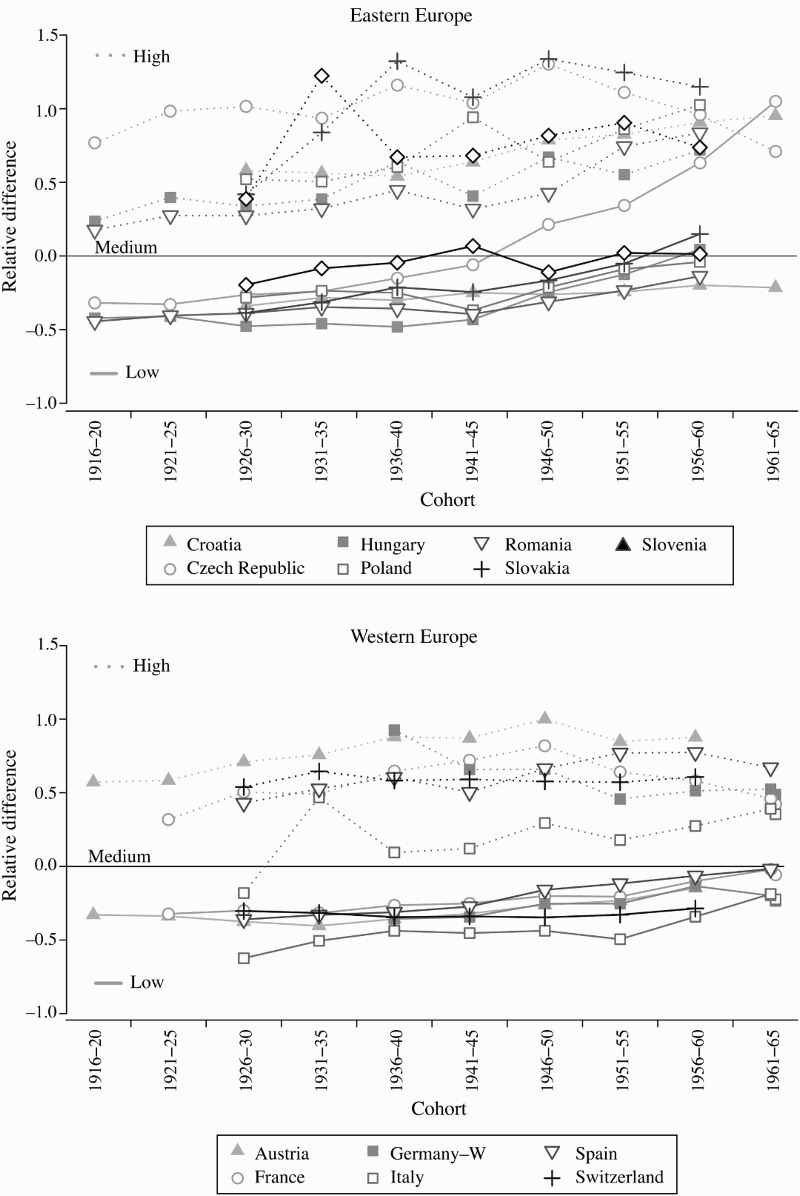
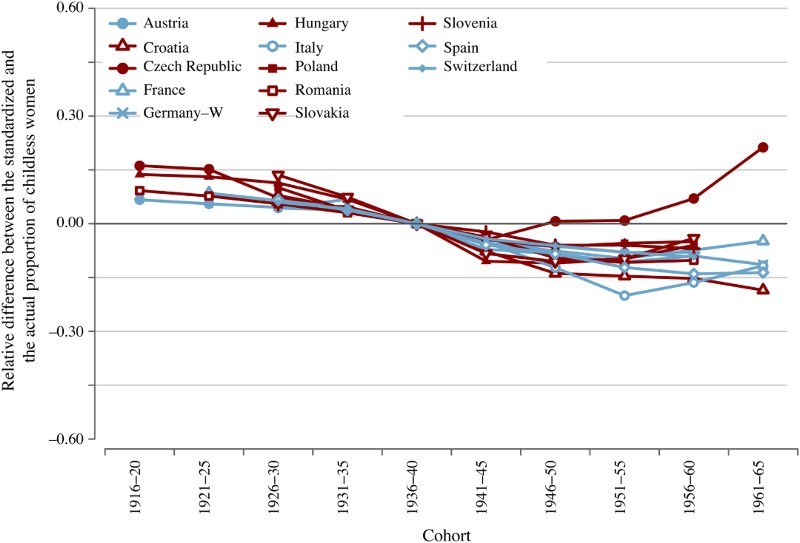
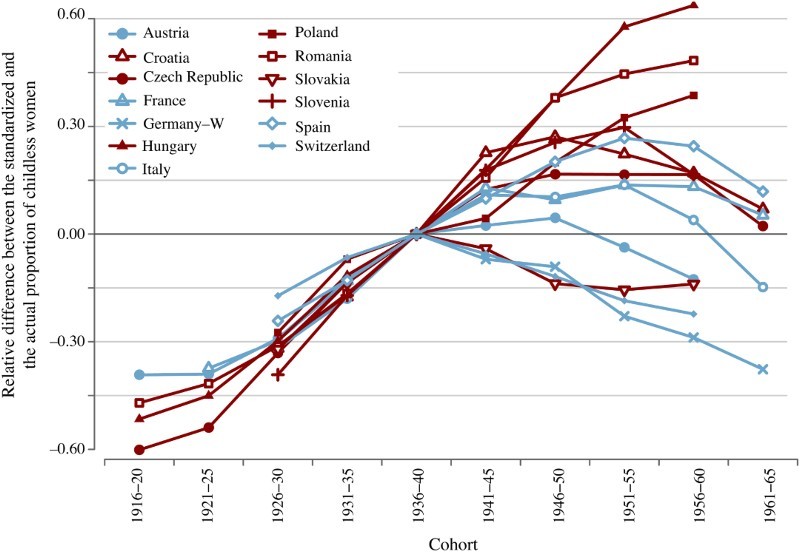
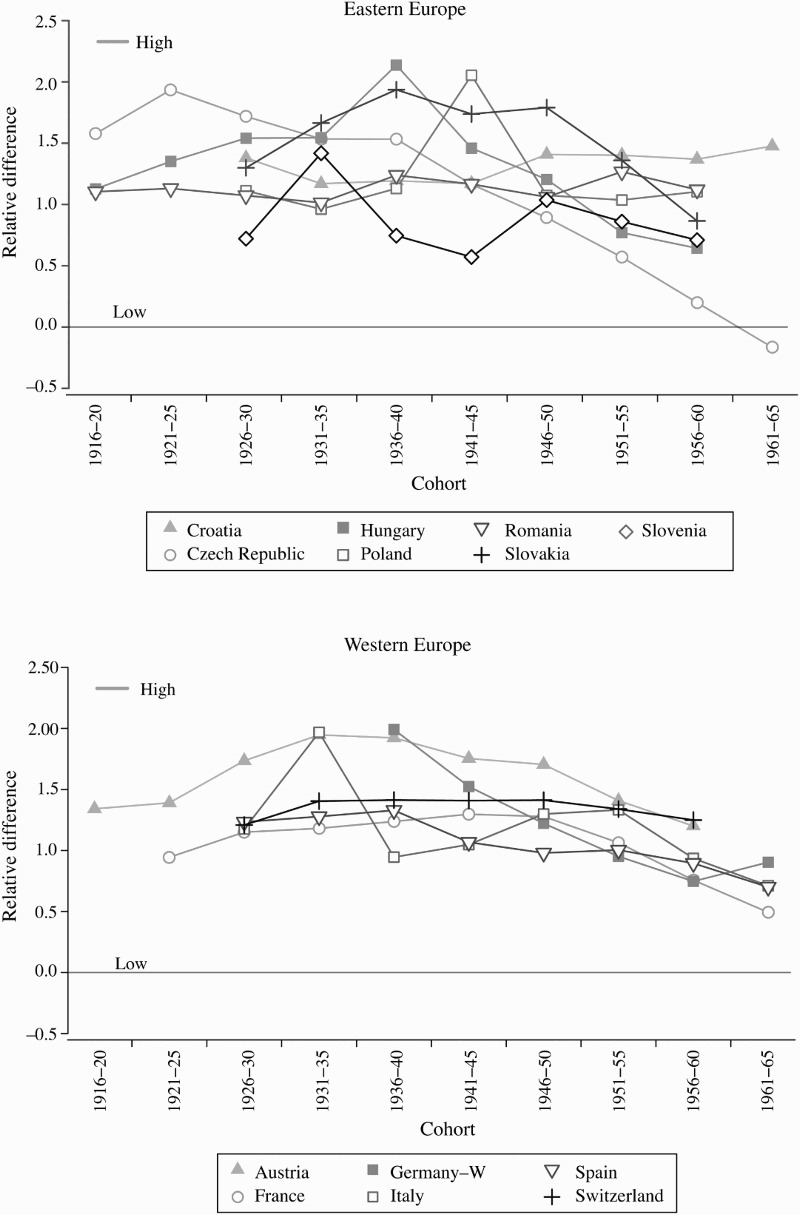
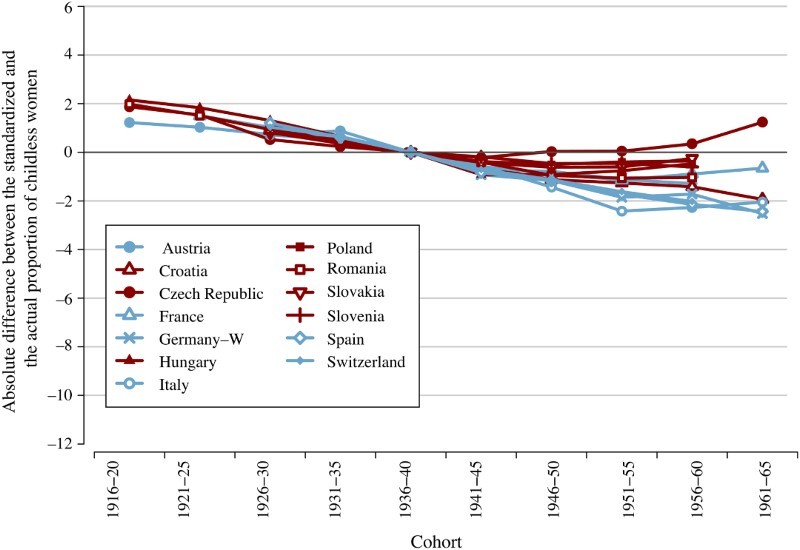
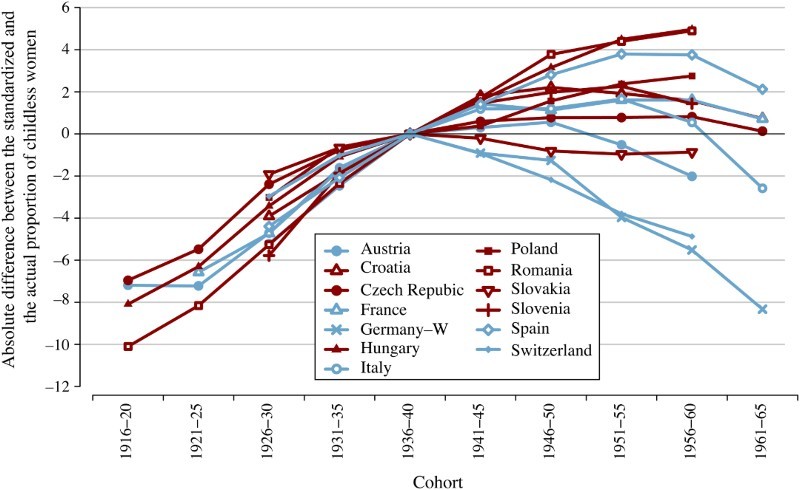
Verification
Claims the paper makes
The claims and statistics of this paper haven’t been checked yet.
Free: it reads the open-access text and checks the first 5 claims that cite a source we can check. Create a free account to check every claim.
Claims other papers make about this one
Each is checked against this paper’s own text: does it say what the citing paper says it does?
The source backs part of the claim, not all of it — or backs it for a different population, condition or comparison.
In the citing paper
“Contrary to findings from many other European countries (Sobotka et al. 2017; Beaujouan et al. 2016), the negative educational gradients in CTF observed in older female cohorts have disappeared.”
From Education, Gender, and Cohort Fertility in the Nordic Countries (2019) · cites this paper as Beaujouan et al. 2016
Experimental — accuracy not yet measuredThe cited source says what the claim attributes to it.
In the citing paper
“However, recent studies suggest that educational expansion has had only limited effects on patterns and developments in ultimate fertility (Sobotka et al. 2017) and childlessness (Beaujouan et al. 2016) by educational level in continental European countries.”
From Education, Gender, and Cohort Fertility in the Nordic Countries (2019) · cites this paper as Beaujouan et al. 2016
Self-check
Percentages, sums and reported differences re-computed from the paper’s own numbers.
The self-check needs the paper’s full text.
Citations
Cites
Becker, G. S. (1991) · doi:10.4159/9780674020665 · Cited by 10,565 · cited 1×
“According to the New Household Economics (Becker 1981), the opportunity cost of raising children is greater for higher-income women (who usually also have higher-than-average levels of education), which would make them more likely to forgo motherhood.”
BackgroundThe American Occupational Structure.
Blalock, H. M., Blau, P. M., Duncan, O. D., & Tyree, A. (1968) · American Sociological Review · doi:10.2307/2092399 · Cited by 4,412
A new data set of educational attainment in the world, 1950–2010
Barro, R. J., & Lee, J. W. (2013) · Journal of Development Economics · doi:10.1016/j.jdeveco.2012.10.001 · Cited by 4,333
International Standard Classification of Education, ISCED 1997
UNESCO United Nations Educational, S. A. C. O. (2003) · Advances in Cross-National Comparison · doi:10.1007/978-1-4419-9186-7_10 · Cited by 2,351
The Quiet Revolution That Transformed Women's Employment, Education, and Family
Goldin, C. (2006) · American Economic Review · doi:10.1257/000282806777212350 · Cited by 1,831 · cited 2×
“As the demand for qualified women in the labour force boomed, it became possible for the better educated to combine family and work and easier for women to re-enter the labour force when the children reached school age (Goldin 2006).”
BackgroundThe Unfolding Story of the Second Demographic Transition
Lesthaeghe, R. (2010) · Population and Development Review · doi:10.1111/j.1728-4457.2010.00328.x · Cited by 1,794 · cited 1×
“…their increased childlessness, highly educated women are forerunners of new behaviour, as they have been in other characteristics of family career (Lesthaeghe 2010; Ní Bhrolcháin and Beaujouan 2013), the increase might herald a forthcoming increase in childlessness in all social strata in the…”
BackgroundPakulski, J., Best, H., Christmas-Best, & Horrman-Lange, U. (2012) · UTAS Research Repository · Cited by 1,785
The Silent Revolution in Europe: Intergenerational Change in Post-Industrial Societies
Inglehart, R. (1971) · American Political Science Review · doi:10.2307/1953494 · Cited by 1,736 · cited 1×
“While the Western democracies experienced the beginning of great social changes in the late 1960s with the spread of individualism (Inglehart 1971; Van de Kaa 1996, 2004), these were less visible in state-socialist countries.”
BackgroundWork and family research in the first decade of the 21st century
Bianchi, S. M., & Milkie, M. A. (2010) · Journal of Marriage and Family · doi:10.1111/j.1741-3737.2010.00726.x · Cited by 1,145 · cited 2×
“…lives that brought change to national fertility levels in the twentieth century, primary importance has been assigned to growing educational attainment and labour force participation, together with effective fertility control (Murphy 1993; Brewster and Rindfuss 2000; Bianchi and Milkie 2010).”
Background(2020) · Staying Afloat · doi:10.1515/9780804786355-016 · Cited by 989
Research works printed but not linked: 5
- 20. Doman ´ski, H. 2004. O ruchliwos ´ci społecznej w Polsce [On social mobility in Poland]. Warsaw: IFiS PAN.
- 29. Giza-Poleszczuk, A. 2007. Rodzina i system społeczny [The family and the social system], in M. Marody (ed.), Wymiary z ˙ycia społecznego [The dimensions of social life]. Warsaw: Wydawnictwo Naukowe SCHOLAR, pp. 290-317.
- 51. Miettinen, A., A. Rotkirch, I. Szalma, A. Donno, and M. L. Tanturri. 2015. Increasing childlessness in Europe: time trends and country differences, Families and Societies Working Paper Series 33. Minnesota Population Center. 2015. Integrated Public Use Microdata Series, International: Version 6.4 [Machine-read- able database]. Minneapolis: University of Minnesota.
- 74. Stloukal, L. 1999. Understanding the 'abortion culture' in Central and Eastern Europe, in H. P. David and J. Skilogianis (eds.), From Abortion to Contraception: A Resource to Public Policies and Reproductive Behavior in Central and Eastern Europe from 1917 to the Present. Westport, CT: Greenwood Press, pp. 23-37.
- 84. Van Agtmaal-Wobma, E. and M. van Huis. 2008. De relatie tussen vruchtbaarheid en opleidingsniveau van de vrouw [The relationship between female fertility and level of education], Bevolkingstrends 2e kwartaal 32-41.
Cited by
Education, Gender, and Cohort Fertility in the Nordic Countries
Jalovaara, M., Neyer, G., Andersson, G., Dahlberg, J., Dommermuth, L., Fallesen, P., & Lappegård, T. (2019) · European Journal of Population · doi:10.1007/s10680-018-9492-2 · Cited by 404
“Recent studies suggest that educational expansion has had only limited effects on childlessness patterns by educational level in continental European countries (Beaujouan et al. 2016).”
BackgroundPopulation Research and Policy Review
(2013) · Population Research and Policy Review · doi:10.1007/11113.1573-7829 · Cited by 381
Beaujouan, E., & Berghammer, C. (2019) · Population Research and Policy Review · doi:10.1007/s11113-019-09516-3 · Cited by 317
“8 Very low childlessness levels continued long after the fall of communism (Beaujouan et al. 2016).”
BackgroundChildlessness in Europe: Reconstructing Long-Term Trends Among Women Born in 1900–1972
Sobotka, T. (2017) · Demographic Research Monographs · doi:10.1007/978-3-319-44667-7_2 · Cited by 181
Cohort fertility decline in low fertility countries: Decomposition using parity progression ratios
Zeman, K., Beaujouan, E., Brzozowska, Z., & Sobotka, T. (2018) · Demographic Research · doi:10.4054/demres.2018.38.25 · Cited by 159
Self-citationFrom never partnered to serial cohabitors: Union trajectories to childlessness
Jalovaara, M., & Fasang, A. (2017) · Demographic Research · doi:10.4054/demres.2017.36.55 · Cited by 109
“Childlessness, defined as reaching the end of one’s reproductive life without entering parenthood, has increased in most European societies, although the trends vary substantially (Beaujouan, Brzozowska, and Zeman 2016; Miettinen et al. 2015).”
BackgroundDrewelies, J., Huxhold, O., & Gerstorf, D. (2019) · Psychology and Aging · doi:10.1037/pag0000423 · Cited by 67
Educational Differences in Cohort Fertility Across Sub-national Regions in Europe
Nisén, J., Klüsener, S., Dahlberg, J., Dommermuth, L., Jasilioniene, A., Kreyenfeld, M. R., Lappegård, T., Li, P., Martikainen, P., Neels, K., et al. (2020) · European Journal of Population / Revue européenne de Démographie · doi:10.1007/s10680-020-09562-0 · Cited by 82
Riederer, B. E., & Berghammer, C. (2019) · European Sociological Review · doi:10.1093/esr/jcz058 · Cited by 59
Brini, E. (2020) · Genus · doi:10.1186/s41118-020-00074-7 · Cited by 34
“…2012; Brañas- 1To be noted is that educational differences in childlessness among women appear to have diminished or disappeared over time (Beaujouan et al., 2016; Tanturri and Mencarini, 2008; Tocchioni, 2018 for Italy; Kravdal and Rindfuss, 2008 for Norway; Rotkirch and Miettinen,…”
Szalma, I., & Bitó, T. (2021) · Reproductive Biomedicine & Society Online · doi:10.1016/j.rbms.2021.06.005 · Cited by 45
Education and fertility in the context of rising inequality
Adserà, A. (2018) · Vienna Yearbook of Population Research · doi:10.1553/populationyearbook2017s063 · Cited by 42
“2015), as the childlessness rates of less-educated women are becoming closer to those of mediumeducated women (Beaujouan et al. 2016).”
BackgroundWhen men choose to be childless: An interpretative phenomenological analysis
Smith, I., Knight, T., Fletcher, R. J., & Macdonald, J. A. (2019) · Journal of Social and Personal Relationships · doi:10.1177/0265407519864444 · Cited by 40
Change in the perceived reproductive age window and delayed fertility in Europe
Lazzari, E., Compans, M., & Beaujouan, É. (2024) · Population Studies · doi:10.1080/00324728.2023.2298678 · Cited by 47
“…United States (Hayford 2013), and changing educational composition is an important factor explaining variations in cohort fertility rates across low-fertility countries (Lazzari et al. 2021), but the rise in child-lessness in Europe is unrelated to educational composition (Beaujouan et al. 2016).”
La proportion de femmes sans enfant a-t-elle atteint un pic en Europe ?
Beaujouan, É., Sobotka, T., Brzozowska, Z., & Zeman, K. (2017) · Population & Sociétés · doi:10.3917/popsoc.540.0001 · Cited by 16
Self-citationLife-Course Trajectories of Childless Women: Country-Specific or Universal?
Tocchioni, V., Rybińska, A., Mynarska, M. A., Matysiak, A., & Vignoli, D. (2022) · European Journal of Population / Revue européenne de Démographie · doi:10.1007/s10680-022-09624-5 · Cited by 19
“, 2019; Mynarska & Rytel, 2020), a handful of studies show a marked variation in childlessness trends (Sobotka, 2017) and correlate across countries (Beaujouan et al., 2016; Miettinen et al., 2015; Rijken & Merz, 2014).”
BackgroundThe Part-Time Revolution: Changes in the Parenthood Effect on Women’s Employment in Austria
Berghammer, C. (2021) · doi:10.1553/0x003ccd40 · Cited by 18
Is 40 the New 30? Increasing Reproductive Intentions and Fertility Rates beyond Age 40
Beaujouan, É., & Sobotka, T. (2022) · Optimizing the Management of Fertility in Women over 40 · doi:10.1017/9781009025270.002 · Cited by 12
Kinlessness at older ages: Prevalence and heterogeneity in 27 countries
Pittavino, M., Arpino, B., & Pirani, E. (2024) · The Journals of Gerontology Series B · doi:10.1093/geronb/gbae180 · Cited by 24
“…demographic behaviors that influence the likelihood of experiencing kinlessness at older ages, such as singlehood, divorce/separation, and childlessness, may be positively or negatively associated with education depending on the period, country, and the specific behaviors considered (49; 50).”
BackgroundIs Two Still Best? Change in Parity-Specific Fertility Across Education in Low-Fertility Countries
Brzozowska, Z., Beaujouan, É., & Zeman, K. (2022) · Population Research and Policy Review · doi:10.1007/s11113-022-09716-4 · Cited by 17
“As a result, over nine in ten women born between 1940 and the late 1950s became mothers (Beaujouan et al., 2016; Brzozowska, 2015).”
BackgroundInfluentialSelf-citationChildlessness and Development in Sub-Saharan Africa: Is There Evidence for a U-shaped Pattern?
Verkroost, F. C. J., & Monden, C. W. S. (2022) · European Journal of Population / Revue européenne de Démographie · doi:10.1007/s10680-022-09608-5 · Cited by 14
Brzozowska, Z., Beaujouan, É., & Zeman, K. (2021) · doi:10.1553/0x003cced8 · Cited by 10
Self-citationSchmidt, E. (2024) · Journal of Family Research · doi:10.20377/jfr-942 · Cited by 10
“Correspondingly, in Austria, the share of childless women aged 40 or older decreased up to the 1940 birth cohort (Beaujouan et al., 2016), the total fertility rate peaked at 2.70 in 1965, and the average age at first birth reached a low of 22.9 years in 1970 (Kaindl & Schipfer, 2023).”
BackgroundInfluentialSex Differences in Childlessness in Norway: Identification of Underlying Demographic Drivers
Kravdal, Ø. (2021) · European Journal of Population / Revue européenne de Démographie · doi:10.1007/s10680-021-09590-4 · Cited by 16
Coping strategies for happy childless ageing: an explorative study in Poland
Abramowska-Kmon, A., Mynarska, M. A., & Timoszuk, S. (2023) · Genus · doi:10.1186/s41118-022-00180-8 · Cited by 13
“, the share of childless women was especially low among women with low and medium levels of education, and was higher, but was still low, among women with tertiary education (Beaujouan et al., 2016).”
BackgroundBeaujouan, É., & Berghammer, C. (2021) · doi:10.1553/0x003ccff4 · Cited by 9
Mynarska, M. A., & Brzozowska, Z. (2022) · Social Inclusion · doi:10.17645/si.v10i3.5377 · Cited by 10
“Analyses of (almost) ultimate childlessness have shown that it is becoming increasingly difficult for the low‐educated and low‐skilled to have children (Beaujouan et al., 2016; Jalovaara et al., 2019; Rotkirch & Miettinen, 2017).”
BackgroundSelf-citationRybińska, A. (2020) · European Journal of Population / Revue européenne de Démographie · doi:10.1007/s10680-019-09550-z · Cited by 11
The association between childlessness and voting turnout in 38 countries
Mogi, R., & Arpino, B. (2022) · Demographic Research · doi:10.4054/demres.2022.47.14 · Cited by 7
“We used the first nine rounds of the European Social Survey and logistic regression models to estimate the association between childlessness and having voted in the last national elections using data from 38 countries.”
BackgroundInfluentialLeocádio, V. A., Verona, A. P., & de Miranda-Ribeiro, A. (2022) · Population Research and Policy Review · doi:10.1007/s11113-022-09725-3 · Cited by 11
“Permanent childlessness has become increasingly prominent in fertility studies in developed countries (Beaujouan et al., 2016; Kreyenfeld & Konietzka, 2017).”
BackgroundChwastek, A., & Mynarska, M. A. (2024) · Journal of Reproductive and Infant Psychology · doi:10.1080/02646838.2024.2316317 · Cited by 13
“Importantly, recent studies indicate that the relationship between educational attainment and childbearing has been changing (Beaujouan et al., 2016).”
Les origines du baby-boom en Suisse au prisme des parcours féminins
Duvoisin, A. (2019) · Peter Lang CH eBooks · doi:10.3726/b16428 · Cited by 8
Regional fertility predictors based on socioeconomic determinants in Slovakia
Dická, J. N., & Lipták, F. (2024) · Journal of Population Research · doi:10.1007/s12546-024-09340-3 · Cited by 9
Cabella, W., & Velázquez, C. (2025) · Journal of Population Research · doi:10.1007/s12546-025-09406-w · Cited by 9
Le déclin de la natalité dans le monde et en Europe
Parant, A. (2023) · Les analyses de Population & Avenir · doi:10.3917/lap.046.0001 · Cited by 4
Las trayectorias de las mujeres sin hijos en Uruguay
Pardo, I., Cabella, W., & Nathan, M. (2020) · Revista Brasileira de Estudos de População · doi:10.20947/s0102-3098a0115 · Cited by 11
Growing Childlessness and One‐Child Families in Slovakia in the Shadow of Fragile Pronatalism
Šprocha, B. (2022) · Social Inclusion · doi:10.17645/si.v10i3.5227 · Cited by 10
Machen Kinder glücklich ? Wert von Kindern und ideale Kinderzahl
Berghammer, C., Beham-Rabanser, M., & Zartler, U. (2018) · Springer eBooks · doi:10.1007/978-3-658-21081-6_10 · Cited by 4
Children of Separation: An International Profile
Žilinčíková, Z., Škopek, J., & Léopold, T. (2023) · Population and Development Review · doi:10.1111/padr.12592 · Cited by 8
Kolk, M., & Skirbekk, V. (2019) · NORA - Norwegian Open Research Archives · doi:10.17045/sthlmuni.9778685.v1 · Cited by 4
Krapf, S., Buber‐Ennser, I., & Bujard, M. (2023) · Comparative Population Studies · doi:10.12765/cpos-2023-22 · Cited by 6
“Numerous studies have shown a nexus between education and actual fertility (e.g., Beaujouan et al. 2016; Nisén et al. 2021; Perelli-Harris et al. 2010; Pötzsch et al. 2013).”
BackgroundRybińska, A. (2020) · European Journal of Population / Revue européenne de Démographie · doi:10.1007/s10680-020-09554-0 · Cited by 3
Changing childbearing age norms in Europe in times of fertility postponementPreprint
Lazzari, E., Compans, M., & Beaujouan, É. (2022) · doi:10.31235/osf.io/xbheq · Cited by 3
On a microdemographic framework for decomposing contemporary fertility dynamics
Shaw, S. J. (2025) · Scientific Reports · doi:10.1038/s41598-025-11522-9 · Cited by 4
Une approche biographique mixte pour renouveler l’étude du baby-boom
Duvoisin, A., & Oris, M. (2020) · Cahiers québécois de démographie · doi:10.7202/1073341ar · Cited by 3
Decomposing changes in first birth trends: Quantum, timing, or variance
Mogi, R., & Mundo, M. D. C. D. (2020) · Vienna Yearbook of Population Research · doi:10.1553/populationyearbook2020.res03 · Cited by 2
“This increasing trend can be observed throughout Europe (Beaujouan et al. 2016; Miettinen et al. 2015; Kreyenfeld and Konietzka 2017), North America (the US: Frejka 2017, Canada: Ravanera and Beaujot 2014) and Japan (Raymo et al. 2015).”
BackgroundInfluentialEducational differences in cohort fertility across sub-national regions in Europe
Nisén, J., Klüsener, S., Dahlberg, J., Dommermuth, L., Jasilioniene, A., Kreyenfeld, M. R., Lappegård, T., Peng, L., Martikainen, P., Neels, K., et al. (2019) · doi:10.4054/mpidr-wp-2019-018 · Cited by 2
Leesch, J., & Hiekel, N. (2026) · European Journal of Population / Revue européenne de Démographie · doi:10.1007/s10680-026-09766-w · Cited by 2
“Although educational differences in women’s transition to parenthood have declined or even reversed in some countries over the past decades, in most contexts a clear pattern persists (Beaujouan et al., 2016; Jalovaara et al., 2019).”
Wykształcenie par a (bez)dzietność w Polsce
Osiewalska, B. (2017) · Studia Demograficzne · doi:10.33119/sd.2017.2.2 · Cited by 1
Mureşan, C. (2018) · Studia Universitatis Babeş-Bolyai. Sociologia · doi:10.2478/subbs-2018-0005 · Cited by 3
Regional variation in women’s education-fertility nexus in Northern and Western Europe
Wood, J., Marynissen, L., Nisén, J., Fallesen, P., Neels, K., Trimarchi, A., Dommermuth, L., van Gaalen, R. I., Kolk, M., & Martikainen, P. (2021) · doi:10.4054/mpidr-wp-2021-021 · Cited by 2
Educational hypogamy and second births in Hungary
Bartus, T. (2018) · Demográfia · doi:10.21543/dee.2018.1
Demographic Techniques: Decomposition and Standardization
Brzozowska, Z. (2019) · The Blackwell Encyclopedia of Sociology · doi:10.1002/9781405165518.wbeosd019.pub2
Self-citationSzabó, L. (2021) · Demográfia · doi:10.21543/dee.2020.1 · Cited by 1
Optimizing the Management of Fertility in Women over 40
(2022) · Cambridge University Press eBooks · doi:10.1017/9781009025270 · Cited by 1
Razlike u kohortnom fertilitetu prema migracijskom obilježju: slučaj Grada Zagreba
Ekonomski fakultet Sveučilišta u Zagrebu, Z., & Čipin, I. (2022) · Migracijske i etničke teme / Migration and Ethnic Themes · doi:10.11567/met.38.1.1
Žilinčíková, Z., Ястребов, Г. А., & Léopold, T. (2025) · Population Studies · doi:10.1080/00324728.2025.2462288
“More highly educated European and North American women more often remain childless than their lower-educated counterparts (Abma and Martinez 2006; Baudin et al. 2015; Beaujouan et al. 2016; Beaujouan and Berghammer 2019).”
Spatial Variation in the Educational Gradient of First Motherhood in Spain: Occurrence and Timing
Valdés, M. T., Suero, C., & Bernardi, F. (2025) · Population Space and Place · doi:10.1002/psp.70106
“Notably, much of this literature relies on cross ‐ country comparisons (Beaujouan et al. 2016; Van Bavel et al. 2018; Wood et al. 2014), while studies examining within ‐ country variation remain scarce. understanding the spatial dynamics of demographic behavior is a central concern (Entwisle 2007).”
Pour qui sonne l'heure ? : devenir père ou mère tardivement à l'épreuve des normes et de l'âge
Compans, M. (2021) · theses.fr (ABES) · doi:10.70675/b16e508az3ca6z4555z80a0z803130e80fb1 · Cited by 2
Sturm, N., Trimarchi, A., & Bavel, J. V. (2026) · Vienna Yearbook of Population Research · doi:10.1553/p-kddn-zj78
Leocádio, V. A., Koops, J. C., & Gauthier, A. H. (2026) · Population and Development Review · doi:10.1111/padr.70073 · Cited by 1
“Research examining the educational gradient in fertility has often relied on summary measures, such as cohort total fertility rates and ultimate childlessness (Beaujouan, Brzozowska, and Zeman 2016; Jalovaara et al. 2019).”
Explaining the changing gender and parenthood gap in working from home in Austria (2019–2024)
Riederer, B. E., Berghammer, C., & Göltl, G. (2026) · Community Work & Family · doi:10.1080/13668803.2026.2740108
Educational pairings, partners’ economic resources, and second births in Austria
Trimarchi, A., Steiber, N., Winter-Ebmer, R., & Berghammer, C. (2026) · Demographic Research · doi:10.4054/demres.2026.55.26 · Cited by 1
Metadata
- Authors
- Beaujouan, E., Brzozowska, Z., & Zeman, K.
- Affiliations
- SGH Warsaw School of Economics (PL)
- Vienna Institute of Demography (AT)
- Venue
- Population Studies
- Publisher
- Informa UK Limited
- Published
- 2016-08-21
- Volume
- 70
- Issue
- 3
- Pages
- 275-291
- ISSN
- 0032-4728 (ISSN-L)
- 1477-4747
- PMC
- PMC5214374
- OpenAlex
- W2516012219
- Semantic Scholar
- 8967dc33dec7568af65f3cf0e93f9c9d31484bf6
- Cited by
- 64
- References
- 97
- Citations by year
- 2026: 5 · 2025: 4 · 2024: 5 · 2023: 4 · 2022: 11 · 2021: 9 · 2020: 7 · 2019: 8 · 2018: 6 · 2017: 4
- FWCI
- 16.76
- Type
- journal article
- Language
- en
- Open access
- hybrid
- doi.org
- Licence
- Locations
- Population Studies (publishedVersion, cc-by-nc-nd)
- PubMed Central (publishedVersion, cc-by-nc-nd)
- PubMed (publishedVersion)
- WU Research (publishedVersion, cc-by-nc-nd)
- ePubWU Institutional Repository (Wirtschaftsuniversität Wien) (submittedVersion, cc-by-nc-nd)
- RePEc: Research Papers in Economics (submittedVersion)
- Funders
- European Research Council (ERC Grant agreement no. 284238 (EURREP project))
- Topics
- Social Sciences › Demography › Family Dynamics and Relationships
- Social Sciences › Sociology and Political Science › Intergenerational and Educational Inequality Studies
- Social Sciences › Arts and Humanities › History › Historical Studies on Reproduction, Gender, Health, and Societal Changes
- Keywords
- childlessness, educational attainment, fertility trends, women's education, twentieth-century Europe, Western Europe, Southern Europe, Eastern Europe
- MeSH terms
- Adult, Aged, Birth Rate, Educational Status, Europe, Family Characteristics, Female, Humans, Middle Aged, Socioeconomic Factors, Reproductive Behavior
About these checks
Registry, retraction, Cites and statistics results are computed, not judged, with one exception: a printed reference that no index lists is read once by a model before it counts as a citation error. Claims are extracted by a model and kept only when their quote appears verbatim in the text; each cited source is then checked, with a model’s help, for whether it says what the claim relies on. Those verdicts can be wrong — read the claim’s quote and the cited source before relying on one.
Statistics and arithmetic are recomputed, not judged.
Confidence bands are shown only for fields calibrated on our annotated test set. None is calibrated yet, so no band is shown.
What counts as a claim ›How we measure confidence ›How we check this ›
Are you an author, or do you see a problem with this page? Request a review
Data sources
Bibliographic data: Semantic Scholar, OpenAlex, Crossref.
Contains information from the Semantic Scholar Academic Graph Datasets, made available under the ODC Attribution License (ODC-BY 1.0).
Semantic Scholar’s data is described in: Kinney, R., et al. (2023). The Semantic Scholar Open Data Platform. arXiv:2301.10140.
