

Examining system-level agency in the context of spatially embedded industries: a study of Greater Manchester’s domestic retrofit industry
Open accessThe DOI matches its Crossref record; 54 of the 54 references it cites were found in a registry or an index.
Abstract
This paper uncovers the role of system-level agency in improving the availability of key resources for the emergence and growth of a spatially embedded industry. Our case of decarbonisation of the housing stock in Greater Manchester, UK, demonstrates that system-level agency entails linking up resources formation and mobilisation processes that play out at both the levels of territory and industry. Our findings underscore the importance of learning processes in driving the adaptation of system-level agent’s strategies to address persistent and emerging barriers to new path development but call for more attention to the resource requirements arising from industry characteristics.
Overview
The claims and statistics of this paper haven’t been checked yet.
Free: it reads the open-access text and checks the first 5 claims that cite a source we can check. Create a free account to check every claim.
Integrity signals
Registry
Cites
Statistics
Figures
Verification
Claims the paper makes
The claims and statistics of this paper haven’t been checked yet.
Free: it reads the open-access text and checks the first 5 claims that cite a source we can check. Create a free account to check every claim.
Claims other papers make about this one
Each is checked against this paper’s own text: does it say what the citing paper says it does?
The check wasn’t confident either way, so it gives no verdict — never disputed.
In the citing paper
“The persistent system-level context ensures that agents operate with a shared and evolving understanding of goals, environment, and prior decisions, enabling coherent coordination and sustained autonomy across complex workflows [206,207].”
From AI Agents vs. Agentic AI: A Conceptual taxonomy, applications and challenges (2026) · cites this paper as [206]
Experimental — accuracy not yet measured
Self-check
Percentages, sums and reported differences re-computed from the paper’s own numbers.
The self-check needs the paper’s full text.
Citations
Cites
Path dependence and regional economic evolution
Martin, R., & Sunley, P. (2006) · Journal of Economic Geography · doi:10.1093/jeg/lbl012 · Cited by 2,422 · cited 1×
“An industry’s transition to greener activities is a place-dependent process that requires reconfiguring existing resources which can either be achieved through innovation as firms engage in path renewal or through diversification as firms expand into related fields (Martin & Sunley, 2006).”
Process Studies of Change in Organization and Management: Unveiling Temporality, Activity, and Flow
Langley, A., Smallman, C., Tsoukas, H., & Van de Ven, A. H. (2013) · Academy of Management Journal · doi:10.5465/amj.2013.4001 · Cited by 2,301 · cited 2×
“…new path development processes across three phases that correspond to the launch of national policy for domestic energy efficiency (phase I), the initiation of efforts to decouple local action from national policy (phase II) and the start of the COVID pandemic (phase III) (Langley et al., 2013).”
Forms of knowledge and modes of innovation
Jensen, M. B., Johnson, B., Lorenz, E., & Lundvall, B. Å. (2007) · Research Policy · doi:10.1016/j.respol.2007.01.006 · Cited by 1,765 · cited 1×
“By contrast, synthetic knowledge builds on existing capabilities and is developed through direct experience with a technology, which makes it tacit and spatially embedded (Jensen et al., 2007).”
Martin, R. (2010) · Economic Geography · doi:10.1111/j.1944-8287.2009.01056.x · Cited by 906 · cited 1×
“Dominant theories in Evolutionary Economic Geography (EEG) highlight the importance of pre-existing conditions for new industry emergence, such as the resources and capabilities present in regions (Boschma & Frenken, 2009; Martin, 2010).”
Relatedness as driver of regional diversification: a research agenda
Boschma, R. (2017) · Regional Studies · doi:10.1080/00343404.2016.1254767 · Cited by 768
Global Innovation Systems—A conceptual framework for innovation dynamics in transnational contexts
Binz, C., & Truffer, B. (2017) · Research Policy · doi:10.1016/j.respol.2017.05.012 · Cited by 639 · cited 12×
“…applications only; whether the financial investments must be mobilised locally or can be accessed in global venture capital networks; and whether the product is legitimate across the globe or accepted only by highly specialised and spatially concentrated customer groups (Binz & Truffer, 2017).”
InfluentialTrinity of change agency, regional development paths and opportunity spaces
Grillitsch, M., & Sotarauta, M. (2020) · Progress in Human Geography · doi:10.1177/0309132519853870 · Cited by 587 · cited 3×
“…systems naturally favour certain actions or interventions (Miörner, 2020; Musiolik et al., 2020), this calls to an important distinction between adapting the strategies of agency to the system as opposed to shaping the sys-tem to enable further change agency (Grillitsch & Sotarauta, 2020).”
Maskell, P., & Malmberg, A. (1999) · European Urban and Regional Studies · doi:10.1177/096977649900600102 · Cited by 552 · cited 1×
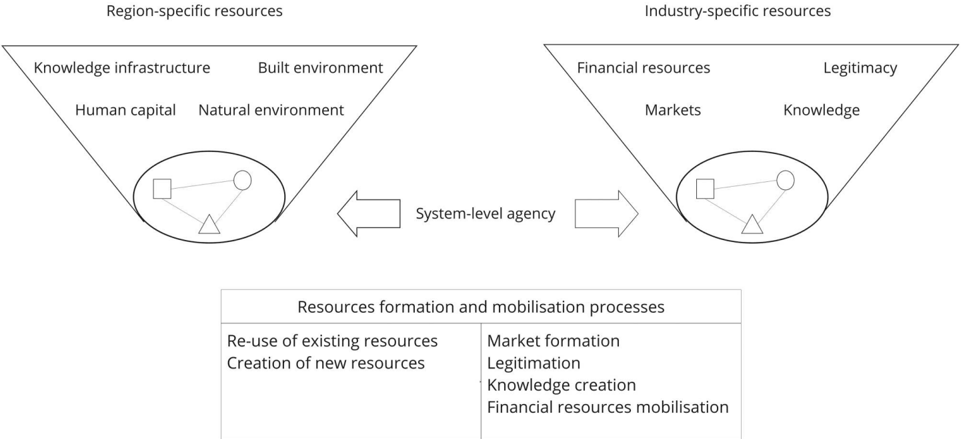
“Maskell and Malmberg (1999) identify the natural and built environment , knowledge infrastructure , and human capital as some of the resources that exist at the RIS level.”
Towards a comprehensive understanding of new regional industrial path development
Hassink, R., Isaksen, A., & Trippl, M. (2019) · Regional Studies · doi:10.1080/00343404.2019.1566704 · Cited by 501 · cited 3×
“We respond to calls to investigate agency in more diverse industrial contexts (Hassink et al., 2019) and shed light on the interactions between territorial and technological dimensions of innovation systems (Benner, 2024).”
Boschma, R., Coenen, L., Frenken, K., & Truffer, B. (2017) · Regional Studies · doi:10.1080/00343404.2016.1258460 · Cited by 464 · cited 7×
“In addition to place dependence, Boschma et al. (2017) point to the importance of path dependence that plays out across multiple spatial scales and shapes industrial development dynamics.”
InfluentialAgents of Structural Change: The Role of Firms and Entrepreneurs in Regional Diversification
Neffke, F., Hartog, M., Boschma, R., & Henning, M. (2018) · Economic Geography · doi:10.1080/00130095.2017.1391691 · Cited by 395 · cited 3×
“The re-use of existing resources (e.g., human capital and the built environment) or creation of new resources (e.g., research centres) provides opportunities for regions to diversity into new economic activities (Henning, 2022; Neffke et al., 2018).”
Trippl, M., Grillitsch, M., & Isaksen, A. (2018) · Progress in Human Geography · doi:10.1177/0309132517700982 · Cited by 377
Binz, C., Truffer, B., & Coenen, L. (2016) · Economic Geography · doi:10.1080/00130095.2015.1103177 · Cited by 341 · cited 4×
“…dependence through strategic coupling with global production networks, linking local industrial development dynamics to non-local markets and anchoring extra-regional resources locally (Binz et al., 2016; Gong et al., 2024; Grillitsch & Hansen, 2019; MacKinnon et al., 2022; Trippl et al., 2018).”
InfluentialIndustrial strategy: building a Britain fit for the future
Strategy, I. (2017) · Cited by 331
Coenen, L., & Truffer, B. (2012) · European Planning Studies · doi:10.1080/09654313.2012.651802 · Cited by 330 · cited 2×
“There is an increasing interest in how regions may pursue green restructuring strategies to exploit global demand for low-carbon technologies (e.g., Coenen & Truffer, 2012; Jakobsen et al., 2022; Trippl et al., 2020).”
Musiolik, J., Markard, J., & Hekkert, M. (2012) · Technological Forecasting and Social Change · doi:10.1016/j.techfore.2012.01.003 · Cited by 294 · cited 3×
“In the TIS framework, system-level agency is associated with the process of system building, which encompasses ‘the deliberate creation or modification of broader institutional or organizational structures’ (Musiolik et al., 2012, p. 1035).”
O'Dwyer, B. (2004) · The Real Life Guide to Accounting Research · doi:10.1016/b978-008043972-3/50025-6 · Cited by 270 · cited 1×
“Following the development of a storyline, the empirical material was coded using an open coding procedure (O’Dwyer, 2004).”
Trippl, M., Baumgartinger-Seiringer, S., Frangenheim, A., Isaksen, A., & Rypestøl, J. O. (2020) · Geoforum · doi:10.1016/j.geoforum.2020.02.016 · Cited by 259 · cited 7×
“…path with a permanent presence in GM, the city-regional authority’s system-level agency seems to have had a positive impact on creating conditions for this spatially embedded industry to emerge and grow locally (Blažek et al., 2024; Gong & Binz, 2023; Trippl et al., 2020; Uyarra & Flanagan, 2022).”
InfluentialGreen growth – A synthesis of scientific findings
Capasso, M., Hansen, T., Heiberg, J., Klitkou, A., & Steen, M. (2019) · Technological Forecasting and Social Change · doi:10.1016/j.techfore.2019.06.013 · Cited by 245 · cited 1×
“Recognising the potential of green industries to spur economic growth through exports, inward investment and high-quality jobs, researchers are examining how local economies can transform to foster green growth (Capasso et al., 2019).”
Some Notes on Institutions in Evolutionary Economic Geography
Boschma, R., & Frenken, K. (2009) · Economic Geography · doi:10.1111/j.1944-8287.2009.01018.x · Cited by 240 · cited 1×
“Dominant theories in Evolutionary Economic Geography (EEG) highlight the importance of pre-existing conditions for new industry emergence, such as the resources and capabilities present in regions (Boschma & Frenken, 2009; Martin, 2010).”
Green industry development in different types of regions
Grillitsch, M., & Hansen, T. (2019) · European Planning Studies · doi:10.1080/09654313.2019.1648385 · Cited by 234 · cited 1×
“…dependence through strategic coupling with global production networks, linking local industrial development dynamics to non-local markets and anchoring extra-regional resources locally (Binz et al., 2016; Gong et al., 2024; Grillitsch & Hansen, 2019; MacKinnon et al., 2022; Trippl et al., 2018).”
Geels, F. W., & Turnheim, B. (2022) · Cambridge University Press eBooks · doi:10.1017/9781009198233 · Cited by 211 · cited 3×
“While the lack of skills extended across the country (Geels & Turnheim, 2022; Rosenow & Eyre, 2016), erosion of the industry’s legitimacy had a concentrated spatial effect (Gong et al., 2022).”
Regional industrial restructuring resulting from individual and system agency
Isaksen, A., Jakobsen, S.-E., Njøs, R., & Normann, R. (2019) · Innovation: The European Journal of Social Science Research · doi:10.1080/13511610.2018.1496322 · Cited by 196 · cited 5×
“By allowing GMCA to create and expand local networks around the retrofit industry, local programmes also supported GMCA’s resource mobilisation and formation efforts (Isaksen et al., 2019; Musiolik et al., 2020).”
InfluentialAgency and actors in regional industrial path development. A framework and longitudinal analysis
Jolly, S., Grillitsch, M., & Hansen, T. (2020) · Geoforum · doi:10.1016/j.geoforum.2020.02.013 · Cited by 167 · cited 2×
“Institutional entrepreneurship and place-based leadership are examples of agency that reaches beyond the boundaries of a single organisation and seeks to change the regional environment in which industrial change takes place (Grillitsch & Sotarauta, 2020; Jolly et al., 2020).”
A post mortem of the Green Deal: Austerity, energy efficiency, and failure in British energy policy
Rosenow, J., & Eyre, N. (2016) · Energy Research & Social Science · doi:10.1016/j.erss.2016.07.005 · Cited by 156 · cited 2×
“While the lack of skills extended across the country (Geels & Turnheim, 2022; Rosenow & Eyre, 2016), erosion of the industry’s legitimacy had a concentrated spatial effect (Gong et al., 2022).”
Creating innovation systems: How resource constellations affect the strategies of system builders
Musiolik, J., Markard, J., Hekkert, M., & Furrer, B. (2020) · Technological Forecasting and Social Change · doi:10.1016/j.techfore.2018.02.002 · Cited by 151 · cited 6×
“By orchestrating the alignment of institutions and coordination of actors in networks, system-level agents drive the formation and mobilisation of industry-specific resources, thereby improving conditions for the emergence of new and the transformation of existing industries (Musiolik et al., 2020).”
InfluentialEnergy efficiency and the policy mix
Rosenow, J., Fawcett, T., Eyre, N., & Oikonomou, V. (2016) · Building Research & Information · doi:10.1080/09613218.2016.1138803 · Cited by 129 · cited 3×
“While the lack of skills extended across the country (Geels & Turnheim, 2022; Rosenow & Eyre, 2016), erosion of the industry’s legitimacy had a concentrated spatial effect (Gong et al., 2022).”
Institutional Agency and Path Creation
Sotarauta, M., & Suvinen, N. (2018) · Springer eBooks · doi:10.1007/978-3-319-71661-9_5 · Cited by 127 · cited 1×
“By changing formal institutions (e.g., policies and regulations) or informal institutions (e.g., user preferences or norms), institutional entrepreneurs enable innovations to compete in established markets (Sotarauta & Suvinen, 2018).”
Re-imagining evolutionary economic geography
Kogler, D. F., Evenhuis, E., Giuliani, E., Martin, R., Uyarra, E., & Boschma, R. A. (2023) · Cambridge Journal of Regions Economy and Society · doi:10.1093/cjres/rsad029 · Cited by 109
Self-citationEmerging industries: institutions, legitimacy and system-level agency
Gong, H., Binz, C., Hassink, R., & Trippl, M. (2022) · Regional Studies · doi:10.1080/00343404.2022.2033199 · Cited by 107 · cited 2×
“While the lack of skills extended across the country (Geels & Turnheim, 2022; Rosenow & Eyre, 2016), erosion of the industry’s legitimacy had a concentrated spatial effect (Gong et al., 2022).”
Expanding Analyses of Path Creation: Interconnections between Territory and Technology
Njøs, R., Sjøtun, S. G., Jakobsen, S., & Fløysand, A. (2020) · Economic Geography · doi:10.1080/00130095.2020.1756768 · Cited by 105 · cited 5×
“However, the localised processes that shape region-specific resources cannot be fully understood without considering the distinct characteristics of technologies (Njøs et al., 2020) and industries (Binz & Truffer, 2017) that they support.”
InfluentialMiörner, J. (2020) · Regional Studies · doi:10.1080/00343404.2020.1854713 · Cited by 96 · cited 5×
“As innovation systems naturally favour certain actions or interventions (Miörner, 2020; Musiolik et al., 2020), this calls to an important distinction between adapting the strategies of agency to the system as opposed to shaping the sys-tem to enable further change agency (Grillitsch & Sotarauta,…”
InfluentialThe Changing British Policy Style: From Governance to Government?
Richardson, J. (2017) · British Politics · doi:10.1057/s41293-017-0051-y · Cited by 92 · cited 1×
“Greater Manchester (GM) comprises 10 municipal auth-orities which focus predominantly on policy implementation since major policy decisions are made by central government in London (Richardson, 2018).”
Legitimation, institutions and regional path creation: a cross-national study of offshore wind
MacKinnon, D., Karlsen, A., Dawley, S., Steén, M., Afewerki, S., & Kenzhegaliyeva, A. (2021) · Regional Studies · doi:10.1080/00343404.2020.1861239 · Cited by 87 · cited 1×
“…dependence through strategic coupling with global production networks, linking local industrial development dynamics to non-local markets and anchoring extra-regional resources locally (Binz et al., 2016; Gong et al., 2024; Grillitsch & Hansen, 2019; MacKinnon et al., 2022; Trippl et al., 2018).”
Breul, M., Hulke, C., & Kalvelage, L. (2021) · Economic Geography · doi:10.1080/00130095.2021.1922277 · Cited by 77 · cited 5×
“Recent contributions suggest that the mobilisation of region-specific resources facilitated formation of industry-specific resources in the tourism (Breul et al., 2021), unmanned aerial vehicles (UAV) (Uyarra & Flanagan, 2022) and videogame industries (Gong & Binz, 2023).”
InfluentialSystem-level agency and its many shades: path development in a multidimensional innovation system
Benner, M. (2023) · Regional Studies · doi:10.1080/00343404.2023.2179614 · Cited by 75 · cited 6×
“In doing so, we shed light on how system-level agency navigates the territorial and technological dimensions of innovation systems to support the growth of new industrial paths (Benner, 2024).”
InfluentialRetrofitting existing housing: how far, how much?
Jones, P., Lannon, S., & Patterson, J. L. (2013) · Building Research & Information · doi:10.1080/09613218.2013.807064 · Cited by 73 · cited 1×
“In principle, retrofits should translate into better comfort of living and health, reduced carbon emissions and energy bill reductions (Jones et al., 2013).”
Uyarra, E., & Flanagan, K. (2021) · Regional Studies · doi:10.1080/00343404.2021.1980522 · Cited by 73 · cited 7×
“…path with a permanent presence in GM, the city-regional authority’s system-level agency seems to have had a positive impact on creating conditions for this spatially embedded industry to emerge and grow locally (Blažek et al., 2024; Gong & Binz, 2023; Trippl et al., 2020; Uyarra & Flanagan, 2022).”
InfluentialSelf-citationConfigurational innovation systems – Explaining the slow German heat transition
Wesche, J., Negro, S. O., Dütschke, E., Raven, R. P. J. M., & Hekkert, M. P. (2019) · Energy Research & Social Science · doi:10.1016/j.erss.2018.12.015 · Cited by 71 · cited 4×
“In such cases, the formation of industry-specific resources (e.g., markets) depends heavily on the re-use of region-specific resources (e.g., built environment; Wesche et al., 2019).”
InfluentialPolicy action for green restructuring in specialized industrial regions
Jakobsen, S., Uyarra, E., Njøs, R., & Fløysand, A. (2021) · European Urban and Regional Studies · doi:10.1177/09697764211049116 · Cited by 71 · cited 2×
“There is an increasing interest in how regions may pursue green restructuring strategies to exploit global demand for low-carbon technologies (e.g., Coenen & Truffer, 2012; Jakobsen et al., 2022; Trippl et al., 2020).”
Self-citationMiörner, J., & Trippl, M. (2019) · European Planning Studies · doi:10.1080/09654313.2019.1652570 · Cited by 69 · cited 6×
“Second, our study demonstrates that in addition to learning about structural conditions manifested in the available resources, agents also learn about how well these resources meet the needs of a new path (Binz & Truffer, 2017; Miörner & Trippl, 2019; Rohe & Mattes, 2022).”
InfluentialGong, H., & Andersen, A. D. (2023) · Technological Forecasting and Social Change · doi:10.1016/j.techfore.2023.123141 · Cited by 69 · cited 5×
“Further, while extra-regional industry-specific resources can sometimes be anchored locally (Binz et al., 2016; Gong et al., 2024), this is challenging for industries whose innovative capacity and market demand are spatially embedded (Binz & Truffer, 2017).”
InfluentialLevelling up policies and the failure to learn
Coyle, D., & Muhtar, M. A. (2023) · Contemporary Social Science · doi:10.1080/21582041.2023.2197877 · Cited by 63 · cited 2×
“Since 2011, there have been ongoing efforts to devolve more powers to local governments to support ‘place-based’ policy action in the UK (Coyle & Muhtar, 2023).”
Shaping factors in the emergence of technological innovations: The case of tidal kite technology
Andersson, J., Hellsmark, H., & Sandén, B. A. (2018) · Technological Forecasting and Social Change · doi:10.1016/j.techfore.2018.01.034 · Cited by 61 · cited 2×
“The resource-view of TIS emphasises markets , knowledge , financial resources and legitimacy as core industry-specific resources (e.g., Andersson et al., 2018; Binz et al., 2016; Breul et al., 2021; Gong & Andersen, 2024; Gong & Binz, 2023; Njøs et al., 2020; Uyarra & Flanagan, 2022).”
Beating the Casino: Conceptualizing an Anchoring-based Third Route to Regional Development
Gong, H., Yu, Z., Binz, C., & Truffer, B. (2023) · Economic Geography · doi:10.1080/00130095.2023.2276474 · Cited by 54
What about the regional level? Regional configurations of Technological Innovation Systems
Rohe, S., & Mattes, J. (2022) · Geoforum · doi:10.1016/j.geoforum.2022.01.007 · Cited by 49 · cited 4×
“These industrial characteristics mediate whether existing region-specific resources can be re-used or new resources must be created, or whether industry-specific resources can be formed locally or mobilised from elsewhere (Miörner & Trippl, 2019; Rohe & Mattes, 2022; Rypestøl et al., 2021).”
InfluentialInvestigating agency: methodological and empirical challenges
Grillitsch, M., Rekers, J. V., & Sotarauta, M. (2021) · Edward Elgar Publishing eBooks · doi:10.4337/9781788979689.00028 · Cited by 44
Hassink, R., Gong, H., Fröhlich, K., & Herr, A. (2021) · European Planning Studies · doi:10.1080/09654313.2021.2017857 · Cited by 36 · cited 1×
“There are significant tensions between the imperative of addressing climate change and achieving regional development objectives (Hassink et al., 2021).”
Cluster development and regional industrial restructuring: agency and asset modification
Rypestøl, J. O., Isaksen, A., Eriksen, E. L., Iakovleva, T. A., Sjøtun, S. G., & Njøs, R. (2021) · European Planning Studies · doi:10.1080/09654313.2021.1937951 · Cited by 23 · cited 3×
“These industrial characteristics mediate whether existing region-specific resources can be re-used or new resources must be created, or whether industry-specific resources can be formed locally or mobilised from elsewhere (Miörner & Trippl, 2019; Rohe & Mattes, 2022; Rypestøl et al., 2021).”
Gong, H., & Binz, C. (2023) · Geoforum · doi:10.1016/j.geoforum.2023.103729 · Cited by 22 · cited 13×
“…path with a permanent presence in GM, the city-regional authority’s system-level agency seems to have had a positive impact on creating conditions for this spatially embedded industry to emerge and grow locally (Blažek et al., 2024; Gong & Binz, 2023; Trippl et al., 2020; Uyarra & Flanagan, 2022).”
InfluentialBlažek, J., Kadlec, V., & Květoň, V. (2023) · European Planning Studies · doi:10.1080/09654313.2022.2163155 · Cited by 20 · cited 4×
“In this paper, we focus on system-level agency, that is, actions and interventions that engender change at the level of technological or regional innovation systems (e.g., Blažek et al., 2024; Gong & Binz, 2023; Uyarra & Flanagan, 2022).”
InfluentialNjøs, R., Sjøtun, S. G., Jakobsen, S., & Fløysand, A. (2024) · Economic Geography · doi:10.1080/00130095.2024.2389858 · Cited by 19 · cited 1×
“…that for industry-specific resources to engender new path development in regions, they need to be embedded in the place-specific institutional environments (Coenen & Truffer, 2012) and material contingencies (Njøs et al., 2024) through processes of anchoring (Binz et al., 2016; Gong et al., 2024).”
Ziembla, M., Uyarra, E., & Pinkse, J. (2024) · Environmental Innovation and Societal Transitions · doi:10.1016/j.eist.2024.100915 · Cited by 10 · cited 2×
“By maintaining a collective commitment to industrial change, place-based leaders facilitate access to political support and social capital, which are necessary for new economic activities to develop in regions (Ziembla et al., 2024).”
Self-citationHenning, M. (2022) · Agenda Publishing eBooks · doi:10.2307/j.ctv2b6z88r · Cited by 6 · cited 8×
“The re-use of existing resources (e.g., human capital and the built environment) or creation of new resources (e.g., research centres) provides opportunities for regions to diversity into new economic activities (Henning, 2022; Neffke et al., 2018).”
Influential
Cited by
AI Agents vs. Agentic AI: A Conceptual Taxonomy, Applications and Challenges
Sapkota, R., Roumeliotis, K. I., & Karkee, M. (2025) · arXiv · doi:10.48550/arxiv.2505.10468 · Cited by 295
“The persistent system-level context ensures that agents operate with a shared and evolving understanding of goals, environment, and prior decisions, enabling coherent coordination and sustained autonomy across complex workflows [206,207].”
AI Agents vs. Agentic AI: A Conceptual taxonomy, applications and challenges
Sapkota, R., Roumeliotis, K. I., & Karkee, M. (2026) · Information Fusion · doi:10.1016/j.inffus.2025.103599 · Cited by 671
“The persistent system-level context ensures that agents operate with a shared and evolving understanding of goals, environment, and prior decisions, enabling coherent coordination and sustained autonomy across complex workflows [206,207].”
AI Agents vs. Agentic AI: A Conceptual Taxonomy, Applications and Challenges
Sapkota, R., Roumeliotis, K. I., & Karkee, M. (2025) · SuperIntelligence - Robotics - Safety & Alignment · doi:10.70777/si.v2i3.15161 · Cited by 186
Scaling innovation through public procurement: Market acceleration, building, and transformation
Merisalo, M., Pihlajamaa, M., Uyarra, E., Valovirta, V., & Oksanen, J. (2026) · Research Policy · doi:10.1016/j.respol.2026.105563 · Cited by 8
Self-citationHealy, A. (2026) · Hydrogeology Journal · doi:10.1007/s10040-026-03059-6 · Cited by 1
“Alternatively, agency can be considered at the level of a system as a whole, recognising how interactions occur at multiple scales involving multiple actors (Grillitsch and Sotarauta 2020; Newey 2023; Ziembla et al. 2025).”
Metadata
- Authors
- Ziembla, M., Uyarra, E., & Pinkse, J.
- Affiliations
- University of Manchester (GB)
- King's College London (GB)
- Corresponding author
- Ziembla, Matt
- Venue
- Regional Studies
- Publisher
- Informa UK Limited
- Published
- 2025-02-19
- Volume
- 59
- Issue
- 1
- ISSN
- 0034-3404 (ISSN-L)
- 1360-0591
- OpenAlex
- W4407749975
- Cited by
- 7
- References
- 54
- Citations by year
- 2026: 5 · 2025: 2
- FWCI
- 12.86
- Type
- journal article
- Language
- en
- Open access
- hybrid
- doi.org
- Licence
- Locations
- Regional Studies (publishedVersion, cc-by-nc-nd)
- Research Explorer (The University of Manchester) (publishedVersion, cc-by-nc-nd)
- Research Portal (King's College London) (submittedVersion, cc-by-nc-nd)
- Figshare (submittedVersion, cc-by)
- Figshare (cc-by)
- Funders
- Regional Studies Association (R124830)
- Topics
- Social Sciences › Development › Regional Development and Innovation
- Social Sciences › Economics, Econometrics and Finance › Economics and Econometrics › Agglomeration and Urban Systems
- Physical Sciences › Environmental Science › Global and Planetary Change › Sustainability and Climate Change Governance
- Keywords
- resource mobilization, resource formation, learning process, barriers to innovation, Greater Manchester
About these checks
Registry, retraction, Cites and statistics results are computed, not judged, with one exception: a printed reference that no index lists is read once by a model before it counts as a citation error. Claims are extracted by a model and kept only when their quote appears verbatim in the text; each cited source is then checked, with a model’s help, for whether it says what the claim relies on. Those verdicts can be wrong — read the claim’s quote and the cited source before relying on one.
Statistics and arithmetic are recomputed, not judged.
Confidence bands are shown only for fields calibrated on our annotated test set. None is calibrated yet, so no band is shown.
What counts as a claim ›How we measure confidence ›How we check this ›
Are you an author, or do you see a problem with this page? Request a review
Data sources
Bibliographic data: Semantic Scholar, OpenAlex, Crossref.
Contains information from the Semantic Scholar Academic Graph Datasets, made available under the ODC Attribution License (ODC-BY 1.0).
Semantic Scholar’s data is described in: Kinney, R., et al. (2023). The Semantic Scholar Open Data Platform. arXiv:2301.10140.
