

Risk factors for the recurrence of pelvic organ prolapse: a meta-analysis
Open accessThe DOI matches its Crossref record; 34 of the 34 references it cites were found in a registry or an index; 7 of the 16 sources its claims cite were checked for support.
Abstract
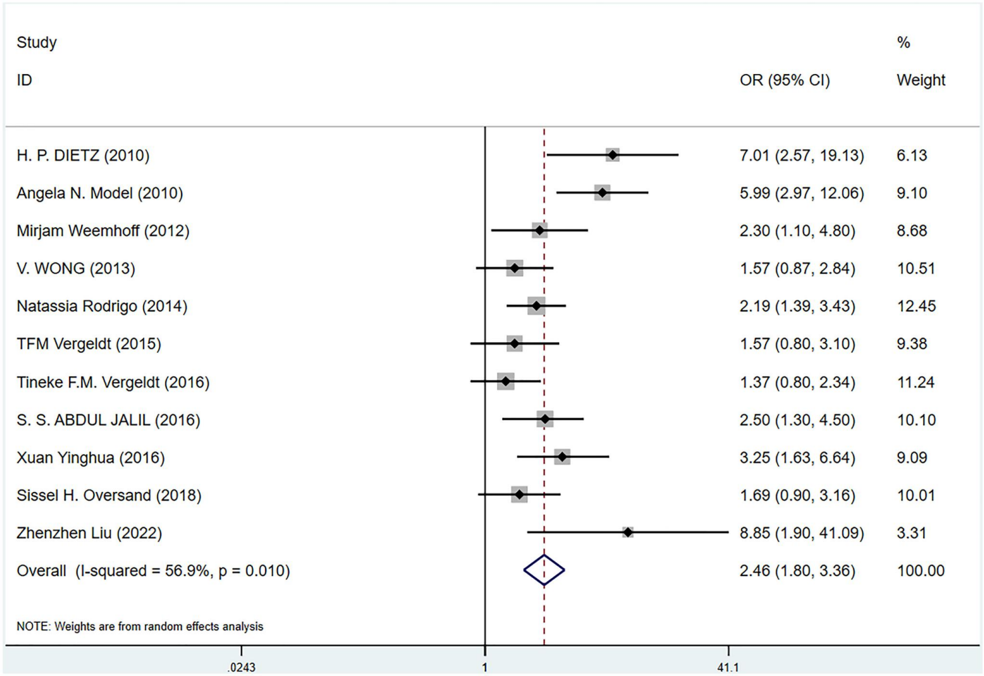
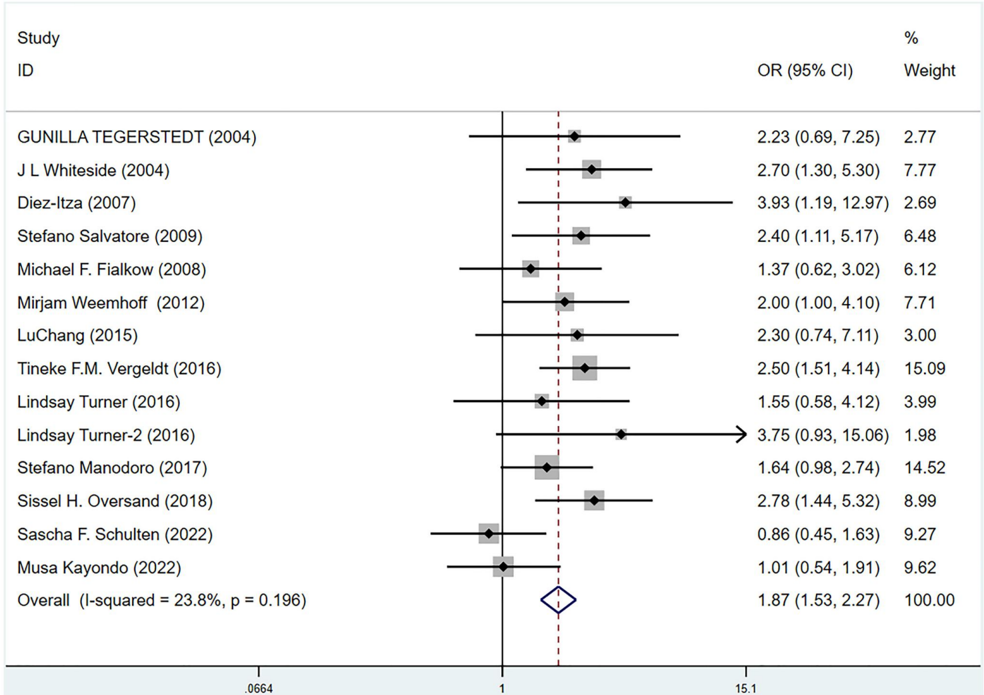
Female pelvic organ prolapse (POP) is a common condition, which has a high recurrence rate after reconstructive surgery, and the risk factors for POP recurrence are unclear. The aim of this study was to perform a meta-analysis to determine risk factors for POP recurrence. A thorough search of PubMed, Medline, EMBASE, Cochrane Central Register of Controlled Trials, and China Academic Journal Network Publishing Database was conducted for relevant publications until 29 October 2022, without language restrictions. A total of 29 studies involving 6597 patients were included, and the recurrence rate of POP after surgery was 37.7%. Significant OR and CI were found for levator avulsion (OR: 2.46, 95% CI: 1.80–3.36), preoperative stage ≥ III (OR: 1.87, 95% CI: 1.53–2.27), hiatal area on Valsalva manoeuvre (OR: 1.08, 95% CI: 1.03–1.12) and previous pelvic floor surgery (OR: 1.60, 95% CI: 1.07–2.39). Levator avulsion, preoperative stage ≥ III, hiatal area on Valsalva manoeuvre and previous pelvic floor surgery are significant risk factors for POP recurrence.IMPACT STATEMENTWhat is already known on this subject? It has been reported that genetic factors, parity, obesity, birth-induced injury during delivery, etc. are risk factors for POP development and recurrence after operation.What do the results of this study add? There are few literatures about the risk factors of POP recurrence at present. Our research has increased the information regarding risk factors for POP recurrence.What are the implications of these findings for clinical practice and/or further research? Our study provides an overview of the risk factors affecting POP recurrence and their contribution (OR, CI) to POP recurrence, which provides valuable evidence-based basis for clinical decision-making in POP treatment and prevention of POP recurrence.
Overview
CoChat Summary
TL;DR
This meta-analysis of 29 studies and 6597 patients found a 37.7% recurrence rate of pelvic organ prolapse after surgery and identified levator avulsion, preoperative stage ≥ III, hiatal area on Valsalva manoeuvre, and previous pelvic floor surgery as significant risk factors. Overweight/obesity, parity, menopause, smoking, history of hysterectomy, constipation, chronic pulmonary diseases, and diabetes mellitus were not statistically significant.
Key findings
- Among 6597 patients, 2419 had recurrence after POP surgery, giving a recurrence rate of 37.7%.
- Significant risk factors were levator avulsion (OR 2.46, 95% CI 1.80–3.36), preoperative stage ≥ III (OR 1.87, 95% CI 1.53–2.27), hiatal area on Valsalva manoeuvre (OR 1.08, 95% CI 1.03–1.12), and previous pelvic floor surgery (OR 1.60, 95% CI 1.07–2.39).
- No statistically significant effects were found for overweight or obesity, parity, menopause, smoker, history of hysterectomy, constipation, chronic pulmonary diseases, or diabetes mellitus.
- Sensitivity analyses yielded similar results for all assessed factors except parity; publication bias was detected for levator avulsion (Egger’s P = 0.04, Begg’s P = 0.04), with no evidence of publication bias for the other factors.
Methods
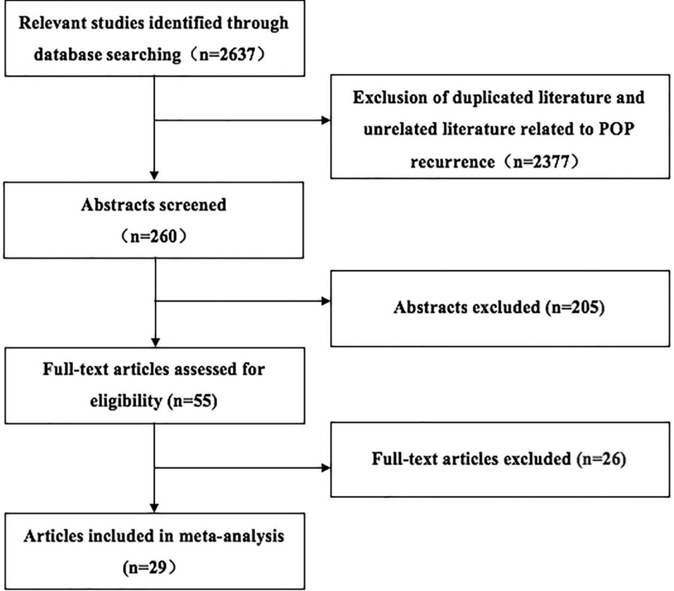
- Systematic search of PubMed, Medline, EMBASE, Cochrane Central Register of Controlled Trials, and China Academic Journal Network Publishing Database until 29 October 2022, without language restrictions; 2637 articles were initially evaluated and 29 studies were included.
- Included studies were cohort and case-control studies from Europe, America, Australia, and Asia; data extraction used a standardised form, and meta-analysis was performed in Stata 15.
- ORs and 95% CIs were pooled; heterogeneity was assessed with Cochran’s Q and I², using random-effects or fixed-effects models accordingly; Egger’s and Begg’s tests assessed publication bias. Meta-analysis was restricted to factors reported in three or more literatures.
Limitations
- Stated: differences in definitions of recurrent prolapse, inclusion criteria, and risk factors narrowed the ability to compare and use all available information in statistical analysis.
- Stated: some included literature was of low quality, with incomplete information or no extractable data causing loss of information; publication bias was detected for levator avulsion, possibly from searching English and Chinese literature; data were largely from retrospective studies, and some had similar population sizes.
- Evident from the text: all included studies were observational (cohort and case-control), so the pooled associations cannot establish causality.
Model-written summary. Check it against the paper before relying on it.
Integrity signals
Registry
Cites
Statistics
Figures



Verification
Claims the paper makes
5 Valid · 0 Not valid · 1 Not checked · 17 Own results and interpretations
The cited sources support only part of this claim — read each source’s verdict below.
In the paper
“However, surgery for POP is known to have a high recurrence rate of 36% (Tegerstedt and Hammarstr€ om 2004, Diez-Itza et al. 2007, Fialkow et al. 2008, Friedman et al. 2018).”
§ Risk factors for the recurrence of pelvic organ prolapse: a meta-analysis > Discussion
What the sources say
- Partly supportedcites Tegerstedt and Hammarstr€ om 2004 matched to “Operation for pelvic organ prolapse: a follow-up study” (2004) sourceExperimental — accuracy not yet measured
The Results report a substantial rate of persistent or recurrent anatomic prolapse: 56 of 128 women (44%) at a median follow-up of 11.3 years. The paper supports the general point that recurrence can be high, but it does not report the attributed 36% rate. (LLM, conf=0.88)
- Not checked — no full text of the sourcecites Diez-Itza et al. 2007 matched to “Risk factors for the recurrence of pelvic organ prolapse after vaginal surgery: a review at 5 years after surgery” (2007) source
- Not checked — no full text of the sourcecites Fialkow et al. 2008 matched to “Incidence of recurrent pelvic organ prolapse 10 years following primary surgical management: a retrospective cohort study” (2008) source
boosted- Asserted: passes — The authors put it forward as true.
- Checkable: passes — It can be checked against evidence.
- Load-bearing: passes — The paper’s conclusions depend on it.
- Based: passes — The paper gives a reason why it holds.
- Partly supported
The cited sources support only part of this claim — read each source’s verdict below.
In the paper
“According to the literature, the recurrence rate of POP after reconstructive surgery can be as high as 58% (Whiteside et al. 2004, Delancey et al. 2008, Fritel et al. 2009, Friedman et al. 2018).”
§ Risk factors for the recurrence of pelvic organ prolapse: a meta-analysis > Introduction
What the sources say
- Not checked — no full text of the sourcecites Whiteside et al. 2004 matched to “Risk factors for prolapse recurrence after vaginal repair” (2004) source
- Partly supportedcites Delancey et al. 2008 matched to “Graphic integration of causal factors of pelvic floor disorders: an integrated life span model” (2008) sourceExperimental — accuracy not yet measured
The Introduction mentions recurrence of pelvic floor disorders after surgery, but it gives no recurrence rate. Searches for “58%” and recurrence after reconstructive surgery found no passage supporting that figure specifically for pelvic organ prolapse; page numbers are unavailable in our copy. (LLM, conf=0.83)
- Could not verifycites Fritel et al. 2009 matched to “Symptomatic Pelvic Organ Prolapse at Midlife, Quality of Life, and Risk Factors” (2009) sourceExperimental — accuracy not yet measured
The Results report that 70 women had previously undergone POP surgery, but do not give a postoperative recurrence rate. Searches for “58%” and for recurrence after reconstructive surgery found no passage addressing the claimed rate. (LLM, conf=0.78)
plain- Asserted: passes — The authors put it forward as true.
- Checkable: passes — It can be checked against evidence.
- Load-bearing: passes — The paper’s conclusions depend on it.
- Based: passes — The paper gives a reason why it holds.
A result the paper reports from its own data — it cites no other source for it, so there is none to check. The quote shows it is in the paper.
In the paper
“A total of 29 studies involving 6597 patients were included”
- Also stated in: § Description of included studies · plain
“A total of 6597 patients were included.”
§ Risk factors for the recurrence of pelvic organ prolapse: a meta-analysis > Abstract
plainn = 6,597- Asserted: passes — The authors put it forward as true.
- Checkable: passes — It can be checked against evidence.
- Load-bearing: passes — The paper’s conclusions depend on it.
- Based: passes — The paper gives a reason why it holds.
- Also stated in: § Description of included studies · plain
A result the paper reports from its own data — it cites no other source for it, so there is none to check. The quote shows it is in the paper.
In the paper
“Significant OR and CI were found for levator avulsion (OR: 2.46, 95% CI: 1.80-3.36)”
- Also stated in: § Risk factors for POP recurrence · plain
“the risk factors for recurrence of POP are associated with levator avulsion (OR: 2.46, 95% CI: 1.80-3.36,Figure 2)”
§ Risk factors for the recurrence of pelvic organ prolapse: a meta-analysis > Abstract
plainstates an association- Asserted: passes — The authors put it forward as true.
- Checkable: passes — It can be checked against evidence.
- Load-bearing: passes — The paper’s conclusions depend on it.
- Based: passes — The paper gives a reason why it holds.
- Also stated in: § Risk factors for POP recurrence · plain
A result the paper reports from its own data — it cites no other source for it, so there is none to check. The quote shows it is in the paper.
In the paper
“previous pelvic floor surgery (OR: 1.60, 95% CI: 1.07-2.39)”
- Also stated in: § Risk factors for POP recurrence · plain
“previous pelvic floor surgery (OR: 1.60, 95% CI: 1.07-2.39, Figure S2)”
§ Risk factors for the recurrence of pelvic organ prolapse: a meta-analysis > Abstract
plainstates an association- Asserted: passes — The authors put it forward as true.
- Checkable: passes — It can be checked against evidence.
- Load-bearing: passes — The paper’s conclusions depend on it.
- Based: passes — The paper gives a reason why it holds.
- Also stated in: § Risk factors for POP recurrence · plain
6 more claims
Create a free account to see all 23 claims and every source verdict.
- Probably not a substantial claim. 5
- It may state two separate claims as one. 11
Claims other papers make about this one
Each is checked against this paper’s own text: does it say what the citing paper says it does?
In the citing paper
“Recurrence rates following primary surgery range from 13 to 30% at 1–2 years, varying by definition (subjective symptoms, anatomical stage ≥ 2, or reoperation) and are influenced by patient factors (age, parity, obesity), anatomical features (prolapse stage, levator integrity), and procedural elements (compartment addressed, concomitant repairs)”
From Individualized Prediction of Recurrence Following Uterine-Preserving Pelvic Organ Prolapse Repair Using Internally Validated Machine Learning Models (2026) · cites this paper as [5]
Self-check
Percentages, sums and reported differences re-computed from the paper’s own numbers.
Each contradiction between two passages listed here was confirmed by an independent check.
Rated major: it would touch a result — a value a result rests on, reported and recomputed p-values on opposite sides of the significance level, two passages that conflict with no sign which is right, or a cited work retracted before this paper was published.
In the paper
“A total of 6597 patients were included.Of these, 2419 cases had recurrence after operation for POP, with a recurrence rate of 37.7%.”
§ Risk factors for the recurrence of pelvic organ prolapse: a meta-analysis > Description of included studies
Reported 37.7 · recomputed 36.668183
Rated minor: it would not touch a result — a value no result rests on, a p-value that stays on the same side of the significance level, or a conflict that is clerical, resolved elsewhere in the paper, or outside its own findings.
In the paper
§ Risk factors for the recurrence of pelvic organ prolapse: a meta-analysis > Discussion
“preoperative POP score (> III)”
§ Risk factors for the recurrence of pelvic organ prolapse: a meta-analysis > Discussion
“Preoperative stage (III-IV)”
Citations
Cites
van Enst, W. A., Ochodo, E., Scholten, R. J., Hooft, L., & Leeflang, M. M. (2014) · BMC Medical Research Methodology · doi:10.1186/1471-2288-14-70 · Cited by 429 · cited 1×
“Egger’s and Begg’s test, which are the most common statistical tests used for detecting asymmetric funnel plot, were performed to investigate the publication bias (Sterne et al. 2009, van Enst et al. 2014).”
MethodRisk factors for prolapse recurrence after vaginal repair
Whiteside, J. L., Weber, A. M., Meyn, L. A., & Walters, M. D. (2004) · American Journal of Obstetrics and Gynecology · doi:10.1016/j.ajog.2004.06.109 · Cited by 329 · cited 3×
“According to the literature, the recurrence rate of POP after reconstructive surgery can be as high as 58% (Whiteside et al. 2004, Delancey et al. 2008, Fritel et al. 2009, Friedman et al. 2018).”
BackgroundGraphic integration of causal factors of pelvic floor disorders: an integrated life span model
DeLancey, J. O. L., Kane Low, L., Miller, J. M., Patel, D. A., & Tumbarello, J. A. (2008) · American Journal of Obstetrics and Gynecology · doi:10.1016/j.ajog.2008.04.001 · Cited by 267 · cited 4×
“…that genetic factors, parity, obesity, birth-induced injury during delivery, etc. are risk factors for POP development and recurrence after operation (Tegerstedt and Hammarstr € om 2004, Diez-Itza, Aizpitarte and Becerro 2007, Delancey et al. 2008, Fritel et al. 2009, Friedman et al. 2018).”
BackgroundInfluentialRisk factors for prolapse recurrence: systematic review and meta-analysis
Friedman, T., Eslick, G. D., & Dietz, H. P. (2018) · International Urogynecology Journal · doi:10.1007/s00192-017-3475-4 · Cited by 222 · cited 8×
“Although these risk factors have been analysed by other studies (Tegerstedt and Hammarstr € om 2004, Diez-Itza et al. 2007, Fialkow et al. 2008, Fritel et al. 2009, Friedman et al. 2018), our analysis shows these factors does not always have statistical significance.”
BackgroundResultInfluentialSymptomatic Pelvic Organ Prolapse at Midlife, Quality of Life, and Risk Factors
Fritel, X., Varnoux, N., Zins, M., Breart, G., & Ringa, V. (2009) · Obstetrics & Gynecology · doi:10.1097/aog.0b013e3181985312 · Cited by 197 · cited 5×
“Although these risk factors have been analysed by other studies (Tegerstedt and Hammarstr € om 2004, Diez-Itza et al. 2007, Fialkow et al. 2008, Fritel et al. 2009, Friedman et al. 2018), our analysis shows these factors does not always have statistical significance.”
BackgroundInfluentialReoperation 10 years after surgically managed pelvic organ prolapse and urinary incontinence
Denman, M. A., Gregory, W. T., Boyles, S. H., Smith, V., Edwards, S. R., & Clark, A. L. (2008) · American Journal of Obstetrics and Gynecology · doi:10.1016/j.ajog.2008.01.051 · Cited by 180 · cited 2×
“…that maintaining the normal position of female genital organs depends on normal anatomical structure and function of the pelvic floor muscles, fascia and uterine ligaments (Tegerstedt and Hammarstr € om 2004, Diez-Itza et al. 2007, Fialkow et al. 2008, Denman et al. 2008, Friedman et al. 2018).”
BackgroundLevator avulsion is a risk factor for cystocele recurrence
Dietz, H. P., Chantarasorn, V., & Shek, K. L. (2010) · Ultrasound in Obstetrics & Gynecology · doi:10.1002/uog.7678 · Cited by 180
Diez-Itza, I., Aizpitarte, I., & Becerro, A. (2007) · International Urogynecology Journal · doi:10.1007/s00192-007-0321-0 · Cited by 161 · cited 4×
“…that maintaining the normal position of female genital organs depends on normal anatomical structure and function of the pelvic floor muscles, fascia and uterine ligaments (Tegerstedt and Hammarstr € om 2004, Diez-Itza et al. 2007, Fialkow et al. 2008, Denman et al. 2008, Friedman et al. 2018).”
BackgroundInfluentialWeemhoff, M., Vergeldt, T. F. M., Notten, K., Serroyen, J., Kampschoer, P. H. N. M., & Roumen, F. J. M. E. (2012) · International Urogynecology Journal · doi:10.1007/s00192-011-1524-y · Cited by 137
Levator defects are associated with prolapse after pelvic floor surgery
Model, A. N., Shek, K. L., & Dietz, H. P. (2010) · European Journal of Obstetrics & Gynecology and Reproductive Biology · doi:10.1016/j.ejogrb.2010.07.046 · Cited by 137
Dietz, H. P. (2008) · International Urogynecology Journal · doi:10.1007/s00192-008-0695-7 · Cited by 97 · cited 3×
“…inflammation of vulva, etc. POP is common in middle-aged and elderly women, which seriously affects the health and quality of life of those women with symptomatic disorders, and easily induces anxiety, depression, and other mental disorders (Whiteside et al. 2004, Delancey et al. 2008, Dietz 2008).”
BackgroundFialkow, M. F., Newton, K. M., & Weiss, N. S. (2008) · International Urogynecology Journal · doi:10.1007/s00192-008-0678-8 · Cited by 89 · cited 4×
“…that maintaining the normal position of female genital organs depends on normal anatomical structure and function of the pelvic floor muscles, fascia and uterine ligaments (Tegerstedt and Hammarstr € om 2004, Diez-Itza et al. 2007, Fialkow et al. 2008, Denman et al. 2008, Friedman et al. 2018).”
BackgroundInfluentialIdentification of risk factors for genital prolapse recurrence
Salvatore, S., Athanasiou, S., Digesu, G. A., Soligo, M., Sotiropoulou, M., Serati, M., Antsaklis, A., & Milani, R. (2009) · Neurourology and Urodynamics · doi:10.1002/nau.20639 · Cited by 89 · cited 1×
“…have shown that risk factors for POP include age, BMI, parity, family history of POP, levator avulsion, diabetes mellitus and other chronic diseases (Tegerstedt and Hammarstr € om 2004, Diez-Itza et al. 2007, Fialkow et al. 2008, Denman et al. 2008, Salvatore et al. 2009, Vergeldt et al. 2015).”
BackgroundRodrigo, N., Wong, V., Shek, K. L., Martin, A., & Dietz, H. P. (2014) · Australian and New Zealand Journal of Obstetrics and Gynaecology · doi:10.1111/ajo.12171 · Cited by 85
Is levator avulsion a predictor of cystocele recurrence following anterior vaginal mesh placement?
Wong, V., Shek, K., Rane, A., Goh, J., Krause, H., & Dietz, H. P. (2013) · Ultrasound in Obstetrics & Gynecology · doi:10.1002/uog.12433 · Cited by 55
Manodoro, S., Frigerio, M., Cola, A., Spelzini, F., & Milani, R. (2018) · International Urogynecology Journal · doi:10.1007/s00192-017-3448-7 · Cited by 43
Operation for pelvic organ prolapse: a follow-up study
Tegerstedt, G., & Hammarström, M. (2004) · Acta Obstetricia et Gynecologica Scandinavica · doi:10.1111/j.0001-6349.2004.00468.x · Cited by 42 · cited 6×
“Although these risk factors have been analysed by other studies (Tegerstedt and Hammarstr € om 2004, Diez-Itza et al. 2007, Fialkow et al. 2008, Fritel et al. 2009, Friedman et al. 2018), our analysis shows these factors does not always have statistical significance.”
BackgroundInfluentialSchulten, S. F., Detollenaere, R. J., IntHout, J., Kluivers, K. B., & Van Eijndhoven, H. W. (2022) · American Journal of Obstetrics and Gynecology · doi:10.1016/j.ajog.2022.04.017 · Cited by 39
Levator hiatal area as a risk factor for cystocele recurrence after surgery: a prospective study
Vergeldt, T., Notten, K., Weemhoff, M., van Kuijk, S., Mulder, F., Beets‐Tan, R., Vliegen, R., Gondrie, E., Bergmans, M., Roovers, J., et al. (2015) · BJOG: An International Journal of Obstetrics & Gynaecology · doi:10.1111/1471-0528.13340 · Cited by 35 · cited 1×
“…have shown that risk factors for POP include age, BMI, parity, family history of POP, levator avulsion, diabetes mellitus and other chronic diseases (Tegerstedt and Hammarstr € om 2004, Diez-Itza et al. 2007, Fialkow et al. 2008, Denman et al. 2008, Salvatore et al. 2009, Vergeldt et al. 2015).”
BackgroundRappa, C., & Saccone, G. (2016) · American Journal of Obstetrics and Gynecology · doi:10.1016/j.ajog.2016.06.022 · Cited by 35 · cited 1×
“In agreement with previous studies (Abdul Jalil et al. 2016, Rappa and Saccone 2016, Turner et al. 2016, Cho, Moon and Kim 2017), we have shown that levator avulsion, preoperative stage � III, hiatal area on Valsalva man-oeuvre and previous pelvic surgery history are risk factors for POP…”
ResultEdenfield, A. L., Amundsen, C. L., Weidner, A. C., Wu, J. M., George, A., & Siddiqui, N. Y. (2013) · Obstetrics & Gynecology · doi:10.1097/aog.0b013e3182839eeb · Cited by 30
Turner, L., Lavelle, E., Lowder, J. L., & Shepherd, J. P. (2016) · Female Pelvic Medicine & Reconstructive Surgery · doi:10.1097/spv.0000000000000278 · Cited by 30 · cited 1×
“In agreement with previous studies (Abdul Jalil et al. 2016, Rappa and Saccone 2016, Turner et al. 2016, Cho, Moon and Kim 2017), we have shown that levator avulsion, preoperative stage � III, hiatal area on Valsalva man-oeuvre and previous pelvic surgery history are risk factors for POP…”
ResultRisk factors for recurrence of genital prolapse
Salvatore, S., Siesto, G., & Serati, M. (2010) · Current Opinion in Obstetrics & Gynecology · doi:10.1097/gco.0b013e32833e4974 · Cited by 26
Anatomical Cystocele Recurrence: Development and Internal Validation of a Prediction Model
Vergeldt, T. F. M., van Kuijk, S. M. J., Notten, K. J. B., Kluivers, K. B., & Weemhoff, M. (2016) · Obstetrics & Gynecology · doi:10.1097/aog.0000000000001272 · Cited by 25
Factors associated with recurrence after colpocleisis for pelvic organ prolapse in elderly women
Cho, M. K., Moon, J. H., & Kim, C. H. (2017) · International Journal of Surgery · doi:10.1016/j.ijsu.2017.06.086 · Cited by 23 · cited 1×
“In agreement with previous studies (Abdul Jalil et al. 2016, Rappa and Saccone 2016, Turner et al. 2016, Cho, Moon and Kim 2017), we have shown that levator avulsion, preoperative stage � III, hiatal area on Valsalva man-oeuvre and previous pelvic surgery history are risk factors for POP…”
ResultDoes it matter whether levator avulsion is diagnosed pre‐ or postoperatively?
Jalil, S. S. A., Rojas, R. G., & Dietz, H. P. (2015) · Ultrasound in Obstetrics and Gynecology · doi:10.1002/uog.15837 · Cited by 16 · cited 1×
“In agreement with previous studies (Abdul Jalil et al. 2016, Rappa and Saccone 2016, Turner et al. 2016, Cho, Moon and Kim 2017), we have shown that levator avulsion, preoperative stage � III, hiatal area on Valsalva man-oeuvre and previous pelvic surgery history are risk factors for POP…”
ResultKayondo, M., Geissbüehler, V., Migisha, R., Kajabwangu, R., Njagi, J., Kato, P. K., Fajardo, Y., Lugobe, H. M., & Kaye, D. K. (2022) · International Urogynecology Journal · doi:10.1007/s00192-021-04930-8 · Cited by 15
Impact of levator muscle avulsions on Manchester procedure outcomes in pelvic organ prolapse surgery
Oversand, S. H., Staff, A. C., Volløyhaug, I., & Svenningsen, R. (2019) · Acta Obstetricia et Gynecologica Scandinavica · doi:10.1111/aogs.13604 · Cited by 13
Bodner-Adler, B., Bodner, K., Carlin, G., Kimberger, O., Marschalek, J., Koelbl, H., & Umek, W. (2022) · Wiener klinische Wochenschrift · doi:10.1007/s00508-021-01861-8 · Cited by 11
Liu, Z., Sharen, G., Wang, P., Chen, L., & Tan, L. (2022) · BMC Women s Health · doi:10.1186/s12905-022-01686-1 · Cited by 10
Kim, J. H., Lee, S., Chae, H. D., Shin, Y. K., Lee, S. R., & Kim, S. H. (2021) · Obstetrics & Gynecology Science · doi:10.5468/ogs.21235 · Cited by 8
Yang, J., Zhang, K., Han, J., Wang, Y., Yao, Y., & Wang, H. (2021) · Gynecologic and Obstetric Investigation · doi:10.1159/000520979 · Cited by 7
Clinical analysis of the relapse and its related factors in patients with pelvic organ prolapse
Zhang, X. (2005) · Cited by 1
Anatomical Cystocele Recurrence
Vergeldt, T. F. M., van Kuijk, S. M. J., Notten, K. J. B., et al. (2016) · Obstetrical & Gynecological Survey · doi:10.1097/ogx.0000000000000317
Research works printed but not linked: 4
- 13. Higgins, J., Green, S.R., 2011. Cochrane handbook for systematic review of interventions Version 5.1.0 (updated March 2011). The Cochrane Collaboration. Training.cochrane.org/handbook/archive/v5.1/
- 18. Lu, C., Wei, W. and Lu, D., 2015. The risk factors for pelvic organ prolapse treated by traditional surgical procedures. Chinese Clinical Doctor, 43, 76-79.
- 26. Sterne, J.A., Egger, M. and Moher, D., 2009. Adressing reporting bias; detecting repoting bias. In: J.P.T. Higgins, S. Green, eds. Oxford: Wiley- Blackwell. 310-324.
- 35. Xuan, Y., et al., 2016. Study on postoperative application of trasnspreineal 3d ultrasound for pelvic organ prolapse. Chinese Journal of Clinical Obstetrics and Gynecology, 17 (3), 216-219.
Cited by
Tius, V., Arcieri, M., Taliento, C., Pellecchia, G., Capobianco, G., Simoncini, T., Panico, G., Caramazza, D., Campagna, G., Driul, L., et al. (2025) · International Journal of Gynecology & Obstetrics · doi:10.1002/ijgo.15891 · Cited by 16
Transvaginal Mesh Versus Native Tissue Repair for Anterior and Apical Pelvic Organ Prolapse
Sokol, E. R., Tu, L. M., Thomas, S. L., Erickson, T. B., & Roovers, J. (2024) · Journal of Obstetrics and Gynaecology Canada · doi:10.1016/j.jogc.2024.102658 · Cited by 7
Lo, T., Rellora, L. E., Rom, E., Chiung, H., Yang, C., & Lin, Y.-H. (2025) · International Urogynecology Journal · doi:10.1007/s00192-025-06105-1 · Cited by 4
“…* Coronary artery disease, stroke, cardiac dysrhythmias studies have shown that a preoperative stage > III and prior pelvic floor surgery increases the likelihood of POP recurrence by 37.7% following surgery [13, 15], yet our study demonstrated opposite outcomes, despite a higher-risk demographics.”
InfluentialGao, Q., Lou, W., Song, X., Guo, J., Ye, Y., Zhang, Y., Dou, Z., Zhao, X., Shi, H., Sun, Z., et al. (2024) · Heliyon · doi:10.1016/j.heliyon.2024.e30805 · Cited by 4
“A meta-analysis suggested the recurrence risk of POP surgery was 37.7 % [4].”
BackgroundInfluentialCervical prolapse during labor: A case report
Worku, A. B., Kebede, M. A., Wudineh, A. A., et al. (2025) · Case Reports in Women s Health · doi:10.1016/j.crwh.2025.e00690 · Cited by 1
“Cervical prolapse is typically associated with risk factors such as precipitous labor, instrumental deliveries, abnormal fetal positioning, multiple gestations, preterm labor, polyhydramnios (excessive amniotic fluid), and advanced maternal age [2 – 4 , 7 – 11 ].”
Metadata
- Authors
- Shi, W., & Guo, L.
- Affiliations
- Sichuan University (CN)
- Shandong University (CN)
- Corresponding author
- Guo, Lingling
- ORCID
- Shi, Wei
- Venue
- Journal of Obstetrics and Gynaecology
- Publisher
- Informa UK Limited
- Published
- 2023-01-16
- Volume
- 43
- Issue
- 1
- Pages
- 2160929-2160929
- ISSN
- 0144-3615 (ISSN-L)
- 1364-6893
- OpenAlex
- W4316662012
- Cited by
- 27
- References
- 32
- Citations by year
- 2026: 8 · 2025: 11 · 2024: 6 · 2023: 2
- FWCI
- 1.18
- Type
- journal article
- Language
- en
- Open access
- gold
- doi.org
- Licence
- Locations
- Journal of Obstetrics and Gynaecology (publishedVersion, cc-by)
- PubMed (publishedVersion)
- DOAJ (DOAJ: Directory of Open Access Journals) (submittedVersion, cc-by-sa)
- Funders
- Science Foundation from Science and Technology Department of Sichuan Province (23KPZP0189)
- Topics
- Health Sciences › Medicine › Urology › Pelvic floor disorders treatments
- Health Sciences › Medicine › Obstetrics and Gynecology › Uterine Myomas and Treatments
- Health Sciences › Medicine › Surgery › Hernia repair and management
- Keywords
- pelvic organ prolapse, prolapse recurrence, risk factors, levator avulsion, pelvic reconstruction
- MeSH terms
- Birth Injuries, Female, Humans, Obesity, Parity, Pregnancy, Risk Factors, Ultrasonography, Pelvic Floor, Pelvic Organ Prolapse
About these checks
Registry, retraction, Cites and statistics results are computed, not judged, with one exception: a printed reference that no index lists is read once by a model before it counts as a citation error. Claims are extracted by a model and kept only when their quote appears verbatim in the text; each cited source is then checked, with a model’s help, for whether it says what the claim relies on. Those verdicts can be wrong — read the claim’s quote and the cited source before relying on one.
The claim verdicts this report counts are experimental: their accuracy is not yet measured.
A language model drew the claims from the paper on 2026-09-28, under version 3 of the claim definition (model deepseek-v4.1-flash, prompt extract-v3).
A second model labelled each claim on 2026-09-28 (model jev-1.13-20260917, definition revision gold-guideline-v0.2).
Cited sources are checked with a language model’s help (gpt-6-sol).
Statistics and arithmetic are recomputed, not judged.
Confidence bands are shown only for fields calibrated on our annotated test set. None is calibrated yet, so no band is shown.
What counts as a claim ›How we measure confidence ›How we check this ›
Are you an author, or do you see a problem with this page? Request a review
Data sources
Bibliographic data: Semantic Scholar, OpenAlex, Crossref.
Contains information from the Semantic Scholar Academic Graph Datasets, made available under the ODC Attribution License (ODC-BY 1.0).
Semantic Scholar’s data is described in: Kinney, R., et al. (2023). The Semantic Scholar Open Data Platform. arXiv:2301.10140.
