

The DOI matches its Crossref record; 3 of the 3 references it cites were found in a registry or an index.
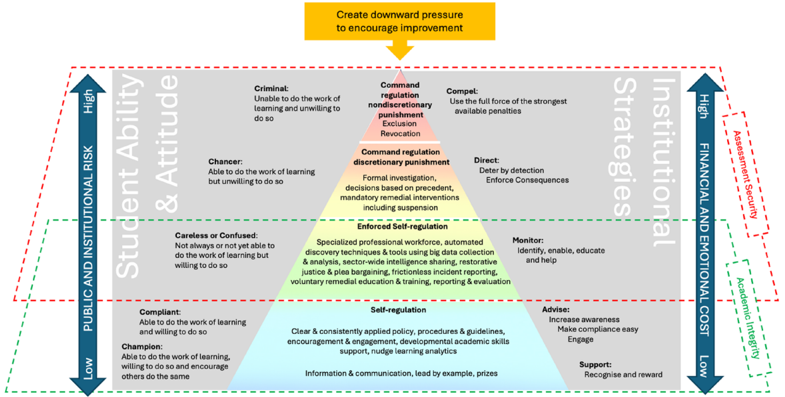
The educational integrity enforcement pyramid: a new framework for challenging and responding to student cheating
Abstract
Current approaches used by educational institutions to address the problem of student cheating are not working.This is because the discourse of academic integrity that currently dominates is, on its own, inadequate for addressing the problem.We propose that in order for higher education institutions to challenge cheating effectively, they need to learn from history and to look outside their own sector to find a new way of responding to student cheating behaviours.We propose a new framework for this.We take the theory of responsive regulation, developed by Ayres and Braithwaite, and combine it with the discourse of assessment security introduced by Dawson to form the Educational Integrity Enforcement Pyramid.We use this pyramid to show how institutions can operationalize this new approach and use it to identify gaps in their strategic response to the challenging problem of student cheating.
Overview
The claims and statistics of this paper haven’t been checked yet.
Free: it reads the open-access text and checks the first 5 claims that cite a source we can check. Create a free account to check every claim.
Integrity signals
Registry
Cites
Statistics
Figures


Verification
Claims the paper makes
The claims and statistics of this paper haven’t been checked yet.
Free: it reads the open-access text and checks the first 5 claims that cite a source we can check. Create a free account to check every claim.
Claims other papers make about this one
Each is checked against this paper’s own text: does it say what the citing paper says it does?
In the citing paper
“In such contexts, the risk is fragmented governance, where institutions adopt isolated tools or policies without aligning them to the dominant drivers identified across the literature and without coordinating responsibility across organisational levels (Ellis & Murdoch, 2024;Khan et al., 2022).”
From Drivers of academic dishonesty and multi-level prevention strategies: an umbrella review (2026) · cites this paper as Ellis & Murdoch, 2024
In the citing paper
“This literature also underscores a practical dilemma: some forms of detection are contested and may generate false positives or inequitable impacts, increasing the importance of transparent, educative approaches and proportionate enforcement (Ellis & Murdoch, 2024).”
From Drivers of academic dishonesty and multi-level prevention strategies: an umbrella review (2026) · cites this paper as Ellis & Murdoch, 2024
In the citing paper
“Assessment redesign, formative scaffolding and transparent guidance can reduce opportunity while also making legitimate completion more feasible (Bretag et al., 2019;Ellis & Murdoch, 2024;Noorbehbahani et al., 2022).”
From Drivers of academic dishonesty and multi-level prevention strategies: an umbrella review (2026) · cites this paper as Ellis & Murdoch, 2024
In the citing paper
“Recent empirical and review work similarly highlights motivational profiles, learning goals and the perceived meaning of tasks as relevant antecedents to misconduct, supporting the view that prevention should include both capability-building and assessment redesign rather than relying solely on deterrence (Ellis & Murdoch, 2024;Perkins et al., 2020).”
From Drivers of academic dishonesty and multi-level prevention strategies: an umbrella review (2026) · cites this paper as Ellis & Murdoch, 2024
Self-check
Percentages, sums and reported differences re-computed from the paper’s own numbers.
The self-check needs the paper’s full text.
Citations
Cites
Plagiarism in Higher Education: Tackling Tough Topics in Academic Integrity
Eaton, S. E. (2021) · doi:10.5040/9798400697142 · Cited by 199
Comas-Forgas, R., Lancaster, T., Calvo-Sastre, A., & Sureda-Negre, J. (2021) · Heliyon · doi:10.1016/j.heliyon.2021.e08233 · Cited by 100
Research works printed but not linked: 25
- Alonso J. 2023. “In Proctoring Debate Stanford Faculty Takes ‘Nuclear Option’.” Inside Higher Ed. May 5 2023. Accessed February 19 2024. https://www.insidehighered.com/news/students/academics/2023/05/05/proctoring-debate-stanford-faculty-takes-nuclear-option.
- 10.1093/oso/9780195070705.001.0001 · DOI · Paper page
- 10.1007/s40979-020-00055-5 · DOI
- Bertram Gallant, T. 2008. “Academic Integrity in the Twenty-First Century: A Teaching and Learning Imperative. ASHE Higher Education Report, Volume 33, Number 5.” ASHE Higher Education Report 33 (5): 1–143.
- Braithwaite, J. 1985. To Punish or Persuade: Enforcement of Coal Mine Safety. Albany: SUNY Press.
- 10.1093/oso/9780195222005.001.0001 · DOI · Paper page
- Carroll, L., and D. White. 2022. “University Students Caught Paying Others to Do Their Work at Record Levels.” Sydney Morning Herald, November 6, 2022.
- 10.1007/s10805-023-09480-w · DOI
- Curtis, G. J., and C. Ellis, “Degrees of Deniability: Contract Cheating and the Value Chain of Corruption in Higher Education – Experiences from Australia.” In Handbook on Corruption in Higher Education, edited by E. Denisova-Schmidt, P. G. Altbach and H. de Wit. Northampton, MA: Edward Elgar.
- 10.1007/978-3-031-21796-8 · DOI
- 10.1007/978-981-287-079-7_109-1 · DOI
- 10.1186/s40468-021-00149-y · DOI
- 10.32674/hepe.v5i1.1359 · DOI
- 10.1186/s41039-021-00166-8 · DOI
- 10.1007/978-3-031-54144-5_181 · DOI
- 10.1111/j.1467-9930.2007.00247.x · DOI
- 10.1007/s10805-019-09358-w · DOI
- 10.1111/j.1748-5991.2008.00039.x · DOI
- McKenzie, N., and M. Bachelard. 2023. “Fake schools, fake students: Criminals make mockery of education visas.” Sydney Morning Herald, May 16, 2023.
- McKenzie, N., A. Ballinger, and W. Kuang. 2021. “It’s easy’: Migration agents offering fake visas for $500 a month.” The Age, October 31, 2021.
- 10.1007/s10805-023-09485-5 · DOI
- 10.1016/j.jebo.2014.12.019 · DOI
- 10.2307/3053402 · DOI · Paper page
- Toma, J. D., and M. Kavanaugh. 2011. “Ethical Challenges and the Aspirational University: Fund Raising and Spectator Sports.” In Creating the Ethical Academy: A Systems Approach to Understanding Misconduct and Empowering Change, edited by Tricia Bertram Gallant, 97–114. Abingdon: Routledge.
- 10.11575/CPAI.V5I1.74195 · doi:10.11575/cpai.v5i1.74195
Cited by
Nikolic, S., Sandison, C., Haque, R., Daniel, S., Grundy, S., Belkina, M., Lyden, S., Hassan, G. M., & Neal, P. (2024) · Australasian Journal of Engineering Education · doi:10.1080/22054952.2024.2372154 · Cited by 98
Nikolic, S., Wentworth, I., Sheridan, L., Moss, S., Duursma, E., Jones, R. A., Ros, M., & Middleton, R. (2024) · Australasian Journal of Educational Technology · doi:10.14742/ajet.9643 · Cited by 102
“Although much attention is given to academic integrity factors, the emphasis cannot be placed on assessments alone and needs a holistic approach (Ellis & Murdoch, 2024).”
Thinking to learn: managing the risks of outsourcing to GenAI
Chase, A.-M., & Galvin, K. (2026) · Assessment & Evaluation in Higher Education · doi:10.1080/02602938.2026.2620055 · Cited by 8
Nikolic, S., Faculty of Engineering and Information Sciences, U. O. W., Ros, M., Al-Abdeli, Y. M., Fairweather, H., School of Engineering, E. C. U., & Head of Accreditation, E. A. (2025) · STEM Education · doi:10.3934/steme.2025027 · Cited by 5
A Three-Step Approach to Shift from Assessment Integrity to Assurance of Learning in the Age of AI
Thite, S. D., Danish, N., Florez, G. O., & Rougieux, F. (2024) · 2024 World Engineering Education Forum - Global Engineering Deans Council (WEEF-GEDC) · doi:10.1109/weef-gedc63419.2024.10854944 · Cited by 3
Metadata
- Authors
- Ellis, C., & Murdoch, K.
- Affiliations
- University of Sydney, Sydney, Australia
- Macquarie University, Sydney, Australia
- Venue
- Assessment & Evaluation in Higher Education
- Publisher
- Informa UK Limited
- Published
- 2024-03-22
- Volume
- 49
- Issue
- 7
- Pages
- 924-934
- ISSN
- 0260-2938
- 1469-297X
- Cited by
- 33
- References
- 3
- Language
- en
About these checks
Registry, retraction, Cites and statistics results are computed, not judged, with one exception: a printed reference that no index lists is read once by a model before it counts as a citation error. Claims are extracted by a model and kept only when their quote appears verbatim in the text; each cited source is then checked, with a model’s help, for whether it says what the claim relies on. Those verdicts can be wrong — read the claim’s quote and the cited source before relying on one.
Statistics and arithmetic are recomputed, not judged.
Confidence bands are shown only for fields calibrated on our annotated test set. None is calibrated yet, so no band is shown.
What counts as a claim ›How we measure confidence ›How we check this ›
Are you an author, or do you see a problem with this page? Request a review
Data sources
Bibliographic data: Semantic Scholar, OpenAlex, Crossref.
Contains information from the Semantic Scholar Academic Graph Datasets, made available under the ODC Attribution License (ODC-BY 1.0).
Semantic Scholar’s data is described in: Kinney, R., et al. (2023). The Semantic Scholar Open Data Platform. arXiv:2301.10140.
