

Summarise, elaborate, try again: exploring the effect of feedback literacy on AI-enhanced essay writing
Open accessThe DOI matches its Crossref record; 28 of the 28 references it cites were found in a registry or an index; 12 of the 40 sources its claims cite were checked for support.
Abstract
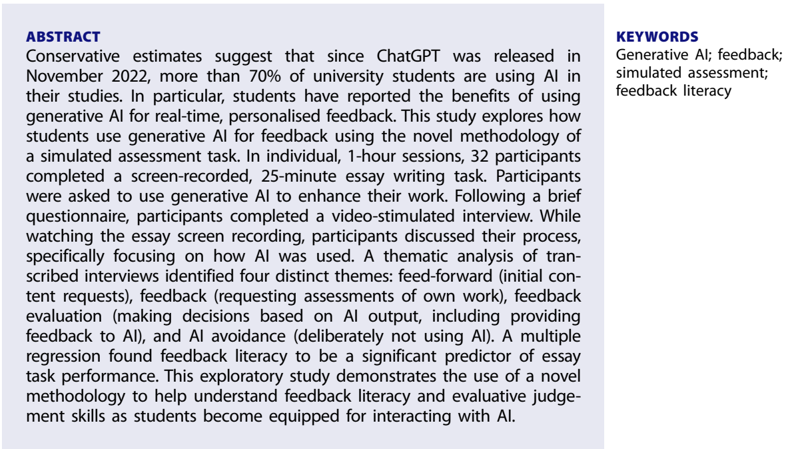
Conservative estimates suggest that since ChatGPT was released in November 2022, more than 70% of university students are using AI in their studies. In particular, students have reported the benefits of using generative AI for real-time, personalised feedback. This study explores how students use generative AI for feedback using the novel methodology of a simulated assessment task. In individual, 1-hour sessions, 32 participants completed a screen-recorded, 25-minute essay writing task. Participants were asked to use generative AI to enhance their work. Following a brief questionnaire, participants completed a video-stimulated interview. While watching the essay screen recording, participants discussed their process, specifically focusing on how AI was used. A thematic analysis of transcribed interviews identified four distinct themes: feed-forward (initial content requests), feedback (requesting assessments of own work), feedback evaluation (making decisions based on AI output, including providing feedback to AI), and AI avoidance (deliberately not using AI). A multiple regression found feedback literacy to be a significant predictor of essay task performance. This exploratory study demonstrates the use of a novel methodology to help understand feedback literacy and evaluative judgement skills as students become equipped for interacting with AI.
Overview
CoChat Summary
TL;DR
In a simulated 25-minute essay task with 32 psychology students, feedback literacy was the only significant positive predictor of essay grade in a multiple regression, although the overall model was non-significant. Thematic analysis identified four themes in how students used and avoided generative AI for feedback: feedforward, feedback, feedback evaluation, and AI avoidance.
Key findings
- The overall regression model accounted for a non-significant 35% of variance in essay grade, F(6, 25) = 2.26, p = .071. Feedback literacy was the only significant positive predictor of essay grade, β = 0.46, t(25) = 2.56, p = 0.017, 95% CI [0.09, 0.83], sr² = .17; feedback literacy and essay grade were also positively and significantly correlated (p = 0.019; Table 1 r = .41*).
- All 32 participants engaged with AI at least once; all used ChatGPT, with one participant using their own premium account. Less than 20% of participants explicitly asked AI for overall essay feedback, and most feedback requests were for line-level language improvements such as paraphrasing, synonyms, and grammar.
- All but one participant evaluated the accuracy or usefulness of AI content at least once. Half of the participants also expressed active attempts to avoid AI use during certain points of the task.
- Thematic analysis produced four distinct themes: feedforward (initial content requests), feedback (requesting assessments of own work), feedback evaluation (making decisions based on AI output, including providing feedback to AI), and AI avoidance (deliberately not using AI).
Methods
- Thirty-two psychology students (21 female, 11 male) at the University of Queensland participated; ages ranged from 17 to 46 (M = 21.5, SD = 6.1), and 68.75% were in their first year.
- In individual 60-minute sessions, participants completed a screen-recorded, 25-minute essay task with unrestricted internet access and ChatGPT (free-tier) provided under researcher credentials. After the essay, they completed a questionnaire and a video-stimulated interview while watching back the screen recording.
- Essays were graded blindly on criteria scored 0–10, summed, and converted to a percentage. A standard multiple regression tested essay grade against prior knowledge, squared task confidence, task effort, AI frequency, AI trust, and feedback literacy. Interview transcripts were analyzed using Braun and Clarke’s six-phase thematic analysis.
Limitations
- The authors state three limitations: the statistical analysis was underpowered, so regression conclusions cannot be asserted with confidence; the sample came from the psychology program of a single university and does not represent university students broadly; and the simulated task had fidelity limitations because a real-world assignment would typically involve greater topic knowledge and more time, and students knew their performance would not affect actual grades.
- The text also makes evident that the overall regression model was non-significant (p = .071) with N = 32, consistent with the authors’ stated concern about being underpowered.
- The text notes that one researcher completed all transcriptions and data coding; the paper frames this as a strength of reflexive thematic analysis, but it also means coding was not independently checked by a second researcher.
Model-written summary. Check it against the paper before relying on it.
Integrity signals
Registry
Cites
Statistics
Figures


Verification
Claims the paper makes
12 Valid · 2 Not valid · 23 Not checked · 88 Own results and interpretations
The cited sources support only part of this claim — read each source’s verdict below.
In the paper
“Conversely, students who lack self-efficacy in their learning may be disadvantaged in their studies as they cannot effectively apply feedback from generative AI (Carless and Boud 2018).”
§ Assessment & evAluAtion in HigHer educAtion Summarise, elaborate, try again: exploring the effect of feedback literacy on AI-enhanced essay writing > Feedback literacy
What the sources say
- Partly supportedcites Carless and Boud 2018 matched to “The development of student feedback literacy: Enabling uptake of feedback” (2018) sourceExperimental — accuracy not yet measured
The Introduction says student self-efficacy can affect responses to critical feedback and that learners need strategies and agency to make productive use of comments. It does not address generative-AI feedback or establish that students lacking self-efficacy cannot effectively apply it; the claim extends a general point about feedback to that specific source. (LLM, conf=0.86)
hedgedstates a possible cause- Asserted: passes — The authors put it forward as true.
- Checkable: passes — It can be checked against evidence.
- Load-bearing: unclear — It is unclear whether the paper’s conclusions depend on it.
- Based: passes — The paper gives a reason why it holds.
- Partly supported
The cited sources support only part of this claim — read each source’s verdict below.
In the paper
“This explanation is supported by a study from Escalante, Pack, and Barrett (2023) in which students considered AI-generated feedback more 'readable and detailed' compared to human-generated feedback.”
§ Assessment & evAluAtion in HigHer educAtion Summarise, elaborate, try again: exploring the effect of feedback literacy on AI-enhanced essay writing > Cognition
What the sources say
- Partly supportedcites Escalante, Pack, and Barrett (2023) matched to “AI-generated feedback on writing: insights into efficacy and ENL student preference” (2023) sourceExperimental — accuracy not yet measured
In Study 2 (Relating to RQ2), students who preferred AI feedback cited its clarity, ease of understanding, and detailed comments; one contrasted its extensive feedback with tutors’ limited time. But the Discussion and conclusion attributes the exact finding that AI feedback was more “readable and detailed” than instructor feedback to Dai et al. (2023), while this study found preferences were roughly evenly split. The citing sentence overstates that comparison as a finding about Escalante et al.’s students generally. (LLM, conf=0.85)
plain- Asserted: passes — The authors put it forward as true.
- Checkable: passes — It can be checked against evidence.
- Load-bearing: unclear — It is unclear whether the paper’s conclusions depend on it.
- Based: passes — The paper gives a reason why it holds.
- Partly supported
The cited sources support only part of this claim — read each source’s verdict below.
In the paper
“positive feedback promotes feelings of self-efficacy (Beattie et al. 2016;Peifer et al. 2020)”
§ Assessment & evAluAtion in HigHer educAtion Summarise, elaborate, try again: exploring the effect of feedback literacy on AI-enhanced essay writing > Motivation
What the sources say
- Not matchedcites Beattie et al. 2016
An author–year citation the paper’s reference list doesn’t settle. We don’t search these by name.
- Supportedcites Peifer et al. 2020 matched to “Well Done! Effects of Positive Feedback on Perceived Self-Efficacy, Flow and Performance in a Mental Arithmetic Task” (2020) source
The Discussion’s Practical Implications section recommends positive feedback as an intervention to enhance self-efficacy based on the study’s results. This directly supports the citing sentence’s paraphrase. (LLM, conf=0.94)
plainstates a cause- Asserted: passes — The authors put it forward as true.
- Checkable: passes — It can be checked against evidence.
- Load-bearing: unclear — It is unclear whether the paper’s conclusions depend on it.
- Based: passes — The paper gives a reason why it holds.
- Not matched
The cited sources support only part of this claim — read each source’s verdict below.
In the paper
“regardless of institutional policy, students are using generative AI tools (Črček and Patekar 2023).”
§ Assessment & evAluAtion in HigHer educAtion Summarise, elaborate, try again: exploring the effect of feedback literacy on AI-enhanced essay writing > Practical implications, limitations and future directions
What the sources say
- Partly supportedcites Črček and Patekar 2023 matched to “Writing with AI: University Students’ Use of ChatGPT” (2023) sourceExperimental — accuracy not yet measured
The Results (page not specified) report that 44.7% of surveyed Croatian university students used ChatGPT for assignments despite instructors’ predominantly negative stance. The paper does not establish that students used it regardless of institutional policy; it reports varied instructor positions rather than comparing use under different university policies. (LLM, conf=0.87)
plain- Asserted: passes — The authors put it forward as true.
- Checkable: passes — It can be checked against evidence.
- Load-bearing: passes — The paper’s conclusions depend on it.
- Based: passes — The paper gives a reason why it holds.
- Partly supported
A result the paper reports from its own data — it cites no other source for it, so there is none to check. The quote shows it is in the paper.
In the paper
“A thematic analysis of transcribed interviews identified four distinct themes: feed-forward (initial content requests), feedback (requesting assessments of own work), feedback evaluation (making decisions based on AI output, including providing feedback to AI), and AI avoidance (deliberately not using AI).”
- Also stated in: § Qualitative analysis · plain
“A thematic analysis conducted according to Braun and Clarke (2006) six-phase methodology produced four distinct themes: feedforward, feedback, feedback evaluation, and AI avoidance (see Figure 1).”
§ Assessment & evAluAtion in HigHer educAtion Summarise, elaborate, try again: exploring the effect of feedback literacy on AI-enhanced essay writing > Abstract
plain- Asserted: passes — The authors put it forward as true.
- Checkable: passes — It can be checked against evidence.
- Load-bearing: passes — The paper’s conclusions depend on it.
- Based: passes — The paper gives a reason why it holds.
- Also stated in: § Qualitative analysis · plain
60 more claims
Create a free account to see all 125 claims and to verify the 8 references still open.
- Probably not a substantial claim. 43
- It may state two separate claims as one. 30
- Borderline: one of the tests for a substantial claim is unclear. 2
- The quote only partly states this claim. 2
Claims other papers make about this one
Each is checked against this paper’s own text: does it say what the citing paper says it does?
In the citing paper
“Hawkins, Taylor-Griffiths, and Lodge (2025) studied feedback literacy in a simulated assignment and suggested that students judge feedback from GenAI or avoid using it.”
From How university students work on assessment tasks with generative artificial intelligence: matters of judgement (2026) · cites this paper as Hawkins, Taylor-Griffiths, and Lodge (2025)
Statistics recomputed
Every reported test result, recomputed from its test statistic and degrees of freedom. A result shows as not adding up only once an independent check has confirmed it.
- ConsistentF(6, 25) = 2.26reported p = .071 · recomputed p = .070
“F(6, 25) = 2.26, p = .071”
- Consistentt(25) = 2.56reported p = .017 · recomputed p = .017
“t(25) = 2.56, p = .017”
- Consistentt(25) = 0.59reported p = .562 · recomputed p = .560
“t(25) = 0.59, p = .562”
- Consistentt(25) = 1.01reported p = .324 · recomputed p = .322
“t(25) = 1.01, p = .324”
- Consistentt(25) = -1.58reported p = .127 · recomputed p = .127
“t(25) = -1.58,p = .127”
2 more recomputed tests
Create a free account to see every test the Stats check recomputed.
Self-check
Percentages, sums and reported differences re-computed from the paper’s own numbers.
Rated minor: it would not touch a result — a value no result rests on, a p-value that stays on the same side of the significance level, or a conflict that is clerical, resolved elsewhere in the paper, or outside its own findings.
In the paper
“β = 0.16, t(25) = 0.59, p = 0.562, CI [-0.32, 0.48], sr 2 = 0.01”
§ Assessment & evAluAtion in HigHer educAtion Summarise, elaborate, try again: exploring the effect of feedback literacy on AI-enhanced essay writing > Practical implications, limitations and future directions
Reported 0.16 · recomputed 0.08
Citations
Cites
Using thematic analysis in psychology
Braun, V., & Clarke, V. (2006) · Qualitative Research in Psychology · doi:10.1191/1478088706qp063oa · Cited by 194,414
Hattie, J., & Timperley, H. (2007) · Review of Educational Research · doi:10.3102/003465430298487 · Cited by 12,905 · cited 3×
“Students in our study typically requested task-level feedback (Hattie and Timperley 2007).”
Building a practically useful theory of goal setting and task motivation: A 35-year odyssey.
Locke, E. A., & Latham, G. P. (2002) · American Psychologist · doi:10.1037/0003-066x.57.9.705 · Cited by 7,766 · cited 1×
“Locke and Latham (2002) argue that learning goals are especially important for driving self-regulated attention and motivation.”
The Role of Goal Orientation in Self-Regulated Learning
Pintrich, P. R. (2000) · Handbook of Self-Regulation · doi:10.1016/b978-012109890-2/50043-3 · Cited by 5,173 · cited 6×
“The feedback students received from generative AI’s dot-point topic summarisations and essay exemplars promoted a metacognitive awareness of knowledge acquisition, which Pintrich (2000) refers to as ‘judgements of learning’ (459).”
InfluentialConceptual and design thinking for thematic analysis.
Braun, V., & Clarke, V. (2022) · Qualitative Psychology · doi:10.1037/qup0000196 · Cited by 4,502 · cited 1×
“According to Braun and Clarke (2022), reflexive thematic analysis considers the coding and theme identification an inter-pretive process, and that the researcher’s interpretation of the data (within the boundaries of the study’s foundational theories, i.e. feedback literacy), is a strength, not a…”
A Review of Self-regulated Learning: Six Models and Four Directions for Research
Panadero, E. (2017) · Frontiers in Psychology · doi:10.3389/fpsyg.2017.00422 · Cited by 2,915 · cited 2×
“We interpret these skills within the broader scope of self-regulated learning (SRL) capabilities (Pintrich 2000; Panadero 2017).”
Students' voices on generative ai: perceptions, benefits, and challenges in higher education
Chan, C. K. Y., & Hu, W. (2023) · arXiv · doi:10.48550/arxiv.2305.00290 · Cited by 2,504 · cited 3×
“In one study, 30% of students reported using AI for generating text, while another study reported idea generation and real-time, personalised feedback to be the most common reasons for use (Chan and Hu 2023; Higher Education Policy Institute 2024).”
InfluentialThe development of student feedback literacy: Enabling uptake of feedback
Carless, D., & Boud, D. (2018) · Assessment & Evaluation in Higher Education · doi:10.1080/02602938.2018.1463354 · Cited by 2,428 · cited 5×
“Feedback literacy skills are best considered within Carless and Boud (2018) four-component framework: appreciating feedback, judgement-making, managing affect, and taking action.”
InfluentialStudents’ voices on generative AI: perceptions, benefits, and challenges in higher education
Chan, C. K. Y., & Hu, W. (2023) · International Journal of Educational Technology in Higher Education · doi:10.1186/s41239-023-00411-8 · Cited by 2,301 · cited 3×
“In one study, 30% of students reported using AI for generating text, while another study reported idea generation and real-time, personalised feedback to be the most common reasons for use (Chan and Hu 2023; Higher Education Policy Institute 2024).”
InfluentialFeuerriegel, S., Hartmann, J., Janiesch, C., & Zschech, P. (2024) · Business & Information Systems Engineering · doi:10.1007/s12599-023-00834-7 · Cited by 2,267
Handbook of Self-Regulation of Learning and Performance
Schunk, D. H. (2011) · Routledge eBooks · doi:10.4324/9780203839010 · Cited by 2,122
The Power of Feedback Revisited: A Meta-Analysis of Educational Feedback Research
Wisniewski, B., Zierer, K., & Hattie, J. (2020) · Frontiers in Psychology · doi:10.3389/fpsyg.2019.03087 · Cited by 1,199 · cited 2×
“These findings are consistent with existing research that has demonstrated the positive effect of feedback on academic outcomes (Wisniewski, Zierer, and Hattie 2019), and the conceptualisation of feedback literacy as a sophisticated toolset required for seeking out, evaluating, and applying said…”
Sitzmann, T., & Ely, K. (2011) · Psychological Bulletin · doi:10.1037/a0022777 · Cited by 897 · cited 1×
“This finding is consistent with existing research that positive feedback promotes feelings of self-efficacy (Beattie et al. 2016; Peifer et al. 2020), which is central to goal-orientated SRL behaviours (Sitzmann and Ely 2011).”
AI-generated feedback on writing: insights into efficacy and ENL student preference
Escalante, J., Pack, A., & Barrett, A. (2023) · International Journal of Educational Technology in Higher Education · doi:10.1186/s41239-023-00425-2 · Cited by 589 · cited 1×
“This explanation is supported by a study from Escalante, Pack, and Barrett (2023) in which students considered AI-generated feedback more ‘readable and detailed’ compared to human-generated feedback.”
The promise and challenges of generative AI in education
Giannakos, M., Azevedo, R., Brusilovsky, P., Cukurova, M., Dimitriadis, Y., Hernandez-Leo, D., Järvelä, S., Mavrikis, M., & Rienties, B. (2025) · Behaviour & Information Technology · doi:10.1080/0144929x.2024.2394886 · Cited by 543
Abbas, M., Jam, F. A., & Khan, T. I. (2024) · International Journal of Educational Technology in Higher Education · doi:10.1186/s41239-024-00444-7 · Cited by 531 · cited 1×
“In a real-world assignment, university students would typically have greater topic knowledge, and more time in which to complete the task, although evidence already exists that time pressures of university workloads are associated with greater AI use (Abbas, Jam, and Khan 2024).”
Meyer, J., Jansen, T., Schiller, R., Liebenow, L. W., Steinbach, M., Horbach, A., & Fleckenstein, J. (2024) · Computers and Education: Artificial Intelligence · doi:10.1016/j.caeai.2023.100199 · Cited by 311 · cited 2×
“A study of 459 grade 10 students investigating the effects of AI-generated feedback on essay task revision partially overcame this design limitation (Meyer et al. 2024).”
Järvelä, S., Järvenoja, H., Malmberg, J., Isohätälä, J., & Sobocinski, M. (2016) · Learning and Instruction · doi:10.1016/j.learninstruc.2016.01.005 · Cited by 220 · cited 1×
“…supported by existing literature which has demonstrated the benefits of co-regulated learning in other contexts for the forethought and planning (Järvelä et al. 2016; vrieling-Teunter et al. 2022) and monitoring and reflection (Saariaho et al. 2016) phases of SRL, and, the limitations of…”
Robinson, S., Pope, D., & Holyoak, L. (2013) · Assessment & Evaluation in Higher Education · doi:10.1080/02602938.2011.629291 · Cited by 152 · cited 1×
“Appreciating feedback also involves managing one’s emotional response to feedback, as feedback that suggests one is incorrect or underperforming can be a threat to identity and motivation and cause feelings of frustration and disappointment (Robinson, Pope, and Holyoak 2013).”
Measuring what learners do in feedback: the feedback literacy behaviour scale
Dawson, P., Yan, Z., Lipnevich, A., Tai, J., Boud, D., & Mahoney, P. (2024) · Assessment & Evaluation in Higher Education · doi:10.1080/02602938.2023.2240983 · Cited by 116 · cited 3×
“Dawson et al. (2024) 24-question self-report survey was used to measure participant feedback literacy on a 6-point scale (1 = never, 6 = always).”
InfluentialWriting with AI: University Students’ Use of ChatGPT
Črček, N., & Patekar, J. (2023) · Journal of Language and Education · doi:10.17323/jle.2023.17379 · Cited by 109 · cited 1×
“The learning landscape is changing, and regardless of institutional policy, students are using generative AI tools (Črček and Patekar 2023).”
Peifer, C., Schönfeld, P., Wolters, G., Aust, F., & Margraf, J. (2020) · Frontiers in Psychology · doi:10.3389/fpsyg.2020.01008 · Cited by 87 · cited 1×
“This finding is consistent with existing research that positive feedback promotes feelings of self-efficacy (Beattie et al. 2016; Peifer et al. 2020), which is central to goal-orientated SRL behaviours (Sitzmann and Ely 2011).”
The role of performance feedback on the self-efficacy–performance relationship.
Beattie, S., Woodman, T., Fakehy, M., & Dempsey, C. (2016) · Sport, Exercise, and Performance Psychology · doi:10.1037/spy0000051 · Cited by 69 · cited 1×
“This finding is consistent with existing research that positive feedback promotes feelings of self-efficacy (Beattie et al. 2016; Peifer et al. 2020), which is central to goal-orientated SRL behaviours (Sitzmann and Ely 2011).”
Student teachers’ self- and co-regulation of learning during teacher education
Saariaho, E., Pyhältö, K., Toom, A., Pietarinen, J., & Soini, T. (2016) · Learning: Research and Practice · doi:10.1080/23735082.2015.1081395 · Cited by 47 · cited 1×
“…of co-regulated learning in other contexts for the forethought and planning (Järvelä et al. 2016; vrieling-Teunter et al. 2022) and monitoring and reflection (Saariaho et al. 2016) phases of SRL, and, the limitations of co-regulated learning for encouraging learning autonomy (Embo and valcke 2019).”
Vrieling, E., Henderikx, M., Nadolski, R. J., & Kreijns, K. (2022) · Frontiers in Psychology · doi:10.3389/fpsyg.2022.793798 · Cited by 43 · cited 1×
“…literature which has demonstrated the benefits of co-regulated learning in other contexts for the forethought and planning (Järvelä et al. 2016; vrieling-Teunter et al. 2022) and monitoring and reflection (Saariaho et al. 2016) phases of SRL, and, the limitations of co-regulated learning for…”
Experimental Evidence on the Effectiveness of Automated Essay Scoring in Teacher Education Cases
Riedel, E., Dexter, S. L., Scharber, C., & Doering, A. (2006) · Journal of Educational Computing Research · doi:10.2190/u552-m54q-5771-m677 · Cited by 25 · cited 1×
“The essay question provided to participants was adapted from Riedel et al. (2006): ‘Consider how technology can add value to the classroom in order to meet the diverse needs of learners.”
Improving Student Midwives' Workplace Learning by Moving from Self-to co-Regulated Learning!
Embo, M., & Valcke, M. (2019) · Women and Birth · doi:10.1016/j.wombi.2018.08.004 · Cited by 12 · cited 1×
“…of co-regulated learning in other contexts for the forethought and planning (Järvelä et al. 2016; vrieling-Teunter et al. 2022) and monitoring and reflection (Saariaho et al. 2016) phases of SRL, and, the limitations of co-regulated learning for encouraging learning autonomy (Embo and valcke 2019).”
Learning with Generative Artificial Intelligence Within a Network of Co-Regulation
Lodge, J. M., De Barba, P., & Broadbent, J. (2024) · Journal of University Teaching and Learning Practice · doi:10.53761/m2v9an32 · Cited by 9 · cited 3×
“Students in our study engaged in co-regulation with generative AI (as per Lodge, de Barba, and Broadbent 2024) to ease the cognitive burden of an assessment task by outsourcing cognitively intense activities to AI.”
InfluentialSelf-citation
Cited by
Walton, J., Bearman, M., Crawford, N., Tai, J., & Boud, D. (2026) · Assessment & Evaluation in Higher Education · doi:10.1080/02602938.2025.2570328 · Cited by 28
“Others can make strong judgements to avoid using GenAI (Hawkins, Taylor-Griffiths, and Lodge 2025; Henderson et al. 2025).”
AI self-efficacy and knowledge graph-integrated generative AI feedback in higher education
Tu, Y.-F., Liu, G.-P., Hwang, G., Chen, X.-W., & Guo, X.-G. (2026) · The Internet and Higher Education · doi:10.1016/j.iheduc.2026.101079 · Cited by 10
Fredriksson, A.-L. (2025) · Frontiers in Education · doi:10.3389/feduc.2025.1612398 · Cited by 4
The Dimensions of Abundance in AI-Generated Feedback
Lindsay, E. D., Rodda, A. E., Lindqvist, A. L., Quince, Z., Lim, M., & Jiang, D. (2026) · Education Sciences · doi:10.3390/educsci16030465 · Cited by 3
Student Perspectives on GenAI : Usage, Attitudes, and Academic Integrity in Psychology Education
Bloxham, A., Newham, T., Ryding, C., & Hadlington, L. (2026) · Applied AI Letters · doi:10.1002/ail2.70025 · Cited by 5
Metadata
- Authors
- Hawkins, B., Taylor-Griffiths, D., & Lodge, J. M.
- Affiliations
- The University of Queensland (AU)
- Corresponding author
- Lodge, Jason M.
- ORCID
- Lodge, Jason M.
- Venue
- Assessment & Evaluation in Higher Education
- Publisher
- Informa UK Limited
- Published
- 2025-04-22
- Volume
- 51
- Issue
- 5
- Pages
- 879-891
- ISSN
- 0260-2938 (ISSN-L)
- 1469-297X
- OpenAlex
- W4409672219
- Cited by
- 17
- References
- 27
- Citations by year
- 2026: 14 · 2025: 4
- FWCI
- 11.62
- Type
- journal article
- Language
- en
- Open access
- hybrid
- doi.org
- Licence
- cc-by-nc-nd
- creativecommons.org/licenses/by-nc-nd/4.0/ (vor)
- doi.org/10.1080/policies-text-data-mining (tdm)
- Locations
- Assessment & Evaluation in Higher Education (publishedVersion, cc-by-nc-nd)
- Topics
- Physical Sciences › Computer Science › Computer Science Applications › Online Learning and Analytics
- Physical Sciences › Computer Science › Artificial Intelligence › Intelligent Tutoring Systems and Adaptive Learning
- Social Sciences › Psychology › Developmental and Educational Psychology › Innovative Teaching and Learning Methods
- Keywords
- feedback literacy, generative AI, student use of AI, feedforward, feedback evaluation, university students
About these checks
Registry, retraction, Cites and statistics results are computed, not judged, with one exception: a printed reference that no index lists is read once by a model before it counts as a citation error. Claims are extracted by a model and kept only when their quote appears verbatim in the text; each cited source is then checked, with a model’s help, for whether it says what the claim relies on. Those verdicts can be wrong — read the claim’s quote and the cited source before relying on one.
The claim verdicts this report counts are experimental: their accuracy is not yet measured.
A language model drew the claims from the paper on 2026-10-05, under version 3 of the claim definition (model deepseek-v4.1-flash, prompt extract-v3).
A second model labelled each claim on 2026-10-05 (model jev-1.13-20260917, definition revision gold-guideline-v0.2).
Cited sources are checked with a language model’s help (gpt-6-sol).
Statistics and arithmetic are recomputed, not judged.
Confidence bands are shown only for fields calibrated on our annotated test set. None is calibrated yet, so no band is shown.
What counts as a claim ›How we measure confidence ›How we check this ›
Are you an author, or do you see a problem with this page? Request a review
Data sources
Bibliographic data: Semantic Scholar, OpenAlex, Crossref.
Contains information from the Semantic Scholar Academic Graph Datasets, made available under the ODC Attribution License (ODC-BY 1.0).
Semantic Scholar’s data is described in: Kinney, R., et al. (2023). The Semantic Scholar Open Data Platform. arXiv:2301.10140.
