

ChatGPT, Education, and Understanding
Open accessThe DOI matches its Crossref record; 58 of the 58 references it cites were found in a registry or an index; 7 of the 10 sources its claims cite were checked for support.
Abstract
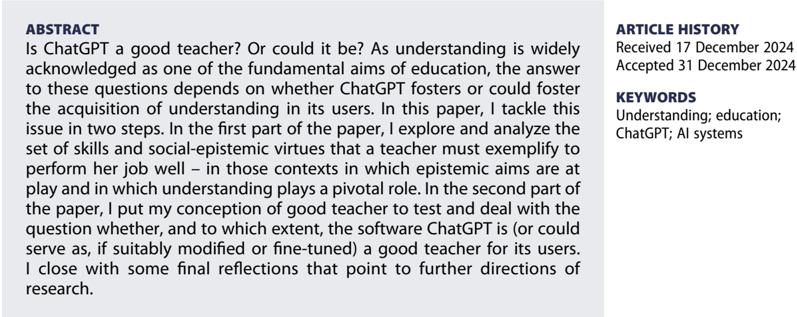
Is ChatGPT a good teacher? Or could it be? As understanding is widely acknowledged as one of the fundamental aims of education, the answer to these questions depends on whether ChatGPT fosters or could foster the acquisition of understanding in its users. In this paper, I tackle this issue in two steps. In the first part of the paper, I explore and analyze the set of skills and social-epistemic virtues that a teacher must exemplify to perform her job well – in those contexts in which epistemic aims are at play and in which understanding plays a pivotal role. In the second part of the paper, I put my conception of good teacher to test and deal with the question whether, and to which extent, the software ChatGPT is (or could serve as, if suitably modified or fine-tuned) a good teacher for its users. I close with some final reflections that point to further directions of research.
Overview
CoChat Summary
TL;DR
This paper asks whether ChatGPT is or could be a good teacher, focusing on education’s epistemic aim of understanding. It argues that good teaching requires social-epistemic virtues such as intellectual honesty, epistemic empathy, and epistemic care, and that ChatGPT can sometimes behave as if it has empathy and care but cannot genuinely care because it is a predictive algorithm.
Key findings
- Sincerity is not a classroom virtue: the insincere teachers Stella and Lilith can effectively generate knowledge and understanding if they are competent and intellectually honest, i.e. stably tethered to the best available evidence.
- Epistemic empathy and epistemic care are central to fostering objectual understanding; epistemic care requires not just caring behavior but a motivational structure grounded in appreciation of the other’s epistemic well-being.
- In the author’s tests, ChatGPT 4.0 behaved in ways that would be called epistemically empathetic or caring if done by a human: it inferred an unspoken why-question about flamingos at Lake Constance, offered multiple possible explanations, tailored an explanation for a 4-year-old, and responded to a flat-Earth prompt by simulating flat-Earth arguments while noting they are unsupported.
- A hypothetical accuracy-fine-tuned “ChatGPT 95” would be intellectually honest and a reliable source of knowledge, but whether it fosters understanding depends on whether it could possess and exercise epistemic empathy and epistemic care; ChatGPT can take care of users epistemically but cannot truly care about their epistemic well-being.
Methods
- Conceptual/philosophical analysis of understanding, teacher virtues, and ChatGPT, assuming for the sake of argument an objectualist and antireductionist conception of understanding.
- The paper examines three social-epistemic virtues in education: intellectual honesty, epistemic empathy, and epistemic care.
- It uses the author’s own interactions with ChatGPT 4.0 as illustrative tests, including prompts about wild flamingos at Lake Constance, explaining flamingos to a 4-year-old, and defending a flat-Earth belief.
Limitations
- The author states that some empirical claims—e.g. that teaching and learning run smoother with an epistemically caring teacher, and that students are more prone to trust such a teacher—are hard to back up from the armchair and not fully justified.
- The author notes that the reflections on epistemic care hold only under the assumption of a friendly or ideal epistemic environment, not one affected by polarization or epistemic injustice.
- The author restricts attention to ChatGPT and says only a comparative analysis of different LLMs could confirm whether the arguments apply more generally; the text also makes evident that the ChatGPT evidence is anecdotal single-user interaction rather than a controlled empirical study.
Model-written summary. Check it against the paper before relying on it.
Integrity signals
Registry
Cites
Statistics
Figures


Verification
Claims the paper makes
6 Valid · 6 Not valid · 1 Not checked · 69 Own results and interpretations
The cited sources support only part of this claim — read each source’s verdict below.
In the paper
“As understanding is widely acknowledged as one of the fundamental aims of education, the answer to these questions depends on whether ChatGPT fosters or could foster the acquisition of understanding in its users.”
- Also stated in: § 1. Introduction · boosted
“which is widely acknowledged to be one of the fundamental epistemic goals of education (Croce and Pritchard 2022;Elgin 1999Elgin , 2021Elgin , 2022;;Pritchard 2020).”
What the sources say
- Partly supportedcites Croce and Pritchard 2022 sourceExperimental — accuracy not yet measured
Section 1 (page unavailable) identifies understanding as a possible epistemic aim of education and an elevated epistemic good. It does not establish that understanding is widely acknowledged as a fundamental aim; the paper instead develops an account centered on cultivating intellectual character. (LLM, conf=0.86)
- Not checked — no full text of the sourcecites Elgin 1999 source
- Could not verifycites Pritchard 2020 sourceExperimental — accuracy not yet measured
The opening discussion and “The Puzzle Resolved” identify intellectual virtue and self-confidence as educational goals, but neither identifies understanding as a fundamental aim. A search for “understanding” found it in other contexts, not as an educational aim; the cited paper therefore does not establish the attributed claim. (LLM, conf=0.74)
boosted- Asserted: passes — The authors put it forward as true.
- Checkable: passes — It can be checked against evidence.
- Load-bearing: passes — The paper’s conclusions depend on it.
- Based: passes — The paper gives a reason why it holds.
- Also stated in: § 1. Introduction · boosted
The cited sources support only part of this claim — read each source’s verdict below.
In the paper
“The first versions of ChatGPT have been shown to deliver inaccurate, biased, and sometimes irrelevant information (Floridi and Chiriatti 2020).”
What the sources say
- Partly supportedcites Floridi and Chiriatti 2020 sourceExperimental — accuracy not yet measured
In “Three Tests: Mathematics, Semantics, and Ethics,” the authors report an incorrect arithmetic answer, irrelevant output, and stereotyped or racist responses. Those observations concern GPT-3, however, not the first versions of ChatGPT. The paper does not establish the claim for ChatGPT. (LLM, conf=0.88)
boostedstates a cause- Asserted: passes — The authors put it forward as true.
- Checkable: passes — It can be checked against evidence.
- Load-bearing: passes — The paper’s conclusions depend on it.
- Based: passes — The paper gives a reason why it holds.
- Partly supported
The cited sources support only part of this claim — read each source’s verdict below.
In the paper
“Very much like passing a Turing test does not qualify a machine as intelligent, passing an equivalent test for epistemic empathy would not automatically qualify ChatGPT as epistemically empathetic.”
What the sources say
- Partly supportedcites Floridi and Chiriatti (2020, 683) sourceExperimental — accuracy not yet measured
The Introduction states that passing the Turing test does not qualify an AI as intelligent, supporting the sentence’s analogy. The paper does not discuss a test for epistemic empathy or whether passing one would qualify ChatGPT as epistemically empathetic; that application is the citing authors’ extension of the argument. (LLM, conf=0.84)
plain- Asserted: passes — The authors put it forward as true.
- Checkable: passes — It can be checked against evidence.
- Load-bearing: passes — The paper’s conclusions depend on it.
- Based: passes — The paper gives a reason why it holds.
- Partly supported
A result the paper states — it cites no source for it, so there is none to check. The quote shows it is in the paper.
In the paper
“First, the software is able to address my epistemic needs effectively, although these are not explicit in the prompt it receives.”
plainstates a causeSingle case- Asserted: passes — The authors put it forward as true.
- Checkable: passes — It can be checked against evidence.
- Load-bearing: passes — The paper’s conclusions depend on it.
- Based: passes — The paper gives a reason why it holds.
A result the paper states — it cites no source for it, so there is none to check. The quote shows it is in the paper.
In the paper
“Another impressive capacity of ChatGPT, one that is particularly important when it comes to fostering understanding, is its capacity to adapt its message (in both form and content) depending on who is asking the question.”
plain- Asserted: passes — The authors put it forward as true.
- Checkable: passes — It can be checked against evidence.
- Load-bearing: passes — The paper’s conclusions depend on it.
- Based: passes — The paper gives a reason why it holds.
19 more claims
Create a free account to see all 82 claims and every source verdict.
- Probably not a substantial claim. 53
- It may state two separate claims as one. 15
- The quote only partly states this claim. 1
Self-check
Percentages, sums and reported differences re-computed from the paper’s own numbers.
Each contradiction between two passages listed here was confirmed by an independent check.
Rated minor: it would not touch a result — a value no result rests on, a p-value that stays on the same side of the significance level, or a conflict that is clerical, resolved elsewhere in the paper, or outside its own findings.
In the paper
§ 5. Final Thoughts: Epistemic Enveloping
“In a paper entitled 'What the Near Future of Artificial Intelligence Can Be', Floridi draws a distinction between difficult and complex tasks (Floridi 2019, 9).”
§ References
“Floridi, L. 2019. "What the Near Future of Artificial Intelligence Could Be."”
Citations
Cites
GPT-3: Its Nature, Scope, Limits, and Consequences
Floridi, L., & Chiriatti, M. (2020) · Minds and Machines · doi:10.1007/s11023-020-09548-1 · Cited by 2,519 · cited 2×
“The first versions of ChatGPT have been shown to deliver inaccurate, biased, and sometimes irrelevant information (Floridi and Chiriatti 2020).”
Stanford Encyclopedia of Philosophy 2009: Building an Endowment with Community Support
Loy, M. (2015) · doi:10.18665/sr.22353 · Cited by 2,465
The Value of Knowledge and the Pursuit of Understanding
Kvanvig, J. L. (2003) · Cambridge University Press eBooks · doi:10.1017/cbo9780511498909 · Cited by 998
Pritchard, D. (2005) · doi:10.1093/019928038x.001.0001 · Cited by 874
Lackey, J. (2008) · Oxford University Press eBooks · doi:10.1093/acprof:oso/9780199219162.001.0001 · Cited by 688 · cited 1×
“To appreciate this, think of Stella, Lackey’s teacher, who teaches evolutionary theory to her students while being committed to young-Earth creationism (Lackey 1999, 2008).”
Toward a Feminist Theory of Caring
Tronto, J. C., & Fisher, B. M. (1990) · Cited by 603
Depth: An Account of Scientific Explanation
Gijsbers, V. (2009) · International Studies in the Philosophy of Science · doi:10.1080/02698590903007212 · Cited by 597
Elgin, C. Z. (2017) · The MIT Press eBooks · doi:10.7551/mitpress/11118.001.0001 · Cited by 582
Elgin, C. Z. (2017) · The MIT Press eBooks · doi:10.7551/mitpress/9780262036535.001.0001 · Cited by 553
Understanding Scientific Understanding
de Regt, H. W. (2017) · Oxford Scholarship Online · doi:10.1093/oso/9780190652913.001.0001 · Cited by 474
Cited by
Artificial Epistemic Authorities
Hauswald, R. (2025) · Social Epistemology · doi:10.1080/02691728.2025.2449602 · Cited by 46
Parker, L., Loper, A. J., Carter, C. W., Hayes, J., & Karakas, A. (2026) · Computers and Education Open · doi:10.1016/j.caeo.2025.100329 · Cited by 10
Boon or Bane? Evaluating AI-driven learning assistance in higher education professional coursework
Sun, Y., Yang, H., Yu, H. K., & Suen, R. (2025) · Education and Information Technologies · doi:10.1007/s10639-025-13642-1 · Cited by 14
“Recent advancements in generative AI (GenAI) (Chiu, 2024), particularly the devel - opment of Large Language Models (LLMs) like ChatGPT (Malfatti, 2025), have dramatically lowered the barrier for individuals, regardless of their technological expertise, to access and utilize the sophisticated…”
AI, Education, and Understanding: When to Drive and When to Walk
Rump, J. M. (2025) · Digital Society · doi:10.1007/s44206-025-00236-0 · Cited by 4
“Compare the LLM’s contributions to our objectual, non-propositional understanding with those of a human teacher or classmate (Cf. Malfatti, 2025).”
Counter-Closure Principles in the Age of Complex Software Systems: A Generalized Challenge from AI
Baggio, M. (2025) · Social Epistemology · doi:10.1080/02691728.2025.2588583 · Cited by 1
Metadata
- Authors
- Malfatti, F. I.
- Affiliations
- Universität Innsbruck (AT)
- Corresponding author
- Malfatti, Federica Isabella
- Venue
- Social Epistemology
- Publisher
- Informa UK Limited
- Published
- 2025-01-21
- Volume
- 39
- Issue
- 6
- Pages
- 652-666
- ISSN
- 0269-1728 (ISSN-L)
- 1464-5297
- OpenAlex
- W4406630582
- Semantic Scholar
- 2244871897a48213c8a3948fab95c8cc4a26ad3a
- Cited by
- 21
- References
- 53
- Citations by year
- 2026: 9 · 2025: 12
- FWCI
- 17.46
- Type
- journal article
- Language
- en
- Open access
- hybrid
- doi.org
- Licence
- Locations
- Social Epistemology (publishedVersion, cc-by)
- PhilPapers (PhilPapers Foundation) (submittedVersion)
- Digital Library of the University of Innsbruck (University of Innsbruck) (submittedVersion, cc-by)
- Funders
- Tiroler Wissenschaftsförderung (F.32999/7-2021)
- Topics
- Social Sciences › Education › Artificial Intelligence in Education
- Social Sciences › Arts and Humanities › Philosophy › Epistemology, Ethics, and Metaphysics
- Social Sciences › Arts and Humanities › Philosophy › Education, Philosophy, and Society
- Keywords
- ChatGPT, understanding, intellectual virtues, teacher skills, AI-assisted learning
About these checks
Registry, retraction, Cites and statistics results are computed, not judged, with one exception: a printed reference that no index lists is read once by a model before it counts as a citation error. Claims are extracted by a model and kept only when their quote appears verbatim in the text; each cited source is then checked, with a model’s help, for whether it says what the claim relies on. Those verdicts can be wrong — read the claim’s quote and the cited source before relying on one.
The claim verdicts this report counts are experimental: their accuracy is not yet measured.
A language model drew the claims from the paper on 2026-10-05, under version 3 of the claim definition (model deepseek-v4.1-flash, prompt extract-v3).
A second model labelled each claim on 2026-10-05 (model jev-1.13-20260917, definition revision gold-guideline-v0.2).
Cited sources are checked with a language model’s help (gpt-6-sol).
Statistics and arithmetic are recomputed, not judged.
Confidence bands are shown only for fields calibrated on our annotated test set. None is calibrated yet, so no band is shown.
What counts as a claim ›How we measure confidence ›How we check this ›
Are you an author, or do you see a problem with this page? Request a review
How to cite
Cite CoChat for the checks on this page, and the paper for its own findings.
- This page
- CoChat. (2026). Citation check: ChatGPT, Education, and Understanding. https://app.cochat.ai/papers/10.1080/02691728.2025.2449599
- The paper
- Malfatti, F. I. (2025). ChatGPT, Education, and Understanding. Social Epistemology. https://doi.org/10.1080/02691728.2025.2449599
Data sources
Bibliographic data: Semantic Scholar, OpenAlex, Crossref.
Contains information from the Semantic Scholar Academic Graph Datasets, made available under the ODC Attribution License (ODC-BY 1.0).
Semantic Scholar’s data is described in: Kinney, R., et al. (2023). The Semantic Scholar Open Data Platform. arXiv:2301.10140.
