

Does gradeless learning affect students’ academic performance? A study of effects over time
Open accessThe DOI matches its Crossref record; 61 of the 61 references it cites were found in a registry or an index; 4 of the 38 sources its claims cite were checked for support.
Abstract
This study examines the effect of gradeless learning on well-being, stress, motivation, learning approach, and later academic performance.
Overview
CoChat Summary
TL;DR
This study examines whether replacing first-year grades with pass/fail assessment and feedback affects later academic performance in a Danish Business and Psychology bachelor’s programme. It finds no significant average effect on later exam grades, but gradeless learning increased motivation and reduced surface-strategy learning.
Key findings
- Gradeless learning had no statistically significant effect on later academic achievement: third-semester GPA coefficients were 0.164 (SE 0.111) for the class of 2021 and 0.132 (SE 0.124) for the class of 2022; fourth-semester GPA coefficients were −0.198 (SE 0.122) and −0.163 (SE 0.148); bachelor’s thesis coefficients were 0.018 (SE 0.139) and 0.041 (SE 0.154).
- Students in the gradeless programme were significantly more motivated, both intrinsically (b = .741, p < .001) and extrinsically (b = .686, p < .001).
- Students in the gradeless programme were significantly less likely to use a surface-strategy learning approach (b = −.833, p < .000); other learning-approach subscales were not statistically significant.
- Well-being outcomes showed expected signs but were statistically insignificant: stress (b = −0.218), loneliness (b = −0.123), and social integration (b = 0.291). The paper also reports a tendency for students with higher prior achievement to be negatively affected by gradeless learning.
Methods
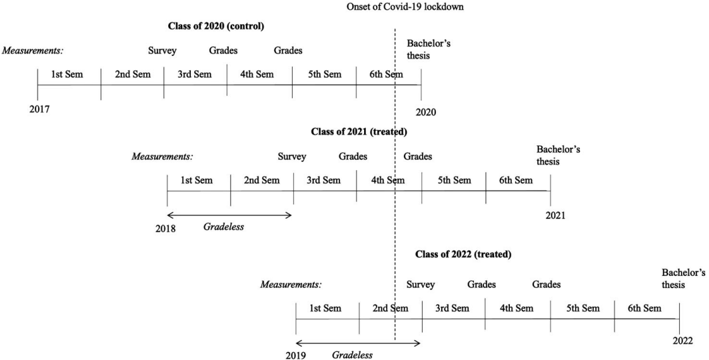
- The study uses a cohort-comparison design around a 2018 intervention in the first year of a Business and Psychology bachelor’s programme at a large Danish business school. All first-year grades were replaced with pass/fail assessments and written/oral feedback from teachers and peers; the class of 2020 was the pre-intervention comparison cohort, and the classes of 2021 and 2022 were treatment cohorts.
- Data came from administrative records on attrition, grades, and demographics, plus surveys on well-being, study approach, and motivation. Survey response rates were 23% for the class of 2020 and 47% for the class of 2021; the class of 2022 survey was not comparable because of Covid-19.
- Main outcomes were GPA from the third semester, GPA from the fourth semester, and the final bachelor’s thesis grade, all on a 7-point scale. The authors estimate OLS regressions with a gradeless-treatment dummy and controls for age, gender, nationality, and prior academic achievement, plus interactions for gender and high school GPA.
Limitations
- The authors state that the results come from a single study programme attracting high-achieving students, so generalizability to other contexts, student types, and cultural settings is unknown.
- The authors state that survey response rates varied from 23% to 47%, raising concerns about differential attrition; exam scores are imperfect proxies for learning; unobservable differences between non-responders may remain; and the last data collection coincided with the Covid-19 pandemic.
- Evident from the text: the design is not randomized, and Table 1 shows cohort differences, including that the class of 2022 was on average one year younger and had higher admission GPAs, with the authors noting admission requirements increased over time.
Model-written summary. Check it against the paper before relying on it.
Integrity signals
Registry
Cites
Statistics
Figures


Verification
Claims the paper makes
4 Valid · 3 Not valid · 18 Not checked · 31 Own results and interpretations
The cited sources support only part of this claim — read each source’s verdict below.
In the paper
“Contrary to expectation, our findings did not replicate previous results regarding a reduction in stress and an increase in well-being among students in gradeless learning (see e.g.Matthews and Noyes 2016;McMorran and Ragupathi 2020).”
§ Does gradeless learning affect students' academic performance? A study of effects over time > Discussion
What the sources say
- Not matchedcites Matthews and Noyes 2016
An author–year citation the paper’s reference list doesn’t settle. We don’t search these by name.
- Partly supportedcites McMorran and Ragupathi 2020 matched to “The promise and pitfalls of gradeless learning: responses to an alternative approach to grading” (2020) sourceExperimental — accuracy not yet measured
The Results and ‘Benefit: less stress, smoother university transition’ sections report that students and faculty perceived reduced stress and an easier transition during the grade-free first semester. The paper does not report a measured increase in student well-being; its findings are survey respondents’ perceptions of benefits, including reduced stress. (LLM, conf=0.85)
plain- Asserted: passes — The authors put it forward as true.
- Checkable: passes — It can be checked against evidence.
- Load-bearing: unclear — It is unclear whether the paper’s conclusions depend on it.
- Based: passes — The paper gives a reason why it holds.
- Not matched
The cited sources support only part of this claim — read each source’s verdict below.
In the paper
“From previous studies of gradeless learning we know that students feel more comfortable collaborating with others in a gradeless learning setting (Kjærgaard, Mikkelsen, and Buhl-Wiggers 2022) and that it positively influences students' willingness to explore new opportunities (Hayek et al. 2015), which points to how gradeless learning can support students in developing their generic skills.”
§ Does gradeless learning affect students' academic performance? A study of effects over time > Discussion
What the sources say
- Not matchedcites Kjærgaard, Mikkelsen, and Buhl-Wiggers 2022
An author–year citation the paper’s reference list doesn’t settle. We don’t search these by name.
- Partly supportedcites Hayek et al. 2015 matched to “Grading Hampers Cooperative Information Sharing in Group Problem Solving” (2015) sourceExperimental — accuracy not yet measured
Our copy of Hayek et al. (2015) reports only that the expectation of individual grades reduced cooperative groups' pooling of unshared information in hidden-profile problem-solving tasks (General Discussion; Overview of Experiments), with the non-graded control conditions exchanging a higher proportion of that novel information — so a benefit of the absence of grading on openness to new information is in it, but as a group information-sharing measure in a laboratory task, not as students' 'willingness to explore new opportunities'. No passage of our copy addresses exploring opportunities, generic skills, or gradeless learning as an educational setting; where adjacent outcomes appear (reduced creativity, amplified confirmatory tendencies, impaired learning), the paper credits them to other works (Amabile, 1983; Hayek, Toma, Oberlé, & Butera, 2014; Butler & Nisan, 1986) rather than reporting them (Controversial Effects of Grades). The strongest general statement is the recommendation 'to avoid grading individuals in cooperative groups' (General Discussion), which is directional, not a finding about exploration. (LLM, conf=0.68)
hedgedstates a possible cause- Asserted: passes — The authors put it forward as true.
- Checkable: passes — It can be checked against evidence.
- Load-bearing: unclear — It is unclear whether the paper’s conclusions depend on it.
- Based: passes — The paper gives a reason why it holds.
- Not matched
A result the paper reports from its own data — it cites no other source for it, so there is none to check. The quote shows it is in the paper.
In the paper
“Table 4 shows no clear tendency of differential effects between males and females.”
§ Does gradeless learning affect students' academic performance? A study of effects over time > Results
plain- Asserted: passes — The authors put it forward as true.
- Checkable: passes — It can be checked against evidence.
- Load-bearing: unclear — It is unclear whether the paper’s conclusions depend on it.
- Based: passes — The paper gives a reason why it holds.
- Rests on an assumption not shown here.
A result the paper reports from its own data — it cites no other source for it, so there is none to check. The quote shows it is in the paper.
In the paper
“Panel B in Table 2 presents the effects of gradeless learning on students' learning approach, showing that students in the gradeless programme were significantly less likely to have a surfacestrategy approach than students not exposed to gradeless learning (b = -.833;p < .000).”
- Also stated in: § Results · plain
“Students exposed to gradeless learning were thus less likely to employ a learning approach based on rote learning than students not exposed to gradeless learning.”
§ Does gradeless learning affect students' academic performance? A study of effects over time > Results
plainstates a cause- Asserted: passes — The authors put it forward as true.
- Checkable: passes — It can be checked against evidence.
- Load-bearing: passes — The paper’s conclusions depend on it.
- Based: passes — The paper gives a reason why it holds.
- Rests on an assumption not shown here.
- Also stated in: § Results · plain
A result the paper reports from its own data — it cites no other source for it, so there is none to check. The quote shows it is in the paper.
In the paper
“For the class of 2022 we see a negative effect in the fourth semester for males.”
§ Does gradeless learning affect students' academic performance? A study of effects over time > Results
plainstates a cause- Asserted: passes — The authors put it forward as true.
- Checkable: passes — It can be checked against evidence.
- Load-bearing: unclear — It is unclear whether the paper’s conclusions depend on it.
- Based: passes — The paper gives a reason why it holds.
- Rests on 2 assumptions not shown here.
21 more claims
Create a free account to see all 56 claims and to verify the 4 references still open.
- Probably not a substantial claim. 21
- It may state two separate claims as one. 11
- The quote only partly states this claim. 3
Self-check
Percentages, sums and reported differences re-computed from the paper’s own numbers.
Each contradiction between two passages listed here was confirmed by an independent check.
Rated minor: it would not touch a result — a value no result rests on, a p-value that stays on the same side of the significance level, or a conflict that is clerical, resolved elsewhere in the paper, or outside its own findings.
In the paper
§ Does gradeless learning affect students' academic performance? A study of effects over time > Setting and study population
“The average age was between 20.3 and 21.6”
§ Does gradeless learning affect students' academic performance? A study of effects over time > Conclusion
“| Age | 21.410 | 21.636 | 20.223 | -0.227 | 1.187*** | 1.413*** |”
Rated minor: it would not touch a result — a value no result rests on, a p-value that stays on the same side of the significance level, or a conflict that is clerical, resolved elsewhere in the paper, or outside its own findings.
In the paper
§ Does gradeless learning affect students' academic performance? A study of effects over time > Setting and study population
“their admission GPAs lay between 9.3 and 10.1”
§ Does gradeless learning affect students' academic performance? A study of effects over time > Conclusion
“| High school | 9.325 | 9.611 | 10.158 | -0.285* | -0.832 | |”
Rated minor: it would not touch a result — a value no result rests on, a p-value that stays on the same side of the significance level, or a conflict that is clerical, resolved elsewhere in the paper, or outside its own findings.
In the paper
§ Does gradeless learning affect students' academic performance? A study of effects over time > Setting and study population
“76-78% were female”
§ Does gradeless learning affect students' academic performance? A study of effects over time > Conclusion
“| Female | .795 | .760 | .769 | 0.035 | 0.026 | -0.009 |”
Citations
Cites
A Global Measure of Perceived Stress
Cohen, S., Kamarck, T., & Mermelstein, R. (1983) · Journal of Health and Social Behavior · doi:10.2307/2136404 · Cited by 32,807 · cited 1×
“We measured stress levels by means of a validated translation of the Perceived Stress Scale (Cohen, Kamarck, and Mermelstein 1983; Eskildsen et al. 2015) and social integration by asking three questions, each based on a 5-point Likert scale and then combined into an index.”
MethodA Short Scale for Measuring Loneliness in Large Surveys: Results From Two Population-Based Studies
Hughes, M. E., Waite, L. J., Hawkley, L. C., & Cacioppo, J. T. (2004) · Research on Aging · doi:10.1177/0164027504268574 · Cited by 4,781 · cited 1×
“To measure loneliness, we used the Three-Item Loneliness Scale (T-ILS) (Hughes et al. 2004).”
MethodThe revised two‐factor Study Process Questionnaire: R‐SPQ‐2F
Biggs, J., Kember, D., & Leung, D. Y. P. (2001) · British Journal of Educational Psychology · doi:10.1348/000709901158433 · Cited by 2,122 · cited 1×
“To measure the learning approach, we used a validated translation of the Biggs Study Approach Questionnaire (Biggs, Kember, and Leung 2001; Lassesen 2011).”
MethodExtrinsic Rewards and Intrinsic Motivation in Education: Reconsidered Once Again
Deci, E. L., Koestner, R., & Ryan, R. M. (2001) · Review of Educational Research · doi:10.3102/00346543071001001 · Cited by 1,596 · cited 2×
“…e ff ect (Dobrow, Smith, and Posner 2011; Pulfrey, Buchs, and Butera 2011), whereas others criticize grades for shifting students ’ focus from an intrinsic motivation for learning to an extrinsic motivation for rewards (Butler 1988; Deci, Koestner, and Ryan 2001; Pulfrey, Darnon, and Butera 2013).”
BackgroundPunished by Rewards: The Trouble with Gold Stars, Incentive Plans, A'S, Praise, and Other Bribes
Kohn, A. (1999) · Cited by 1,356
BUTLER, R. (1988) · British Journal of Educational Psychology · doi:10.1111/j.2044-8279.1988.tb00874.x · Cited by 536 · cited 1×
“…e ff ect (Dobrow, Smith, and Posner 2011; Pulfrey, Buchs, and Butera 2011), whereas others criticize grades for shifting students ’ focus from an intrinsic motivation for learning to an extrinsic motivation for rewards (Butler 1988; Deci, Koestner, and Ryan 2001; Pulfrey, Darnon, and Butera 2013).”
BackgroundExplaining the Gender Gap in Math Test Scores: The Role of Competition
Niederle, M., & Vesterlund, L. (2010) · Journal of Economic Perspectives · doi:10.1257/jep.24.2.129 · Cited by 527 · cited 1×
“Previous literature has found that females tend to shy away from competition (Niederle and Vesterlund 2010) and that assessment based on teacher assessment favours females while assessments based on exams tend to favour males (Angelo and Reis 2021).”
BackgroundMotivated Strategies for Learning Questionnaire
Pintrich, P. R., & De Groot, E. V. (2012) · PsycTESTS Dataset · doi:10.1037/t09161-000 · Cited by 399
Teaching More by Grading Less (or Differently)
Schinske, J., & Tanner, K. (2014) · CBE—Life Sciences Education · doi:10.1187/cbe.cbe-14-03-0054 · Cited by 326
Graduate attributes for 2020 and beyond: recommendations for Australian higher education providers
Oliver, B., & Jorre de St Jorre, T. (2018) · Higher Education Research & Development · doi:10.1080/07294360.2018.1446415 · Cited by 266 · cited 2×
“…skills or ‘ holistic competences ’ (Chan and Yeung 2021) is also an important area for research, as such competences are important for students graduating into an increasingly globalized and unpredictable world (Hendry 2006; Longmore, Grant, and Golnaraghi 2018; Oliver and Jorre de St Jorre 2018).”
BackgroundBloodgood, R. A., Short, J. G., Jackson, J. M., & Martindale, J. R. (2009) · Academic Medicine · doi:10.1097/acm.0b013e31819f6d78 · Cited by 219 · cited 4×
“…Marks 2016), to explore the impact of grades on students ’ approach to learning (Dahlgren et al. 2009), to reduce stress and increase well-being (Bloodgood et al. 2009; McMorran and Ragupathi 2020; McMorran, Ragupathi, and Luo 2017), and to increase interest and motivation (Hayek et al. 2015;…”
BackgroundResultInfluentialWhy grades engender performance-avoidance goals: The mediating role of autonomous motivation.
Pulfrey, C., Buchs, C., & Butera, F. (2011) · Journal of Educational Psychology · doi:10.1037/a0023911 · Cited by 210 · cited 1×
“Some support the notion of grades ’ motivating e ff ect (Dobrow, Smith, and Posner 2011; Pulfrey, Buchs, and Butera 2011), whereas others criticize grades for shifting students ’ focus from an intrinsic motivation for learning to an extrinsic motivation for rewards (Butler 1988; Deci, Koestner, and…”
BackgroundEskildsen, A., Dalgaard, V. L., Nielsen, K. J., Andersen, J. H., Zachariae, R., Olsen, L. R., Jørgensen, A., & Christiansen, D. H. (2015) · Scandinavian Journal of Work, Environment & Health · doi:10.5271/sjweh.3510 · Cited by 195 · cited 1×
“We measured stress levels by means of a validated translation of the Perceived Stress Scale (Cohen, Kamarck, and Mermelstein 1983; Eskildsen et al. 2015) and social integration by asking three questions, each based on a 5-point Likert scale and then combined into an index.”
MethodThe Benefits of Pass-Fail Grading on Stress, Mood, and Group Cohesion in Medical Students
Rohe, D. E., Barrier, P. A., Clark, M. M., Cook, D. A., Vickers, K. S., & Decker, P. A. (2006) · Mayo Clinic Proceedings · doi:10.4065/81.11.1443 · Cited by 188 · cited 1×
“…Spring et al. (2011) found the performance of psychology students receiving pass/fail grades to be lower than those assessed with multi-level grading, and other studies have reported no signi fi cant di ff erence between graded and gradeless learning (Rohe et al. 2006; White and Fantone 2010).”
ResultImpact of pass/fail grading on medical students’ well‐being and academic outcomes
Spring, L., Robillard, D., Gehlbach, L., & Moore Simas, T. A. (2011) · Medical Education · doi:10.1111/j.1365-2923.2011.03989.x · Cited by 184 · cited 4×
“A review by Spring et al. (2011) showed that enhanced student well-being compensated for a slightly lower academic performance among a group of students receiving pass/fail grades.”
BackgroundResultInfluentialA Unilateral Grading Contract to Improve Learning and Teaching
Danielewicz, J., & Elbow, P. (2009) · College Composition & Communication · doi:10.58680/ccc20099471 · Cited by 158 · cited 1×
“Although still limited, studies on this form of learning have often been designed to advance student learning (Danielewicz and Elbow 2009; Jackson and Marks 2016), to explore the impact of grades on students ’ approach to learning (Dahlgren et al. 2009), to reduce stress and increase well-being…”
BackgroundThe impact of grades on student motivation
Chamberlin, K., Yasué, M., & Chiang, I.-C. A. (2023) · Active Learning in Higher Education · doi:10.1177/1469787418819728 · Cited by 149 · cited 3×
“…(Brilleslyper et al. 2012; Knowlton 2010; Lynch and Hennessy 2017), create unhealthy competition (Tannock 2017), induce stress and anxiety (Chamberlin, Yasué, and Chiang 2018; Khanna 2015), and to direct attention and e ff orts towards memorization and surface learning rather than deep…”
BackgroundMaking the grade: a history of the A–F marking scheme
Schneider, J., & Hutt, E. (2014) · Journal of Curriculum Studies · doi:10.1080/00220272.2013.790480 · Cited by 143
'They don't give us our marks': The role of formative feedback in student progress
Smith, E., & Gorard, S. (2005) · Assessment in Education: Principles, Policy & Practice · doi:10.1080/0969594042000333896 · Cited by 135 · cited 1×
“While some studies have shown that gradeless learning can improve learning (see, e.g. Jackson and Marks 2016; Roberts and Dorstyn 2017), others have found mixed (Spring et al. 2011) or negative e ff ects (E. Smith and Gorard 2005).”
BackgroundPass–fail grading: laying the foundation for self-regulated learning
White, C. B., & Fantone, J. C. (2010) · Advances in Health Sciences Education · doi:10.1007/s10459-009-9211-1 · Cited by 112 · cited 5×
“This con fi rms fi ndings from previous literature (Chamberlin, Yasué, and Chiang 2018; White and Fantone 2010).”
BackgroundResultInfluentialAutonomy and task performance: Explaining the impact of grades on intrinsic motivation.
Pulfrey, C., Darnon, C., & Butera, F. (2013) · Journal of Educational Psychology · doi:10.1037/a0029376 · Cited by 99 · cited 3×
“Indeed, grades have been found to decrease intrinsic motivation (Deci, Koestner, and Ryan 2001; Kohn 1993), shift students ’ focus from learning to performance (Brilleslyper et al. 2012; Knowlton 2010; Lynch and Hennessy 2017), create unhealthy competition (Tannock 2017), induce stress and anxiety (Chamberlin, Yasué,…”
BackgroundKohn, A. (1994) · Quality Management in Health Care · doi:10.1097/00019514-199412000-00011 · Cited by 95
Dyer, S., & Hurd, F. (2015) · Academy of Management Learning and Education · doi:10.5465/amle.2014.0104 · Cited by 80 · cited 1×
“…may hamper the achievement of desired learning outcomes, especially when it comes to transformative skills, such as critical re fl ex-ivity, which are based on dialogue, collaboration, and interaction rather than on a super fi cially learned set curriculum (Dyer and Hurd 2016; Walker et al. 2019).”
BackgroundStudent perspectives on assessment: Experience in a competency-based portfolio system
Altahawi, F., Sisk, B., Poloskey, S., Hicks, C., & Dannefer, E. F. (2012) · Medical Teacher · doi:10.3109/0142159x.2012.652243 · Cited by 80 · cited 1×
“These fi ndings have been echoed in studies by Dahlgren et al. (2009) and Altahawi et al. (2012), both of which indicated that from a student perspective gradeless systems catalyse re fl exive behaviours.”
ResultUngraded Pop Quizzes: Test-Enhanced Learning Without All the Anxiety
Khanna, M. M. (2015) · Teaching of Psychology · doi:10.1177/0098628315573144 · Cited by 77 · cited 2×
“The impacts of using graded versus ungraded quizzes were compared in a study by Khanna (2015), who found that students receiving ungraded quizzes performed better on subsequent tests than those whose quizzes were graded.”
BackgroundMethodTannock, S. (2017) · Studies in Higher Education · doi:10.1080/03075079.2015.1092131 · Cited by 75 · cited 3×
“Some scholars have proposed that grades be eliminated from education entirely (Kohn 1993; Tannock 2017); others have experimented with such less drastic alternatives as grading without points (Brilleslyper et al. 2012) or withholding grades (Jackson and Marks 2016).”
BackgroundMcMorran, C., Ragupathi, K., & Luo, S. (2017) · Assessment & Evaluation in Higher Education · doi:10.1080/02602938.2015.1114584 · Cited by 71 · cited 4×
“Focusing speci fi cally on the fi rst year of university, McMorran, Ragupathi, and Luo (2017) found that a gradeless system eased students ’ transition into university and intrinsically fostered their ‘ love of learning ’ (362).”
BackgroundInfluentialLongmore, A.-L., Grant, G., & Golnaraghi, G. (2017) · Journal of Transformative Education · doi:10.1177/1541344617738514 · Cited by 71 · cited 1×
“…skills or ‘ holistic competences ’ (Chan and Yeung 2021) is also an important area for research, as such competences are important for students graduating into an increasingly globalized and unpredictable world (Hendry 2006; Longmore, Grant, and Golnaraghi 2018; Oliver and Jorre de St Jorre 2018).”
BackgroundStudent perception of academic grading: Personality, academic orientation, and effort
Tippin, G. K., Lafreniere, K. D., & Page, S. (2012) · Active Learning in Higher Education · doi:10.1177/1469787411429187 · Cited by 69 · cited 1×
“…’ learning approach away from surface learning and thus undergird ‘ requirements often looked for in university students like self-discipline, independence, and an openness to experience resulting in intellectual curiosity, creativity and an open attitude ’ (Tippin, Lafreniere, and Page 2012, 59).”
BackgroundDoes grading affect educational attainment? A longitudinal study
Klapp, A. (2015) · Assessment in Education: Principles, Policy & Practice · doi:10.1080/0969594x.2014.988121 · Cited by 61 · cited 4×
“Based on a natural experiment stemming from a Swedish policy decision to make grading optional, one of these studies was able to compare larger groups of students ( n = 8,558) (Klapp 2015).”
BackgroundInfluentialEducating Managers for Post-bureaucracy
Hendry, J. (2006) · Management Learning · doi:10.1177/1350507606067160 · Cited by 60 · cited 1×
“…skills or ‘ holistic competences ’ (Chan and Yeung 2021) is also an important area for research, as such competences are important for students graduating into an increasingly globalized and unpredictable world (Hendry 2006; Longmore, Grant, and Golnaraghi 2018; Oliver and Jorre de St Jorre 2018).”
BackgroundGrading systems, features of assessment and students’ approaches to learning
Dahlgren, L. O., Fejes, A., Abrandt-Dahlgren, M., & Trowald, N. (2009) · Teaching in Higher Education · doi:10.1080/13562510902757260 · Cited by 54 · cited 3×
“…to advance student learning (Danielewicz and Elbow 2009; Jackson and Marks 2016), to explore the impact of grades on students ’ approach to learning (Dahlgren et al. 2009), to reduce stress and increase well-being (Bloodgood et al. 2009; McMorran and Ragupathi 2020; McMorran, Ragupathi, and Luo…”
BackgroundResultThe promise and pitfalls of gradeless learning: responses to an alternative approach to grading
McMorran, C., & Ragupathi, K. (2020) · Journal of Further and Higher Education · doi:10.1080/0309877x.2019.1619073 · Cited by 54 · cited 10×
“A frequent concern is that the removal of grades diminishes student e ff ort, motivation and subsequently learning (McMorran and Ragupathi 2020; Spring et al. 2011).”
BackgroundResultInfluentialGrades as Money and the Role of the Market Metaphor in Management Education
Beatty, J. E. (2004) · Academy of Management Learning & Education · doi:10.5465/amle.2004.13500516 · Cited by 52 · cited 1×
“’ When students perceive grades as the primary outcome of education, they pursue performance objectives rather than learning objectives, which may lead to negative outcomes for the learning environment and demotivate individuals who fail to obtain good grades (Beatty 2004).”
BackgroundLearning to earn? The role of performance grades in higher education
Lynch, R., & Hennessy, J. (2017) · Studies in Higher Education · doi:10.1080/03075079.2015.1124850 · Cited by 47 · cited 2×
“…motivation (Deci, Koestner, and Ryan 2001; Kohn 1993), shift students ’ focus from learning to performance (Brilleslyper et al. 2012; Knowlton 2010; Lynch and Hennessy 2017), create unhealthy competition (Tannock 2017), induce stress and anxiety (Chamberlin, Yasué, and Chiang 2018; Khanna 2015),…”
BackgroundSutherland, D., Warwick, P., Anderson, J. R., & Learmonth, M. (2018) · Organizational Behavior Teaching Review · doi:10.1177/1052562918787849 · Cited by 44 · cited 1×
“Business school students are generally more instrumental and goal-oriented than students studying other disciplines (see, e.g. Parks-Leduc, Mulligan, and Rutherford 2020; Sutherland et al. 2018), for which reason they may be more positive towards grades.”
BackgroundReduced grading in assessment: A scoping review
Normann, D.-A., Sandvik, L. V., & Fjørtoft, H. (2023) · Teaching and Teacher Education · doi:10.1016/j.tate.2023.104336 · Cited by 44
Managing the Grading Paradox: Leveraging the Power of Choice in the Classroom
Riza, S. D., Smith, W. K., & Posner, M. A. (2011) · Academy of Management Learning and Education · doi:10.5465/amle.2011.62798933 · Cited by 43
Parks-Leduc, L., Mulligan, L., & Rutherford, M. A. (2021) · Academy of Management Learning & Education · doi:10.5465/amle.2018.0157 · Cited by 40
Student Perceptions of an Online Ungraded Course
Guberman, D. (2021) · Teaching & Learning Inquiry · doi:10.20343/teachlearninqu.9.1.8 · Cited by 39 · cited 3×
“…of grading shifted the practice from being ‘ based on relative standing to be[ing] based on absolute levels of achievement, aligning with Bloom ’ s description of ‘ learning for mastery ’ (1968) and arguments that all or nearly all students could succeed at very high levels ’ (Guberman 2021, 87).”
BackgroundResultWhat We Know About Grading: What Works, What Doesn't, and What's Next
Guskey, T. R., & Brookhart, S. M. (2019) · Cited by 38
Improving the effectiveness of feedback by use of assessed reflections and withholding of grades
Jackson, M., & Marks, L. (2016) · Assessment & Evaluation in Higher Education · doi:10.1080/02602938.2015.1030588 · Cited by 36 · cited 5×
“…fi cant di ff erence between students ’ performances in the two groups (Armstrong 2010), whereas a third study comparing di ff erent cohorts of students in the same course showed that a combination of feedback and with-holding of grades signi fi cantly raised subsequent grades (Jackson and Marks 2016).”
BackgroundResultInfluentialHow does engaging in authentic research at undergraduate level contribute to student well-being?
Walkington, H., & Ommering, B. W. C. (2022) · Studies in Higher Education · doi:10.1080/03075079.2022.2082400 · Cited by 32 · cited 1×
“…stressful times (Amirkhan, Bowers, and Logan 2019), but the growing numbers of students reporting challenges to their well-being and mental health have made this crucial period a particularly pressing concern for universities to address (see, e.g. Lisnyj et al. 2022; Walkington and Ommering 2022).”
BackgroundLisnyj, K. T., Pearl, D. L., McWhirter, J. E., & Papadopoulos, A. (2022) · Studies in Higher Education · doi:10.1080/03075079.2022.2083101 · Cited by 32 · cited 1×
“…stressful times (Amirkhan, Bowers, and Logan 2019), but the growing numbers of students reporting challenges to their well-being and mental health have made this crucial period a particularly pressing concern for universities to address (see, e.g. Lisnyj et al. 2022; Walkington and Ommering 2022).”
BackgroundFluency, Accuracy, and Complexity in Graded and Ungraded Writing
Armstrong, K. M. (2010) · Foreign Language Annals · doi:10.1111/j.1944-9720.2010.01109.x · Cited by 31 · cited 2×
“…graded and ungraded assignments showed a slightly positive but not signi fi cant di ff erence between students ’ performances in the two groups (Armstrong 2010), whereas a third study comparing di ff erent cohorts of students in the same course showed that a combination of feedback and…”
ResultApplying stress theory to higher education: lessons from a study of first-year students
Amirkhan, J. H., Bowers, G., & Logan, C. (2019) · Studies in Higher Education · doi:10.1080/03075079.2019.1601692 · Cited by 31 · cited 1×
“The fi rst year of higher education can be one of life ’ s most stressful times (Amirkhan, Bowers, and Logan 2019), but the growing numbers of students reporting challenges to their well-being and mental health have made this crucial period a particularly pressing concern for universities to address…”
BackgroundChan, C. K. Y., & Luk, L. Y. Y. (2021) · Higher Education Research & Development · doi:10.1080/07294360.2021.1877628 · Cited by 24 · cited 2×
“…on the e ff ects of gradeless learning on a broader set of learning outcomes, as such research will help to inform future educational strategies, including for designing assessments of holistic competences, which grade-based, formal assessments may have di ffi culty determining (Chan and Luk 2022).”
BackgroundWhat's The Point? The Benefits of Grading Without Points
Brilleslyper, M., Ghrist, M., Holcomb, T., Schaubroeck, B., Warner, B., & Williams, S. (2012) · PRIMUS · doi:10.1080/10511970.2011.571346 · Cited by 23 · cited 4×
“…have been found to decrease intrinsic motivation (Deci, Koestner, and Ryan 2001; Kohn 1993), shift students ’ focus from learning to performance (Brilleslyper et al. 2012; Knowlton 2010; Lynch and Hennessy 2017), create unhealthy competition (Tannock 2017), induce stress and anxiety…”
BackgroundInfluentialNielsen, T. (2018) · Cogent Education · doi:10.1080/2331186x.2018.1504485 · Cited by 23 · cited 1×
“Motivation captures both intrinsic and extrinsic motivations and was measured by means of a validated adaption of the Motivated Strategies for Learning Questionnaire (Nielsen 2018; Pintrich and Others 1991).”
MethodGrading Hampers Cooperative Information Sharing in Group Problem Solving
Hayek, A.-S., Toma, C., Oberlé, D., & Butera, F. (2015) · Social Psychology · doi:10.1027/1864-9335/a000232 · Cited by 22 · cited 3×
“…the impact of grades on students ’ approach to learning (Dahlgren et al. 2009), to reduce stress and increase well-being (Bloodgood et al. 2009; McMorran and Ragupathi 2020; McMorran, Ragupathi, and Luo 2017), and to increase interest and motivation (Hayek et al. 2015; White and Fantone 2010).”
BackgroundTo assess or not to assess holistic competencies – Student perspectives in Hong Kong
Chan, C. K. Y., & Yeung, N. C. J. (2021) · Studies In Educational Evaluation · doi:10.1016/j.stueduc.2021.100984 · Cited by 21 · cited 2×
“…in exams related to disciplinary knowledge, we acknowledge that the impact of gradeless learning on soft skills or ‘ holistic competences ’ (Chan and Yeung 2021) is also an important area for research, as such competences are important for students graduating into an increasingly…”
BackgroundKjærgaard, A., Mikkelsen, E. N., & Buhl-Wiggers, J. (2023) · Management Learning · doi:10.1177/13505076221101146 · Cited by 21 · cited 2×
“…between grades and motivation, a relationship that includes the lower likelihood that students will carry out their studies without grades (cf. McMorran and Ragupathi 2020) as well as the tendency among students to let grades de fi ne who they are (Kjærgaard, Mikkelsen, and Buhl-Wiggers 2022).”
BackgroundSelf-citationGender gaps in different grading systems
Angelo, C., & Reis, A. B. (2020) · Education Economics · doi:10.1080/09645292.2020.1853681 · Cited by 20
Golding, C. (2018) · Teaching in Higher Education · doi:10.1080/13562517.2018.1491024 · Cited by 12 · cited 1×
“More recently, these critiques have renewed interest in the alternatives to letter-or number-based grades, including pass/fail systems and narrative evaluations, often referred to as ‘ gradeless learning ’ (Golding 2019; McMorran and Ragupathi 2020).”
BackgroundThe Use of Praxis in the Classroom to Facilitate Student Transformation
Walker, K., Dyck, B., Zhang, Z., & Starke, F. A. (2017) · Journal of Business Ethics · doi:10.1007/s10551-017-3630-3 · Cited by 11 · cited 1×
“…may hamper the achievement of desired learning outcomes, especially when it comes to transformative skills, such as critical re fl ex-ivity, which are based on dialogue, collaboration, and interaction rather than on a super fi cially learned set curriculum (Dyer and Hurd 2016; Walker et al. 2019).”
BackgroundMatthews, R., & Noyes, A. (2016) · Journal of Further and Higher Education · doi:10.1080/0309877x.2014.953456 · Cited by 9 · cited 2×
“Gradeless learning has also been found to reduce stress and increase students ’ well-being (see e.g. Bloodgood et al. 2009; Matthews and Noyes 2016; McMorran and Ragupathi 2020; McMorran, Ragupathi, and Luo 2017).”
BackgroundResult(2010) · DOAJ (DOAJ: Directory of Open Access Journals) · Cited by 9
Roberts, R. M., & Dorstyn, D. S. (2017) · Training and Education in Professional Psychology · doi:10.1037/tep0000129 · Cited by 9 · cited 1×
“While some studies have shown that gradeless learning can improve learning (see, e.g. Jackson and Marks 2016; Roberts and Dorstyn 2017), others have found mixed (Spring et al. 2011) or negative e ff ects (E. Smith and Gorard 2005).”
BackgroundWhen students are allowed to choose: grading scale choices for degree projects
Nystrôm, K. (2017) · Studies in Higher Education · doi:10.1080/03075079.2017.1290062 · Cited by 4 · cited 1×
“Moreover, students who believe that gradeless learning (pass/fail) reduces the stress associated with thesis writing prefer this system to letter-or number-based grading (Nyström 2018).”
BackgroundRagupathi, K. (2022) · Lancaster EPrints (Lancaster University) · doi:10.17635/lancaster/thesis/1889 · Cited by 2
Barbero (2014) · doi:10.1016/j · Cited by 1
Research works printed but not linked: 2
- 9. Brookhart, S. 2004. Grading. Upper Saddle River, NJ: Pearson Education.
- 31. Lassesen, Berit. 2011. "Student Approach to Learning: An Empirical Investigation of Factors Associated with Student Approach to Learning." PhD thesis, Department of Psychology and Behavioural Sciences, Aarhus University.
Cited by
Explaining the Gender Gap in Math Test Scores: The Role of Competition
Niederle, M., & Vesterlund, L. (2010) · Journal of Economic Perspectives · doi:10.1257/jep.24.2.129 · Cited by 527
Jansson, A., Boman, J., Schéle, I., Holmström, S., Rozental, A., Semb, O., Fahlström, M., Stenman, L., Bitar, A., & Lindquist, D. (2025) · Frontiers in Medicine · doi:10.3389/fmed.2025.1623792 · Cited by 17
Mesny, A., Roberge‐Maltais, I., & Galy, A. (2025) · The International Journal of Management Education · doi:10.1016/j.ijme.2025.101307 · Cited by 27
Lindskov, C. M. (2025) · Youth & Society · doi:10.1177/0044118x251343633 · Cited by 7
“Grades were also a significant concern among students and are a significant debate within educational science, with several critical voices highlighting the potential damaging effects of grades as a performance measurement (Chamberlin et al., 2023; Kjærgaard et al., 2024; Klapp et al., 2024).”
Chakiso, Z. T., Bushisso, E. W., & Wanna, W. (2025) · Language Testing in Asia · doi:10.1186/s40468-025-00356-x · Cited by 12
“However, scholars have underscored the limitations of relying solely on statistical analyses to capture the multifaceted and dynamic nature of academic performance and English language learning, particularly in ESL/EFL contexts (Lee & Greene, 2007; Kjærgaard et al., 2024).”
Metadata
- Authors
- Kjærgaard, A., Buhl-Wiggers, J., & Mikkelsen, E. N.
- Affiliations
- Copenhagen Business School (DK)
- Corresponding author
- Kjærgaard, Annemette
- Venue
- Studies in Higher Education
- Publisher
- Informa UK Limited
- Published
- 2023-07-05
- Volume
- 49
- Issue
- 2
- Pages
- 336-350
- ISSN
- 0307-5079 (ISSN-L)
- 1470-174X
- OpenAlex
- W4383344029
- Cited by
- 23
- References
- 60
- Citations by year
- 2026: 3 · 2025: 17 · 2024: 2
- FWCI
- 16.30
- Type
- journal article
- Language
- en
- Open access
- hybrid
- doi.org
- Licence
- Locations
- Studies in Higher Education (publishedVersion, cc-by-nc-nd)
- CBS Research Portal (Copenhagen Business School) (submittedVersion, cc-by-nc-nd)
- Topics
- Social Sciences › Education › Student Assessment and Feedback
- Social Sciences › Education › Evaluation of Teaching Practices
- Social Sciences › Psychology › Developmental and Educational Psychology › Education, Achievement, and Giftedness
- Keywords
- academic performance, student well-being, student stress, student motivation, surface learning, performance grading, university students
About these checks
Registry, retraction, Cites and statistics results are computed, not judged, with one exception: a printed reference that no index lists is read once by a model before it counts as a citation error. Claims are extracted by a model and kept only when their quote appears verbatim in the text; each cited source is then checked, with a model’s help, for whether it says what the claim relies on. Those verdicts can be wrong — read the claim’s quote and the cited source before relying on one.
The claim verdicts this report counts are experimental: their accuracy is not yet measured.
A language model drew the claims from the paper on 2026-10-10, under version 3 of the claim definition (model deepseek-v4.1-flash, prompt extract-v3).
A second model labelled each claim on 2026-10-10 (model jev-1.13-20260917, definition revision gold-guideline-v0.2).
Cited sources are checked with a language model’s help (gpt-6-sol and qwen3.8-omni-flash).
Statistics and arithmetic are recomputed, not judged.
Confidence bands are shown only for fields calibrated on our annotated test set. None is calibrated yet, so no band is shown.
What counts as a claim ›How we measure confidence ›How we check this ›
Are you an author, or do you see a problem with this page? Request a review
Data sources
Bibliographic data: Semantic Scholar, OpenAlex, Crossref.
Contains information from the Semantic Scholar Academic Graph Datasets, made available under the ODC Attribution License (ODC-BY 1.0).
Semantic Scholar’s data is described in: Kinney, R., et al. (2023). The Semantic Scholar Open Data Platform. arXiv:2301.10140.
